
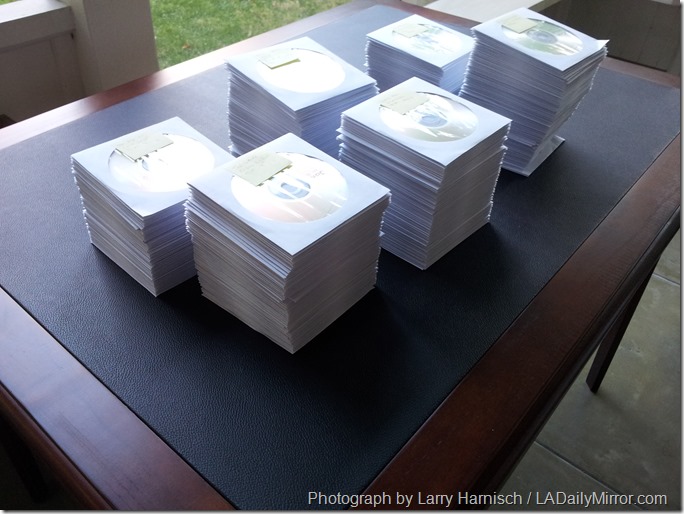
A portion of the bounty from the Great TCM Experiment of 2014.
From mid-August to early November, I conducted the “Great TCM Experiment,” in which I recorded everything on TCM.
Yes, everything as in everything.
A portion of the bounty from the Great TCM Experiment of 2014.
From mid-August to early November, I conducted the “Great TCM Experiment,” in which I recorded everything on TCM.
Yes, everything as in everything.
Note: This is a repost from 2013.
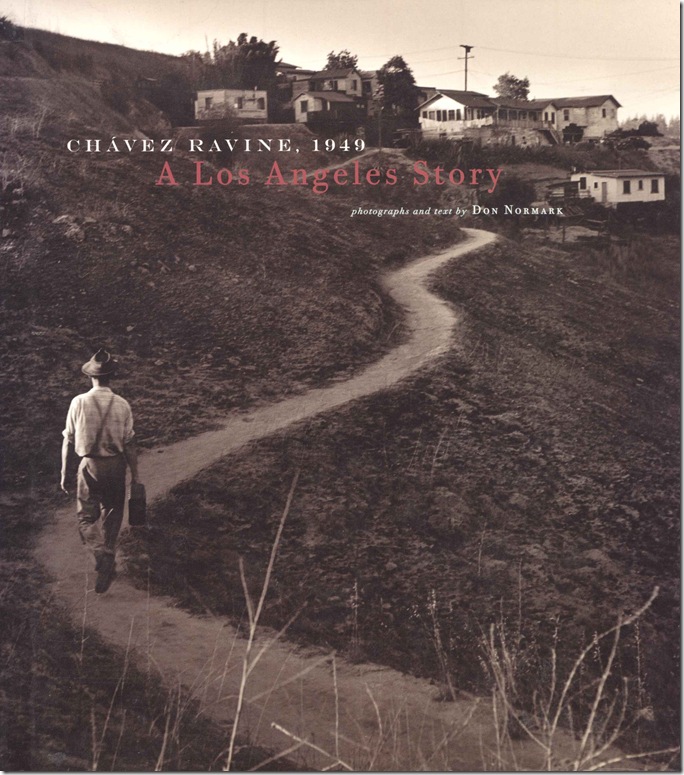
You might have to hunt a bit for Don Normark’s 1999 book “Chavez Ravine, 1949,” but your search will be rewarded. The photos are terrific and the residents’ recollections make the book even better. Copies can be found via bookfinder.com.
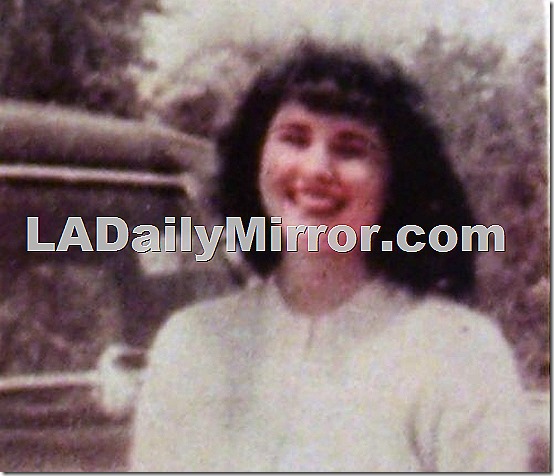
Georgette Bauerdorf, National Police Gazette, August 1946.
At long last, we finish our examination of the Georgette Bauerdorf case with many questions unanswered. Without more information, we can only speculate about many aspects of the killing. For that matter, we can merely guess about what Georgette’s life might have been like had she not been killed.
I undertook this little project primarily to demonstrate the differences between Georgette’s case and the 1947 killing of Elizabeth Short. Following the lead of some of the more sensational newspaper coverage of the era, several crime books have attempted to link the cases to more murders of the era to show that there was a serial killer at work in Los Angeles. But a close and careful examination of the Bauerdorf and Short cases shows that there was no relationship.
Georgette Bauerdorf, an Unsolved Murder:
Part 1 | Part 2 | Part 3 | Part 4 | Part 5 | Part 6 | Part 7 | Part 8 | Part 9 | Part 10 | Part 11 | Part 12 | Part 13 | Part 14 | Part 15 | Part 16 | Part 17 | Part 18 | Part 19 | Part 20 | Part 21 | Part 22 | Part 23 | Part 24 | Part 25 | Part 26 | Part 27 | Part 28 | Part 29 | Part 30 | Part 31

Hollywood Heritage Museum, 2100 N. Highland Ave., will be hosting an Afternoon With the Authors on Saturday, Dec. 6, from noon to 4 p.m.
Scheduled guests include:
Julia Adams, John Bengtson, Bob Birchard, Jon Boorstin, Angela Cartwright and Tom McClaren, Ken LaZebnik, Rosemary Lord, Mary Mallory, Hugh O’Brian, Rocky Lang, Mike Oldham, Manny Pacheco, Christina Rice, Darrell Rooney, Bryan Taves, Mark Vieira, Marc Wanamaker and Dawn Wells.
Note: This is a repost from 2013.
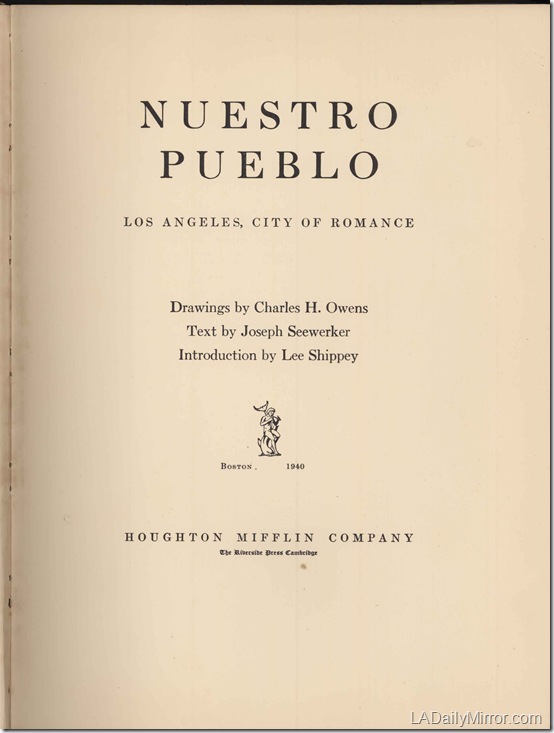
Whenever I’m asked about my favorite books on Los Angeles, my first recommendation is “Nuestro Pueblo,” a selection of features by Times artist Charles Owens and writer Joseph Seewerker that appeared in The Times. I went through all of them when the blog was at latimes.com, so I won’t repeat them now, but if you’re a fan of Rediscovering Los Angeles, which was illustrated by Owens with commentary by Timothy Turner, you may enjoy “Nuestro Pueblo.” Unfortunately, Rediscovering Los Angeles was never published in book form and has languished in obscurity.
“Nuestro Pueblo” is long out of print and the prices have gone up since I started writing about it, with some dealers asking more than $100 for a copy. A patient shopper can still find a copy for less than $20, however. One of my favorite tools for finding out of print books is bookfinder.com, which shows wide price range on copies of “Nuestro Pueblo.”
And what are your gift recommendations for this holiday season?
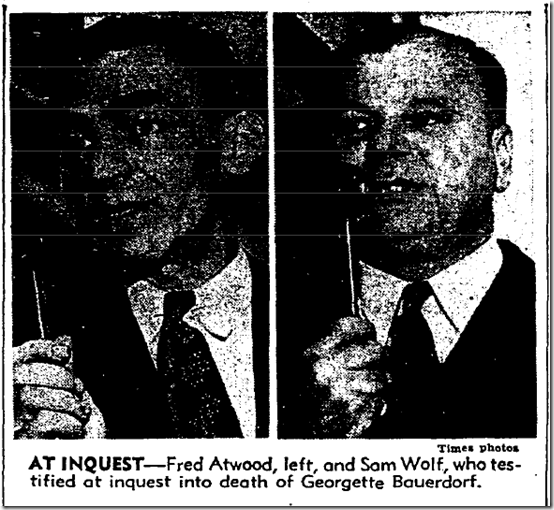
Oct. 21, 1944: Fred Atwood, left, Los Angeles Times.
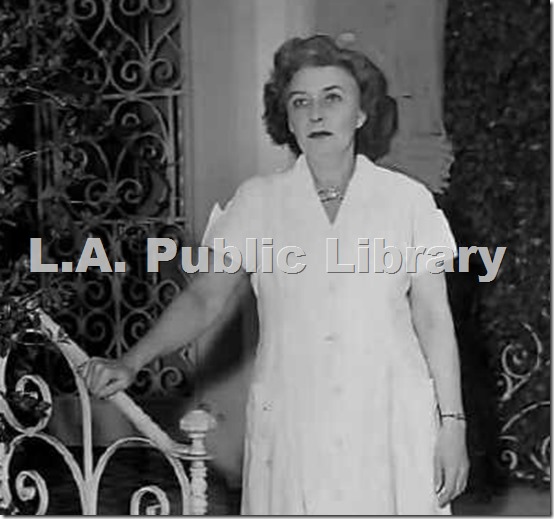
Lulu Atwood, in a photo courtesy of the Los Angeles Public Library.
In this series of posts on the Georgette Bauerdorf case, we have looked at the history of El Palacio Apartments, crime in West Hollywood, the history of the Hollywood Canteen, Georgette’s movements before the killing, how the killing might have occurred, the killer’s behavior afterward – even what type of car she was driving and the neighborhood where it was abandoned.
Georgette Bauerdorf, an Unsolved Murder:
Part 1 | Part 2 | Part 3 | Part 4 | Part 5 | Part 6 | Part 7 | Part 8 | Part 9 | Part 10 | Part 11 | Part 12 | Part 13 | Part 14 | Part 15 | Part 16 | Part 17 | Part 18 | Part 19 | Part 20 | Part 21 | Part 22 | Part 23 | Part 24 | Part 25 | Part 26 | Part 27 | Part 28 | Part 29 | Part 30 | Part 31
Dec. 3, 1944: Arturo Toscanini conducts the NBC Symphony Orchestra in three movements of the Beethoven Septet in E flat and the Symphony No. 2. Courtesy of otronmp3.com.
Note: This is a repost from 2013.
If you enjoy Mary Mallory’s columns (and our survey shows that readers do) you might like this anthology of Hollywood Heights called “Hollywoodland: Tales Lost and Found.” It’s available for the Kindle, but don’t forget that Amazon has a free app so you can read it on a PC or on an iPad.
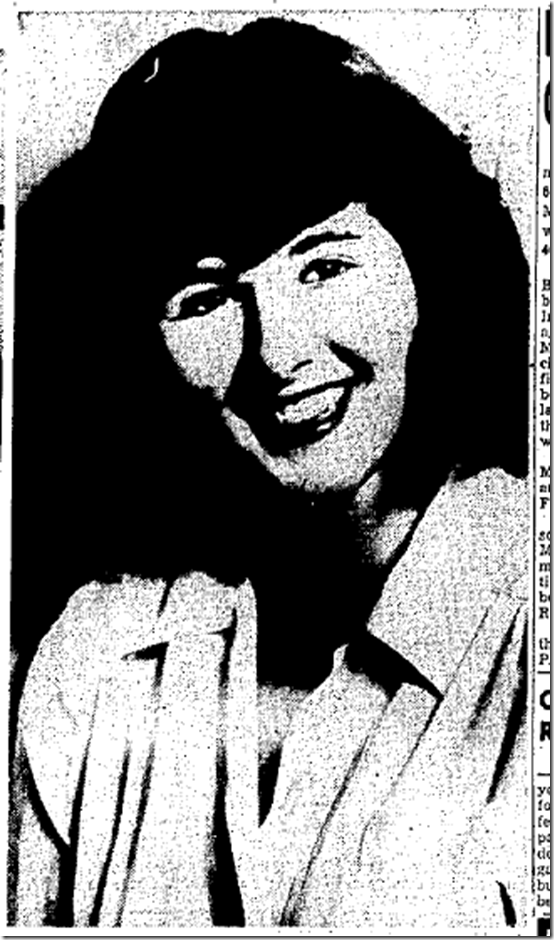
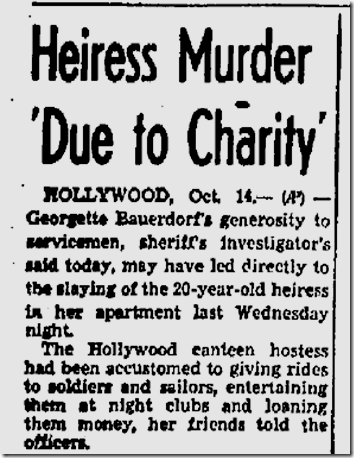
Oct. 15, 1944: A handout photo of Georgette Bauerdorf, Oakland Tribune.
We have been examining the behavior of Georgette Bauerdorf’s killer to see if we could distill something about him, going from least speculative to most speculative rather than chronological order. Previous posts have looked at signs of his “undoing” the crime after the killing; the actual murder; and his actions after leaving the crime scene, in which he dumped the Bauerdorf car about 10 miles away.
Now we come to the most speculative part of the inquiry: How Georgette and the killer met.
Georgette Bauerdorf, an Unsolved Murder:
Part 1 | Part 2 | Part 3 | Part 4 | Part 5 | Part 6 | Part 7 | Part 8 | Part 9 | Part 10 | Part 11 | Part 12 | Part 13 | Part 14 | Part 15 | Part 16 | Part 17 | Part 18 | Part 19 | Part 20 | Part 21 | Part 22 | Part 23 | Part 24 | Part 25 | Part 26 | Part 27 | Part 28 | Part 29 | Part 30 | Part 31
Note: This is a repost from 2013. True style never goes out of date, after all.
We are being bombarded by stories about Black Friday and Cyber Monday, with videos of long lines at stores and the attendant consumer frenzy.
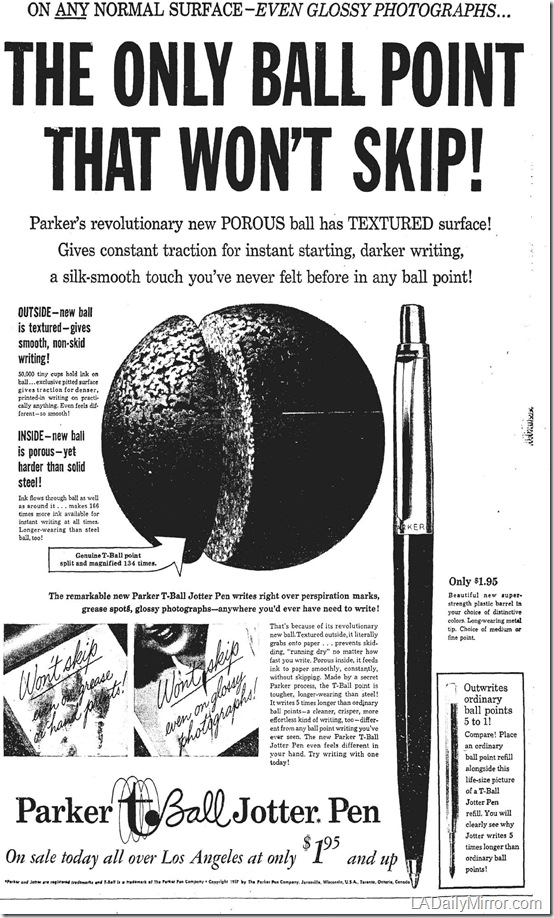
The L.A. Daily Mirror prefers a more subdued approach to buying gifts during the holiday season. Here’s proof that an ideal retro gift can be practical and inexpensive. It’s the Parker T-Ball jotter, which has changed very little since this 1957 ad.
You can pick one up at most office supply stores for about $8. We like ours with the gel refill, medium point. Perfect for doing the New York Times crossword puzzle.
What’s on your shopping list? If you have a good gift idea, share it with us.
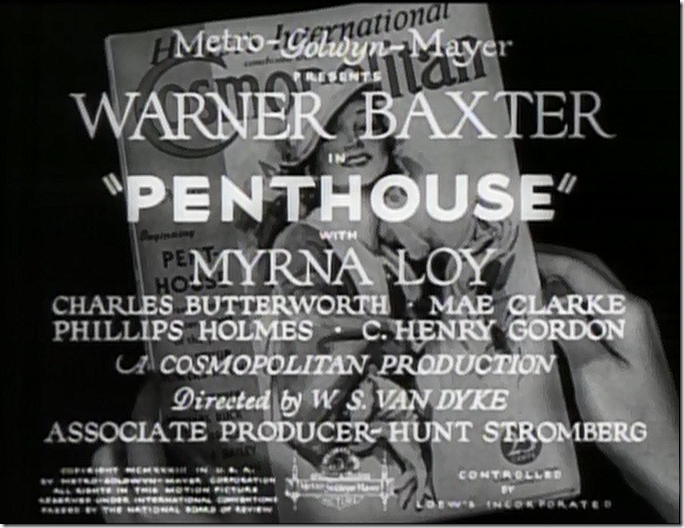
This is the Metro “Golwyn” Mayer production of “Penthouse,” with Warner Baxter, Myrna Loy, Charles Butterworth, Mae Clarke, Phillips Holmes and C. Henry Gordon, directed by W.W. Van Dyke. Screenplay by Frances Goodrich and Albert Hackett from a story by Arthur Somers Roche.
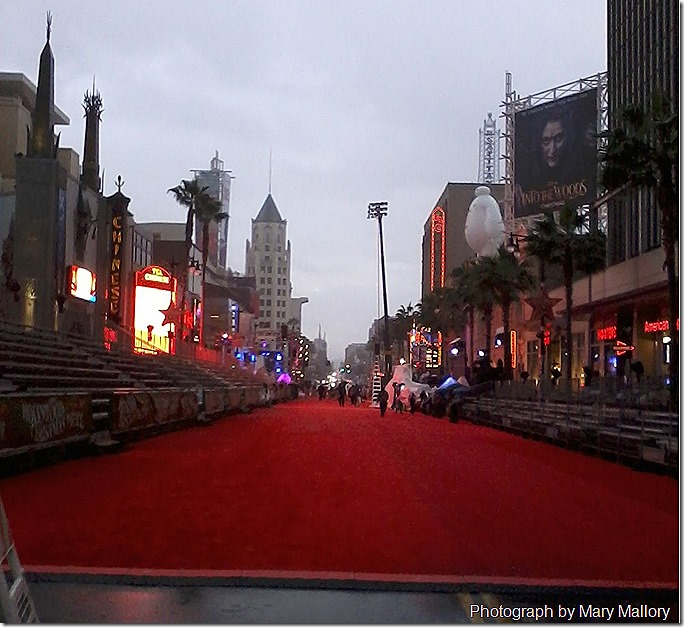
The view down Hollywood Boulevard in 2014. Photograph by Mary Mallory.
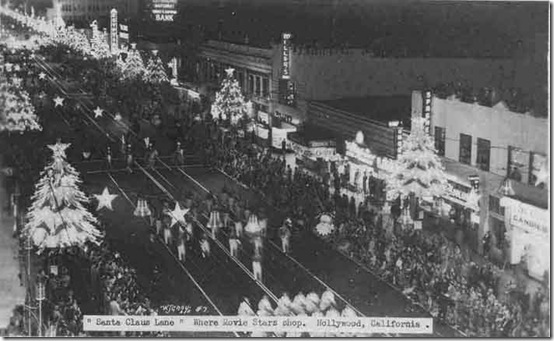
Photo: Santa Claus Lane, shown in a postcard on EBay, listed as Buy It Now for $8.50.
Note: This is a post from 2011, with an update from 2014
Created by the Hollywood Chamber of Commerce in 1928 as a way to boost holiday shopping on Thanksgiving weekend, the Hollywood Christmas Parade has endured for over 83 years under a variety of names. The first parade, called the Santa Claus Lane Parade, featured Jeanette Loff, Santa Claus, and a few floats. Its older cousin, the downtown Los Angeles Christmas parade, attracted tens of thousands and featured elaborate floats, like the Macy’s Thanksgiving Day Parade, started by the New York Department store to increase sales.
Mary Mallory’s “Hollywoodland: Tales Lost and Found” is available for the Kindle.
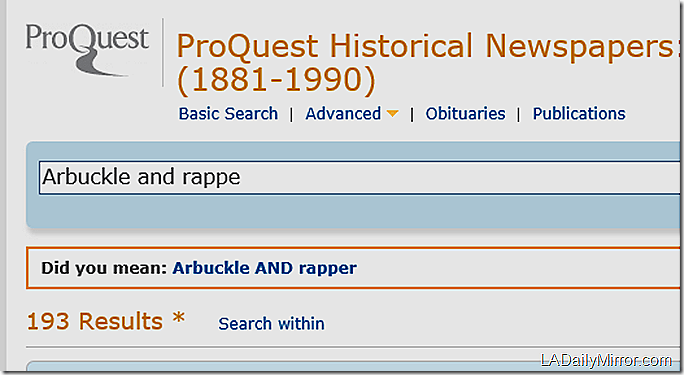
Dear ProQuest: No, I did not. Perhaps you are thinking of Nipsey Hussle.
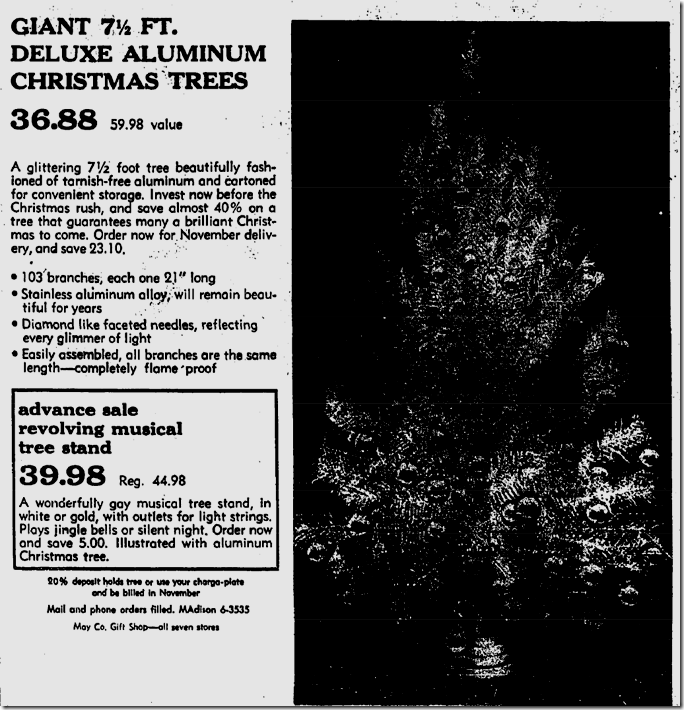
To all who long for a “kinder simpler time” and say that today’s retailers start their Christmas sales too early, here is the May Co. ad for aluminum Christmas trees, which was published Oct. 11, 1959, well before Halloween. (You see, nothing has really changed, has it?)
And for $39.98 on sale, you could buy “A wonderfully gay musical tree stand in white or gold.”
Adjusted for inflation, that aluminum Christmas tree cost $300 in 2014 dollars. The tree stand was $326.21.
From 2010: “Oh Tin-Enbaum.”
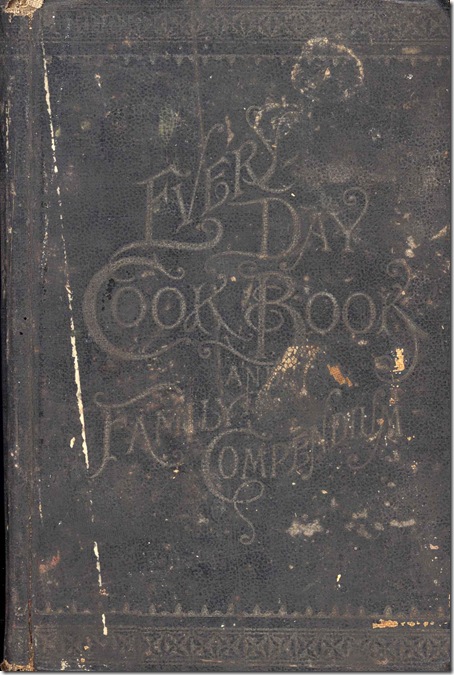
Note: This is a repost from 2011. Happy Thanksgiving!
Here’s a traditional roast turkey recipe from the “Every-Day Cook-Book and Family Compendium,” written about 1890 by Miss E. Neill. Be sure your fire is bright and clear and watch out for the gall-bag.
Continue reading
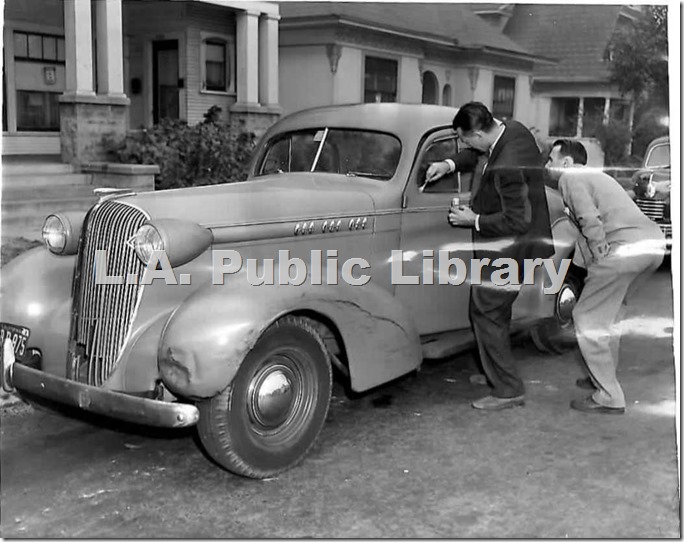
Garner Brown and John Schilling examine the Bauerdorf car for fingerprints, courtesy of the Los Angeles Public Library.
So far we have been looking at the behavior of the man who killed Georgette Bauerdorf to see if we can distill something about him. And rather than going in chronological order, we have taken it from least speculative to most speculative. The last two posts examined the killer’s behavior in “undoing” the crime: putting Georgette’s body in the bathtub, turning on the hot water, cleaning up the bloodstain on the bedroom rug and trying to remove the piece of fabric that he had had rammed down her throat.
Georgette Bauerdorf, an Unsolved Murder:
Part 1 | Part 2 | Part 3 | Part 4 | Part 5 | Part 6 | Part 7 | Part 8 | Part 9 | Part 10 | Part 11 | Part 12 | Part 13 | Part 14 | Part 15 | Part 16 | Part 17 | Part 18 | Part 19 | Part 20 | Part 21 | Part 22 | Part 23 | Part 24 | Part 25 | Part 26 | Part 27 | Part 28 | Part 29 | Part 30 | Part 31
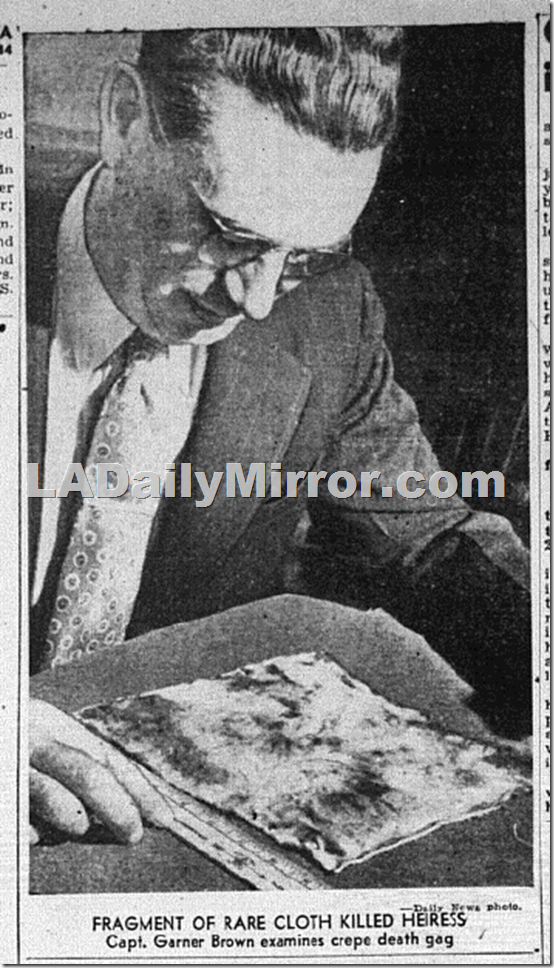
Oct. 20, 1944: Garner Brown examines the piece of crepe tetra used to kill Georgette Bauerdorf, Daily News.
In an attempt to distill the character traits of the man who killed Georgette Bauerdorf, we have been looking at his unusual and unnecessary behavior at the crime scene: Putting the body in the bathtub, turning on the hot water and trying to clean up the blood on the bedroom rug. And rather than taking the phases of the crime in chronological order, we are going from least speculative to most speculative.
Georgette Bauerdorf, an Unsolved Murder:
Part 1 | Part 2 | Part 3 | Part 4 | Part 5 | Part 6 | Part 7 | Part 8 | Part 9 | Part 10 | Part 11 | Part 12 | Part 13 | Part 14 | Part 15 | Part 16 | Part 17 | Part 18 | Part 19 | Part 20 | Part 21 | Part 22 | Part 23 | Part 24 | Part 25 | Part 26 | Part 27 | Part 28 | Part 29 | Part 30 | Part 31
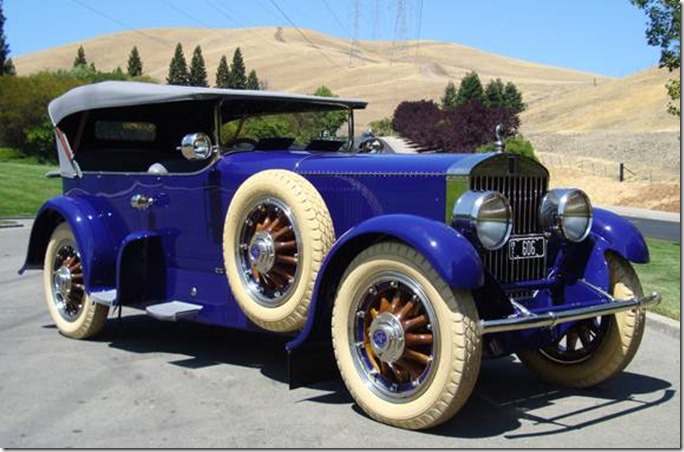
Fatty Arbuckle’s 1919 Pierce Arrow, via Hemmings Motor News.
As the countdown to the holidays begins, the L.A. Daily Mirror will offer occasional gift suggestions. Here’s an item that is sure to surprise your favorite car buff or vintage film fan. This is Roscoe “Fatty” Arbuckle’s 1919 Pierce Arrow. According to the vendor, the chassis for this vehicle was delivered to Don Lee Coach and Bodyworks in Los Angeles in 1918 and customized in a design by Harley Earl.
Price? You’re going to ask about the price? It’s listed as “inquire.”
Note: I didn’t notice before, but the car seems to have right-hand drive. How curious.
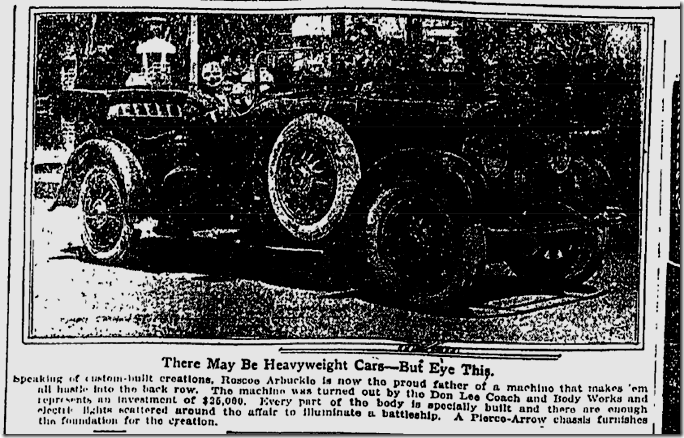
And here is Arbuckle at the wheel of his machine, in a photo published in The Times on May 2, 1920.
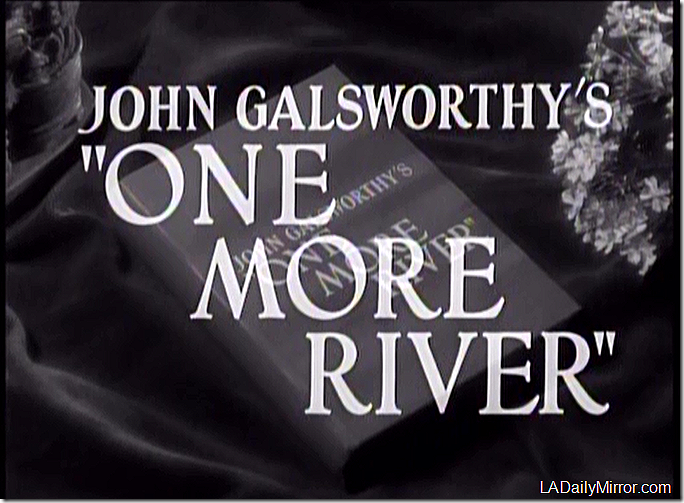
This week’s mystery movie has been the 1934 Universal film “One More River,” starring Diana Wynyard, Frank Lawton, Colin Clive and Mrs. Patrick Campbell. It was directed by James Whale with a script by R.C. Sherriff, adapted from the novel by John Galsworthy. Art direction was by Charles D. Hall, photography by John J. Mescall and music by W. Franke Harling. Special effects by John P. Fulton and edited by Ted Kent.
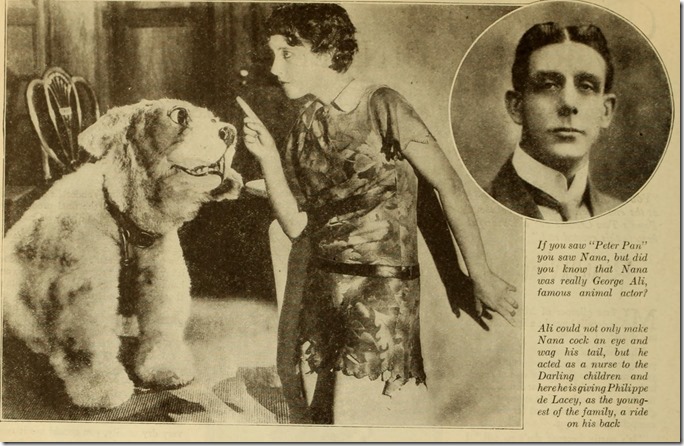
George Ali in “Peter Pan.”
Best remembered for portraying Nana the dog in Herbert Brenon’s 1924 film adaptation of “Peter Pan,” George Ali excelled at playing all types of animal characters in vaudeville and the stage for over thirty years. His realistic, animated portrayals of four legged creatures earned him the moniker, “world’s greatest animal impersonator” in many reviews. Wearing an oversize animal costume, Ali’s expressive, whimsical performances touched children and adults alike, giving dignity and human like qualities to pets or service animals.
Not much is known about Ali’s early years prior to working on stage. A 1925 issue of Photoplay, describing his wonderful work in “Peter Pan,” states that Ali “was trained as an acrobat in his youth by a troupe of strolling Arab gymnasts. His non-professional name is George Edward Bolinbroke.” Searches under both names, however, fail to turn up any evidence of his true name and background.
 ladailymirror.com