Discord in Alhambra


1957_0805_hed

1957_0805_cars
Aug. 5, 1957

Alhambra

Robert D. Smallfield and his former wife, Wilma, have a novel
arrangement. Divorced after 17 years of marriage, Robert rents a room
from Wilma at their former home, 1222 S. Marengo, Alhambra, so that he can pay her monthly alimony of $60 ($429.92 USD 2006).

He has enough money to buy himself a new Chevrolet and, since he’s
single, has begun dating, sometimes bringing his dates over to dinner
with his ex-wife.

This does not go well.

And so Wilma Alice Smallfield, 44, gets behind the wheel of her 1949
Buick and vents her fury with her ex-husband, his girlfriend and his
new Chevrolet.

The fight begins at home when Wilma sees the girlfriend in Robert’s new Chevy.

"She rammed the car on
Valley Boulevard at Westminster Avenue and Smallfield sped away," The
Times said. "But she caught him again, with another blow, on Valley
Boulevard at Charnwood Avenue. At the Lillyvale Avenue intersection,
she scored the third time.

"Smallfield felt his chances of
escape would be better in the hilly section of town, so he took off for
the highlands. He lost her, too. He waited a while then sneaked back
onto Valley Boulevard. But there she was, waiting in ambush at the
Borland Rose crossing, and the duel began again with another smashup.


"In desperation, Smallfield ducked behind a warehouse at 5359 Valley Blvd., where he works, and this was the final battle scene, where the husband’s car was battered at least five more times. 

1957_0805_wilma"As Smallfield got out of his car, he said, his wife tried to pin him between his car and the building. 

"Mrs. Smallfield got out of her car, brandishing a 2×4 club, but Smallfield outran her after tearing out the wiring of her car."


During her arrest and in jail, Wilma insists she meant Robert no
harm: "I didn’t want to kill him. You can’t understand how much I love
him. I just wanted to scare him."

And that’s it for the "Hey, Martha!" story in The Times. So let’s keep
digging. Wilma was given a one-year suspended sentence and a $250 fine.

But Robert wasn’t at liberty terribly long. He died July 2, 1963, at
the age of 48. Wilma lived to be 60, dying in 1973. She apparently
never remarried. None of the stories mention any children.

And what became of the girlfriend? The Times is curiously silent on the matter.

Email me

Posted in #courts | Tagged , , , , , | Comments Off on Discord in Alhambra

Mickey Cohen–author

1957_0804_cohen

1958_cohen_sep_01
Aug. 4, 1957


Oceanside

Box 7, Folders 216-229 of the Ben Hecht
archives at the Newberry Library in Chicago appear to contain whatever
was produced during the time Hecht worked with gangster Mickey Cohen on the
story of the mobster’s life.

"It might be the basis for a top book," Hecht said. "It’s exciting, unusual, frank and startling."

The
men began work in 1956 on a film to be produced by United Artists under
the title "The Mickey Cohen Story" or "The Poison Has Left Me,"
according to The Times, which noted that Hecht was working on "A Farewell to Arms" and had obligations to write two pictures for British film companies. 

By the summer of 1957, Cohen had produced a 150-page manuscript that he showed to Hecht, who was staying in Oceanside.

Noting that Cohen had apparently dictated the manuscript, Hecht said: "He must
have done it himself. No one but Mickey uses words that way. It’s a
goldmine of facts–I haven’t seen so many facts since I was a newspaper
reporter. It has Mickey’s indelible stamp."

Hecht dismissed any
speculation on the project, saying: "Mickey brought it to me and asked
me to read it and tell him what I thought of it. I don’t know of any
plans he may have for it."

In truth, Hecht and Cohen worked on
the manuscript with some diligence. "I spent four days in Oceanside
with him and we got a lot done," Cohen said. There were so many
interruptions that Hecht suggested the two of them retreat to his villa
in Rome, but the federal government took a dim view of the former
mobster going to Italy, home of Lucky Luciano, Joe Adonis and other
deported gangsters.

"They seem to think maybe I’m going over there for something other than the reason I’m really going," Cohen said.

In
January 1958, Cohen went to Chicago to work with Hecht on the book.
Earlier that day, Cohen allegedly roughed up a waiter who spilled coffee
on him during an early morning gathering at the Villa Capri, 6735 Yucca St.,
as Frank Sinatra, Robert Mitchum and several others were celebrating
Sammy Davis Jr.’s opening appearance at the Moulin Rouge.

The
next month, Cohen said he had given up his flower shop to spend all of
his time with Hecht writing the movie version of his life.

The book was nearly finished by March and was
due out in the fall of 1958, at least according to Cohen. "It’ll knock
the blocks off people," Cohen said as he left Los Angeles for Los Cocos
Hotel in La Paz,  Mexico, to spend a week with Hecht on the project.

George
Bieber, Cohen’s attorney, said a studio had offered $200,000
($1,433,056.75 USD 2006) and 80% of the profits but that Cohen wanted
$200,000 and 20% of the gross. Bieber also said the book would bring
Cohen about $500,000 to $750,000 and that 50,000 copies had already
been ordered.

And then everything went off the rails, as happens so often in Hollywood.

In
September 1958, the Saturday Evening Post began a four-part series
titled "Mickey Cohen: The Private Life of a Hood" by freelance writer
Dean Jennings. In October 1958, Cohen sued Curtis Publishing, the
parent company of the Saturday Evening Post, saying that the series
ruined any possibility of publishing his book, but he dropped the suit
in December 1958.

It’s clear from testimony in Cohen’s 1961
tax evasion trial that he was selling interest in the book. Nightclub
owner Bernard "Happy" Koomer said he gave Cohen $15,000 in May 1957 for
a 10% share. Koomer testified that he stopped payment on several checks
and that when he met Cohen, the gangster tore up the checks, threw the
pieces in Koomer’s face and seized a diamond ring given to Koomer as
security. It is interesting to speculate that the book may have been far more
profitable if it remained unpublished–rather like "The Producers."

Apparently whatever remains of the Cohen project is in the 94 cubic feet of
material in the Hecht archives in Chicago. There’s a good dissertation
in there for some historian, I guarantee you.

Email me

Posted in #courts, art and artists, books, Film, LAPD, Mickey Cohen, Nightclubs | Tagged , , | 1 Comment

Literary diversions

I.A.L. Diamond, Nov. 6, 1966

1966_1106_diamond_3

Posted in Film, Hollywood | Tagged , , | Comments Off on Literary diversions

Never returned

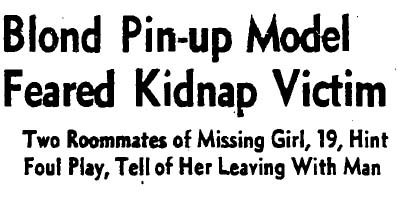
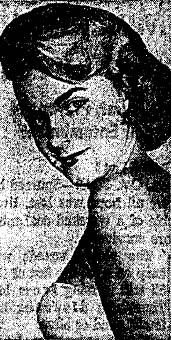
I found this in the archives. Poor thing, only 19. She never got to see her daughter grow up.

Judith Ann Dull June 23, 1938-Aug. 1, 1957


1957_judy_dull_latimesc


1957_judy_dull_latimesb

Posted in #courts, Homicide, West Hollywood | Tagged , , , , | Comments Off on Never returned

Photo shoot

Aug. 3, 1957
Los Angeles

In June 1957, about the time she turned 19, Judy, at right, met Betty at a Hollywood photographer’s studio. They were both young and hoping for modeling careers, so Betty, 19, asked Judy to move into the apartment at 1302 N. Sweetzer Ave., which she shared with a third aspiring model, Lynn, 22.

In late July, Judy complained to her roommates that she felt she was being followed, but assumed it had to do with legal action brought by her estranged husband, Robert, over custody of their 1-year-old daughter, Susan.

She filed for divorce June 7 and was awarded custody of the girl, but Robert took Susan back three weeks later. He said Judy “kept the baby’s home and person ‘in a filthy state’ ” and neglected the girl “to associate with other men.” A custody hearing was scheduled for Aug. 9 and Judy was hoping to find a job to show that she was a good mother.

“Judy was not the Hollywood type at all,” Betty said. “She and I were like sisters. She was  going to get a job in a dime store to prove she was worthy of her child.”

Judith Ann (Vanhorn) Dull never made that custody hearing. On the afternoon of July 29, 1957, a photographer named Johnny Glinn came to the apartment and asked for Lynn. She wasn’t home, but Glinn noticed some of Judy’s pictures and asked about hiring her instead. Glinn made an appointment to pick up Judy at 2 p.m. on Aug. 1, 1957, offering to
pay $40 ($286.61 USD 2006) for two hours of modeling.

Betty thought Glinn was creepy for following Judy around the apartment the day they left on the photo shoot. “I knew there was something odd about the man,” she said. “He said he wanted to shoot pinup pictures. Yet he told her to bring a selection of street outfits, which she did.”

She became worried when Judy didn’t return and called Glinn’s phone number, and was even more concerned when it turned out to be a machine shop (he actually lived at 5924 Melrose). The next day, she reported Judy’s disappearance to deputies at the West Hollywood sheriff’s station.

But by then Judy was dead and buried in a shallow grave 4 1/2 miles west of Indio, 100 feet off Highway 60/70. Glinn eventually took detectives to the site. His real name: Harvey Murray Glatman.

To be continued.

Email me

Posted in Homicide, West Hollywood | Tagged , , , | 3 Comments

Preservation notes

Bukowski_apts
Kim Cooper and Richard Schave, my friends at the 1947project, note that the apartments at 5124 De Longpre Ave in Hollywood where Charles Bukowski produced "Post Office" is on Craigslist:

Approximately a 12,500 square foot lot – currently holds a completely
vacant apartment building (bungalow style). It is a REAL INVESTMENT,
perfect for builders, investors, contractors, etc. You can easily tear
down the old building and do new construction! This is a rare-find in a
high-demand area; Hollywood – close to restaurants, studios, shopping
centers, etc. The dimensions of the lot are 53 ft by 230 ft.

Kim says: "L.A. sure knows how to take care of its literary landmarks!"
Photograph courtesy of Richard Schave, Esotouric

Posted in art and artists, books, Hollywood | Tagged , , | Comments Off on Preservation notes

‘I Hate Cops!’

Aug. 2, 1957
Los Angeles

It was St. Patrick’s Day, 1957, and a few customers got rowdy in a bar
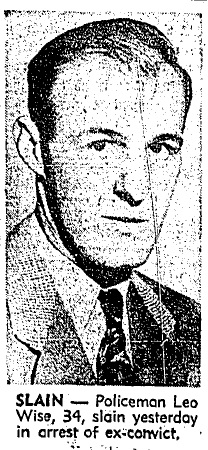
at Pico Boulevard and Figueroa Street. Police Officer Leo Wise
separated a couple of men who were fighting and ordered them to leave.
But instead of going home, Marion James Linden, 43, went to his car and
got a gun.

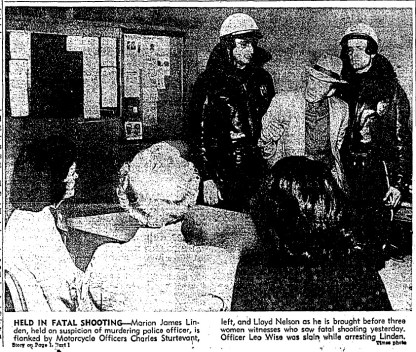
Wise saw Linden lingering outside and tried to arrest him. Instead, Linden shot him to death.

In his last moments, Wise struggled to get to the police call box. Angel Gutierrez Sahaguez and three others ran to help Wise, but he told
them to follow Linden’s car. Wise’s dying words: “Take the number of those plates and call police!”

The men followed the killer and flagged down motorcycle Officers Charles Sturtevant and Lloyd Nelson, who arrested Linden at 11th Street and Alvarado.

“I hate cops!” Linden yelled. “I shot one of them and I hope he’s dead and wish I’d got some more.”
When newsmen saw Linden the next day, he had a bandage over one eye and there were marks on his face, The Times said. Detective Sgts. Vance Brasher and Pat Murphy “explained that he threw a ‘whing-ding’ Sunday in the police homicide office and struck his face on a desk,” The Times  said.

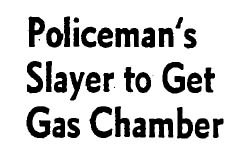
On Aug. 1, 1957, Linden was sentenced to death in the gas chamber. He filed several appeals, including charges that a “fraudulent tape
recording of a confession” was used in his trial. A judge postponed
Linden’s execution in 1959 and the U.S. Court of Appeals granted him another stay of execution in 1960.

But on July 12, 1961, Marion James Linden, who had served eight years in Colorado for killing his wife, was executed in the gas chamber at
San Quentin. It took him six minutes to die, The Times said.

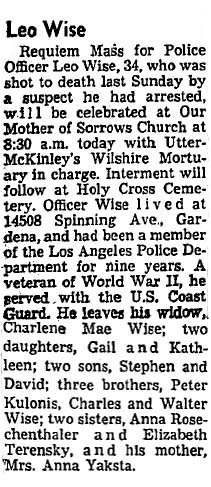
Leo Wise, 34, left a widow, two sons and two daughters, ages 2 to 9. He joined the police force Jan. 5, 1948.

Email me

Posted in #courts, Downtown, Homicide, LAPD | Tagged , , , , | Comments Off on ‘I Hate Cops!’

Countdown to Watts

Aug. 1-7, 1957
Los Angeles

A search through The Times for early August reveals several stories
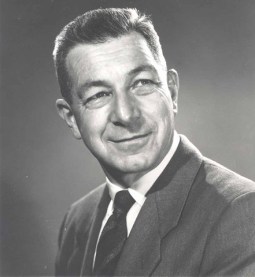
about Chief William H. Parker being honored for 30 years service with
the Los Angeles Police Department. In a luncheon at the Biltmore
Bowl hosted by actor George Murphy, 800 business and community leaders
paid tribute to Parker.

There was also a story about the California Supreme Court reversing a
decision that upheld Parker’s use of listening devices in surveillance.
“It is elementary that public officials must themselves obey the law,”
the Supreme Court said.

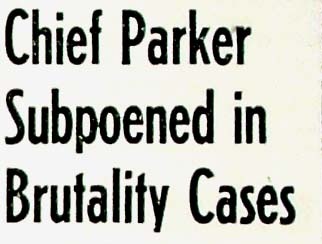
But oddly enough, there is not a word about the NAACP brutality suits against Parker and the Police Department.

We must turn to the California Eagle, a weekly serving the African
American community, for news that Parker had been subpoenaed in the
case. The Eagle noted that the class-action suits seeking $500,000 in
damages had been given “the ‘blackout’ treatment” by the daily press,
radio and TV. The NAACP was weighing whether to buy air time on radio
stations to publicize the case, the Eagle said.

Attorney George L. Vaughn Jr., head of the local NAACP’s Legal Redress Committee, added two more plaintiffs, for a total of 10, the Eagle said.

According to the Eagle, two hod carriers, Thomas Jefferson, 22, 2180 E.
101st St.
, and Joe Thompson, 24, 4051 S. Halldale, were arrested April
28 during what was apparently a traffic stop.

“When they complained
about the handcuffs being too tight, they state that Officers Graham
and Dent of the 77th Street police station began beating them with
their nightsticks, insulting them with obscene epithets and telling
them that ‘We’re going to show you how we treat niggers in Louisiana!’
” the Eagle said.

When Jefferson and Thompson asked to see a sergeant at the 77th Street
station, they were beaten again, charged with grand theft, held
overnight and released, the Eagle said.


The white media’s conspiracy of silence continued
.

Interesting note: According to the State Bar of California, George Louis Vaughn Jr.
graduated from Lincoln University in Jefferson City, Mo., and
Washington University Law School in St. Louis, Mo. He was admitted to
the bar in 1955 and suspended in 1960. He received public reprovals in
1970, 1972, 1973 and 1980. He was disbarred in 1985.

In 1970, he was apparently appointed as a lawyer for attorney Paul
Fitzgerald, who was representing Patricia Krenwinkel in the Manson
family trial.

Email me

Posted in #courts, Countdown to Watts, LAPD | Tagged , , , , , | Comments Off on Countdown to Watts

Spanish blood

Aug. 1, 1957
Los Angeles

Maybe it’s heat, maybe it’s the smog (what would be a Stage 3 alert today), but The Times is full of odd crime news.
A rabid 2-year-old fox terrier mix went on a rampage starting at Wilshire Boulevard and Western Avenue, biting five people before a police officer shot it to death.

Stanley Papin, 49, a painter living at 9620 Anza Ave., Inglewood, followed the dog after being bitten on his right hand until Officer
George Audet killed the animal.

Papin and four others were treated for dog bites at Central Receiving Hospital, including Ray Ratliff, 18, who left before being told that the dog was rabid so he didn’t know he would need to undergo the Pasteur treatment.

Ratliff began hitchhiking to Sacramento, but returned to San Pedro after being  picked up by a driver, a Good Samaritan who told him he should return to Los Angeles for treatment.

Speaking of Good Samaritans, three people were in custody after 11-year-old Wayne Halford, a Times paperboy living at 3425 Military Ave., noticed them burglarizing a house and drew a picture of their
car–including the license number: HCW 864. Police arrested Keith Nelson, 19; Johnny Godinez, 22; and Barbara A. Pope, 18, and recovered $2,000 in stolen jewelry.

Market owner Paul Gertz was not so fortunate during a holdup of his store at 436 S. Atlantic. Gertz told police that four customers were so distracted by a gorgeous woman shopping at the store that they didn’t notice the robbery and couldn’t provide descriptions to police.

Bonus fact: The first rabies case in California was reported in Los Angeles in 1898.

Email me

Posted in #East L.A., Environment, LAPD, Robberies | Tagged , , , , | Comments Off on Spanish blood

Matt Weinstock

July 31, 1957

The whole thing started many months ago when Sparks Stringer poured out
his chagrin here at being unable to find any farkleberries in L.A. He
had in mind whipping up a farkleberry pie like his mother used to make
down South.

Clearly there’s something unlikely and contagious about the word
farkleberry. Publicist Joe Weston was so enchanted by it he named his
frisky Siamese cat Farkleberry. Others thought it was a gag. It isn’t.
A farkleberry, I’m told, is somewhere between a huckleberry and a
gooseberry.

Comes now a letter from Capt. M.R. Flehinger, who used to sell the
Daily News at Beverly Boulevard and Normandie and is now with the Air
Force in Japan.

“After asking in vain for farkleberry pie in Hong Kong, Bangkok and
most of the larger cities in Japan,” he writes, “I though I’d scored in
a Tokyo restaurant. But it was only the accommodating manager and the
language barrier working against me. What I got was a plain berry pie,
I think. Of course, it might have been farkleberry but how can you be
sure?”


The search goes on.

ALTHOUGH Mrs.
Alex Mayer of North Hollywood has been making regular purchases on her
charge account at a department store, she has received no bill for
three months. The other day, she phoned the store and inquired about
it.

A girl looked up the account and reported, “The reason you haven’t
received a bill is that you moved and the mail we sent to your new
address has been coming back.”

Mrs. Mayer, puzzled, said they hadn’t moved, they still lived on Bonfield Street.

“Well,” said the girl, “on the last payment we had from you your
address was a post office box–PO 50042–and our statements have been
returned from there.”

So Mrs. Mayer explained that PO 5-0042 is her telephone number–PO as
in POplar. And now, lucky girl, she will be able to pay her bill.*

Oh, I can tell you, life can be complicated.

AROUND TOWN–As an added fillip to its lavish party for the movie “Omar Khayyam,”
Paramount operatives scoured the city’s tobacconists for Omar
cigarettes. Mostly the tobacco boys said they hadn’t seen any in 25
years. But guess where the Paramounters found an unlimited
supply–Rexall’s.

* In the dark ages, phone numbers had a two-letter prefix. Common ones
in Los Angeles were AT lantic, AX minster, CI trus, HO llywood, MA
dison, OX ford, RI chmond, etc.–lrh

Posted in Columnists, Film, Food and Drink, Matt Weinstock | Tagged , , , , , | Comments Off on Matt Weinstock

Women attacked

July 31, 1957
Los Angeles

In the continuing assaults across the city, a North Hollywood housewife fought off an intruder while a 60-year-old Hollywood woman was saved from strangling by the staff of her Hollywood apartment building after she was grabbed from behind in the hallway, gagged and raped.

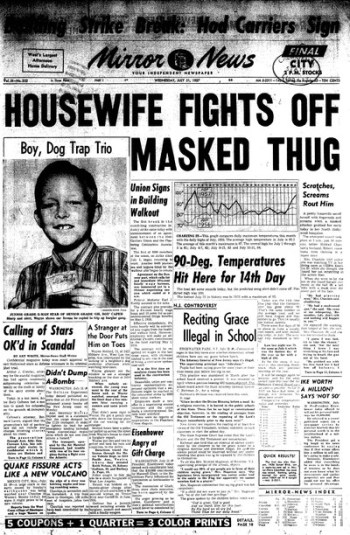
Mildred Chastain, 40, 11228 1/2 Emelita St.,
said she was watching TV about 1 a.m. on July 31, 1957, as she waited for her husband, Robert, to get home from his job at a liquor store. She heard scratching at the screen door and thought it was the cat trying to get in. Chastain opened the door and a masked gunman barged into the house.

“I guess I was foolish to take the chance, but the next thing I knew I was scratching at his face and trying to knock the gun out of his
hand,” she said. “He grabbed me with his free hand but I had him off
balance. I knocked him against the washing machine. Then I screamed
like crazy.”

According to the Mirror, 30 LAPD officers joined by six officers from
the Burbank Police Department made a house-to-house search for the
attacker, who had been prowling the neighborhood for two months.

In Hollywood, an unidentified woman told police she was going into her 12th-floor apartment at 1811 N. Whitley on the afternoon of July 30 when she was grabbed from behind. She said she
never got a look at the rapist who blindfolded her, tied her wrists with a silk stocking and gagged her.

Although she was tied up, the woman knocked the receiver off her telephone to summon help. The desk clerk and the janitor found her nearly dead from “a knotted garment in her mouth,” The Times said.

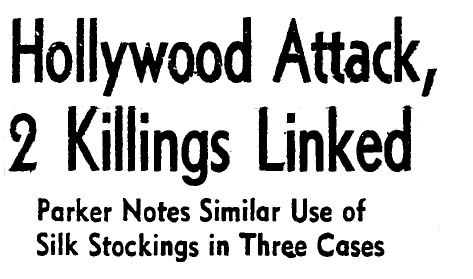
Police Chief William H. Parker said the Hollywood attack was like the stranglings of Marjorie Hipperson and Ruth Goldsmith.

To be continued.

In the meantime, read more about 1811 N. Whitley. Search for Oct. 12, 1947, entry at the 1947project.

Email me

Posted in Hollywood, Hollywood Division, Homicide, LAPD, San Fernando Valley | 1 Comment

No deal

July 30, 1957
Los Angeles

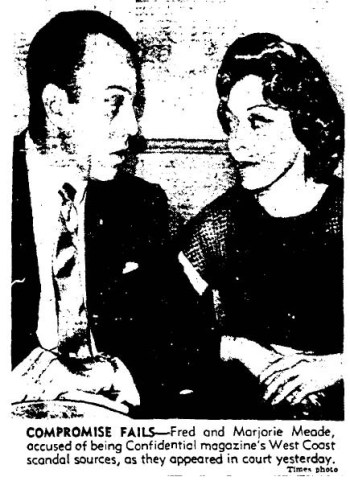
The state prosecutor and the defense had reached an agreement on most points in the conspiracy trial involving Confidential and Whisper magazines.

According to the proposed accord, Confidential and Whisper would:

1.Abandon their present format, would stop printing smear stories and publicize the change in newspaper ads.

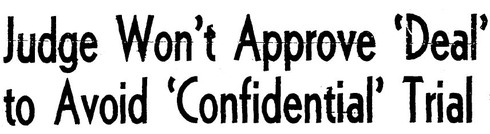
2. Los Angeles County Superior Court Judge Herbert V. Walker would decide the case based on grand jury transcripts.

3. Charges against Fred and Marjorie Meade (the alleged sources of
the magazines’ stories) would be dropped because “they are out of
business the minute the format of the magazine is changed,” according
to Chief Assistant Atty. Gen. Clarence Linn.

Defense attorney Arthur J. Crowley agreed to everything except Linn’s
insistence that guilty verdicts against the corporations–Whisper Inc.,
Confidential Inc., Hollywood Research Inc. and Publishers Distributing
Corp–could not be appealed.

Linn told the judge that the agreement would suppress the magazines and
Crowley noted that the deal would avoid a long trial that would
threaten the reputations of Hollywood celebrities.

To which Walker said: No. “I don’t think a good reason has been given
here for the dismissal of the indictments against the individuals.”

The Mirror said there was little scandal in the 143-page grand jury
transcript, noting that it mostly dealt with testimony by 20 witnesses
that publisher Robert Harrison’s objective was to print “as much
shocking material as he could obtain by wiretaps, by using prostitutes
as witnesses or by any other means.”

Ronnie Quillan testified:

“Harrison stressed the point that he primarily was just interested in the sexual activities of the stars and celebrities and whether they were homosexuals or weren’t,
in other words, the most lurid phases of their lives that he could
expose.”

To be continued.

Email me

Posted in #courts, #gays and lesbians, Hollywood | Tagged , , , | Comments Off on No deal

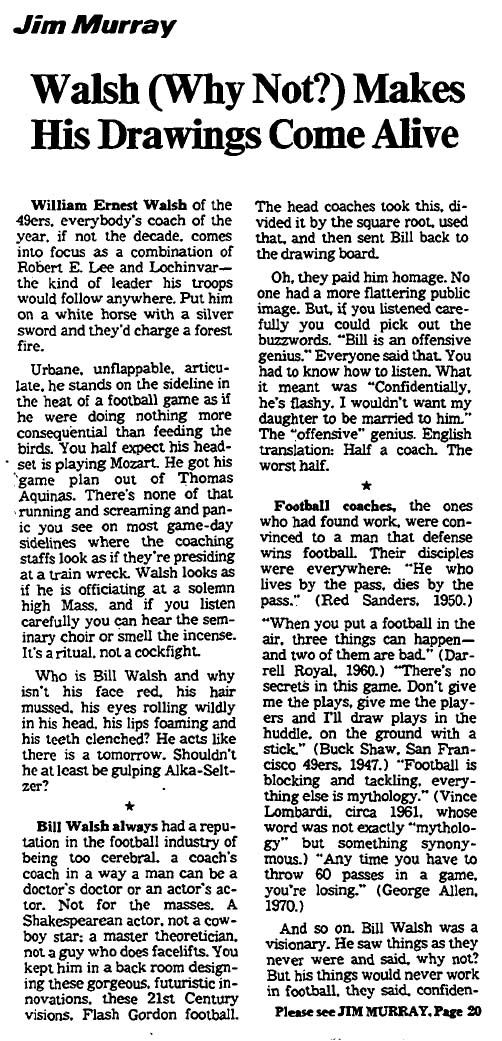
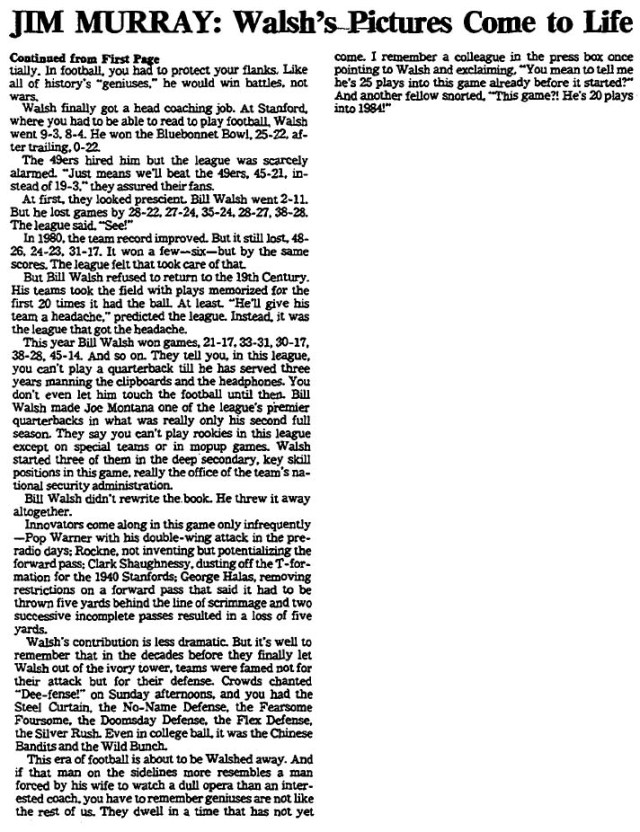
Bill Walsh in The Times

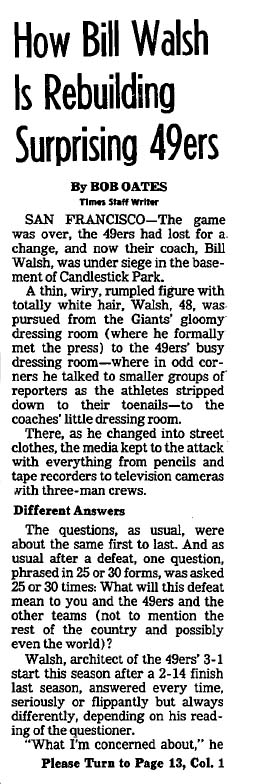
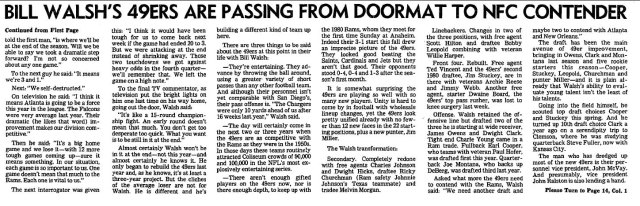
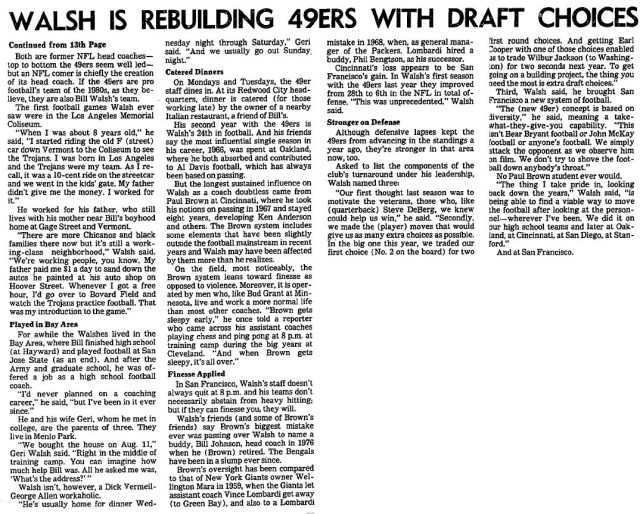
Bob Oates on Bill Walsh rebuilding the 49ers, Oct. 1, 1980; and Jim Murray on Bill Walsh, Jan. 10, 1982:

Bob Oates, Part 1

Bob Oates, Part 2

Bob Oates, Part 3

Jim Murray, Part 1

Jim Murray, Part 2

Posted in @news, Sports | Tagged , , , , , | Comments Off on Bill Walsh in The Times

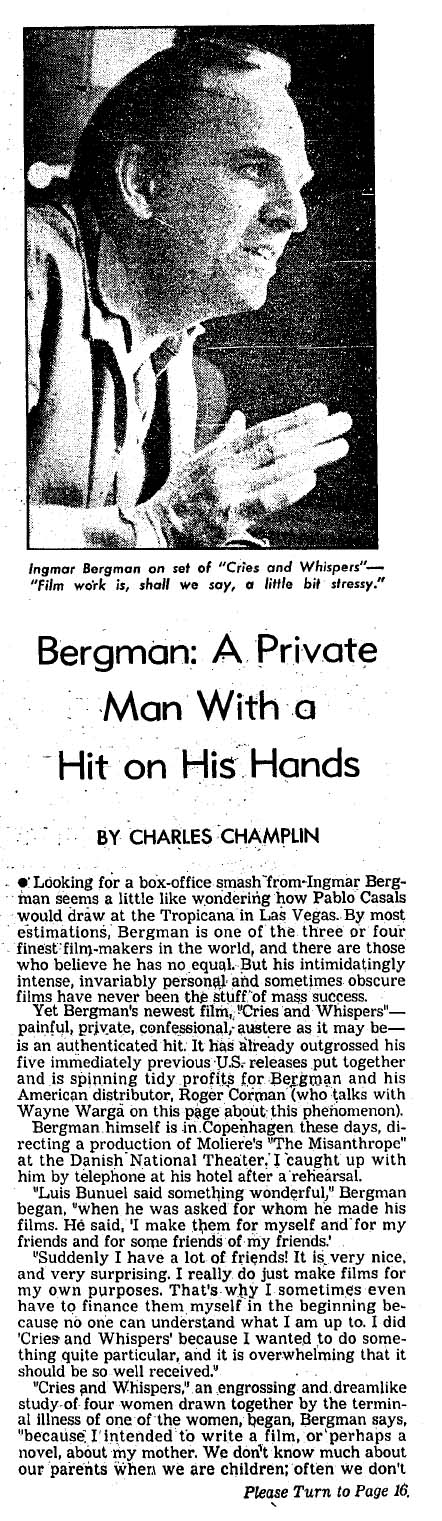
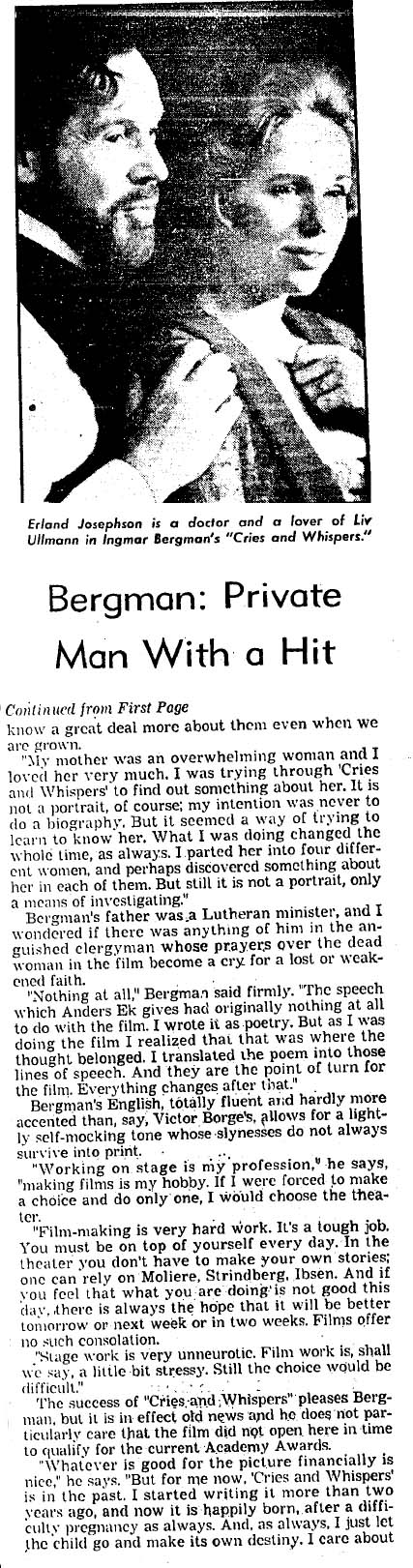
Ingmar Bergman on ‘Cries and Whispers’

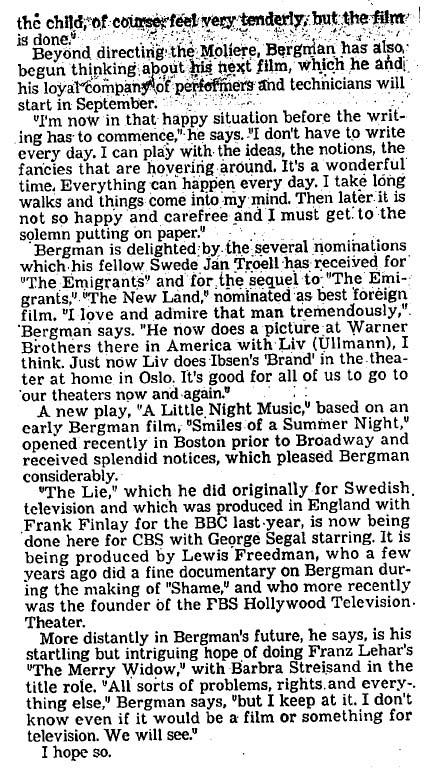
Charles Champlin’s interview with the late Ingmar Bergman on “Cries and Whispers,” Feb. 25, 1973:

Part 1

Part 2

Part 3

Posted in @news, Film | Tagged , , , , , | Comments Off on Ingmar Bergman on ‘Cries and Whispers’

Random queries


The hits for the Daily Mirror blog show that someone is researching the Feb. 13, 1969, robbery of the Bank of America at 3320 S. Hill. Here’s your answer:

The Times wrote very little about the case, although police killed two robbers. According to the account, the unidentified men were believed to be part of a five-member gang that robbed the bank Jan. 10, 1969,
getting $17,600 ($98,532.55 USD 2006).

A stolen car was found nearby with its engine running, The Times said. The slain holdup men were wearing stocking masks, gloves and “two changes of clothes, one of which apparently was to be discarded after
the robbery to hamper identification.”

Aha! A little research shows that on July 2, 1969, James “Tayari” Doss and his wife, Carmelita, were convicted in the January 1969 holdup. Doss was the vice chairman of a black nationalist group called US headed by Ron Karenga, the man who founded Kwanzaa. The other three robbers weren’t identified, The Times said.

The Times apparently didn’t cover the Dosses’ sentencing. The only other citation I can find is Pacific Stars and Stripes, July 3, 1969.

There is no further information on the Dosses.

Email me

Posted in Downtown, LAPD, Robberies | Tagged , , , , , , , | Comments Off on Random queries

Cold case solved

July 25-31, 1957
Los Angeles

Nine minutes after the cyanide pellets were dropped in the gas chamber
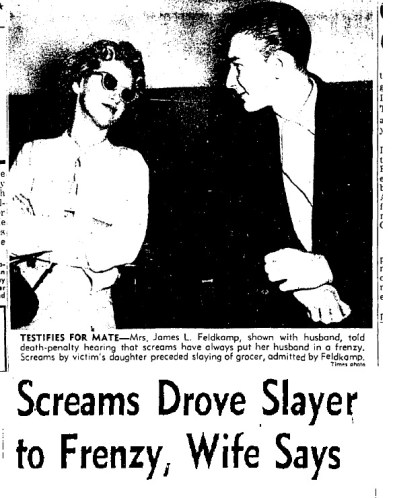
at San Quentin, James Lewis Feldkamp,  25, who had once tried to become an
LAPD officer, was dead.

If he hadn’t been turned down by the Police Department,  he said, he would have gone straight.

If the FBI hadn’t found his juvenile police record,* he might have been hired.

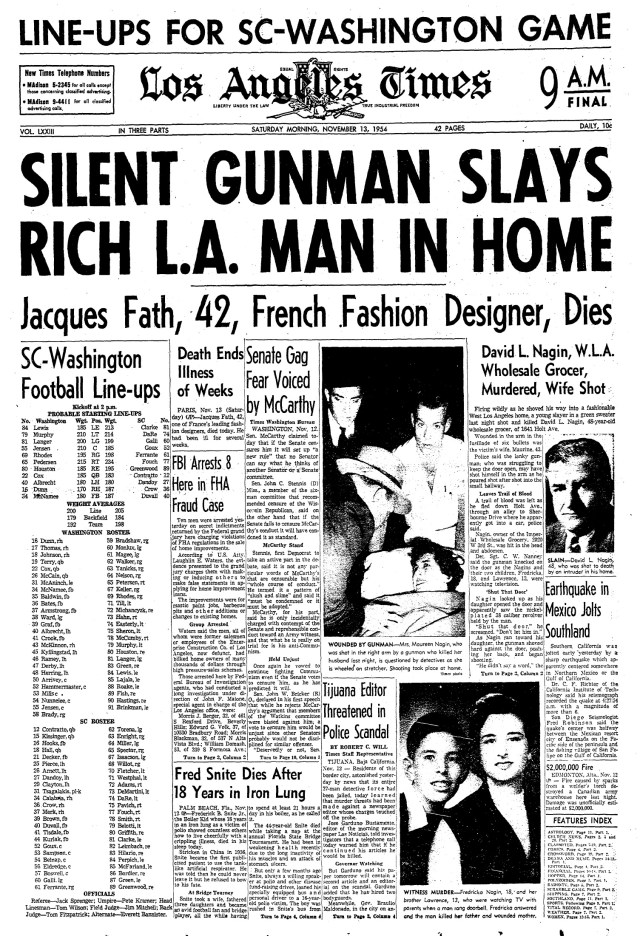
But because of a burglary committed at the age of 15, James Lewis Feldkamp went to the home of David L. Nagin,  1641 Holt Ave., with a loaded gun. Somehow, this seemed like logical reasoning to him.

It was supposed to be an easy job with a three-way split for Feldkamp,
Ambrose (Bocho) Lucero and Joel Leyva Villas, a truck driver who worked
at the wholesale grocery run by Nagin.

Villas and Lucero met in jail, where Villas was serving a sentence for
forgery and Lucero was serving a term for armed robbery. When Villas
finished his sentence, he contacted Lucero and they began planning the
Nagin holdup. It is unclear when or how Feldkamp became involved.

According to Villas, they failed in two attempts to rob Nagin at his office so they tried his home, knowing that he would have a large amount of cash he planned to deposit the next morning.

On the night of Nov. 12, 1954, Lucero apparently went to the home and asked the Nagins’ housekeeper, Marie Jacobs, about the address. Nagin went out to speak with him, returned and told Jacobs to be sure to lock the back door. “We don’t know who this kid is or whether he really wanted anybody,” Nagin said.

Later that evening, as Nagin, his wife, Maurine, and daughter, Fredericka, watched TV, Feldkamp knocked at the door. Fredericka answered it, thinking it was her boyfriend.

“I didn’t want to kill him or anybody else,” Feldkamp said. “When I rang the doorbell a young girl answered the door and screamed when she saw my gun.

“Shut that door!” Nagin screamed. “Don’t let him in!”

“She shoved the door in my face,” Feldkamp said. “I panicked. I shot myself, the man and somebody I didn’t see.”

Leaving a trail of blood after shooting himself twice in the wrist, Feldkamp went to a nearby car. He and Lucero hid on the floor of the back seat while Feldkamp’s 17-year-old-wife, Lucy, drove them to Mexicali and persuaded a doctor to treat the bullet wounds. (Another woman, possibly
Lucero’s wife, Carmen, may have been with them, police said).


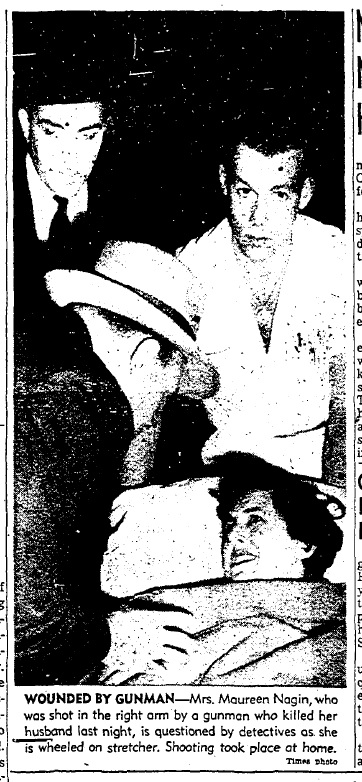
Nagin was killed instantly and Maurine had been wounded in the right arm.

Maurine testified at the inquest: “I remember seeing the man shooting.
The flash blinded me…. I saw my husband was hit–I don’t know where.

“I tried to hold him up but the weight was too much for me. We fell
together and the man was still shooting. I felt I was hit and I cried,
‘Oh my God, we’re both dead.’

“My husband closed his eyes as we were falling. I called, ‘Dave, Dave’ and he never opened his eyes again.”

The investigation turned up some early leads but then went cold. It
wasn’t until July 24, 1957, when Feldkamp was arrested in the robbery of a market at 7132 Sepulveda Blvd., Van Nuys, that the case broke. In an anonymous phone call, a man told detectives to talk to Feldkamp about the Nagin killing. Feldkamp denied any knowledge of the case, but Lucy Feldkamp broke down during questioning and admitted that he had killed Nagin.

Feldkamp and Villas were charged in the killing, but Lucero was tried in Mexico because he had dual citizenship. It is unclear what became of Lucero and Villas, but Feldkamp waived his right to a jury trial and pleaded guilty to first-degree murder.

James Lewis Feldkamp, who almost became an LAPD officer, was executed Feb. 27, 1959.

David L. Nagin’s funeral was conducted by Rabbi Jacob Pressman at Hollywood Cemetery.

* Why wasn’t his juvenile record destroyed? A good question and I don’t have the answer.

Email me

Posted in Homicide, LAPD | Tagged , , , , | 4 Comments

Matt Weinstock

July 29, 1957

I tore a taco the other day with my favorite villain, Paul Fierro.

Chances are that you’ve seen him in movies or TV without knowing who he
was. He’s the tall, dark, grim guy who gives the hero trouble.

Mostly he portrays treacherous Indians, with or without clothes or
warpaint. He is indifferent on this point. “I can go naked,” he says.
“I got muscles.”

The important thing to Paul and others who play minor character roles
is getting enough work so they can live in the quiet [illegible] style
to which they are accustomed.  Paul has a cottage in Laurel Canyon and
his passions are cooking and laughing at life.

Born in L.A.’s “Dogtown,” he attended Castelar Street School, Vernon Avenue School, Venice High and Madera High, upstate.

He sold papers at Santa Barbara Avenue and Figueroa Street and fought
at a smoker in a Spring Street gym when he was 8. Won, too.


He played football, halfback, at Madera and won a scholarship to North
Carolina State, where he played in 1935, 1936, 1937 under coach Hunk
Anderson of Notre Dame. “I ran into the Civil War,” he recalls.

He can’t help being amused at all the fuss over aid to athletes, as if
it were something new. He says he got room, board, tuition, books,
laundry and $25 a week.

Funny things are always happening to Paul. Not long ago, while driving
his old Ford to Madera, he stopped to pick up a soldier near Fresno. As
the soldier got in, fear clouded his face and he exclaimed, “Jeepers!
Lou Garcia!” Turned out he’d seen a movie at his base the night before
in which Paul played a fierce Mexican devil who robbed a stagecoach and
kidnapped an old lady. Paul quieted the youth’s fear.

“I’ve never had a kissing role, said Paul, 41, and a stalwart 200
pounds, “but I don’t mind.” He’s reconciled to playing bad guys. Only
one thing. He has to watch his weight. “You can’t get too round,” he
explained. “Fat guys can’t scare people.”

Paul was preparing to leave for Bend, Ore., on location for the Lindsley Parsons production “Rio Bravo.”
[Note: Not the John Wayne movie. It was released as “Oregon Passage”].
In it he will play, for a change, a friendly Indian scout named, of all
things, Nato!

A LADY NAMED Louise
reports she spent a sleepless night pondering upon this classified ad
in a neighborhood paper in Hollywood: “Diamond ring. Will trade for gun
or ?”

She remains fascinated by the “or ? ” She reasons, here is a person
with a diamond ring which he–presumably it is a he–wishes to unload.
He’ll take a gun or what have you.

His mention of the gun indicates he’s in a surly mood, in which case
the question mark would likely mean a gallon of poison, a tree with a
noosed rope attached or a do-it-yourself bomb kit.

Tell you what. I’m going to do, Louise. I’m going to ignore the whole thing and try to get some sleep.

Posted in Columnists, Film, Matt Weinstock | Tagged , , | Comments Off on Matt Weinstock

Here’s to the Thunder Riders

Photos courtesy of the Autry National Center.
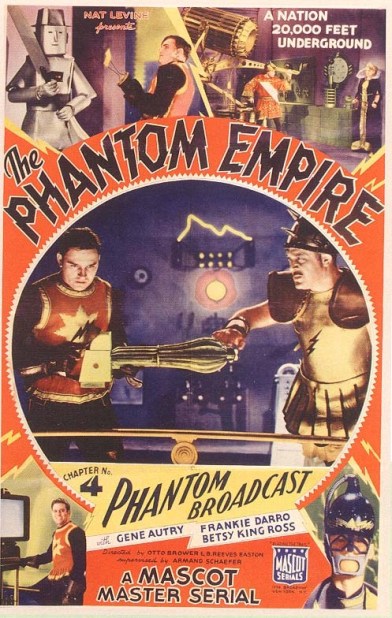
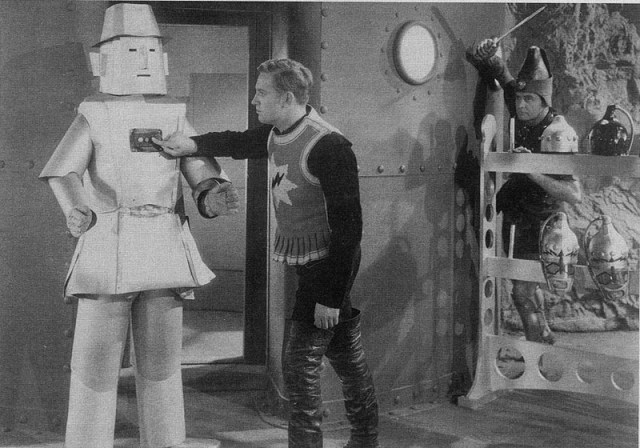
Gene Autry reboots a Muranian robot deep beneath Radio Ranch.


The Autry National Center is marking the centennial of Gene Autry’s birth with a showing of “The Phantom Empire,” my favorite movie combining science fiction and cowboys (the other contenders being “Valley of Gwangi” and “Night of the Lepus”).

“Phantom Empire” will be shown from 10 a.m. to 2 p.m. (remember it’s a 12-part serial) Sept. 29 at the Wells Fargo Theater at the Autry museum in Griffith Park.

I love the costumes in this movie. It looks like they just raided the wardrobe department for whatever they could find from all sorts of different period pictures.

In the 1969 “Valley of Gwangi,” bad things happen when cowboys capture a Tyrannosaurus rex for a wild west show.

In the 1972 “Night of the Lepus,” bad things happen when a studio green lights a movie about giant bunnies terrorizing the Southwest.

Email me

Posted in broadcasting, Film, Hollywood | Tagged , , , | 1 Comment

Literary diversions

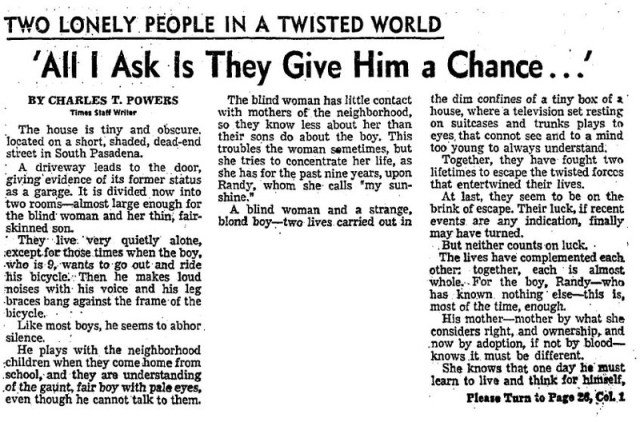
Although we overlapped slightly at The Times, I never met Chuck Powers, who left the paper to write novels only to die of a rare blood disease shortly before his first book, the critically acclaimed “In the Memory of the Forest,” was published in January 1997.

So even though we were nominally colleagues, Powers was something of a discovery for me and I grilled current and former co-workers about him. Everyone, without exception, praises “Forest,” which is set in Poland.

I’m pleased to present a Powers story published May 11, 1969. It’s quite a compelling piece of work. It is interesting to speculate on what he might have produced had he not died at the age of 53.

Part 1

Part 2

Part 3

Posted in @news, books | Tagged , , | Comments Off on Literary diversions

Rewriting history

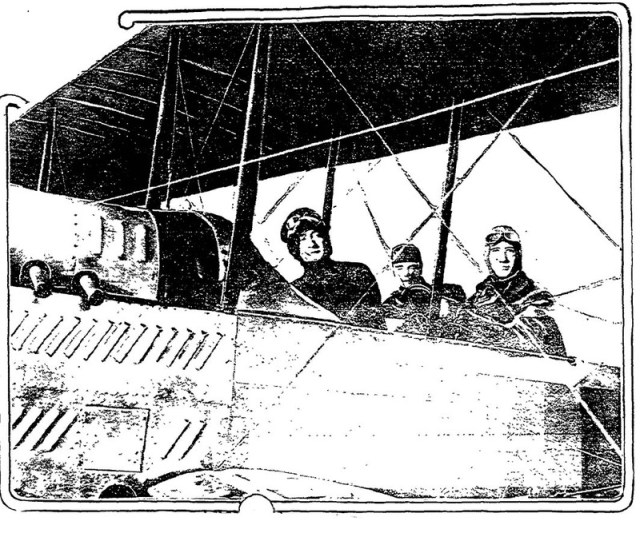
From left, Times reporter Bonnie Glessner, Tiny Broadwick and Glenn Martin, Jan. 9, 1914
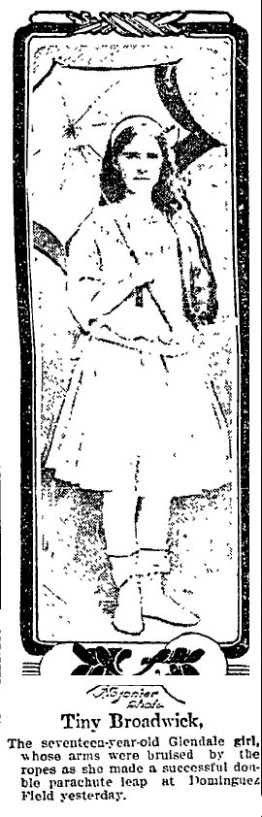

This was supposed to be an upbeat story about the early days of aviation–a nice change of pace from crime and death.
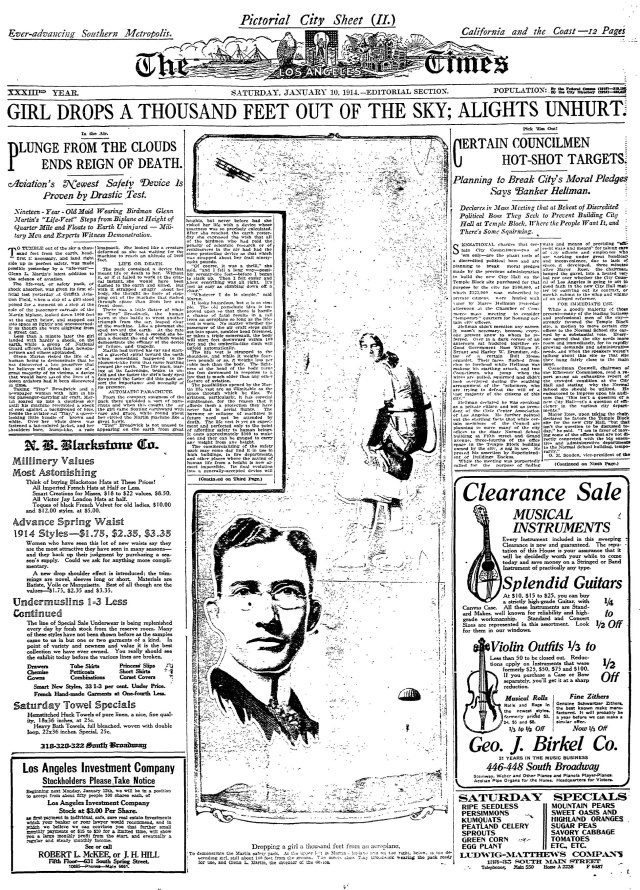
And it is–but not the kind I imagined. Instead of a story about a person, this turned into a story about a mistake.

On July 28, 1957, The Times published  Harry Nelson’s feature about Georgia “Tiny Broadwick” Brown, a petite great-grandmother who was famous in her youth as
a parachutist, appearing at balloon ascensions and air shows from about 1908 to 1922.

In the course of the story, Nelson said that Broadwick made history June 20, 1913, in an exhibition over Griffith Park, with one of the first parachute jumps from an airplane.

A bit of background: Broadwick was born in North Carolina in 1893 to a family named Thompson and when she was about 14, she met George Broadwick, an inventor and
traveling aeronaut.  Tiny Broadwick joined the show and performed parachute jumps. Her specialty was  jumping with a parachute, discarding it and opening another one in what she called a “cutaway.” If she had enough altitude, she might make up to four cutaways, she said.

Her first jump to be recorded in The Times occurred in 1912, during the second air show at Dominguez Hills (the first, in 1910, is a story unto itself and far too complicated to get into here). She was later said to have appeared at the 1910 show, but I can’t find any record of it so far.

Two years later, The Times sent reporter Bonnie Glessner aloft with Broadwick and pilot Glenn Martin, who was at the controls of his newest biplane. As they were flying about 80 mph at an altitude of about 1,000 feet, Broadwick climbed out of the plane and positioned herself to jump using Martin’s aerial “life vest.”

“When she was ready to drop, Martin touched my shoulder,” Glessner wrote, “I faced about and turned my eyes on the face of the child. She was clambering over the side of the machine as though it were
stationary. Once over, she clung tenaciously, her eyes fixed on Martin, who was just then looking down over the side of the aeroplane. The signal came while he watched below. Just the slight movement of his
hand but the girl understood  and her lips formed a ‘goodbye’ which I sensed rather than heard. Smiling at me, she stepped off into space, not even a tremor of the machine showing she was gone.”

Note that I said “two years later.” The story is dated Jan. 10, 1914, and deals with an incident that occurred the day before: Jan. 9, 1914.

Not June and not 1913.

Oops.

So how did a Jan. 9, 1914, parachute jump become June 20, 1913, and later June 21, 1913?

Unlike Nelson, we have Proquest, so we can trace the mistake, which has quite a pedigree.

An unsigned  Jan. 31, 1949, story changes the year, saying that the jump occurred over Griffith
Park on Jan. 10, 1913, “and got a three-column write-up in The Times.”

It is apparently Nelson we have to thank for changing the date from Jan. 10, 1913, to June 20, 1913. And by the time of a 1966 story by Dorothy Townsend, June 20 has become June 21. This date appears in Broadwick’s 1978 obituary and, of course, is all over the Internet.

I’ll go fix the Wikipedia entry and see how long it lasts before somebody tweaks it.

Email me

Posted in @news, Transportation | Tagged , , , , , | Comments Off on Rewriting history