June 26, 1938


1938_0626_home

The home of the week, above, and below, via Google maps’ street view.


Posted in Architecture | Tagged , | Comments Off on June 26, 1938

Jackie Robinson, track star

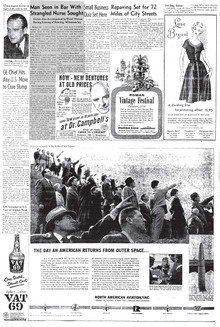
1938_0626_page
June 26, 1938

By Keith Thursby
Times staff writer

1938_0626_robinson

Dropcap_i_1914_3 It might be the shortest newspaper notice in Jackie Robinson’s career.

A two-paragraph item in The Times announced that Robinson, described as the "sensational all-around Pasadena Junior College athlete," would be leaving for Buffalo to compete in the AAU track and field championships the following month.

Robinson had been the recipient of a campaign to raise money for the train trip. The Times said that Charles W. Paddock, a former world-record sprinter, had started the campaign and Robinson’s "school mates" had raised most of the $239. The story also mentioned that a local newspaper conducted the campaign, which must mean it was some other paper. Paddock worked at the Long Beach Press-Telegram and Pasadena Star-News, according to websites such as http://frankwykoff2.com/charley_paddock.htm

Robinson also came up in a June 21 Los Angeles Angels game story. The Times reported that Robinson would participate the next night in an exhibition race as part of "Track Night" at Wrigley Field to raise money for the Buffalo track meet. The next night’s story mentioned the race but not Robinson. Readers did learn, however, that one of the runners from Riverside Junior College forgot to bring his track shoes and had to borrow a pair of baseball spikes.

keith.thursby@latimes.com

Posted in Front Pages, Sports | Tagged , , | Comments Off on Jackie Robinson, track star

June 26, 1908

1908_0626_hed_2

Above, Normandie and Martin Luther King Jr. Boulevard, "Home of the Garbage Burrito."

1908_0625_cover

1908_0625_runover
Dropcap_t_1910 he Times’ Harry Carr, fresh from the Republican National Convention in Chicago, heads to Lincoln, Neb., to interview William Jennings Bryan, the Democratic presidential candidate.

"When he is on the stump, Bryan is the simple child of the people who helps baggage smashers handle his trunks. Today, in fact, he brought out a humble request that plain alpaca coats be worn at a banquet to be given him here in place of dress suits.

"Bryan, you good, old faker, if you can get away with that and also pose as the influential, rich country squire, you are a wonder, and I guess you can."

Glen Curtiss flies his Curtiss No. 2 airplane 41 seconds at an altitude of 40 feet for a distance of 2,175 feet. A record … President Grover Cleveland is laid to rest … And turmoil in Tehran …

On the jump, an armed mob hunts a man who robbed and beat a woman at Normandie and Santa Barbara (now Martin Luther King Jr. Boulevard) and attacked another woman during his escape. 

Email me

Posted in @news, Front Pages, Politics | Tagged , , , , | Comments Off on June 26, 1908

June 25, 1958


1958_0625_adamson


1958_0625_page


1958_0625_webb_3
Someone apparently doesn’t like Dorothy Adamson’s fox terrier, which is missing after her apartment at 1034 Hilldale was bombed. An unidentified caller had complained about the dog’s barking, The Times says. Alas, the paper never followed up on this story.

And wedding bells ring for Jack Webb and former Miss USA Jackie Loughery, who met when Webb was casting "Pete Kelly’s Blues." The couple are going to live on the Republic Studios lot, The Times says. They divorced in 1964.

Email me


Posted in #Jazz, Animals, Film, Front Pages, Hollywood, LAPD | Tagged , , , , , | Comments Off on June 25, 1958

June 25, 1938


1938_0625_scotties

1938_0625_cover

1938_0625_runover


Dropcap_w_1934 e have more fallout from Earle Kynette’s conviction in the Harry Raymond bombing. On the jump, The Times reports that seven officers will face a police board of rights on charges of obstructing the Raymond investigation.

Mayor Frank Shaw sends a letter to members of the county grand jury noting the achievements of the Police Department … but more important, he also tries to remove Police Commission Vice President Charles W. Ostrom. An attorney, Ostrom has clients who include Milton "Farmer" Page, a leading underworld figure. Shaw says Ostrom should either quit the commission or stop representing Page. Ostrom, however, says he will "go out fighting." 

Shaw was unable to remove Ostrom, who remained in office. But the victory was temporary… (Bonus fact: Ostrom died in 1959 at the age of 77).

Farmer_page_mug

Milton "Farmer" Page, above, was a major underworld figure in early Los Angeles and was among the defendants in the case against Tony Cornero’s gambling ship, the Rex. I’m going to have to dig up more about him; he sounds like quite a character.

Email me

Posted in #courts, @news, City Hall, Downtown, Front Pages, LAPD, Politics | Tagged , , , , , , , , | 1 Comment

June 25, 1908


1908_0625_cleveland


1908_0625a_cover

1908_0625_crash


Dropcap_t_1908
rue confession: I mixed up June 26, 1908 and June 25, 1908. I suppose that happens more often that one might suspect–or not. Readers either politely didn’t bring it to my attention or didn’t notice. Thank you for your diplomacy.

To get to the point: The Times notes that the death of Grover Cleveland leaves the United States without a living ex-president. That will change when Theodore Roosevelt is succeeded by William Taft, but I’m trying to think of the next time the U.S. was in a similar situation. Certainly not in my lifetime.

In the second section, eight people are injured in the head-on crash of two streetcars at the Arroyo Seco bridge. Passengers on the outbound streetcar blame the crash on inattention by the motorman, who was "working with his motor" before the streetcar collided with the inbound car from Pasadena. Note that one of the injured was taken home instead of going to a hospital.

Also notice a meeting of Zionists for a fundraiser at the synagogue at Olive and Temple. Those who contribute to the cause can have their names inscribed in an elaborate "book of gold," The Times says. 

Email me


Posted in @news, Front Pages, Politics, Religion, Transportation | Tagged , , , | 1 Comment

June 24, 1958


1958_0624_ads_2 

1958_0624_page


1958_0620_scebbi_2


Dropcap_a_baker t left, a nine-room home in an all-white neighborhood is heavily vandalized after being sold to an African American doctor and his family.

The Times says vandals caused $15,000 ($109,315.53 USD 2007) damage to the newly redecorated home at 4240 Cerritos Ave., Long Beach, by putting  a garden hose up on the second story letting the water run all night; splashing bleach on the new carpeting; and cutting a huge hole in the carpet.

Dr. Charles T. Terry said he still intended to move into the home, noting that he believed the vandalism did not reflect the feelings of his neighbors.

The next day, 150 neighbors joined a nonprofit organization that would decide whether people were eligible to buy homes in the area. The group condemned the vandalism to the Terrys’ home but said they needed to protect their property values by deciding who could buy a house in the area. 

The City Council, meanwhile, passed a resolution saying that "people of all colors and creeds are welcome in Long Beach."

Also note the killing of Police Officer Thomas Scebbi after he and his partner, Ramon Espinoza, pulled over about 2 a.m. on June 20 in front of 332 S. Kingsley Drive to question a man wearing white gloves about a series of liquor store holdups. Espinoza (The Times also called him Espinosa) was badly wounded and expected to die of his injuries, but he recovered to testify against James Eugene Hooten. Hooten was executed in the gas chamber for the killing, May 13, 1960.

Email me


Posted in #courts, Countdown to Watts, Film, Front Pages, Hollywood, Homicide, LAPD | Tagged , , , , , | 1 Comment

June 24, 1938


1938_0624_nuestro_pueblo


1938_0624_cover


1938_0624_runover


Dropcap_n_1938_nuestro
uestro Pueblo is a new discovery for me, and a very happy one. The Times began the feature by writer Joe Seewerker and artist Charles Owens in June 1938, publishing installments Mondays, Wednesdays and Fridays. The series ended in October 1939 after Seewerker and his young son, Joe Jr., were badly injured in a car accident. The last installment bids farewell with a jaunty "hasta la vista." The series was published as a book with an introduction by The Times’ Lee Shippey.

And never mind the fallout from the Harry Raymond bombing, here’s really important news: The two leads of "Gone With the Wind" have finally been cast, The Times says. The movie will star Clark Gable as Rhett Butler and Norma Shearer as Scarlett O’Hara.

The Times says three supporting roles have been cast: Walter Connolly as Scarlett’s father, Gerald; Maurice Murphy as Charles Hamilton, Scarlett’s first husband; and Margaret Tallichet as Scarlett’s sister Carreen.

Of course, we know GWTW didn’t quite turn out this way.
Email me


Posted in #courts, Architecture, art and artists, books, City Hall, Downtown, Film, Front Pages, Hollywood, LAPD, Nuestro Pueblo | Tagged , , , , , , | 2 Comments

June 24, 1908


1908_0624_pix


1908_0624_cover

Dropcap_b_1904
loodshed and slaughter mark the beginning of the Persian Civil War, which lasted until 1909. In February, the shah, Mohammad Ali, escaped an assassination attempt when two bombs were dropped on his motorcade from the roof of a house. A driver and several "outriders" were killed, along with many spectators, but the shah was spared because he had sent the car ahead as a decoy while he was in another vehicle.

In July 1909, Mohammad Ali fled to the Russian legation and his son Ahmad Miraza was proclaimed shah, The Times said.
Email me


Posted in @news, Front Pages | Tagged , , , , | Comments Off on June 24, 1908

Los Angeles traffic

1958_0622_map


1958_0622_cover

Page 26
1958_0622_page26

Page 27
1958_0622_page27


Dropcap_i_packard_2
f only Ray Hebert had asked the right question. But how was he to know? Twenty years after Ed Ainsworth focused on a "motorway" system in his series on Los Angeles traffic, Ray Hebert examines the growth of Southern California’s freeways.

Unfortunately, there’s no historic overview looking back at the state of the city’s congested streets that led up to the development of the freeways. All we have is a point in the time line.

Hebert focuses mainly on the progress of the various freeways under construction–and the  50-year-old map contains only a few surprises for today’s motorists. (There’s no hint of the Century Freeway).

But here’s the tantalizing part of his story. Hebert writes ominously:

"The Los Angeles area will still be beset by freeway problems when most of the persons reading this story have given way to much younger men and women."

Quoting Assistant State Highway Engineer Edward T. Telford, Hebert writes: "… freeways are a continuing thing. Our successors will still be working on them. They will still have problems."

What problems did traffic engineers foresee in 1958? Here are some hints:

"Although the system is far from complete, there are signs that some of the freeways converging at the four-level hub interchange have reached their maximum travel load….

"… Some motorists, for short, close-in trips, are going back to existing surface streets, which are being made more attractive due to efforts of local jurisdictions."   

In other words, the downtown four-level was at maximum capacity 50 years ago. And people were already choosing surface streets for short trips because of congestion. Sound familiar?

Email me


Posted in Downtown, Freeways, Front Pages, Transportation | Tagged , , , , | 1 Comment

Mystery photos

 
As promised, here’s a roundup of recent mystery photos, ready for a second guess. I have added some obscure, cryptic clues.

Email me

2008_0513_mystery_pix3

Ronald and Nancy Reagan with a Hoosierland hoopster.
2008_0526_mystery_pix

Theda Bara, right, and an actress from one of Dustin’s most famous films.

2008_0602_mystery_pix
Lily Pons and a man I’m sure you will recall.

  • Mayor Frank Shaw? (Duane Laible). Absolutely right. Frank Shaw is declaring Lily Pons Day.
2008_0609_mystery_pix
Eve Arden with an L.A. official who was a walk in the park.

  • Los Angeles County Supervisor Ernest E. Debs? (Brady Westwater). Very good!
Posted in Uncategorized | 4 Comments

George Carlin, RIP

1978_0703_cover
1978_0705__carlin

Dropcap_m_martinlewis aybe you remember him as Al Sleet, the "Hippy, Dippy Weatherman with the hippy, dippy weather … man" or as Rufus in "Bill and Ted’s Excellent Adventure" or the author of an incredible number of jokes that are  eternally circulating on the Internet. Or perhaps you have heard of his bit on the "Seven Dirty Words." Here’s a transcript of the skit that got him in trouble.

Below, an interview with Carlin last year.

Email me

Oct. 4, 2007

By Mike Flaherty
Special to The Times

Dropcap_t_martinlewis he acerbic stand-up comedian and social commentator is celebrating 50 years in show biz — and last week’s release of "George Carlin: All My Stuff," a 14-DVD collection of his HBO specials spanning 1977 to 2005. Although he shows no sign of slowing down, he did take some time to chat about his career, his healthy pessimism and our commander in chief.

—

So, 50 years in show biz, huh? Does that number date from a specific gig?

It dates from the day I took the air at a radio station in Shreveport, La., in 1956. You know what? It’s really 51 years; we’re fudging it a year just for convenience’s sake.

I was 18, and they had me do newscasts first, then I became a DJ two or three months later.

Do you have a favorite among the 12 HBO specials on "All My Stuff"?

Yeah, "Jammin’ in New York," 1992. Prior to that period, I’d refer to myself in interviews as a comedian who wrote his own material. But that was the point where I probably became more of a writer who performed his own material. The material became more like essays, they became more socially conscious, and it was just a major jump from being what I think of as only an entertainer to being an artist-entertainer.

I’m looking at the titles of your last few — "You Are All Diseased," "Complaints and Grievances," "Life Is Worth Losing." If I didn’t know better, I’d think you were a pessimist.

Dropcap_w_martinlewis ell, I am a pessimist as far as the world is concerned. I have absolutely low prospects for the human race; I have very low prospects for this country. For myself, though, very high prospects. I’m a personal optimist.

How does one keep pessimism from making them miserable, souring their outlook, preventing them from embracing life?

You can’t care. You see, I don’t care about the outcome in this country [or] on this planet because I know this is all temporal b.s. It’s not a religious point of view, it’s just realism. I like living somewhere detached from all of this emotionally. I don’t really have a stake in the outcome anymore.

Dropcap_a_martinlewis bout 30 years ago, I became a person who said, "You know something? People aren’t worth worrying about and caring about." One by one, yes; any time I’m with one person, I’m fine. There’s all sorts of compassion and empathy in my heart. But when you consider them as a group, from a distance, I don’t give a . . . about them.

How about George Bush?

Just a product of the American system. People always blame the politicians, and I say, "Well, where do you think they come from?" They are products of American culture, American society, schools, churches, communities, businesses, families, homes. So what are you complaining about? This is you, the government of the people, by the people and for the people. So, I don’t let them off the hook by attacking the people they put out front. But clearly George Bush is an electrifyingly incurious man.

I’m guessing the notion of retirement doesn’t appeal to you.

No, no. I get a great deal of joy out of this. An artist is never really satisfied; you just keep scratching underneath the surface trying for more.

When is the next HBO special, and what’s it called?

The next one is March 1, called "It’s Bad for Ya."

Continue reading →

Posted in #courts, books, broadcasting, Film, Front Pages, Hollywood, Stage | Tagged , , , , , , | Comments Off on George Carlin, RIP

June 23, 1908

1908_0623_texas

Posted in @news, Countdown to Watts, Homicide | Tagged , , , | Comments Off on June 23, 1908

Voices–James Ellroy

 
Aug. 30, 1995


By Amy Wallace

Times Staff Writer


Dropcap_i_witness_2
n his 1987 crime novel, "The Black Dahlia," James Ellroy had the
audacity–what he would call the "righteous authorial authority"–to
cook up a solution to Los Angeles’ most famous unsolved homicide.


Leading his readers on a tour of the City of Angels’ seediest streets,
Ellroy wrote of a young homicide dick who became obsessed with the
Dahlia–a would-be actress named Elizabeth Short who in 1947 was found
slain and severed in two. In fiction, Ellroy did what no real detective
has ever done: He made the Dahlia’s killer pay.


Now, Ellroy has set out to solve another decades-old Los Angeles-area
killing. Fresh from a promotional tour for his acclaimed 11th novel,
"American Tabloid" (Knopf, 1995), he has begun researching a book about
the mysterious 1958 murder of Geneva Hilliker Ellroy, his own mother.


Crime literature may never be the same.


After all, this is the murder that Ellroy says made him the man he is
today. The 47-year-old author traces his fascination with all things
criminal back to the day his mother was found, strangled and half-nude,
near Arroyo High School in El Monte. And he admits that over the years
he has used her death to stir up interest in his novels.


"I’ve exploited it," he says flatly, recalling how a previous
publisher, eager to promote "The Black Dahlia," encouraged him to tell
interviewers about his past. "He said, ‘If you’re willing to talk about
this on the media circuit, we can put you out there and sell some
books.’ And he was right. I told the story 9 million times."


Dropcap_a_witness_2
self-described "master self-promoter with a tight grip on a pop-psych
show-and-tell," Ellroy used to tell reporters that his mother–a
divorced alcoholic who could sometimes be harsh to her son–got
"whacked." More than once, he referred to her slaying, which occurred
when he was 10 years old, as "the Geneva snuff."


But today his tone is fervent, not flip. Thirty-seven years since he
lost her, he is trying to find his mother again, to recognize the woman
who gave him voice.


"To one degree or another I’ve exploited her or ignored her. I’ve
understood that for a long time. But now, I know the true force that
this woman and her death has had on me," he says, explaining that by
investigating her murder, he hopes also to understand more about her
life. "This is an attempt to go back, to portray the woman with love
and, if possible, bring her killer to justice."


Dropcap_s_witness o it is that Ellroy, whose raw, tautly written but very dark books
have won him both a faithful following and a coterie of critics, has
arrived in an uncharacteristically soft-spoken place. This is a man who
made a career out of chronicling the lives of burned-out cops, has-been
or never-was stool pigeons, two-bit snitches and three-time losers.
This is a man who can–and does–use the words milieu and Zeitgeist in
a single sentence, a 6-foot-3-inch espresso addict who manages to
appear brooding even when wearing loud Reyn Spooner Hawaiian shirts
(his favorite apparel).


This is no mama’s boy. On the contrary, Ellroy says he hated his mother when she died.


"On my 10th birthday in March, 1958, she said, ‘Now you’re a young man.
You can decide if you want to live with your dad or live with me,’ " he
recalls. When he chose his father, "she whacked me in the face. I had
made up my mind that was the last time she was going to do that and, of
course, it was. . . . The next thing I know, she’s dead."


Ellroy’s decision to reopen the investigation of his mother’s slaying
came after a newspaper reporter-friend discovered Geneva Ellroy’s
murder file while researching a story about unsolved San Gabriel Valley
homicides. Ellroy had never thought to track down the file himself, but
once he learned it was there, he couldn’t get it out of his head.


If nothing else, he knew, it would make a great story: a grown man
confronting a gruesome incident from his childhood, a hardened crime
novelist coming face to face with the most personal of crimes. He
arranged to write a piece for GQ magazine about reading the murder
file–a collection of police reports, mug shots and coroner’s data–for
the first time. The article, called "My Mother’s Killer," was a
finalist for a National Magazine Award. But it didn’t give Ellroy the
peace he’d hoped for.


"I thought the pictures would wound me," he wrote in GQ. "I thought
they would grant my old nightmare form. I thought I could touch the
literal horror and somehow commute my life sentence. I was mistaken.
The woman refused to grant me a reprieve."


Dropcap_s_witness_2 o, he resolved to go further, to expand the article into a book, to be titled "My Dark Places."


Embarking on a real homicide investigation was a daunting task, even
for someone who’d written about so many fictional ones. Ellroy hired a
detective he’d met when he first viewed the murder file, Sgt. Bill
Stoner, who was retiring after 32 years with the Los Angeles County
Sheriff’s Department and was looking for a new challenge.


Stoner, a reserved man with a neat mustache and a modest manner, was
the first to tell Ellroy that they were unlikely to solve the case. The
killer’s trail was ice cold. So many years had elapsed that many of the
key players–and perhaps the killer himself–were dead. Others would be
hard-pressed to remember details of that hot June night in 1958 when
Geneva Ellroy lost her life.


But this unusual partnership–Ellroy in his white Jack Purcell
sneakers, Stoner in his wine-colored loafers–had one thing in its
favor. Stoner knew from experience that on rare occasions the passing
of years can unlock secrets: previously reluctant witnesses want to
unburden their consciences before they die.


Today, Ellroy and Stoner have a particular person in mind who they hope
will come forward, a woman they call simply the Blonde. It is only a
matter of reaching her, they believe, to let her know they need her
help.


Dropcap_g_witness eneva Ellroy dressed pretty on the night she died. Her sleeveless blue
and black dress was set off nicely by a blue-lined, full-length coat.
She wore faux pearls–a simple necklace complemented by a huge ring on
her left hand. It was a Saturday, her son was staying with his father,
and she was going out.


She arrived at the Desert Inn, a bar on East Valley Boulevard in El
Monte, about 8 o’clock. Several people remember that she was joined by
a woman and a man. The man was 40ish, white, swarthy and about six feet
tall. The woman was younger and described as "hard-faced." She wore a
brown summer dress and tied her blond hair back in a ponytail.


The Swarthy Man and Geneva Ellroy left the Desert Inn about 10 p.m.
Twenty minutes later they pulled a dark green Oldsmobile into a nearby
drive-in, Stan’s, and ordered a snack. The carhop remembers that they
talked vivaciously and seemed to have been drinking. By 11 p.m., they
were gone, but three hours later, they drove in again.


Geneva Ellroy ordered chili. She was chatting gaily, but her clothes
looked disheveled, and the carhop speculated she and her companion had
been necking. The Swarthy Man, meanwhile, looked sullen. He ordered
coffee and acted bored with the woman at his side.


The couple left at 2:45 a.m. Eight hours later, Geneva Ellroy was found
dead. One of her stockings was tied around her neck. Her broken
necklace lay under her body, and 47 pearls were found scattered nearby.


Dropcap_w_witness hen interviewed by police, patrons of the Desert Inn said that the
Blonde and the Swarthy Man were not regulars. One hard-drinking
customer said the Swarthy Man had given his name, but he couldn’t
remember it. An artist made a sketch of the Swarthy Man, which was
circulated to newspapers and law enforcement around Los Angeles County.


But police came up empty, lacking leads and suspects.


Today, the Desert Inn is a Mexican restaurant called Valenzuela’s.
Stan’s Drive-In was demolished long ago. But the mystery remains, and
Ellroy and Stoner say the Blonde is their best hope for solving it.
They talk about her frequently, speculating about why she has remained
silent.


"The Blonde is the key," Stoner tells Ellroy. "Was she a girlfriend of
your mother’s? Of the suspect’s? Maybe she’s married to the suspect."


Ellroy picks up where Stoner leaves off. Maybe the Blonde was married
to someone else who was criminally connected to the Swarthy Man. Maybe
she feared reprisals. But surely, he says, surely she has told someone
what she knows.


"She’s a barfly. A juicer," says Ellroy. "These people shoot their mouths off."


Stoner concurs. "She’s told somebody–maybe a bar acquaintance–about
her girlfriend who was murdered, about how she was lucky it wasn’t her.
All we have to do is hit the right person."


If and when they do, they’ve made it easy for that person to get in
touch. Ellroy has a toll-free tip line, which he repeats to anyone who
will listen: (800) XXX-XXX–[Number deleted because this is a 1995 story–lrh].


Dropcap_s_witnesstoner and Ellroy have had some disappointments. One of the original
investigating officers is dead and the other can’t remember much.
They’ve found the carhop, whose memory is flawless, but she admitted
she never was quite sure about the type of car the Swarthy Man drove.


They’ve talked to Geneva Ellroy’s landlady. She cried when she saw
James, and provided him with some details about his mother he didn’t
remember. She used to like to make popcorn, for example, and eat it
with a spoon. But the landlady was no help when it came to identifying
the Swarthy Man and the Blonde.


Ellroy and Stoner are working under a publisher’s deadline: The book
must be written by mid-1996. If they don’t get their man by then,
Ellroy will write about the search, about his fierce friendship with
Stoner, about his mother’s life and his own. In some ways, he muses,
such an outcome would be fittingly ironic.


"It [would be] Geneva Hilliker Ellroy’s last laugh," he says, slipping
briefly into her voice as he imagines what she’d say. "Jimmy, you
exploited me and now . . . you’ve gotten three weeks on the New York
Times bestseller list. You would have gotten 83 [weeks] if you’d found
the killer before the hardcover was published!"


But Ellroy says his search will continue until the killer is caught. And if that day comes after deadline?


"Then [my publisher] is going to say, ‘Come here,’ " Ellroy says,
beckoning with a long finger. " ‘Come here and write an addendum for
the paperback edition.’ "


Posted in books, Film, Homicide | Tagged , , , , , | Comments Off on Voices–James Ellroy

Geneva Ellroy, RIP

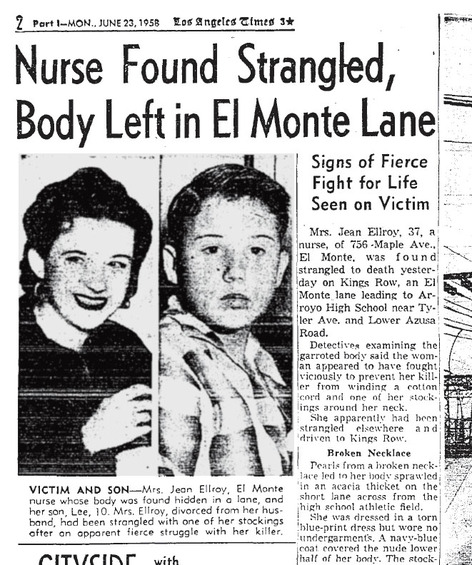
Geneva Ellroy crime scene, Arroyo High School, El Monte, Calif., via Google maps street view.


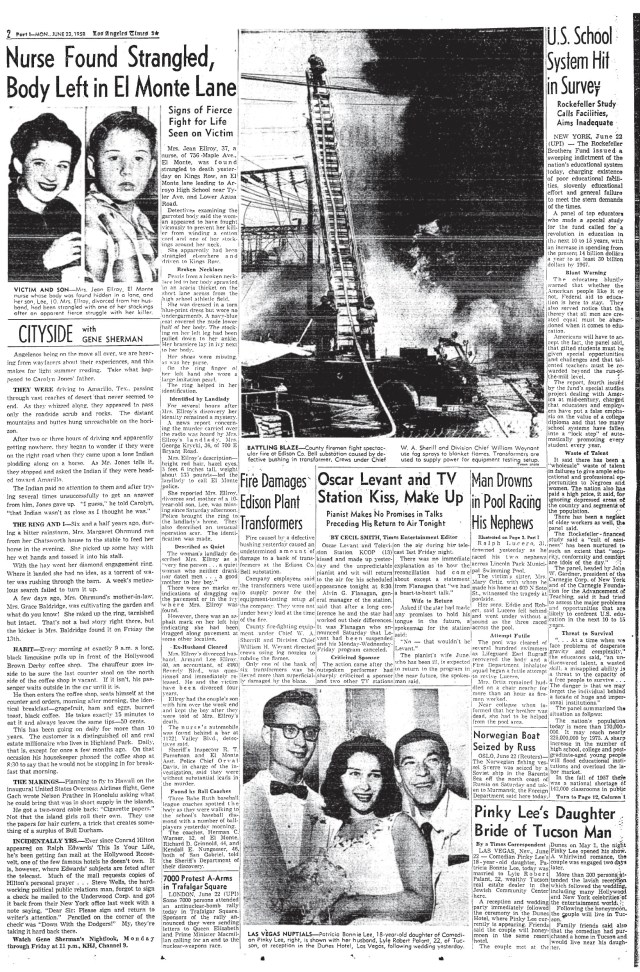
o much has already been written about the June 1958 murder of Geneva Hilliker Ellroy; there’s very little I can add to what my friend James Ellroy, above, hasn’t already said in interviews, first-person articles or in his 1996 book, “My Dark Places.”Most of the locations still exist. The businesses have changed along Santa Anita Avenue, but Arroyo High School is much the same. The last time I checked, there was still a restaurant at 11721 Valley Blvd., where her car was found after the killing.

Regular Daily Mirror readers will recall a series of strangulations in 1957, but I haven’t come across any in 1958 until now. The only prominent serial killer at large at the moment is Harvey Glatman, who has killed Judith Dull and Shirley Ann Bridgeford and will claim his next victim in July.


Photo from findagrave.com

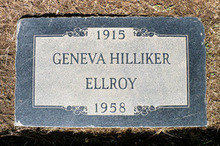
Geneva Hilliker Ellroy is buried in Inglewood Park Cemetery. Her grave is next to the chain-link fence along Avenue of the Champions. When you are at her grave you will be near an intersection with a stoplight almost directly across the street from a clinic. (Findagrave.com has the exact number if you want to save yourself the time of looking for it).

Here’s a noir twist for you: Most of the sections of Inglewood Park Cemetery are named for flowers. Geneva Ellroy is buried in the section west of the one named “Dahlia.”

Really.

Email me


Posted in books, Front Pages, Homicide | Tagged , , , , , , | 1 Comment

June 22, 1938

1938_0622_nuestro_pueblo

Posted in art and artists, books, Nuestro Pueblo | Comments Off on June 22, 1938

Found on EBay

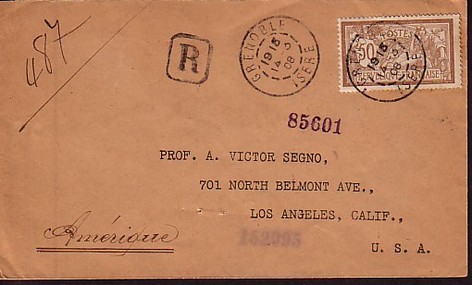
Why if it isn’t another another envelope sent to our old friend Prof. A. Victor “How to Have Beautiful Hair,”  “How to Be Happy Though Married” Segno. Alas, the money that was in this envelope was spent long ago. The envelope is being sold on EBay.   Hey wait! This envelope was already offered for sale in January!
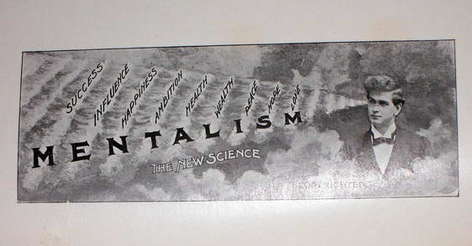
An artist’s conception of Prof. A. Victor Segno transmitting a “success wave.”

Posted in books | Tagged , , , | Comments Off on Found on EBay

June 21, 1938

1938_0621_ads

1938_0621_cover


1938_0621_runover


1938_0621_jews


Dropcap_o_1934 ne thing you have to say about Los Angeles Mayor Frank Shaw: He has a sense of humor.

Upon returning from Washington, where he spent the final days of the Earle Kynette trial, Shaw was given a list of written questions.

He was asked for "any comment he cared to make on the conviction of Acting Police Capt. Earle Kynette and Lt. Roy Allen; his position in reference to a resolution by Councilman Hyde asking the mayor, the chief of police and the Police Commission to resign; whether he intended to ask for a reorganization of the Police Department, particularly as to the intelligence squad; an investigation of the squad; will his brother, Joe Shaw, remain with the administration; the $90,000 secret service fund; Dist. Atty Fitts’ announcement that he is going after the ‘higher-ups’ in the Raymond bombing case; and other items."

Shaw said, in part: "Out of 18,000 city employees, three have been charged with crime and two of them have been found guilty. As a public official, sworn to uphold the Constitution of the United States and the charter of the city of Los Angeles, I was required to regard these men with the same presumption of innocence as the law grants to every other citizen….

"Councilman Hyde’s resolution calling for resignation of myself, the police commissioners and Chief Davis was clearly the gesture of a candidate for office who must use sensational means to get his name before the voters. The City Council refused to take it seriously. Upon the face of it, it is ridiculous."

Note: On Sept. 16, 1938, it won’t be so funny.

Email me


Posted in #courts, City Hall, Downtown, Film, Front Pages, Hollywood, LAPD | Tagged , , , , , , , | Comments Off on June 21, 1938

June 21, 1908

1908_0621_taft_phone


1908_0621_cover


Dropcap_r_1922
epublican William Taft gets the news that he has been nominated as the party’s presidential candidate. This sequence of photos must have seemed revolutionary for 1908. (And yes, this photo reminds me of one of my all-time favorite headlines: "Says Bad Words Into Phone"). 

Also note the story about fighting in Mexico between Yaqui Indians and U.S. and Mexican troops. Read about Yaqui Easter ceremonies here.

Email me


Posted in @news, Front Pages, Politics | Tagged , , , , | Comments Off on June 21, 1908

June 21, 1908


1908_0621_crocker

1908_0621_hotel


Angels_flight_nd

1908_0621_architecture


Dropcap_i_vadis_3 nteresting things from The Times Real Estate Section: The changing face of downtown Los Angeles (shout-out to my pals at onbunkerhill.org) and a proposed luxury hotel for Hollywood that I don't believe was built.

This postcard at left gives a better view of the observation tower and Angels Flight shown above in the 1908 photo of Bunker Hill. The building just to the left of the tower is the Crocker Mansion, which was demolished in 1908.

As for the hotel, it was the brainchild of Albert H. Beach, a promoter and developer who also had the notion of building a huge cotton mill in Los Angeles in 1909.  According to his 1936 obituary, Beach, 74, was a Canadian who came to Los Angeles in 1881 and was a playwright before he became a real estate developer. Hollywood's Beachwood Park was one of the 150 subdivisions he handled, The Times said.

Email me


Posted in 1908, Architecture, Downtown, Front Pages, Hollywood, Real Estate | Tagged , , , , , , | Comments Off on June 21, 1908