Immigration and labor notes

1957_0809_bracero

1957_bracerosAug. 9, 1957
Los Angeles

The Times ran a series of brief stories in 1957 on the braceros, workers brought from Mexico to the U.S.

In January, it noted that 460,000 to 470,000 braceros would be working in the U.S. in 1957, up from 432,618 in 1956.

Later that month, The Times said that in 1956, a record of 161,603 laborers were processed in the U.S. Foreign Labor Reception Center in the Imperial Valley. The center picked up the braceros in Mexico and allocated them to farms in  California, Oregon, Washington,  Arizona, Utah,  Nevada and Idaho. The previous record, set in 1955, was 119,659.

In fact, the U.S. was importing so much labor that Mexico began a public works program and an irrigation project to keep at least some of the men home, The Times said.

Of course there were problems, The Times noted. Atty. Gen. Pat Brown (the future governor) was fighting with the federal government to allow the braceros to bring their families, noting that the camps of single men were prone to prostitution and drugs. The U.S., however, said the families would add too much demand for housing, hospitalization and relief (i.e. welfare).

1957_bracero_recipes And there were other complications. The Imperial Valley farmers disliked the Labor Department's bureaucracy in handling the braceros and wanted the program transferred to the Department of Agriculture, which supervised it until World War II. One reason: The Labor Department had too much paperwork and moved slowly, threatening crops that had to be processed quickly. And, the farmers said, the Labor Department was too "industry minded."

Still, the braceros were working their way into American culture. In fact, The Times ran a page of "bracero recipes" made popular in the camps of Fullerton and urged Orange County housewives to try some of the spicy bracero dishes. (Yes, one calls for "Jap chiles.")

The Times said:

"The men in the Fullerton housing unit … are mainly fed their native diet because they cannot be expected to adjust to American foods and customs during their short-term contracts in this country. American foods are added, however, to improve the nutritional balance of each meal."

A year-end report noted that the number of braceros processed in El Centro declined slightly in 1957 to 159,000. U.S. officials said a crackdown on illegal immigration had spurred an increase in the bracero program, but that it had leveled off in 1957.

I do not intend to delve further into the topic of immigration and foreign labor (in fact, searching The Times for "braceros" reveals far too many stories about Gov. Ronald Reagan, Cesar Chavez and the UFW, with well-known bylines, for yours truly to go wading).

But I have to note that although The Times reports the nuts and bolts of the braceros, it deals only slightly with the need for the program:

"The braceros are brought into this country as temporary farm workers to fill labor needs that cannot be met with domestic workers."

Translation: Americans won't do these jobs.

What became of the bracero program? The law establishing the program expired in 1964.

Email me


Posted in 1957, Immigration | Tagged , , , , | Comments Off on Immigration and labor notes

Fashion notes

Aug. 8, 1957
Los Angeles

Los Angeles men: You’re slobs, surpassed only by your male counterparts in Houston and Fort Worth. You should let your wives pick out your clothes, or so says Francis DeWitt Pratt of the American Institute of Men’s and Boys’ Wear.

And this is in the day when the average corporate president in America owned 14.3 suits, 29 shirts, 30 pairs of socks, 10 pairs of shoes, four hats, 65 neckties, two overcoats, two topcoats, 1.5 raincoats, 3.9 sports coats, seven sets of cuff links and 5.8 pairs of pajamas.

Long before a battered baseball cap and a fanny pack were the height of men’s fashions.


1957_0808_fashion

Posted in Uncategorized | Tagged , , , , | Comments Off on Fashion notes

Confidential: Tells the Facts and Names the Names


1957_0808_confidential

1957_0808_ritzi
Aug. 8, 1957

Los Angeles

Prosecutors opened the case against Confidential and Whisper by
charging that the magazines used prostitutes to lure movies stars into
compromising situations and published the incidents in scandalous
articles. The magazines, Publishers Distributing Corp. and Hollywood
Research Inc. were charged with printing lewd, obscene materials and
advertising abortions and male rejuvenation.

The first order of business for Assistant Atty. Gen. Clarence Linn and
Deputy Dist. Atty. William L. Ritzi (who will be the judge in the Patty
Hearst case) is to show the close financial ties between the magazines
and Hollywood Research Inc., run by Fred and Marjorie Meade.

Noting that Marjorie Meade was the niece of Robert Harrison, the
publisher of Confidential and Whisper, Linn said: "Records will show
that they [the Meades] bought stories from people of the night life,
questionable characters, private detectives."

Linn added: "We will show that the printed material was lewd and
obscene, that it had a substantial tendency to corrupt and that an
attempt was made to impeach the honesty and integrity of living
persons. We will not attempt to turn this court into an animated
Confidential."

Defense attorney Arthur J. Crowley replied: "The evidence will show
that these stories are not innuendo but that the real stories behind
the articles are far worse than the stories that are printed."
Insisting that articles such as "Don’t Take Those Abortion Pills" were
a public service, Crowley said: "There was no intent here to crucify
any individual for one slip off the straight and narrow. There was
never any desire by Harrison or anyone else to injure anybody."

The American Civil Liberties Union, meanwhile, submitted a brief to the
U.S. Court of Appeals seeking to keep Atty. Gen. Pat Brown from barring
distribution of the scandal magazines during the trial.

Attorney A.L. Wirin said that although the ACLU had no sympathy with
Confidential or Whisper, "it does support the right of any publication
to be free of censorship" until the prosecution of the magazines was
finished, The Times said.

To be continued

Email me

Posted in #courts, Hollywood | Tagged , , , | 1 Comment

Hal Fishman–1970

Nov. 8, 1970, Los Angeles Times

1970_1108_fishman

Posted in Uncategorized | Tagged , , | Comments Off on Hal Fishman–1970

Oliver Hardy dies

The world mourns one of film’s greatest comedians, Oliver Hardy, who died in North Hollywood on Aug. 7, 1957. He was 65.

Part 1

1957_0807_hardy01

Part 2

1957_0807_hardy02

The Mirror, Page 1 (Note the price of gas, 23.9 cents a gallon, is $1.71 USD 2006)

1957_0807_mirror_hardy01

Page 2


1957_0807_mirror_hardy02

Posted in Film, Hollywood, San Fernando Valley | Tagged , , , , | Comments Off on Oliver Hardy dies

Countdown to Watts


1965_0812_watts

Aug. 5, 1957

Los Angeles

In eight years (the headline above is from The Times, Aug. 12, 1965), Los Angeles will explode in the Watts
riots and many people will wonder how it happened. Here’s part of the
answer. This article from the Mirror is so appalling that I’m running
it in its entirety. (And no, The Times didn’t even cover the problem).

Here are the highlights:

  • Of the 80 elementary school districts whose prospective teachers are referred by Los Angeles County, only six
    have black teachers: Willowbrook, Enterprise, Compton, Monrovia, Keppel
    Union and Soldedad. Some districts refuse to hire African Americans,
    others have defacto segregation because they are in white communities
    and hire local residents.
  • Of the 10 chartered cities in Los Angeles County that screen their own
    teachers, only four will hire blacks: Los Angeles, Long Beach, Santa
    Monica and Pasadena.

The reason, according to county school Supt. C.C. Trillingham: Timid school officials and an apathetic public.

Did I mention that there was a teacher shortage as schools prepared to
open for the fall? The Mirror said there were 300 unfilled positions
and roughly 150 black teachers who couldn’t get jobs (assuming that the figures were largely unchanged from 1956).

And L.A. couldn’t do the math.

1957_0805_negroes

Email me


Posted in Countdown to Watts | Tagged , , , , , | Comments Off on Countdown to Watts

Judy Dull update


1957_0807_dull_hed

Aug. 7, 1957
Los Angeles

Professional photographer David Sutton, 8426 1/2 W. 3rd, tells the Mirror that he spoke with missing model Judy Ann Dull an hour before she disappeared with a photographer calling himself Johnny Glinn (or Glynn).

Sutton said he had been subpoenaed by her husband's attorneys in their child custody case.

"Apparently her husband's lawyers had a notion that I had photographed her in the nude," Sutton said. "That is entirely wrong. Judy Ann was a high-type girl, absolutely straight. She was working to make enough money to keep her baby."

Dull made an appointment to pose for Sutton after she finished her modeling job with Glinn, but she never returned.

Sutton worked for such prominent magazines of the day as Life and Look, and photographed John Wayne many times over their 20-year professional relationship, according to an online biography.

Email me

Posted in 1957, Hollywood, Homicide, West Hollywood | Comments Off on Judy Dull update

Hiroshima 12 years later

Aug. 6, 1957
New York

1957_0807_hiroshima

I wish I could find the story that went with this picture, but I haven’t been successful so far. I’ll keep digging. There’s a wiki entry on Hubert Schiffer. 

Email me

Posted in Uncategorized | Tagged , , , | Comments Off on Hiroshima 12 years later

Songs of the week

The picks from KWFB-AM (980), Aug. 3, 1957.

I actually recognize most of these tunes; "Old Cape Cod" and "Gold Mine in the Sky" are new to me, but at least I’ve heard of Patti Page and  Pat Boone.  Alas I can’t find a clip of Helen Grayco doing "Black Coffee"–or anything else.  Anyone care to identify  "Happy Pierre in Hi-Fi?" 

1957_0805_kfwb

Email me

Posted in broadcasting, Music, Rock 'n' Roll | Tagged , , , | 4 Comments

Discord in Alhambra


1957_0805_hed

1957_0805_cars
Aug. 5, 1957

Alhambra

Robert D. Smallfield and his former wife, Wilma, have a novel
arrangement. Divorced after 17 years of marriage, Robert rents a room
from Wilma at their former home, 1222 S. Marengo, Alhambra, so that he can pay her monthly alimony of $60 ($429.92 USD 2006).

He has enough money to buy himself a new Chevrolet and, since he’s
single, has begun dating, sometimes bringing his dates over to dinner
with his ex-wife.

This does not go well.

And so Wilma Alice Smallfield, 44, gets behind the wheel of her 1949
Buick and vents her fury with her ex-husband, his girlfriend and his
new Chevrolet.

The fight begins at home when Wilma sees the girlfriend in Robert’s new Chevy.

"She rammed the car on
Valley Boulevard at Westminster Avenue and Smallfield sped away," The
Times said. "But she caught him again, with another blow, on Valley
Boulevard at Charnwood Avenue. At the Lillyvale Avenue intersection,
she scored the third time.

"Smallfield felt his chances of
escape would be better in the hilly section of town, so he took off for
the highlands. He lost her, too. He waited a while then sneaked back
onto Valley Boulevard. But there she was, waiting in ambush at the
Borland Rose crossing, and the duel began again with another smashup.


"In desperation, Smallfield ducked behind a warehouse at 5359 Valley Blvd., where he works, and this was the final battle scene, where the husband’s car was battered at least five more times. 

1957_0805_wilma"As Smallfield got out of his car, he said, his wife tried to pin him between his car and the building. 

"Mrs. Smallfield got out of her car, brandishing a 2×4 club, but Smallfield outran her after tearing out the wiring of her car."


During her arrest and in jail, Wilma insists she meant Robert no
harm: "I didn’t want to kill him. You can’t understand how much I love
him. I just wanted to scare him."

And that’s it for the "Hey, Martha!" story in The Times. So let’s keep
digging. Wilma was given a one-year suspended sentence and a $250 fine.

But Robert wasn’t at liberty terribly long. He died July 2, 1963, at
the age of 48. Wilma lived to be 60, dying in 1973. She apparently
never remarried. None of the stories mention any children.

And what became of the girlfriend? The Times is curiously silent on the matter.

Email me

Posted in #courts | Tagged , , , , , | Comments Off on Discord in Alhambra

Mickey Cohen–author

1957_0804_cohen

1958_cohen_sep_01
Aug. 4, 1957


Oceanside

Box 7, Folders 216-229 of the Ben Hecht
archives at the Newberry Library in Chicago appear to contain whatever
was produced during the time Hecht worked with gangster Mickey Cohen on the
story of the mobster’s life.

"It might be the basis for a top book," Hecht said. "It’s exciting, unusual, frank and startling."

The
men began work in 1956 on a film to be produced by United Artists under
the title "The Mickey Cohen Story" or "The Poison Has Left Me,"
according to The Times, which noted that Hecht was working on "A Farewell to Arms" and had obligations to write two pictures for British film companies. 

By the summer of 1957, Cohen had produced a 150-page manuscript that he showed to Hecht, who was staying in Oceanside.

Noting that Cohen had apparently dictated the manuscript, Hecht said: "He must
have done it himself. No one but Mickey uses words that way. It’s a
goldmine of facts–I haven’t seen so many facts since I was a newspaper
reporter. It has Mickey’s indelible stamp."

Hecht dismissed any
speculation on the project, saying: "Mickey brought it to me and asked
me to read it and tell him what I thought of it. I don’t know of any
plans he may have for it."

In truth, Hecht and Cohen worked on
the manuscript with some diligence. "I spent four days in Oceanside
with him and we got a lot done," Cohen said. There were so many
interruptions that Hecht suggested the two of them retreat to his villa
in Rome, but the federal government took a dim view of the former
mobster going to Italy, home of Lucky Luciano, Joe Adonis and other
deported gangsters.

"They seem to think maybe I’m going over there for something other than the reason I’m really going," Cohen said.

In
January 1958, Cohen went to Chicago to work with Hecht on the book.
Earlier that day, Cohen allegedly roughed up a waiter who spilled coffee
on him during an early morning gathering at the Villa Capri, 6735 Yucca St.,
as Frank Sinatra, Robert Mitchum and several others were celebrating
Sammy Davis Jr.’s opening appearance at the Moulin Rouge.

The
next month, Cohen said he had given up his flower shop to spend all of
his time with Hecht writing the movie version of his life.

The book was nearly finished by March and was
due out in the fall of 1958, at least according to Cohen. "It’ll knock
the blocks off people," Cohen said as he left Los Angeles for Los Cocos
Hotel in La Paz,  Mexico, to spend a week with Hecht on the project.

George
Bieber, Cohen’s attorney, said a studio had offered $200,000
($1,433,056.75 USD 2006) and 80% of the profits but that Cohen wanted
$200,000 and 20% of the gross. Bieber also said the book would bring
Cohen about $500,000 to $750,000 and that 50,000 copies had already
been ordered.

And then everything went off the rails, as happens so often in Hollywood.

In
September 1958, the Saturday Evening Post began a four-part series
titled "Mickey Cohen: The Private Life of a Hood" by freelance writer
Dean Jennings. In October 1958, Cohen sued Curtis Publishing, the
parent company of the Saturday Evening Post, saying that the series
ruined any possibility of publishing his book, but he dropped the suit
in December 1958.

It’s clear from testimony in Cohen’s 1961
tax evasion trial that he was selling interest in the book. Nightclub
owner Bernard "Happy" Koomer said he gave Cohen $15,000 in May 1957 for
a 10% share. Koomer testified that he stopped payment on several checks
and that when he met Cohen, the gangster tore up the checks, threw the
pieces in Koomer’s face and seized a diamond ring given to Koomer as
security. It is interesting to speculate that the book may have been far more
profitable if it remained unpublished–rather like "The Producers."

Apparently whatever remains of the Cohen project is in the 94 cubic feet of
material in the Hecht archives in Chicago. There’s a good dissertation
in there for some historian, I guarantee you.

Email me

Posted in #courts, art and artists, books, Film, LAPD, Mickey Cohen, Nightclubs | Tagged , , | 1 Comment

Literary diversions

I.A.L. Diamond, Nov. 6, 1966

1966_1106_diamond_3

Posted in Film, Hollywood | Tagged , , | Comments Off on Literary diversions

Never returned

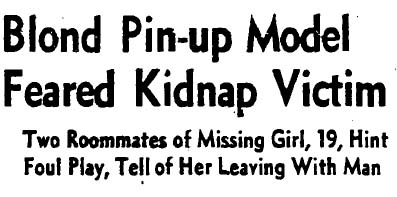
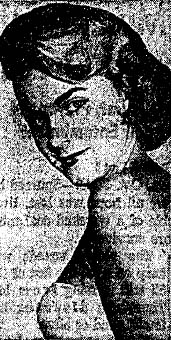
I found this in the archives. Poor thing, only 19. She never got to see her daughter grow up.

Judith Ann Dull June 23, 1938-Aug. 1, 1957


1957_judy_dull_latimesc


1957_judy_dull_latimesb

Posted in #courts, Homicide, West Hollywood | Tagged , , , , | Comments Off on Never returned

Photo shoot

Aug. 3, 1957
Los Angeles

In June 1957, about the time she turned 19, Judy, at right, met Betty at a Hollywood photographer’s studio. They were both young and hoping for modeling careers, so Betty, 19, asked Judy to move into the apartment at 1302 N. Sweetzer Ave., which she shared with a third aspiring model, Lynn, 22.

In late July, Judy complained to her roommates that she felt she was being followed, but assumed it had to do with legal action brought by her estranged husband, Robert, over custody of their 1-year-old daughter, Susan.

She filed for divorce June 7 and was awarded custody of the girl, but Robert took Susan back three weeks later. He said Judy “kept the baby’s home and person ‘in a filthy state’ ” and neglected the girl “to associate with other men.” A custody hearing was scheduled for Aug. 9 and Judy was hoping to find a job to show that she was a good mother.

“Judy was not the Hollywood type at all,” Betty said. “She and I were like sisters. She was  going to get a job in a dime store to prove she was worthy of her child.”

Judith Ann (Vanhorn) Dull never made that custody hearing. On the afternoon of July 29, 1957, a photographer named Johnny Glinn came to the apartment and asked for Lynn. She wasn’t home, but Glinn noticed some of Judy’s pictures and asked about hiring her instead. Glinn made an appointment to pick up Judy at 2 p.m. on Aug. 1, 1957, offering to
pay $40 ($286.61 USD 2006) for two hours of modeling.

Betty thought Glinn was creepy for following Judy around the apartment the day they left on the photo shoot. “I knew there was something odd about the man,” she said. “He said he wanted to shoot pinup pictures. Yet he told her to bring a selection of street outfits, which she did.”

She became worried when Judy didn’t return and called Glinn’s phone number, and was even more concerned when it turned out to be a machine shop (he actually lived at 5924 Melrose). The next day, she reported Judy’s disappearance to deputies at the West Hollywood sheriff’s station.

But by then Judy was dead and buried in a shallow grave 4 1/2 miles west of Indio, 100 feet off Highway 60/70. Glinn eventually took detectives to the site. His real name: Harvey Murray Glatman.

To be continued.

Email me

Posted in Homicide, West Hollywood | Tagged , , , | 3 Comments

Preservation notes

Bukowski_apts
Kim Cooper and Richard Schave, my friends at the 1947project, note that the apartments at 5124 De Longpre Ave in Hollywood where Charles Bukowski produced "Post Office" is on Craigslist:

Approximately a 12,500 square foot lot – currently holds a completely
vacant apartment building (bungalow style). It is a REAL INVESTMENT,
perfect for builders, investors, contractors, etc. You can easily tear
down the old building and do new construction! This is a rare-find in a
high-demand area; Hollywood – close to restaurants, studios, shopping
centers, etc. The dimensions of the lot are 53 ft by 230 ft.

Kim says: "L.A. sure knows how to take care of its literary landmarks!"
Photograph courtesy of Richard Schave, Esotouric

Posted in art and artists, books, Hollywood | Tagged , , | Comments Off on Preservation notes

‘I Hate Cops!’

Aug. 2, 1957
Los Angeles

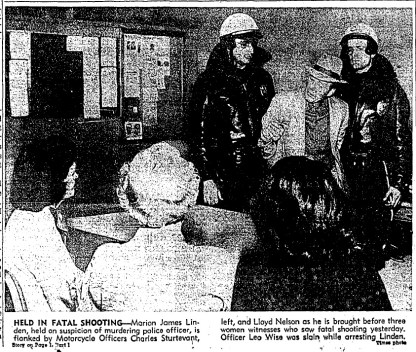
It was St. Patrick’s Day, 1957, and a few customers got rowdy in a bar
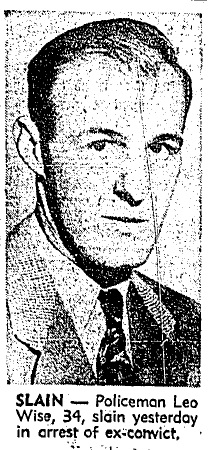
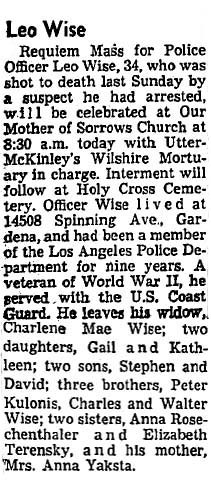
at Pico Boulevard and Figueroa Street. Police Officer Leo Wise
separated a couple of men who were fighting and ordered them to leave.
But instead of going home, Marion James Linden, 43, went to his car and
got a gun.

Wise saw Linden lingering outside and tried to arrest him. Instead, Linden shot him to death.

In his last moments, Wise struggled to get to the police call box. Angel Gutierrez Sahaguez and three others ran to help Wise, but he told
them to follow Linden’s car. Wise’s dying words: “Take the number of those plates and call police!”

The men followed the killer and flagged down motorcycle Officers Charles Sturtevant and Lloyd Nelson, who arrested Linden at 11th Street and Alvarado.

“I hate cops!” Linden yelled. “I shot one of them and I hope he’s dead and wish I’d got some more.”
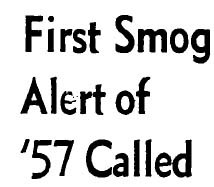
When newsmen saw Linden the next day, he had a bandage over one eye and there were marks on his face, The Times said. Detective Sgts. Vance Brasher and Pat Murphy “explained that he threw a ‘whing-ding’ Sunday in the police homicide office and struck his face on a desk,” The Times  said.

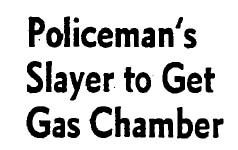
On Aug. 1, 1957, Linden was sentenced to death in the gas chamber. He filed several appeals, including charges that a “fraudulent tape
recording of a confession” was used in his trial. A judge postponed
Linden’s execution in 1959 and the U.S. Court of Appeals granted him another stay of execution in 1960.

But on July 12, 1961, Marion James Linden, who had served eight years in Colorado for killing his wife, was executed in the gas chamber at
San Quentin. It took him six minutes to die, The Times said.

Leo Wise, 34, left a widow, two sons and two daughters, ages 2 to 9. He joined the police force Jan. 5, 1948.

Email me

Posted in #courts, Downtown, Homicide, LAPD | Tagged , , , , | Comments Off on ‘I Hate Cops!’

Countdown to Watts

Aug. 1-7, 1957
Los Angeles

A search through The Times for early August reveals several stories
about Chief William H. Parker being honored for 30 years service with
the Los Angeles Police Department. In a luncheon at the Biltmore
Bowl hosted by actor George Murphy, 800 business and community leaders
paid tribute to Parker.

There was also a story about the California Supreme Court reversing a
decision that upheld Parker’s use of listening devices in surveillance.
“It is elementary that public officials must themselves obey the law,”
the Supreme Court said.

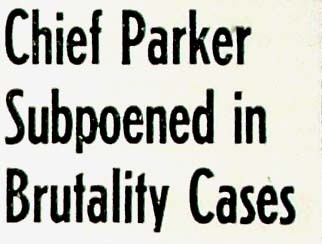
But oddly enough, there is not a word about the NAACP brutality suits against Parker and the Police Department.

We must turn to the California Eagle, a weekly serving the African
American community, for news that Parker had been subpoenaed in the
case. The Eagle noted that the class-action suits seeking $500,000 in
damages had been given “the ‘blackout’ treatment” by the daily press,
radio and TV. The NAACP was weighing whether to buy air time on radio
stations to publicize the case, the Eagle said.

Attorney George L. Vaughn Jr., head of the local NAACP’s Legal Redress Committee, added two more plaintiffs, for a total of 10, the Eagle said.

According to the Eagle, two hod carriers, Thomas Jefferson, 22, 2180 E.
101st St.
, and Joe Thompson, 24, 4051 S. Halldale, were arrested April
28 during what was apparently a traffic stop.

“When they complained
about the handcuffs being too tight, they state that Officers Graham
and Dent of the 77th Street police station began beating them with
their nightsticks, insulting them with obscene epithets and telling
them that ‘We’re going to show you how we treat niggers in Louisiana!’
” the Eagle said.

When Jefferson and Thompson asked to see a sergeant at the 77th Street
station, they were beaten again, charged with grand theft, held
overnight and released, the Eagle said.


The white media’s conspiracy of silence continued
.

Interesting note: According to the State Bar of California, George Louis Vaughn Jr.
graduated from Lincoln University in Jefferson City, Mo., and
Washington University Law School in St. Louis, Mo. He was admitted to
the bar in 1955 and suspended in 1960. He received public reprovals in
1970, 1972, 1973 and 1980. He was disbarred in 1985.

In 1970, he was apparently appointed as a lawyer for attorney Paul
Fitzgerald, who was representing Patricia Krenwinkel in the Manson
family trial.

Email me

Posted in #courts, Countdown to Watts, LAPD | Tagged , , , , , | Comments Off on Countdown to Watts

Spanish blood

Aug. 1, 1957
Los Angeles

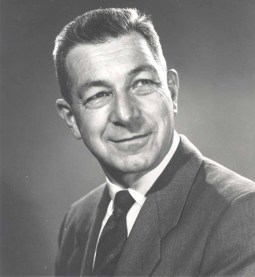
Maybe it’s heat, maybe it’s the smog (what would be a Stage 3 alert today), but The Times is full of odd crime news.
A rabid 2-year-old fox terrier mix went on a rampage starting at Wilshire Boulevard and Western Avenue, biting five people before a police officer shot it to death.

Stanley Papin, 49, a painter living at 9620 Anza Ave., Inglewood, followed the dog after being bitten on his right hand until Officer
George Audet killed the animal.

Papin and four others were treated for dog bites at Central Receiving Hospital, including Ray Ratliff, 18, who left before being told that the dog was rabid so he didn’t know he would need to undergo the Pasteur treatment.

Ratliff began hitchhiking to Sacramento, but returned to San Pedro after being  picked up by a driver, a Good Samaritan who told him he should return to Los Angeles for treatment.

Speaking of Good Samaritans, three people were in custody after 11-year-old Wayne Halford, a Times paperboy living at 3425 Military Ave., noticed them burglarizing a house and drew a picture of their
car–including the license number: HCW 864. Police arrested Keith Nelson, 19; Johnny Godinez, 22; and Barbara A. Pope, 18, and recovered $2,000 in stolen jewelry.

Market owner Paul Gertz was not so fortunate during a holdup of his store at 436 S. Atlantic. Gertz told police that four customers were so distracted by a gorgeous woman shopping at the store that they didn’t notice the robbery and couldn’t provide descriptions to police.

Bonus fact: The first rabies case in California was reported in Los Angeles in 1898.

Email me

Posted in #East L.A., Environment, LAPD, Robberies | Tagged , , , , | Comments Off on Spanish blood

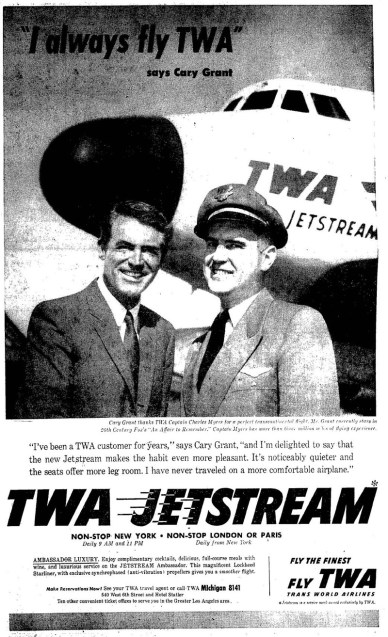
Matt Weinstock

July 31, 1957

The whole thing started many months ago when Sparks Stringer poured out
his chagrin here at being unable to find any farkleberries in L.A. He
had in mind whipping up a farkleberry pie like his mother used to make
down South.

Clearly there’s something unlikely and contagious about the word
farkleberry. Publicist Joe Weston was so enchanted by it he named his
frisky Siamese cat Farkleberry. Others thought it was a gag. It isn’t.
A farkleberry, I’m told, is somewhere between a huckleberry and a
gooseberry.

Comes now a letter from Capt. M.R. Flehinger, who used to sell the
Daily News at Beverly Boulevard and Normandie and is now with the Air
Force in Japan.

“After asking in vain for farkleberry pie in Hong Kong, Bangkok and
most of the larger cities in Japan,” he writes, “I though I’d scored in
a Tokyo restaurant. But it was only the accommodating manager and the
language barrier working against me. What I got was a plain berry pie,
I think. Of course, it might have been farkleberry but how can you be
sure?”


The search goes on.

ALTHOUGH Mrs.
Alex Mayer of North Hollywood has been making regular purchases on her
charge account at a department store, she has received no bill for
three months. The other day, she phoned the store and inquired about
it.

A girl looked up the account and reported, “The reason you haven’t
received a bill is that you moved and the mail we sent to your new
address has been coming back.”

Mrs. Mayer, puzzled, said they hadn’t moved, they still lived on Bonfield Street.

“Well,” said the girl, “on the last payment we had from you your
address was a post office box–PO 50042–and our statements have been
returned from there.”

So Mrs. Mayer explained that PO 5-0042 is her telephone number–PO as
in POplar. And now, lucky girl, she will be able to pay her bill.*

Oh, I can tell you, life can be complicated.

AROUND TOWN–As an added fillip to its lavish party for the movie “Omar Khayyam,”
Paramount operatives scoured the city’s tobacconists for Omar
cigarettes. Mostly the tobacco boys said they hadn’t seen any in 25
years. But guess where the Paramounters found an unlimited
supply–Rexall’s.

* In the dark ages, phone numbers had a two-letter prefix. Common ones
in Los Angeles were AT lantic, AX minster, CI trus, HO llywood, MA
dison, OX ford, RI chmond, etc.–lrh

Posted in Columnists, Film, Food and Drink, Matt Weinstock | Tagged , , , , , | Comments Off on Matt Weinstock

Women attacked

July 31, 1957
Los Angeles

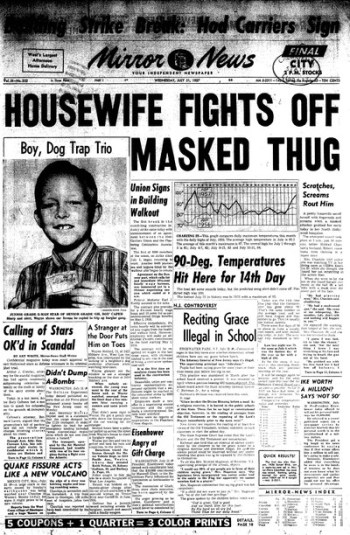
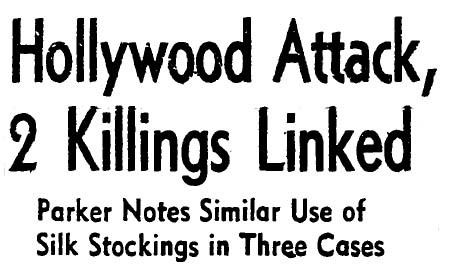
In the continuing assaults across the city, a North Hollywood housewife fought off an intruder while a 60-year-old Hollywood woman was saved from strangling by the staff of her Hollywood apartment building after she was grabbed from behind in the hallway, gagged and raped.

Mildred Chastain, 40, 11228 1/2 Emelita St.,
said she was watching TV about 1 a.m. on July 31, 1957, as she waited for her husband, Robert, to get home from his job at a liquor store. She heard scratching at the screen door and thought it was the cat trying to get in. Chastain opened the door and a masked gunman barged into the house.

“I guess I was foolish to take the chance, but the next thing I knew I was scratching at his face and trying to knock the gun out of his
hand,” she said. “He grabbed me with his free hand but I had him off
balance. I knocked him against the washing machine. Then I screamed
like crazy.”

According to the Mirror, 30 LAPD officers joined by six officers from
the Burbank Police Department made a house-to-house search for the
attacker, who had been prowling the neighborhood for two months.

In Hollywood, an unidentified woman told police she was going into her 12th-floor apartment at 1811 N. Whitley on the afternoon of July 30 when she was grabbed from behind. She said she
never got a look at the rapist who blindfolded her, tied her wrists with a silk stocking and gagged her.

Although she was tied up, the woman knocked the receiver off her telephone to summon help. The desk clerk and the janitor found her nearly dead from “a knotted garment in her mouth,” The Times said.

Police Chief William H. Parker said the Hollywood attack was like the stranglings of Marjorie Hipperson and Ruth Goldsmith.

To be continued.

In the meantime, read more about 1811 N. Whitley. Search for Oct. 12, 1947, entry at the 1947project.

Email me

Posted in Hollywood, Hollywood Division, Homicide, LAPD, San Fernando Valley | 1 Comment