
Aug. 17, 1957
Los Angeles
The "five swaggering gang members" who were arrested in the killing of John Edwards were released after being cleared by two witnesses. The slaying was never solved.

Aug. 17, 1957
Los Angeles
The "five swaggering gang members" who were arrested in the killing of John Edwards were released after being cleared by two witnesses. The slaying was never solved.
Leonard Feather on Max Roach, Jan. 6, 1977


Aug. 16, 1957
Santa Monica
We will never know what really happened on the night ad executive Guy F. Roberts was shot to death in a Santa Monica motel room because everyone involved was lying to cover
up the truth and–except for the detectives who coerced a phony
confession–wildly drunk.
The newspapers finally published an
account that was fairly factual, but only years after a young man was
wrongly convicted in the killing. I would like to think that at least
some good came out of all the injustice.
The main characters are:

Here’s what happened: Although she has been living
with Roberts for two weeks and plans to marry him, Nina and Charles
conclude an evening of bar-hopping by going to the cocktail lounge
where William plays the piano, having left Roberts asleep in the motel
room.
Charles and William argue and Charles leaves in Roberts’ car. When
William finishes his set at 12:30 a.m., he and Nina go to his home and
have more drinks. Nina finally leaves by taxi but stops along the way to have another drink.
About
2 a.m. she finally returns to the motel room and gets some money off
the top of the dresser to pay the cabdriver. She comes back, sits down
on the bed and only then notices that the room
has been ransacked, that there’s blood everywhere and that Roberts has
been
killed with a shotgun blast that tore away the left side of his
face.
"Men’s
and women’s clothing was strewn about the room," the Mirror said.
"Bureau drawers were opened and their contents scattered, indicating
that they had been ransacked. Blood was spattered about the room. A
trail of it led to the bathroom where an attempt had been made by the
murderer to clean up. Tooth powder was spilled on the floor and wash
basin.""Detectives
said there was ‘considerable evidence’ of a drinking party. Beer cans
and a whiskey bottle and glasses were found in the rubbish can and
sink."
Santa
Monica police obtained a confession from Charles by warning him that if
he didn’t admit killing Roberts, they would charge his mother.
"I went back to the motel and had a couple more drinks," Charles said
in confessing to the crime. "Roberts was still sleeping. The next thing
I knew I went out to get a shotgun from the car. Then all I can
remember is I saw blood on Roberts. I don’t actually remember any
shooting, but it must have been me.
"I respected Roberts more than my real father. Roberts and I were the
best of friends and I was all for his marrying my mother. The reason I
went with my mother was to protect her from Miles. He had broken her
nose once and I didn’t know what he would do when she told him she was
going to marry Roberts."
According to Santa Monica Police Detective Ward Bell, Charles said: "I don’t know why I did it. I was very fond of him."
According to Santa Monica Police Detective Robert Holborow, Charles
said: "I don’t understand why I killed him. It should have been
[William] Miles."
Because it doesn’t make much sense for anybody to kill someone they
respect rather than someone they dislike, Nina offered incriminating
testimony about her son:
According to Nina, Charles said: "Gee, mom, I’m sorry. I don’t know why
I did it." She also told reporters: "It all adds up. I know who did it.
But I can’t say. I think Sonny [her son] had something to do with it.
He’s all fouled up."

Charles’ father was granted permission to come to Los Angeles to handle
his son’s defense. After two days of arguments, the judge had ruled
that Charles’ coerced confession was inadmissible, but even so,
Detective Holborow testified that during a police interrogation,
Charles had admitted killing Roberts. The judge declared a mistrial.
In his second trial, Charles said he left the bar after arguing with
William because he was upset with his mother for continuing to see her
old boyfriend while she planned to marry Roberts.
"She would write on the mirror at Mr. Miles’ house, ‘I love you’ and
then she’d go up to Mr. Roberts’ place and write the same thing on the
mirror. It was a mess," Charles testified. William had repeatedly
rambled on about "teaching Roberts a lesson," Charles said, adding that
William claimed Roberts had also "tried to steal one of his former
wives."
Jurors found Charles guilty of involuntary manslaughter in December
1957. While conceding that his son would probably serve prison time,
Charles Guy Jr. said he hoped to gain custody of his son upon his
release and planned to take him back to North Carolina.
"That’s fine with me, Dad," Charles said. "That’s the day I’ll be looking forward to."
Although she was the main witness for the prosecution, Nina did not
attend the reading of the verdict against her son. She told reporters:
"I’m heartbroken. I know Sonny is guilty but I know he wasn’t in his
right mind. I don’t blame Sonny for what he said [about her] during the
trial. I know he had to do it."
In 1963, Paul Coates wrote about what Nina told him as he was covering the trials:
Before the case went to court, she told me a curious, rather chilling thing.
"I’d like to help my son," she said, "But I can’t do it. I don’t dare."
I asked her what she meant.
"After it happened," she explained,
"I talked to my family in North Carolina. I was warned that if the
family name was dragged into the trial, I’d have my conscience to live
with for the rest of my life."I’m too afraid of my father to cross him," Mrs. Miles added. "Even if it would help my own son. It’s always been that way."
 Coates also quoted a letter Charles had received from his father:
"God willing, you someday
will come home here. People will welcome you and you can make the kind
of name that when you marry will be carried proudly by your children,
just as I am proud that you carry my name. I will never be ashamed that
you are my son and that I named you after myself and your grandfather.
He said you would come back someday to the people who really love you.
And believe me, you will."
While he was being held at Vacaville, Charles recorded some songs. They
were released by Capitol Records on the album "The Prisoner’s Dream."
Time magazine said he had the power "of a young, white Leadbelly."
Charles was released from prison in 1963 and returned to North Carolina. Aside from a single, he apparently never made any more recordings.
Long out of print, reissues of "The Prisoner’s Dream" are available from
specialty houses.
Nina C. Miles, who attempted suicide in 1958, died May 2, 1977, at the age of 57.
The family name was presumably protected to her father’s satisfaction.
Another story not appearing in the Los Angeles Times…..
The California Eagle, Aug. 15, 1957


Aug. 15, 1957
Los Angeles
Here’s your case:
 John Emmett Edwards,* 17, 243 E. 137th St., is on a double date at the
Roadium, a drive-in theater at 2500 Redondo Beach Blvd., Torrance, with his girlfriend, Frances Clemens**, 16; her brother, Leo, 22; and his
date, Frances Hill, 20.
Edwards excuses himself to go to the restroom. They never see him again.
Hazel Lizon, 20, says: “I was telephoning from a booth near the restroom entrance when I saw four or five men try to pick a fight with a young boy. He tried to get away, but one of the men knocked him down. Then they went in the restroom and a minute later the Edwards boy went in. I could hear a terrific fight going on in there. Then the men ran out and within two minutes the Edwards boy came out, bent over and groaning.
“I said to him: ‘Why don’t you call the cops?’ but he just groaned, took two steps and fell face down.”
Los Angeles Times, Oct. 27, 1950

Fuel efficiency in the 1950s.


I’m always interested in what working women–in this case a group of
women writers–have to say about other working women. I wasn’t
surprised to find some attitudes that are outmoded today and I’ll try
not to judge the stories or the writers too harshly. But to discover a
working woman staunchly preaching against other working women, that was
a surprise, especially under the guise of reporting.

The first story, by longtime staff writer Dorothy Townsend, stands
by itself and reports on a luncheon speech at the Ambassador Hotel by
Dr. Horace B. Cates of Good Samaritan Hospital examining the health
issues of working women.
The second two, which were paired in
the feeble hope that they would make more sense that way, also deal
with the future of working women.
Norma H. Goodhue,
The Times women’s club editor for many years, focuses mainly on older
workers and tacks on women as an afterthought. This is, after all, the
women’s pages. Although the subject belongs on Page 1, that day is long
in the future.
The final story, by Anne Norman, is about the
most important subject–the future of women in the workplace–but editorializes
so heavily against working women that I am shocked it was written by a
woman.
We can quickly dispense with the luncheon speech. The
Times says: "Married or single, the modern businesswoman often finds
herself playing a dual role in society: career girl-housekeeper. She’s
a lot more likely to spend Saturdays cleaning the house or apartment
than the male is." (Plus ca change, etc.).
In brief, because of
the stresses facing them, working women "are apt to fall into a chronic
physical and emotional fatigue, suffer insomnia, muscle spasms,
tension, loss of or increased appetite, headaches, temper tantrums–any
or all of these."
Why aren’t women keeling over at an early
age, like men? The Times says, "Thousands of years of childbearing has
produced in women ‘built-in reserves,’ physical and emotional. ‘For
example, women can take insults that men couldn’t take.’ "
The
story (Part 1, Part 2) about older workers is interesting mostly because it doesn’t
present the now customary view of baby boomers. In 1957, the fear was
that the Depression-era "baby bust" generation (the U.S. birth rate
declined in the late 1920s and early 1930s) was joining the prime
employment group ages 24 to 44, and would have to support baby boomers
(ages 5 to 15 born after World War II) as well as older workers being
forced to retire at the age of 65.
"The economics picture: A
small working force will be supporting the very young and the very old;
either give the older worker a chance to produce or expect demands for
more considerations in the form of pensions and relief–which spells
taxes," The Times says.
And finally, the shock in coverage of a national study titled
"Womanpower," prepared by the National Manpower Council with the
philosophy: "Women constitute not only an essential but also a
distinctive part of our manpower resources. They are essential because
without their presence in the labor force we could neither produce and
distribute the goods nor provide the educational, health and other
social services which characterize American society."
Rather than any further reporting, the article (Part 1, Part 2) quickly becomes a
critique of the 400-page study. Now keep in mind that this was written
by a woman–and a working woman at that:
"But the council, with the
exception of one or two fleeing mentions, seems to be unaware that as
more and more women leave their homes to enter the labor force, more
and more children are going to be deprived of the only truly adequate
care available to them, their mothers."

(My caption: Above,
young inmates languish at a Los Angeles day-care center, callously abandoned by their
irresponsible working mothers instead of being at home, where they could improve their minds by watching
TV shows like "Mighty Mouse," "Queen for a Day" and "The Edge of Night," ensuring that the U.S. doesn’t lose the space race to
the Soviets).
But wait, it gets much worse. After conceding that some women, such as
divorcees and widows, have to work, the story faults working wives:
"The council says that
these mothers go to work because of ‘the desire for a higher standard
of living in a culture which encourages ever-rising consumption and
material well-being.‘"That’s a polite way of saying that
the mothers of today put the latest appliances, modern homes and
fin-tailed automobiles ahead of their children’s welfare."
–snip–
"It means that as mothers leave their homes to earn money to maintain
that ‘higher standard of living’ now considered so necessary, more
places will be needed in which to dump the children they leave behind
them."
Imagine my surprise to encounter this attitude elsewhere in The Times’
coverage of working women in 1957. A story by Times veteran writer
Evelyn De Wolfe says that American working women "are primarily
concerned with meeting the ‘cost of high living rather than the high
cost of living.’ "
I will leave further exploration of these stories to someone working on a dissertation in women’s history. There’s lots of fertile material.
Here’s a final quote from the "Womanpower" story:
"Uncle Sam seems to be the
only one who is insisting that the child’s welfare is more important
than an augmented family income. Women in the armed services are
permitted to marry but they are given a general discharge as soon as it
is discovered they are pregnant."
Bonus fact: The Times did away with its Women of the Year awards in 1977, deciding that "a women-only awards program [is] unnecessary in today’s world."
Aug. 15, 1957
Los Angeles

Twenty-five years ago, Jack Pearson shot his 7-year-old brother.
It was an accident.
But Jack, then 16, panicked and ran away.
He thought, apparently, that his brother would die.
Yesterday, I detailed the events which led up to the shooting, the
shooting itself, and Jack’s disappearance a few hours afterward.
The accident occurred on their father’s farm in Central Canada. After
the younger brother was bundled onto a sleigh by his parents for the
nine-mile trip to a doctor, Jack stood in silence at the door of the
farmhouse, awaiting their return.
Then, without speaking to his other brothers and sisters, he walked out into a growing blizzard and disappeared.
I talked this week with the victim of the accident–Walter Pearson.
He’s 32 now. He arrived in Southern California a few months ago with
his wife and two children. He had been shot in the mouth, but no scar
remains.
The lasting scar, he fears, may have remained with his brother.
Plenty of confused 16-year-old kids have tried to meet the world with a
bundle on the end of a broomstick–but few carried the extra burden of
guilt which Jack took along.

And that’s what bothers Walter most.
"I guess, to this day, he thinks I’m dead," he told me.
"And that he was the one who killed me."
How such a belief might have twisted Jack down a wrong path was pretty obvious to both of us.
"The whole family was aware of it," he said. Then quietly, he added:
"We’ve tried very, very hard, to find him."
The search, Walter told me, was started by the youth’s parents when they returned from Grandview the day after the shooting.
"They went back to town immediately, and checked all the farms along the way."
They asked and received assistance from the Red Cross, the Salvation Army and the police.
There were theories (the main one being that Jack hopped a freight to Winnipeg, 250 miles distant) but that was all.
Walter’s personal theory was–and still is–that his brother went to sea.
"It’s been a lot of years, but I can still remember how enthused he used to be with the little boats he’d carve for me."
The theory, however, was almost exploded a year ago–by a set of startling coincidences
Or maybe they weren’t coincidences.
Jim, another of the eight grown Pearson children, wrote Walter about them.
In his letter, Jim–9 years old when Jack disappeared–related that he
was watching television one night when a vaguely familiar face came on
camera.
The man was being interviewed.
He said his name was Joe. He said he came from a large family. And he
said that years ago, as a boy, he had run away from home. When asked
where, he replied:
"From a farm in Central Canada."
He was one of several men interviewed, and that’s about all he said.
The man conducting the interviews was a Vancouver (British Columbia) minister.
And the interviewees were the floaters and bums of that city’s Skid Row.
Aug. 13, 1957
Los Angeles
Swedish massages, photo models (they even provide the camera) and lots of lonely people. Take a look at the Daily Mirror’s personals (click on the image for the full listings):


 Aug. 4-12, 1957
Mooresville, N.C.
A reporter and a photographer from a small
North Carolina weekly were hacking their way through the woods along the Catawba River for a story about a hydroelectric project when they
came to a clearing and saw her. In that moment, Dorothy Brown’s life was changed forever.
Writer Tom McKnight and photographer Fletcher Davis of the Mooresville Tribune
found the 16-year-old drawing water from a well outside her family’s two-room cabin.* She was barefoot, wearing a cotton shirt tied at the
waist and her father’s cutoff jeans.
“She is tall and lithe and willowy and very beautiful,” McKnight wrote. He called her a
“statuesque young girl carved from the classical pattern of a Greekgoddess…. Her hair is deep brown like the rich earth and her eyes blue like the sea and her teeth are even and shine in the sun.”
The third of nine children, Dorothy had dropped out after seventh grade to help take care of her younger brothers and sisters, and because she had no clothes to wear to school, the papers said. Continue reading

I was listening to the prayers of the
people during today’s church service and was shocked to hear "Jean
Spangler" among the names. I told myself it could be a coincidence.
Maybe it was someone else named Jean Spangler, or for all I know, it
could have been Gene Spangler, not necessarily the actress who vanished
without a trace.
 Aug. 12, 1957
Los Angeles
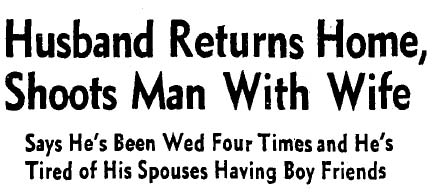
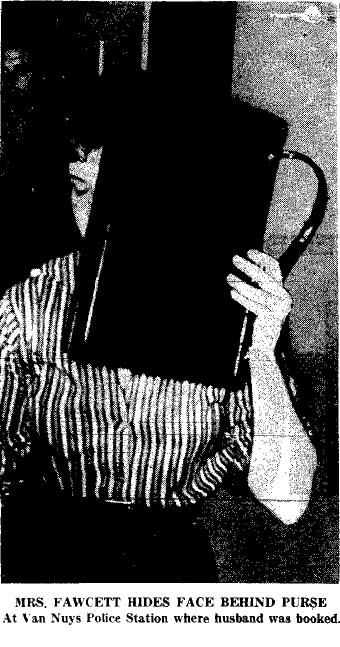 John Gordon Fawcett, 42, had enough. His last three marriages had ended
with his wives getting boyfriends and so when he found his fourth wife
in the bedroom with another man….
“This happens every time,” he said. “I got just a little tired of it.”
At 28, Janet Fawcett was 14 years younger than her husband. I suppose if she’d been more mature she could have asked John a few questions before marrying him. Something like, “Have you been married before?” or more to the point: “Do you keep a loaded .45 semiautomatic
around the apartment?” (The answer to both those questions was: Yes).
But from what she told police about the shooting, she doesn’t sound all that bright–or at least she didn’t think through what might happen if her husband found her with another man in their bedroom.
Aldous Huxley, July 20, 1952
"Horror stories implying neglect and incompetence, especially by nursing personnel, are heard regularly."
"We all came with such high hopes. Can we provide high-quality healthcare in the ghetto? I’m not sure. It’s very spotty so far."
"I have never seen so many sick people. We never catch up."
"We’ve got difficulties, but nothing we can’t handle. We’ve come a long way."
Times staff writer Harry Nelson did a terrific job with this story. He captures the challenges, the hopes and the incredible frustrations of King/Drew. And this was 32 years before it lost federal funding. Take the time to read this story. It’s worth the effort.
The Times, March 23, 1975.
Part 1

Part 2


Aug. 11, 1957
Princeton, N.J.
I’ve intentionally avoided politics so far, but hindsight is a
wonderful way to judge 50-year-old attempts to forecast the future, in
this case, the 1960 presidential election.
Let’s see how George Gallup did with the Democrats.
The front-runner for most of 1957 was Sen. Estes Kefauver of Tennessee,
followed by Sen. John F. Kennedy of Massachusetts, the eventual winner.
Although Kennedy had a slight lead in June, Kefauver began and
ended the year as the top Democratic candidate, according to Gallup.
In February, Kefauver led Kennedy among all Democratic voters 49% to 38%,
Gallup said. (Among Republicans, Vice President Richard Nixon outpolled Sen. William F.
Knowland of California 63% to 23%). The problem with Kennedy, Gallup
found, was that he did not have national prominence–26% of Democrats
said they didn’t know who he was.
In June, the two men traded places, with Kennedy over Kefauver 50% to
39%. Gallup again found that Kennedy lacked national recognition–among
Democrats, 28% didn’t know who Kennedy was.
By August, however, Kefauver was back on top, although by a closer
margin (Kefauver 29% to Kennedy’s 23%). The remaining six candidates
were:
More important, Kennedy and Kefauver were almost evenly matched among independent voters (25% vs. 24%), Gallup found.
Although Kefauver led Kennedy 26% to 19% in November, the ultimate tests, at least for our purposes, came in August 1957.
Kennedy easily defeated Knowland in a hypothetical presidential race, 51% to 37%, Gallup found.
As for a hypothetical race against Nixon, Kennedy was the winner 48% to
43%, Gallup found. And as Gallup noted, Nixon prevailed slightly in
every part of the country except the South, which handed Kennedy a huge
margin of 64% to 25%.
The popular vote, as reported by The Times on Nov. 11, 1960:
50.2% for Kennedy, 49.8% for Nixon. It was the closest election since
1888, The Times said.
To be continued…
Oh don’t do this to me.
OK, kids. "Gunsmoke" was an incredibly popular TV show that went off
the air in . . . 1975. (What? Could this be right? Surely it wasn’t
that long ago). It was something called a "Western," which was the
staple of TV programming in the 1950s and what we had before "Star
Trek" was invented. In fact "Star Trek" was originally conceived as a
knockoff of another Western and was pitched as (Lord help me) " ‘Wagon
Train’ to the stars."
No, I’m serious.
What was "Maverick?"
Oh you kids these days.


Aug. 10-15, 1957
Los Angeles
In testimony that was at times as colorful as its red and yellow
covers, the Confidential magazine trial continued with an appearance by
its former editor in proceedings that were all the more interesting
because of celebrities who were trying to avoid appearing.
One of the more prominent reluctant witnesses was Tab Hunter, who
ultimately did not testify but earned his way into the headlines by
trying to escape publicity.
Hunter was the subject of a
September 1955 article implying that he was gay. His plea was that
because the article was not part of the prosecution’s case against
Confidential his testimony was unnecessary. Defense attorney Arthur J.
Crowley’s strategy was to subpoena as many stars as possible to prove
that Confidential’s stories were accurate and said he needed Hunter
because he wouldn’t know until the trial got underway whose testimony
might be required.
Although Errol Flynn, below right, came to Los Angeles in hopes of testifying
against the magazine, many celebrities left town to avoid being
called. "We’ve been covering certain nightclubs and premieres," in
hopes of serving subpoenas, said former LAPD Officer Fred Otash, a
private detective often employed by Confidential. "Some of these people
are lying pretty low."
The main witness for the prosecution
was Howard Rushmore, a former staffer of the Communist Daily Worker and
onetime member of the Communist Party who became editor of Confidential
in October 1954.
Rushmore testified that Confidential
publisher Robert Harrison hired him out of frustration because the
magazine’s stories weren’t racy enough.
"Mr. Harrison told me
our stories were too tame," Rushmore testified. "He said we needed
stories that would make our readers whistle and say: ‘I never knew that
before.’ "

The first task was to get scandalous material.
Rushmore said Harrison didn’t like the stories submitted by Los Angeles
newspaper reporters because they were too tame. Instead, Rushmore was
to develop a stable of informants who could provide a higher caliber of
dirt. I’ve already looked at Ronnie Quillan’s
checkered career as a Confidential informant, but the main source of
information was Francesca de Scaffa, an actress who was briefly the
third wife of actor Bruce Cabot. Rushmore described De Scaffa as "our
chief Hollywood source."
"She said she had access to almost
every home in Hollywood and she could get a lot of stories," Rushmore
testified. "She said she would get material even if it involved affairs
for her with male subjects."
However, De Scaffa proved
unreliable, Rushmore said. "When an article based on her information
resulted in a lawsuit, she changed her original story and admitted that
she had not been present," he testified. "This gave me concern as to
her reliability."
(To complicate matters, De Scaffa attempted
suicide in May 1957 while hiding in Mexico City to avoid the
Confidential trial. She was eventually deported to Cuba as "an
undesirable visitor," The Times said).
In many cases, the
details were unimportant, Rushmore said. "Harrison often overruled his
attorneys on the matter of whether articles were too dangerous to print
and expressed the opinion that in the case of film people articles
could be printed without documentary proof," The Times said.
To be continued.
Note: According to Who’s Who in France, De Scaffa married French envoy and politician Raymond Offroy, who died in 2003.
(I suppose you are wondering why The Times used Marilyn Monroe in a Page 1 headline on a story that barely mentioned her. So am I. Like many articles in Proquest, this story is incomplete because it changed between editions. Sometimes the jump from Page 1 is lost or in other cases all that remains is the jump of a story. In this case, Monroe is mentioned in the lede and nowhere else. Such are the mixed rewards of research. Bonus fact: On Aug. 1, 1957, Monroe, who was married to playwright Arthur Miller, was rushed to Doctors Hospital in New York, where she suffered a miscarriage.)

Aug. 9, 1957
Los Angeles
Top shows for the first two weeks of July 1957:
The All-Star baseball game (American League 6, National League 5 ) was the top-rated show for the period, with 12,896,000 TV sets tuned in, The Times said.
TV writer Cecil Smith noted that only one NBC program–the game show
"Twenty-One"–was in the top 10. He attributed the poor showing to the fact that the network had recently announced
55% of its fall shows would be new, including programs starring
Eddie Fisher, George Gobel, Dinah Shore, Rosemary Clooney, Jane Wyman and
Gisele MacKenzie, plus "The Court of Last Resort" based on a series by Erle
Stanley Gardner, a sitcom starring Joan Caulfield titled "Sally" and
three unidentified westerns.
About "Twenty-One." In early 1957, the shows featured a bright fellow named Charles Van Doren. Maybe you’ve heard of him.


