
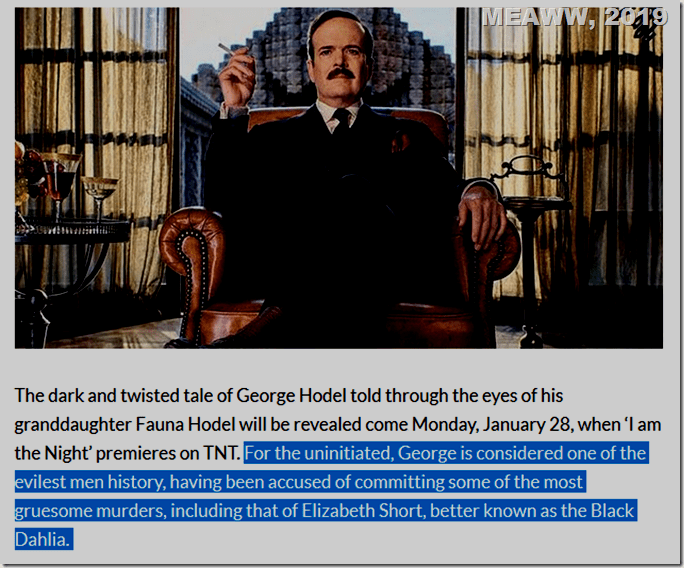
One thing you know about evil sociopaths is that they like to treat impoverished people of color. Yep. That’s what evil sociopaths do, fer sure.
One thing you know about evil sociopaths is that they like to treat impoverished people of color. Yep. That’s what evil sociopaths do, fer sure.
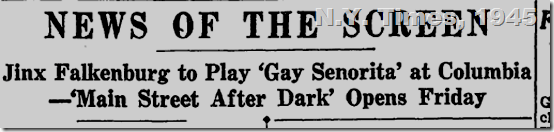
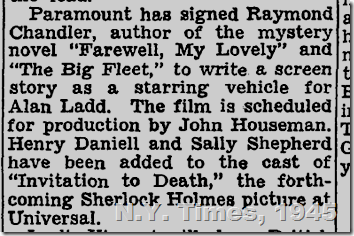
Jan. 9, 1945: The New York Times reports that Paramount signed Raymond Chandler to write a script. Contrast this with John Houseman’s account of making the film in “Lost Fortnight,” originally published in Harper’s magazine, August 1965, and reprinted with the published screenplay in 1976.
(Raymond Chandler wrote “The Big Fleet?” Oh dear, oh dear.)
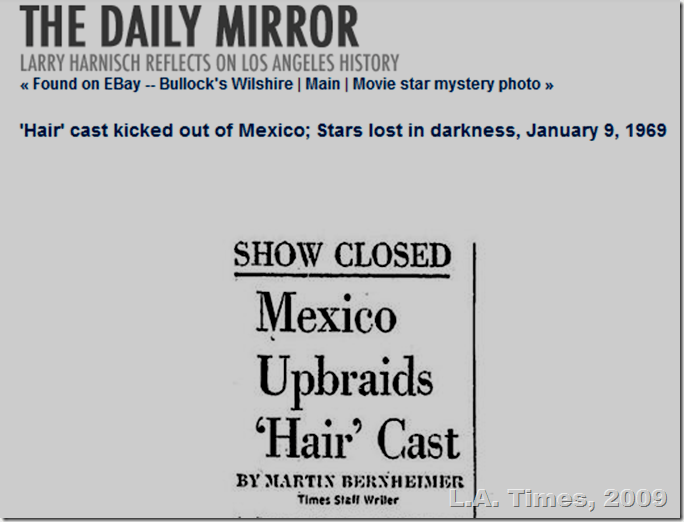
Jan. 9, 1969: A Martin Bernheimer byline on a story about the misfortunes of a Mexican production of “Hair.” “Upbraided?” Now there’s a clever headline.
Keith Thursby writes: The ABA and LA should have been a good fit. The game was wide open, with lots of dunks and three-pointers. The team even had a perfect name for the town–the Stars. Definitely a better match than the previous season when the franchise was called the Anaheim Amigos.
The entire post originally appeared on latimes.com and is available at Archive.org.
 Comes now that hiatus between cries, when the feverish race begins to clear away Christmas bets in time to pay for auto license renewals by Feb. 4 and then face up to income taxes in April.
“Any changes in the rules?” I asked a tax consultant.
“No important ones,” he said, “but you might remind people that they may not claim deductions for dog licenses, traffic fines, baby-sitters, campaign contributions, diaper service, dues for social clubs or life insurance.”
He went on, “Best rule of thumb to follow is that almost anything has to do with creating income is a legitimate business expense. If you go to San Francisco on business it’s deductible, but if you go there to see the bridges it isn’t. Not even Alcatraz.”
Weinstock also checks in with Bob Crane, then at KNX-AM.
Note: This column originally appeared in the L.A. Mirror in 1959 and was republished on latimes.com in 2009..
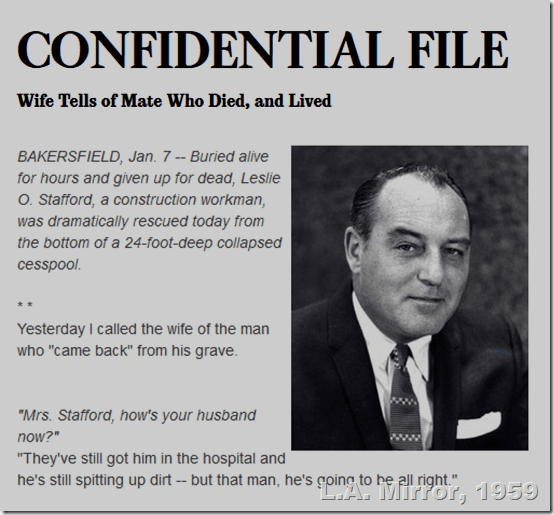
Note: This column originally appeared in the L.A. Mirror in 1959 and was republished on latimes.com in 2009. Also at Archive.org..

This popped into my inbox this morning and golly it’s amazing just how many mistakes some crime buffs can pack into one blog post. Then again, the Internet.
Ready? Let’s find five obvious errors.

Jan. 8, 1939: The Times’ Edwin Schallert makes his Oscar predictions, seconding a “Warner landslide” published in The Times two weeks earlier with James Cagney (“Angel With Dirty Faces”) as best actor, Bette Davis (“Jezebel”) as best actress, Michael Curtiz (“Four Daughters”) as best director and “Adventures of Robin Hood” as best film..
Also, a look at the items that Sierra Club members use to mark their mountain climbs.
The column previously appeared on latimes.com in 2009 and is available via Archive.org.
 A group of grimly playful fellows at SC who call themselves Asthmatics Anonymous advise that at a raw-lunged meeting in the basement which serves as headquarters they have regrouped as Asthmatics Militant.
First move was to change the association’s motto from “As I live and breathe” to “You should live so long.” (“Here’s crud in your eye” was considered but deemed inappropriate.)
Second action was to wire their Detroit operative, a talented wheezer, inquiring what goes on back there. His reply has just come zinging through.
Matt Weinstock takes a light look at new cars. And has an item about a practical joker who snatched the purse of a temp employee wrapping gifts at a department store and got it wrapped. He assumed it would be returned to the store. But it wasn’t.
The column originally appeared in 1959 in the L.A. Mirror and was republished on latimes.com in 2009. The entire post is here via Archive.org..
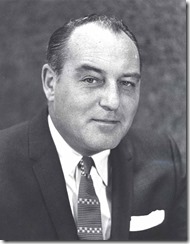 I don’t know what you do for kicks, but my friend Tiger Small snatches toupees.
Not just anybody’s toupees, understand. The Tiger’s selective. He’s been working the Catskill-Manhattan-Miami circuit for years, dealing only with the best people. The cream of the show business crowd. Doctors. Professional men.
When he came to Hollywood last month he brought quite a reputation with him.
“But in this town,” he was telling me yesterday, “they bloat everything way out of proportions.”
The Tiger — an animated conversationalist — explained that it was just a sideline with him. That he lifted his first toupee strictly as a favor for a chorus girl friend and then sort of fell into the habit.
Paul Coates knew some interesting characters, like Tiger Small, who stole toupees.
This column originally appeared in the L.A. Mirror in 1959 and was republished on latimes.com in 2009. The entire post is here, via Archive.org..
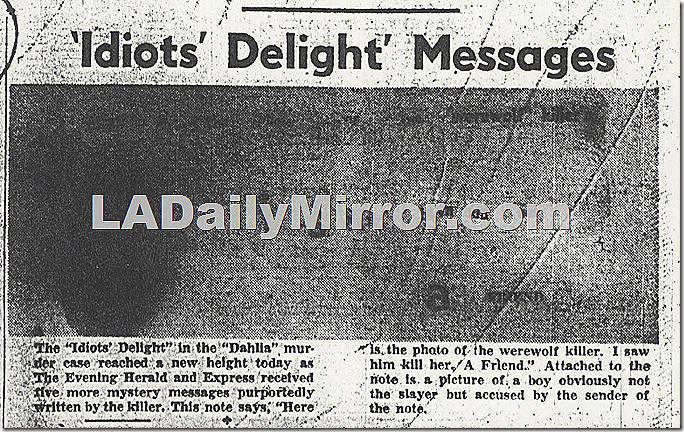
A practical joke from 1947 is the source of the “Black Dahlia Avenger” franchise.
During the investigation of the Black Dahlia case, the killer mailed a small envelope of Elizabeth Short’s belongings to the newspapers. After that, crackpots and pranksters flooded the police and the newspapers with joke messages. One prankster using the name “Black Dahlia Avenger” sent a string of postcards and messages to the Los Angeles Herald-Express, often spelling the name “Hearld.”
Police and the newspapers attached no significance whatsoever to these prank messages. it wasn’t until Steve Hodel came along in 2003 that “Black Dahlia Avenger” was anything but a joke.
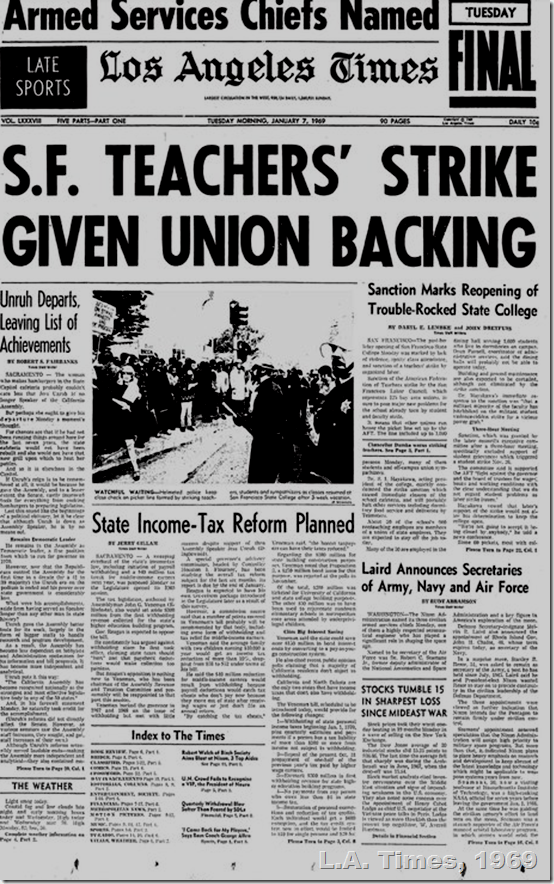
Jan. 7, 1969: A 15-point drop in the Dow is Page 1 news in 1969. I wonder what they would think of today’s economic meltdowns..
Also: Gordon Lightfoot makes his debut in Los Angeles and Keith Thursby on the Rams rehiring Coach George Allen.
This post originally appeared in 2009 on latimes.com and is available via Archive.org.
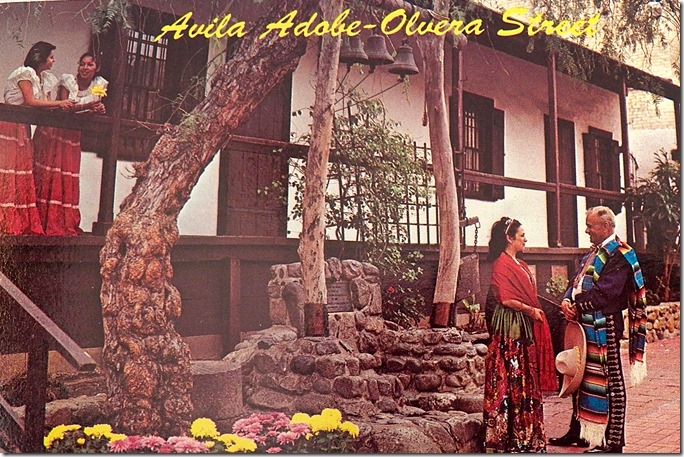
A postcard of the Avila Adobe, listed on EBay for $1.89.
“A people that has lost touch with its historical past, forgotten its traditions and wasted its heritage is as unfortunate as a man who has lost his memory. Without knowledge of the past, both the present and the future are meaningless.”
Harry Chandler, Olvera Street News, December 1933
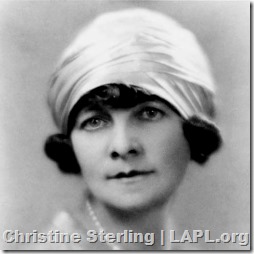 Long before Los Angeles or Hollywood possessed any historic preservation organizations fighting to save architectural, cultural or historically significant buildings, Los Angeles Times Editor and Publisher Harry S. Chandler astutely summed up what preservation is all about: saving structures that help define a sense of identity and place, showing where we as a society and people come from.
Throughout its history, the city has often turned a blind eye to its past, demolishing buildings reflecting the daily lives of both ordinary and powerful citizens trying to make an impact on their own time and place. These sites and buildings often reveal the history of less powerful citizens of the time, those of other races, cultures, and orientations that are often written out of historical texts.
Mary Mallory’s latest book, “Living With Grace: Life Lessons from America’s Princess,” is now on sale.
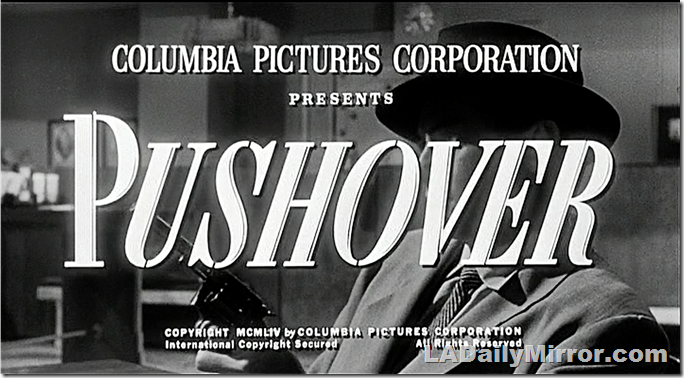
This week’s mystery movie was the 1954 Columbia film “Pushover,” with Fred MacMurray, Phil Carey, Kim Novak (her film debut), Dorothy Malone, E.G. Marshall and Allen Nourse.
Screenplay by Roy Huggings, based on stories by Thomas Walsh and William S. Ballinger, gowns by Jean Louis, photography by Lester H. White, art direction by Walter Holscher, film editing by Jerome Thoms, set decoration by James Crowe, makeup by Clay Campbell, hairstyles by Helen Hunt, associate producer Philip A. Waxman, music conducted by Morris Stoloff and musical score by Arthur Morton. Produced by Jules Schermer, directed by Richard Quine.
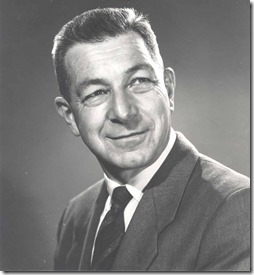 A very upsetting ruling came down recently from Appellate Justice Paul Vallee.
Shocked by the discovery that three men were held in jail for five days before being arraigned, he stated in an opinion, “It appears the police are permitted to flout, defy and violate the law they are sworn to uphold.”
Asked for a ruling on Justice Vallee’s opinion, City Atty. Arnebergh advised Chief Parker that prisoners must be arraigned within two days after being arrested, to be taken before a magistrate without delay. It also raises the question whether it’s legal to arrest a person on “suspicion.”
That hollow laughter you hear is from those who weren’t so lucky.
Weinstock also writes about the death of Victor Angel, who was fatally injured by the falling body of Louise Albina Stark after she jumped off the seventh-floor ledge of a building at Broadway and 4th St.
This column originally appeared in the L.A. Mirror in 1959 and was republished on latimes.com in 2009.
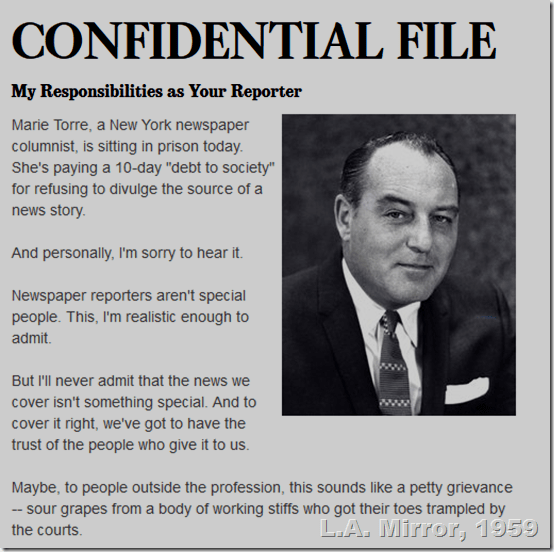
Jan. 6, 1959: Paul Coates writes about protecting his sources, citing the case of New York Herald Tribune writer Marie Torre, who was sentenced to 10 days in jail for refusing to reveal her source for a story about Judy Garland.
Coates’ column originally appeared in the L.A. Mirror in 1959 and was republished on latimes.com in 2009.

Jan. 6, 1959: Here’s a busy news day in 1959. Errol Flynn is wounded in the leg while “campaigning” with Fidel Castro. On the jump, Keith Thursby takes a look at The Times’ interview by Jeane Hoffman with Eleanor Gehrig.
The post originally appeared in 2009 when the Daily Mirror was hosted by latimes.com.
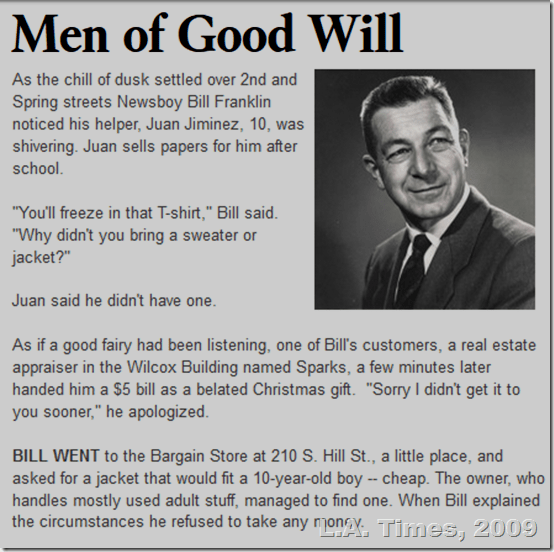
Matt Weinstock was a master of stringing little vignettes into a column. He didn’t do major reporting, like Paul Coates, but had a nice, light touch and occasionally stirred the heartstrings of Los Angeles. He also delved into L.A. history and some of its many, many quirks..

Along with Parkey Sharkey, Desmond Slattery was one of the colorful characters in Paul Coates columns..

Kenneth Savoy told holdup men “If you want my wallet, you’re going to have to kill me to get it.” So they did. The story of George Albert Scott and Curtis C. Lichtenwalter, who were robbing bars across Los Angeles.

I’m late to the party on this book, but I was pleased to run across a Q and A with historian David Blight of Yale on his new biography, “Frederick Douglass: Prophet of Freedom.” The session, with Princeton professor Eddie S. Glaude Jr., is worth your time.
 ladailymirror.com

