
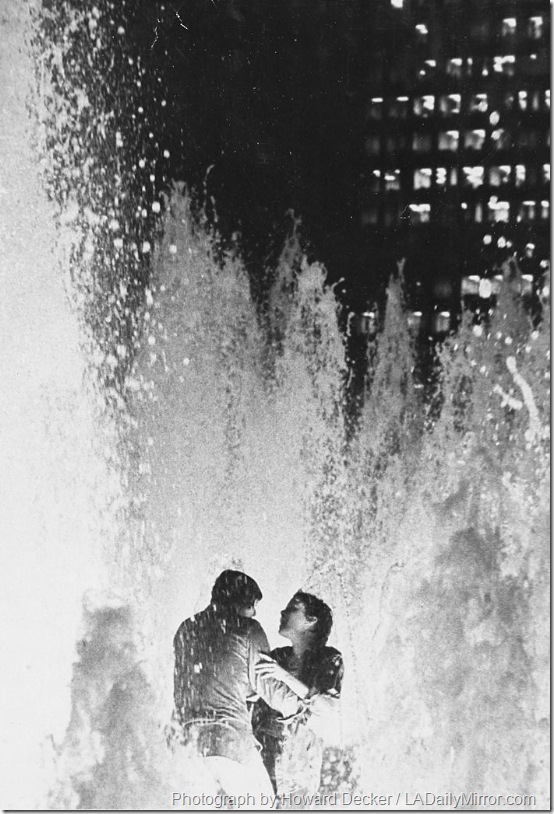
Photographs by Howard Decker
Our pal Fibber (Howard Decker) sends along two pictures as mystery photos. Thanks!
[Congratulations to Lorenzo for identifying Season Hubley!]
Photographs by Howard Decker
Our pal Fibber (Howard Decker) sends along two pictures as mystery photos. Thanks!
[Congratulations to Lorenzo for identifying Season Hubley!]
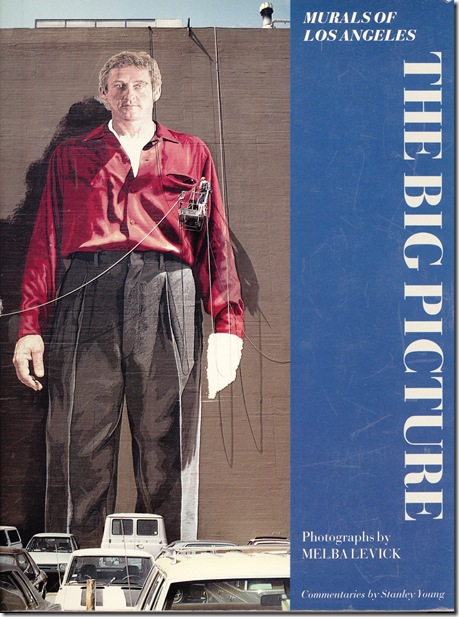
I picked up “The Big Picture,” Melba Levick and Stanley Young’s 1988 book about Los Angeles murals, not realizing what a terribly sad book it would be. As Young notes: “Most artists are aware that, exposed as it is to the elements, both human and natural, there is a limited life-expectancy for any mural.”
I wanted it for one picture, specifically.
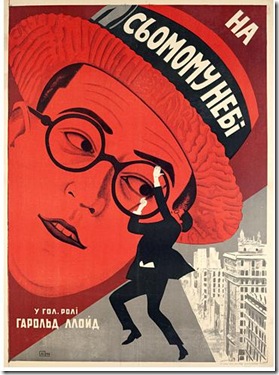 Friday’s New York Times has a brief article on an exhibit of Soviet film posters at the Tony Shafrazi Gallery on West 26th Street in Chelsea.
According to the New York Times, the posters were collected by Susan Pack, a graphics historian and the author of “Film Posters of the Russian Avant-Garde,” who sold them two years ago.
The unidentified buyer is displaying them in the gallery in an exhibit titled “Revolutionary Film Posters: Aesthetic Experiments of Russian Constructivism, 1920-1933.”
The Times says that none of the posters on display is for sale, but that the owner is selling some duplicates for $8,000 to $200,000.
The gallery has more than 100 images of the posters on its website and they are stunning. It’s particularly interesting to see foreign interpretations of Hollywood, such as this poster for what appears to be Harold Lloyd’s “Safety Last” but is translated by the gallery as “Seventh Heaven.”
The exhibit ends July 30.
Photo: “Seventh Heaven” Credit: Tony Shafrazi Gallery
Last Thursday’s New York Times had a terrific story by Austin Considine about Charles B. Woehrle, who received a Patek Philippe watch while imprisoned at Stalag Luft III (he ordered the watch and promised to pay for it after the war). A burglar stole the watch in the mid-1970s, but thanks a niece, the company recently gave him a replacement.
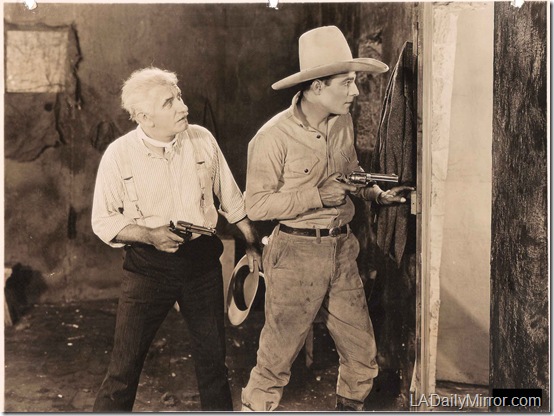
Here’s another mystery photo from Steven Bibb’s collection!
[Update: Please congratulate Don Danard for identifying our mystery hero as Buddy Roosevelt. His mystery companion isn’t identified on the back of the picture, but Don says it is Lafe McKee.]
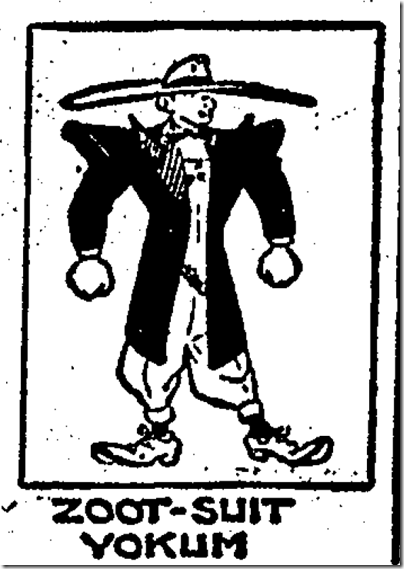
May 9, 1943: Al Capp satirizes zoot suits in a series about “Zoot-Suit Yokum.”
In Part 1, we saw that in 1942, The Times originally portrayed zoot suits as a youthful fad, but that attitudes hardened toward them once the War Production Board outlawed them to conserve fabric. We saw that some servicemen were hassling zoot-suiters and there were regular reports of crimes committed by Eastside zoot suit gangs.

Jan. 14, 1943: Here’s an essay by Timothy Turner, and the headline, unfortunately reflects the bias of whoever wrote it rather than Turner’s thoughts. Turner was an interesting fellow who spent many years in Mexico and covered the Mexican Revolution.
Here’s part of what he has to say:
 The Mexican problem confronting this city today is compounded by color prejudice. Most of these young Mexicans have much Indian blood. There is a definite caste system against them. It is not like that against the Negro. Like Orientals they can go into restaurants and theaters. But a young Mexican American finds the economic bars up against him. He or she cannot get a job in stores or offices, even as a waiter or waitress in restaurants. The Mexican, however, can be a bus boy. This is being changed by the manpower shortage, and we are beginning to see Mexican faces where we never saw them before. Mexicans have been barred from many factories engaged in war work, causing much bitterness. The Mexican, generally speaking, is left to hard labor or the most menial work. We have graduated a whole generation of young Mexicans out of high school, educated sons and daughters of Mexican laborers into a middle class which for them does not exist.
This, folks, is a daring statement for the editorial page of the conservative, right-wing Los Angeles Times.
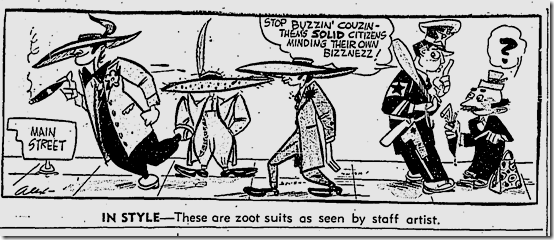
March 22, 1943: A Times cartoon shows zoot-suiters as “solid citizens minding their own bizness.”
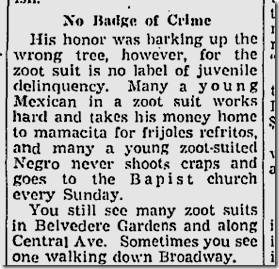
On March 22, 1943, The Times published a story by Turner that makes fun of the zoot suit but is sympathetic to young men who wear them. “The zoot suit is no label of juvenile delinquency,” he says.
The Zoot Suit Riots are three months away….
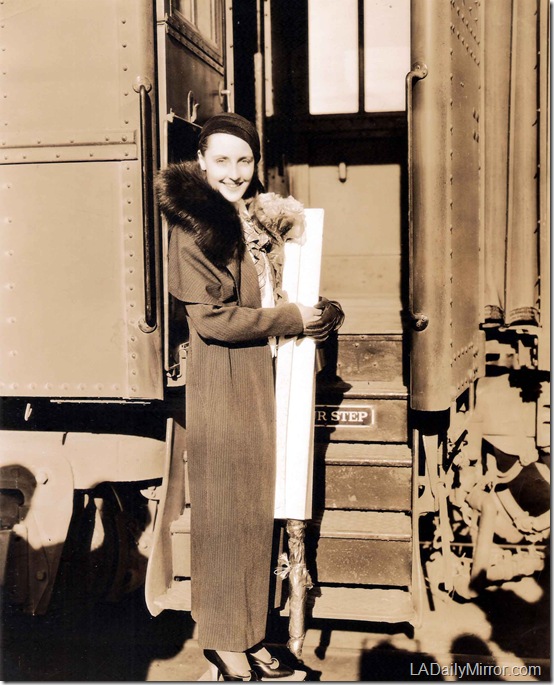
Here’s another mystery photo, courtesy of Steven Bibb. There’s a closer look on the jump.
[Update: This is Dorothea Wieck (d. 1986), known for “Maedchen in Uniform,” arriving in Los Angeles, April 13, 1933. She returned to Germany because she didn’t like the roles she was given in Hollywood. She was erroneously reported killed during the Allied bombing of Dresden in 1945. Notice the long coat. According to The Times’ story, she had a strict policy of not allowing photographs of her…. ]
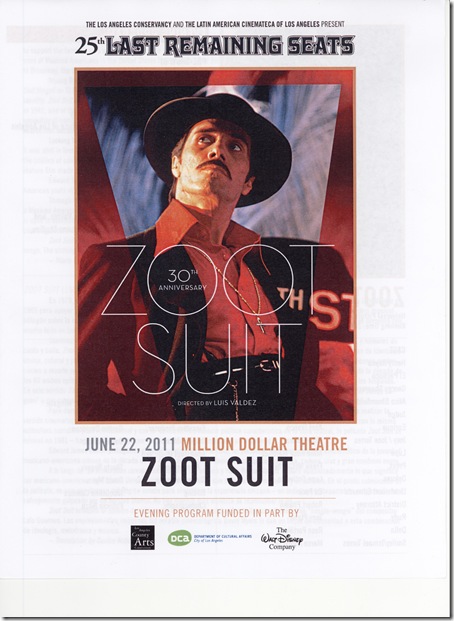
I was extremely fortunate to attend Wednesday night’s showing of “Zoot Suit” and hear remarks by the panel that preceded the show. Betto Arcos moderated a session with director Luis Valdez, Rose Portillo (Della), Edward James Olmos (El Pachuco) and Eric Avila, associate professor of Chicano studies at UCLA.
“Zoot Suit” is a powerful movie (because of the small budget, it is essentially a film of the play) and the historian in me kept whispering: “Look it up.” Here’s a sample of what I found:
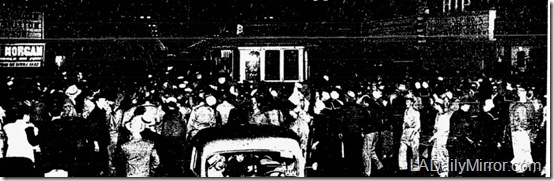
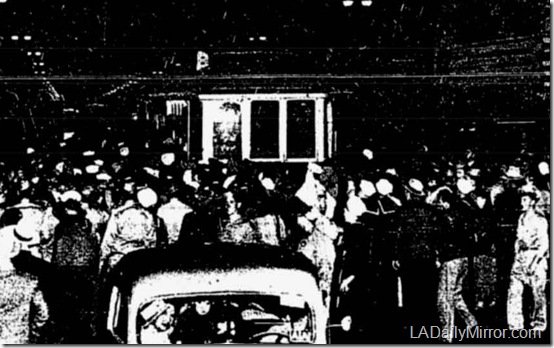
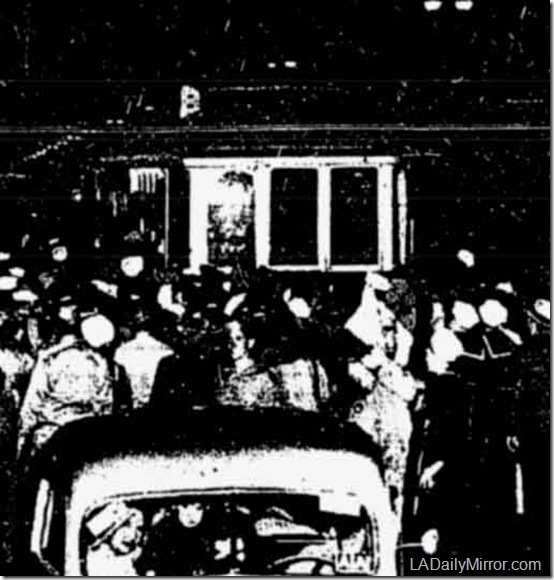
June 8, 1943: Servicemen and civilians block a streetcar on Main Street to remove a passenger wearing a zoot suit.
“Zoot Suit” combines two historic events: The 1942 “Sleepy Lagoon” killing and the 1943 Zoot Suit Riots. To keep things from becoming overly complicated, I’m going to look at the Zoot Suit Riots first and then delve into the “Sleepy Lagoon” killing.
Photo 1: Program for “Zoot Suit” Credit: Jose Legaspi
Photo 2: A mob stops a streetcar looking for a zoot-suiter, June 8, 1943. Credit: Los Angeles Times
Queen of the Dead—dateline June 25, 2011
• Wheelchair-bound actor and male stripper Lee Kemp, 39, died of cancer on April 11. The British actor became a paraplegic after a 1990 motorcycle accident and—against all odds—continued his career, even winning the much coveted Sexiest Man in Yorkshire competition in 2005. Besides campaigning for disabled people’s rights in the UK, Kemp headed a troupe of male strippers called The Crippendales, who were featured in an eponymous 2007 film.
• Maria Gomes Valentim died on June 21—born in 1896, she was at the time of her death the world’s oldest documented person (just a month shy of 115, and she didn’t look a day over 90). Valentim was born the same year as George Burns, F. Scott Fitzgerald, “Big Edie” of Grey Gardens, silent film stars Blanche Sweet and Barbara La Marr, and Jim “Fibber McGee” Jordan. The Brazilian native is not known to have done anything of interest to anyone outside her family except living 114 years, but a granddaughter noted that “she has lived long because she has always taken care of her own life – and not the life of others,” a lesson many would do well to emulate. Except for the living 114 years part. I can’t imagine a worse fate.
• An 85-year-old religious figure (a dean of Lincoln, England) died on June 8. This is mostly of note to us because his name was The Very Reverend Oliver William Twisleton-Wykeham-Fiennes, which I find absolutely delightful. The Telegraph—who never lets us down—adds that “his great-great-grandfather had been Archdeacon of Hereford and earned a mention in Kilvert’s Diary for preaching a sermon described as ‘a rigmarole.’”
• Balding, nerdy-looking British musician and comic Simon Brint, 61, died on June 11. He and Roland Rivron formed the group Raw Sex, parodying bands from Velvet Underground to the Mamas and the Papas to the Pet Shop Boys. The duo was often seen on French and Saunders, and Brint provided music for such Britcoms as Absolutely Fabulous, Hippies, The Savages, Coupling, Monarch of the Glen, and Teenage Kicks.
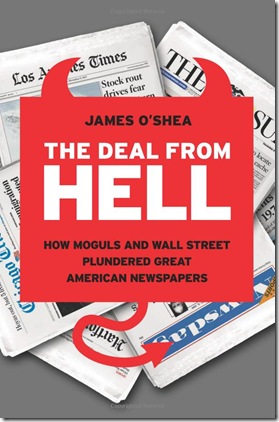 Bryan Burrough reviews James O’Shea’s “The Deal From Hell” in the New York Times column “Off the Shelf.”
Burrough writes: “Mr. O’Shea, a onetime top editor at both The Chicago Tribune and The Los Angeles Times, tells the story of these two papers’ magnificently botched corporate marriage — a fine tale, though from the subtitle it would appear that his publisher didn’t want to market it as such, perhaps thinking that no one much cared.”
The New York Times has a great feature about Samuel J. Battle on the centennial of him becoming the first African American appointed to the New York Police Department.
Excerpts from an interview given in 1960 for Columbia’s oral history project are here and they are well worth reading.
 |
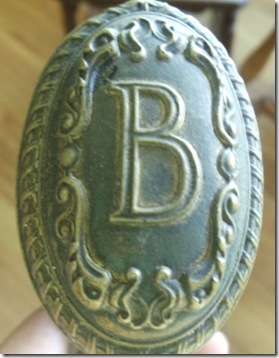 |
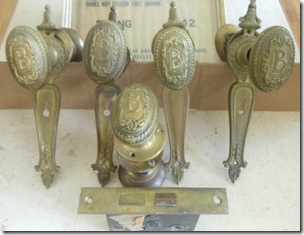
A set of door hardware from the Biltmore Hotel has been listed on EBay. Biltmore items turn up somewhat often on EBay, but they are usually postcards, menus, tableware, shoehorns, bottle openers, etc. I have never seen this type of thing before. The vendor says these items were purchased at an auction. Bidding starts at $395. As with anything on EBay, items and the vendor should be evaluated thoroughly before submitting a bid.
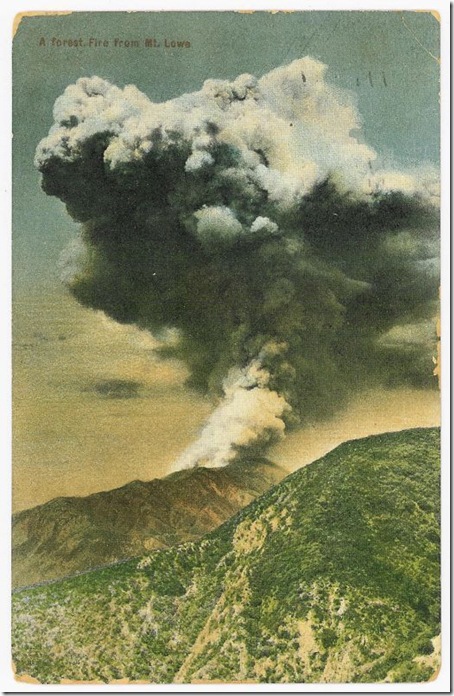
This dramatic postcard showing a huge wildfire, as seen from Mt. Lowe, has been listed on EBay. We have a cycle of natural disasters in Southern California: Heavy rains around December produce mudslides >> The rains bring spring greenery >> that dies off in the hot summer >> and catches fire in August or September (somebody always picks a hot, dry, windy day to do some welding) >> which denudes the hillsides >> so that when it rains, we get mudslides. Bidding on this card, postmarked 1911, is $2.
Randy Lewis of The Times has a nice obit on Fred Steiner (1923-2011), who composed the famous theme for the “Perry Mason” show:
Steiner said he wanted to create music for Mason, writer Erle Stanley Gardner’s legal-eagle lawyer, that projected two key facets of his personality: suave sophistication and the underlying toughness that allowed him to go head-to-head with the criminals with whom he often came into contact. The piece he came up with, titled “Park Avenue Beat,” pulsed with the power of the big city and the swagger of a beefy hero played to perfection by actor Raymond Burr.
“In those days, jazz — or in those days, rhythm and blues was the big thing — represented the seamier side of life,” Steiner told National Public Radio interviewer Nina Totenberg in 2002. “Don’t ask me why — that’s a sociological question.”
 |
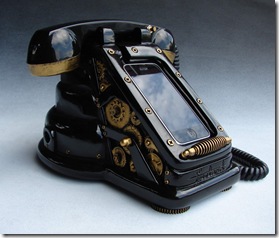 |
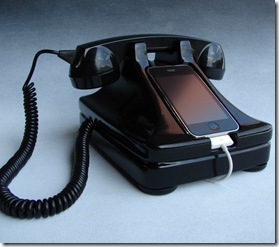
Maybe it’s not enough for your cellphone to have a ringtone that’s an old-school phone. Maybe you need an iPhone docking station that looks like an old phone. These are made by Freeland Studios in the regular (left, $195) and Steampunk ($350) styles.
Photos: iretrophones Credit: Freeland Studios
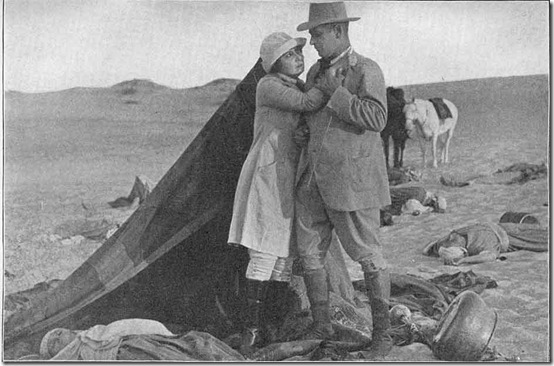
Here’s a mystery couple in a mystery movie.
There’s a new photo on the jump!
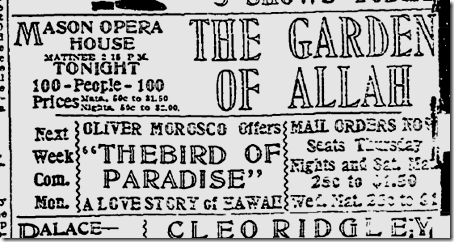
[Update: These photos are from the 1916 Selig-Polyscope film “The Garden of Allah” starring Helen Ware and Tom Santschi. These photos appear in the photoplay edition of Robert Hichens book, which is listed on EBay. Bidding starts at $6.90.]

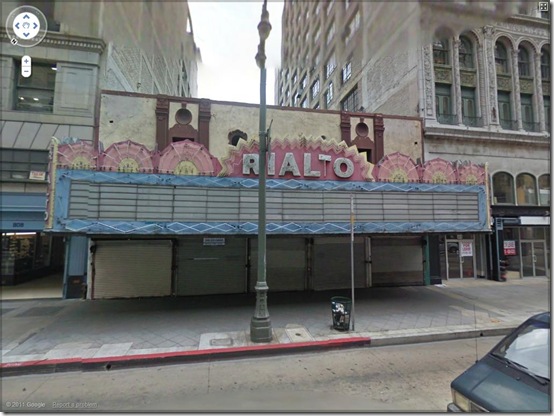
The Rialto, 812 S. Broadway, via Google maps’ street view.
[Update 2: “The Garden of Allah” opened at the Mason Opera House on Jan 1, 1917. Curiously enough, the film was rescored by Joseph Carl Brell in April 1917 for a re-release at Quinn’s Rialto, a 900-seat theater at 812 S. Broadway. Sid Grauman bought the theater in 1919, remodeled it and renamed it Grauman’s Rialto, according to The Times. ]
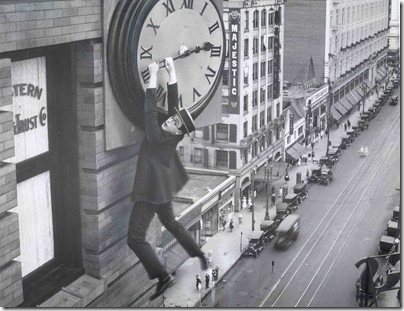
The Los Angeles Conservancy has posted a guide to filming locations for Harold Lloyd’s 1923 film “Safety Last” in conjunction with a showing of the film on June 29 at the Orpheum as part of the Last Remaining Seats series. (The movie is sold out, but it’s always worth checking with the conservancy to see if some tickets have been returned).
The self-guided tour of “Safety Last” locations, by John Bengston, is a thorough examination of the different buildings used in the film and is well worth reading. Bengston is the author of “Silent Visions: Discovering Early Hollywood and New York Through the Films of Harold Lloyd.”
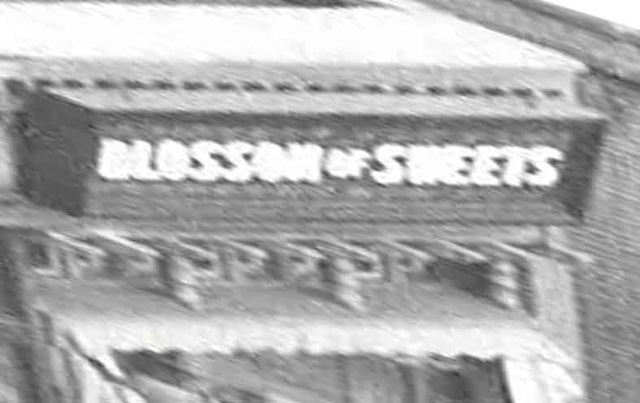
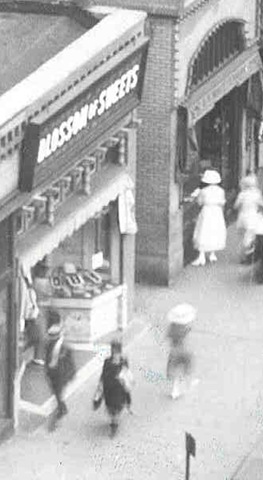
I’m always amazed by the amount of detail in the large-format photos used before the advent of the 35-millimeter camera. Enlarging the top photo from “Safety Last” reveals shoppers passing the Blossom of Sweets shop, 849 S. Broadway.
 |
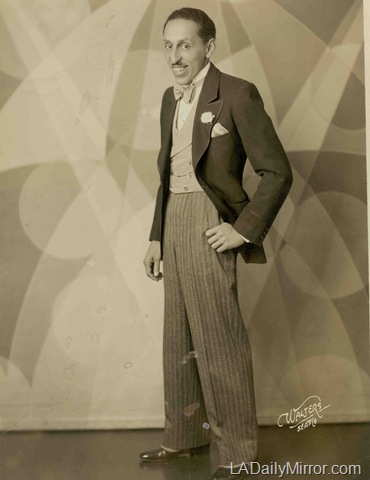 |
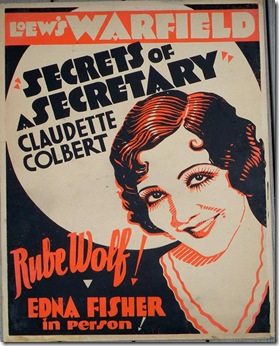
This poster for “Secrets of a Secretary” – with an appearance by Edna Fisher and Rube Wolf, above right, has been listed on EBay. Rube Wolf isn’t terribly well-known today, except around the Daily Mirror HQ. He was a prominent composer and bandleader in Los Angeles. (Video: “Pretty Red Hibiscus”). For this event, he was appearing at Loew’s Warfield in San Francisco. Bidding on the poster starts at $199.
Watching CBS’ new savior, Jeff Sagansky, hold his first press conference this week, I kept wondering whether he’d ever heard William Link, co-creator of “Columbo,” describe the origins of that classic Peter Falk detective show.
It “should have been a failure,” Link said, because it broke five cardinal rules of network TV: “It had very little action and almost no sex. The central character often didn’t enter until 15 or 20 minutes after the opening credits. The plots were complex, demanding the viewer’s strict attention. Entire episodes could be nothing more than stretches of cat-and-mouse dialogue. The lead, when he finally did show up, wasn’t a 6-foot, granite-jawed, two-fisted hunk of macho bravado, but a short, klutzy, badly groomed, ill-attired career officer who didn’t carry a gun and was easily winded.”
”Columbo” was part of a great lineup of early 1970s mysteries on NBC that also included “The Snoop Sisters” (Helen Hayes and Mildred Natwick and Art Carney as their chauffeur in the pilot episode), “Hec Ramsey” (Richard Boone), “McCloud” (Dennis Weaver) and “McMillan & Wife” (Rock Hudson and Susan Saint James).


Steven Bibb, a member of the Daily Mirror’s Brain Trust, has graciously shared some of his pictures as mystery photos. Thanks Steven!
[Update: This is Dorothy Dell in a 1934 photo from “Wharf Angel.” Please congratulate Eve Golden for identifying her!]
Dell was killed in a car wreck on Lincoln Avenue a few hundred feet past South Gate Street – an intersection I’m not able to locate – hours after a preview of her latest film, “Shoot the Works,” when the car driven by Dr. Carl Wagner struck a curb and rolled over, hitting several trees and shearing off a utility pole. Wagner was a witness in the Sphinx Murder of Pasadena. What was the Sphinx Murder? I’ll save that for another time.
[Update 2: The accident was at Lincoln Avenue and WESTgate Street in Pasadena, not South Gate. Nothing like moving a car accident to the other end of L.A. The perils of the rewrite desk taking information by phone.]
 ladailymirror.com