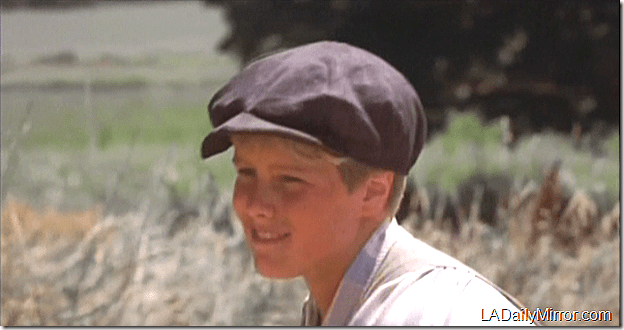
… and this movie would be?

… and this movie would be?

I was watching this movie the other night and thought: “Hey! Wait a minute. That’s…..”
The film shouldn’t be too hard to identify. But the location … hmmmmmm. As I often say, living in Los Angeles is like living in a big movie set. They film everywhere.

Photo: Thompson submachine gun, serial No. 4208, with detachable stock and ammunition drum. Credit: Mayo Auction and Realty.
This .45-caliber Thompson submachine gun 1921A, reputedly seized after a 1933 shootout with Bonnie and Clyde, is being auctioned, along with the couple’s Winchester 12-gauge shotgun on Jan. 21, by Mayo Auction and Realty of Kansas City, Mo.
The weapons have been in the possession of a police officer’s family for many years and were loaned to the Springfield, Mo., Police Museum from 1973 to 2011, the vendor says.
Presumably, any collector with enough money and interest to acquire this submachine gun knows the paperwork that is involved in owning one.
And in case you’re wondering, a submachine gun fires handgun ammunition (.45 caliber, in this case) rather than machine gun-caliber ammunition.

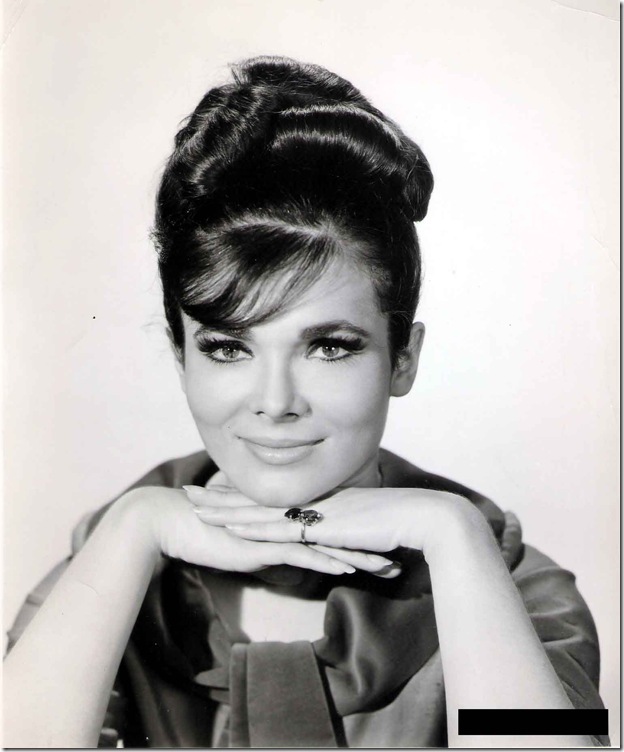
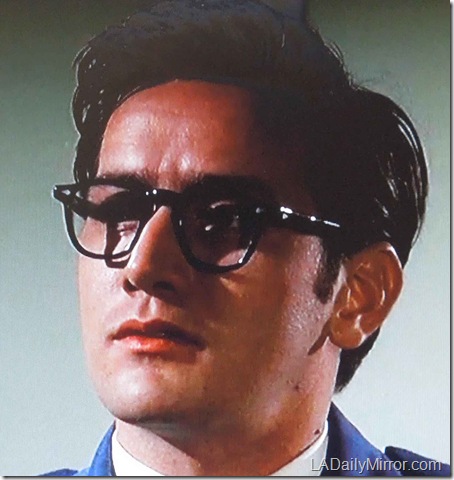
Here’s another mystery photo from the collection of Steven Bibb!
[Update: This is Lois Butler in “The Boy From Indiana.”


Jan. 5, 1962: A dark, painful day in the history of Los Angeles journalism. Virtually overnight, the city becomes a two-newspaper town. The evening Mirror ceases publication Jan. 5, merging with The Times, and the morning Examiner merges with the evening Herald-Express on Jan. 7, prompting a congressional investigation of possible collusion.
A tearful Norman Chandler, president of Times-Mirror Co., tells Mirror employees: “This is to me the most difficult, heart-rending statement I have ever had to make. The Mirror was my dream — this paper was conceived by me. I believed in its reason for being. I had confidence in its ability to grow with the community and to mature as a successful metropolitan paper.”
“Unfortunately, the economics have proved to be such that my original concept has not worked out.”
Randolph A. Hearst, president of Hearst Publishing Col, says: “The conditions which force the Examiner to cease publication are the same conditions that have resulted in the demise of many other well-known newspapers throughout the country. Costs have risen far more rapidly than revenue. Continuing losses, with no foreseeable change in the trend, make discontinuance of the Examiner an economic necessity.”
Rep. Emanuel Celler (D-New York), head of the House Judiciary Committee, says “a city of 2 1/2 million people with a metropolitan area of almost 7 million will become a two-newspaper town.”
Discussing the consolidation of newspapers, Celler says: “This trend bodes ill for our much-vaunted freedom of speech and press and shackles such freedom. In many instances, both sides of the problems are never presented and the news as well as the editorials often become slanted. This must be forfended.”
The late Marty Rossman, who worked at The Times in 1962, told me: “The blood ran on the floor that day.” Some of the Mirror’s high-profile columnists and writers (Paul Coates, Matt Weinstock and Paul Weeks, for example) moved to The Times. Others were not so fortunate. The late Bill Kershaw, a slot when I started at The Times, lost his job and went to the Herald Examiner before rejoining The Times. The late Jerry Clark, a former Mirror employee, once said he asked Otis Chandler who decided to kill the Mirror. Otis replied: “I did. Next question.”
For people too young to recall afternoon papers or understand their function, here’s a brief explanation: The morning papers (or AMers) tended to be a straightforward reporting of the news of the day, and for much of the 20th century, there were multiple editions per day for home delivery, closing stock market figures, racing results, street sales, etc. The afternoon papers (or PMers) tended to be updates of breaking news stories, with more sensational treatment, stock market figures, racing results, features, serialized novels (a specialty of the Herald-Express) and that sort of thing.
As American lifestyles changed after World War II and into the 1960s, more people were getting their news from television, cutting into the circulation of afternoon papers until they slowly faded away.
The Examiner’s circulation was 381,037 daily; 693,773 Sunday. The Herald-Express’ circulation was 393, 215. I’ll have to do some digging to find the Times’ and Mirror’s circulation figures. The Herald Examiner folded in 1989 and many employees joined The Times.


Jan. 5, 1942: Nazi patrols plow through students protesting in Paris’ Latin Quarter, “firing a warning burst from machine guns over the heads of the crowd” and then proceeding to “clean up the situation,” The New York Times reports. “A separate report stated that at least 100 hostages had been ‘liquidated.’ ”
Japanese immigrants Henry Morishita and K. Goto try to establish their San Diego vegetable market as the headquarters of the Free Japanese Committee to Aid Democracy, which would raise money to help U.S. defense.
Times columnist Tom Treanor, who was killed covering the liberation of France, muses on what life will be like after the war.
“In the aircraft factories, employment of women, after a lull, is about to pick up again. Experience to date has shown that women can do what has heretofore been considered men’s work and do it satisfactorily. Many jobs they perform better,” Treanor says.
Redondo Beach Councilwoman Bernice Venable has come up with a play to beautify the many blocks of right of ways abandoned by the Pacific Electric Railway.
“When the Pacific Electric abandoned its right of way the removal of rails left broad stretches of unsightly, broken ground centering some of the city’s most scenic residential boulevards,” The Times says.
And yes, that means the streetcar system was already being dismantled before World War II. Are you surprised? Good.
Nathan Marsak, this is for you: Recent enemy submarine activity off the coast has restricted the movement of tankers, which in turn has curtailed oil production. The Times once covered the mining and oil industries, believe it or not.
Film director Fritz Lang is planning a lecture tour on “Fear Psychology.”
Jimmie Fidler says: Study in contrasts: Bouncing Betty Grable and sedate Judy Garland at adjoining tables at the Mocambo.


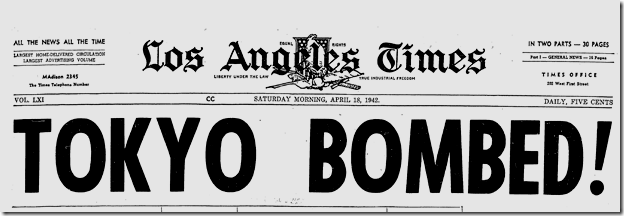
Jan. 3, 1942: Manila falls to the Japanese.
“The Bare Facts of 1942” opens at the Aztec, 251 S. Main.
Movie theater patrons Tombio Ambo and Shigeki Kayama are in custody after Winifred J. Stephens accused them of hissing a newsreel of President Roosevelt and applauding scenes of the Pearl Harbor attack.
Stephens told police that when she turned to talk to the young men, one of them spit at her.
Tom Treanor looks at how the loss of automobiles will affect daily life — the government had just announced that no new cars would be made “for the duration” so auto plants could be converted to defense production. The Times also reported that private automobiles might be nationalized to meet war demands.
Treanor also writes that he angered readers when he said Los Angeles’ streetcar service had improved. (Streetcar fans, please note).
Jimmie Fidler says: Pic of the week: Universal’s “Hellzapoppin’ ” (Olsen and Johnson -Martha Raye.) Madhouse jitters that’ll have your side apoppin’

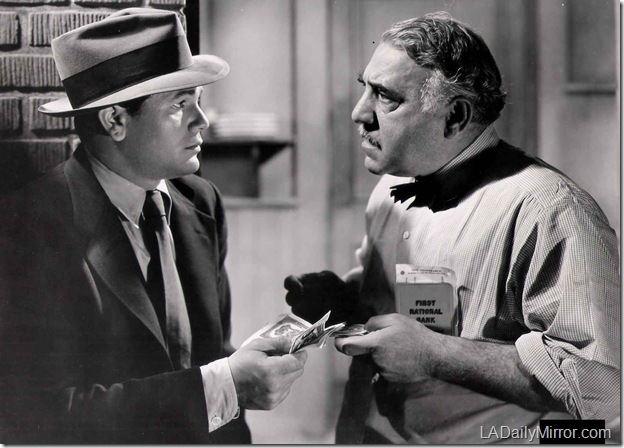
And this movie would be?
[Updated: This is the 1954 film “Dragnet.” Please congratulate Julie Merholz, Robert Howe, Richard Heft and “KMA 367” (that’s the LAPD’s call sign in case you don’t recognize it) for identifying this screen grab. This one was a little tougher than “D.O.A.” ]

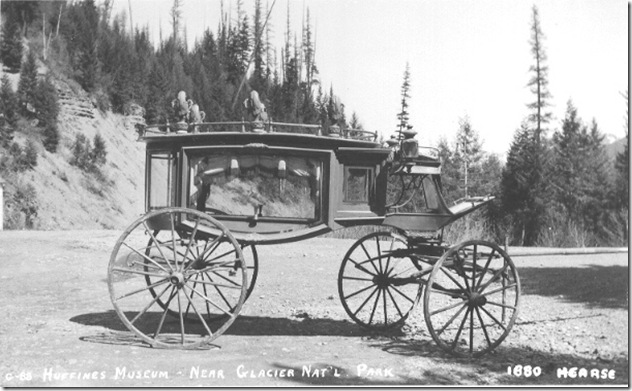
Photo: A set of mourners (hearse not included) listed on EBay as Buy It Now for $124.99.
Queen of the Dead – dateline January 2, 2012
• Comedy writer Joe Bodolai, 63, killed himself on December 26. No one interviewed seemed surprised: “I’m not shocked at all,” “He was a pretty unhappy guy,” “L.A. can chew you up and spit you out. It’s a tough place and it can be a very lonely place,” were some of the comments. Bodolai was a successful Canadian standup, and moved to New York where he wrote for SNL in 1981-82; he then coproduced the shows Kids in the Hall (1990-91) and Comics! (late 1990s). He also worked on the film Wayne’s World. His blog reveals him to have been a huge conspiracy nut (9/11, JFK, Israel), which is why, really, people, don’t keep blogs. But less annoyingly, he reminisced about the Canadian comedy scene: “I love Canadian comedy, the POV, the sweet pomegranate seal meat mixture of it, the lack of mean with the Robin Hood arrows.” And people? Rethink the blogs. We really don’t need to know some of this stuff.

And this movie would be?


Photo: Looking south on Broadway at 3rd Street, via Google’s Street View.
Jan. 1, 1942:
Downtown Los Angeles is oddly quiet on New Year’s Eve after police and military authorities banned the regular street celebrations. Hotels and nightclubs were sold out and many thousands attended church services “to pray for divine guidance and solace in the Year of Our Lord 1942,” The Times said.

Here’s a mystery couple – are they celebrating New Year’s? – from the collection of Steven Bibb.
[Updated: This is Johnny Sands. Please congratulate Don Danard for identifying him and Dewey Webb for identifying the film! Steven Bibb thought the mystery woman might be Noreen Nash, but Patricia Medina is also a possibility.]


Dec. 31, 1941: Celebrate New Year’s Eve at the Hollywood Palladium with Tommy Dorsey, Buddy Rich AND Frank Sinatra … plus Connie Haines and the Pied Pipers.
John P. Varnum has a cute little racket. He pretends to be a Navy commander and visits the homes of Pearl Harbor victims, claims to have known the men and asks for money to get to San Pedro, where he can get his paycheck.
Astronomer Edwin P. Hubble says that after a six-year study, evidence does not support what we now call the Big Bang theory, according to the Associated Press. “The universe probably is not exploding but is a quiet, peaceful place and possibly just about infinite in size.”
I’m really puzzled by this story. Sources today credit Hubble with the Big Bang theory, so I’m not sure whether it was still evolving at this point or whether the AP writer didn’t understand Hubble’s presentation. Can the Brain Trust shed any light on this matter?
Jimmie Fidler says: George Montgomery’s deferment may be canceled by his Montana draft board. He claimed support of his family…. I never knew a man who could ask more pertinent questions that Eddie Albert or who paid closer attention to the answers.

OK, it’s an MGM production. But what film uses this green background at the opening?


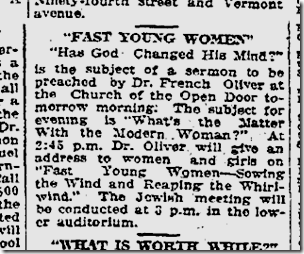
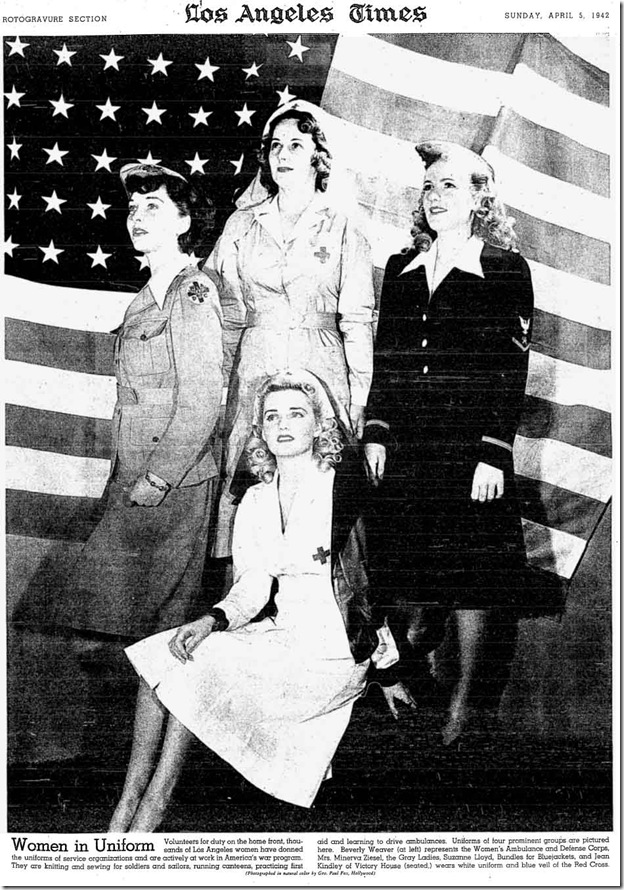
Dec. 30, 1941: It seems that local women didn’t get the memo about the being the “Greatest Generation.” They’re a bunch of slackers in the war against the Axis and don’t want to work as air-raid wardens.
“Los Angeles women have been challenged and they are not meeting the challenge,” says Mrs. John Stearns Thayer, head of the California Federation of Women’s Clubs.
“Even in the small towns of the San Joaquin Valley I found registration for all services 100%. Los Angeles women are lagging with an indifference and a selfishness that is most disturbing. They are asking other women to work overtime to protect them — and that is terribly unfair.”
It seems that women lose interest once they discover that there’s no uniform (gasp!) and there’s no pay (ahem).
“They Died With Their Boots On” starts tomorrow at the Warners Hollywood and Downtown. (Added feature, “Rhapsody in Rivets.”)
Tom Treanor writes that wartime sacrifices will be good for Americans, who have gotten soft and lazy. “More walking won’t do many people harm. For the long haul, there are streetcars and buses? Remember them?”
Jimmie Fidler says: Mary Astor, who turned over her husband (Manuel del Campo) to the Canadian R.A.F. months ago, has now turned over her private plan to Uncle Sam.