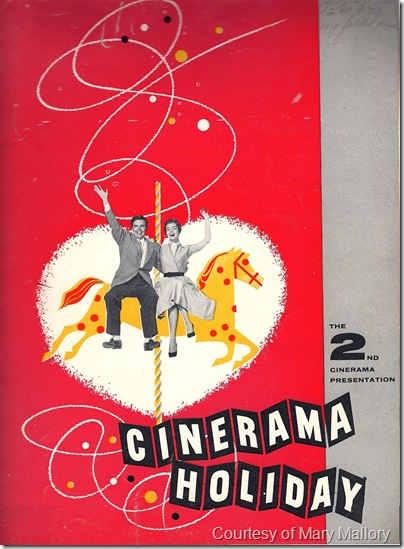
“Cinerama Holiday” is being presented this weekend during TCM’s Classic Film Festival. The film will be shown Sunday at 9 a.m. at the Cinerama Dome.
Here’s Mary Mallory’s post on Philippe de Lacy and ‘Cinerama Holiday’ from last October
“Cinerama Holiday” is being presented this weekend during TCM’s Classic Film Festival. The film will be shown Sunday at 9 a.m. at the Cinerama Dome.
Here’s Mary Mallory’s post on Philippe de Lacy and ‘Cinerama Holiday’ from last October
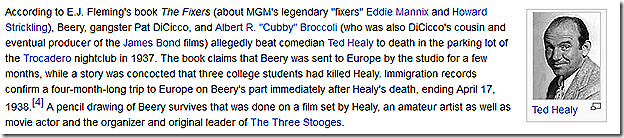
As longtime readers know, the L.A. Daily Mirror is usually a Wikipedia-free zone. I consider it a sinkhole of myth, mistakes, rumors and folklore that is created and maintained by “citizen scholars,” crackpots, coding tweakers, factoid zealots and folks in tinfoil hats. (There – that should get a rebuttal from the usual suspects).
Yes, it’s good for looking up “When was the War of 1812?” or “What color was the old gray mare?” and if you’re seeking a painfully detailed plot summary of every episode of “The Simpsons” or a lengthy biography of Eric Cartman, this place is for you. Otherwise, no.
However, I stumbled across this little jewel and when I managed to get my jaw off the floor, I thought it might be a good way to explore Wikipedia’s fundamental problems and at the same time delve into Hollywood myth. This is going to be a long, tedious examination of Wikipedia and the historical record on a molecular level. Stooge fans, I think you’re going to enjoy this.
Previously
Me vs. Wikipedia
Wikipedia Hoax Exposed
A World Without Wikipedia – Not Such a Bad Idea
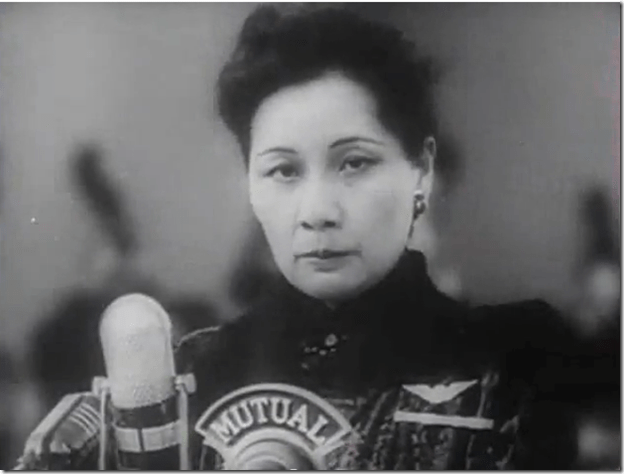
Madame Chiang in a film clip at the Hollywood Bowl, beginning at the 4:22 mark on a newsreel posted on YouTube.
Seventy years ago, film producer David O. Selznick staged an over-the-top extravaganza April 4, 1943, at the Hollywood Bowl honoring Madame Chiang Kai-Shek and China Relief, the likes of which will probably never be seen again. Featuring high showmanship and a cast of thousands, this stage show celebrated a woman as beautiful and tough as Selznick’s Scarlett O’Hara.
Selznick served as one of Hollywood’s most prominent supporters of China Relief, a cause championed by his friends Henry and Clare Luce. He agreed to organize two prominent Los Angeles events to publicize and raise funds in support, desperately needed after the vicious attacks by Japanese soldiers for more than six years. These events would occur near the end of Madame Chiang’s 1943 tour of the United States.

A world without Wikipedia – not such a bad idea.
Regular readers of the L.A. Daily Mirror know that I consider Wikipedia a sinkhole of mistakes and folklore that is created and maintained by “citizen scholars,” coding tweakers, crackpots and folks in tinfoil hats.
Beginning on Tuesday, in a multi-part series, I’m going to use one alleged incident as a way to explore Wikipedia’s fundamental problems and delve into the dubious source material on the alleged incident that was taken from a dreadful book about Hollywood.
We will find eight different Wikipedia entries on the same alleged “incident” – none of them are identical and some of them contradict one another – and we will discover that the book used as “source material” is not only filled with errors but contains malicious lies about people who are conveniently dead and unable to defend themselves. It’s the kind of source material that would be banned from any respectable encyclopedia but fits nicely with Wikipedia’s “citizen scholar” ethos.
Tune in Tuesday morning.
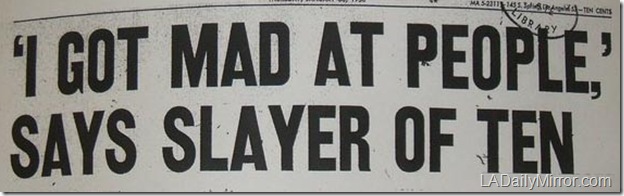
Among the events scheduled for this weekend’s Los Angeles Times Festival of Books, you may especially enjoy a panel moderated by Patt Morrison titled “The Real L.A. Noir,” featuring reporters Andrew Blankstein and Richard Winton — and me.
The panel is 3:30 p.m. to 4:30 p.m. on Saturday in Los Angeles Times Booth 60. Hope to see you there – and bring your questions!
Photo: A headline from the Mirror about the Charles Starkweather case. You would NEVER see a headline like this in The Times. Ever. I used to have this over my desk and the folks shooting “The Soloist” liked it so much that they plastered it all over the newsroom.
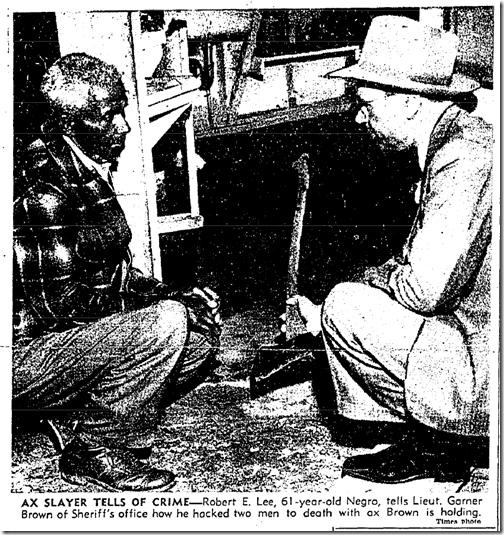
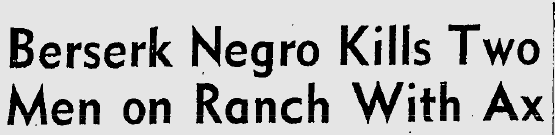
April 18, 1943: Robert Earl Lee, 61, a worker at ranch in the Malibu Hills, surrenders to authorities after killing his employer, Nelson Ross Wolfe, and another ranch hand, Albert Everett Miller, with an ax.
Lee, described by The Times as “a short, frail-looking Negro,” said: “Mr. Wolfe bawled me out for not moving the milk cow out to pasture and about the chicken yard last Friday…. This morning he took me on again and asked me if I thought cows could fly like mosquitoes and get into pastures over fences. So I just grabbed an ax and hit him.”
Lee was sentenced to life in prison in the killings.
Also: A Russian village is being built at Santa Monica Boulevard and Formosa Avenue for “The North Star.” And yes, in later years this movie will be deemed subversive, showing communist influences in Hollywood.
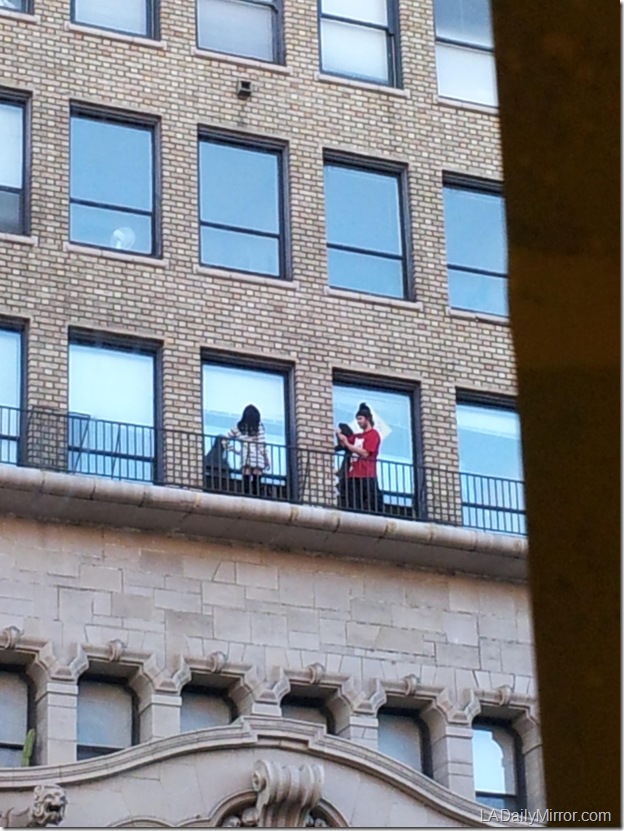
The things you see in downtown Los Angeles.
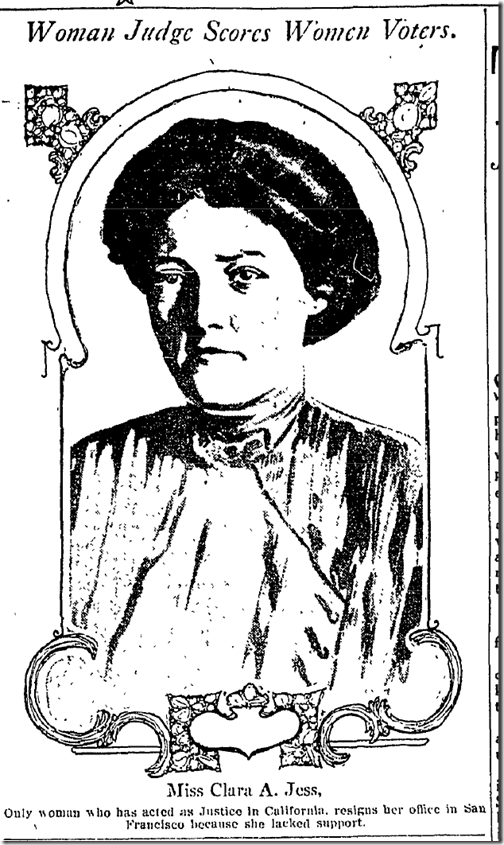
April 17, 1913: Clara Jess, described as the first woman in California to be appointed as a judge, resigns after a year. She was the recorder of Daly City and functioned like a justice of the peace, according to an A.P. story in The Times.
Jess was sued on allegations of false imprisonment after jailing the town marshal for a day because he refused to serve a warrant on a friend.
“Miss Jess does not believe that women are temperamentally unfitted for the bench but she is disappointed at the lack of support she received from women voters,” the A.P. story says.


The entire issue of the Los Angeles Star is available via USC, scanned from a copy at the Huntington.
April 11, 1863: Very slim pickings for local news this week as nearly the entire issue of the Los Angeles Star is devoted to long, tedious, vitriolic rants about the Republican Party, Lincoln and the Civil War.

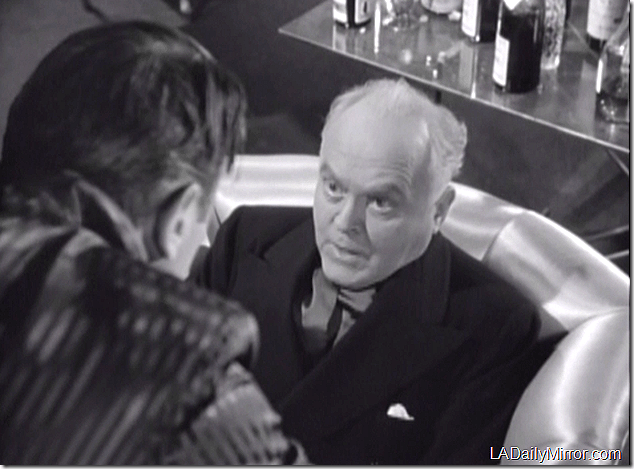
And here’s a mystery chap for Monday. Note his interesting choice of headwear.
Update: Yes, this is “Riding High,” which is one of the strangest movies I have ever seen. Entire sequences (not just a shot here or there) were picked up in big chunks from “Broadway Bill” and several of the actors — including Clarence Muse, Douglass Dumbrille and Ward Bond — were brought back to add new footage. The time warp between 1934 and 1950 is staggering. If anyone knows of another movie where this was done, leave a note.

Eighty-five years ago, the Mack Sennett Studio opened at 4024 N. Radford in Studio City. The studio functioned as a magnet in hopes of drawing other film production companies and studios to the surrounding land owned by Central Motion Picture District.
The Central Motion Picture District land syndicate was conceived by Harry Merrick, formerly president of the Chicago Assn. of Commerce, now a local real estate man. Merrick helped organize Chicago’s Central Manufacturing District and recognized that the wide-open space near the Los Angeles River in North Hollywood could function in a similar fashion for the movie industry.

“City Across the River” with a young Tony Curtis, left.
Shady dames and slick gunsels are now on screen during the 15th Annual Film Noir Festival spooling at American Cinematheque’s Egyptian Theatre in Hollywood. Usual suspects like “Sunset Boulevard” and “The Killers” are joined by rare archival prints of many films chosen by Czar of Noir Eddie Muller and Los Angeles Kingpin Alan K. Rode.
The opening weekend featured Cy Endfield’s shocking and powerful “Try and Get Me,” based on an actual 1934 kidnapping and murder in San Jose. A very young Lloyd Bridges plays a flashy yet psycho hoodlum who guides struggling ex-vet Frank Lovejoy into a life of crime. “The Other Woman,” a poor man’s “Sunset Boulevard,” features Cleo Moore as a bad actress out to punish the director for denying her a small part. “Repeat Performance” could be called the “It’s a Wonderful Life/Groundhog Day” of noir, in which Joan Leslie relives a year of her life wondering if outcomes will change.
Special screenings of upcoming films not on DVD include 1949’s “City Across the River,” featuring a young Tony Curtis, and a double dose of Cornell Woolrich, with Burgess Meredith and Claire Trevor starring in “Street of Chance” (1942), followed by L.A. Daily Mirror favorite Gail Russell in 1948’s “Night of a Thousand Eyes.”
Other rare noirs include “Chicago Calling” (1952), with Dan Duryea portraying an unemployed, alcoholic photographer prowling the streets of Los Angeles’ Bunker Hill, “Appointment With a Shadow” (1951), a Cinemascope noir, “Guilty Bystander” (1950), with Zachary Scott playing an alcoholic ex-cop out to find his kidnapped son, “Cry of the City” (1948), an Expressionist story of good and evil, with Victor Mature and Richard Conte chasing each other over Manhattan’s dirty streets, a foreign version of “Native Son” (1951), featuring an appearance by novelist Richard Wright himself, and “No Way Out” (1950), in which a young Sidney Poitier makes his feature film debut.
For a crackling ending to proceedings, the festival concludes with a screening of “Roadhouse” (1950), followed by what the Film Noir Foundation is calling “Jefty’s Roadhouse” in the Egyptian’s courtyard, which includes Italian dinner, martinis, Dean Mora’s hot Swingtet, sultry vocalists, burlesque, bowling, and an interactive movie mystery caper. Check out the American Cinematheque’s website for further information and to purchase tickets.

April 12, 1983: Oscar-winning animator Zbigniew Rybczyński, 34, is in custody on charges of battery after he allegedly kicked a security guard in the groin outside the Academy Awards ceremony at the Dorothy Chandler Pavilion — and then kicked a deputy in the groin while being taken into custody.
Rybczyński, who did not speak English, won an Oscar for the eight-minute film “Tango.” Officials did not know of a motive for the attack, The Times said.
Oh look at this:


April 11, 1943: And here begins one of my favorite “Li’l Abner” episodes: Zoot Suit Yokum.
The Times reports a strange encounter on Guadalcanal in which an unidentified Marine took a rifle from a wounded Japanese lieutenant.
According to Torrance Police Chief John Stroh,who had temporary possession of the rifle, before the Japanese lieutenant died, he told the Marine that he was from El Monte and had graduated from El Monte High School and USC. The lieutenant had apparently gone to Japan just before the war.
Hedda Hopper writes positively about “Mission to Moscow,” a movie she — and many others — denounced during the McCarthy era. (She also considered “Mr. Smith Goes to Washington” and “Meet John Doe” to have communist influences).
Now filming: “Henry Aldrich Haunts a House,” “Corvettes in Action,” “Saratoga Trunk” and “A Guy Named Joe.”

April 10, 1913: The Times seems to be featuring a woman artist, but it’s difficult to make out her elaborate signature. Is it N. Tanaga? V. Tanaga? V. Kanaga? Aha! she was Neva Kanaga. Further research indicates she was Neva S. Kanaga, who was 20 in 1912 and married to Marvin H. Brown, 23, of Fresno. She later worked as an illustrator under the name Neva Kanaga Brown.
On the jump, a clever piece of writing, typical of the era, about a bear that escaped from its owner at Main and 68th streets. And no, the police did not shoot the bear out of the palm tree.
Talk about unintended consequences: A bill before the Legislature designed to prevent Japanese farmers from owning land in California could apply to European investors as well. Oops.
Among the events scheduled for the upcoming Los Angeles Times Festival of Books (April 20-21), you may especially enjoy a panel moderated by Patt Morrison titled “The Real L.A. Noir,” featuring reporters Andrew Blankstein and Richard Winton — and me.
The panel is 3:30 p.m. to 4:30 p.m. on April 20. Hope to see you there – and bring your questions!
Photo: A headline from the Mirror about the Charles Starkweather case. You would NEVER see a headline like this in The Times. Ever. I used to have this over my desk and the folks shooting “The Soloist” liked it so much that they plastered it all over the newsroom.


Read the entire April 4, 1863, issue, from the Huntington Library, scanned by USC.
April 4, 1863: Most of this issue of the Star is devoted to the Civil War and virulent criticism of the North, Abolitionists, President Lincoln, etc.
One item of local interest involves the turnpike over San Fernando Mountain being built by Mr. E.T. Beale. Beale received a franchise for a turnpike from the Legislature, but the Board of Supervisors was unwilling to ratify his franchise because the grading wasn’t good enough. The board and Beale reached another agreement providing for further grading of the road and recommended a toll lasting 20 years as follows:
$2 for a team of 12 or 10 animals
$1.75 for a team of eight animals
$1.50 for a team of six animals
$2.25 (presumably $1.25) for a team of four animals
$1 for two animals
50 cents for one animal
25 cents for a horse and man
25 cents for pack animals
10 cents each for cattle or loose animals
3 cents for sheep.

This is a special shout-out to one of our regular readers, Grant Lockhart. Enjoy, Grant! Sorry about the fuzzy quality. It’s the best I can do.
Update: Dear friends, I regret to report the loss of one of our regulars, Grant Lockhart, the father of Claire Lockhart, whom many of you know. Grant was an expert on old films and regularly identified our mystery movies. You may recall that he recognized last week’s mystery film, “Flesh,” from the first image. Claire writes by way of biography: “He was a celebrity journalist with the Daily Mail and Weekend magazine in London. Old movies were his great passion.”
Grant had been in declining health for some time and was a fan of B-Westerns, so I thought he would enjoy seeing an old “horse opera” as a mystery movie, and I planned this week especially for him. Sadly, he passed away without ever seeing it. So let’s finish out the week in his honor. I apologize for the fuzzy quality of these pictures, but I don’t have any B-Westerns in the archives and I had to obtain this from another source.

When Americans think of classic illustrators from the early 20th century, names such as Charles Dana Gibson, Harrison Fisher, Haskell Coffin, James Montgomery Flagg, and John Held Jr. spring to mind. Forgotten by almost everyone, but in every way these men’s equal, is the great female artist Nell Brinkley. Her image of American womanhood supplanted that of Gibson, conveying the vivacity, intelligence, and spunk of young women eager to take on the world.
Born on Sept. 5, 1886, Brinkley scribbled drawings growing up as a child in Edgewater, Colo. Headstrong and determined, she announced at age 17 that she would leave high school to earn a living as an artist. Soon thereafter, the Denver Post hired the young woman as an editorial cartoonist at $7 a week. Unfortunately, she earned the nickname “Smearo” and was fired after six months. After two years of art school, Brinkley was hired by the Denver Times to draw what became her stock-in-trade, beautiful girls.