
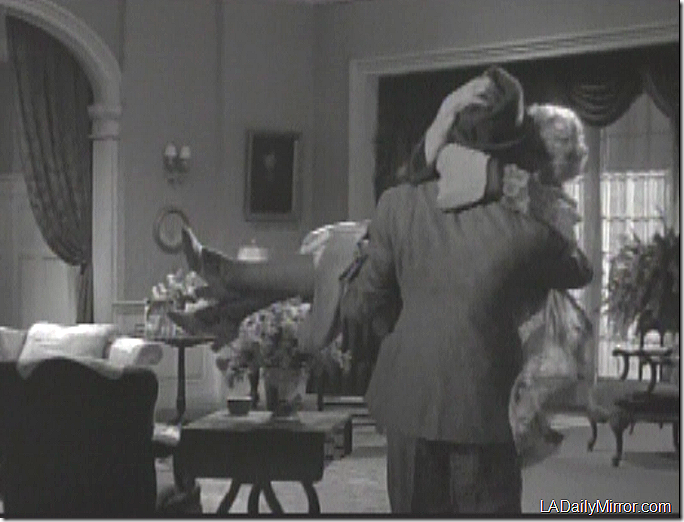
And we start the week with a couple of mystery folks.
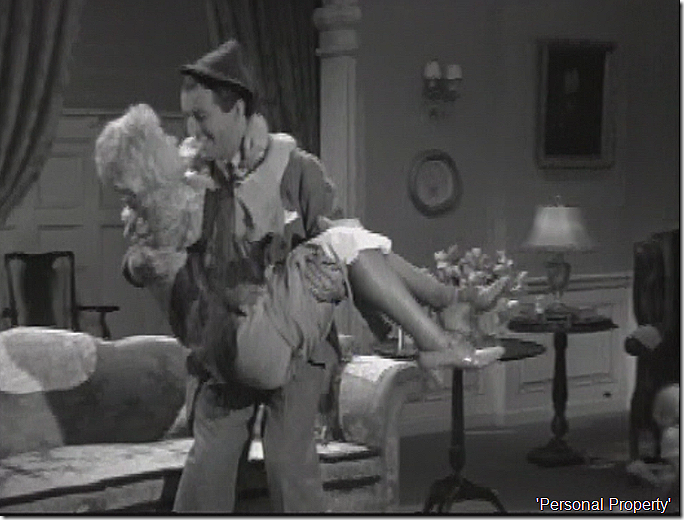
You’ll have to admit, it would have been much easier to identify “Personal Property” if I had used some of these shots.
And we start the week with a couple of mystery folks.
You’ll have to admit, it would have been much easier to identify “Personal Property” if I had used some of these shots.
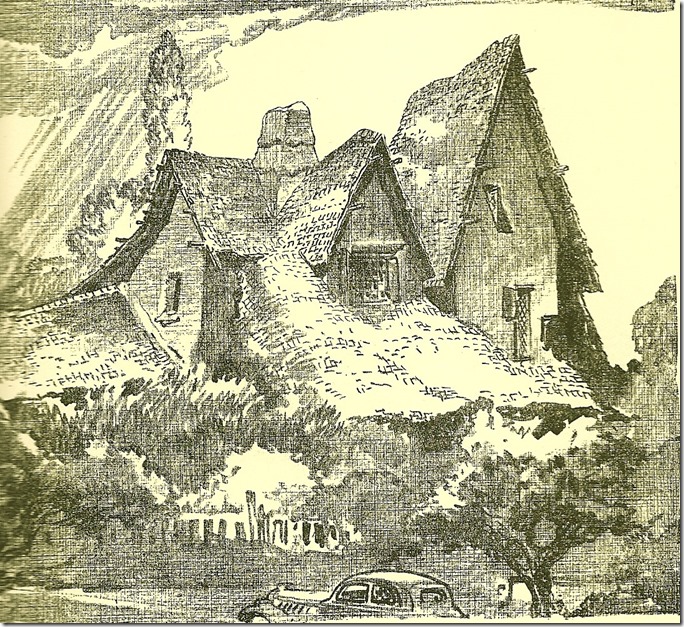
A sketch of the “The Witch’s House” by Charles Owens from “Nuestro Pueblo,” courtesy of Mary Mallory
Once upon a time, home design and architecture saluted fantasy and make-believe, and not just in fiction. Bilbo Baggins and lucky leprechauns resided in twee little bungalows, short, off-kilter, hutch-like, but so did imaginative and childlike Los Angeles residents of the 1920s. Storybook architecture, dreamed up and promoted by film industry veterans, flourished near movie studios, magical little Brigadoon-like structures.
A strong proponent of storybook design was Hollywood art director Harry Oliver. Noted for his work as art director on films “7th Heaven” (1927) and “Street Angel” (1928). Oliver merrily dreamed up colorful structures on the side, like the famous Van de Kamp’s windmills and Los Feliz’s Tam-o-Shanter restaurant. Another whimsical structure, however, remains his most famous design, the Witch’s House in Beverly Hills.
Mary Mallory’s “Hollywoodland:Tales Lost and Found” is available as an ebook.

What grandma used to call a “penny postal” showing the State Normal School in Los Angeles has been listed on EBay. And who would like to tell us what’s there now? This postcard is listed as Buy It Now for $2.99.
 Note: I’m reposting an item for newer readers that I originally wrote in 2006 for the 1947project.
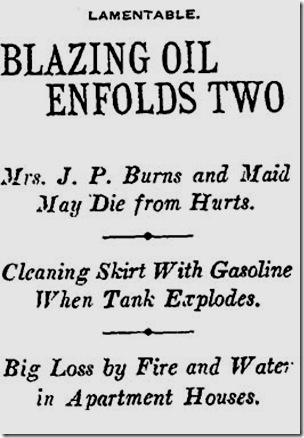
Oct. 26, 1907: Two women in the West Adams District were badly burned and expected to die after a bowl of gasoline they were using to clean a soiled dress exploded, engulfing their apartment at 42 St. James Park in flames.
Mrs. James P. Burns (identified helpfully by The Times as the wife of James P. Burns) and maid Catherine Blake had spread a dress across a table and wrapped their hands with rags soaked in gasoline to clean it. Because the electric lights weren’t bright enough, Burns told Blake to light several candles. The candles ignited the bowl of gas, which in turn set off a nearby tank of gasoline.
With her clothes on fire, Blake ran to the rear porch of the second-story apartment and jumped to the ground while Burns fled to a hallway. The building manager ran to the second floor upon hearing the explosion and wrapped Burns in a rug to extinguish the flames.
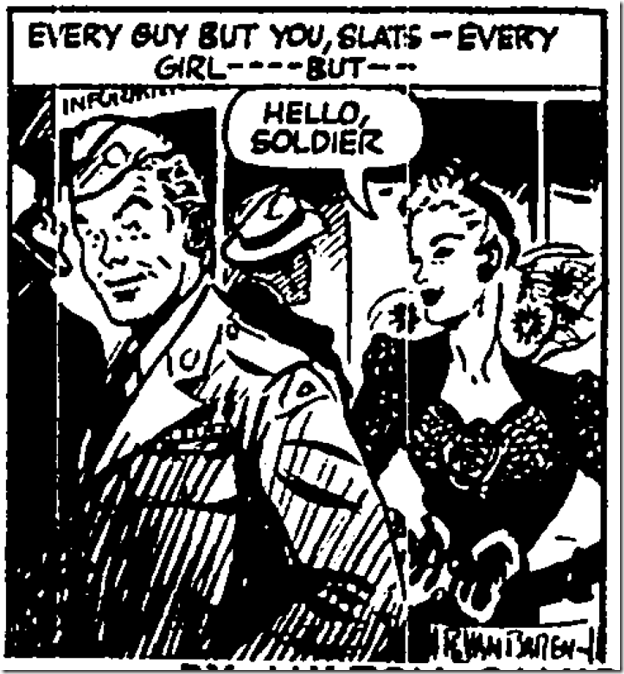
Oct. 25, 1943: Three bandits who hit a handful of businesses met their match at a cafe at 1306 S. Main St. when they tried to hold up assistant manager Joe D. Poindexter.
Two of them came into the cafe and ordered tomato juice. When Poindexter opened the cash register to ring up the sale, they drew guns.
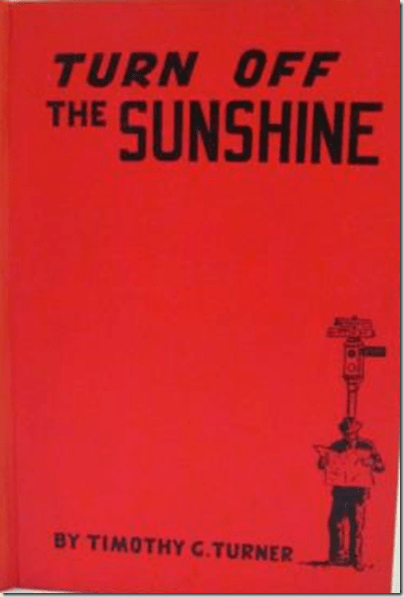
A copy of Timothy G. Turner’s “Turn Off the Sunshine” has been listed on EBay. Turner, you may recall, was the Times columnist who worked with artist Charles Owens on Rediscovering Los Angeles. Bidding on this copy of the book – which has a broken spine – is (get ready) $950. No, I’m not kidding. With no dust jacket and a broken spine.
But don’t despair. You can find it at Archive.org – free.
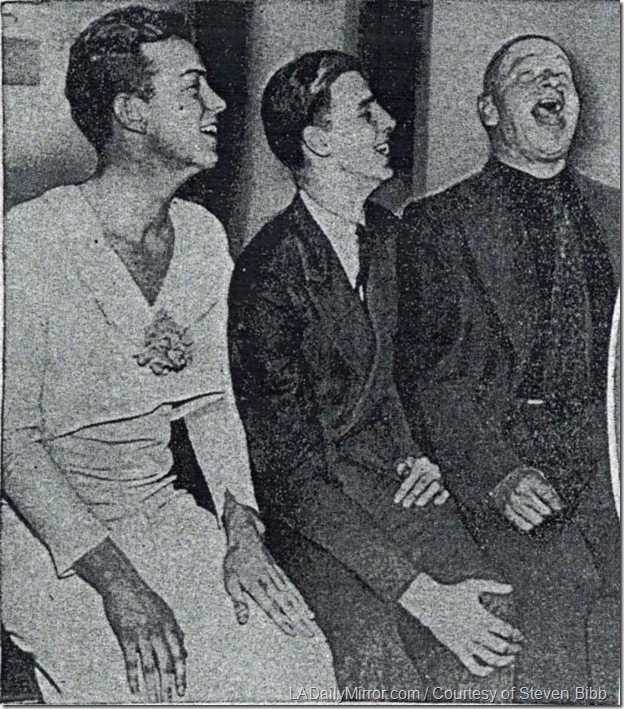
David Bacon, seven years before he was killed, in a publicity photo for the Hasty Pudding show at Harvard.
In case you just tuned in, we are looking at the unsolved Sept. 12, 1943, killing of actor David G.G. Bacon.
And here he is, before he went to Hollywood, then known as Gaspar G. Bacon, left, with John Roosevelt and Wallace Beery in an undated photo of a Hasty Pudding show at Harvard.
Again, thanks to regular L.A. Daily Mirror reader Steven Bibb for this photo, which appeared in an unidentified newspaper with a feature story by Peter Levins. Levins wrote a series of stories in the late 1940s titled “Album of Famous Mysteries.” Among other places, Levins’ stories appeared in the American Weekly, distributed with the Chicago Sunday Herald-American. Here’s a sample from 1947.
The “Masked Marvel Murder” Part 1 | Part 2 | Part 3 | Part 4 | Part 5 | Part 6 | Part 7
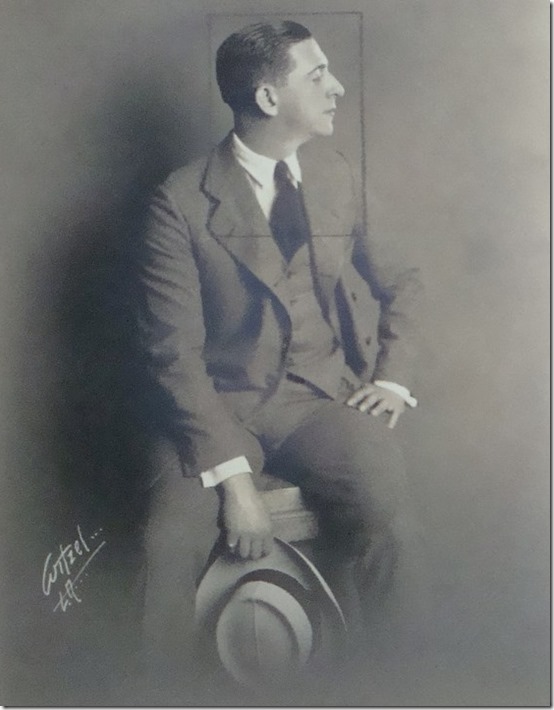
A portrait of Edward Everett Horton by the Witzel studio has been listed on EBay. Witzel was one of the leading portrait studios in Los Angeles in the early part of the 20th century and took many publicity photos for film and stage actors. Bidding on the photo of Mr. Horton starts at $39.95. Notice that someone cropped it down to a mug shot and the crop lines are, alas, intact.
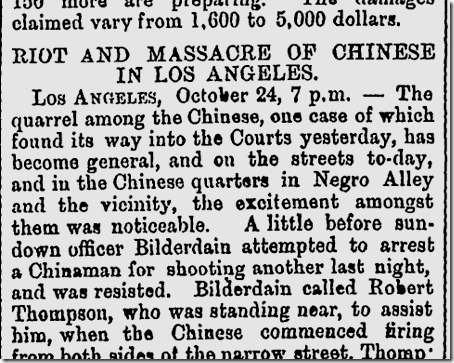
At top, an account of the massacre in the Daily Southern Cross of Auckland, New Zealand, Dec. 9, 1871,
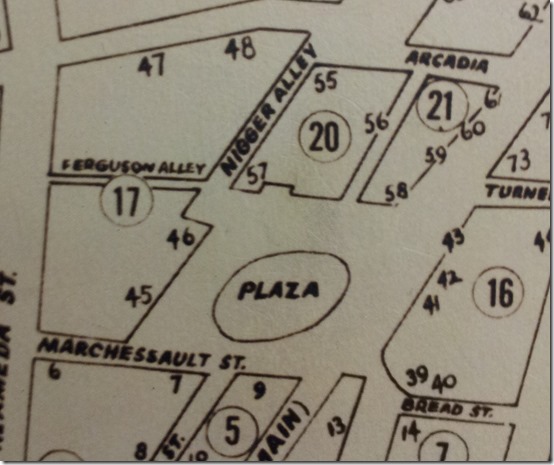
Above, a detail of a Los Angeles map displayed in the Globe Lobby of the Los Angeles Times Building showing the Plaza and what the newspaper account described as “Negro Alley.”
Tomorrow is the anniversary of the Chinese Massacre of 1871. Here’s a series of posts I did several years ago:
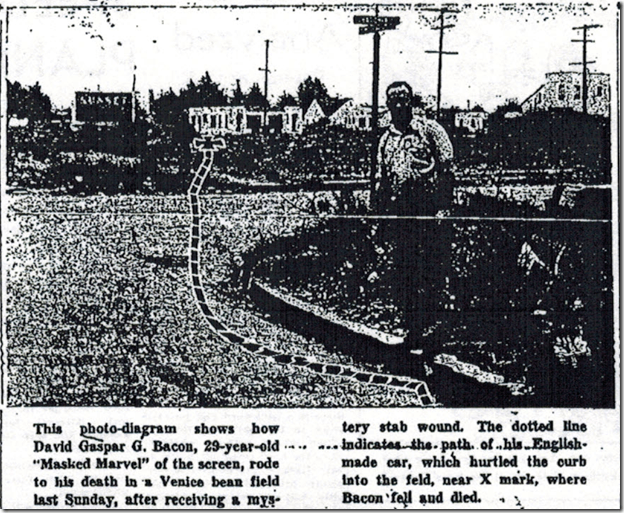
In case you just tuned in, we are looking at the unsolved Sept. 12, 1943, killing of “Masked Marvel” actor David G.G. Bacon.
And we have regular L.A. Daily Mirror reader Steven Bibb to thank for this puzzle. Steven provided me with some clips on the case, including this scan of the Sept. 14, 1943, Los Angeles Herald-Express.
The “Masked Marvel Murder” Part 1 | Part 2 | Part 3 | Part 4 | Part 5 | Part 6
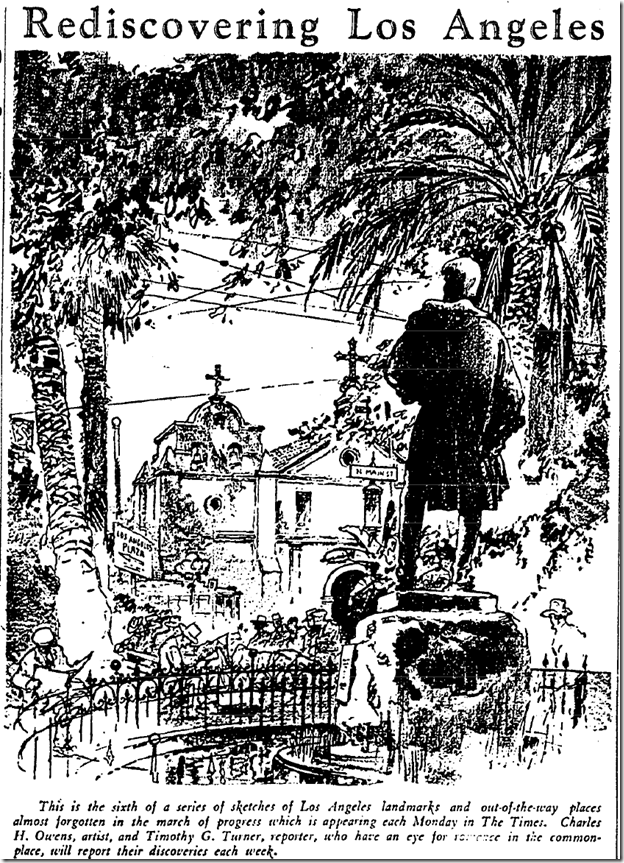
Dec. 9, 1935: For the sixth installment, Times artist Charles Owens and columnist Timothy G. Turner visit the old Plaza.
Turner says: “Historically, it was never much, never a really Mexican plaza with parking and a kiosk for a municipal band. When Los Angeles was a Mexican-American town (it still is down in Old Town) the Plaza was never parked and was a mudhole in wet weather.
[By “parking,” Turner isn’t referring to cars. He means sitting for a long time.]
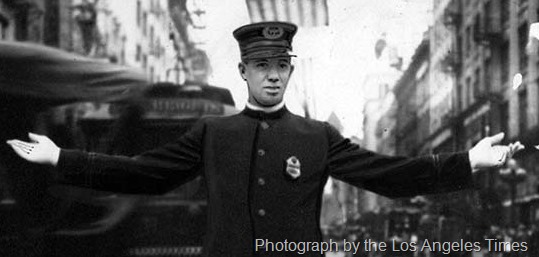
My Los Angeles Times colleague Scott Harrison does wonderful work going through The Times photo archives. Here’s his latest post on a “new”method of directing traffic in which police stopped using whistles. This is Officer F.M. Wilson at Broadway and 5th Street in 1915. (Notice the streetcar in the background)
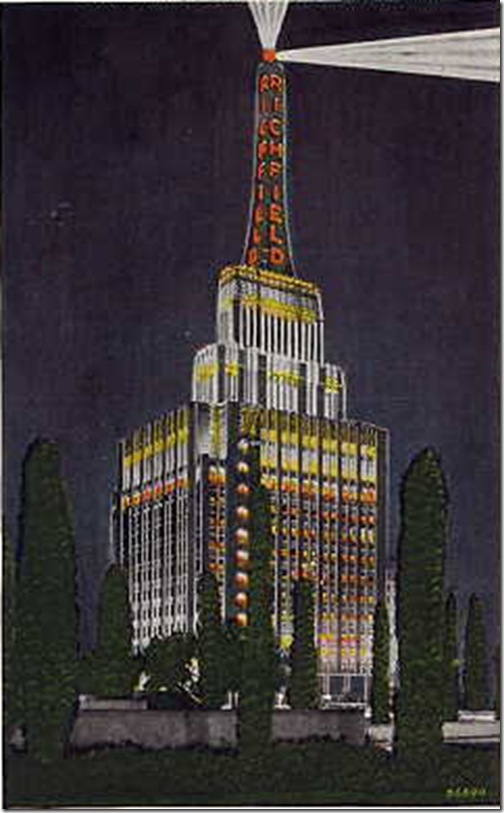
The Richfield Building in an undated postcard.
After years of deprivation, darkness and worry during World War I and its aftermath, America was ready to look toward a shining future of prosperity and sunshine in the 1920s. Overnight, fashion, music and the arts embraced change, style and risk-taking. Much was modeled after the 1925 Exposition International des Arts Decoratifs et Industriel Modernes in Paris, which displayed bold conceptions of applied arts, reveling in eclectic, glorious design. The new style embraced technology and the machine age, reflecting a belief in a dynamic, energetic future.
Architecture celebrated the Moderne style as well. Color, geometric shapes and lavish ornamentation replaced monochromatic massing in buildings. Triangles, sunbursts and zigzags screamed progress in modern buildings as they stretched toward the sky. New York’s Chrysler Building exemplified the new look, bold, sleek and gorgeous. The American Radiator Building also embraced the modern by daring to wreath itself in gold and black colors, a glamorous and contemporary design.
Mary Mallory’s “Hollywoodland: Tales Lost and Found” is available at Amazon.
Sorry, folks. No mystery movie this week. Everything should be back to normal next week. But wait! I think I’ve fixed it!
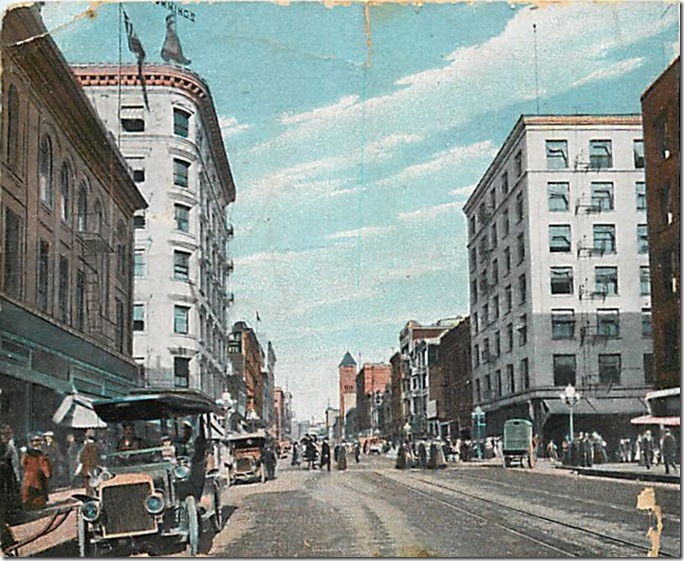
This postcard, marked 1909, showing Broadway, looking north just below 4th Street, has been listed on EBay. Bidding starts at $8.95.
And for comparison, here’s what it looks like on Google Street View.
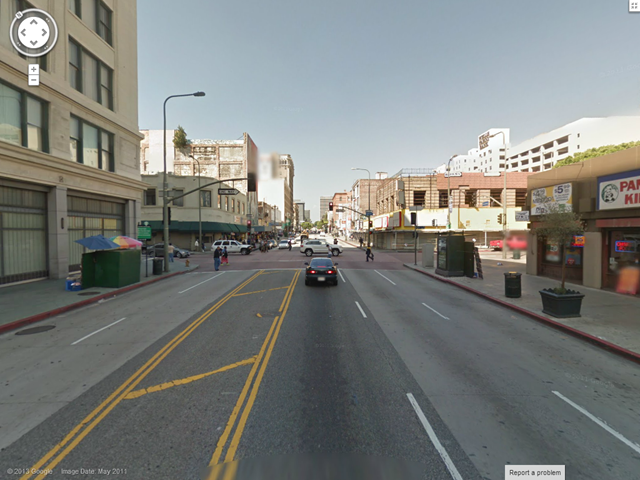
Let’s take a closer look.
Oct. 18, 1943: Los Angeles is in the middle of a paternity suit brought by Shirley Evans Hassau, 21, against Errol Flynn. Hassau charged that Flynn was the father of her daughter Marilyn, who was 3. Hassau was seeking $1,750 a month child support, $10,000 in attorneys fees, $5,000 for hospital expenses and $2,000 in court costs.
An aunt, Florence Muller of San Francisco, had raised Marilyn since she was 5 weeks old and refused to let Hassau see her, The Times said.
Hassau’s suits against Flynn were dismissed in 1951. In 1940, two weeks after Marilyn was born, Flynn agreed to pay Hassau $2,000 although he denied being the father. The actor said he wanted to avoid a long court trial and adverse publicity.

In case you just tuned in, we are looking at the unsolved Sept, 12, 1943, killing of actor David G.G. Bacon, who appeared in Republic’s “Masked Marvel” serial.
In Part 1, witnesses described Bacon driving erratically on Washington Boulevard, then crashing into a bean field, where he died of a deep stab wound.
In Part 2, we found that Bacon went to Venice by himself, leaving his pregnant wife, singer Greta Keller, at home. He also didn’t take his three dogs, as was his custom when he went swimming. Police said that robbery probably wasn’t the motive, because he had $13 in his wallet and was wearing two valuable rings. They also noted that he habitually picked up hitchhikers.
In Part 3, we looked at his personal life and his marriage to singer Greta Keller, who was 11 years his senior and apparently more established in her career. Of particular interest was his arrest for contributing to the delinquency of a minor – which was reported in a United Press story, with no further details.
In Part 4, police were trying to determine the mysterious contents of a diary that Bacon kept in code.
In Part 5, it was revealed that Bacon rented a studio apartment a mile from his home.
Today we will look at the mysterious sweater found in his car.
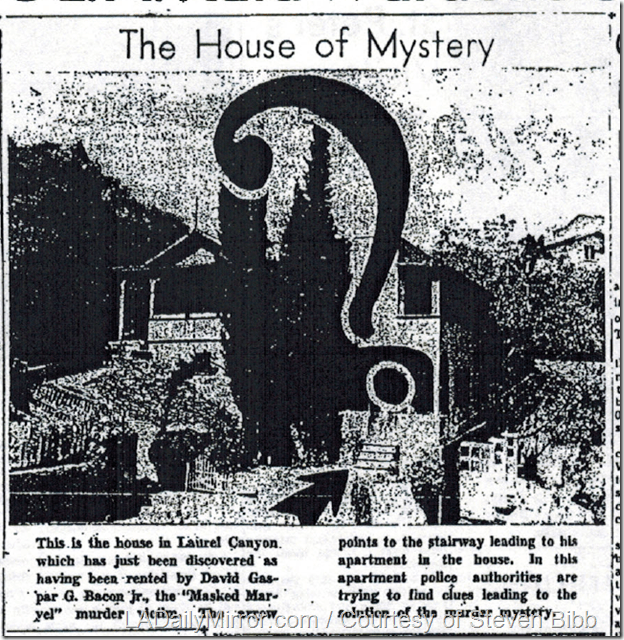
David Bacon’s secret getaway, from the Sept. 18, 1943, Los Angeles Herald-Express, courtesy of Steven Bibb.
In case you just tuned in, we are looking at the unsolved Sept, 12, 1943, killing of actor David G.G. Bacon, who appeared in Republic’s “Masked Marvel” serial.
In Part 1, witnesses described Bacon driving erratically on Washington Boulevard, then crashing into a bean field, where he died of a deep stab wound.
In Part 2, we found that Bacon went to Venice by himself, leaving his pregnant wife, singer Greta Keller, at home. He also didn’t take his three dogs, as was his custom when he went swimming. Police said that robbery probably wasn’t the motive, because he had $13 in his wallet and was wearing two valuable rings. They also noted that he habitually picked up hitchhikers.
In Part 3, we looked at his personal life and his marriage to singer Greta Keller, who was 11 years his senior and apparently more established in her career. Of particular interest was his arrest for contributing to the delinquency of a minor – a 15-year-old newsboy – which was reported in a United Press story.
In Part 4, police were trying to determine the mysterious contents of a diary that Bacon kept in code.
Today, Bacon’s secret hideaway.

 ladailymirror.com