
Native Angelenos will, of course, recognize that this photo was taken at the end of Reseda Boulevard about 1947. The man with the model airplane is W. Gilbert Clark, now UCLA professor emeritus of physics. Thanks for sharing!

Native Angelenos will, of course, recognize that this photo was taken at the end of Reseda Boulevard about 1947. The man with the model airplane is W. Gilbert Clark, now UCLA professor emeritus of physics. Thanks for sharing!
Edith Piaf opens at the Mocambo. Chet Baker… Art Blakey… Buddy Collette…. Slim Gaillard….And look at all the Dixieland groups. Who knew?

 July 18, 1957
Don Bailey Jr. has no red tab on his rear license plate.
He applied for it like other motorists during the renewal period but
never received it. Apparently it was lost in the processing at
Sacramento or in the mail.
He is stopped almost every day and asked about the tab.
He explains the situation to the officers. He shows them his canceled
check for $84 ($601.88 USD 2006) dated Feb. 4 and a memo that he is authorized to drive
the car, a 1955 Olds, License BBS664. He tells them this has been
verified by the Inglewood and L.A. offices of the Motor Vehicle
Department and he has been instructed to carry the check and memo with
him at all times until the matter is cleared.
The officers sympathize and let him go.
On July 7, at about 1:30 a.m. Bailey was stopped near 39th and
Crenshaw. His wife, sister-in-law and sleeping child were in the car.
One officer put a flashlight on his rear plate and asked to see his 1957 license. Bailey handed him his “evidence.”
The officer was unconvinced and wrote a citation. He listed three
counts–wrong address on operator’s license, lights out of adjustment
and “no evidence of ’57 registration.”
Bailey refused to sign the citation. Then, as he puts it, “We both got pretty hot.”
The officer said he’d have to take him in if he didn’t sign the ticket. Bailey remained adamant.
The officer handcuffed him behind his back and Bailey told his wife to drive their car home.
At University Station, Bailey was given the usual alternative–sign the ticket or be booked in jail. He finally decided to sign.
He explains, “The reason I didn’t want to sign it was that to do so
would be conceding that I was driving my car illegally and that I’d
thrown away my $84.”
When the case comes up in court, Bailey plans to plead not guilty.
CULTURAL NOTE–Remember
the ubiquitous wartime phrase “Kilroy was here?” Well, in the men’s
room of a Hollywood Boulevard restaurant-bar, reports Tom Lempertz,
someone has written, “In hoc loc Kilrex erat.”
CURE FOR INSOMNIA
My body is ready for slumber
Except for my worrisome head;
It’s best to abandon the blankets
And watch the late movie instead.
–Martha Manheim


Mildred Hall, 44, who vanished Nov. 15, 1956, and was the subject of a
Paul Coates column, resurfaced in April 1959, posing as many baffling
questions as she did when she disappeared after leaving a note for her
husband, Harold, that she was running some errands and would be back
soon.
"I always prayed. God, how I prayed someone would recognize me," said
Hall, an actress who gave up her movie career to raise a family.
"The first thing I remembered was sitting in a bus station in Meridian,
Miss., with 33 cents in my pocket and a ticket for New Orleans," she
told The Times.
She worked as a cocktail waitress in New Orleans, but after being
robbed apparently blacked out and found herself on a ship bound for
Manila. Next, she stowed away on a ship to Havana, she said.
"There, I got a job as a shill in a casino and earned enough money to
fly to Key West Fla., where I worked for six months as a singer. Then I
teamed up with a magician and his wife and traveled across the
country," Hall said.
Somehow, she got to Ventura, where she was hospitalized. While she was gone, her husband divorced her, The Times said.
There’s no further word in The Times on Hall or what became of her
children. It’s impossible to sort out all the Mildred Halls in the
California death records and the Social Security Death Index. She had a brother, Bob, who was a lifeguard in Santa Monica in the 1950s. Her mother, Adeline M. Lucas, died Feb. 24, 1976.
We also know that her father, Charles M. Lloyd (real name Charles Lloyd Maude),
an actor in silent films and vaudeville, died in Camarillo State
Hospital in 1948, so there may have been some predisposition toward mental
illness. But that is only a guess. As Coates said: "Mildred Hall is not
a simple person to explain."

July 17, 1957
Los Angeles
The painful comparison: "800 Negroes Lose Jobs" and "Deep South Editors Here, See Race Tension Ending." And to make things even worse, the Southern editors were entirely well-meaning and sincere.
The Mirror interviewed editors from a variety of U.S. newspapers who were in Los Angeles to attend "Editor's Day" at Disneyland the week after the American Society of Newspaper Editors convention in San Francisco.
Although the story mostly gathered the editors' impressions of Los Angeles, it led with the views of George Chaplin of the New Orleans Item and Grover C. Hall of the Montgomery, Ala., Advertiser.
Chaplin, a former editor of Pacific Stars and Stripes who was later editor in chief at the Honolulu Advertiser, said: "I believe there is too much generalization about the race problem–which is a national and an international problem, rather than one confined to the South. There is a tremendous body of goodwill in the South and it is found among the moderates. But too much of the news is being made by extremists since the moderate, by nature, is reluctant to grab the mike or the headline."
What's even more interesting are the remarks by Hall, who won a Pulitzer Prize in 1928 for editorials attacking racial and religious intolerance. According to a 1941 Time magazine article, Hall broke the power of the Klan in Alabama.
According to the Mirror: "Hall said his city is proud of its Negro population, and that they are fitting into the community from an economical standpoint.
"Of course," he said, "colored people are leaving the rural sections in spectacular fashion. However, those that remain manage to contribute to the community in a very satisfactory manner.
"We have no violence. The colored people, for the most part, are resolving the problem themselves. Our part is to help."
Let me repeat that: The editor of the Montgomery, Ala., Advertiser says there's no violence. In 1957. And the Mirror let him get away with it.
Jan. 6, 1957
Jan. 11, 1957
Jan. 28, 1957
May 31, 1957
We don't have any problems in Montgomery. No sir. "The colored people, for the most part, are resolving the problem themselves."

July 17, 1957
Los Angeles
With the cancellation of the Navaho cruise missile program, North American Aviation made plans to lay off 15,600 employees, nearly a third of the workforce at its plant in Downey.
Efforts
were made to find jobs for some of the workers at other aerospace firms
such as Douglas, which was making the DC-6 and DC-7, Hughes, Lockheed
and Northrop. The State Department of Employment was also staying open
in the evenings to help place workers, the Mirror said.

"But
the consensus appears to be that only the engineers and some highly
skilled types–such as machinists, tool designers and makers–will find
it easy to get new jobs," the Mirror said. "For the ordinary aircraft
worker, it will be tough sledding. And there is still the possibility
that additional thousands will be laid off as the result of
cancellation by NAA of more than $35,000,000 in orders placed with
subcontractors."
The layoffs were difficult for all employees,
but the California Eagle, a weekly newspaper serving the African
American community, focused on about 800 black workers who lost their jobs. (And in case there is any doubt, the headline above is from the Eagle, certainly not any of the white newspapers in Los Angeles).
"Some of the laid-off Negro workers report that they have been
offered jobs at other North American plants–as janitors," the Eagle
said. "Some of the workers interviewed by the Eagle stated that Negro
men and women who have been working in skilled jobs and who have
seniority have been offered employment at other North American
facilities through the Los Angeles area, but not at their customary
skills.
"According to these reports, at least two of the very
few Negro women employed as electronics assemblers have been asked to
return as janitors–cleaning bathrooms, keeping areas clean, etc.
"These
workers also say that at least one Negro engineer, one toolmaker and
one friction tester have also been told they could be hired as
janitors."
Workers harshly criticized the Eisenhower
administration for scrapping the Navaho, the Eagle said. "Said one
worker: ‘There’s not a Republican in this end of town.’ "
Defense
Secretary Charles Wilson, the former president of General Motors, was
particularly disliked, the Eagle said, because a GM division near
Milwaukee had been given a large missile contract.
"Most of the Negroes who worked in Downey lived in Watts and Compton,
Downey being a lily-white town," the Eagle said, quoting Nate Brown,
head of the United Auto Workers unit representing employees in the
missile program.
Brown denied charges that there was discrimination in laying off black
employees. "While some Negroes were hit as the ‘last hired,’ for the
most part Negroes fared about the same as whites," Brown said.
"About
90% of the black employees at North American had been hired in the
lowest-paying jobs as janitors, laborers and in the shipping and
receiving departments. A number of these men, however, have been
upgraded, largely as a result of union pressure," Brown said.
Although
the Navaho missile was canceled, some of the rocket propulsion,
supersonic airframe and guidance technology was used in later
projects.
Note: North American eventually lowered the number of layoffs to 12,000.
Photograph courtesy of NASA.

Photograph by Larry Harnisch Los Angeles Times
Here’s something fun to do on a Saturday morning: Meet friends for
breakfast at a restaurant where a drunk movie actress plowed her new
convertible through the front window in 1957.
When I read the story I assumed Russell was in the parking lot and
simply hit the gas pedal instead of the brakes. But no. After looking
at the height of the curb and width of the sidewalk, I decided she must
have been flying. And as there’s no side street directly across Beverly
Boulevard from where she struck the restaurant, I can’t imagine how she
managed to hit it so squarely perpendicular. But she did.
Here’s the counter, 1957:

Los Angeles Times
And the counter today:

Photograph by Larry Harnisch Los Angeles Times
Since you asked, Jan’s is a pretty nice breakfast place. It was a bit
of a brain-teaser that early in the morning to ponder why a half-order
of French toast costs more than the jumbo French toast, but the three
of us put our heads together and figured it out. Definitely worth
another visit.
July 16, 1957
 Account 727-1 in the auditor's office of the Southern Pacific is known within the company as the "Conscience Fund."
It consists of money sent in by people for services rendered but unpaid for. An average of $200 a year is contributed, mostly anonymously.
Many such conscience cases are of long standing. Recently, a man sent in $250 as restitution for tools he took from the company in 1896.
A more typical donation came from "A Patron"– a $1 bill for a train ride beyond the point called for by his ticket.
Another made good the freight charge on a bicycle he sneaked aboard a train.
Last month, this letter came from a woman of 83:
"In the late summer of 1887 with an uncle and aunt who were supporting and caring for me, I came from East Portland, Ore., to Pasadena, Cal., tourist or second class. I came on a half-fare ticket. My birthday was in December 1874, making me between 12 and 13. If the conductor had asked for full fare for me I think my uncle would have paid it. He died many years ago. I wish a clear conscience concerning this. Kindly inform me what amount for restitution will be satisfactory to you."
 After checking, the SP wrote her that the difference between the fare paid for her and an adult ticket in 1887 would have been $17.82. She promptly forwarded a check for this amount.
Realizing these people find it important to clear their minds of such obligations, the company accepts these contributions and, when names and addresses are given, commends them.
A NEW PROGRAM on mental illness, "Focus on Sanity," will be presented tomorrow on KNXT.
While at Patton State Hospital documenting the series, a camera crew focused on a woman patient who had been committed in 1908 and was singing. Another patient approached her and asked her for a cigarette.
The new "star" looked witheringly at her old buddy and said, "Don't bother me now–I'm on television." The fever gets them all.
AROUND TOWN –As Jacquelin Molinaro passed Wilshire and Western the other night a workman on a ladder changing the marquee on the Wiltern Theater called out to the driver of a red Messerschmitt (a sample, above). "Hey, bub, what is it going to be when it grows up?"
Photograph from sixtiescity.com

July 15, 1957
SUBJECT’S NAME: Mildred Dolores Hall.
SUBJECT’S DESCRIPTION: Age, 42, height, 5 feet, 6 inches. Weight, 118 lbs., Red-blond hair. Brown eyes. Slim-medium build.
Any person with information as to the subject’s whereabouts is
requested to contact the Missing Persons Section of the Los Angeles
Police Department.
Mildred Hall is not a simple person to explain.
She was born of theatrical parents and she knew the business well.
Stars and industry pioneers of 25 years ago were personal friends of
hers.
And she herself came as close to becoming a name actress as anyone can without–that is–actually doing so.
Whether she would have made it is foolish to argue.
Because at the peak of her beauty, Mildred Hall quit the business to become a wife.
It was the role she wanted. And, for the last 18 years, she apparently
played it well. She found many friends and was an active and devoted
mother to her four children.
She was, until eight months ago: Nov. 15, 1956.
What happened on that date, or since, nobody knows.
In an effort to learn–to find a logical theory–I contacted more than a dozen of her close associates and friends.

All told me what they knew. Many had personal theories. But each one’s report made the puzzle even more complex.
It was as if Mildred Hall were 12 different persons.
I’ll throw out the supposition and present what I believe to be fact.
And I hope that somewhere in it lies the key to the case of the most
complex missing person I have yet encountered.
Mildred Hall’s movements on the morning of Nov. 15 are established:
Shortly before 8 o’clock, she drove her three oldest children to
school. Then she took her youngest boy, Tommy, 4, shopping with her.
She bought groceries and a pair of shoes for her 16-year-old. She went
to the bank and drew out $100, apparently to do her Christmas shopping.
she returned home between 10 and 11.
Tommy went out to play and Mrs. Hall’s husband, Harold, who had worked the night before, was asleep.
He awakened shortly after noon and was told by his son that Mildred had gone back to town again.
Hall says he still has the note which his wife left for him on the kitchen table.
"I have an appointment uptown at 12:30 p.m. Shouldn’t be more than an
hour at most. I have something very important to talk to you about.
Lots of love, Millie."
Mildred Hall never had the "very important" talk with her husband.
Five weeks later, her car was found. It was parked in the 2000 block of
South Genesee Street, some three miles from her Palms home at 3666
Keystone Ave.
Police report that the keys were in it, and so was her wallet with all
her identification. There was no money found, but on the floor lay her
Christmas shopping list.
Thorough investigation of the vehicle revealed no other clues.
Hall reports one other discovery which struck him as strange. "When she
disappeared she left her wedding ring home on the dresser. Never
before, to my knowledge, had she taken it off."
He also says that his wife never suffered loss of memory or blackouts in his presence.
Other friends say that they had witnessed her blackouts. But that they started only shortly before she disappeared.
But strangest of all was the following report by Hall:
"It was pure coincidence.
"About two hours after she left had left home–before, of course,
anyone had any reason to suspect she’d be missing–a friend of ours saw
her shopping.
"The friend walked up to her and addressed her by name.
"But Millie just looked kind of blank. And she turned and walked away."
[Note: To be continued–lrh]


July 16, 1957
Los Angeles
At a field lab in the Santa Susana Mountains, an
experimental nuclear reactor has begun generating electricity for San Fernando Valley housewives, thanks to our friend,
Mr. Atom, the Mirror says.
Housewives "wouldn’t know it if it sparked before their eyes, for
electricity is electricity the world around," the Mirror says. "It’s
just that the source of the heat which generates the juice is
different." The reactor "marked a peacetime application of a terrifying
scientific fact–that when you split an atom, a lot of power, a lot of
heat is generated."
After explaining how a nuclear reactor works, the Mirror noted: "The
small amount of uranium in the reactor will last three years!"
Of course, it’s impossible today to say "Santa Susana Field Lab" without adding "Superfund site," a subject far too complex for this humble blog.
But let’s take a look the Sodium Reactor Experiment that began in 1957.
Before it was deactivated in 1966 and eventually dismantled at an
expense of $13 million (more than twice its original cost), the reactor
suffered a meltdown in 1959 that released 260 to 459 times the
radioactivity spilled at Three Mile Island.
Oops.

According to a story from 1979, when officials of Atomics
International–a division of Rockwell International–acknowledged the
20-year-old meltdown, "13 of the reactor’s 43 uranium fuel rods
ruptured or suffered some degree of melting in the July 13, 1959,
accident."
Although technical publications had discussed the incident for years, the meltdown was never reported in the news media.
"It was a messy accident, but I’m not aware of any evidence that it endangered the public," Theodore B. Taylor of the President’s Commission on Three Mile Island, said in 1979. "It was nothing like Three Mile Island."
(I’m assuming Taylor was not referring to the magnitude of the release but the fact that the spill occurred at a remote site rather than in a populated area).
Briefly, the reactor’s coolant system became clogged due to a leak, the
fuel rods overheated and spilled a "massive" amount of radioactive
fission products, The Times said in 1979.
"Despite numerous indications that something was wrong inside," The
Times said, "Atomics International continued to run the reactor at low
power for two weeks after the accident, shutting it down July 26, 1959.
Many original documents on Santa Susana Field Lab are available here.

 July 16, 1957
Los Angeles
Ladies and gentlemen of the jury, you have heard the witnesses and seen the evidence. Now you must decide whether to find Wallace LeRoy Schiers, 34, guilty of second-degree murder in the killing his wife, Lillian, 39, on or about Feb. 12, 1957.
Let me summarize the case briefly:
Mr. Schiers also testified that he and Mrs. Schiers had been working on their income tax returns that evening. Witnesses have testified that Mr. and Mrs. Schiers recently took out a $2,800 loan ($20,062.79 USD 2006) to put a sunken living room in their home and have said that the Schierses frequently argued about money.
Mr. Schiers and Mrs. Schiers kept separate bedrooms. Mr. Schiers, a foreman at the Bendix plant in North Hollywood, testified that he went to bed about 1 a.m. on Feb. 12, 1957, and left for work about 6:30 a.m. without checking on Mrs. Schiers. Mr. Schiers testified that when he went to bed, Mrs. Schiers was in the bathroom.
Two friends, Louise Peterson and Mildred Butcher, described finding Mrs. Schiers' body after she did not answer repeated phone calls. Mrs. Peterson and Mrs. Butcher said they entered the Schierses home about 9 a.m. through an unlocked side door after seeing Mrs. Schiers' car in the garage. They found her nude body sprawled on the floor of her bedroom with her arms outstretched. There was no signs of a struggle and detectives speculate that Mrs. Schiers may have been killed in her sleep.
Detectives said Mrs. Schiers had been beaten in the head with a heavy instrument like a lug wrench or a hatchet. Her bed was soaked with blood and there were blood spatters on the floor and ceiling. Medical experts testified that death occurred about 11 p.m. and was caused by a wound to Mrs. Schiers' left temple 2 inches long and 1 1/4 inches wide.
Investigators did not find any blood residue in Mrs. Schiers' bathroom, but found evidence of blood in Mr. Schiers' bathroom. Investigators also said that tests for blood on Mr. Schiers were positive.
Mrs. Ramona Allen, who lives in the home adjoining the Schierses' property, said that about 7:30 a.m. on the morning of the killing, she found the gate to the fence separating the two lots had been battered down. Mrs. Allen testified that about 3 a.m. that morning, she heard "a lot of commotion as if someone was prowling in her garage. "I heard an awful crash," she said. Her husband went outside to check, but didn't see anything. Mrs. Allen said that dogs in the neighborhood barked for about an hour.
Mrs. Schiers' mother, Mrs. Sally Johnson, testified that when she visited the home after the killing, she noted that two heavy glass candlesticks were missing from her daughter's bedroom and a massive green bottle was missing from the kitchen. Medical examiner Dr. Frederick Newbarr testified that the wounds on Mrs. Schiers' body were star-shaped, the same design as the missing candlesticks.
Mr. Schiers has insisted that he is not guilty of killing his wife and defense experts note that the positive test for blood is imperfect and will also register false positives for a variety of other common substances.
In addition, a polygraph test administered to Mr. Schiers by the Los Angeles Police Department was inconclusive. However, a police officer testified that Mr. Schiers was told that the test showed he was guilty and Mr. Schiers answered that there was something wrong with the machine.
Please recall that the defense objected to police testimony about the polygraph results because they are inadmissible in court. The judge has instructed you to disregard any testimony about the polygraph results.
Your verdict?
 July 15, 1957
Farther and farther go the freeways, preceded by roaring monsters which sweep aside or reduce to rubble everything in their paths, then claw and shape the earth. But all is not lost.
Every Tuesday, Lenard Kester takes his art class sketching. For this month's subject, he selected the quickly disappearing old houses in the path of the new San Diego (Sepulveda) Freeway south of Santa Monica Boulevard.
The first week all was serene as his pupils, mostly housewives, worked at their easels.
Last Tuesday, the second session, Lenard noticed that a group of neat little cottages with orderly gardens several blocks south of their location had been pushed into huge piles of unrecognizable rubble. Meanwhile, a chugging bulldozer half a block from where they were painting gave portent of evil things to come.
Clearly, the houses and backgrounds his students had half-finished would be gone before this week's session.
But during the afternoon the contractor on the freeway job came by to see what they were doing. He ventured the opinion that one pupil's painting looked like a Van Gogh.
Upshot was that he gave orders that the section was not to be disturbed until the paintings were completed.
I DIDN'T REALIZE it until John Grover, the gourmet, told me, but L.A. has long been a tripeless desert.
But you know how gourmets are–sneaky. So John, a tripe lover from way back, has wheedled Rocco Guarino, cook at Anthony's across from City Hall, into putting tripe on the menu one day each week.
"This is definitely a cultural breakthrough," gloats John.
Me, I can't tell the difference between trip and octopus.
AT RANDOM–A man about to board an elevator in a Spring Street building asked Ann, the operator, "Is this the champagne flight?"
July 15, 1957
Los Angeles
 They had been through triumph and tragedy, and spent more time together
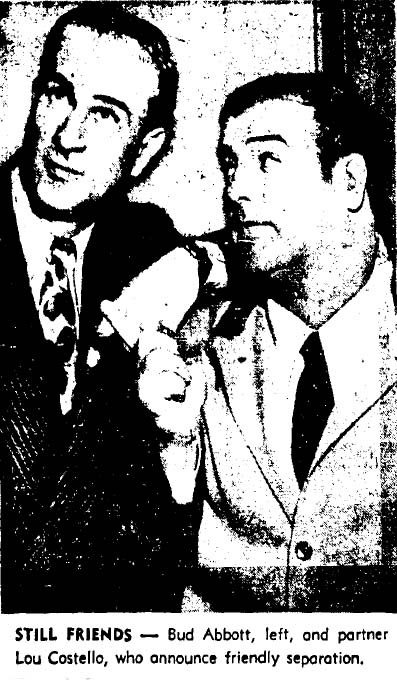
than many married couples. But it was time for a change. The scripts were lousy and getting worse. One of them wanted to keep working and the other wanted to quit and raise thoroughbreds.
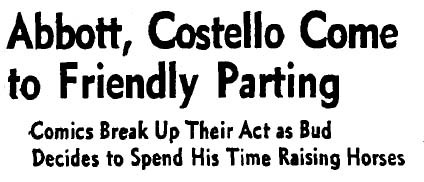
So Bud Abbott and Lou Costello split the act. Abbott, the straight man, was going to retire to his ranch in Ojai. Costello, the pudgy comedian, was going solo–he didn’t want to work with anyone else.
Soon it was Abbott vs. Costello in a $222,465 lawsuit over money from a
TV contract, although the men apparently remained friends.
And in less than two years, Costello was gone. He was hospitalized after he collapsed in an apartment at 4222 Ethel Ave., where his family was living while a home was being built at 3322 Longridge Terrace, Van Nuys. At the time of his death, Costello had some TV dates on Steve Allen’s show and was to appear at the Dunes in Las Vegas. Continue reading

July 15, 1957
The painting on the cover of Time speaks to us a bit
differently now than it did to the readers of 1957. There
is little room for subtlety in an illustration intended to compete on
newsstands with so many other magazines, forcing artist Henry Koerner to convey a simple message that could be grasped immediately.
There is Norman Chandler, a captain of Southern California industry,
with the visual shorthand for Los Angeles that has become such a
cliche: City Hall, palm trees and the mountains. Looking dignified and
eminently trustworthy, with his hair parted down the middle like the baritone in a barbershop quartet, he is holding a copy of the Los Angeles Times
folded into a sailor’s hat as if he were about to play with one of the
younger members of the next crop of Chandlers.
There are several messages we can see today that might have eluded the
harried newsstand customer of 1957: The inference that the Los Angeles Times
was best used for something other than reading (the article, in fact, calls it "neither a
great paper nor a poor one") and perhaps that Chandler was a tin-pot
Napoleon not to be taken seriously — at least nowhere outside crazy
Southern California. We might even surmise that The Times was nothing
but an expensive plaything for the Chandler family.
The anonymous cover story
conveys a similar message with just as little subtlety. Bristling with
biased and unnecessary adjectives (beaches are not merely beaches but
"the very Pacific beaches") and occasional odd metaphors (Gen. Harrison Otis
"began to carve his name in the sand with his editorial cannon balls,")
Time paints the portrait of a noisy, shrill city that could be accompanied by
hustle-bustle music and staccato notes from a xylophone, like one of "The March of Time" newsreels:
Nourished by a generous soil and a benign climate, this open-toed,
pastel empire last week beat with a great hum-thrumming vitality. On
Wilshire Boulevard, rivet guns prattled into the fresh steel of new
office buildings. The reiterated whop of the hammered nail rang out in
a 6,000-house development on San Fernando farmland, in a 17,000-house
subdivision in the tawny hills 40 miles to the southwest in Palos
Verdes—and wherever bulldozers sliced down citrus groves to make room
for more.From the swarms of workers in electronics and aircraft plants
came one big, tumultuous earache. And millions of nerves throbbed with
the nightmare of 3,000,000 cars (one for every 2.2 people v. Detroit’s
one for every 3.2) cascading over 204 miles of multilaned freeways.
Added to this was the arrival in Los Angeles last week of 4,200 popeyed
newcomers (25 every hour of the year). Like the ever-moving,
ever-changing populace that moved aside to make room for them, the new
Angelenos eagerly got set to join the scurrying rhythms and busy
polyphony: to work more change, to make more moves, more money, new
houses, new businesses—and to crowd out of the way of next week’s
horde of 4,200.
In this bouncing scenery, the one unchanging force
is the Los Angeles Times. Each morning it drops with a thick,
self-assured plop on 462,257 doorsteps from Anaheim to Azusa,* like a
faintly welcome striped-pants uncle (wealthy but voluble). Neither a
great newspaper nor a poor one, the Times, from its downtown limestone
monolith, serves as an unshakable herald, chronicling the region with
loving detail, goading Angelenos toward the megalopolitan destiny
ordained by Harrison Otis.
The Times proudly announced the upcoming article in a Page 2
story–full of quotes and without a single quibble–as if the Chandlers
were thrilled that the East Coast news establishment was writing about
them at all.

From our perspective, the Time article is not terribly flattering but noteworthy for several reasons. It certainly falls into
the trap of portraying the Chandler family as a dynasty of visionaries and mavericks who boldly and single-handedly shaped the
ever-sprawling city, ruthlessly attacking all opponents. (Also see "Thinking Big").
And like most articles about Los Angeles, the report takes a slap at Hollywood, crackpot preachers, Forest Lawn, refugees from Iowa and a vain, superficial, suntanned populace that is making its fledgling attempts at culture.
Gen. Harrison Otis is depicted as a cantankerous, eccentric old coot shouting orders as if he were eternally under siege, so forceful a personality that it seems like the entire article is about him, although he constitutes only a third of the story. Harry
Chandler, in contrast, is the shrewd power-broker operating quietly behind the scenes. One
of the most telling quotes is this:
"The difference between Harry and Norman," says one
old-time Angeleno, "is that Harry sat in his office and ruled this city
like a king. Norman doesn’t rule; he isn’t interested in ruling. What
he wants is to become an institution."
Norman Chandler comes off as an unimposing
milquetoast compared to his predecessors and must share the limelight with his wife, Dorothy "Buff" Chandler, portrayed as a terrifying
uber-clubwoman, gadding about the city in her little Simca, meddling in
civic and cultural affairs and nagging her husband to "do
something" about that nasty smog.
If it were no more than this, the story would merely be a dusty curio, worth little more today than the few statistics we can
glean from it. But the parallels between past and present, hidden in
the Time story, are fascinating. Even breathtaking. Beneath the boilerplate
analysis of a crass, frenzied Los Angeles lurks a telling reality:
Compare this, from 1957:
Yet in a town where the Times is
one of the few enduring institutions, Norman Chandler knows better than
to try to wield an overpowering political club. Today’s Los Angeles is
too amorphous for one man to rule, one newspaper to command,* or even
one political organization to anneal.
And this, from a March 26, 2006, article by Peter H. King and Mark Arax:
Those who study Los Angeles today employ terms like "horizontal" and
"diffuse" to describe the city’s power structure. They talk of a power
vacuum and note that, with so many of its old Fortune 500 companies
dissolved, bought up, relocated, Los Angeles has become something of a
"branch city." Whether this represents a good or bad development is
open to interpretation.
"Today there is no single node of power in the city," said Mayor
Antonio Villaraigosa. "It’s diffused geographically, diffused among
important stakeholders — business, labor, for instance — and also
racially and ethnically…. There is a devolution of power today that
is more grass-roots and more focused on specific neighborhoods."
Simply said, the past is far more complicated and layered than we realize and much more like the present than we care to admit. There are no quick descriptions of Los Angeles–and no easy answers–that are of any use; the city is too big and too diverse for a thumbnail sketch. Only the broadest canvas will do and even then the city bleeds over the edges.
I like this final quote from Time:
"Sums up Buffie Chandler: "I don’t say Los Angeles is the most beautiful
place on earth, or even the most desirable. I love San Francisco, for
instance. But I could never live there, because everything that needed
doing has long since been done. In Los Angeles, things will always need
doing, things will always need to be made better. Los Angeles is a
place for the kind of people who are willing to try something new. It’s
a place for people who want to build a new world."
July 15, 1957
Los Angeles
Not so fast, Los Angeles. The Bums aren’t coming!

Carey McWilliams, the author of "Southern California: An Island on the Land," catalogues a few morose, quirky poets in The Times, Aug. 9, 1931.

July 14, 1957
Los Angeles
The very name connotes elegance in home electronics: The Granada Hills.
Really. And an early American TV at that, back in the days when television sets were supposedly to look like fine furniture instead of big black boxes. And if you’re really fancy, you might want the Palmdale.

Here’s the entire ad:

July 11, 1957
Los Angeles
Here’s a vintage Al Hirschfeld drawing done for “The Pride and the Passion,” starring Frank Sinatra, Sophia Loren and Cary Grant. Hirschfeld is famous not only for being a fabulous artist but for hiding the name of his daughter Nina (born in 1945) in his drawings. In later years, he placed a number next to his name so people would know how many “Ninas” there were, but since this is an earlier drawing, there’s no number to guide us.
There is at least one “Nina” in this picture, but it’s reversed. The question is whether Hirschfeld flopped the artwork before adding his name or hid the “Ninas” as mirror images. (This is the only flopped “Nina” I have ever seen).
The original
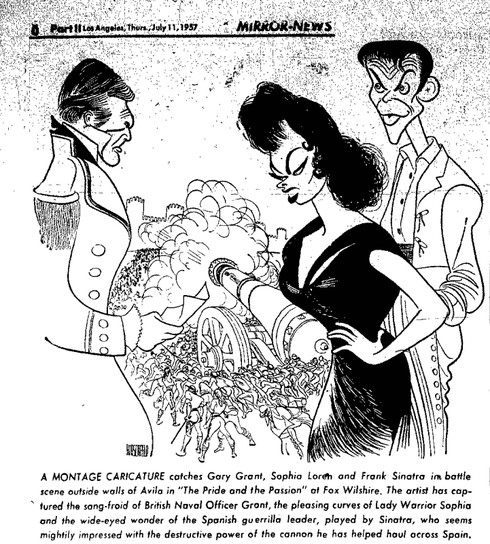
The closeup
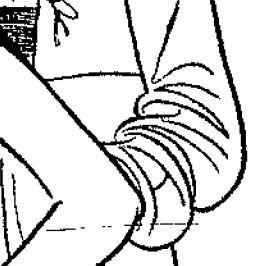
The closeup flopped
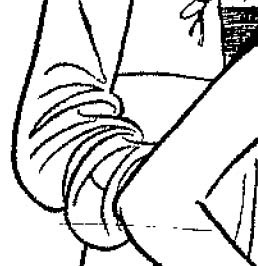
And the original flopped.
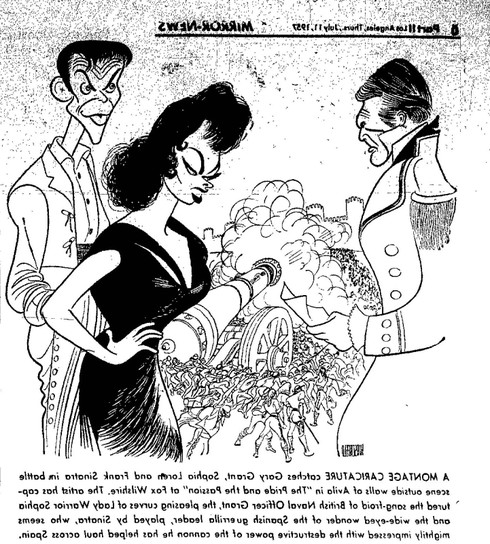
Was Hirschfeld saying that Frank Sinatra had something up his sleeve? I wish we could ask him. Note that the caption doesn’t even identify Hirschfeld but refers to him as “the artist.”
See any more? Let me know.
Email me


