One for the books


1957_0714_foy_hed

1957_0714_foy_pix July 14, 1957
Los Angeles

At 95, Mary Foy has the formula for longevity: Watch your health, keep mentally active and be Irish. 

The Times catches up with Foy and her "double cousin," Ella Foy O'Gorman, as the women celebrate their 95th birthdays in the home they share at 1706 S. Menlo Ave.

Foy is of special significance because she became the city's first librarian–in 1879–and where would we researchers be without librarians?

Born on July 13, 1862, Foy was the first of 10 children, The Times said in 1933, the daughter of Samuel Calvert Foy, a saddlemaker, and Lucinda Macy, who learned the alphabet while crossing the country to Los Angeles in a covered wagon in 1850. Foy was born in the family home at Macy and Main streets. Her family moved to 7th Street and Figueroa about 1904, then moved again to San Rafael Heights in Pasadena.

Foy was the sole employee of the library when it was above a saloon at Main and Temple streets, at a monthly salary of $74 ($1,512.56 USD 2006). "Miss Foy once recalled that patrons of the saloon often came to her and her books to settle their arguments," The Times said in her 1962 obituary.

Five years after graduating from Los Angeles High School, she returned as a teacher and became the principal before resigning in 1901 to fight for women's suffrage. She also attended law school. A lifelong Democrat, Foy served as a national committeewoman to the Democratic National Convention in 1919 and ran for Congress in 1934. She helped found the pioneer organization that became the First Century Families of California and was active in the Native Daughters of the Golden West.

For her, the most interesting time in local history was 1867 to 1876, when "Los Angeles awoke from being a sleepy pueblo and began to grow into a modern American city," The Times said.

At 95, she and her cousin were "smart as paint and wise as serpents," living in a home full of books, manuscripts and artifacts of the past, The Times said. "The orderly little house is neat and workmanlike, with a marked mental aura. The cousins betray a persisting love of adornment with their bright dresses with pleated ruffles at the necklines, strands of pearls and brooches."

As for never marrying, Foy said: "I wasn't prejudiced against it" (one story, in fact noted that she was "much too pretty to be a bluestocking"). "I was too busy to think of it."


1957_0714_foy_school

In the 1940s, she led the unsuccessful fight to preserve the 1873 Los Angeles High School on Fort Moore Hill, which was demolished in 1949 to make way for the Hollywood Freeway. The redwood building was too expensive to move, the group decided. The wrecking company planned to cut part of the building into sections to be sold as storerooms.

Foy died Feb. 18, 1962, and was buried at Evergreen Cemetery after lying in state at City Hall. She was the oldest living graduate of Los Angeles High School.

I'll leave you with two memorable quotes:

When asked about their social lives, Foy and O'Gorman said they went out occasionally even at the age of 95, "However our constant companion is right in this house. It is the dictionary," they said.

"I've lived through dozens of depressions," Foy said in 1933. "Whenever the rains failed we had 'em for one thing. Californians have faced disaster too often to be scared about this one. We always bounce back."

Email me

Posted in 1957, books, Cemeteries, City Hall | Tagged , , , , , , | 1 Comment

Time warp to 1910

Dec. 10, 1910
Los Angeles

I came across this article in looking for something else and found it too fascinating not to share. That’s why I love research.

1910_1210_2

Email me

Posted in #courts | Tagged , , , | Comments Off on Time warp to 1910

Sea bag murder


1957_0712_sea_bag

1957_0713_covel
July 12-13, 1957

Los Angeles

Two men from the Harbor Department were picking trash out of the main
channel at Terminal Island when they saw the big canvas bag–twice the
size of a Navy sea bag–drifting against the pier of Berth 233, so heavy that they could barely pull it aboard.

The bag was slit and they could see a human head. Upon investigation,
police found the nude body of woman who had been tied with cord and put
in the bag, which was filled with rocks and the weights from a set of
barbells.

She was 35 to 40 years old, 5-feet-5, 117 pounds, with brown eyes and
dark hair streaked with gray, officials said. She had been in the water
about three weeks, they said. "A half-inch cord looped around her neck and knees
jackknifed the body almost double," The Times said. "A second cord was
wound around the body."

There were no bullet wounds or cuts and nothing was found beneath her fingernails to indicate a struggle, authorities said.

In response to news reports, police were contacted by a harbor guard who told them about a woman who
had been missing from her job at St. Mary’s Hospital in Long Beach. She was Virginia Covel, 42, a nurse’s aide who had previously
worked at Harbor General Hospital in Torrance. The Torrance hospital
provided Covel’s last
known address, 419 S. Walker St., San Pedro, and a set of fingerprints that matched the body.

Further investigation found that the house on Walker Street had been
rented by Knute Berg, 43, a marine firefighter. Berg told police that
Covel had been involved with a fisherman named Hilding Fridell, but
left him because he went into jealous rages.

1957_0713_fridell
When Fridell, 50, returned to his home at 2225 S. Gaffey St., San Pedro, and found Officers Hayward Johnson and Charles Burgin waiting, he broke into sobs.

"I loved her, but she was running around with another fellow," Fridell said.

Fridell said he beat Covel to death on the Fourth of July, took 60
sleeping pills in a suicide attempt, but woke up in the morning next to
her body. He bought the canvas bag and weights at a San Pedro war
surplus store and dumped the body off the end of Berth 233 on July 6.
Pretending to be her landlord, Fridell called St. Mary’s Hospital and
said Covel had made an emergency trip to Logan, Utah, to see her
mother, Vada Blair.

According to police, Covel was the daughter of an Army colonel and had
worked at several Bay Area hospitals before coming to Southern
California.

Fridell pleaded guilty to manslaughter, but The Times never reported
his sentencing. No trace of him can be found in public records.

Email me

Posted in #courts, Homicide, LAPD | Tagged , , , , | Comments Off on Sea bag murder

A bill of goods


1957_0712_suicide

July 12, 1957

Los Angeles

Harold D. Jensen was apparently quite a salesman, because he certainly sold his fiancee a bill of goods.

Before marrying Barbara Jean Burton, 26, 8343 Clarence Ave., Jensen
wrote a prenuptial agreement promising her a new car, $337,000 ($2,414,700.63 USD 2006) , a new
diamond ring, $1 million on the birth of her first child and sole
ownership of a dress shop in San Marino.

And for good measure, he threw in $3.5 million in uranium holdings in
Guatemala, plus half of all the oil, mineral and lumber interests he
had there. Which was zero.

In reality, Jensen was a former World War II flier who managed a
lumberyard in Eureka until it was destroyed in a fire a year earlier.

Burton was one of his co-workers at the lumberyard, but left Eureka for
San Gabriel when the business burned down. She had been studying at the
Loretta Young Way modeling school, 233 1/3 Colorado Blvd., Pasadena,
and working as a photographers model when she married Jensen July 9,
1957, in Las Vegas.

Their bodies were found in a 1956 T-bird on Route 66 three miles south of
Victorville. Jensen had shot Burton with a .22-caliber rifle and killed
himself. It was unclear how long they had been there, their heads
resting next to one another.

San Bernardino County Sheriff’s Detective R. H. Waite said Jensen’s prenuptial agreement was "ridiculous on the face of it."

Macabre note: Searching Proquest for "newlyweds found dead" brings up
an array of gruesome stories:

  • "Hollywood Newlyweds Found Dead in Utah"
    (Oct. 30, 1947), cause of death under investigation.
  • "Carbon Monoxide
    Fumes Kill Newlywed Couple" (Jan. 21, 1948).
  • "Four Meet Death as Plane
    Crashes Into Residential Area" (July 18, 1952), a private plane crashed
    in Hawthorne.
  • "Newlywed, 20, Found Hanged" (Aug. 24, 1957), a recent
    bride was found hanging in a closet with her hands tied at her sides
    with leather belts.
  • "Newlyweds’ Bodies Go Back to Iran" (Jan. 16, 1985),
    the groom killed himself after the bride suffocated as he was trying to
    smuggle her into the country in a suitcase.

And what of Clarence Avenue? It’s been renamed Sheffield Road. San Marino, you know.

Email me

Posted in Homicide, Suicide | Tagged , , , | Comments Off on A bill of goods

Matt Weinstock

Matt_weinstockd
July 11, 1957

There was a traffic tie-up at the Harbor turnoff the other day as
Inspectors Ed Walker and Bob Houghton were traveling inbound on the
Hollywood Freeway.

They threaded their way through it and came upon a woman behind the
wheel of a T-bird, stopped on the Hollywood Freeway about 50 feet
beyond the Harbor turnoff.

"Anything wrong, lady?" one asked, thinking she might be ill.

"No," was the determined reply. "I’m waiting for traffic to clear so I can back up–I want to go on that other freeway!"

PEOPLE ARE always
asking Jamaica Elwood, who observed her 18th birthday on July 4 last
week, about her unusual name. The answer is this corner’s hot weather
story of the month.

1957_0711_ads
Jamaica was born in Chicago. The family had been pressuring her mother
to name her Camille Theodora after relatives. Her mother had resisted.

Came the day when mother and child were to go home. The weather was
sweltering. The hospital asked the baby’s name. The mother said she
hadn’t decided. The hospital people said she had to name it, for their
records, before she could take it home.

Perspiring profusely, Ma picked up a copy of Esquire magazine and
became an enchanted by a beautiful ad showing a tall, cool drink made
with Jamaica rum. And that’s how Miss Elwood, girl Friday at the
publication Motor Racing on North Western Avenue, got her name.

THINGS ARE a little tense around the stables at Hollywood Park, a spy whispers, since the scandal over doping horses.

Owners and trainers wear identification badges now, you know, and those
who frequent the place are aware they are under scrutiny by a corps of
operatives assigned by the Horse Racing Board.

These gentlemen are derisively referred to as the Keystone Gestapo.

Stable habitues contend a horse can be hopped if someone so desires no
matter how closely he is watched. And you know what they call a race in
which a hopped horse runs? The Drugstore Handicap.

AT RANDOM–Baffling
fragment of conversation overheard in a Broadway lunchroom, one young
woman to another: "I don’t know him, but I know his brother and his
brother is better looking."

Posted in Columnists, Downtown, LAPD, Matt Weinstock, Sports, Transportation | Tagged , , , , , | Comments Off on Matt Weinstock

Another plan for the Ambassador

July 11, 1957
Los Angeles

Yes, it’s another architectural plan, this one for the site of the Ambassador Hotel. And no, it never got built, either. Somewhere in Los Angeles, there’s a small library of designs that were shelved over the last century.

Perceptive readers may wonder if the David Schine mentioned in this story is the G. David Schine from the McCarthy hearings. The answer is, as a matter of fact, yes.

1957_0711_ambassador

Posted in Uncategorized | Tagged , , , | Comments Off on Another plan for the Ambassador

We get queries

Someone keeps landing on the blog because they’re trying to find out when the palm trees were planted on Sherman Way.

Luckily, I have Proquest at hand, so let’s see.

Hm. Someone apparently didn’t like the palms because they were cutting
them down, according to a 1985 story. Apparently half a dozen 60-foot
Mexican palms disappeared one weekend from the south side of Sherman
Way between Balboa Boulevard and Louise Avenue.

In 1970, Councilman Donald Lorenzen fought to save the 40-year-old
palms on Sherman Way in Winnetka when a gasoline company sought to cut
some of them down for access to a service station. Lorenzen sounds like a
colorful character who was good for quotes. He apparently once said
that homeowners had been against been against progress "since they
drove the Indians out of the Encino hillsides."

A 1962 story says the palm trees were planted on Sherman Way in 1932.
"We were trying to imitate Pasadena," according to Dick Speer of the
Canoga Park Chamber of Commerce.

And here, in 1935, palm trees about to be planted.


1935_0226_palms

Bonus facts: Antonio Sanchez was killed in 1959 when he crashed into a
palm tree at Sherman Way and Sepulveda Boulevard. In 1953, Dorothy
Roberts was killed when she hit a palm tree at Sherman Way and Haskell
Avenue. In 1942, a car full of youths overturned while circling a palm tree in the 15100 block of Sherman Way, killing 12-year-old Ronald
Case.

There ya go.

Email me

Posted in San Fernando Valley | Tagged , , | Comments Off on We get queries

Paul Weeks, in memoriam

I am informed that Paul Weeks, whose stories appear on the Daily Mirror blog, notably his profile of Police Chief William H. Parker, has passed away at the age of 86 due to liver cancer. Services are pending.

He leaves a widow, the former Barbara Rasmussen, whom he married in 1990, and his
first wife, Ruth Looney, the mother of his two children, Bill Wells and Barbara
Huntington. He also leaves four grandchildren and two great-grandchildren.

Posted in @news | Tagged , | Comments Off on Paul Weeks, in memoriam

Bar brawl


1957_0710_sica_hed

1957_0710_sica_times
July 10-11, 1957
Los Angeles

There isn’t much in doubt about what happened that night in North
Hollywood; the only mystery comes much later. That night, Frank “Puggy”
Sica, 40, and Salvatore Di Giovanni, 39, were having a few drinks with
Ronnie Kopp at the Club Shobah, 4923 Lankershim Blvd.

As it turned out, Kopp was a waitress at the club and neglecting the rest of her customers while chatting with Sica, a man with no convictions and many arrests, and Di Giovanni, who had been convicted of burglary.

Unable to get Kopp’s attention, Ann T. Burgess, 23, approached Sica’s table and requested some service.

According to police, Di Giovanni punched Burgess twice and knocked her out. Then
he told Kopp: “If you be a witness to this thing remember you have two kids and I’ll take care of them.” Authorities said Kopp resisted Di Giovanni’s attempt to drag her out of the Club Shobah, so he knocked her down and he and Sica kicked her.

Police had been to the bar earlier that night but were told there was no trouble.  Before they
arrived a second time, Mike Sboto, the bartender, pulled a gun from under the counter and fired several shots because the men were kicking Kopp. Di Giovanni punched Sboto and Sica threw a drink at him, police said.

1957_0710_sicaa
In response, Sboto punched Di Giovanni and Sica. “I hit them with everything I could lay my hands on,” he said. Di Giovanni had two black eyes, and “one detective had to chase the terrified Sica two blocks before he caught up with him,” the Mirror said.

The Times, meanwhile, said that when police arrived, Di Giovanni had Sboto under a shuffleboard table and was punching him in the face.

Burgess signed a complaint against Di Giovanni. And then, of course, all the witnesses got amnesia. The bar was mysteriously burglarized and trashed. Without
witnesses’ statements, the district attorney’s office was forced to file misdemeanor charges accusing Sica and Di Giovanni of battery, disturbing the peace and being drunk.  They pleaded guilty and  were fined $100 each.

Two years later, Sica began trying to get a piano bar at his restaurant, Sir Sico’s, 8351 San Fernando Road, in Sun Valley, but he always ran into trouble because of his record and because his brothers, Joseph and Fred, were involved in organized crime.

Not until 1967, after numerous hearings and appeals, did a judge order the Police Commission to approve a piano bar at Sica’s restaurant.

The real mystery is what became of Frank Sica,  who vanished from the pages of The Times about 1970. California death records list three men named Frank Sica. Frank A. Sica, born in 1909, died  in 1976 in Los Angeles County. Frank Ralph Sica, born in New Jersey in  1917, died  in Los Angeles County on April 4, 1987. (This is presumably the Sica in question). Frank Rocco Sica, born in 1926, died Sept. 19, 1999, in El Dorado County.

The site of Sir Sico’s is apparently occupied by La Herradura Restaurant, according to Google. The site of the Club Shobah is occupied by the Lodge, which appears in “Reservoir Dogs,” (thank you, Google). 

No further trace can be found of Mike Sboto or Ronnie Kopp.

Update, Dec. 18, 2008: Michele Kamleiter writes:

I can across this article accidently while looking for an obituary on my neighbor.  I believe (based on the picture) that my neighbor was the Mike Sboto, bartender, of your article.

Mike was a retired stage hand who had worked on a number of productions including the original Grease movie.  For at least the last 15 years, he had lived in Las Vegas.

He was a true gentleman and a kind soul who passed suddenly on December 2, 2008.  He will be deeply missed.

Email me

Posted in #courts, LAPD, San Fernando Valley | Tagged , , , , , | Comments Off on Bar brawl

Paul V. Coates–Confidential File

July 10, 1957Paul_coates

Since my boyhood days in the wheat fields of Manhattan I have steadfastly held Hollywood in veneration.

I feigned interest in Lou Gehrig and Carl Hubbell and Hank Greenberg
and the rest of their sweaty ilk to remain in good standing with the
stickball crowd.

But I found my real idols at the local cinema…

…Tom Mix, Oliver Hardy, Rudy Vallee.

To me it was obvious that they–and they alone–were the genuine, true
(and odorless) models of American manhood, to be enthroned and emulated.

Surreptitiously, I would slip down to the corner magazine stand to filch the latest copy of Movieland Heroes.

And even more surreptitiously, I would jam it between the jibbering,
statistic-laden pages of the St. Louis Sporting News, baseball’s answer
to the Wall Street Journal.

I did this as a condescending gesture to my playmates, who naively
thought that all the world’s a diamond and all the men and women merely
players.

But I knew different.

1957_island
I knew that girls didn’t play baseball.

And that the world was a stage, not a diamond.

I knew because my filched fan magazines carefully illustrated that
Hollywood, not Yankee Stadium, was the birthplace of such fine American
traits as bravery, integrity and go-get-em.

But then, shortly following my adolescence, there came a mass confusion to my life.

Suddenly, people–more specifically authors–began saying nasty things about the film capital of the nation.

They wrote books like "The Last Tycoon" and "What Makes Sammy Run."

But I wasn’t shaken from my faith. I still worshiped my heroes.

(I did, however, occasionally mumble to myself).

Patiently, I waited for them to spit their final, un-American venom. But they never did quite finish.

In fact, new spitters arrived on the scene.

En masse, they moved to Hollywood to sit in soft chairs and peck at typewriters and cash $1,000 studio checks every week.

Supposedly, they were writing new Great American Movies.

But actually, they were pecking out subversive, anti-Hollywood prose to
be published in book form after the termination of their studio
contracts.

And then a few years later, sold back to the movies.

Their disloyalty annoyed me but I figured that if they were making a
buck (if that’s what they wanted) by biting the golden hand that fed
them, they had some excuse.

Besides, Hollywood had little difficulty surviving the insult.

But today, there’s a more dangerous game being played around the film capital.

It’s called Star Bite Hollywood.

And its rules, briefly, are (1) amass $1,000,000 or so by emoting for
the simply pleased public (us) and then (2) when you’ve been built up
to the point of financial security, look back on your career and hiss:

"They’ve ruined me."

Don’t be too specific as to who or what ruined you.

Just say that your talents were ill-used and prostituted. Or, with a
vague swish of the hand, "They’re all a bunch of damn idiots."

According to my latest copy of Daily Variety (Hollywood’s answer to the
St. Louis Sporting News), a calypso singer by the name of Harry
Belafonte is the latest to jump on the bandwagon.

His direct accusation:

"I was catapulted out of drama school into a series of compromises like (my first three) pictures."

Variety quotes Mr. Belafonte as denouncing his latest film effort,
"Island in the Sun" as "a terrible picture based on a terrible
best-selling book."

"I hate Hollywood and the cliches of American culture," he was quoted.

I have long considered Belafonte a very talented young man. And it came
as a shock to learn that, by his own admission, his commercial success
was nothing but a sinister plot of the movie barons.

Put me in the same embarrassing position and I think that I might be magnanimous enough to let bygones by bygones.

Maybe, some day, he will too.

Even though Hollywood has robbed him of his priceless poverty.

[Note: I have neglected to get into the complicated controversy surrounding the
1957 film "Island in the Sun"; so many stories, so little time to blog.
The picture’s interracial aspects, though muted, touched off quite an
outcry and Joan Fontaine got a fair amount of hate mail. I’ll have to
rummage through my notes and see if I can find some of the stories.
They are amazing.]

Posted in Columnists, Film, Hollywood, Paul Coates | Tagged , , , , , | 1 Comment

A few golden hours


July 10, 1957
Los Angeles

Let’s suppose you are a famous comedian with a hit TV show. Fame and wealth are yours–more than you could have ever imagined. You are recognized wherever you go.

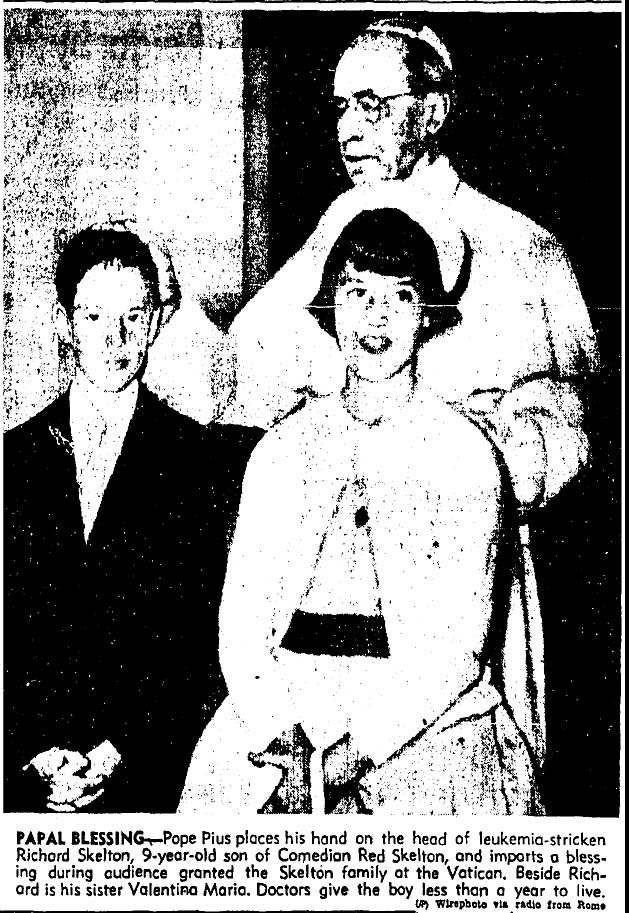
Now let’s suppose that the doctors at UCLA say your 9-year-old son, Richard, has less than a year to live because of incurable leukemia. Maybe only five months. All that wealth and fame can’t bring him even one more day.

You don’t know how to explain such things to a 9-year-old, so you haven’t told him. Right now, the leukemia is in remission. He has no idea he has such a brief time to live.

But when he sees “The Last Days of Pompeii” on TV and thinks it looks interesting, that’s all you need to book a trip for you, your wife, your son and your 10-year-old daughter to Pompeii. There’s no way to pack a lifetime’s worth of experiences into a year, but you can try, so you add stops in Copenhagen, Switzerland, Rome, Barcelona,  Paris, London and Dublin, Ireland. Continue reading →

Posted in Film, Forest Lawn, Hollywood, Mickey Cohen, Television | Tagged , , , , , , , | 2 Comments

Driving Survey–Route 6

Here’s my jaunt down Route 6: Arcadia to the Auto Club on South
Figueroa. Note that I had to alter the route since Figueroa is a
one-way street north of Olympic. Also note that I made the trip on a
Sunday afternoon rather than rush hour. Still, I beat the 1957 drive
time of 47 minutes by 5 minutes. (Also note that I followed the posted
speed limits at all times). I have to say, it’s a nice, easy route
until Chinatown, which is not my favorite place to drive.  And I would
never go through downtown L.A. on Broadway during rush hour.

01_huntington_baldwin

Photographs by Larry Harnisch Los Angeles Times
Huntington Drive and Baldwin Avenue, Arcadia, 4:30 p.m. (Yes, I know I’m heading the wrong way).

02_huntginton_goldenwest

Huntington and Golden West Avenue, 4:30 p.m. Notice the wide center median in Arcadia. San Marino. This used to be the right of way for streetcar tracks.

03_huntington_rosemead

Huntington and Rosemead Boulevard, 4:31 p.m.

04_huntington_sangabe

Huntington and San Gabriel Boulevard, 4:33 p.m.

05_huntington_sanmarino

Huntington and San Marino Avenue, 4:36 p.m.

Huntington and Oak Knoll Avenue, 4:39 p.m.

Huntington and Los Robles Avenue, 4:40 p.m.

Huntington and Marengo Avenue, 4:41 p.m.

Huntington and Fair Oaks Avenue, 4:42 p.m.

Huntington and Fremont Avenue, 4:43 p.m.

Huntington and Pueblo Avenue, 4:47 p.m.

Huntington and Monterey Road, 4:47 p.m. (I made such good time that I didn’t even get a chance to take  pictures).

06_huntington_mission

Huntington and Mission Road, 4:50 p.m.

07_huntington_broadway

Huntington and North Broadway, 4:51 p.m.

08_broadway_johnston

Broadway and Johnston Street, 4:53 p.m.

09_broadway_ave22

Broadway and Avenue 22, 4:54 p.m.

10_broadway_i5

Broadway and Interstate 5, 4:55 p.m. (Shout out to Kim and Richard at 1947project HQ!) 

11_broadway_spring

Broadway and North Spring Street, 4:55 p.m.

12_broadway_solano

Broadway and Solano Avenue, 4:56 p.m. (Shout out to the cornfield!)

13_broadway_bernard

Broadway and Bernard Street, 4:57 p.m.

14_broadway_ord

Broadway and Ord Street, 4:59 p.m. (Shout out to Philippe!)

15_broadway_arcadia

Broadway and Arcadia Street, 4:59 p.m. (Shout out to the Hall of Justice! You knew there was once a huge tunnel here, right?)

16_broadway_1st

Broadway and 1st Street, 5 p.m. (Shout out to The Times Building!)

17_broadway_2nd

Broadway and 2nd Street, 5:01 p.m.

18_broadway_3rd

Broadway and 3rd Street, 5:01 p.m. (Shout out to the Bradbury Building, the Million Dollar Theater and Grand Central Market!)

19_broadway_6th

Broadway and 6th Street, 5:03 p.m. In the heart of downtown’s theater district.

20_broadway_8th

Broadway and 8th Street, 5:04 p.m. (Shout out to the Tower and Orpheum theaters!)

21_broadway_olympic

Broadway and Olympic Boulevard, 5:05 p.m. (10th Street was renamed Olympic for the 1932 Los Angeles Games. You knew that, right?)

Olympic and Hill Street, 5:05 p.m.

22_olympic_olive
Olympic and Olive Street, 5:06 p.m.

23_olympic_grand

Olympic and Grand Avenue, 5:06 p.m.

24_olympic_figueroa

Olympic and Figueroa Street, 5:07 p.m. (Hey, there’s a bus–shout out to mass transit!)

25_figueroa_pico

Figueroa and Pico Boulevard, 5:09 p.m.

26_figueroa_venice

Figueroa and Venice Boulevard, 5:09 p.m. (Shout out to the Santa Monica Freeway and Patriotic Hall!)

27_figueroa_washington

Figueroa and Washington Boulevard, 5:11 p.m.

28_figueroa_adams

Figueroa and Adams Boulevard, 5:12 p.m. (Hey, there’s another bus. Shout out to mass transit!) 

Total miles: 15.4; time: 42 minutes.

Email me

Posted in Transportation | Tagged , , , , , , , , , | 1 Comment

Hipperson suspect


1957_0709_hipperson_hed

1957_0709_boyerJuly 9, 1957
Los Angeles

Detectives investigating the killing of nurse Marjorie Hipperson
are questioning a con artist with ulcers who was an orderly
at Hollywood Presbyterian Hospital, where Hipperson and her fiance,
Dr. Walter Deike, worked.

Monte Melvin Krier, 29, who is being held on forgery charges in the
prison ward of General Hospital, says he knew Hipperson and saw her on
the day she was killed. He says he left Hollywood Presbyterian shortly
after the  slaying out of fear of the police.  "I quit my job because I
knew they were going to find out about my record," said Krier, who had
served a total of 11 years in prison for forgery and burglary.

"Miss Hiperson was a very friendly girl," Krier said. "We had lunch
several times and we talked quite a bit while we were working. The last
time I saw her was the day she was murdered."

Krier reluctantly admitted that he knew where Hipperson lived because
both of them had gotten a ride home from work with a fellow employee.

After he was arrested on the forgery charges ("I have a champagne
appetite with a beer pocketbook," he said) detectives began questioning
him in the Hipperson case. "They fingerprinted me twice," Krier said.
"They thought my palm print matched ones found in the apartment but now
I think they have cleared me."

(Krier’s con worked this way: He would check into a hospital for
ulcers, then write hot checks for jewelry and clothing  to merchants
who assumed he was trustworthy because he was in a hospital. When he
got enough merchandise, he skipped out of the hospital).

Detectives are also investigating an attack on Carol Boyer, 24, 2113 N. Rodney Drive
in Los Feliz, who fought off a man who attacked her with a pipe about
4:30 a.m. while she slept. Neighbors say the attacker had canvassed the
apartment building two weeks earlier by posing as a census taker
seeking information on single people.

Police also arrested  Conrado Hernandez, 44, 9339 S. Western Ave., after firing a warning shot as he was allegedly breaking into a home at 416 N. Orange Grove Ave. 

Monte Krier died Jan. 4, 1998, in Los Angeles. He was 69, according to California death records.

Email me

Posted in Hollywood, Hollywood Division, Homicide | Tagged , , , , , | Comments Off on Hipperson suspect

Matt Weinstock

Matt_weinstockd_2
July 8, 1957

Readers may have noticed that, except when vital to the story, this paper no longer uses the names of victims of rapists.

The policy was prompted by the editors’ opinion that printing these
names only added to the grief of the women innocently involved. And,
except in unusual cases, names of juveniles who get into trouble have
always been deleted.

There’s evidence that the distress that comes later can be almost as bad as the terror and indignity of the incident itself.

Not long ago a woman of 21 was sitting in a parked car with a young
man. They were suddenly set upon by five youths who viciously beat the
young man and forced the young woman to submit. The names of the couple
were used at the time.

Four of the five assailants were later arrested and will receive the punishment they deserve.

But life has become miserable for the girl, the innocent victim in the
case. She is the object of vile gossip and sidelong glances, even by
friends–a shameful thing.

Posted in Columnists, Matt Weinstock | Tagged , , , | Comments Off on Matt Weinstock

Literary diversions

Detective Sgt. Joe Wambaugh gets in trouble for writing a book. Nov. 18, 1970.

Part 1

1970_1118_wambaugha

Part 2

1970_1118_wambaughb_2

Part 3

1970_1118_wambaughc

Posted in books, Downtown, LAPD | Tagged , , , | Comments Off on Literary diversions

Ronnie Quillan update

Here’s the August 1955 article from Whisper magazine referred to in my earlier post on Ronnie Quillan (thank you, EBay). Quillan actually provided the information for this story, so we have to assume it was at least somewhat accurate. In reading this sleazy, vicious account, it’s no wonder the scandal magazines got shut down.

I am not familiar with the name Patricia Hirsch, who is mentioned as a prostitute.  However, a woman by that name pleaded guilty to vice charges in 1954 after being arrested in Malibu, according to The Times. And I cannot locate anything on Frank Harwyn Vanderveld  II.

The saddest thing, of course, is Quillan’s disintegration. A tragic Hollywood tale.


1955_whisper_cover


Page 1

1955_whisper01

Page 2

1955_whisper02

Page 3

1955_whisper03

Page 4

1955_whisper04

Page 5

1955_whisper05

Posted in #courts | Tagged , , , , | Comments Off on Ronnie Quillan update

Paul V. Coates–Confidential File

Paul_coates_3
July 6, 1957

Teenagers’ magazines are a comparatively new fad. But in spite of their
recent arrival, they have already grabbed a strong position of
influence. And respect. Yesterday, I printed some letters written to
Lilly Cooper, Dig magazine’s problem editor.

They were written by teenagers. But they couldn’t be printed in the
periodical, even though it is published specifically for that age group.

The letters were too "hot." Too many parents would complain.

Yet, Miss Cooper asks hesitantly whether the type of adult who objects
to such letters might often be the type responsible for them.

"So many kids have turned to us–complete strangers–for answers to their most serious problems," Miss Cooper tells me.

"Why us? Why not their parents or someone else in their communities?"

The answer might be found in some of the letters.

Here’s one from a 16-year-old schoolgirl:

"My rep has been marred by an 18-year-old boy whom I met in the next town.

"I dated him quite a while.

"One night he started something which I told him would have to stop even though I loved him. And he agreed.

"But it happened again and I couldn’t stop him.

1957_0706_ad
"Well, now I’m going to have a baby and he just won’t marry me.

"He got some other guys to say that they had done it, too, so he wouldn’t be responsible.

"Could you help me. Please!"

Try this one, from Judy:

"Just finished reading your article about teenage spankings.

"I envy the kids who just get spankings or simple punishment. Have them
try getting pushed up against the wall, choking around the neck and
punched in the face, stomach and chest with a fist.

"Or for simple punishment, a beating with a thick belt.

"That’s what happens to me, a 16-year-old girl, by my father. Maybe I
deserve it. I don’t know and care less. I’ve had it for so long I just
don’t feel anything any more."

In the two weeks’ collection of problem letters which Miss Cooper showed me, the majority were from pregnant girls.

One, however, was from a young boy suffering perverted sexual urges. He
couldn’t face his father or his priest, he admitted, "because they
think too much of me."

A 15-year-old wrote that she accidentally discovered pornographic pictures and literature in her parents’ bedroom.

"I felt like screaming when I read it because my father’s name was
actually used in the literature. I just stood and cried and shook all
over."

The most pathetic letter, however, came from Jane:

"I have never turned to anyone before and still don’t know who to go to for help.

"I’m only 16 1/2 and a junior in high school, but since I was 12 I’ve been falling downward.

"When I started going out with boys I looked for any kind of affection. You see, no one ever told me to be careful.

"I saw no harm in what I was doing. I knew nothing about life or sex.
My name became bad, of course, and my girlfriends and schoolmates
avoided me. I couldn’t understand why!

"Now 15, I started going with servicemen, older boys, fellows out of town. I began to drink. Almost every weekend I was drunk.

"Then I began going with a ‘cat’ from the big city. I was accepted into a large gang AFTER I proved I could smoke dope.

"Thank God I’ve avoided ‘H’ and mainlining.

"I really live two lives–my home and school life and my outside life.
I’ve hurt so many boys, good clean-cut guys that happen to fall in love
with me. I would take money from them, make them take me here and there
and then bow out.

"Yes, I guess I’m just no good.

"My mother tries hard to make things nice for me by buying me records,
clothes, etc. You just can’t buy love and affection, though.

"My dad is a drinker and goes a bit crazy sometimes. He’s put us both in the hospital from time to time.

"I’m trying my best to be as polite as possible and write as best I can
and use the best English. I could lengthen this by all the laws I’ve
broken but I only want to give you enough of a picture of me to help me
out.

"Lilly, I think I’m very sick emotionally.

"If you can’t help me, please, please tell me who could."

The letters I used were just average. There were dozens more like them.

Apparently the kids who wrote them knew no adult–parents, friend, neighbor–in whom they felt they could confide with trust.

The reflection is on us–and the image isn’t pretty.

[Note: These teenagers are in their 60s now. I wonder what their lives were like and whether they overcame the pain of their early years. I certainly hope so. –lrh.]

Posted in #gays and lesbians, Columnists, Paul Coates | Tagged , , , , , , | 1 Comment

Ouch!


1957_0706_gordo

July 6, 1957

Los Angeles

Oh this is a painful moment on the Mirror’s comics page. I was always a big fan of Gus Arriola and "Gordo,"
which I read for many years. The strips are beautifully drawn and the Aztec motifs are wonderful. But I certainly don’t recall the dialect. Ouch!

Arriola was a former MGM
animator and here’s what he had to say about the strip:

The early Gordos were very stereotypical, yes, and the dialogue was very broken English. A couple of editors started complaining that it was hard to read, and salesmen said it was difficult
  to sell.
So little by little I began clearing up the dialogue and cleaning up the characters myself in order to appeal to a wider audience.

And then I saw this: Ack!!!!


1957_0706_lil_pedro

"Gordo" is a model of sensitivity compared to "Lil’ Pedro." I can’t find any information about the
artist or the strip. I can only imagine the reaction of my old pal Rudy
Wagner, who became furious whenever he discussed the lawn statues of a
Mexican sleeping against a cactus.

Email me

Posted in Uncategorized | Tagged , , , , , , | Comments Off on Ouch!

The searchers

Jack_webb_30
The stats for my blog allow me to see the search terms people use to
reach the Daily Mirror. I never realized there were so many people
interested in Mickey Cohen. There are quite a few false hits and some
interesting queries.

To the person researching Jack Webb’s "-30-":
Despite what you may have read or heard, the movie was not filmed in
the Examiner Building (this was lore for many years at The Times among
former Her-Exers). Webb built an exact duplicate on a sound stage. He
did this for "Dragnet" too.

To the person researching Gamblers Anonymous: I hope you found what you needed.

And to whoever is researching "little girl lost intestines in swimming pool"–I am at a loss for words.

At right, the VHS box for "-30-" Kids! Don’t Play Here!

Email me   

Posted in Weblogs | Tagged , , , | 1 Comment

Gail Russell–in memoriam

Photographs by the Los Angeles Times

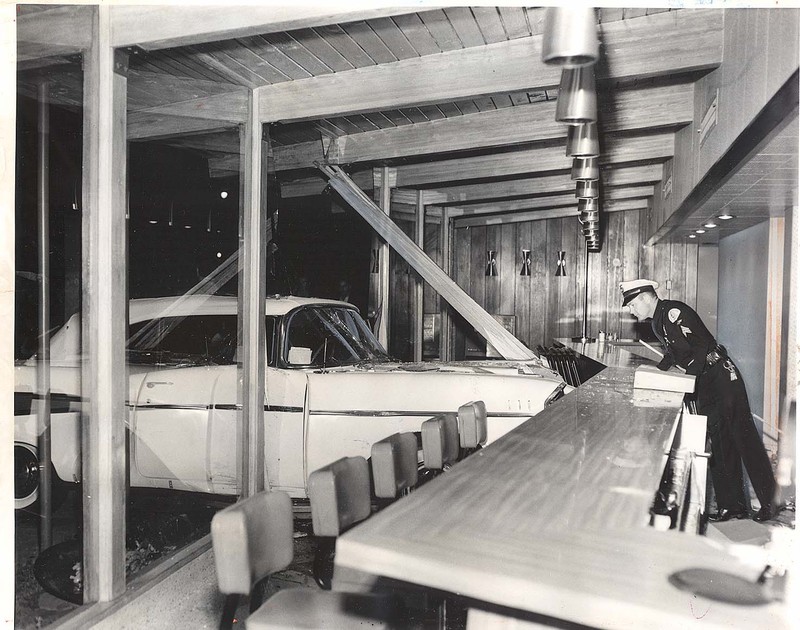
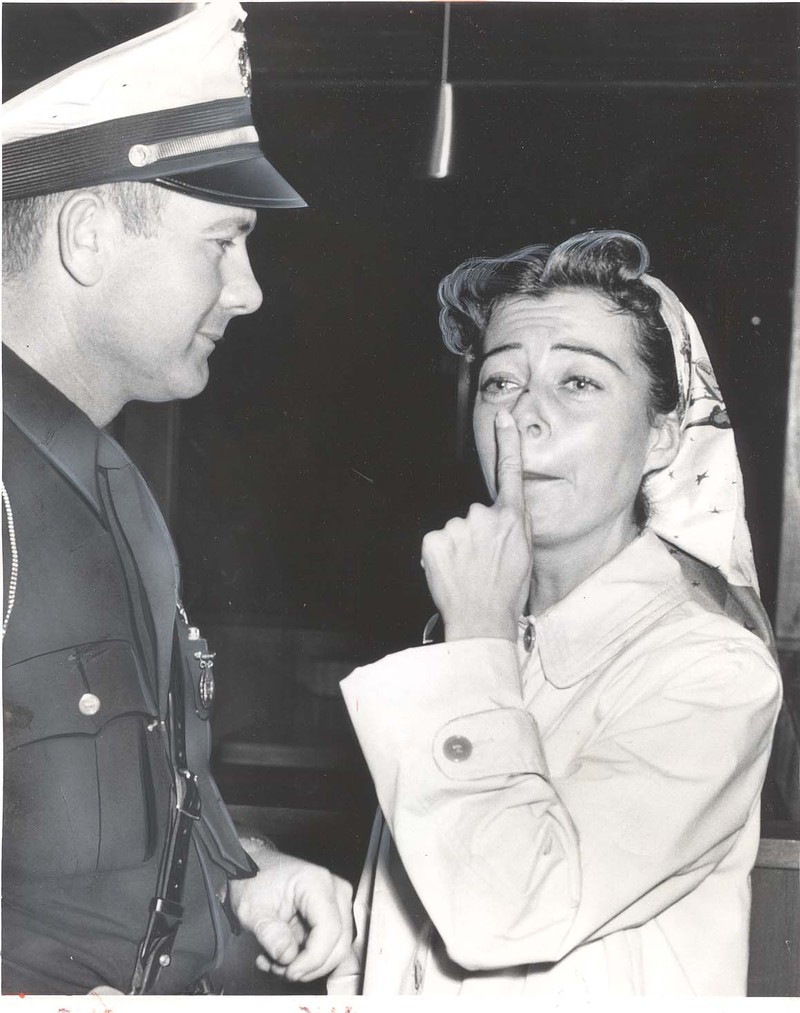
Sgt. C.H. Specht examines damage to Jan’s Restaurant, 8424 Beverly Blvd., caused by Gail Russell’s convertible.  Below right, Russell fails a test for intoxication administered by Specht.

July 6, 1957
Los Angeles

You poor thing. Look at you lying there, probably for a couple days now, sealed off from the world in a little home on the Westside. No husband, no children and no career. Just an empty vodka bottle on the floor and you sprawled next to it in a blouse and the pants from your pajamas. Dead at 35. Your mother wanted you to have the career she never had. I’m sure she didn’t realize you weren’t cut out to be a movie star; so tightly wound and such a painfully shy, insecure bundle of nerves.

Let’s go back 20 years to 1941, when you were studying to be an artist and someone started calling you “the Hedy Lamarr of Santa Monica High.” How you hated that nickname and kept
apologizing for it, so embarrassed that when you finally ran into Lamarr volunteering one night at the Hollywood Canteen you looked the other way. Continue reading →

Posted in #courts, Cemeteries, Film, Hollywood, LAPD | Tagged , , , , , , | 21 Comments