Police shakeup

July 25, 1957
Los Angeles

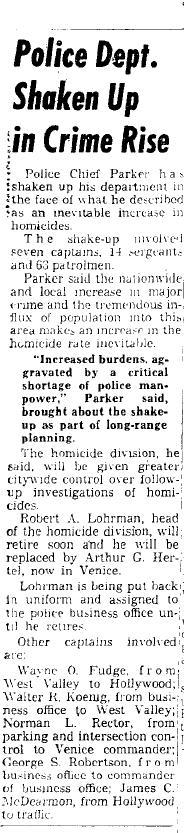
As surprising as it seems now, there was a time when the Los Angeles newspapers actively covered top-ranking personnel at the LAPD. Most readers would be hard-pressed to name the current head of Robbery-Homicide (Capt. Kyle B. Jackson), but in the 1940s and ’50s, the papers routinely
tracked retirements, transfers and promotions.

In the summer of 1957, Capt. Robert A. Lohrman, who had headed the Homicide Division since 1951, was transferred to the business office because he was planning to retire. The new head of Homicide was Capt. Arthur G. Hertel.

Lohrman’s term as head of Homicide included the L. Ewing Scott case, the alleged abduction of Marie “The Body” McDonald and the Barbara Graham case, which was made into the movie “I Want to Live.” He also
handled Busby Berkeley’s 1946 suicide attempt.

Hertel died of an infected pancreas in 1961, while he was still head of Homicide, at the age of 46. Lohrman died in 1999.

Email me

Posted in Homicide, LAPD | Tagged , , | Comments Off on Police shakeup

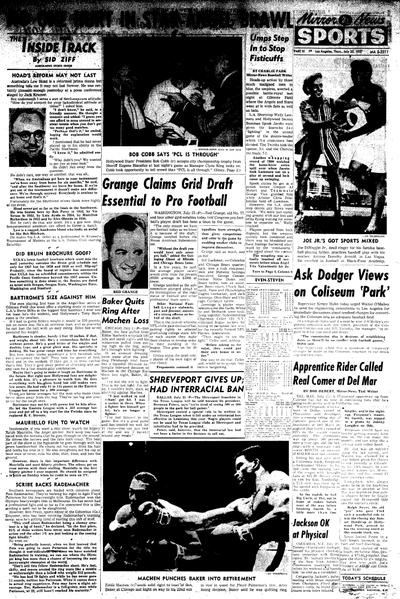
Brawl at Gilmore Field

July 25, 1957

The Angels vs. the Hollywood Stars

Page 1

Continue reading →

Posted in Sports | Tagged , , , | 2 Comments

Countdown to Watts

July 25, 1957
Los Angeles

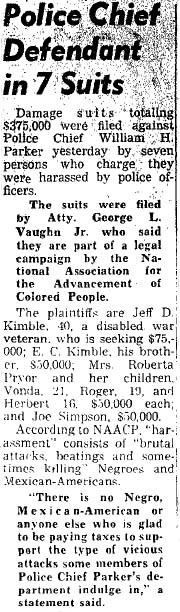
To The Times, a class-action suit accusing the Los Angeles Police
Department of brutality simply wasn’t newsworthy. The Mirror did a bit
better: a few paragraphs on Page 12.


And these were juicy stories:

  • A Baptist minister who was arrested after reporting an assault.
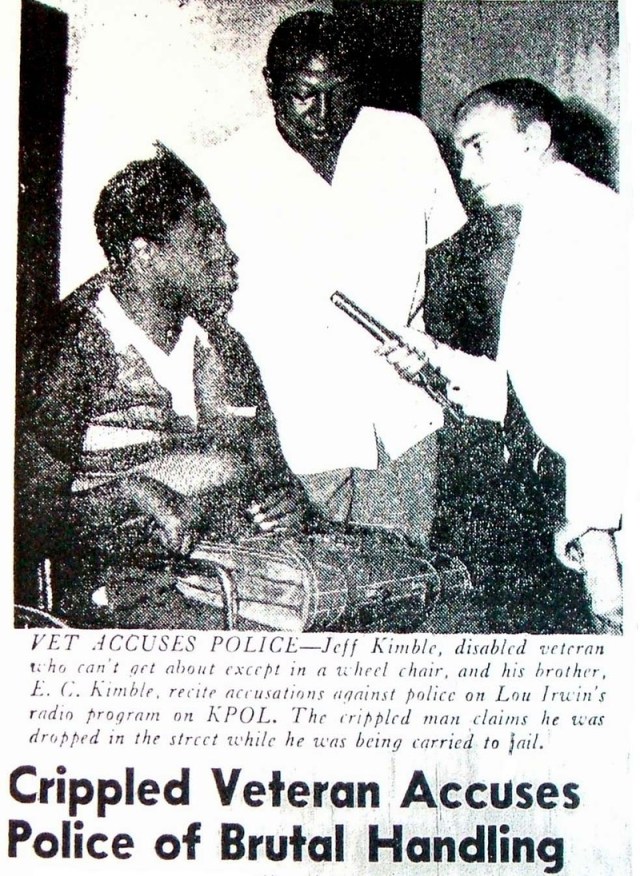
  • A disabled veteran in a wheelchair who was dropped in the street as officers were carrying him into a police station.
  • A teenager who was shot in the stomach and the back as he stood
    on a street corner after complying with officers’ orders to take his
    hands out of his pockets.

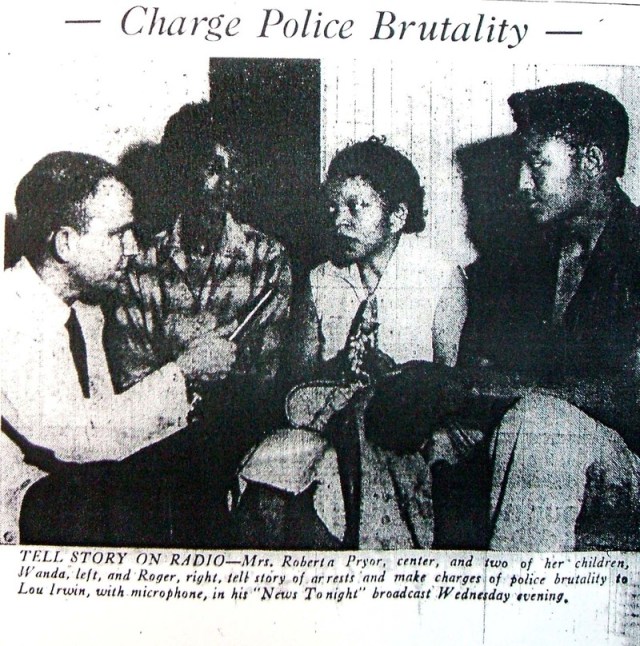
It gets worse. Lew Irwin of KPOL-AM was the only white newsman to
profile the lawsuits in depth, but the station’s management killed his story as a personal favor to Police Chief William H. Parker.

Instead of quietly preserving the status quo, the white news media’s conspiracy of silence only fueled the anger and distrust that would erupt in the Watts riots.

Because for the California Eagle, a weekly serving the African American community, the brutality suits were Page 1 news.

None of the individuals had police records, “not even a traffic
ticket,” the Eagle said. The NAACP chose the cases from many others
because they were the most flagrant.

According to the Eagle, eight of the cases occurred between June 3 and July 4, 1957. The ninth occurred earlier in the year.

The most recent incident was reported by Roberta Pryor, 637 E. Vernon, and her children, Roger, 19, Wanda, 17 and Herbert, 16.

Pryor told the NAACP that on July 4, she noticed a youth in the back of
a police car as she was walking through a parking lot near her home.
Pryor said she asked police why they were holding the youth. Her son
Roger joined them and police began questioning him.

The officers “apparently didn’t like the answers he gave and reportedly
knocked him to the ground, addressing him with obscene words,” the
Eagle said. “When he protested the language in the presence of his
mother, one of the officers reportedly threw his arm around the youth’s
neck, choking him.

“When the younger son came up, the police reportedly roughed him up
also, then took the two boys, the sister and the mother down to the
police station. Roger was booked on suspicion of grand theft auto, held
for two days and then released, the NAACP attorneys claimed.”

Disabled veteran Jeff Kimble, 6339 Estrella Ave.,
and his brother, E.C. Kimble, were arrested after bank authorities
became suspicious when E.C. Kimble tried to deposit some cash and
government checks. “The two of them were taken to the station. Since
there was no wheelchair lift available, two men lifted Jeff Kimble from
the car and started carrying him. Partway to the entrance, they
apparently lost their grip and let the crippled man drop,” the Eagle
said.

The brothers were eventually released when the Treasury Department confirmed that the checks were indeed Jeff Kimble’s.

Another case involved the Rev. Simon Washington, 7027 S. Denver St., a Baptist minister who worked as a salesman for Supreme Liberty Life Insurance.

Washington said he had an appointment to meet a client at 2nd and San
Pedro streets when another man “came up to him and began molesting
him,” the Eagle said. Washington called officers, who arrested him on
charges of being drunk. Washington said they beat him en route to the
station and that the charges were eventually dropped.

Raymond Korengay, 3668 S. Normandie Ave.,
said he was arrested after police came to his home in search of his
brother, who was wanted on a traffic warrant. Kornegay said that
although his brother wasn’t home, police brushed past him without a
warrant, beat him and although he was bleeding profusely, drove around
for two hours before taking him to the Georgia Street Receiving
Hospital. He was charged with interfering with an officer.

Herman Johnson, 17, 669 E. 40th Place,
said he was standing on a sidewalk when police approached and told him
to take his hands out of his pockets. He was hospitalized after being
shot twice, the Eagle said, and was recuperating on a farm in Arkansas.

To be continued….

Email me

Posted in Countdown to Watts | Tagged , , , , , , | Comments Off on Countdown to Watts

Champagne flight

July 25, 1957
Las Vegas

There was no room for retired jeweler Saul F. Binstock, 62, on the chartered flight to Las Vegas, so he boarded a Western Air Lines plane at Burbank. As always, he bought insurance naming his wife, Eva, as
the beneficiary.

In addition to the round-trip flight, his getaway package included limousine service from the airport to the Hacienda Hotel, dinner, champagne and $5 in gambling chips. Although Binstock called Eva to tell her he was looking at some watch shops, he remained at McCarran Field and gave his coupon booklet to one of the agents, saying: “Maybe you can use this.”

At 2:50 a.m., Binstock got on Western Air Lines Flight 39 after turning down a seat on a plane
chartered by the Hacienda. Witnesses said he tore up a few pieces of paper just before boarding. As soon as the Convair CV-240 took off, Binstock went to the lavatory in the rear of the aircraft.


Maybe he thought of his wife over the next 47 minutes. Perhaps it was his son, Sydney, a dentist; or his daughters Muriel and Joyce (or Joyann). Maybe he thought of the Canoga Park jewelry store he recently sold or the family home at 5739 Rhodes Ave. Mostly, I imagine, he thought about the explosives in his left
hand–blasting caps according to the Civil Aeronautics Board and dynamite according to other sources–and how he planned to set them
off.

Several passengers became worried about Binstock’s extended absence and asked the flight attendant to check on him. As she
walked to the back of the aircraft, there was what one passenger called: “A hell of a blast.” At 3:33 a.m., Saul F. Binstock, who had
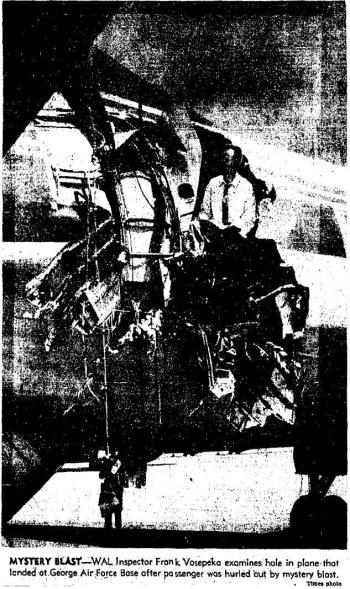
spent his life repairing small, precious  mechanisms, blew a car-sized hole in the airplane, which was flying at 10,000 feet. He was the only victim.

Capt. Milton L. Shirk, 37, and co-pilot Seth
Oberg, 25,  landed the plane safely at George Air Force Base after radioing that they had an emergency.

Binstock’s body was found in the Ord Mountains after an intense search. Three fingers of his left hand
were blown away. One of the two $62,500 insurance policies he purchased in Burbank had a suicide clause that voided any payments and the insurance company said it would not pay a benefit on any claim submitted for his death. A private investigator for the family said Binstock “was in good health and financially OK.”

Rabbi Aaron Wise of the Valley Jewish Community Center conducted the funeral at Groman Mortuary Chapel. Binstock was buried in Pittsburgh.

Convair N8406H was repaired and continued flying.

Here’s a photo from 1959.  And here’s one from 1961.

Email me

Posted in Suicide, Transportation, travel | Tagged , , , , | Comments Off on Champagne flight

Paul V. Coates–Confidential File

July 22, 1957

SUBJECT’S NAME–Dr. George Ripley Fuller.

SUBJECT’S DESCRIPTION–Age, 28. Height 5 feet, 10 inches. Weight, 150 pounds. Blond hair. Blue eyes. Slight horizontal scar upper lip on right.

Any person with information as to subject’s whereabouts is requested to
contact Missing Persons Section, Los Angeles Police Department.

Much has been written concerning the strange disappearance of Dr. George Fuller, brilliant young UCLA physiologist.

But there’s been a lot, too, that hasn’t.

And that’s what I’m just about to tell today.

Maybe the new facts can start the year-old mystery unraveling. And
maybe–hope the doctor’s parents–once the unraveling process has
started it won’t end until the case is solved.

Dr. Fuller disappeared from his home at 470 Midvale Ave., near UCLA on May 31 of last year.

He left the house at 7 p.m. He told his wife, Renee, that he was going to attend a seminar on campus.

The seminar was called off. And Dr. Fuller never returned home.

Because of Fuller’s position and brilliance, both the police and press
considered the case a “hot” one. They investigated it thoroughly and
publicized it widely.

But they found no substantial clues.

And no solid, logical explanation.

Fuller’s wife told police that her husband had driven off with a few
dollars, at most, and few extra clothes, if any. She added that he had
always been considerate in telling her where he was going.

Seven weeks after Fuller’s disappearance, police found his car. It was
parked on North Sunset Plaza Drive, not too distant from his home. In
it were his ice skates and camera and a book entitled “Adventures in
Good Eating.”

But any immediate clues possibly contained more negative value than
positive. Because it’s more than feasible that the real explanation of
Dr. Fuller’s disappearance began years before he was bodily missing.

The young doctor was the last of three sons born to Mr. and Mrs. Walter
Fuller. His two older brothers were college graduates and successful in
their professions when he was still a teenager.

He admired them greatly. Maybe, the parents admitted when I talked to
them last week, he placed his brothers on too high a pedestal–before
embarking on a personal campaign to emulate them.

Because from the time that young George graduated from high school in
New York he permitted his desire to be the best in whatever he
undertook to become an almost compulsive force.

Definitely, he was brilliant. After three years of college he applied
for and was accepted by three medical schools. He won one of New York
State’s highest scholarships.

He graduated from Cornell Medical College in 1953 and was asked to
remain as a fellow in physiology there. He did, for two years.

Then he and his wife, whom he married in his first year of med school, drove west.

“George,” his mother told me, “was attracted to UCLA by Dr. Magoun. He
knew him by reputation only, but wanted very much to work under him.”

Dr. Horace W. Magoun, then chairman of the department of anatomy, is recognized as one of the world’s top neurophysiologists.

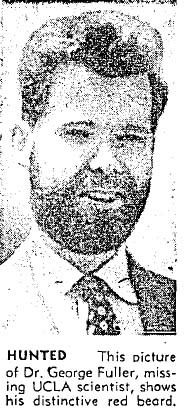
On the trip to California in June of 1955, Fuller grew the beard which
later became his trademark. It was a jutting  bright red, in contrast
to his blond hair.

“But,” his mother told me, “I suppose he’s shaved it now.”

Friends say that, once here, Fuller permitted his work to swallow him
more completely than ever. His conversations, his friends, his
life–all revolved around his research.

But possibly it began getting to him.

Because half a year before he vanished the young doctor phoned his
mother in New York to say he was visiting a psychiatrist here.

The psychiatrist later told Mrs. Fuller that George had expressed the wish to visit his parents in New York.

Then, just a few months before he vanished, he wrote a few most unusual letters to his parents.

“They were extremely critical of us,” his mother told me, “but it’s hard to say exactly how. Or why.

“Like his disappearance, it just didn’t make sense.”

[Was Fuller ever found? Stay tuned for more–lrh]

Posted in Uncategorized | Tagged , , , , | 3 Comments

CSI–2007

I had the good fortune to attend the first day of the International Assn. for Identification convention in San Diego yesterday and although most of the sessions are focused on new technologies, I was there to talk about the past, the 1947 Black Dahlia case.

One of the conference’s features is a crime scene contest set up in a room at the Town and Country Resort and Convention Center. (The contests always have a local theme. The convention in Dallas, for example, featured a “Who Shot J.R.?” crime scene).

About half a dozen four-member teams are competing against one another to see what they can learn during their allotted 45 minutes at the crime scene. The contestants, a combination of investigators and students from across the country, take the competition quite seriously. To win the contest, a team must collect nine pieces of a Black Dahlia jigsaw puzzle over the course of the convention and score points for noticing bits of evidence in the room. They must also present a report and diagram of the scene.

Since the contest doesn’t end until later this week, I won’t say anything more about it except that the crime scene is wickedly devious and the teams are extremely competitive.

I attended two sessions that would have fascinated the men who investigated the Black Dahlia crime scene: Ray Pinker, head of the LAPD crime lab; Leland “Lee” Jones, the other half of the crime lab; and Gilbert Laursen, an LAPD photographer.

The first session was on using gun bluing to reveal fingerprints on bullet casings and other metallic objects. It’s a simple, low-tech process that can develop a print. Gun bluing is old technology. The new part is being able to make a digital photograph of the print and run it through AFIS. (The Automated Fingerprint Identification System, for those of you who’ve never heard of it). Jack Webb would have loved it.

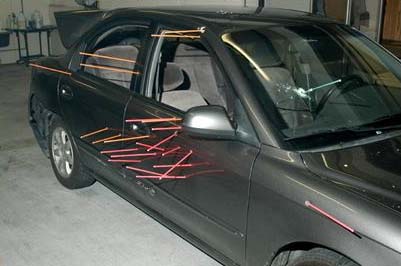
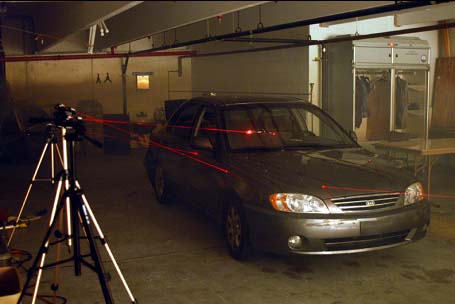
The other session involved using lasers and plastic rods to trace bullet trajectories. The session presenters, King C. Brown, M. Dawn Watkins and Rus Ruslander, put on a great light show with relatively inexpensive lasers sold as torpedo levels in stores like Home Depot, Lowe’s and Harbor Freight. It is impressive to see lasers or plastic rods retracing the bullet paths in a car that’s been shot up with an AK-47.

One other thing that struck me was the wide range of people attending the conference. I met a high school teacher who gives CSI classes and there was half a dozen investigators from Colombia who brought a translator and participated in a session by using wireless headphones. Federal, state and local agencies were heavily represented.

The convention is going on all week in San Diego. Here’s the information.

Back to 1957….

Email me

Photographs courtesy King C. Brown.

Posted in #courts, @news, books, Crime and Courts, Current Affairs, Homicide, LAPD, Robberies, Science | Tagged , , , , , , | Comments Off on CSI–2007

KFWB–980

July 24, 1957
Los Angeles

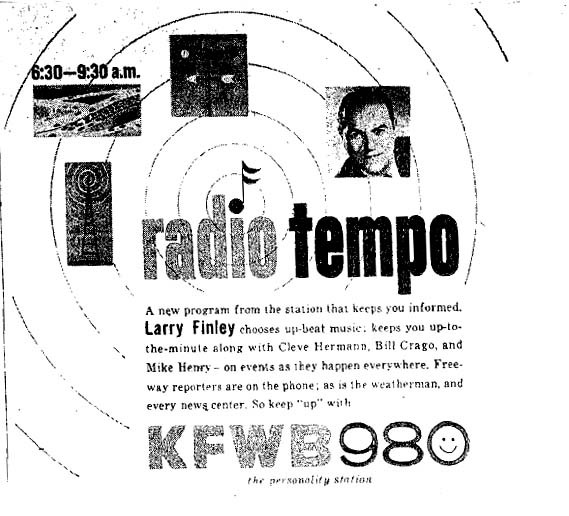
You mean there was a time when KFWB didn’t have an all-news format? Yes, indeed. Read about Larry Finley here. More (much, much more) about Boss radio here.  Vintage air checks from KFWB (and many, many other radio stations) here (a subscription site).

A smiley face in 1957? That’s a new one on me.

Email me

Posted in @news, Music, Rock 'n' Roll | Tagged , , , | Comments Off on KFWB–980

Matt Weinstock

July 22, 1957

This is to report that a distressing situation has arisen in MacWestlake Park.

Certain pigeons–just a few of the hundreds in the park, mind you–have
adopted a decidedly unmilitary attitude toward the recently dedicated
statue of the General of the Army Douglas MacArthur. Apparently they
believe he’s just another Beethoven. (Note: This is a reference to the
statue of Beethoven in Pershing Square across from
what used to be Philharmonic Auditorium and is now a vacant lot at Olive and 5th
thanks to a hurried developer with big plans–lrh).

There stands the general, erect, imperious, fastidious, hands to sides, as was intended.

But these uncouth, subversive pigeons have taken to bathing themselves
in the stagnant water in the enclosed forecourt surrounding the statue
and one of them sits by the hour on the peak of the general’s cap,
preening itself. Others flutter about him with careless disregard of
his welfare. They’re smart, they realize he can’t fight back or censor
their criticism.

Clearly this is a moment for a command decision. Fortunately there’s a
man in our midst with the know-how to cope with this crisis–Fred Beck.

Beck has proposed that funds be raised or appropriated for a statue of
a pigeon 15 feet high. The idea is that any generals passing through
L.A. would be given carte blanche to perch on the statue of the
pigeon–in reprisal.

I know just the place for this overgrown pigeon. Alongside.

AS BACKYARD barbecue addicts know, the big switch lately has been to the small, compact hibachi.

Paul Drus went looking for one but the stores in his neighborhood in
South Los Angeles were sold out. So he went to Little Tokyo and found
one in a store near 1st and San Pedro streets.

As the store owner wrapped it, he said: “Used to sell three, four
hibachis in one year. Now all buy and hard to keep in stock. Japanese
cook on hibachi three thousand years. Whatsamatter? Los Angeles just
learning to cook?”

Posted in Columnists, Downtown, Food and Drink, Matt Weinstock | Tagged , , , | Comments Off on Matt Weinstock

Pepe Arciga

July 22, 1957

Usually, advance press releases dealing with anyone’s mammoth or secretly puny celluloid projects begin this way:

So-and-so Productions take pleasure in announcing the filming of
another 12-reeler to star so-and-so…. It might be pointed out that
our producer, So-plus-So, has had much affinity with the people where
the picture is being filmed…”

That is how run-of-mill press releases go. Sometimes they wind up
forgotten in wastebaskets. Now let’s look in on still another fanfare
which struck closer to home. Me.

Here’s what it says:

“Dave Crown’s Coronado Productions is preparing a telefilm, late this
summer, based on the dramatic and colorful career of Kenneth Beldin. An
innovation will be the usage of Spanish and English language.”

After several checking attempts I’m unable to tell whether “Dave Crown’s Coronado Productions” is or ain’t.

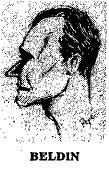
On the matter of Kenneth Beldin, I don’t have to check. Years ago I met this man. To the end of my days I will never forget him.

He is tall, very gaunt and not unlike movie character Mischa Auer. His
face always had the look of a man tortured or consumed by inner powers
telling him to go out into the wilds and look for something.

I first met him around 1939. At the time I was employed by the National
Railways of Mexico in Mexico City. Desk and field job interpreting for
visiting Americans.

He had been hired by the railway to cook up suitable travel brochures
which would help attract more turistas from the Eastern Seaboard, then
considered lush territory.

So he was hired. Overnight he disappeared from sight. For days none of
his acquaintances or bosses heard anything about Beldin. Police were
alerted. The American Consulate as well.

Nearly two weeks later he popped up sporting a beard about the same size as that which now hangs from Ernest Hemingway.

His complexion, originally a pale tan, had turned yellowish. His
cheekbones seemed to have increased in bulk and the man’s light brown
eyes were crisscrossed with countless little red veins.

Kenneth Beldin, the writer-researcher, had done what few brochure
writers ever do when amassing material for their travel pitches. He had
actually thrown caution to the winds and set up shop in the
gosh-darndest villages in the state of Guerrero, where civilization was
something the dwellers wanted no part of.

And to complete the job of going native, not only had he picked up Spanish but also a good smattering of Zapotec dialects.

Indians, to Beldin, were the most fascinating thing in life. For hours
he would sit on his veranda talking to them, trying to solve their
inscrutability and making every effort to be liked by them.

His obsession was to prove, beyond a single scientific doubt, that
Mexican Indians had settled in Mexico after centuries of migration from
the Orient.

Now married to an Indian maiden named Xochitl, Kenneth Beldin has
earned for himself a niche that weighs–and then some. Recently the
official organ of the medical profession in Mexico told this:

“Scientists from the U.S. and other countries travel to exchange ideas
with him (Beldin). He has the undying gratitude of generations of
children in our nation. He will go down in history as “The Apostle of
Sesame Meal.’ “

Posted in Uncategorized | Tagged , , | Comments Off on Pepe Arciga

Lil’ Pedro update

While cruising Beverly Boulevard the other day, I saw this mural on the side of Cactus Mexican Food No. 2 at Beverly and Harvard Boulevard. (For an explanation, see my earlier post on the “Gordo” and “Lil’ Pedro” comic strips). I should note that after my original post, I received an e-mail from a fellow ostensibly living in Mexico who said this figure is based on a famous sculpture by Ignacio Asúnsolo in the National Art Museum in Mexico City and that it’s very popular in Mexico.

All of which may be true, but the little lawn statues certainly infuriated some of my Latino friends in Tucson.


Photograph by Larry Harnisch Los Angeles Times

Email me

Posted in art and artists | Tagged , , , | Comments Off on Lil’ Pedro update

El Segundo revisited

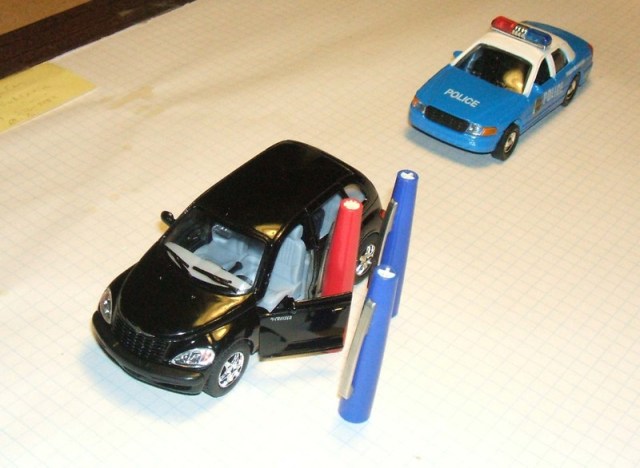
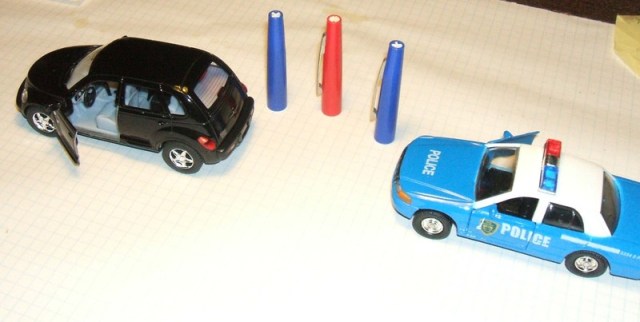
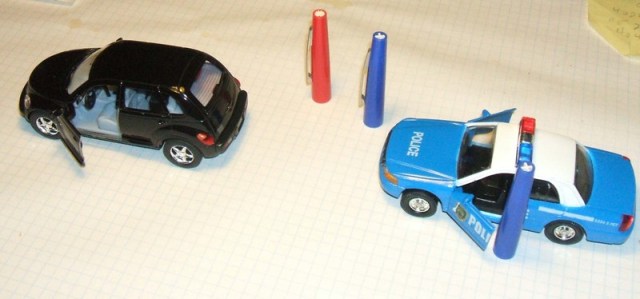
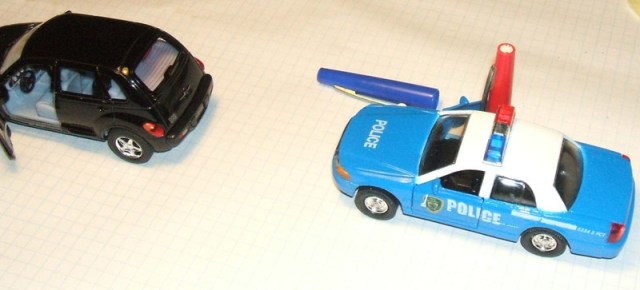
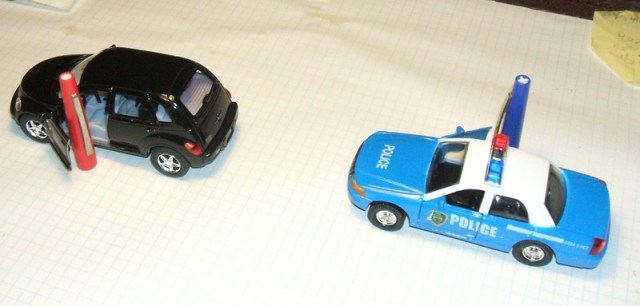
Over lunch today, King C. Brown and I discussed the El Segundo case and I worked out this scenario for what might have happened that night. I apologize for the extremely low-tech simulation but this is all I could find around the hacienda.


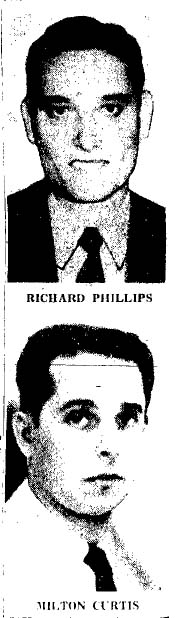
1. Curtis and Phillips remove the driver from the car.


2. Curtis and Phillips shine a flashlight in the driver’s face (possibly a field sobriety test).


3. Curtis gets in the car to radio the dispatcher.


4. The killer shoots Phillips in the back. Then shoots Curtis from the passenger’s side.

5. As the killer flees, Phillips fires four rounds into his car.

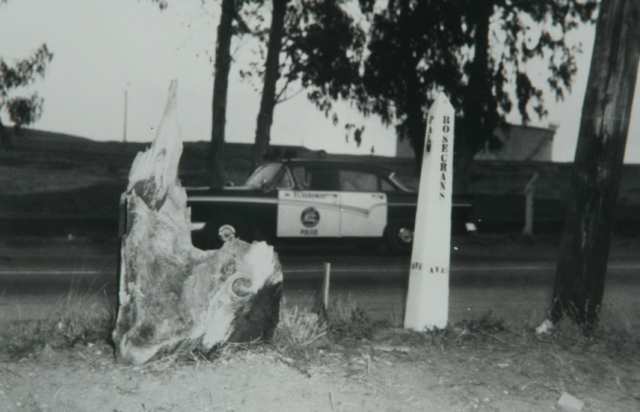
Here’s another picture of the crime scene:

Copy photo of 1957 murder scene of two El Segundo police officers at intersection of Palm Ave. and Rosecrans Ave. near the city’s border with Manhattan Beach during a press conference in El Segundo Wednesday morning January 29 2003.

Email me

Posted in Uncategorized | Tagged , , | Comments Off on El Segundo revisited

Death in El Segundo

July 22, 1957
Los Angeles

We’re heading west on Rosecrans Avenue. It’s early Monday morning, a few moments after 1:30 a.m., and the streets are dark. There’s nobody out but a few drunks and some people heading home from the swing shift. It’s all quiet.

Maybe that’s what these two men on the graveyard shift thought.

Let’s pull over here, at Palm Avenue. North of us is the tank farm for the Standard Oil refinery and south of us are new homes. Up ahead is a police car, all lit up. I make it out to be 1957 Ford 300, four-door black and white. The only sound is the police radio. You can see the front passenger door is open. It says: “El Segundo Police.”

Before we get out, I need to say something: We’re going to find two dead–or dying–police officers up there. At home, there’s two widows who kissed their husbands goodbye and hoped they would see them in the morning. There are five kids who are going to grow up without their fathers. It’s a terrible tragedy and I don’t want to minimize that. But it would be another tragedy if one more police officer died because we didn’t learn a lesson from what happened here. These men can’t tell us, so we’ll never know exactly what went on. But let’s see what we can figure out about the shooting by picking it apart.

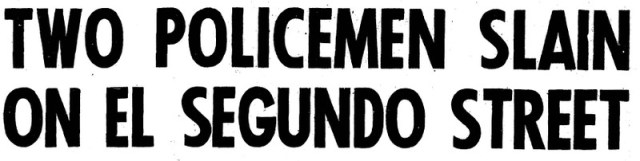
The officer in the driver’s seat is Milton Gus Curtis, 27. He’s fresh out of the academy in Riverside and has been on the El Segundo department for two months. Curtis has been shot in the upper right chest, right side and right forearm (or right wrist) with three .22-caliber short rounds. Continue reading →

Posted in #courts, 1957, @news, Cemeteries, Crime and Courts, Homicide, Science | Tagged , , , , , , | 11 Comments

Literary diversions

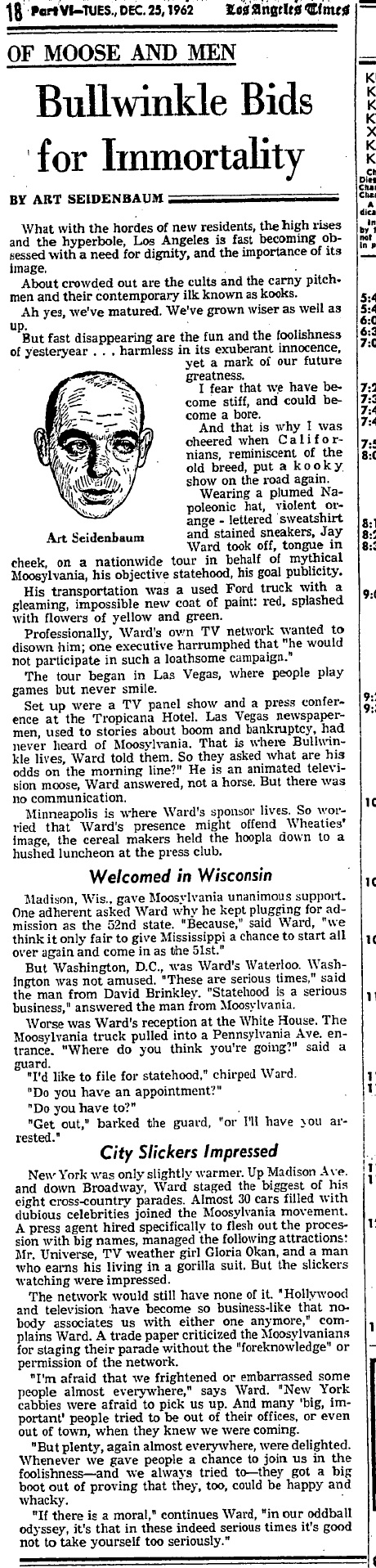
The late Art Seidenbaum on animation (and publicity) genius Jay Ward. Statehood for Moosylvania? As the 52nd state? As the story appeared, Dec. 25, 1962:

Posted in Columnists | Tagged , , , , , | Comments Off on Literary diversions

A question of leadership

July 18-Aug. 1, 1957
Los Angeles

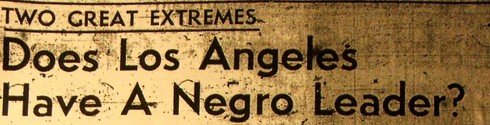
In the summer of 1957, eight years before the Watts riots, the Los Angeles Sentinel, a weekly newspaper serving the black community, published a three-part series by Stanley Robertson titled: “Does Los Angeles Have a Negro Leader?”

Robertson’s conclusion was “No.” But the question remains far more interesting than the answer.

The series began with a hypothetical case: another bombing of a home in a white neighborhood that was recently sold to a black family, like the blasts on Dunsmuir in 1951-52.

Robertson noted the painfully inept effort by one white newspaper to get comments on the bombings from representatives of the African American community. “Some of the answers would have made good copy for ‘Amos ‘n Andy,” Robertson said.

The newspaper, he said, indiscriminately interviewed several prominent doctors and businessmen as well as a convicted gambler, a “would-be politician who had a lucrative ‘book’ going behind his phony real estate office” and a newspaperman who was later convicted of petty theft.

In the event of another bombing or other crisis, Robertson asked:

“What single Negro man or woman in Los Angeles will be the person who will come to the front as not only the spokesman and the champion of the bombed family but for Negroes throughout the city? What single Negro man or woman will have enough ‘influence’  to put the right pressure in the right places so that the investigation of the bombing by police and other authorities will not end as another ‘unsolved case?’

“What Negro in Los Angeles will have enough ‘contact’ with all segments of local radio, television and press so as to ensure that ‘all the facts’ are made public? What Negro in Los Angeles will be ‘powerful enough’ to cause city officials to use every resource at their command in breaking the case?

“In short, what Los Angeles Negro will act as the leader of the Negro people in case such an event takes place? Does the third-largest city in the United States have a Negro leader? Is there a Negro in Los Angeles who is as powerful as New York’s fiery little borough president, Hulan Jack, Chicago’s William Dawson, Montgomery’s Martin Luther King ?

“Or is the third-largest Negro settlement in the United States without a recognized leader?”
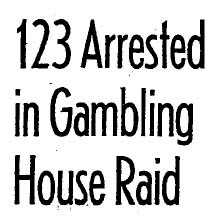
The second part of the series portrayed a sadly disillusioned, cynical view of black politicians and ministers who could be had for a price. Robertson also noted the LAPD’s failure to treat prominent African Americans with the same respect usually accorded to distinguished whites in a famous 1955 gambling raid on the Pacific Town Club, 4332 W. Adams, in which 123 people, many of them doctors and lawyers, were arrested.

“Do you think the same thing would have happened if the same type of affair was going on, as it very often does, at a white club of comparable stature as the Pacific Town Club?” one man asked.

None of Robertson’s sources were identified except by trade, their gender or the amount of time they had been in Los Angeles.

One African American who had lived in Los Angeles for many years said:

“When I was a young man in Los Angeles there weren’t many Negroes here but we fought for the things we wanted. Things which people today are still enjoying but take for granted. We fought for, and got, Negro teachers in the school system. We opened the city and county departments. We fought for equal treatment from the police.

“But our trouble was leadership. Yes, we had some leaders. Some who were pretty promising until the politicians and people in high places got to them. For secure, well-paying positions or an occasional handout, most of them merely became figureheads doing whatever they were asked to do. There were a few who still fought for what they believed in, but against the money these captive leaders had to spend on an occasional barbecue or drink, they soon disappeared.

“I’ve watched people of this type come and go. After World War II, with the large influx of Negroes and the great amount of young Negroes who were attending college and branching out into the fields which had been closed to us in my day I thought this would change. But, honestly, it hasn’t. The only thing which has changed is the price by which people can be bought off.

“We called those people who could be bought off in my time Uncle Toms. There are still Uncle Toms today, only Uncle Toms with fancier clothes and fatter wallets.”

Robertson also described conflict and lack of unity among newcomers and more established blacks. Some in the African American community charged that there was an “old guard” “from the days when the ‘Negro vote’ could be delivered by one whopping big chicken fry, barbecue or watermelon feed at Lincoln Park or South Park,” Robertson said.

There were just as many accusations, he said, that the newer generation of blacks was all too eager to trade their ideals for a Brooks Brothers suit, a T-bird and a home in the suburbs.

The third part of the series described the effects of upward mobility on blacks, the weakness of the local NAACP compared with the Urban League, the Lullaby Guild and the Jack and Jill Organization, and the lack of unity in supporting African American politicians.

One woman told Robertson:

“This losing of ‘identity’ knows no bounds among Negroes who become a success in their chosen profession…. However, most of those who attempt to forget that they are Negroes really don’t realize that one of the major factors in their success has been the fact that they are Negroes. Those people who are appointed, or elected, to public office, for instance, aren’t naive enough to think that they’re holding office because they’re qualified?” 

As for the NAACP, one unidentified official cited an appearance in Los Angeles by Jackie Robinson as part of a nationwide fundraiser. Although Robinson helped raise a significant amount of money in Oakland, Detroit, Chicago and New York, the man said, in Los Angeles, Robinson couldn’t “draw flies.” “Can you blame that on the NAACP leadership or the people of Los Angeles?” the official asked.

Robertson  quoted a woman who said that although a few “talk their way into being regarded by the two major parties as ‘key Negroes,’ no one person is anything more than a political gnat.”

She said: “We tell ourselves that we are much more organized, have made more progress and have more people in higher positions that the Mexican American community here. But what Negro in Los Angeles can we point to who is comparable to City Councilman Edward Roybal, who happens to be of Mexican descent?

“Rather than spending our time fighting among ourselves trying to secure a little plum for ourselves, as seems to happen whenever a Negro announces that he’s a candidate for a particular office, why not get together and back one candidate? How many Mexican-Americans do you suppose have run against Roybal?”

As it stands, Robertson’s series only states the problems and judging by his remarks, his stories hit a nerve in the African American community, eliciting phone calls and letters. But had I been his editor, I would have asked him to write a final installment exploring possible solutions. And for all I know, perhaps he did in a later story that I have yet to discover in the archives.

Instead, he concluded: “Does Los Angeles have a Negro leader? What do you say? I say no, not now, but a few men who, if they continue in their present manner, are only a few years away.”

Unfortunately, Robertson didn’t identify them. And eight years later, white Los Angeles will wonder what all the fuss is about down in Watts.

For those wishing to read the entire series, Part 1 appeared July 18, 1957; Part 2, July 25, 1957; Part 3, Aug. 1, 1957. The Sentinel is available on microfilm at the Los Angeles Public Library.

Bonus facts:

  • The Los Angeles Sentinel is now owned by Danny Bakewell.
  • In 1957, Rodney G. King hadn’t even been born.

Email me

Posted in 1957, Countdown to Watts | Tagged , , , , , , | Comments Off on A question of leadership

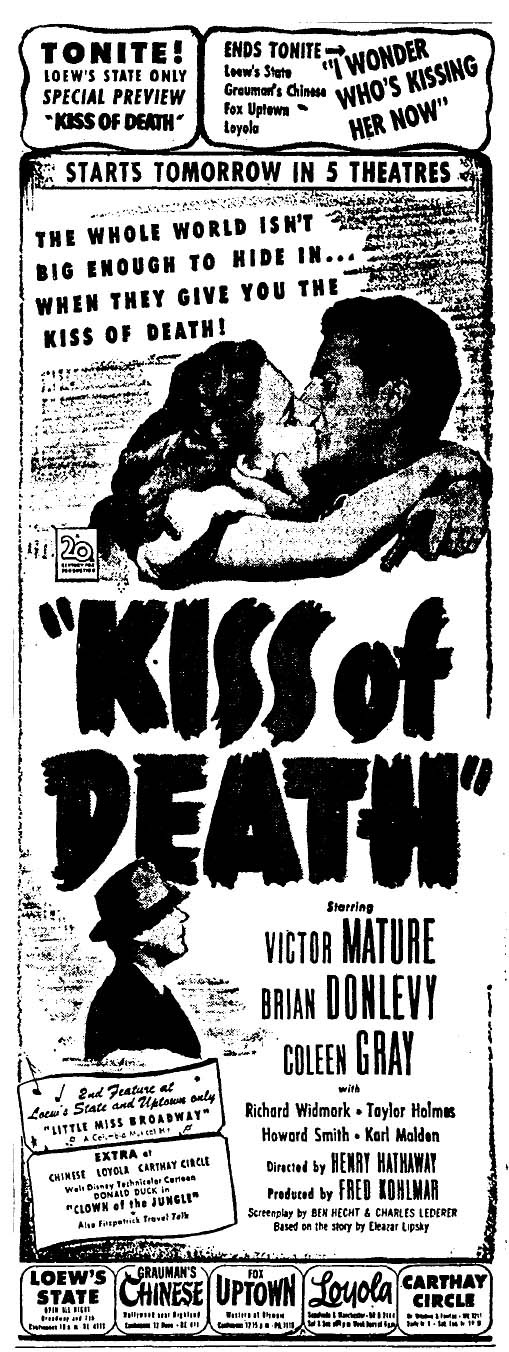
Victor Mature TV

Question: Didn’t Victor Mature own an appliance store?

Answer: Yes, Victor Mature TV: 10739 W. Pico Blvd. The store later moved to 10916 W. Pico.


Posted in Film, Homicide, Television | Tagged , , , | 2 Comments

What happened on Dunsmuir

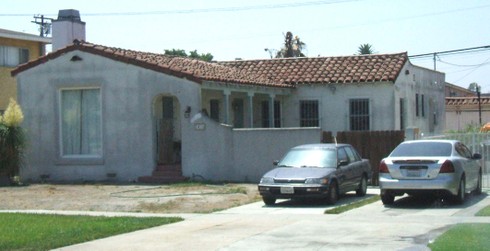
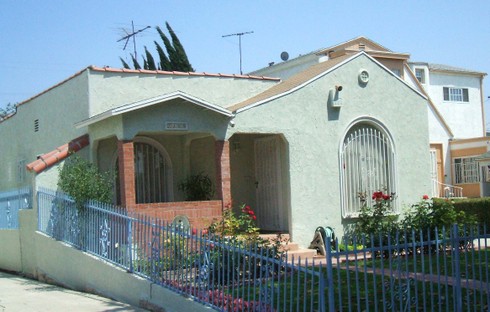
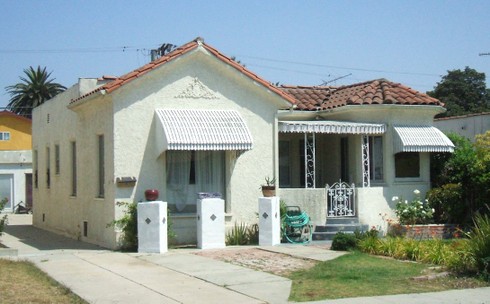
These appear to be four rather ordinary West Adams district homes from the late 1920s and early ’30s and in many ways they are.

Photographs by Larry Harnisch Los Angeles Times

This is 2435 S. Dunsmuir Ave.

This is 2308 S. Dunsmuir Ave.

This is 2135 S. Dunsmuir Ave.

And this is 2130 S. Dunsmuir Ave.

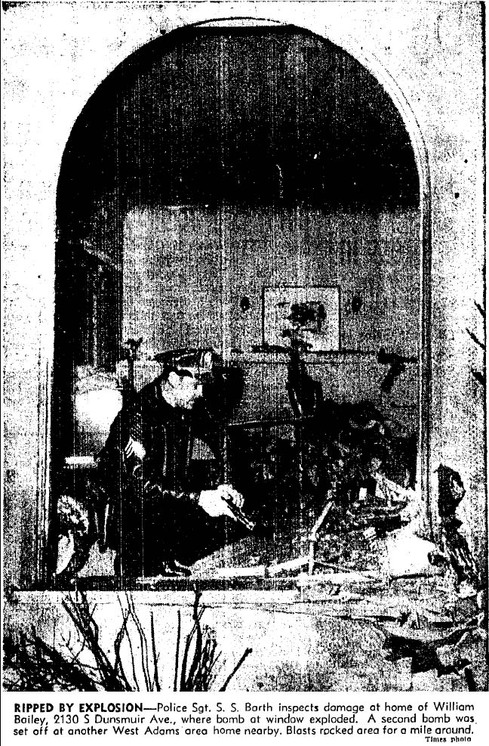
But on March 16, 1952, 2130 S. Dunsmuir looked like this:

About three months before the explosion, William Bailey, a science teacher at Carver
Junior High School, had moved into the house with his wife, Willa, and
their son, William Jr. The family was black. The neighborhood was
white.

Whoever hit the house also bombed the one across the street, which was
being rented by Ralph Martinez and John W. Potts. Presumably they were
black, although The Times doesn’t say so.

On July 25, 1951, 2435 S. Dunsmuir was bombed several days after after it
was sold to Dr. M.D. Matsumoto, a Japanese American physician.

An explosion a few hours earlier ripped  2308 S. Dunsmuir, which was
owned by Sallie H. Mazoway, a real estate agent. “Mrs. Mazoway told
police she had no part in the sale of the Matsumoto house nor had she
sold property to persons not Caucasians,” The Times said. “She did say
that she had received anonymous telephone calls on the subject of such
sales.”

Although police said the explosion at 2308 S. Dunsmuir was like the others, fire officials said it might have been caused by gas that accumulated beneath the house.

There’s one other thing these homes have in common: The bombings were
never solved, despite rewards offered by the NAACP and ACLU soliciting
information.

Email me

Posted in Countdown to Watts, LAPD | Tagged , , , , , , , , , | Comments Off on What happened on Dunsmuir

Insane


July 20, 1957
Riverside

A maid at a Riverside hotel found the battered, nude body of
5-year-old Hiedrun “Heidi” Nicholson bent over double and stuffed into a closet.

It looked “as if someone had been pounding her with a hammer,” The Times said, quoting another hotel maid. The autopsy showed she had a collapsed lung from a broken rib and bruises over most of her  body.

The girl and her mother, Felicitas Nicholson, a 31-year-old German war bride, had checked into the motel with Harry Vern Gates, 40, a Santa Ana salesman.

When he was questioned about Heidi’s death, Gates told police he had taken Nicholson to another motel in Maywood but insisted that she said her daughter was staying with friends.

Police discovered that Feliticas was already in jail after an officer found her lying on the sand in Long Beach at the end of 36th Place.

She was semiconscious and incoherent, according to police, and her purse contained her last will and testament, requesting a Christian burial.

In later interviews, she told police she was a commercial artist and that her parents still lived behind the Iron Curtain in Leipzig, East Germany.

She said she had been married to Air Force Master Sgt. Raymond Nicholson of Stillwater, Okla.

She was found guilty of murder and sentenced to the gas chamber after
Gates testified that Felicitas told her daughter she didn’t love her
anymore and was going to get rid of her.

However, Feliticas was the first person to be tried under a new
California law requiring a sanity hearing for those sentenced to die.

After a 32-day trial, the jury deadlocked and the judge declared a mistrial.

Halfway through the second sanity trial, the judge halted the proceedings and declared Felicitas insane, committing her to
Patton State Hospital.

The judge ordered that she be retried if she ever regained her sanity.
And then Feliticas Solveig Nicholson vanished without a trace.

Email me

Posted in #courts, Homicide | Tagged , , , | Comments Off on Insane

He’s here!

July 19, 1957
Los Angeles

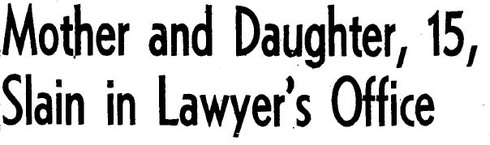
Minda Lee Birnbaum, 15, and her mother, Blanche Lewie, 46, had spent most of the day with the divorce lawyer, Murray
Chotiner. In the late afternoon, as Blanche made some phone calls from the law offices’ library, Minda pecked at a typewriter and talked to Carol Tannis about becoming a secretary.

Then Blanche’s estranged husband, Leo, walked into the offices at 202 S. Hamilton Drive, Beverly Hills. Minda ran to warn her mother, yelling: “He’s here!”
Blanche stood between them as he shouted at Minda: “Why are you doing
this to me?”

After an initial confrontation, Blanche told Tannis to call the police, but Leo warned Tannis: “Don’t do it.”

As Tannis hid behind her desk, Blanche grabbed a pair of scissors but Leo took them away, pulled a Luger from his belt, held the barrel against Blanche’s stomach and pulled the trigger.

Minda ran from the room but tripped and sprawled in the doorway. As she lay on
the floor, Leo put the Luger against the 15-year-old’s head and pulled the trigger. When it didn’t fire, Tannis fled.

Then, two shots.

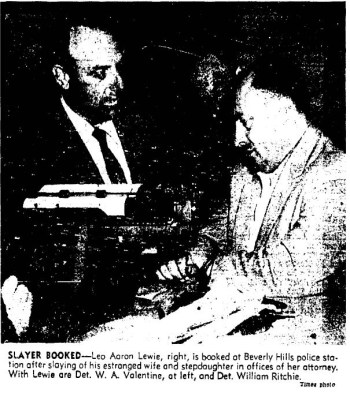
Acting on a tip, police found him at a miniature golf course, 1312 S. Arlington Ave.

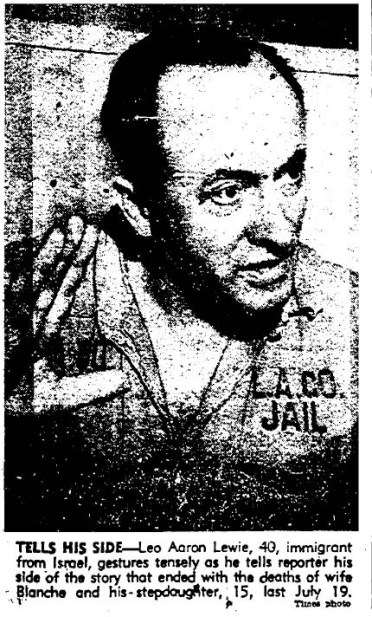
Forty-year-old liquor store clerk Leo Aaron Lewie was a Polish Jew who fled to Israel, he told The Times while in jail awaiting trial on two counts of murder.

He married in 1941, but his wife died giving birth to his son, Aaron, in 1947. A second marriage ended in divorce, he said. Then there was the 1948 war with the Arab states. “Many persons died in the streets,” Lewie said. “I crawled through the streets searching for food for my son.”

Lewie and Aaron left for France. “I came to Paris destroyed inside–my heart, my mind,” he said.

They arrived in New York in 1953 on a business visa. Later that year in Los Angeles, he married Blanche, whose husband had hanged himself in the basement of their home, leaving her with two children, Minda and Martin, who was two years younger. “It was an unhappy home from the
start,” Lewie said.

Blanche loaned him money to start a drive-in and they had a son, Robin. With the profits from the drive-in, the family moved to a home at 2066 Roscomare Road, Bel-Air. In 1956, Lewie sold the restaurant and opened a liquor store at 3901 S. Vermont.

“I worked long hours, seven days a week,” he said. “My wife became moody. She tells me, ‘Leo, I don’t care for you or the kids.’ That night I took the children to dinner and a movie. When we came home my wife hit me. I slapped her. She called the police. They arrest me. Later my stepdaughter Minda tells police I molested her.”

The domestic violence counts were dropped, but he was charged with molesting Minda. When he was finally released on bail, the family had gone into hiding from him.

Lewie insisted the molestation charges were Blanche’s ploy to get a divorce. “My wife said if I give her everything the charges will be dropped,” he said. So he agreed. But instead of dropping the charges,
Blanche was trying to have him deported, he said.

“She pushed me, pushed me, pushed me!” he shouted!
He bought a Luger, planning to go to Chotiner’s office and say that he would kill himself if the charges weren’t dropped. Instead, he found Minda and Blanche.

“She grabbed a pair of scissors and came at
me,” he said. “I lost my head and pushed on the trigger. I put the gun to my head and pulled the trigger again. But there were no bullets
left.”

(Police said that when he was arrested he had a full magazine of ammunition plus some shells in his pocket).

One of the key contentions at the trial was that Lewie had been molesting Minda for two years, but the medical experts disagreed completely. Dr. Charles Demos, a Santa Monica gynecologist who examined
Minda before she was killed, said he found evidence that she had been molested. Dr. Gerald K. Ridge, who performed the autopsy, said he found no evidence that Minda had sexual relations.

In an attempt to determine the truth, investigators exhumed Minda’s body from her crypt at  Beth Olam Cemetery, 900 N. Gower St. Over objections by defense attorney Gladys Root, Dr. Bruce David Stern
testified that his findings “were compatible with the contention that the girl had been repeatedly violated.”

Leo Aaron Lewie was convicted on two counts of second-degree murder March 27, 1958. He died
in San Francisco on April 25, 1983, at the age of 66.

Murray Chotiner, a longtime adviser to Richard Nixon, died in 1974 in Washington, D.C., of injuries from a car accident. He was 64.

More information on the Lewie case is available at the Jewish Coalition Against Sexual Abuse/Assault.

Email me

Posted in #courts, Homicide | Tagged , , , , | Comments Off on He’s here!

Liberace’s mother beaten

July 19, 1957
Los Angeles

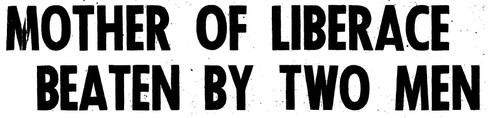
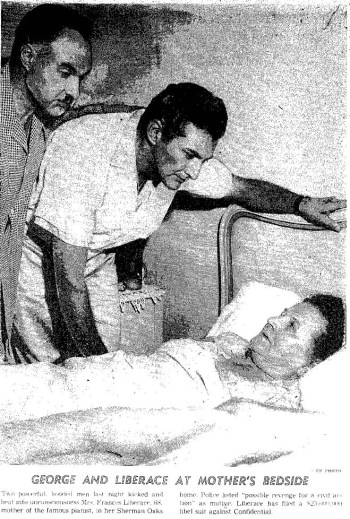
Hours after Liberace gave a deposition in his $25-million libel suit against Confidential magazine, two masked intruders attacked his mother in the garage of Liberace’s home, 15405 Valley Vista Blvd., Sherman Oaks.

Frances Liberace Casadonte, (68, according to the Mirror; 65, according to The Times) said she was on her way to burn some trash in a backyard incinerator when she was attacked by two men.

“They had black hoods with slits for their eyes. They also had some kind of covering, probably stockings, over their shoes,” Casadonte told
police. “I screamed and they chased me into the kitchen. There, one of them grabbed me, hit me or threw me down on the floor. One of them kicked me in the back. I heard one of them say, ‘This will give him something to laugh about.’ Then I fainted.”

A doctor says Casadonte’s heavy corset may have protected her from being badly injured when the attackers kicked her. Liberace was not informed about the assault until he finished his
midnight show at the Moulin Rouge, The Times said.

A family spokesman said: “I feel this whole thing is connected with the Confidential suit. Somebody is trying to frighten us.”

In response, guards were hired to protect the home of Liberace, as well as the home of his brother George in Encino, and that of his brother Rudy in Van Nuys.

According to The Times, several people were questioned in the assault, but no one was ever arrested.

Email me

Posted in #courts, LAPD, San Fernando Valley | Tagged , , | 3 Comments

You, the jury, Part II

July 19, 1957
Los Angeles

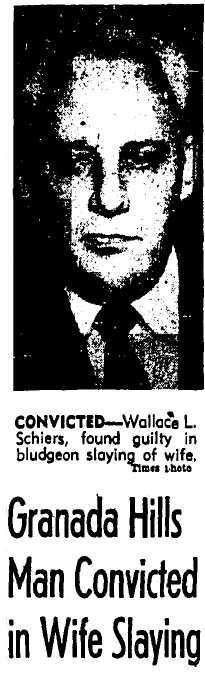
The jury convicted Wallace LeRoy Schiers of second-degree murder on July 18, 1957. But Schiers continued to insist that he did not kill his wife. He said: “I have nothing on my conscience. Somewhere along the line I have got to be exonerated. I am not guilty.”

He was sentenced to five years to life in prison, serving four years in prison and four years’ probation.

But the story is not over. Schiers appealed his conviction while in prison and although his case was rejected by the California Supreme Court, he continued to fight the case even after six years of freedom.

The basis of Schiers’ argument was police testimony about his polygraph test, which was inadmissible in court.  Schiers acted as his own attorney, arguing before the  state Court of Appeal that the judge’s order to strike the testimony and instructions to the jury to ignore it were not enough.  Schiers’ argued that since the polygraph testimony had come up in his preliminary trial, Deputy Dist. Atty. Evan Lewis knew about it and  should have taken steps to prevent it from being introduced in court.

Although the Court of Appeal rejected his plea and the state Supreme Court refused to hear his case, state Supreme Court Justice Jesse W. Carter wrote a dissenting opinion saying:  “By this decision the California judiciary invited repetition of such open debauchery of basic fairness to the discredit of the bench and bar. In my opinion it amounts to denial of due process of law.”

Schiers’ next action was to claim that he had not been furnished with counsel and had to act as his own attorney. He also tried to take the matter before the federal courts but was unsuccessful.

Finally, after a prolonged legal battle, the Court of Appeal reversed Schiers’ conviction in 1971 because of the inadmissible testimony about the polygraph results.

“The court noted the police officer’s testimony did not come as a surprise to the prosecution,” The Times said. “An augmentation of the appeal record allowed by the appellate court showed that police had referred to the lie-detector test in Schiers’ preliminary hearing before trial.

“Thus, in the court’s view, the prosecutor was on notice and should have guarded against any such testimony being presented in the presence of the jury at the trial.

“The fact that he did not indicated that the error was intentional and invited by the prosecution.”

“The error was so prejudicial that the judgment must be reversed,” the court ruled.

Wallace LeRoy Schiers reestablished himself in the aerospace industry. He died Oct. 5, 1994 in Nevada.

Note: I had two votes for not guilty, no votes for guilty. Thanks, gentlemen.

Email me

Posted in #courts, Homicide, LAPD, San Fernando Valley | Tagged , , | 1 Comment