Spring Street revisited

Spring_street02_detail01
Photograph by Munsey Studios, winter 1900

1900_0526_munsey

Dropcap_i_fairbanks_2 found another image of the Ramona Hotel on Spring Street from about the same era as the earlier picture.  Unfortunately, I scanned it at such great resolution that my computer can’t handle the whole thing so I have to crop it down to smaller pieces. Here’s a lovely detail from the overall shot showing a wagon and a streetcar. And I’ve solved a mystery! The utility poles support the overhead cables for the streetcars. (In later times, the cables were attached to large metal rings in buildings. The streetcars may be gone, but the rings are still visible in many older buildings, including The Times). And I’m so happy to have found the little child sitting on the lap of the man driving the wagon. No car seats in the good old days.
Spring_street02_streetcar

And here’s a photo especially for the Daily Mirror readers who like the streetcars. Isn’t this a wonderful photograph? Notice the utility pole for the streetcar cable. You can even make out the motorman and a man riding backward to the left. All aboard for Pico Heights!  And I just know that someone is going to send me the history of LARY Car 111. Email me

Posted in Downtown, Transportation | Tagged , , , , , | 1 Comment

Nuestro Pueblo

1938_0720_nuestro


The 400 block of Jackson Street no longer exists. It’s in the middle of this complex, as shown on Google Earth:
600_jackson_google

I found something really wonderful in researching the temple: A 1950 Sanborn map with an overlay of Little Tokyo from 1940. It’s from Pease Press.

Posted in Downtown, Nuestro Pueblo | Tagged , , , | Comments Off on Nuestro Pueblo

Spring Street

Ramona_big_crop
Photograph by Munsey Studios

The Hotel Ramona was on the southwest corner of Spring and 3rd streets (305 1/2 S. Spring) on the Ramona Block. It apparently went out of business in 1912, when its furnishings were auctioned off. By 1917 it was replaced by a Beacon shoe store.

Ramona_family

Ramona_leaning_man

Dropcap_o_baker02 ne thing I enjoy about going through the old photos is that I never know what I’m going to find. Here’s a historic picture of South Spring Street. I am assuming that it’s a contact print from a glass negative because there is incredible detail that’s only visible in a large scan.

For example, there’s the family at left, on the sidewalk just about to walk out of the frame. And there’s a fellow leaning against a carriage waiting for something or someone. Notice the sharp shadows, indicating that the photo was taken in the afternoon. 

Ramona_standard_sewing Adding to the clutter of the street are some large crates or boxes left by the curb. Notice that the back of the buggy advertises Standard Sewing Machines.
Ramona_crop

Here’s a detail of the photo. Note that Spring takes an oblique angle at 1st Street. Obviously it hadn’t been realigned yet. We can also see that the sidewalks are crowded and traffic is a little more chaotic than we might expect from the overall picture.

1901_0810_campbell Fortunately, almost every building has signage, so we can make out Campbell’s Curio Store and Eaton Music Company, narrowing the date of the photo to about 1900. We also find signs for Mrs. Keiffer Employment, Reynolds Photo, Dr. Seaton the Chiropodist, and "Tub Baths and Massage."
1900_0104_eaton_ad
Ramona_streetcars

Speaking of traffic, notice that we have electric streetcars (the last horse-drawn streetcars didn’t disappear from the city until about 1903).

Ramona_rig

Ramona_bicycles_2

But in addition to the streetcars, we have wagons, buggies, coaches and bicycles. Suddenly Spring Street is starting to seem a bit busy.

Below left, a bicyclist and another bike leaned against the curb. In fact, there are several bicycles that have been left against the curb on both sides of the street. In this era, businesses made heavy use of bike messengers and they were often described as young hoodlums.

Ramona_pedestrians

And we have pedestrians, crossing in the middle of the street, presumably after the northbound streetcar has passed. One thing that’s missing is crosswalks. Notice the ghost of one shadowy bicyclist who was apparently in motion when the picture was taken. I would guess that our photographer used a fairly slow shutter speed, a tight aperture with the focus set for infinity.

Ramona_poles

There’s no such thing as underground cables at this time, so we have utility poles strung with electrical wires.

Ramona_lights

What else is missing besides crosswalks? How about streetlights? I don’t see any lighting except for this curious object outside what appears to be the Orpheum Theater at 235 S. Spring.

1900_0205_autos Here’s what else is missing: Automobiles. "The day when the horse is to be a thing of the past on our streets is not yet in sight," The Times said on Feb. 5, 1900.

"The advance of the automobile, while not very rapid in this country, will be sure, but before it can come into general use the price will have to come down considerably, as at present these horseless carriages are practically out of the reach of people of moderate means."

Email me

Posted in Downtown, Transportation | Tagged , , , , , , | 1 Comment

The Drunkard


Drunkard_01

1933_0713_drunkard

I found this program from "The Drunkard" in a scrapbook that I bought years ago and rediscovered while unpacking a box of books today. "The Drunkard" was one of the most popular and long-running plays ever staged in Los Angeles. This particular program dates from the middle of 1934.


Here’s a post I originally wrote for the 1947project that will give a bit of background:

Dropcap_i_baker
n the summer of 1933, expecting nothing but a brief run and modest
ticket sales, two theater people from Carmel, Preston Shobe and Galt
Bell, hatched the idea of staging P.T. Barnum’s 1843 artifact of the
temperance movement, “The Drunkard” by W.H. Smith. In keeping with the
“meller drammer” atmosphere, the producers removed the theater seats
and installed tables so the audience could drink beer and eat a buffet
meal while hissing the villain, cheering the hero and singing "There Is
a Tavern in the Town."

The men had more ambitious plans for the
theater, including historic Italian plays and a Russian version of
“Uncle Tom’s Cabin” recast as anti-capitalist propaganda. But for
reasons none of them understood, “The Drunkard,” which opened July 6,
1933, kept drawing huge audiences and was selling out weeks in advance.

Drunkard_023

Strangest of all, people kept coming back to see the play, so
that the producers abandoned the rest of the season. And not just
regular theatergoers but movie stars, like Boris Karloff (who suggested
old-time songs to be performed during the olios), Mary Pickford and
John Barrymore.

W.C. Fields adored the play so much that he
not only saw more than 30 performances, but he also built the 1934 film
“The Old-Fashioned Way” around a production of “The Drunkard,” taking
the role of Squire Cribbs and using many members of the Los Angeles
cast. (That’s Jan Duggan “The Bowery Nightingale” with a ping-pong ball
in her mouth getting whacked by Fields with a ping-pong paddle in “You
Can’t Cheat an Honest Man.”)

Drunkard_045

To everyone’s amazement, the play
kept running week after week. The production marked its first year. And
then another. Some cast members left for road shows of “The Drunkard.”
Understudies took on leading roles and became stars of the show. As the
years passed, actors who began as children outgrew their roles and had
to retire. By 1940, there had been 16 weddings among the cast members.

On
an unpainted cupboard in the women’s dressing room, someone tracked the
number of performances and various historic events. On the night of the
2,245th performance, Hitler invaded Poland. On the 3,088th performance,
the Japanese attacked Pearl Harbor. Through the war years, the Theatre
Mart staged special shows for men and women in uniform. By its 7,085th
performance on July 6, 1952, “The Drunkard” had been seen by more than
2 million people.

Finally, the Fire Department cut back on the
size of the audience allowed per show from 340 to 260 and the play was
no longer financially viable. On Oct. 17, 1959, “The Drunkard” closed
with 9,477 performances.

Drunkard_067

Neely Edwards, 76, who had been in
the show since Christmas Eve 1933, said: “I was getting kinda tired
anyhow. I can stay home now and relax for a while. Something usually
comes along.”

In 1960, the theater where millions had booed and
cheered the story of temptation and triumph over the evils of Demon Rum
became the headquarters of Los Angeles Press Club.


The neighborhood of 605 N. Juanita Ave., one block east of Vermont, one block south of Melrose, from Google maps’ street view.
Email me


Posted in Film, Hollywood, Stage | Tagged , , , , | 11 Comments

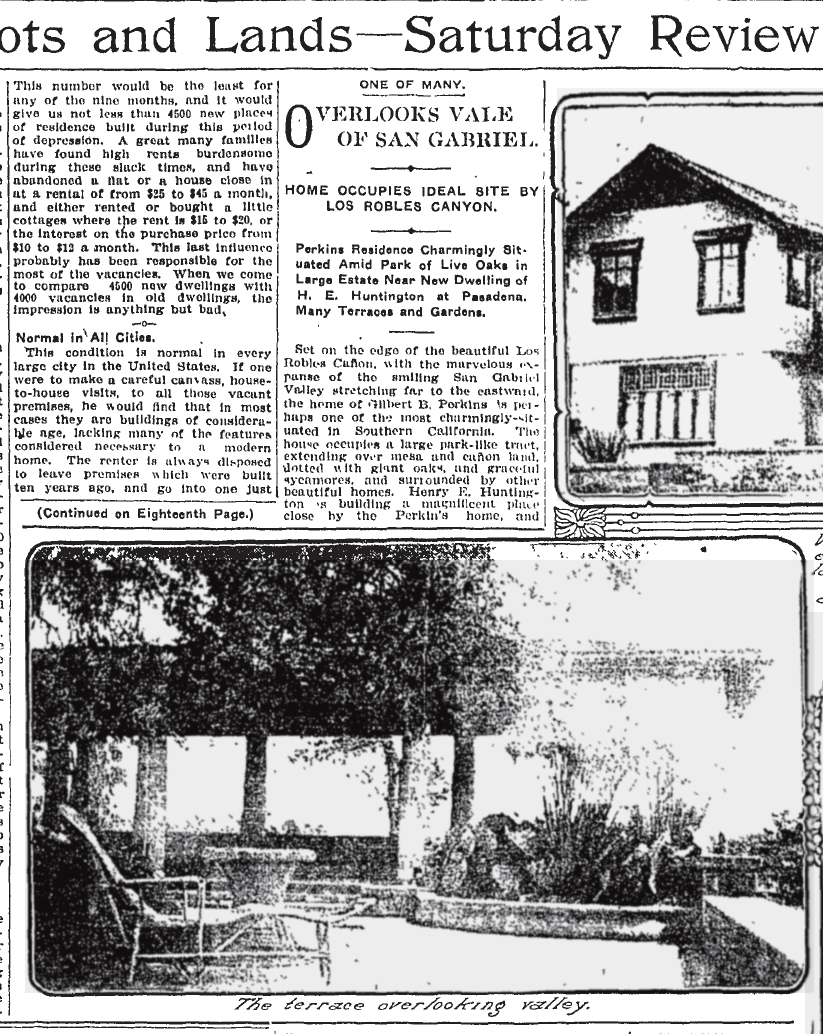
July 19, 1908: Perkins Estate Overlooks Los Robles Canyon

July 19, 1908: Pasadena estate on Los Robles CanyonAbove, details of the Gilbert B. Perkins home on Hillcrest in Pasadena.


Dropcap This was a fun little mystery, complicated by The Times using the wrong middle initial for Gilbert Perkins in the caption.

Perkins sold the home in 1914 to oil executive Frank W. Emery for a reported $125,000 ($2,591,561.05 USD 2007). After Emery died in 1920, the property at 1400 Hillcrest Ave. was sold to Mary Virginia McCormick, daughter of Cyrus H. McCormick, the head of International Harvester. (The Times originally identified her as his sister — ahem).

Continue reading →

Posted in 1908, Architecture, Front Pages, Real Estate | Tagged , , , , | Comments Off on July 19, 1908: Perkins Estate Overlooks Los Robles Canyon

Nuestro Pueblo

1938_0718_nuestro


Above, our artist’s view of Bee Rock and below, Bee Rock courtesy of Google Earth.

Bee_rock_google_earth

Below, suicide at Bee Rock, April 10, 1944.

1944_0411_bee_rock

Posted in Nuestro Pueblo | Tagged , , , | Comments Off on Nuestro Pueblo

Pasadena Freeway

 
1912_map

A map from 1912 shows the plans for the Arroyo Seco Parkway. Note the Silver Lake Parkway, which was not built. The Arroyo Seco Parkway was actually proposed even earlier, as part of Charles Mulford Robinson’s "City Beautiful" project of 1906-7. (He also advocated realigning Spring Street and putting City Hall there … and he proposed planting jacarandas along the city’s streets).

1921_arroyo_seco_crop
Los Angeles Times file photo

This photograph of the Arroyo Seco Road, dated 1921, shows a pleasant country lane between Pasadena and downtown Los Angeles.

1935_0714_crop
Photograph by the Los Angeles Times

Construction on the river channel next to the Pasadena Freeway, July 1, 1935.

1940_1017_crop
Photograph by the Los Angeles Times

Construction is nearly finished, Oct. 17, 1940.

1940_1230_ribbon_crop_file
Los Angeles Times file photo

Rose Queen Sally Stanton, Gov. Culbert Olson and Highway Patrol Chief E. Raymond Cato at the ribbon cutting of the Arroyo Seco Parkway (Pasadena Freeway), Dec. 30, 1940. This is in the general location east of Fair Oaks Avenue in South Pasadena where the sinkhole opened July 16, 2008.

1941_0204_crop
Photograph by the Los Angeles Times

And in a matter of months (Feb. 4, 1941) after the opening, the southbound Arroyo Seco Parkway (Pasadena Freeway) is backed up at the Figueroa Tunnels. If you ever wondered what a 67-year-old traffic jam looks like, this is your answer.

1950_0312_crio_2
Photograph by the Los Angeles Times

Emergency turnouts are added to the Pasadena Freeway in 1950 to ease congestion and prevent accidents.

1961_0615_barriers_gil_cooper_cro_2
Photograph by Gil Cooper / Los Angeles Times

Workers install center dividers on the Pasadena Freeway, June 15, 1961. If you have ever seen the beating that these guardrails take from accidents, you can imagine what it was like when there was nothing but perhaps a little landscaping to keep cars from plunging into oncoming traffic. Email me

Below, the Orange Grove Avenue off-ramp on the southbound Pasadena Freeway via Google maps’ street view.

 
Posted in Freeways, Transportation | Tagged , , , , , , | 7 Comments

July 17, 1938

1938_0717_party
Jack Benny gives a party for his daughter Joan and invites some little friends: Jack Haley Jr., Gary and Dennis Crosby, Dion Fay (son of Barbara Stanwyck and Frank Fay), Melinda Markey (daughter of Joan Bennett and Gene Markey), Al Jolson Jr. and Freddie Astaire Jr. Email me
Posted in Film, Food and Drink, Front Pages, Hollywood | Tagged , , , | 1 Comment

July 17, 1908

1908_0717_hats_4

Don’t get the idea these hats were cheap; wait till you see the actual prices: $219.87 and $186.89, marked down to $86.85 USD 2007.
Below, Democratic presidential candidate William Jennings Bryan gets more inches of copy but Republican candidate William Howard Taft gets the bigger headlines. Note: Although Taft was nominated at the GOP convention, he will make his official acceptance speech July 28. Email me
1908_0717_taft


1908_0717_bryan
Posted in @news, Politics | Tagged , , , , | Comments Off on July 17, 1908

President visits L.A.


Fdr_1938_0716_broadway_02

Photograph by the Los Angeles Times

President Roosevelt at Broadway and 7th Street, July 16, 1938.

1938_0716_protesters

Photograph by the Los Angeles Times

Protesters along the parade route.

1938_0716_railroad

Photograph by the Los Angeles Times

A crowd greets the president, who arrives in his personal railroad car.

1938_0716_station

Photograph by the Los Angeles Times

A detail from the image above.

1938_0716_fdr_speech
Photograph by the Los Angeles Times

President Roosevelt delivers a speech, ignoring Los Angeles Mayor Frank Shaw, left. The president began his address without being introduced by the mayor, The Times said.

1938_0717_cover 
Email me
Posted in Downtown, Front Pages, Politics | Tagged , , , , , | Comments Off on President visits L.A.

Mystery picture

2008_0714_mystery_picture


This one’s a bit different. Who’s the artist?

Update: If you are a faithful Daily Mirror reader, you will recall posts about this artist….

  • Joan Rivers? Interesting guess. Alas, no.
  • Vincent Price? I’m afraid not.
  • Red Skelton? Sorry, no.
  • Henry Major? I’m afraid not.
  • Zsa Zsa Gabor? Alas, no.
  • Phyllis Diller? Interesting guess, but no.
  • Tony Curtis? Interesting, but no.
  • John Wayne Gacy? Ick! NO!!!!
  • Tony Bennett? Sorry, no.
  • Elizabeth Taylor? Alas, no.
  • Al Hirschfeld? Um, probably not.

Email me

Posted in Uncategorized | 12 Comments

Setback for stadium

July 15, 1958

By Keith Thursby

Times staff writer

1958_0715_cover
Los Angeles and the Dodgers lost a round in court in their efforts to build a baseball stadium in Chavez Ravine.

Superior Court Judge Arnold
Praeger ruled that the contract between the city and the Dodgers was
invalid. The deal had been struck when the team moved to Los Angeles,
then voters narrowly approved it in a June 1958 election. Two local
taxpayers then filed lawsuits trying to stop the deal.

The Times’ main story led with
a couple of painful sports metaphors, reporting that Judge Praeger
"struck out the Dodgers’ Chavez Ravine deal," which according to the
paper was "a 32-page doubleheader decision."

The paper was a strong
proponent of the ballpark and there were often clues in stories if you
weren’t sure where the paper stood. Deep in the main story on Praeger’s
ruling was this passage: "As for the voters who decided last June 3
that they were in favor of the Chavez Ravine recreational park–that
doesn’t count!" Interesting how the project was described.

In a story about city
officials’ reactions, Councilman John Holland was referred to as
"perhaps the bitterest foe"  of the stadium plans. The ruling seemed
certain to be appealed, but Holland instead hoped "that plans may be
speedily revived to have the major league baseball stadium constructed
near the Coliseum in or adjacent to Exposition Park."

Dodger owner Walter O’Malley remained confident that the ballpark would be built in Chavez Ravine.

"We came to California in the
first place because we felt it was a fine country and because we wanted
to build a new modern stadium," O’Malley said in a story by The Times’
Al Wolf. "Chavez fits in perfectly with that plan–and we are not
abandoning the program."

keith.thursby@latimes.com

Posted in City Hall, Dodgers, Downtown, Politics, Sports | Tagged , , | Comments Off on Setback for stadium

July 15, 1938

1938_0716_editorial


From The Times’ editorial page, July 16, 1938. Note the Bible passage.
1938_0715_cover

1938_0715_runover


Dropcap_w_1926
e can add this to The Times’ editorials against a federal anti-lynching law (not necessary) and offering refuge to people fleeing Nazi persecution (they would just go on welfare and take jobs away from Americans): What’s all the fuss with a recall election? One thing that’s evident about The Times’ editorial pages in this era is that they were staunchly in favor of the status quo.

Meanwhile, we seem to be in favor of a ballot initiative on working women that I don’t entirely understand. Looks like some digging is in order.
 
At left, petitions are filed seeking to recall Mayor Frank Shaw. He says his opponents are a "disgruntled, discredited, hypocritical handful of politicians, racketeers and misguided zealots…." Los Angeles? Why it’s the "white spot" of the nation!

And we’d be willing to host the 1940 summer Olympics after Tokio was forced to withdraw because of the war between Japan and China. 

Also … Katharine Hepburn and Howard Hughes? Let me say that again: Katharine Hepburn and Howard Hughes?

Email me

Note to Jaded: It’s not such a bargain. Adjusted for inflation, $13.33 is $190.61 USD 2007.


Posted in #games, City Hall, Film, Front Pages, Hollywood, Politics, Sports, Transportation | Tagged , , , , , , | 2 Comments

Nuestro Pueblo


1938_0715_nuestro


Prospect and Myra avenues …  No, I couldn’t make this up. I really couldn’t.


Posted in Hollywood, Nuestro Pueblo | Tagged , , | Comments Off on Nuestro Pueblo

July 15, 1908

1908_0715_perverted

1908_0715_oil_gun

1908_0715_page


Dropcap_h_lincoln
ere’s an update on the story of Joseph H.N. Longy, who was arrested on charges of sending threatening letters to local businessmen. The Times gives an elaborate description of his "oil gun" and a primitive hand grenade that was found in his room.

At left, Frank Leroyxez is badly injured during a Bastille Day celebration when his parachute becomes snarled after he jumps from a gas balloon at Chutes Park. Leroyxez landed on a building at 16th Street and Main (at left, the intersection), and was rescued by firefighters. 

In November, Leroyxez will be part of a balloon race with hopes of setting a distance record.

Also … Chinatown gamblers target police officers for blockading their businesses … Painters are trapped in a stockade being built to house the homeless … Wilmington deals a setback to plans for laying streetcar tracks … And the South Main Street and South Side improvement associations oppose bonds for improved roads.

Email me


Posted in @news, Downtown, Freeways, Front Pages, Science, Transportation | Tagged , , , , , , , | Comments Off on July 15, 1908

El Segundo revisited

1958_0714_gagnon


1958_0714_page

Dropcap_n_nash26 orman Frederick Gagnon looks like an excellent suspect in the unsolved killing of two El Segundo police officers last year.

In an incident quite similar to the El Segundo case, Charles H. May and a female companion (The Times, fortunately, did not identify her) were kidnapped as they left a Lawndale restaurant at 2 a.m. on a Saturday. Gagnon drove them to Crystal Lake, where he pistol-whipped May and raped the woman while bragging that he had killed El Segundo Officers Richard Phillips and Milton Curtis. (Today, we know Gerald F. Mason was the killer).

Gagnon was convicted under the Little Lindbergh law and in 1959 was sentenced to prison without the possibility of parole. The Social Security Death Index lists a Norman F. Gagnon, born in 1927, dying March 25, 1997, in Sacramento.

Email me
 

Posted in #courts, Front Pages, Homicide | Tagged , , , , , | Comments Off on El Segundo revisited

July 14, 1938

1938_0714_ad


1938_0714_page

Dropcap_t_kiddo he Times lists 25 prospective candidates to run against Mayor Frank Shaw in a recall election. Leading the list is Judge Fletcher Bowron, the eventual winner. The list also includes Judge Fricke, county Supervisor John Anson Ford, former Mayor Porter and Clifford Clinton.

And… Hazel Drain and Ray Stanford file an assault complaint against fan dancer Sally Rand. They say the entertainer attacked them at a downtown theater because they were photographing her act. She is accused of biting Drain’s arm, scratching Stanford’s neck and ruining their film.

Email me

Posted in #courts, City Hall, Downtown, Film, Front Pages, Hollywood, Politics | Tagged , , , , , , | Comments Off on July 14, 1938

July 14, 1908

1908_0714_refrigerator

Adjusted for inflation, the $15 refrigerator sold for $329.81 USD 2007, the $26 refrigerator was $571.66 USD 2007.
1908_0714_longy

1908_0714_page
1908_0709_longy

Cropcap_r_lincoln abid socialist Joseph H.N. Longy writes threatening letters to Los Angeles businessmen, saying that he’ll burn down their homes unless they send him $5. Of course, if he had been psychic Victor Segno, and promised to send a daily "success wave" for $1, he would have been successful.  Longy, who was released in 1909, above, used the return address of Howell Hall, 814 S. Main St.

Also note the story on early Los Angeles residents asking the City Council to preserve the Protestant cemetery on Fort Hill, which "has become unsightly through neglect," The Times says.

Email me


Posted in #courts, Cemeteries, Front Pages | Tagged , , , , , | Comments Off on July 14, 1908

July 13 1938

1938_0713_nuestro

North Main Street, below, via Google maps’ street view. Where would you rather go for a walk, Main Street 1938 or Main Street 2008?
1938_0713_page Dropcap_t_theatrical he upcoming election on whether to recall Mayor Frank Shaw is one of the key moments in Los Angeles history. So where does The Times play the story? Page 8 of the second section. Granted, this is only a prelude (Roy Smith announces that he will file the recall petitions tomorrow),  but one still has to wonder about the editors’ news judgment.

And although the filing of recall petitions will land on Page 1, it’s not the lead story. That will be Howard Hughes’ record flight around the world: 3 days, 19 hours, 14 minutes, 10 seconds.

Email me

Posted in #courts, Architecture, art and artists, City Hall, Downtown, Front Pages, LAPD, Politics | Tagged , , , , , , , | 1 Comment

July 13, 1908: Attempt to Smuggle Chinese Into U.S. Ends in Gunfight

July 13, 1908: An attempt to smuggle Chinese men into the U.S. ends in gunfire.

Posted in 1908, Immigration | Comments Off on July 13, 1908: Attempt to Smuggle Chinese Into U.S. Ends in Gunfight