
 C.C. Pierce & Co. Photographers, Los Angeles, Cal., U.S.A. An undated photograph of the Phillips Block, 1887-1912. |
||
|
||
|
C.C. Pierce & Co. Photographers, Los Angeles, Cal., U.S.A. An undated photograph of the Phillips Block, 1887-1912. |
||
|
||
|
 Below, Ducommun and Garey streets, the general area where this picture was drawn, via Google maps’ street view. |
|
|

The Hotel Ramona on Spring Street. |
| I stumbled across this story while researching something else and it’s too good not to post. From The Times, Dec, 28, 1891. Email me
|
 C.C. Pierce & Co. Photographers, Los Angeles, Cal. U.S.A. This picture was taken from Spring and 2nd streets about 1895, and shows the reverse angle of Spring and 1st, which we looked at yesterday. |

One of the most prominent buildings in this photo is the courthouse, which was at Fort (later renamed Broadway) and Temple. |

Above, the courthouse, which was torn down in 1935 after being badly damaged in the Long Beach earthquake, a phenomenon I call "seismic Darwinism." (Thanks to Brady Westwater, I now know that the 1888 cornerstone is outside the Criminal Courts Building). By the way, the two brass cannons that used to be at the courthouse, originally from Ft. Moore, were to be installed in a park in Montebello to commemorate the Battle of Paso de Bartolo, according to a 1941 Times story. |

The Nadeau Hotel, now the site of The Times Building, at 1st Street and Spring. The Nadeau was built in 1882 by Remi Nadeau and demolished in 1932. Note that the gingerbread decoration at the top is false front and disappears in later photos. |
 We also have a better view of the Phillips Block, 1886-1913. A Times article reviewing major Los Angeles buildings for 1886 attributed the Phillips Block to architect R.J. Reeve. The Times gives the dimensions as 120 feet on Spring Street, 131 feet, 6 inches on Franklin Street and a height of 120 feet at the main center of the building. Construction materials were brick, granite and iron, and the cost was $125,000 ($2,850,281.51 USD 2007). Stay tuned for more on the Phillips Block. |
 |
| And finally, we get a good view of the crazy angle in Spring Street. Today, of course, Spring has been realigned so that it’s straight, and it’s been widened.
And why was there a kink in Spring Street? The answer is complicated. At one time, Spring (originally Primavera when Los Angeles’ streets had Spanish names) went in a straight line from the early plaza. Instead of taking a bend at 1st Street as it went south, Spring originally angled through the site of the Nadeau Hotel, the corner of what is now Broadway and 3rd Street, Hill and 4th Street, and Olive and 5th Street. |
| Below, thumbnail histories of Los Angeles’ streets from 1896, including an explanation of why they were 28 feet wide. Warning: This story describes a bullfight in Los Angeles and refers to Calle de los Negros, later known as "N-word Alley." Email me
|
 C. C. Pierce Photographer, 1572 W. Pico, Los Angeles This photograph of Spring Street, looking south from Temple, is slightly later than the one in the previous entry and was taken about 1896. |
||||

Notice that our single-track, horse-drawn streetcars have vanished. Instead, we have parallel tracks for cars powered by–what's this? A cable! Also notice that Spring has been paved with bricks.
|
||||
|
Another detail from the photo shows the Nadeau Hotel at 1st and Spring (now the site of The Times Building). To the left is Jevne's grocery store. Also notice the tower at the center of the picture.
|
||||
|
 Los Angeles Times file photo When this photo was taken, about 1883, Spring Street took an oblique angle at 1st. We're looking north, possibly from the Nadeau Hotel at what is now the site of The Times Building. The curious angle is somewhat visible in the building on the left, labeled the Schumacher Block.
|
 |
| One of the most prominent details in this photo is the horse-drawn streetcar. Notice that there's only one track. How did the cars get around one another? |

Here's how: There was a little "pullout" in the tracks so that one car could get by the other. Notice that the street is unpaved. Also note that we have a vehicle not staying to the right. |
 |
| Although there's no street lighting, we have utility poles with overhead wiring. Notice the filigree on the large cable at the top of the image. |

More to the point, we find a chaotic jam of wagons outside the dry goods store. Notice that some vehicles are blocking others. I should also point out that the early editions of The Times are full of harrowing stories about runaway horses injuring themselves and their passengers.
And, of course, with horses as the main mode of transportation, there will be horse flop. The Times once noted that unpaved streets were actually preferable in some ways because manure mixed with the dirt and "disappeared" while it accumulated and became an annoyance on paved streets. Email me |

July 26, 1948
By Keith Thursby
It’s pretty clear we’re talking about baseball, but who are the Twinks and the Suds? The Twinks were a familiar headline name in The Times for the Hollywood Stars. I never understood the need for the nickname’s nickname. You really need another way to say Stars? The Suds referred to the Seattle Rainiers, named after a local brewery. As a lifelong left-hander, I’ve been called a southpaw, a port sider and even a goofy footer, but a wrong hander? Maybe I’m wrong. Maybe the pitcher was right-handed.
|

|
||||
|
|
|||
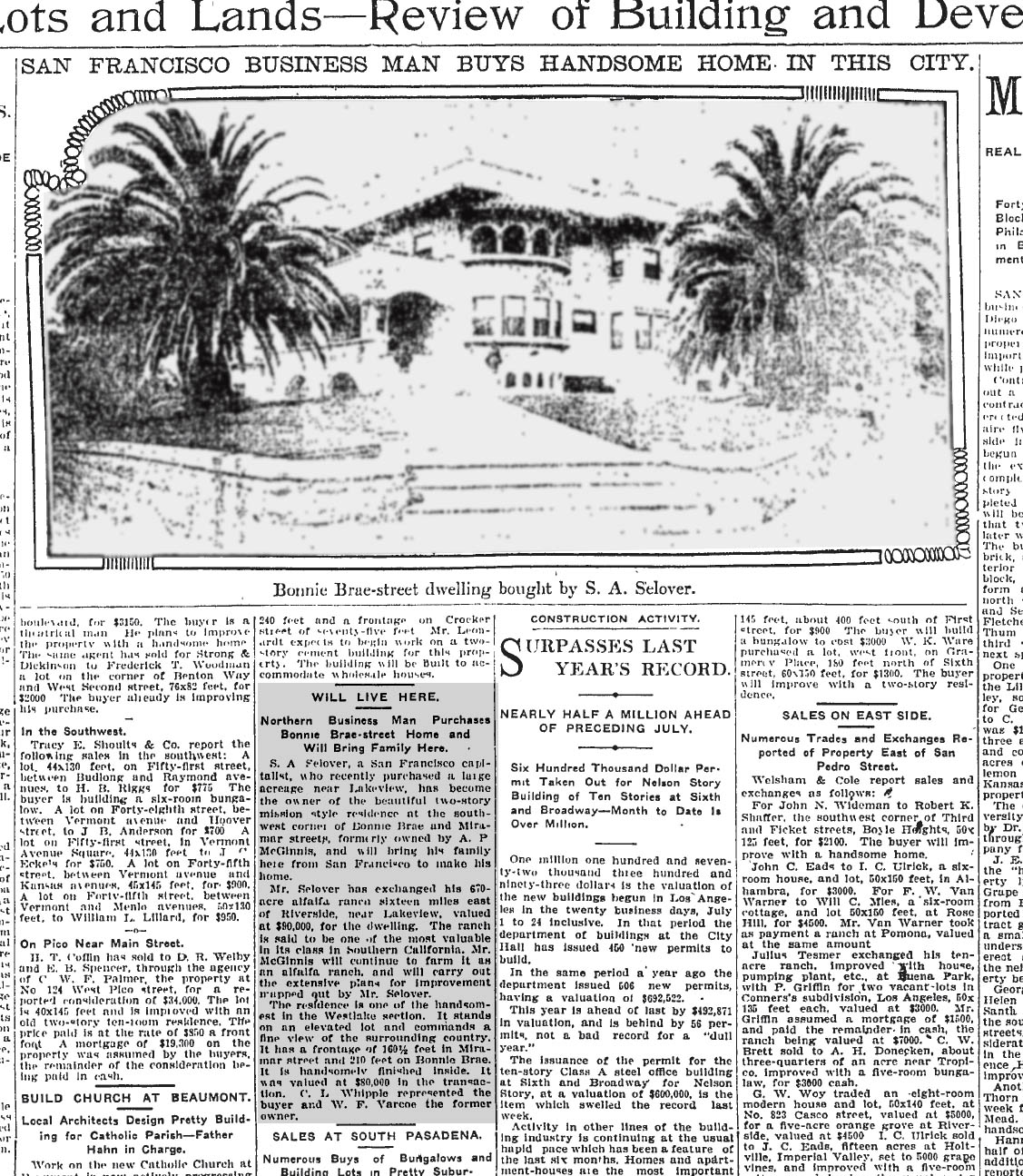 Above, developer Samuel A. Selover buys a home at Bonnie Brae and Miramar streets. Selover, whose projects included Belmont Shore in Long Beach, died in 1939. Below, Bonnie Brae and Miramar via Google maps’ street view. Email me |
 By Keith Thursby Times staff writer The Times published a tidbit about the Hollywood Stars and their owner, Bob Cobb, that made me go looking deeper for more details. Jeane Hoffman reported that Cobb "discovered" Chavez Ravine as a potential home for a baseball team and in 1954 proposed building a stadium and leasing it back to the city for $1 a year. Hoffman said the plan didn’t work because it was for minor league baseball and Cobb was just a little ahead of his time. The Dodgers’ plans to build a stadium were still on hold at this point in 1958 after a Superior Court judge ruled the contract between the team and the city was invalid. But what of Cobbs’ idea? I found a Times story from Dec. 17, 1954, in which Yankees manager Casey Stengel, longtime baseball owner Bill Veeck and Cobb talked to a City Council committee about bringing big league baseball to Los Angeles. According to Paul Zimmerman’s story, the discussion focused on whether the city should expand Wrigley Field or build a ballpark in Chavez Ravine. "No city in the United States can offer what Los Angeles does," Cobb said. "We need something new, something modern and a place to park 25,000 cars." Cobb and his Hollywood Stars have long fascinated me. My mom grew up in Los Angeles and her family’s baseball allegiances were split down the middle between fans of the Stars and the Angels. Photos of Gilmore Field made the experience look glamorous and any search of Pacific Coast League games can find tales of wild fights and long doubleheaders. And Cobb was no ordinary owner, with his connection to the Brown Derby–and what other baseball owner had a salad named after him? After the Dodgers decided to move to Los Angeles–moving the minor league Stars and Angels out of the Southland–Cobb remained civic minded. In searching the website walteromalley.com for any connections between the two owners, I stumbled on a 1957 Times story where Cobb came to O’Malley’s defense. "I’m shocked at the unbelievable position in which Walter O’Malley finds himself," Cobb told The Times’ Hoffman. "We invited this man to Los Angeles. He didn’t solicit us." Hoffman said Cobb’s plan for Chavez Ravine was ahead of his time. The 1957 story had another example. "But you can’t stop progress," he said. "We’re going to have not one but two major league clubs here within five years. Where? Well, this second club will settle in Orange County, probably Anaheim. That’s where the Hollywood Stars were going if the majors hadn’t come." Too bad it didn’t work out. I can seem them now–the Hollywood Stars of Anaheim. Wonder how much they’d charge for a Cobb salad?
|
 |
||||
|
||||
|
|
 |
||
|
||
 |
||
 |

3714 W. Pico, via Google maps. |
| July 23, 1958
* The Times gave Ruth’s age as 24 and California death records say she was born Dec. 19, 1933. If she had served in World War II she would have been much older. Possibly she served during the Korean War. |
 |
||
|
|
||
|
 |
| Sounds familiar, doesn’t it? Except this was published in The Times on July 1, 1901. Today, we shake our heads when we read about someone who works in Santa Monica or downtown Los Angeles and lives in the Inland Empire or the Antelope Valley or in South Orange County. But it’s no different than what people were doing more than a century ago. And we can’t blame the automobile in this era. It’s the streetcar system that allows people to live far from where they work. |
 Photograph by Munsey Studios, winter 1900
|
|

Here’s a closer look at the people on the sidewalk. It’s easy to make out the man’s watch chain. The young boy seems to have something pinned to his shirt and the woman appears to be looking directly at the photographer. |
|

What caught my eye were the signs, "Furnished Rooms," "Cut-Rate Cigar" and my favorite: "Platform Psychic, Independent [Illegible] and Trumpet Medium." I’m going to have to research trumpet mediums and see what they were. Hm. A Times editorial from April 18, 1902, refers to an "independent typewriter and trumpet medium." I wonder if it’s something like "independent writer." The Times editorial writers don’t seem to think much of the paranormal.
|
 Los Angeles Times file photo
|
|
|
 |
||
 |
||
|


 uth lived in a room at the Shari Hotel, 3714 W. Pico, that she shared with a little dog
 and a couple of parakeets. The landlord realized she hadn’t been around for a few days, and when he checked on her, he found her pets were nearly dead.


