
 Xavier University tore down Theda Bara’s former home in Cincinnati. Not for any particular reason. Just because.
Photo: Theda Bara’s former home is demolished. Credit: The Cincinnati Enquirer/Michael E. Keating
Xavier University tore down Theda Bara’s former home in Cincinnati. Not for any particular reason. Just because.
Photo: Theda Bara’s former home is demolished. Credit: The Cincinnati Enquirer/Michael E. Keating
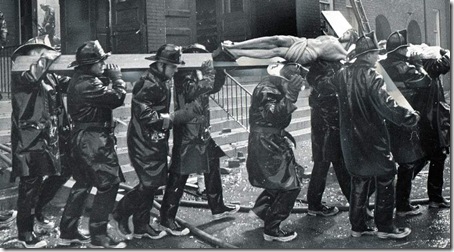
April 10, 1963: Firefighters recover a crucifix from Our Lady of Sorrows Catholic Church. Credit: Detroit News
NEWS
Steve Hindle takes over as research director at the Huntington Library. Pasadena Star- News
The Virginia Museum of Fine Arts reports that its exhibit of the touring show “Picasso: Masterpieces From the Musée Picasso, Paris” was a blockbuster, generating record attendance of about 250,000 and $2.4 million in ticket revenue.
Jacqueline Trescott, writing in the Washington Post, says that according to Chmura Economics & Analytics, the show brought $26.6 million to the Richmond area and $30 million to Virginia. Virginia Museum of Fine Arts press release
The show is at the de Young museum in San Francisco through Oct. 9.
The Daily Mirror Recommends
Marney Rich Keenan of the Detroit News has a terrific story about the restoration of a 13-foot crucifix that was salvaged in 1963 after a fire burned Our Lady of Sorrows Catholic Church.
Keenan says: “Now, 100 years later, the revered Christian symbol and Verbiest family heirloom is once again being rescued. The all-but-forgotten cross — neglected and found on the floor behind an altar at Detroit’s Good Shepherd Church covered by a sheet — will soon be restored to its original beauty. Once refurbished, the crucifix will resume its place of honor for adoration and prayer in a new church home.”
A restoration project at Frank Lloyd Wright’s Martin House Complex includes duplicating the original windows, many of which vanished over the years. Eve Kahn, writing in the New York Times, has the story.
Did the West Make Newspapers, or Did Newspapers Make the West?
On Stanford University’s Rural West Initiative, Krissy Clark and Geoff McGhee write:
“The history of newspapers in the rural West is a history of crisis and triumph in alternation. Failure, and bouncing back from it, have been a tradition. And at a time when there is so much talk about the future of newspapers, this past is worth considering. Ironically, this legacy of turbulence finds rural newspapers relatively unscathed by the calamities currently facing many big city papers. Put another way, there is no crisis in rural Western newspapers; the crisis has always been there. And the papers are stronger for it.”
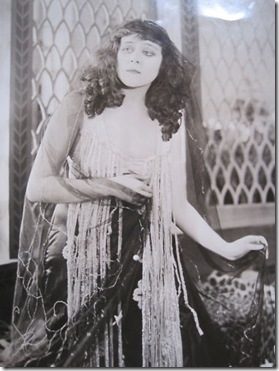 A publicity photo of Theda Bara from the lost film “Salome” has been listed on EBay. The vendor says this is an original studio handout, not a reprint. As with anything on EBay, an item and vendor should be evaluated thoroughly before submitting a bid. Bidding starts at $99.
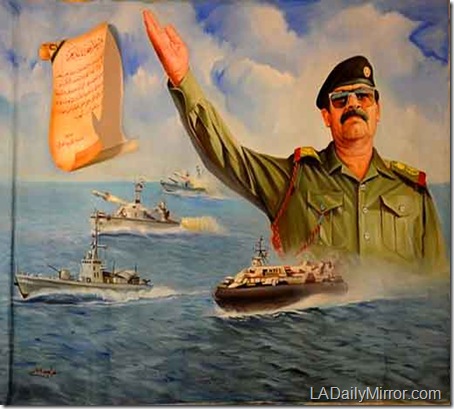
Writing in the Washington Post, Jason Ukman says that 30 items looted from Iraq have been returned, with hundreds more to follow. Investigators have been tracking stolen artifacts on Craigslist and Christie’s, among other places. The recovered items include ancient artifacts and items from Saddam Hussein’s rule.
Ukman says: An estimated 15,000 pieces were stolen from Iraq’s National Museum in pillaging after the U.S.-led invasion in 2003, and many more are believed to have been smuggled out since then by U.S. military personnel and contractors. More than half of the items that have turned up in the United States or elsewhere have been repatriated to Iraq, but treasured items remain missing.
Photo: A recovered painting of Saddam Hussein with perspective corrected by the Daily Mirror. Credit: U.S. Department of Homeland Security

NEWS
The U.S. Justice Department says that oral history interviews are not protected by confidentiality agreements, according to Scott Jaschik on the Inside Higher Ed blog.
Jaschik writes: The U.S. position in the case deals with a number of issues raised by Boston College — some of which don’t relate to issues of academic rights. (For example, the college suggests that release of the records could endanger the peace process in Northern Ireland, and the U.S. rejects that view.)
On the issues related to the rights of researchers and colleges, the brief rejects all of the college’s arguments. The government argues that there is no right of confidentiality a researcher can grant that would withstand a subpoena. The Justice Department notes that Boston College acknowledged in its communication with research subjects that its confidentiality pledges assure privacy “to the extent American law allows,” which the government says isn’t very far in cases like this — whatever implication may have been read into that statement by researchers or by interview subjects.
Reaction by Glenn Reynolds (InstaPundit.com) | James Joyner (Outside the Beltway)
Background on the controversy over oral history interviews with IRA members at Boston College. Boston Globe
FEATURED
My L.A. Times colleague Molly Hennessy-Fiske takes a look at the rush to preserve memories from the Egyptian revolution.
She writes: Archivists at American University in Cairo, the Library of Alexandria and the Egyptian National Library and Archives have separately rushed to chronicle Egypt’s revolution, preserving not just memories and artifacts but the digital ephemera that set this uprising apart: videos, photographs, Facebook and Twitter posts. American University students have started a separate project to translate documents related to the revolution and post them online.
The Daily Mirror Recommends:
NEW YORK
New York’s Department of Parks and Recreation is studying whether pollution is damaging Cleopatra’s Needle, a Central Park landmark since 1881.
According to Francie Diep and Joseph Castro, writing on the New York Times’ always interesting City Room blog, Egypt’s minister of antiquities, Zahi Hawass, said New York’s weather was damaging the obelisk and warned in January that he would “take the necessary steps to bring this precious artifact home.” Hawass’ statement is here.
Photo: Cleopatra’s Needle. Credit: Wikipedia
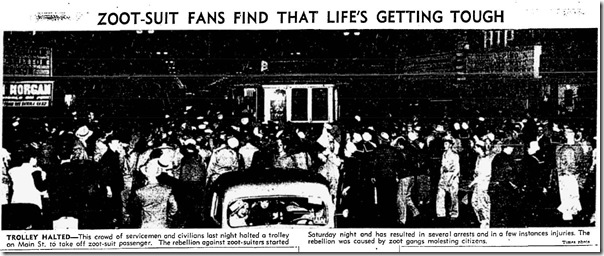
June 8, 1943: A mob of servicemen block a streetcar on Main Street to remove a passenger wearing a zoot suit.
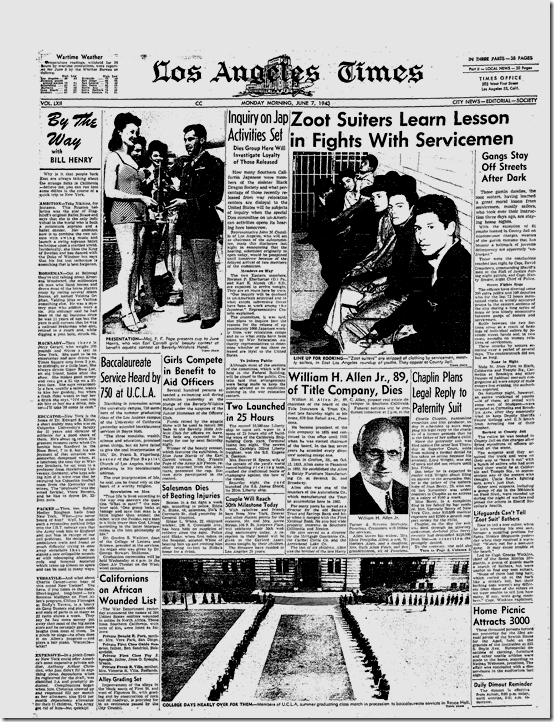
This was supposed to be an easy – if long – post to wrap up the Zoot Suit Riots. But research took another path, because The Times ignored the first days of the riots. I’m used to The Times making some incredibly dumb news decisions in its history, but not covering these events is still pretty shocking. I can’t imagine what they were thinking.
Anyway, there will be a slight detour into further research. I hope you’ll enjoy the scenic route!
To recap: I decided to take a look at the historical background of the Zoot Suit Riots after seeing “Zoot Suit” in the Los Angeles Conservancy’s Last Remaining Seats series.
In Part 1, we saw that The Times initially treated the zoot suit as a youthful fad, but the attitude changed once zoot suits were outlawed by the War Production Board to conserve fabric.
In Part 2, Times columnist Timothy Turner provided some more sympathetic insight (zoot-suiters aren’t all criminals and delinquents) that was a surprising counterpoint to the mainstream opinion.
In Part 3, we looked at the events leading up to the Zoot Suit Riots of June 1943.
Here’s our story:
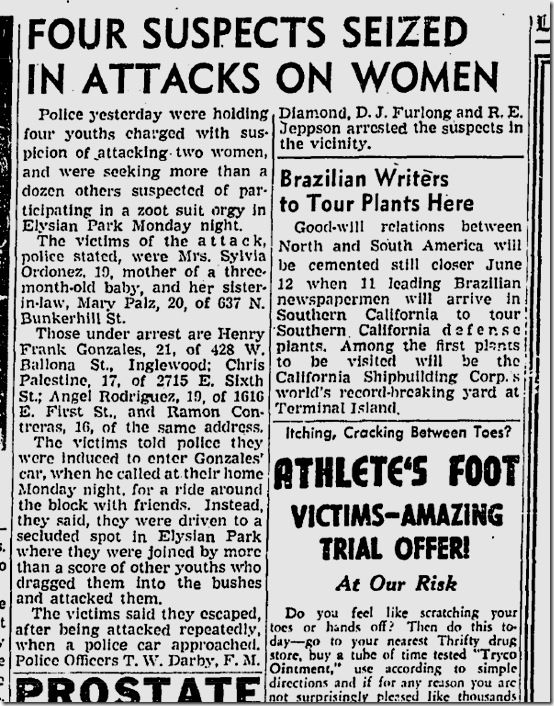
On June 2, 1943, immediately preceding the riots, The Times published this account describing a “zoot suit orgy” in which two women were persuaded to go for a ride with a suspect, but were taken to Elysian Park, dragged into the bushes and “attacked.” I’m presuming they were raped, although the usual newspaper euphemism in this era is “criminally attacked.” And yes, The Times identified the victims and published their addresses, as did all newspapers in this era.
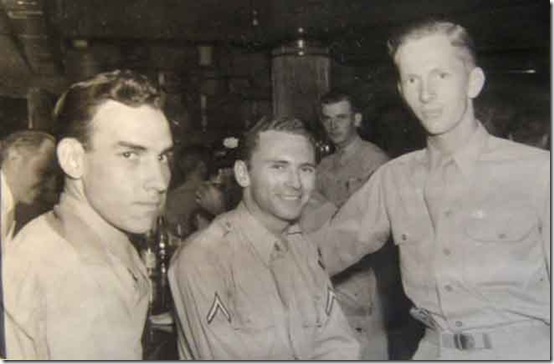
This photo of some young guys having a good time at Earl Carroll’s on Aug. 7, 1943, has been listed on EBay. Bidding starts at $19.95.
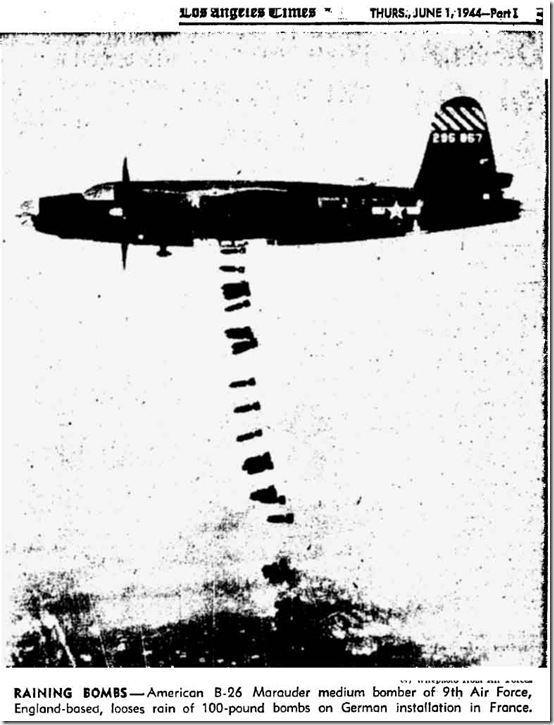

Rick Rouan of the Lancaster (Ohio) Eagle Gazette reports on a B-26 Marauder that is returning to the 1941 Historical Aircraft Group Museum in Geneseo, N.Y., after being restored by the Historical Aircraft Squadron. The plane should arrive in time for the Geneseo Airshow, Thursday through Sunday.
[Update: The June 1, 1944, photo at the top shows a B-26 Marauder. The second story, from Nov. 5, 1944, shows the A-26 Invader, the type of aircraft that was restored.]
 Regular Daily Mirror reader Gary Martin visited the exhibit of Soviet film posters at the Tony Shafrazi Gallery and files this post:
American museums have all become so look alike and all show such similar works by the same small handful of artists, all of whom apparently knew how to Make Money in the best free market sense, that it is absolutely refreshing to go to the art galleries and to see things that have limited commercial value and that are hardly ever seen under the strictures of corporate America sponsorship. This exhibition of Soviet film posters is a good example of what I mean. I suppose that in a more liberal era we might once have seen these at MOMA, but certainly not in this current climate so rigidly proscribed by lock step Reagan Republicanism. So much for the GOP claim that it is the one true and only path to freedom of expression. Art Ongoing
Photo: “Seventh Heaven.” Credit: Tony Shafrazi Gallery
 David Dunlap has a great story in the New York Times’ City Room about the return of an eagle head, sculpted by Adolph A. Weinman, that was salvaged from the demolition of Pennsylvania Station.
There’s lots more about bits and pieces that have been salvaged from Penn Station – some of them are fairly large.
Imagine my surprise to discover there is an Assn. of Wedding Gown Specialists dedicated to preserving that dream outfit. Writing in the Wall Street Journal, Deborah Lynn Blumberg takes a look four companies that clean and preserve wedding dresses.
The Daily Mirror recommends:
Margherita Stancati, writing in the Wall Street Journal, lists what might be the world’s five greatest treasure troves, pegged to the opening of the vaults at Kerala’s Sree Padmanabhaswamy temple.
Julia Moskin, writing in the New York Times’ Diner’s Journal, highlights Gregory Cohen, one of the nation’s experts on American soda fountains.
Photo: Eagle from Penn Station. Credit: Kelly Shimoda for The New York Times


John O’Connor of the Associated Press files a story from Springfield, Ill., about affidavits submitted against Jack Daniel McCullough in the kidnapping and killing of Maria Ridulph.
McCullough, a former police officer, was fired over accusations that he molested a teenage runaway in the 1980s, O’Connor says. His ex-wife and others describe sexual and emotional abuse, O’Connor says, as well as allegations that he ran a photography business in his home and brought in prostitutes to take nude photographs of them.

I had the strangest experience Saturday when I was going through Ernest Hemingway’s FBI file. I was sure the buro had posted Louis Armstrong’s dossier — it’s brief and not terribly interesting except for the fact that it exists. Or did it? I went to the online reading room but there was no Louis Armstrong. And then I noticed the file on Arthur Ashe was gone… And … Gracie Allen? I knew Armstrong’s file was posted because I used it when I talked to a class about public records. What gives?
So I went to Archive.org and found the version of the website from 2004. There’s Louis!
The FBI has unhelpfully redesigned its website with the files alphabetized by FIRST name, so a line-by-line comparison is time-consuming. I’ll leave it to the Daily Mirror Brain Trust to sort through it. Let me know what you find.

In addition to his many other accomplishments (ever see him dance in “Broadway Melody of 1936?”) the late Buddy “Uncle Jed” Ebsen was an outsider artist. An untitled self-portrait in his “Uncle Jed Country Series” has been listed on EBay. Bidding starts at $3,500.
There’s a website with more of Ebsen’s outsider oeuvre.

This rather remarkable example of Batchelder tile has been listed on EBay. The vendor’s family was apparently a Batchelder distributor and has had this since the 1930s. As with anything on EBay, an item and vendor should be evaluated thoroughly before submitting a bid, particularly when serious money is involved. Bidding starts at $2,150.
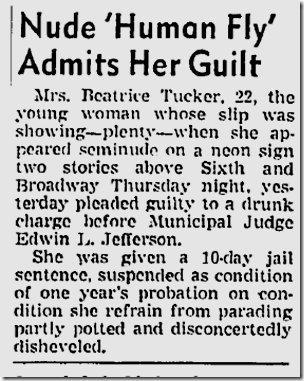
June 5, 1943: A nude (well almost) woman climbs onto a neon sign at 6th and Broadway. Beatrice Tucker was clearly ahead of her time.

Just as we were exploring the history of the Zoot Suit Riots comes news of Kathy Peiss’ book “Zoot Suit” from the University of Pennsylvania Press.
Writing about the book in the New York Times’ Arts Beat, Patricia Cohen raises the question of whether the zoot suit was a fashion statement, a political statement or both.
Photo: Zoot Suit Duck in Disney’s “The Spirit of ’43.”

To accompany U.S. history as told in video games, we have U.S. history as told by Facebook, by Teddy Wayne, Mike Sacks and Thomas Ng in the New York Times.
The Daily Mirror Recommends:
At the Daily Mirror, we’re always interested in how memory works — and how it doesn’t. In a new report, scientists explore the way in which the brain “time stamps” memories. Draft version of the study | Readable NYT version
The writer’s craft: How historian Amanda Foreman keeps track of hundreds of characters in “A World on Fire: Britain’s Crucial Role in the American Civil War.” WSJ
Benjamin and Lyle “Brad” Pogofsky are fighting over their late father’s collection of baseballs autographed by Babe Ruth, Lou Gehrig, Mickey Mantle and other Hall of Famers. It’s a messy, sad story of a family torn apart, despite instructions in the will of Larry Pogofsky, a White Sox board member. Chicago Tribune
CHICAGO
The Pilsen InstaGreeter Outpost, a program of the Chicago Office of Tourism and Culture, gives tours of Chicago’s Pilsen neighborhood, which is a Latino area.
Writing for the Chicago Tribune, Christopher Webber says: Pilsen is the third neighborhood with an InstaGreeter outpost. In response to the intense interest in President Barack Obama’s Chicago roots, the program began offering tours of the Hyde Park neighborhood in 2009. Popular stops include the president’s barber shop and Valois Cafeteria, where he has often eaten. In 2010, an Old Town tour was added to capitalize on the popularity of the Second City comedy troupe.
PITTSBURGH
Bicycle Heaven is part museum and part tribute to a man’s obsession with two-wheeled transportation. AP | He’s also on EBay.

Chicago’s Museum of Science and Industry is holding a competition to select someone who will live at the museum for a month.
The museum’s website says: From Oct. 19 to Nov. 17, 2011, this person’s mission will be to experience all the fun and education that fits in this historic 14-acre building, living here full-time and reporting his or her findings to the outside world.
Think about it: Living in a coal mine or on the captured Nazi submarine U-505 (and no firing torpedoes at Sam Zell!)
Applicants must be able to live in the museum for 30 days with no outside responsibilities, at least 18 years old and cannot be a current or former employee, relative, contractor, volunteer, etc.
And you have to prove that – just because you’re willing to live in a museum for a month – that you’re not seriously deranged.
To apply, you need to submit a 60-second video, a 500-word essay, two photos and an application form.
The fine print is here. The deadline is July 22 at 1700 hours CDT!
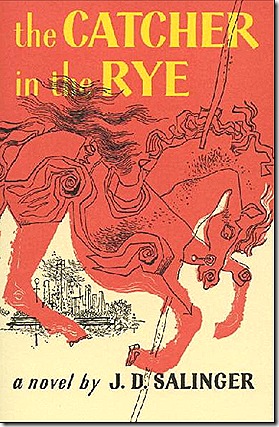
The New York Times’ City Room has a story about a group of letters between author/recluse J.D. Salinger and E. Michael Mitchell, the artist who illustrated the original cover of “Catcher in the Rye.”
Mitchell put the letters up for sale after Salinger refused to autograph a copy of “Catcher in the Rye” in 1993 and they eventually were obtained by the Morgan Library and Museum.
Mitchell’s girlfriend found more letters after the artist’s death, and they are now at the library.
There’s one tantalizing bit amid all of the author’s complaining, the NYT’s Alison Leigh Cowan says: Salinger fans may be cheered to know that the new letters contain further hints that they may yet behold additional Salinger manuscripts. Salinger made passing reference in the 1982 letter to “my manuscripts.” The 1994 letter was more open ended but contained a section that could mean time spent at the typewriter: “I work on,” he wrote. “Same old hours, pretty much.”

Intel has created a virtual “Museum of Me” that draws on a user’s Facebook page to create the ultimate vanity project. And surely anyone with enough ego for this couldn’t possibly be worried about *privacy*.

