They said it

June 27, 1957
Los Angeles

"The Lord made distinctions between the races in the beginning of time. This idea of amalgamation of races and one world and all that is of the devil."

J.H. Seal, chairman of the board of trustees, Normandie Avenue Methodist Church, explaining why all the white members of the congregation were leaving to protest the appointment of an African American minister.

Nope, this was not the deep South. This was L.A.

Email me

Posted in Countdown to Watts, Religion | Tagged , , , , , | Comments Off on They said it

Sports Arena

June 27, 1957
Los Angeles

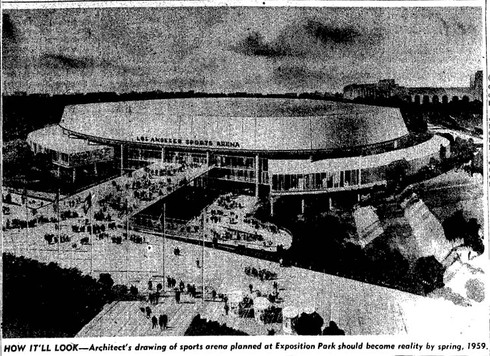
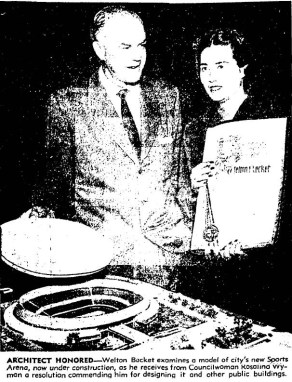
Here’s one plan that was actually built: The Los Angeles Memorial Sports Arena. Designed by the firm of Welton Becket, the arena was intended to be a 19,000-seat facility built for $5.7 million ($40,842,117.48 USD 2006).

“This is the greatest challenge my office has ever had,” said Becket, whose firm designed the Capitol Records Tower, the Theme Building at LAX and the Cinerama Dome. “Although the plans exceed the limits in every case that was given to us, we still would have presented this same plan if we $11,000,000 to work with,” he said.

The arena was opened by Vice President Richard Nixon on the Fourth of July, 1959. It hosted the Lakers (1960-1967), Clippers (1984-1999) and
USC basketball (1959-2006) and was the site of the 1960 Democratic National Convention.

The arena is featured in the exhibit “Housing the Spectacle.”

Email me

Posted in Sports | Tagged , , , , , | Comments Off on Sports Arena

Smog alert

June 27, 1957
Los Angeles

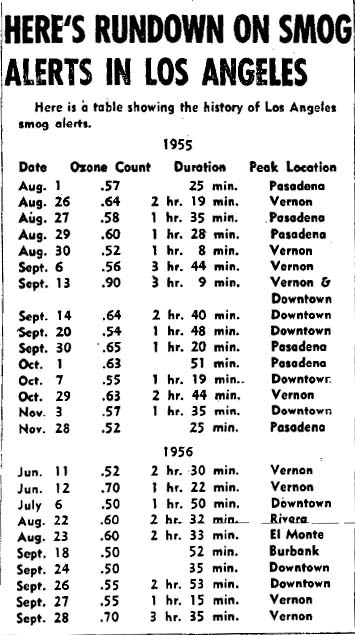
Everybody knows that Los Angeles suffered terrible smog in the 1950s, but without statistics, all we have are stories and photos of toxic clouds obscuring the landscape.

In fact, for the unfortunate people living in Los Angeles in 1957, what was deemed a Stage 1 alert (0.5 parts per million of ozone) would be a Stage 3 alert today. (In a Stage 2 or Stage 3 alert today, all non-emergency driving is discouraged and schoolchildren are banned from outdoor activities).

Now for the really ghastly facts: In 1957, a Stage 2 alert was 1 ppm and a Stage 3 alert was 1.5 ppm. The Mirror notes that  no Stage 2 or 3 alerts had ever been issued, but that in a Stage 3 alert, the governor was authorized to declare a state of emergency.

One of the most polluted days in Los Angeles history was Sept. 13, 1955, when the city reached 0.9 ppm of ozone in Vernon and 0.85
ppm downtown.

Dr. Clarence Mills of the University of Cincinnati said: “The Los Angeles situation is so severe and so fraught with health dangers that any pollution control program should be put on compulsory basis.” Mills urged that a Stage 1 alert be issued at 0.2 ppm, which is, in fact, the current level. Using that figure, Los Angeles had four Stage 1 alerts in the first six months of 1957.

When someone told Mills that his lower figure would have Los Angeles County at a Stage 1 alert for most of the year, he replied: “That’s the way it should be.”

The California Air Resources Board link is here.

Email me

Posted in Downtown, Environment | Tagged , , , , | Comments Off on Smog alert

In Rome

June 26, 1957
Los Angeles

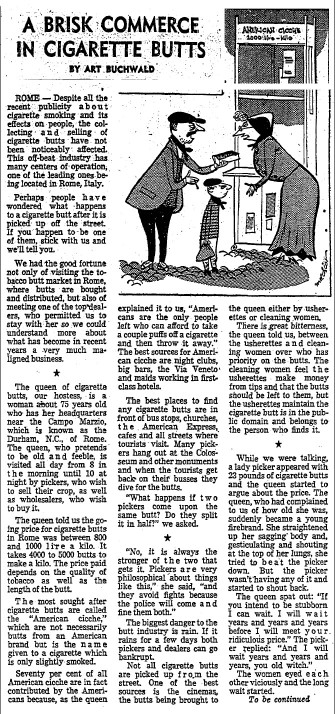
The late Art Buchwald always struck me as one of the least amusing humor columnists America has ever produced. But as this piece shows, he was a pretty fair writer when he wasn’t trying to be funny.

Posted in Columnists | Tagged , , , | Comments Off on In Rome

Boxer dies

June 26, 1957
Los Angeles

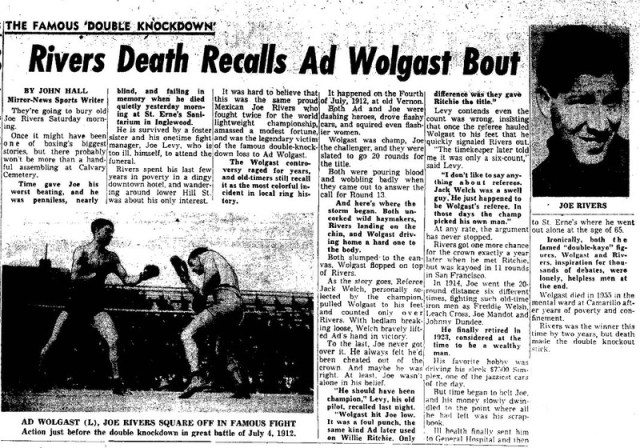
I’m pleased to present the work of John Hall, a columnist for the Mirror, The Times and the Orange County Register. In this piece, he recalls the late boxer “Mexican” Joe Rivers and his fight with Ad Wolgast. (Note that Wolgast is in the International Boxing Hall of Fame and Rivers isn’t.)

Posted in Columnists, Downtown, Sports | Tagged , , , , | 2 Comments

Lawyer drowns in pool


June 26, 1957
Los Angeles

The lawyer drove up to the cabin in Tick Canyon, north of
Saugus, in his Cadillac. He should have been home in Beverly Hills by now, but he phoned his wife, Mary, that he was having dinner with a client.

He parked the Cadillac next to the cabin and left his jaunty straw
“boater” hat in the back seat. Maybe he sat in one of the chairs next to the pool for a while–perhaps all night. Then he put his glasses under the chair, took off his coat, with $109 in loose bills in the pocket, and laid it on the chair, along with his white shirt and tie, and a folder containing his identification cards.

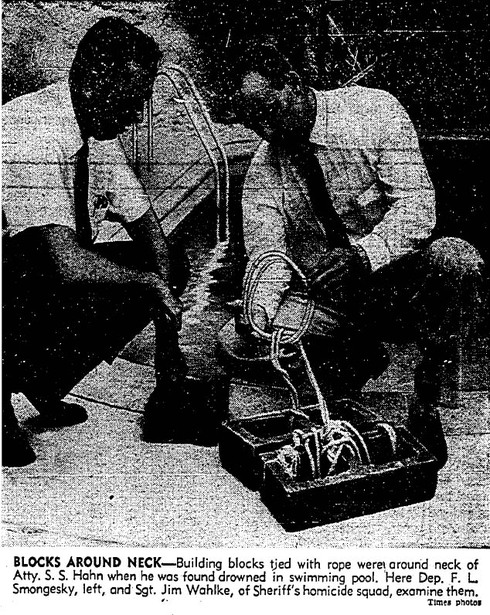
Then he tied one end of a rope around his neck, threaded the other end through two concrete blocks and jumped into the deep end of the pool. That’s where he was found by 17-year-old Bob Nelson, a
neighbor who had been hired to do some chores around the cabin.

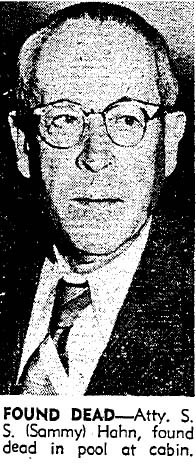
Sammy “S.S.” Hahn, 68, a Russian immigrant, is an obscure figure today, but at the time of his death, he was a well-known attorney who handled some of the most famous clients in Los Angeles, including Aimee Semple McPherson and murderess Louise Peete, one of only three women to be executed in California. A graduate of USC’s law school, Hahn was originally known for his defense work in high-profile criminal cases but later specialized in divorces.

He earned his nickname, “The Corporal,” during a sharp courtroom exchange with Col. William H. Neblett, who protested when Hahn continually referred to him as “Mr. Neblett” instead of “Col. Neblett.” “Your honor, Hahn said, “if my opponent insists on his military rank, so shall I. Henceforth, I respectfully request that I be addressed as Cpl. Hahn.”

Hahn’s apparent suicide puzzled his many friends and devastated his wife, Mary, whom he married in September 1954. Hahn’s wife of 36 years, Teresa, had died in May 1954. Some people speculated that Hahn’s death was not a suicide, especially because he left no note, but medical examiner Dr. Gerald K. Ridge found that his death was an uncomplicated case of asphyxiation.

Mourners attending his funeral at Forest Lawn in Glendale, conducted by Rabbi Samson Levey, included attorney Jerry Giesler and Judges Thurmond Clark, Henry Draeger, Larry Doyle and Mark Brandler. Pallbearers were members of American Legion Post 253 of Beverly Hills.

Email me

Posted in #courts, Suicide | Tagged , , , , | 1 Comment

Voices

I remember well the Paul Coates program on TV, Channel 11, when it was owned by The Times.  Never understood anything he was talking about when he was on, but I remember the stark blackness of the set
behind him.

I was born on a rainy February morning in 1950 in old Methodist Hospital downtown, on the 50th anniversary of Adlai Stevenson’s birth, also in LA.  Throughout the ’50s, 60s and 70s, lived in Hermosa Beach, Manhattan Beach, Redondo Beach, Torrance (I walked to kindergarten and 1st grade on a dirt road bordered by tall eucalyptus and pastureland where we kids would slip thru the barbed wire fence to taunt the bulls hanging with the cows—yes, Torrance, CA 1955-57), Buena Park, La Sierra, Riverside, West Covina, Upland, Palm Springs, Panorama City, Simi Valley, Westwood (UCLA, History, 1972), then lit out for literally greener pastures in the late ’70s to New England, Mass, NH and Vt, where I live now.  I visit L.A. occasionally, see no difference in the traffic flow (I always knew what time of day to take certain roads to zip thru traffic) and much less smog today—and the place looks cleaner, shinier
even, and always try to coincide my trips with a game or two at Dodger Stadium.

What prompted me to write is your story on the dismantlement of the backyard incinerators.  I remember very clearly this first step in smog reduction.  As a 7 yr old in ’57 i paid little attention to smog, other than how it stung and made my eyes water, and remember the haste with which my dad went from getting a notice some official was coming to inspect the fact the incinerator in the backyard would be no more.  This would be in Buena Park, where from the summer of ’57 to ’61 i enjoyed, no, deeply fondly loved the best 4 years of my childhood, as my friends and I would play with the horney
toads which populated the looong-gone orange groves a couple of blocks away, and every Saturday morning I would walk to Knott’s Berry Farm, when entrance was free and it was a quiet, wonderfully smelling place, of eucalyptus (again) and boysenberry, to stroll around in the ersatz-but-real Huck Finn environment, and jump the tracks and dodge the old steam train as it would chug by.

Anyway, I remember my dad burning stuff, paper and dry tree limbs, in the little cement incinerator for the last time before the official came to verify the thing was laid flat, the four sides of the object
left lying where it stayed for years, and the talk that this would reduce the smog.  It did, but little did we know the magnitude of the problem from cars.

Nothing exciting, really, just another fond
little memory you piqued from my childhood.
~  Craig Hill / Montpelier Vt

Posted in Uncategorized | Tagged , , | Comments Off on Voices

Note to farflunglounge.com

I’m glad you folks are linking to me, but I’m quite curious as to what you’ve said as your site is restricted.

Email me

Posted in Hollywood | Tagged | 1 Comment

Victor Segno–man of mystery

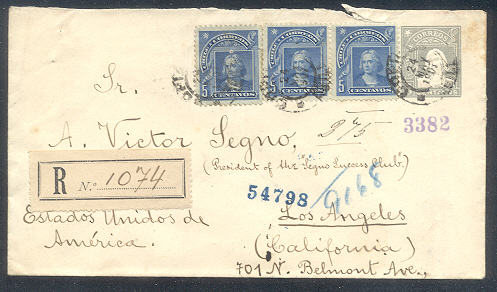
Aha! EBay has  another envelope addressed to A. Victor Segno of the Segno Success Club, 701 N. Belmont.

Segno, author of such books as “The Law of Mentalism,” “How to Be Happy Though Married” and “How to Have Beautiful Hair,” was a mentalist with a simple scam: For a $1 a month, he would send out a mental “success wave” twice a day. And it was quite successful–for him. In a few years, he was able to build an elaborate center in Echo Park (now demolished, apparently).

The Power of Thought
by A. Victor Segno

“I hold it true that thoughts are things
Endowed with bodies, breath and wings,
And that we send them forth to fill
The world with good results–or ill.

That which we call our secret thought,
Speeds to the earth’s remotest spot,
And leaves its blessings or its woes,
Like tracks behind it as it goes.”

“We awaken in another
Just the thoughts our minds contain.
If we’re kind, we win their kindness,
If we hate, they hate again.

We pass on to brother mortals
The vibrations of the soul,
And the knowing ones receive them,
As they search from pole to pole.”

“We build our futures thought by thought,
Or good or bad, and know it not–
Yet so the universe is wrought.

Thought is another name for Fate,
Choose, then, thy destiny and wait–
For love brings love and hate brings hate.”

–The Law of Mentalism, A. Victor Segno, Los Angeles, Calif., 1902

Here’s more about him at the 1947project.

Email me

Posted in Uncategorized | Tagged , , , , , | Comments Off on Victor Segno–man of mystery

Valley blaze


1957_0625_hed
1957_0625_fire


1957_0625_potter
June 25, 1957
Los Angeles

A 50-foot tower of flames fed by 7,000 gallons of pressurized liquid
propane being transferred from a truck to a storage tank was snuffed by
a 28-year-old man who said it was no big deal.

Gerald D. Potter, a heating fuel executive living at 14847 Lassen, may
have saved a block of businesses at Sepulveda and Oxnard boulevards, as
well as untold lives, but he said: "It would have burned out after
a while anyway."

Potter heard news reports of the blaze on the radio and drove to the
American Butane Co. storage yard, 5919 Sepulveda Blvd. As firefighters
provided a protective cover of spray, Potter turned a total of 10
valves on the tanker truck and in the storage yard to quench the
flames.

The only reported injury was second-degree burns suffered by firefighter Paul B. Ruddick of Engine Co. 39 when he shut off another valve.

Note: The original estimate of 15,000 gallons of propane was later reduced to 7,000 gallons.

Email me

Posted in San Fernando Valley | Tagged , , , , , | Comments Off on Valley blaze

Paul V. Coates–Confidential File

Paul_coates
June 24, 1957

SUBJECT’S NAME: Delbert Wilson Miller.
SUBJECT’S DESCRIPTION: Age, 60.
Height, 5 feet, 10 inches. Weight, 155 pounds. Bald, rim of gray hair.
Glass right eye. Tattoo: "IRMA-DELL" upper right arm. Tattoo of
swastika on left forearm.

Any person with information as to subject’s whereabouts is requested to
contact Sgt. Ketcherside, Missing Persons Section, Los Angeles Police
Department.

Large cities have swallowed up persons before.

But never has a metropolis done a job more thoroughly than it did with Delbert Miller.

Fact and circumstance make his disappearance a near impossibility.

Yet, he’s gone.

And no one, in six months of thorough search, has even a hint as to where or why.

Miller is a blind man. He never left his room at the St. Regis Apartments, 237 S. Flower St., without a friend to guide him.

Yet, on Jan. 17, he walked out alone. And vanished.

I talked last week with Miller’s daughter-in-law, Mrs. LaJune Miller of 2963 Partridge Ave.

She told me many things about the missing subject: his habits, his disposition, his dependency on others.

1957_0624_ad
Which might offer a clue as to his whereabouts. I don’t know.

Miller, his daughter-in-law told me, was an independent sort of man.
But age had mellowed his quick temper. And blindness had limited his
activities.

"My husband and I tried several times to get him to live with us," she
said. "But he’d always go back to Flower St. That’s where all his old
cronies were."

Sometimes, she said, he’d stay with them for a month or so, but always,
with a firm, "I’m just in your road here," he’d return downtown.

And have dinner with his son and daughter once or twice a week.

Mrs. Miller and her husband carefully traced the final known movements of the missing man. So did the police.

It was learned that he left his room on the morning of Jan. 17 to shop at Grand Central Market with a friend.

The friend later reported that he returned as far as the Third Street
tunnel with Miller. Then Miller said he could find his way alone and
they parted.

But Miller reached his room. He put his groceries on the table, stepped out, locked the door, and was never again seen.

The rotting groceries and meat were found a few days later.

"It was like he was planning on coming right back," said Mrs. Miller.

She and her husband spent the next six weeks in the neighborhood.

"We’d drive over in the early evening. Sometimes we’d knock on doors,
asking questions. Sometimes we’d approach strangers on the street.
They’d look at us like we were crackpots.

"And sometimes, around midnight, we’d drive home and no sooner would we get there than my husband would say to me:

" ‘Let’s go back. Maybe he’ll be there.’

"And we’d go back and look and wait some more–until 2 or 3 in the morning."

Meanwhile, the police continued a thorough investigation.

They checked relatives, hospitals, hotels, mental hygiene clinics, the
FBI. They, too, quizzed neighbors. They distributed circulars and
placed his fingerprints on FBI file.

Mrs. Miller found one possible clue–but so far it’s done no good.

"The landlady told me," she said, "that a stranger came asking for my father-in-law just three days before he disappeared.

"He was a tall, slender gentleman, well dressed and in his 40s."

I asked her about the swastika tattoo on Miller’s arm.

"Oh, he was so ashamed of it. He’d had it for years–long before
Hitler–and he used to talk quite often about having it removed.

"Just because of it, he’d always wear long-sleeved shirts."

Before we finished our conversation Mrs. Miller admitted, hesitantly,
that in desperation she had gone to a fortuneteller for help.

"I don’t believe in them, but I had no place else to go."

"What," I asked, "did the fortuneteller say?"

"That we’d hear from him very soon," she answered.

"But that–that was over two months ago."

Posted in Columnists, Downtown, LAPD, Paul Coates | Tagged , , | 2 Comments

Now showing!

June 24, 1957
Los Angeles

Now playing at the Million Dollar: "Tropicana" and  "Serenata en Mexico."

1957_0624_million_dollar

Posted in Downtown, Film | Tagged , , , , | Comments Off on Now showing!

Seven Samurai

Trivia note: Akira Kurosawa’s "Seven Samurai" premiered in Los Angeles at the late Linda Lea Theater in 1956.

1957_0624_samurai

Posted in Film | Comments Off on Seven Samurai

Literary diversions

Ross Macdonald, Jan. 15, 1972

Part 1
1972_0115_macdonalda

Part 2
1972_0115_macdonaldb

Part 3
1972_0115_macdonaldc

Part 4
1972_0115_macdonaldd

Posted in books | Tagged , , | Comments Off on Literary diversions

Dead end


1957_0624_hed

June 24, 1957
Los Angeles

Police Capt. Walter R. Koenig was out walking his dog in the 5500 block of Green Oak Drive, where it dead ends in the Hollywood Hills, when he found Baby Boy Doe. 

He was 1 to 3 months old, and someone had wrapped him in blankets and
put him in a cardboard box. An animal discovered Baby Boy Doe and
dragged him out. "Police said the baby’s legs are missing and one
appears to have been cleanly severed with a sharp instrument," the
Mirror said. He had been dead three or four days.

Koenig told investigators he had seen a young couple in the area a week
earlier. When he questioned them about what they were doing, the man
asked for directions and they left, Koenig said.

Rest in peace, Baby Boy Doe.

Koenig joined the LAPD in 1938, a watershed year in Los Angles
politics because it marked the recall of Mayor Frank Shaw and the
reform administration of Fletcher Bowron.
In 1964, he became the police chief in
Torrance. In 1969, shortly before reaching retirement age, Koenig accepted a teaching job at Georgia State
University.

In an extremely rare honor for a police officer, the American Civil
Liberties Union paid tribute to Koenig with its Courage of Conviction
award. "As chief of police, Koenig, while enforcing the law firmly and
fairly, always displayed an awareness of the rights of the individual
as embodied in the Constitution," the ACLU said.

Email me

Posted in Hollywood, Hollywood Division, Homicide, LAPD | Tagged , , , , , | Comments Off on Dead end

Refugees


1957_0623_weidner_hed


1957_0623_weidner June 23, 1957
Pasadena

John, 42, runs a health food store on North Lake Street in Pasadena and lives at 861 Elizabeth St.,
The Times says in a feature story. Born in Holland, he is like many
Europeans who came to America after World War II.  "I love it here," he
says. "You have a spirit of freedom and liberty which is lost in
Europe." 

But the man behind the counter at the health food store is
different from most Americans in several ways: He’s a Seventh-day
Adventist. He’s a member of the Order of the British Empire. He holds
the French Croix de Guerre, the U.S. Medal of Freedom and the Dutch
Order of Orange-Nassau.

His name is John Henry Weidner and for his heroism in saving more than
1,000 people from the Nazis, he will eventually be honored by Israel as
one of the Righteous Among Nations. John’s life makes for quite a
story. His father, a Dutch Reformed minister, and sister died in
concentration camps and John was tortured by the Gestapo, escaping from
the Nazis five times.

But what interests us about him now is something other than his actions during the war.

Let’s jump ahead 10 years. One of his regular customers, a woman
named Mary, will ask John to hire her son as a stocker and delivery
boy. He’s a troubled young man and like John, a refugee–an Arab
Christian from Jerusalem who is having a hard time fitting into
American society. He’s had a few odd jobs, but nothing has worked out.
Since he’s a small man, he even tried being a jockey at Santa Anita,
but ended up filing a disability claim because he suffered a head
injury when he was thrown by a horse.

Mary, a member of the Greek Orthodox Church, had taken her son to St.
Nicholas, the Syrian Orthodox Cathedral, in Los Angeles; First Nazarene
of Pasadena; and finally First Baptist Church of Pasadena, where she
enrolled her son in Sunday school and a group for teenagers. The
Baptists sponsored Mary’s older sons for entry into the U.S. But the
young man didn’t like the Pasadena Baptist church, saying that the
other teenagers were too frivolous in a place intended for reading the
Bible and praying.

John will hire the young man and discover that he is bright, pleasant
and witty, eager to please and so honest that John will trust him to
handle some of the store’s banking. The only problem is that the young
man is extremely sensitive to anything that seems like criticism.

"He
had a lot of pride, a lot of arrogance," John’s wife, Naomi, will say.
"We were always careful how we gave him an order. If you gave him an
order he didn’t like he became very resentful."

Still, John will reach out to the young man whenever he has a spare
moment at the store. But the young man will be a test. "I would like to
be like you but I cannot," he will tell John. "There is no God. You see
in Israel what happens to the Arab. There is no God. How can you have a
God?"

The young man and John will also argue over the Six-Day War, comparing
Israel’s victory to the actions of the Nazis. "You think Jews can’t be
cruel too?" he will ask John.

Eventually, there will be a dispute. John will insist that there was a
misunderstanding and try to make amends, but the young man will be
adamant and quit his job.

Shortly after that, on a night in June that’s the first anniversary of
the Six-Day War, the young man will go to the Ambassador Hotel, where
Democratic presidential candidate Robert F. Kennedy is celebrating his
victory in California primary.

Sirhan Sirhan, who once earned $2 an hour as a stock boy at John
Weidner’s Pasadena health food store, will be waiting in the pantry of
the Ambassador Hotel’s kitchen–with a .22-caliber, eight-shot Iver
Johnson
revolver.

1957_0623_sirhan

"I think he was a man of revolt," John will say of Sirhan. "He was a
kind of anarchist against society, against law and order, against those
who possess. Against those who have more than he has and are more
successful in life."

"In America, freedom does not exist,"  Sirhan told John.  "I agree with the violence." 

John H. Wiedner died in 1994. He once said: "During my father’s lifetime he taught me, my family, his
parishioners and the community that the most important quality in a human
being was to love, respect and treat our fellow man as we wished to be
loved, respected and treated.   

"I was a witness to the barbaric treatment of the Jews by the Nazis. I
personally observed the crushing of the skull of a Jewish infant who was
torn out of the arms of its mother. I was determined to heed
the teachings and example of my father and I did everything that I could
to save as many lives as possible."

Email me


Posted in Homicide, LAPD, RFK | Tagged , , , , | 1 Comment

Saturday morning cartoons


1957_engineer_bill

It’s Engineer Bill on the Cartoon Express! (But who is Skipper Frank? That’s a new one on me).

Here’s a couple of Bob Clampett cartoons:

"Porky in Wackyland," 1938. Wiki entry here.

"Russian Rhapsody," 1944. Wiki entry here.

Disney’s "Der Fuehrer’s Face," 1943.  Wiki entry here.

And Chuck Jones’ "What’s Opera Doc," 1957. Wiki entry here.

Posted in Television | Tagged , , , , , , , , , , | Comments Off on Saturday morning cartoons

Matt Weinstock

Matt_weinstockd
June 22, 1957

By now, presumably, people who voted for the $40,000,000 bond issue to
extend the city’s park and recreation system and expand the zoo know
that $2,000,000 of the money will go for roads into Chavez Ravine,
where someday the Brooklyn Dodgers may have a ballpark.

Apparently many of them didn’t know it on election day.

In fact, they were unaware of this allocation until the matter came
before the City Council this week and was steam-rollered through there
too.

Suddenly, indignation has taken hold.

A woman writes:

"I can’t figure the voters. Maybe they live in boxcars and pay no
taxes. Maybe their kids can pick up the tab. My husband and I sweat
blood to get our house paid for. But, oh boy, we’ve got to have more
taxes, no matter how unjustified, just so the politicians can take a
bow on bringing major league baseball to Los Angeles. I feel like a
dancing bear with a ring through my nose."

Another letter:

"That was a real sneaky job, letting the taxpayers foot part of the
bill to bring the Brooklyn Dodgers, a private, moneymaking enterprise,
to Los Angeles."

Another:

"No one has asked my opinion about the baseball situation in L.A. But here it is: Dodgers go home!"

ONE OF THE big problems of the day is what’s going to happen to backyard incinerators when they’re outlawed.

The other day, G.B., a Hollywood apartment dweller, put the question to the landlady:

"I’m going to leave it exactly as it is," she said firmly. "About the
time I’d get it torn down the Supreme Court will declare the law
unconstitutional. I figure the people who make incinerators aren’t
going to give up without a fight. They’ll take their case to the
highest court in the land."

Posted in Adoptions, Columnists, Dodgers, Downtown, Environment, Matt Weinstock | Tagged , , , , , | 2 Comments

Sketchbook

June 22, 2007
Los Angeles

I got on the Red Line at the 7th and Figueroa station last night to
find two teenage boys with skateboards at one end of the car. They
called out an odd warning for all of us to keep our feet out of the
aisle. "This is a dangerous car," they warned. We soon found out the
reason. One of the boys was sitting astride his skateboard and as we
left the station, the forward motion sent him shooting down the length
of the car.

He did the same thing when the car came to a stop, shooting back to the
front. This continued at each stop until the boy hit someone, thus
ending the game until they got to Union Station.

Email me

Posted in Columnists, Downtown, Transportation | Tagged , , | Comments Off on Sketchbook

Melchior robbers caught

June 22, 1957
Los Angeles
 

Wayne Burke, Richard McFall and Alfred J. Pope fled into the night in what they thought was a clean getaway.
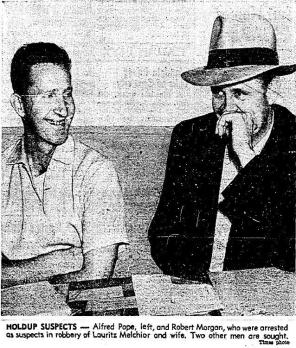
McFall said: “Burke and I got in my car and J. [Pope] took furs and jewelry and guns and hats, masks and gloves and so forth and we were to meet at Johnny Heath’s apartment or bungalow or motel, whatever it was.

“So we drove–Burke and I drove together and we got there 10 or 15 minutes prior to the time that J. arrived. And I had a few items in my pocket of jewelry. Pill cases. Like a compact, something like that, and I don’t believe Burke had any kind of jewelry. He had the money. So we divided the money up there. He and I divided the money and gave J. some of it. $30 or $40, something like that. Burke and I wound up with around $100 apiece.

“We discussed who was going to try and fence the stuff, or who was going to fence it and everything, and everything that had diamonds in it, plus the  one emerald ring we put it out there, and I was–I wanted to divide the stuff; let it go. Burke to either take and fence it all or I will. I didn’t have any place to fence it and he said he did, so he took every piece that was worth anything. All the diamonds and the emerald.

“Originally [Burke] wanted to sit on it, and wait for, I don’t know, a month or few weeks, or something until it cooled off. He thought he would get a better price. Everybody was pressed for money, so he made an agreement. He would go ahead and contact this fence the next day or same night or something to see what he could do to get rid of most of the stuff.”

McFall said: “Later on I gave Spivak five or 10 bucks or something. That was all he wound up with.” Spivak also apparently got a box of cigars.

But on June 19, 1957, the victims identified Burke’s photograph. He was arrested the next day at 7023 1/2 La Tijera and identified by the victims.

“At first he denied any knowledge of the robbery whatsoever,” Police Chief William H. Parker wrote, “but there were indications that he was involved. He did indicate that if possible he would like to cooperate, mainly to protect his wife and young baby, which was approximately one week old at the time.

“Mr. Manley Bowler, assistant district attorney, county of Los Angeles, was contacted and agreed that if Burke would cooperate fully in the recovery of property and testify as a witness for the prosecution, in return he would be granted immunity for his participation in the robbery.”

At 5 a.m. on June 19, there was a knock at Pope’s door. It was Burke–and a police officer. Burke asked Pope for the furs, which Pope had hidden underneath a sofa. Pope was arrested and Burke began helping officers recover the stolen items, which were spread over Los Angeles.

Later that day, McFall stopped at a liquor store to buy some cigarettes and heard a radio broadcast saying that two men had been arrested in the Melchior holdup. The LAPD’s Inspector Ed Walker mentioned McFall by name as being wanted in the robbery.

Abandoning his Chrysler in the parking lot of the Tyler Hotel, McFall had a friend take him to San Fernando, caught a bus to Bakersfield, then another bus to San Francisco and checked in at the Mentone Hotel.

With his cash running out, McFall began trading some of the jewelry for money. He drifted from San Francisco to Reno, to Ogden, Utah, and eventually ended up in Missoula, Mont.

Spivak, meanwhile, panicked when he saw his picture with the news stories about the Melchior robbery.
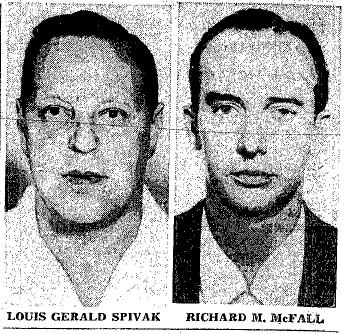
Spivak said: “I checked out of the hotel. I rushed out. I figured it was only a matter of time. Now that he [McFall] was mentioned and they knew McFall was in the hotel and they knew McFall had brought me over to the hotel. I said: ‘The cops will be here any minute to grab me,’ so I just ran and besides I had these checks out for the television sets and stuff and I said ‘Gee, I got to get out of here quick.'”

Spivak and Howard “Blackie” Nichols spent a night in a hotel on Flower Street, then moved to the El Rey Hotel. Unable to sleep, Spivak fled, abandoning Nichols at the hotel.

Spivak said: “I was going up to the room and I saw a door open and a head stick out and I thought they were watching for me, that somebody had noticed my picture in the paper because my picture had been there in the paper, but this time–and I figured somebody might have recognized me, so instead of going to my room, I took the first staircase downstairs and checked out. I didn’t even check out, didn’t stop at the desk or anything. I just left.”

He spent a night in a hotel on Alvarado, then two nights in Santa Monica. Finally, Spivak bought a bus ticket to Oakland and got a room at the Harrison Hotel. He bought a Hudson automobile in Oakland and two nights later, he checked into the Lyric Hotel in San Francisco. He stayed a week at the Governor hotel, then spent a night in Reno. The Hudson broke down on the way back from Reno, so he sold it for scrap and bought a bus ticket to San Francisco, where he was arrested Aug. 3, 1957.

Meanwhile, McFall met another addict, Frank Arriola, in San Francisco. Arriola introduced McFall to Shirley Zusa, whose boyfriend, one of McFall’s drug sources, was in prison.  McFall and Zusa went to Reno and then came back to the Bay Area. McFall stayed in Oakland because police had been to his room in San Francisco looking for him. Zusa took off for a rehab clinic in Los Angeles, leaving her car with McFall.

McFall went to Reno, where he spent a week in bed taking prescription drugs and using paregoric, which contains morphine. From there, he spent about 10 days in Ogden, picking apricots, then went to Missoula. He was arrested Aug. 10, 1957.


McFall said of his arrest: “The car had been parked there all night and all during the day or most of the day with the exception of the time I drove over to a doctor…. I was all full of cement. In fact, I didn’t have a change of clothes. I left everything with Shirley in the same bag.

“I went to Penney’s I think it was, and I bought this pair of Levi’s and I had this clean shirt, and I had clean underwear. I bathed at night after coming back from work.

“The next day I went up and bought this. Saturday morning. Bought the Levi’s and what-not, and I went down to Park Hotel Cafe, and had a milkshake, and I talked to the waitress.
“When I came back–I didn’t know exactly what time it was, but I presume there was some time left before time passed where you didn’t have to put money in the meter. I stepped up and put a couple pennies in the meter and Bud Lamaroux L-a-m-a-r-o-u-x, drove up and asked if it was my car. A police sergeant. I knew he was a policeman. I saw the car. And he radioed for some other cars. We stood there and talked–was it my car, and I told him no, it belonged to a friend. By that time a couple other patrol cars, radio cars, had come up and they searched me and handcuffed me. He looked in the car and reached up under the seat; the gun was in the car. He got that out.”
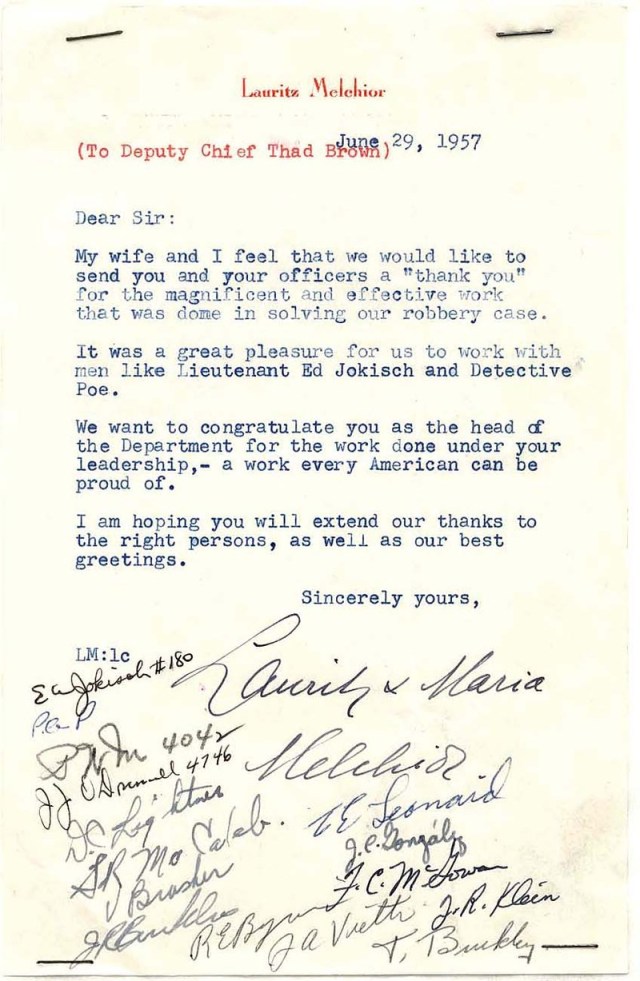
On June 25, 1957, the Los Angeles County Grand Jury indicted Wayne Burke, Richard McFall, Alfred J. Pope and Louis Spivak in the Lauritz Melchior robbery. Pope and McFall pleaded guilty to robbery Nov. 20, 1957. McFall was given five years to life in prison, Pope was given six months in jail.

On Dec. 3, 1957, Spivak was found guilty of  kidnapping as well as robbery. Although he wasn’t present when the crime occurred, Spivak was given the heaviest sentence imposed on any of the men: five years to life in prison, with a minimum term of seven years.

All charges against Burke were dropped because he cooperated with authorities and aided in the return of the property.

Note: I would like to thank retired Police Capt. Ed Jokisch for providing materials on the Melchior case.

Email me

Posted in #courts, 1957, LAPD, Robberies, San Fernando Valley | Tagged , , , , , | 1 Comment