Lil’ Pedro update

While cruising Beverly Boulevard the other day, I saw this mural on the side of Cactus Mexican Food No. 2 at Beverly and Harvard Boulevard. (For an explanation, see my earlier post on the “Gordo” and “Lil’ Pedro” comic strips). I should note that after my original post, I received an e-mail from a fellow ostensibly living in Mexico who said this figure is based on a famous sculpture by Ignacio Asúnsolo in the National Art Museum in Mexico City and that it’s very popular in Mexico.

All of which may be true, but the little lawn statues certainly infuriated some of my Latino friends in Tucson.


Photograph by Larry Harnisch Los Angeles Times

Email me

Posted in art and artists | Tagged , , , | Comments Off on Lil’ Pedro update

El Segundo revisited

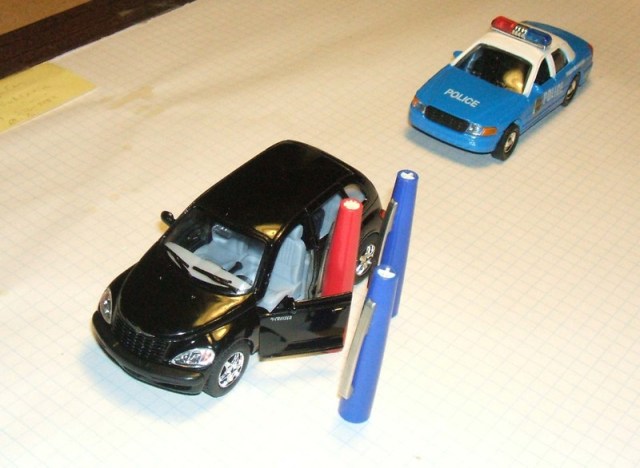
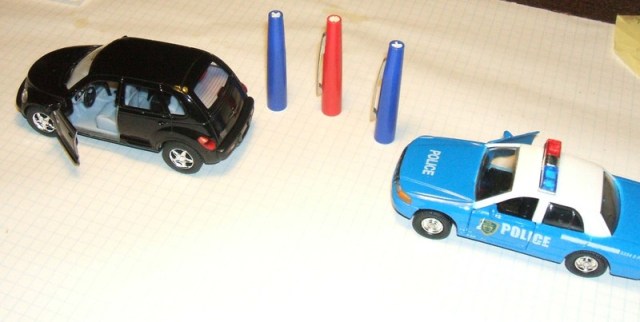
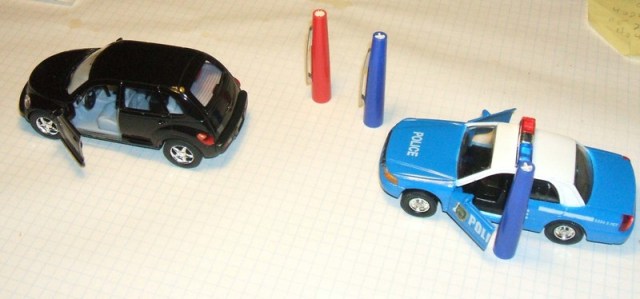
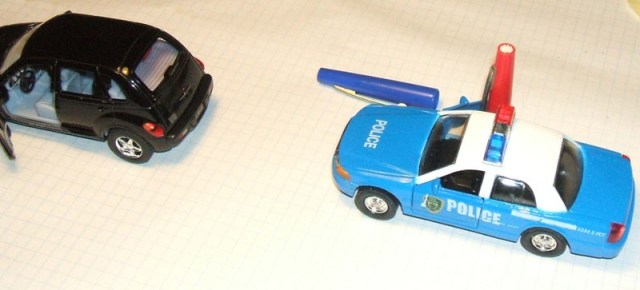
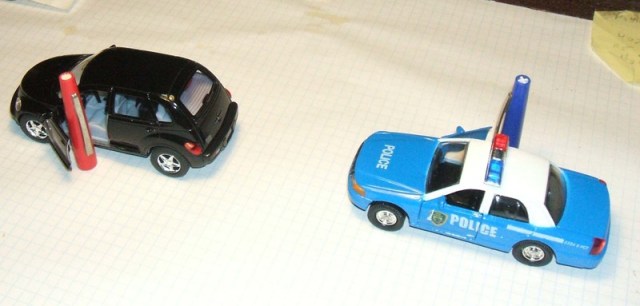
Over lunch today, King C. Brown and I discussed the El Segundo case and I worked out this scenario for what might have happened that night. I apologize for the extremely low-tech simulation but this is all I could find around the hacienda.


1. Curtis and Phillips remove the driver from the car.


2. Curtis and Phillips shine a flashlight in the driver’s face (possibly a field sobriety test).


3. Curtis gets in the car to radio the dispatcher.


4. The killer shoots Phillips in the back. Then shoots Curtis from the passenger’s side.

5. As the killer flees, Phillips fires four rounds into his car.

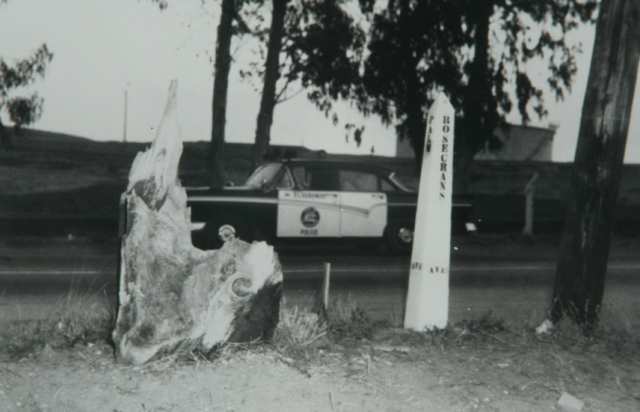
Here’s another picture of the crime scene:

Copy photo of 1957 murder scene of two El Segundo police officers at intersection of Palm Ave. and Rosecrans Ave. near the city’s border with Manhattan Beach during a press conference in El Segundo Wednesday morning January 29 2003.

Email me

Posted in Uncategorized | Tagged , , | Comments Off on El Segundo revisited

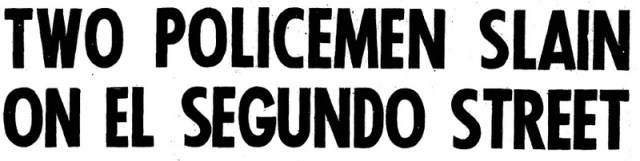
Death in El Segundo

July 22, 1957
Los Angeles

We’re heading west on Rosecrans Avenue. It’s early Monday morning, a few moments after 1:30 a.m., and the streets are dark. There’s nobody out but a few drunks and some people heading home from the swing shift. It’s all quiet.

Maybe that’s what these two men on the graveyard shift thought.

Let’s pull over here, at Palm Avenue. North of us is the tank farm for the Standard Oil refinery and south of us are new homes. Up ahead is a police car, all lit up. I make it out to be 1957 Ford 300, four-door black and white. The only sound is the police radio. You can see the front passenger door is open. It says: “El Segundo Police.”

Before we get out, I need to say something: We’re going to find two dead–or dying–police officers up there. At home, there’s two widows who kissed their husbands goodbye and hoped they would see them in the morning. There are five kids who are going to grow up without their fathers. It’s a terrible tragedy and I don’t want to minimize that. But it would be another tragedy if one more police officer died because we didn’t learn a lesson from what happened here. These men can’t tell us, so we’ll never know exactly what went on. But let’s see what we can figure out about the shooting by picking it apart.

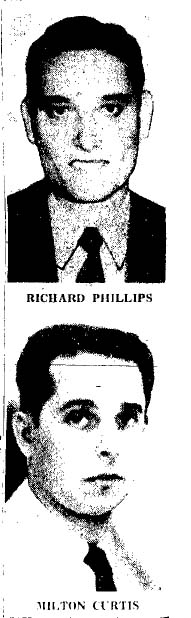
The officer in the driver’s seat is Milton Gus Curtis, 27. He’s fresh out of the academy in Riverside and has been on the El Segundo department for two months. Curtis has been shot in the upper right chest, right side and right forearm (or right wrist) with three .22-caliber short rounds. Continue reading →

Posted in #courts, 1957, @news, Cemeteries, Crime and Courts, Homicide, Science | Tagged , , , , , , | 11 Comments

Literary diversions

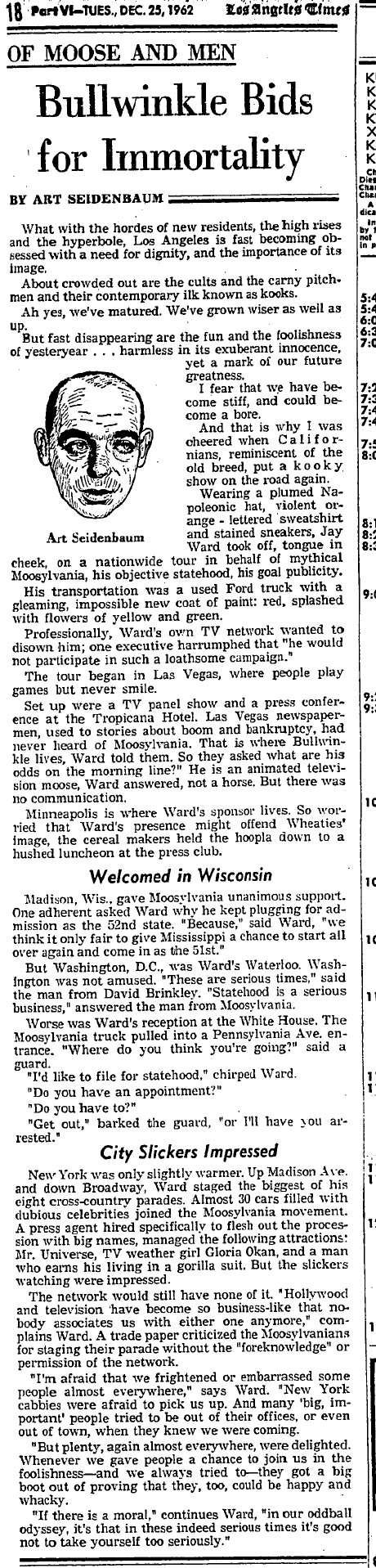
The late Art Seidenbaum on animation (and publicity) genius Jay Ward. Statehood for Moosylvania? As the 52nd state? As the story appeared, Dec. 25, 1962:

Posted in Columnists | Tagged , , , , , | Comments Off on Literary diversions

A question of leadership

July 18-Aug. 1, 1957
Los Angeles

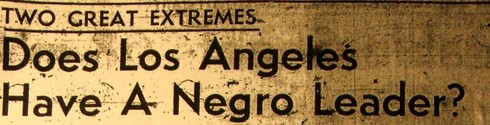
In the summer of 1957, eight years before the Watts riots, the Los Angeles Sentinel, a weekly newspaper serving the black community, published a three-part series by Stanley Robertson titled: “Does Los Angeles Have a Negro Leader?”

Robertson’s conclusion was “No.” But the question remains far more interesting than the answer.

The series began with a hypothetical case: another bombing of a home in a white neighborhood that was recently sold to a black family, like the blasts on Dunsmuir in 1951-52.

Robertson noted the painfully inept effort by one white newspaper to get comments on the bombings from representatives of the African American community. “Some of the answers would have made good copy for ‘Amos ‘n Andy,” Robertson said.

The newspaper, he said, indiscriminately interviewed several prominent doctors and businessmen as well as a convicted gambler, a “would-be politician who had a lucrative ‘book’ going behind his phony real estate office” and a newspaperman who was later convicted of petty theft.

In the event of another bombing or other crisis, Robertson asked:

“What single Negro man or woman in Los Angeles will be the person who will come to the front as not only the spokesman and the champion of the bombed family but for Negroes throughout the city? What single Negro man or woman will have enough ‘influence’  to put the right pressure in the right places so that the investigation of the bombing by police and other authorities will not end as another ‘unsolved case?’

“What Negro in Los Angeles will have enough ‘contact’ with all segments of local radio, television and press so as to ensure that ‘all the facts’ are made public? What Negro in Los Angeles will be ‘powerful enough’ to cause city officials to use every resource at their command in breaking the case?

“In short, what Los Angeles Negro will act as the leader of the Negro people in case such an event takes place? Does the third-largest city in the United States have a Negro leader? Is there a Negro in Los Angeles who is as powerful as New York’s fiery little borough president, Hulan Jack, Chicago’s William Dawson, Montgomery’s Martin Luther King ?

“Or is the third-largest Negro settlement in the United States without a recognized leader?”
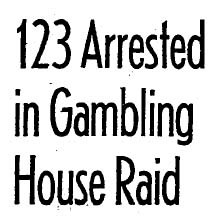
The second part of the series portrayed a sadly disillusioned, cynical view of black politicians and ministers who could be had for a price. Robertson also noted the LAPD’s failure to treat prominent African Americans with the same respect usually accorded to distinguished whites in a famous 1955 gambling raid on the Pacific Town Club, 4332 W. Adams, in which 123 people, many of them doctors and lawyers, were arrested.

“Do you think the same thing would have happened if the same type of affair was going on, as it very often does, at a white club of comparable stature as the Pacific Town Club?” one man asked.

None of Robertson’s sources were identified except by trade, their gender or the amount of time they had been in Los Angeles.

One African American who had lived in Los Angeles for many years said:

“When I was a young man in Los Angeles there weren’t many Negroes here but we fought for the things we wanted. Things which people today are still enjoying but take for granted. We fought for, and got, Negro teachers in the school system. We opened the city and county departments. We fought for equal treatment from the police.

“But our trouble was leadership. Yes, we had some leaders. Some who were pretty promising until the politicians and people in high places got to them. For secure, well-paying positions or an occasional handout, most of them merely became figureheads doing whatever they were asked to do. There were a few who still fought for what they believed in, but against the money these captive leaders had to spend on an occasional barbecue or drink, they soon disappeared.

“I’ve watched people of this type come and go. After World War II, with the large influx of Negroes and the great amount of young Negroes who were attending college and branching out into the fields which had been closed to us in my day I thought this would change. But, honestly, it hasn’t. The only thing which has changed is the price by which people can be bought off.

“We called those people who could be bought off in my time Uncle Toms. There are still Uncle Toms today, only Uncle Toms with fancier clothes and fatter wallets.”

Robertson also described conflict and lack of unity among newcomers and more established blacks. Some in the African American community charged that there was an “old guard” “from the days when the ‘Negro vote’ could be delivered by one whopping big chicken fry, barbecue or watermelon feed at Lincoln Park or South Park,” Robertson said.

There were just as many accusations, he said, that the newer generation of blacks was all too eager to trade their ideals for a Brooks Brothers suit, a T-bird and a home in the suburbs.

The third part of the series described the effects of upward mobility on blacks, the weakness of the local NAACP compared with the Urban League, the Lullaby Guild and the Jack and Jill Organization, and the lack of unity in supporting African American politicians.

One woman told Robertson:

“This losing of ‘identity’ knows no bounds among Negroes who become a success in their chosen profession…. However, most of those who attempt to forget that they are Negroes really don’t realize that one of the major factors in their success has been the fact that they are Negroes. Those people who are appointed, or elected, to public office, for instance, aren’t naive enough to think that they’re holding office because they’re qualified?” 

As for the NAACP, one unidentified official cited an appearance in Los Angeles by Jackie Robinson as part of a nationwide fundraiser. Although Robinson helped raise a significant amount of money in Oakland, Detroit, Chicago and New York, the man said, in Los Angeles, Robinson couldn’t “draw flies.” “Can you blame that on the NAACP leadership or the people of Los Angeles?” the official asked.

Robertson  quoted a woman who said that although a few “talk their way into being regarded by the two major parties as ‘key Negroes,’ no one person is anything more than a political gnat.”

She said: “We tell ourselves that we are much more organized, have made more progress and have more people in higher positions that the Mexican American community here. But what Negro in Los Angeles can we point to who is comparable to City Councilman Edward Roybal, who happens to be of Mexican descent?

“Rather than spending our time fighting among ourselves trying to secure a little plum for ourselves, as seems to happen whenever a Negro announces that he’s a candidate for a particular office, why not get together and back one candidate? How many Mexican-Americans do you suppose have run against Roybal?”

As it stands, Robertson’s series only states the problems and judging by his remarks, his stories hit a nerve in the African American community, eliciting phone calls and letters. But had I been his editor, I would have asked him to write a final installment exploring possible solutions. And for all I know, perhaps he did in a later story that I have yet to discover in the archives.

Instead, he concluded: “Does Los Angeles have a Negro leader? What do you say? I say no, not now, but a few men who, if they continue in their present manner, are only a few years away.”

Unfortunately, Robertson didn’t identify them. And eight years later, white Los Angeles will wonder what all the fuss is about down in Watts.

For those wishing to read the entire series, Part 1 appeared July 18, 1957; Part 2, July 25, 1957; Part 3, Aug. 1, 1957. The Sentinel is available on microfilm at the Los Angeles Public Library.

Bonus facts:

  • The Los Angeles Sentinel is now owned by Danny Bakewell.
  • In 1957, Rodney G. King hadn’t even been born.

Email me

Posted in 1957, Countdown to Watts | Tagged , , , , , , | Comments Off on A question of leadership

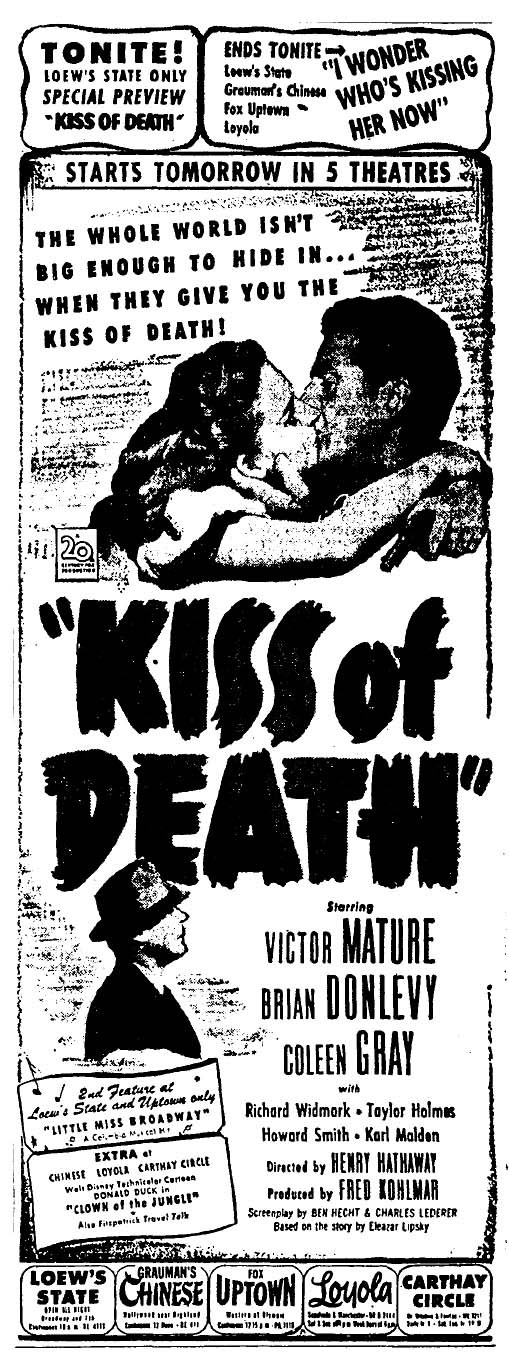
Victor Mature TV

Question: Didn’t Victor Mature own an appliance store?

Answer: Yes, Victor Mature TV: 10739 W. Pico Blvd. The store later moved to 10916 W. Pico.


Posted in Film, Homicide, Television | Tagged , , , | 2 Comments

What happened on Dunsmuir

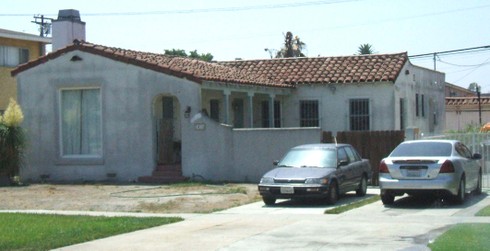
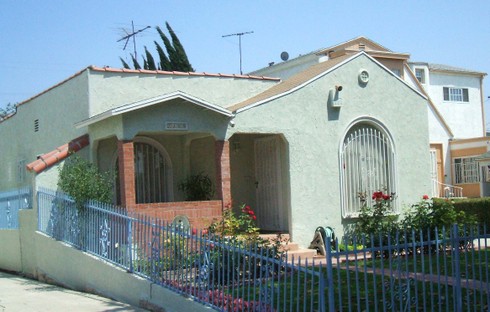
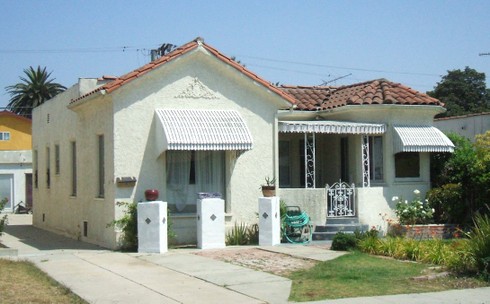
These appear to be four rather ordinary West Adams district homes from the late 1920s and early ’30s and in many ways they are.

Photographs by Larry Harnisch Los Angeles Times

This is 2435 S. Dunsmuir Ave.

This is 2308 S. Dunsmuir Ave.

This is 2135 S. Dunsmuir Ave.

And this is 2130 S. Dunsmuir Ave.

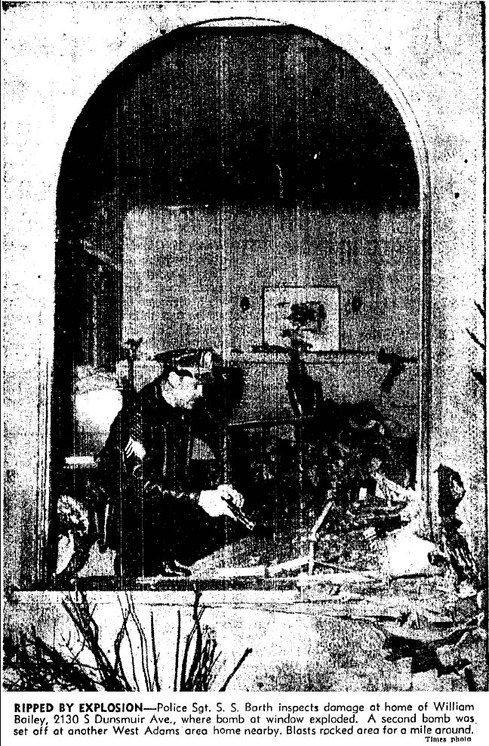
But on March 16, 1952, 2130 S. Dunsmuir looked like this:

About three months before the explosion, William Bailey, a science teacher at Carver
Junior High School, had moved into the house with his wife, Willa, and
their son, William Jr. The family was black. The neighborhood was
white.

Whoever hit the house also bombed the one across the street, which was
being rented by Ralph Martinez and John W. Potts. Presumably they were
black, although The Times doesn’t say so.

On July 25, 1951, 2435 S. Dunsmuir was bombed several days after after it
was sold to Dr. M.D. Matsumoto, a Japanese American physician.

An explosion a few hours earlier ripped  2308 S. Dunsmuir, which was
owned by Sallie H. Mazoway, a real estate agent. “Mrs. Mazoway told
police she had no part in the sale of the Matsumoto house nor had she
sold property to persons not Caucasians,” The Times said. “She did say
that she had received anonymous telephone calls on the subject of such
sales.”

Although police said the explosion at 2308 S. Dunsmuir was like the others, fire officials said it might have been caused by gas that accumulated beneath the house.

There’s one other thing these homes have in common: The bombings were
never solved, despite rewards offered by the NAACP and ACLU soliciting
information.

Email me

Posted in Countdown to Watts, LAPD | Tagged , , , , , , , , , | Comments Off on What happened on Dunsmuir

Insane


July 20, 1957
Riverside

A maid at a Riverside hotel found the battered, nude body of
5-year-old Hiedrun “Heidi” Nicholson bent over double and stuffed into a closet.

It looked “as if someone had been pounding her with a hammer,” The Times said, quoting another hotel maid. The autopsy showed she had a collapsed lung from a broken rib and bruises over most of her  body.

The girl and her mother, Felicitas Nicholson, a 31-year-old German war bride, had checked into the motel with Harry Vern Gates, 40, a Santa Ana salesman.

When he was questioned about Heidi’s death, Gates told police he had taken Nicholson to another motel in Maywood but insisted that she said her daughter was staying with friends.

Police discovered that Feliticas was already in jail after an officer found her lying on the sand in Long Beach at the end of 36th Place.

She was semiconscious and incoherent, according to police, and her purse contained her last will and testament, requesting a Christian burial.

In later interviews, she told police she was a commercial artist and that her parents still lived behind the Iron Curtain in Leipzig, East Germany.

She said she had been married to Air Force Master Sgt. Raymond Nicholson of Stillwater, Okla.

She was found guilty of murder and sentenced to the gas chamber after
Gates testified that Felicitas told her daughter she didn’t love her
anymore and was going to get rid of her.

However, Feliticas was the first person to be tried under a new
California law requiring a sanity hearing for those sentenced to die.

After a 32-day trial, the jury deadlocked and the judge declared a mistrial.

Halfway through the second sanity trial, the judge halted the proceedings and declared Felicitas insane, committing her to
Patton State Hospital.

The judge ordered that she be retried if she ever regained her sanity.
And then Feliticas Solveig Nicholson vanished without a trace.

Email me

Posted in #courts, Homicide | Tagged , , , | Comments Off on Insane

He’s here!

July 19, 1957
Los Angeles

Minda Lee Birnbaum, 15, and her mother, Blanche Lewie, 46, had spent most of the day with the divorce lawyer, Murray
Chotiner. In the late afternoon, as Blanche made some phone calls from the law offices’ library, Minda pecked at a typewriter and talked to Carol Tannis about becoming a secretary.

Then Blanche’s estranged husband, Leo, walked into the offices at 202 S. Hamilton Drive, Beverly Hills. Minda ran to warn her mother, yelling: “He’s here!”
Blanche stood between them as he shouted at Minda: “Why are you doing
this to me?”

After an initial confrontation, Blanche told Tannis to call the police, but Leo warned Tannis: “Don’t do it.”

As Tannis hid behind her desk, Blanche grabbed a pair of scissors but Leo took them away, pulled a Luger from his belt, held the barrel against Blanche’s stomach and pulled the trigger.

Minda ran from the room but tripped and sprawled in the doorway. As she lay on
the floor, Leo put the Luger against the 15-year-old’s head and pulled the trigger. When it didn’t fire, Tannis fled.

Then, two shots.

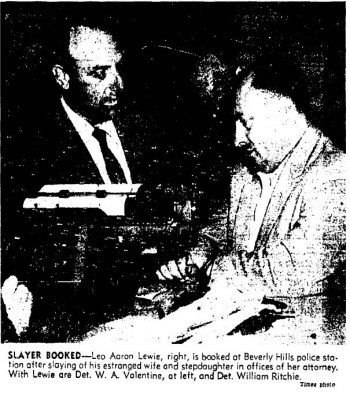
Acting on a tip, police found him at a miniature golf course, 1312 S. Arlington Ave.

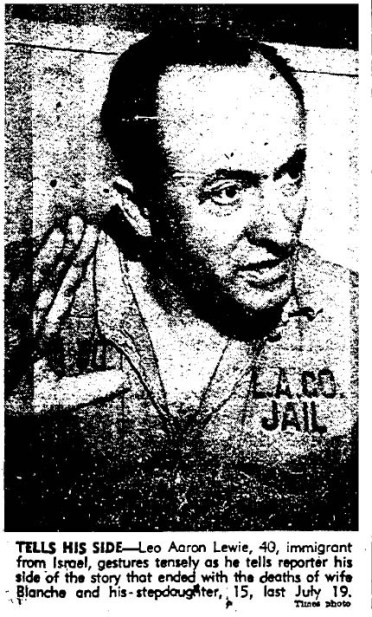
Forty-year-old liquor store clerk Leo Aaron Lewie was a Polish Jew who fled to Israel, he told The Times while in jail awaiting trial on two counts of murder.

He married in 1941, but his wife died giving birth to his son, Aaron, in 1947. A second marriage ended in divorce, he said. Then there was the 1948 war with the Arab states. “Many persons died in the streets,” Lewie said. “I crawled through the streets searching for food for my son.”

Lewie and Aaron left for France. “I came to Paris destroyed inside–my heart, my mind,” he said.

They arrived in New York in 1953 on a business visa. Later that year in Los Angeles, he married Blanche, whose husband had hanged himself in the basement of their home, leaving her with two children, Minda and Martin, who was two years younger. “It was an unhappy home from the
start,” Lewie said.

Blanche loaned him money to start a drive-in and they had a son, Robin. With the profits from the drive-in, the family moved to a home at 2066 Roscomare Road, Bel-Air. In 1956, Lewie sold the restaurant and opened a liquor store at 3901 S. Vermont.

“I worked long hours, seven days a week,” he said. “My wife became moody. She tells me, ‘Leo, I don’t care for you or the kids.’ That night I took the children to dinner and a movie. When we came home my wife hit me. I slapped her. She called the police. They arrest me. Later my stepdaughter Minda tells police I molested her.”

The domestic violence counts were dropped, but he was charged with molesting Minda. When he was finally released on bail, the family had gone into hiding from him.

Lewie insisted the molestation charges were Blanche’s ploy to get a divorce. “My wife said if I give her everything the charges will be dropped,” he said. So he agreed. But instead of dropping the charges,
Blanche was trying to have him deported, he said.

“She pushed me, pushed me, pushed me!” he shouted!
He bought a Luger, planning to go to Chotiner’s office and say that he would kill himself if the charges weren’t dropped. Instead, he found Minda and Blanche.

“She grabbed a pair of scissors and came at
me,” he said. “I lost my head and pushed on the trigger. I put the gun to my head and pulled the trigger again. But there were no bullets
left.”

(Police said that when he was arrested he had a full magazine of ammunition plus some shells in his pocket).

One of the key contentions at the trial was that Lewie had been molesting Minda for two years, but the medical experts disagreed completely. Dr. Charles Demos, a Santa Monica gynecologist who examined
Minda before she was killed, said he found evidence that she had been molested. Dr. Gerald K. Ridge, who performed the autopsy, said he found no evidence that Minda had sexual relations.

In an attempt to determine the truth, investigators exhumed Minda’s body from her crypt at  Beth Olam Cemetery, 900 N. Gower St. Over objections by defense attorney Gladys Root, Dr. Bruce David Stern
testified that his findings “were compatible with the contention that the girl had been repeatedly violated.”

Leo Aaron Lewie was convicted on two counts of second-degree murder March 27, 1958. He died
in San Francisco on April 25, 1983, at the age of 66.

Murray Chotiner, a longtime adviser to Richard Nixon, died in 1974 in Washington, D.C., of injuries from a car accident. He was 64.

More information on the Lewie case is available at the Jewish Coalition Against Sexual Abuse/Assault.

Email me

Posted in #courts, Homicide | Tagged , , , , | Comments Off on He’s here!

Liberace’s mother beaten

July 19, 1957
Los Angeles

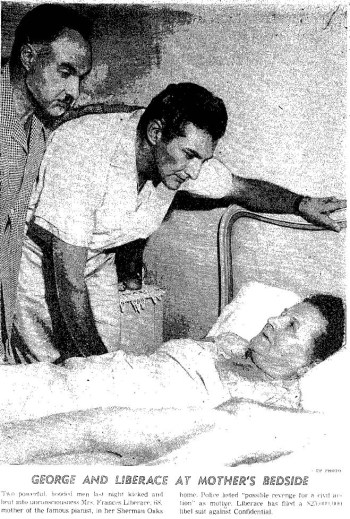
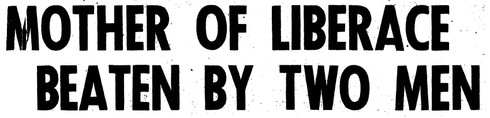
Hours after Liberace gave a deposition in his $25-million libel suit against Confidential magazine, two masked intruders attacked his mother in the garage of Liberace’s home, 15405 Valley Vista Blvd., Sherman Oaks.

Frances Liberace Casadonte, (68, according to the Mirror; 65, according to The Times) said she was on her way to burn some trash in a backyard incinerator when she was attacked by two men.

“They had black hoods with slits for their eyes. They also had some kind of covering, probably stockings, over their shoes,” Casadonte told
police. “I screamed and they chased me into the kitchen. There, one of them grabbed me, hit me or threw me down on the floor. One of them kicked me in the back. I heard one of them say, ‘This will give him something to laugh about.’ Then I fainted.”

A doctor says Casadonte’s heavy corset may have protected her from being badly injured when the attackers kicked her. Liberace was not informed about the assault until he finished his
midnight show at the Moulin Rouge, The Times said.

A family spokesman said: “I feel this whole thing is connected with the Confidential suit. Somebody is trying to frighten us.”

In response, guards were hired to protect the home of Liberace, as well as the home of his brother George in Encino, and that of his brother Rudy in Van Nuys.

According to The Times, several people were questioned in the assault, but no one was ever arrested.

Email me

Posted in #courts, LAPD, San Fernando Valley | Tagged , , | 3 Comments

You, the jury, Part II

July 19, 1957
Los Angeles

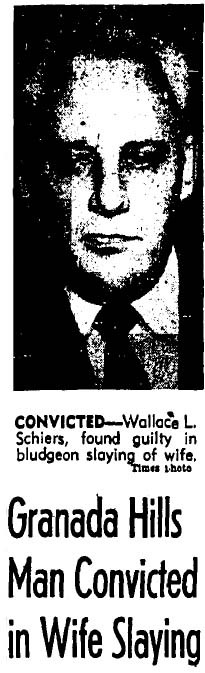
The jury convicted Wallace LeRoy Schiers of second-degree murder on July 18, 1957. But Schiers continued to insist that he did not kill his wife. He said: “I have nothing on my conscience. Somewhere along the line I have got to be exonerated. I am not guilty.”

He was sentenced to five years to life in prison, serving four years in prison and four years’ probation.

But the story is not over. Schiers appealed his conviction while in prison and although his case was rejected by the California Supreme Court, he continued to fight the case even after six years of freedom.

The basis of Schiers’ argument was police testimony about his polygraph test, which was inadmissible in court.  Schiers acted as his own attorney, arguing before the  state Court of Appeal that the judge’s order to strike the testimony and instructions to the jury to ignore it were not enough.  Schiers’ argued that since the polygraph testimony had come up in his preliminary trial, Deputy Dist. Atty. Evan Lewis knew about it and  should have taken steps to prevent it from being introduced in court.

Although the Court of Appeal rejected his plea and the state Supreme Court refused to hear his case, state Supreme Court Justice Jesse W. Carter wrote a dissenting opinion saying:  “By this decision the California judiciary invited repetition of such open debauchery of basic fairness to the discredit of the bench and bar. In my opinion it amounts to denial of due process of law.”

Schiers’ next action was to claim that he had not been furnished with counsel and had to act as his own attorney. He also tried to take the matter before the federal courts but was unsuccessful.

Finally, after a prolonged legal battle, the Court of Appeal reversed Schiers’ conviction in 1971 because of the inadmissible testimony about the polygraph results.

“The court noted the police officer’s testimony did not come as a surprise to the prosecution,” The Times said. “An augmentation of the appeal record allowed by the appellate court showed that police had referred to the lie-detector test in Schiers’ preliminary hearing before trial.

“Thus, in the court’s view, the prosecutor was on notice and should have guarded against any such testimony being presented in the presence of the jury at the trial.

“The fact that he did not indicated that the error was intentional and invited by the prosecution.”

“The error was so prejudicial that the judgment must be reversed,” the court ruled.

Wallace LeRoy Schiers reestablished himself in the aerospace industry. He died Oct. 5, 1994 in Nevada.

Note: I had two votes for not guilty, no votes for guilty. Thanks, gentlemen.

Email me

Posted in #courts, Homicide, LAPD, San Fernando Valley | Tagged , , | 1 Comment

Random shot

Native Angelenos will, of course, recognize that this photo was taken at the end of Reseda Boulevard about 1947. The man with the model airplane is W. Gilbert Clark, now UCLA professor emeritus of physics. Thanks for sharing!

Posted in San Fernando Valley, Science | Tagged , , , , | Comments Off on Random shot

Edith Piaf at the Mocambo

Edith Piaf opens at the Mocambo. Chet Baker… Art Blakey… Buddy Collette…. Slim Gaillard….And look at all the Dixieland groups. Who knew?

Posted in Film, Music, Nightclubs | Tagged , , , , , , | 2 Comments

Matt Weinstock

July 18, 1957

Don Bailey Jr. has no red tab on his rear license plate.

He applied for it like other motorists during the renewal period but
never received it. Apparently it was lost in the processing at
Sacramento or in the mail.

He is stopped almost every day and asked about the tab.

He explains the situation to the officers. He shows them his canceled
check for $84 ($601.88 USD 2006) dated Feb. 4 and a memo that he is authorized to drive
the car, a 1955 Olds, License BBS664. He tells them this has been
verified by the Inglewood and L.A. offices of the Motor Vehicle
Department and he has been instructed to carry the check and memo with
him at all times until the matter is cleared.

The officers sympathize and let him go.

On July 7, at about 1:30 a.m. Bailey was stopped near 39th and
Crenshaw. His wife, sister-in-law and sleeping child were in the car.

One officer put a flashlight on his rear plate and asked to see his 1957 license. Bailey handed him his “evidence.”

The officer was unconvinced and wrote a citation. He listed three
counts–wrong address on operator’s license, lights out of adjustment
and “no evidence of ’57 registration.”

Bailey refused to sign the citation. Then, as he puts it, “We both got pretty hot.”

The officer said he’d have to take him in if he didn’t sign the ticket. Bailey remained adamant.

The officer handcuffed him behind his back and Bailey told his wife to drive their car home.

At University Station, Bailey was given the usual alternative–sign the ticket or be booked in jail. He finally decided to sign.

He explains, “The reason I didn’t want to sign it was that to do so
would be conceding that I was driving my car illegally and that I’d
thrown away my $84.”

When the case comes up in court, Bailey plans to plead not guilty.

CULTURAL NOTE–Remember
the ubiquitous wartime phrase “Kilroy was here?” Well, in the men’s
room of a Hollywood Boulevard restaurant-bar, reports Tom Lempertz,
someone has written, “In hoc loc Kilrex erat.”

CURE FOR INSOMNIA

My body is ready for slumber
Except for my worrisome head;
It’s best to abandon the blankets
And watch the late movie instead.

–Martha Manheim

Posted in Columnists, LAPD, Transportation | Tagged , , , | Comments Off on Matt Weinstock

Missing woman found


1959_0425_mildred_hall

1959_0425_hall_mug
Mildred Hall, 44, who vanished Nov. 15, 1956, and was the subject of a
Paul Coates column, resurfaced in April 1959, posing as many baffling
questions as she did when she disappeared after leaving a note for her
husband, Harold, that she was running some errands and would be back
soon.

Hall was identified by Sister Mary Jeanette at the Notre Dame Academy, 2911 Overland Ave.,
where she went in search of information about her four children. Hall
told reporters that she had wandered the world, wondering who she was,
until she suffered a stroke and cerebral hemorrhage three weeks earlier
in a Ventura hospital.

"I always prayed. God, how I prayed someone would recognize me," said
Hall, an actress who gave up her movie career to raise a family.

"The first thing I remembered was sitting in a bus station in Meridian,
Miss., with 33 cents in my pocket and a ticket for New Orleans," she
told The Times.

She worked as a cocktail waitress in New Orleans, but after being
robbed apparently blacked out and found herself on a ship bound for
Manila. Next, she stowed away on a ship to Havana, she said.

"There, I got a job as a shill in a casino and earned enough money to
fly to Key West Fla., where I worked for six months as a singer. Then I
teamed up with a magician and his wife and traveled across the
country," Hall said.

Somehow, she got to Ventura, where she was hospitalized. While she was gone, her husband divorced her, The Times said.

There’s no further word in The Times on Hall or what became of her
children. It’s impossible to sort out all the Mildred Halls in the
California death records and the Social Security Death Index. She had a brother, Bob, who was a lifeguard in Santa Monica in the 1950s. Her mother, Adeline M. Lucas, died Feb. 24, 1976.

We also know that her father, Charles M. Lloyd (real name Charles Lloyd Maude),
an actor in silent films and vaudeville, died in Camarillo State
Hospital in 1948, so there may have been some predisposition toward mental
illness. But that is only a guess. As Coates said: "Mildred Hall is not
a simple person to explain."

Email me

Posted in Columnists, Film, Hollywood, LAPD, Paul Coates | Tagged , , , , | Comments Off on Missing woman found

Dodgers are coming to L.A.?

1957_0717_dodgers_3

Posted in Dodgers, Sports | Tagged , , , | Comments Off on Dodgers are coming to L.A.?

Meltdown II

July 17, 1957

Our friend, Mr. Atom, at the Santa Susana Field Lab.

1957_0717_atom_cartoon

Posted in Science | Tagged , , | Comments Off on Meltdown II

Countdown to Watts


1957_0717_race

July 17, 1957
Los Angeles

The painful comparison: "800 Negroes Lose Jobs"  and "Deep South Editors Here, See Race Tension Ending." And to make things even worse, the Southern editors were entirely well-meaning and sincere.

The Mirror interviewed editors from a variety of U.S. newspapers who were in Los Angeles to attend "Editor's Day" at Disneyland the week after the American Society of Newspaper Editors convention in San Francisco.

Although the story mostly gathered the editors' impressions of Los Angeles, it led with the views of George Chaplin of the New Orleans Item and Grover C. Hall of the Montgomery, Ala., Advertiser.

Chaplin, a former editor of Pacific Stars and Stripes who was later editor in chief at the Honolulu Advertiser, said: "I believe there is too much generalization about the race problem–which is a national and an international problem, rather than one confined to the South. There is a tremendous body of goodwill in the South and it is found among the moderates. But too much of the news is being made by extremists since the moderate, by nature, is reluctant to grab the mike or the headline."

What's even more interesting are the remarks by Hall, who won a Pulitzer Prize in 1928 for editorials attacking racial and religious intolerance. According to a 1941 Time magazine article, Hall broke the power of the Klan in Alabama.

According to the Mirror: "Hall said his city is proud of its Negro population, and that they are fitting into the community from an economical standpoint.

"Of course," he said, "colored people are leaving the rural sections in spectacular fashion. However, those that remain manage to contribute to the community in a very satisfactory manner.

"We have no violence. The colored people, for the most part, are resolving the problem themselves. Our part is to help."

Let me repeat that: The editor of the Montgomery, Ala., Advertiser says there's no violence. In 1957. And the Mirror let him get away with it.

Jan. 6, 1957
1957_0106_montgomery

Jan. 11, 1957
1957_0111_montgomery

Jan. 28, 1957
1957_0128_montgomery

May 31, 1957
1957_0531_montgomery

We don't have any problems in Montgomery. No sir. "The colored people, for the most part, are resolving the problem themselves."

Email me

Posted in 1957, Countdown to Watts | Tagged , , | Comments Off on Countdown to Watts

Aerospace crashes


1957_0725_eagle_hed

July 17, 1957

Los Angeles

With the cancellation of the Navaho cruise missile program, North American Aviation made plans to lay off 15,600 employees, nearly a third of the workforce at its plant in Downey.

Efforts
were made to find jobs for some of the workers at other aerospace firms
such as Douglas, which was making the DC-6 and DC-7, Hughes, Lockheed
and Northrop. The State Department of Employment was also staying open
in the evenings to help place workers, the Mirror said.

Navaho_missile_3
"But
the consensus appears to be that only the engineers and some highly
skilled types–such as machinists, tool designers and makers–will find
it easy to get new jobs," the Mirror said. "For the ordinary aircraft
worker, it will be tough sledding. And there is still the possibility
that additional thousands will be laid off as the result of
cancellation by NAA of more than $35,000,000 in orders placed with
subcontractors."

The layoffs were difficult for all employees,
but the California Eagle, a weekly newspaper serving the African
American community, focused on about 800 black workers who lost their jobs. (And in case there is any doubt, the headline above is from the Eagle, certainly not any of the white newspapers in Los Angeles).

"Some of the laid-off Negro workers report that they have been
offered jobs at other North American plants–as janitors," the Eagle
said. "Some of the workers interviewed by the Eagle stated that Negro
men and women who have been working in skilled jobs and who have
seniority have been offered employment at other North American
facilities through the Los Angeles area, but not at their customary
skills.

"According to these reports, at least two of the very
few Negro women employed as electronics assemblers have been asked to
return as janitors–cleaning bathrooms, keeping areas clean, etc.

"These
workers also say that at least one Negro engineer, one toolmaker and
one friction tester have also been told they could be hired as
janitors."

Workers harshly criticized the Eisenhower
administration for scrapping the Navaho, the Eagle said. "Said one
worker: ‘There’s not a Republican in this end of town.’ "

Defense
Secretary Charles Wilson, the former president of General Motors, was
particularly disliked, the Eagle said, because a GM division near
Milwaukee had been given a large missile contract.

"Most of the Negroes who worked in Downey lived in Watts and Compton,
Downey being a lily-white town," the Eagle said, quoting Nate Brown,
head of the United Auto Workers unit representing employees in the
missile program.

Brown denied charges that there was discrimination in laying off black
employees. "While some Negroes were hit as the ‘last hired,’ for the
most part Negroes fared about the same as whites," Brown said.

"About
90% of the black employees at North American had been hired in the
lowest-paying jobs as janitors, laborers and in the shipping and
receiving departments. A number of these men, however, have been
upgraded, largely as a result of union pressure," Brown said.

Although
the Navaho missile was canceled, some of the rocket propulsion,
supersonic airframe and guidance   technology was used in later
projects.

Note: North American eventually lowered the number of layoffs to 12,000.

Photograph courtesy of NASA.

Email me

Posted in Countdown to Watts, Science | Tagged , , , , , | Comments Off on Aerospace crashes

Architectural Ramblings


Jans_rest01
Photograph by Larry Harnisch Los Angeles Times

Here’s something fun to do on a Saturday morning: Meet friends for
breakfast at a restaurant where a drunk movie actress plowed her new
convertible through the front window in 1957.

The friends in question were Brady Potts and Mary McCoy and the restaurant was Jan’s, 8424 Beverly Blvd., where Gail Russell trapped the janitor under her car when she jumped the curb and crashed into the building.

When I read the story I assumed Russell was in the parking lot and
simply hit the gas pedal instead of the brakes. But no. After looking
at the height of the curb and width of the sidewalk, I decided she must
have been flying. And as there’s no side street directly across Beverly
Boulevard from where she struck the restaurant, I can’t imagine how she
managed to hit it so squarely perpendicular. But she did.

Here’s the counter, 1957:

Gail_russell_1957_0705b


Los Angeles Times

And the counter today:

Jans_rest02

Photograph by Larry Harnisch Los Angeles Times

Since you asked, Jan’s is a pretty nice breakfast place. It was a bit
of a brain-teaser that early in the morning to ponder why a half-order
of French toast costs more than the jumbo French toast, but the three
of us put our heads together and figured it out. Definitely worth
another visit.

Email me

Posted in books, Film, Food and Drink, Hollywood | Tagged , , , | 1 Comment