A light in the window

1957_0823_signal

Aug. 23, 1957
Los Angeles

Sandra O’Hara, 11, was sent to live with her mother when her parents
divorced and apparently preferred to live with her father, Martin.

So they devised a plan. The next time Sandra’s mother, Veda, 30, had a
male visitor, Sandra would put a light in the window so Martin would
know to come barging in and prove that Veda was an unfit mother.

On a recent evening, Sandra put the light in the window and Martin
discovered Veda entertaining William Griffith, 30. Inquiries revealed
that Griffith was married and the father of four children, The
Times said.

Martin accused his wife of being an alcoholic and punishing Sandra
for no reason. Superior Court Commissioner C. Clinton Clad continued the
case because Veda was too upset to testify, but The Times never
followed up on the matter so we don’t know how it was resolved.

Email me

Posted in #courts | Tagged , , , | Comments Off on A light in the window

Grace Paley–review and interview

Here is an interview with the late Grace Paley by Elizabeth Mehren and Carolyn See’s review of Paley’s "Later the Same Day." Paley died Wednesday at the age of 84.

Interview, May 22, 1985, Part 1

1985_0522_01

Review, May 19, 1985, Part 1

1985_0515_paley01

Continue reading →

Posted in Uncategorized | Tagged , , , | Comments Off on Grace Paley–review and interview

Fuzzy Pink Nightgown


1957_0823_fuzzy

Aug. 23, 1957
Los Angeles

Bad things happen when two men (Ralph Meeker and Keenan Wynn)
abduct a movie star (Jane Russell). It turns out that her upcoming
film is "The Kidnapped Bride" and everyone–including the studio and
the alleged victim–assume that the kidnapping is a publicity stunt.

Well, it must have sounded great as a 30-second pitch. Although the film was released with high hopes and a publicity campaign that included a young woman roaming Los Angeles wearing nothing but a–you guessed it–"The Fuzzy Pink NIghtgown" languishes in obscurity today–in fact it was Russell’s last movie appearance of the 1950s.

More to the point, however, is that a copy of Sylvia Tate’s novel–on
which the movie was based–was found in the Encino home of actress Marie "The
Body" McDonald
after she reported that she had been
kidnapped by two men. Police Chief William H. Parker, in fact, was so
intrigued by the similarities between the novel and McDonald’s story
that he read the entire book.


1957_0105_mcdonald

For example, the movie star in "The Fuzzy Pink Nightgown" is kidnapped when she is sent to a delicatessen to get some turkey sandwiches–the same story McDonald told police, The Times said.

Parked noted that the similarities "don’t prove anything," but he wanted McDonald to explain the
discrepancies between her various versions of the kidnapping. The LAPD even wanted to give her a polygraph test, but her attorney, Jerry Giesler, said the request was insulting and advised her not to take it.

On Jan. 4, 1957, McDonald was found in Indio wearing pajamas and a housecoat and claimed that she had been kidnapped by "two swarthy men" who broke into her home at 17031 Magnolia Blvd.*  Police were immediately suspicious of her story. In the first 15 hours that she was supposedly kidnapped, she placed three calls to friends and none to the police, The Times said. Some words of her alleged abduction note were clipped from newspapers found in her fireplace, the crime lab discovered.

Her ex-husband Harry Karl, better known as "Karl the Shoe Man," doubted the story and told The Times that McDonald "was not a well woman" and had behaved eccentrically. Karl also said McDonald was a "ready fighter" and insisted that anyone who tried to carry her off against her will would have "a lively struggle," The Times said. 

In fact, McDonald at one point accused Karl of arranging the abduction but later admitted she made up that part of the story. After an inconclusive grand jury investigation, the matter was dropped. She died of what was apparently an accidental drug overdose Oct. 21, 1965, at the age of 42.

Read my post on McDonald from the 1947project.

Perhaps the biggest mystery of all is what became of Sylvia Tate. Aside from writing the story for the 1950 film "Woman on the Run," she seems to have vanished without a trace.

*(You’re wondering about her being sent out to get turkey sandwiches. So am I).

Bonus fact: According to The Times, shortly before she was kidnapped, McDonald was reading Meyer Levin’s "Compulsion," a fictionalized account of the Loeb-Leopold case.

Email me

Continue reading →

Posted in Film, Hollywood, LAPD, San Fernando Valley | Tagged , , , , , , | Comments Off on Fuzzy Pink Nightgown

Paul V. Coates–Confidential File

Paul_coates_2
Aug. 22, 1957

Desmond Slattery–actor, naturalist, man-about Googies–paid his annual visit to my plush offices yesterday.

And, of course, I’m glad he did. Because it means that he won’t be around for another 11 months or so.

But don’t get me wrong.

Personally, I have nothing against this fast-talking, nerve-racking gentleman. He’s really quite charming.

It’s just his weird involvement with animals that frightens me.

He first came to my attention by conning me into writing a story that he owned the only Irish wolfhound in Los Angeles.

The day the column appeared, dozens of irate Irish wolfhound owners phoned in their protests.

Another time he sold me on an utterly ridiculous story about his car being attacked by a Jersey cow.

And a year ago, Desmond came by to inform me that he had gone into the
firefly business. He claimed to have 15,000 fireflies at Knott’s Berry
Farm, in crates.

That, of course, was just too much. I tossed him out of the office and dismissed him from my mind as a hopeless liar.

1956_0707
But curiosity gnawed at me. Finally, I couldn’t resist calling Knott’s Berry Farm.

"Did a man named Desmond Slattery leave 15,000 fireflies with you?" I asked, half-apologetically.

"Yes," an exasperated voice replied, "and we wish he’d come and get them. We don’t know what to do with them."

So when he came in yesterday, I treated him with a new respect.

Immediately, without speaking, he plucked a black object from his
necktie and placed it on my desk. He chuckled, hoarsely. "Looks like a
tie-pin, doesn’t it?"

I backed away in terror as the tie-pin began to walk toward me. "It’s alive!" I cried.

"Certainly," he replied.

Then he added, "It’s a cricket. One month old today. And in my bathroom are 2,000 more."

"Wonderful, Slattery. Hadn’t you ought to get back…"

"My goal," he interrupted, "is to take the cricket off the street and put him in the home where he belongs."

I remained a safe distance from my desk. And picked up a bookend.

But Slattery only smiled. "Bad luck to kill them. For centuries they’ve
been good-luck symbols. And I’m the only licensed cricket-raiser in the
country."

His insect began a slow crawl toward tomorrow’s Mash Notes [Coates’ name for his columns of readers’ letters].

Again, he smiled. "How about that? And only a month old. I think–before
you become a skeptic–I should tell you that I’ve already sold 10,000
of them in California alone. Wonderful pets. Anyone who wants luck
wants a cricket."

"People don’t actually buy them" I challenged.

"Complete with imported cages–small, medium and large. In three weeks
I’m leaving for the Orient to build up a pattern of production to
supply a national market."’

He was grinning. "Already they’re calling me ‘Slattery, the Cricket King.’

"Anything a man can get a monopoly on, he can make a fortune on. I
control the crickets and so far I control the cages. If somebody else
tries to import cages, he’ll need crickets. He’ll have to come to me.

"And," he added on a note of triumph, "I won’t sell them to him!"

The flaw was obvious. "And what," I asked, "if he goes off into the fields and collects his own crickets?"

"Wild ones? Sell wild crickets?"

He had me there.

"It’s foolproof," he persisted. "I have taken–you should excuse me–the bugs out of it."

As the man stepped forward to recover his crawling pet, my mind was
idly plotting devices by which I might drop "my old Cricket King friend
Des Slattery" into future Hollywood party conversations.

But then it happened.

The insect leapt happily toward its master. It misjudged the distance.

And a pleasant crackle sounded from under Slattery’s left shoe.

I smiled, sympathetically.

"Bad luck, eh Slattery?" I purred.

Posted in Columnists, Paul Coates | Tagged , , , , | Comments Off on Paul V. Coates–Confidential File

The Choirboys

1957_0817_cop_shoot

Aug. 17-22, 1957

Los Angeles

Officers Robert J. Steele, 25, and James K. Sherratt, 28, were sitting
in Steele’s car at 4 a.m. after finishing their shifts at Newton
Division when a gunman tried to rob them, The Times said.

Both officers, who were not in uniform, reached for Steele’s revolver,
which was on the seat between them, The Times said. But the gun went
off, sending a bullet through Steele’s right thumb and into Sherratt’s
groin. Sherratt underwent surgery at Central Receiving Hospital for
removal of the bullet.

The gunman fled when the shot was fired, The Times said.


1957_0822_copshoot

Except there was no attempted holdup and no gunman. Steele and Sherratt
had been off duty for two hours and were drinking in Steele’s car when
the shooting occurred, the Mirror said.

Sherratt resigned from the department. Steele and Officer T.J. Brown, a
witness, were suspended pending a board of rights inquiry on charges of
filing a false report, misuse of firearms and failure to report a
gunshot.

The next year, a man crossing the road at 7th Street and Central Avenue
died after being hit by car driven by James K. Sherratt of West Covina, The Times said. Sherratt was
not charged.

Email me

Posted in LAPD | Tagged , , , | Comments Off on The Choirboys

Countdown to Watts

The California Eagle, Aug. 22, 1957. The Times never reported the NAACP’s lawsuit against the Police Department. Apparently the Los Angeles police chief giving sworn testimony about the department wasn’t considered news.

1957_0822_parker

Posted in Countdown to Watts | Tagged , , , , | Comments Off on Countdown to Watts

Countdown to Watts

Aug. 21-22, 1957
Los Angeles

Note the contrasting coverage as Kappa Alpha Psi, an African American fraternity, holds its national convention in Los Angeles.

Continue reading →

Posted in 1957, Countdown to Watts | Tagged , , | Comments Off on Countdown to Watts

Paul V. Coates–Confidential File


1956_0613_hiccups
The Mirror, June 13, 1956. Note: No 72-point headline on Jack O’Leary’s hiccups.

Paul_coates Aug. 21, 1957

June 13, 1956, was a grim and heavy news day.

In New York, six children were killed in a cave-in. In San Diego, plans were revealed for production of a new "atom" plane. In Washington, D.C., the U.S. State Department crushed hopes of any meeting between John Foster Dulles and Chou En-Lai, premier and foreign minister of Communist China.

In Moab, Utah, a prospector — found near death in the desert — told of surviving his eight-day ordeal by eating raw lizards and cactus.

And again in the capital, the National Academy of Science gave first warning that waste from atomic industrial plants could contain more lethal matter than could be produced by an all-out atomic war.

But these weren’t the headline stories in Los Angeles.

We had one of our own.

And it read, in bold and black 72-point type:

"JACK O’LEARY’S HICCUPS END"

The date of June 13, 1956, was probably the only one in history when a case of hiccups was explosive enough to push politics and violent death and international tensions onto Page 2.

For the public, it was the end of a story that had held their interest for more than six years — when Jack’s hiccups gained their first inch of newspaper space.

For O’Leary, then 30, it ended an eight-year siege of a malady that had cut his weight from 138 to 72 pounds and shoved him face-to-face with death more times than he’d care to recall.

Jack’s mother called it a miracle, accomplished by "prayer, only prayer, eight years of prayer."

Her comments were greedily absorbed into newsprint.

And every L.A. newspaper dug into its files to compile a history of O’Leary’s fantastic illness.

They recounted that the young Irishman’s hiccups started after an attack of appendicitis on June 15, 1948. They gave play-by-play accounts of:

  • His trips to specialists in Phoenix and the Northwest and the Midwest.
  • His diet, year by year (most of the time he subsisted on a small glass of apple juice a day).
  • The cures and prayers he received in more than 100,000 letters from nearly every country in the world. (One cure, suggested by some Boy Scouts, was that he shoot off his big toe.)

It was Jack O’Leary’s day — newswise and healthwise.

1957_0821_rambler But it didn’t last.

Twenty-four hours later he was yesterday’s news — something you wrap garbage in.

He was forgotten by everyone but the bill collectors.

And that’s his position today. I know because I talked to him.

He doesn’t complain. He’s still thankful to be alive. But he doesn’t hold anything back, either.

He admits that his hiccups wiped out his mother’s $10,000 bank account and put his family $5,000 in debt.

He’s up to 82 pounds now, he says. He’s strong enough to earn a living. He washes and polishes cars in the driveway behind his apartment at 4015 Edenhurst Ave. He makes about $35 a week.

The hiccups?

He says they’re gone now. But in the last 14 months they began again twice. Once for three weeks. Once for six weeks.

He also contracted a skin disease that, he said, was 10 times worse than the hiccups.

Does he still get letters?

Occasionally, a stranger will write to find out how he’s doing. This compares to the day when his hiccups were first publicized — and as many as 7,000 letters poured in during a 24-hour period.

His diet? Toast and tea for breakfast. A vegetable and a little meat and tea for lunch. And the same for supper.

He’s not putting on weight, and he still gets pains in his chest three or four times a day.

But he can still smile at the future.

"Someday, with luck, I’ll have my own business."

He was a market manager when his hiccup siege started. But now he’d just as soon run a modest carwash establishment.

Jack O’Leary seems like a very nice individual. I’m glad I looked him up.

Posted in Columnists, Paul Coates | Tagged , , , | Comments Off on Paul V. Coates–Confidential File

Dodgers, go home!

1957_0821_arechiga_pix
1957_0821_arechiga

Posted in #courts, Sports | Tagged , , | Comments Off on Dodgers, go home!

Confidential: Tells the Facts and Names the Names

August 19,1957: Confidential Surprise Witness Found Dead

Aug. 19-22, 1957
Los Angeles

Maureen O'Hara's passportWhatever Polly Gould knew about Confidential magazine died with her.

The Times said that Gould, 46, a former “investigator” for Confidential and Whisper, had once been a columnist for Jimmy Tarantino’s Hollywood Night Life magazine, a thinly disguised shakedown operation in which businesses were threatened with bad publicity if they didn’t buy ads.

The Times initially reported that Gould was found dead from an overdose of barbiturates in her apartment at 1925 N. Bronson. Police said later that she died of natural causes, but added the  possibility that she died of an overdose. The Times, unfortunately, never reported on the final results of an autopsy.

Ernest Wenberg, an investigator for the attorney general’s office, confirmed that Gould had been called as a prosecution witness and hinted that she may have been hired to spy on Confidential’s operation.

The trial was also complicated by the Aug. 12, 1957, death of a defense witness, world featherweight boxing champion Chalky Wright. A former chauffeur for Mae West, Wright apparently hit his head and drowned in a bathtub shortly before he was to testify that he received $200 for information used in a Confidential article titled “Mae West’s Open-Door Policy.”

West testified that Confidential’s investigators got information from Wright by telling him that they were making a movie about her life and offered him a small role. “He later told me he didn’t say any of the things they claim he did,” West said.

Although Wright’s death was apparently accidental, his former wife, Gertrude Arnold, said she had received death threats the day after being subpoenaed in the trial. Arnold, who was placed under police protection, said a gruff-voiced man called her home and warned: “Girl, if you know what’s good for you, you’ll clam up about this whole thing.”

To be continued.

Email me

Posted in #courts, Film, Hollywood | Tagged , , , , | 2 Comments

Great moments in advertising

Well, you have to admit, it gets your attention.

1957_0819_gas_pump

Posted in 1957 | Tagged , , | Comments Off on Great moments in advertising

Los Feliz strangler

Aug. 20, 1957
Los Angeles

It’s late afternoon and we’re parked outside a 1926 bungalow at 4020 Holly Knoll Drive. Pretty soon the street will be full of police and reporters, but right now everything is quiet.

Ready? Let’s go in. Keep your hands in your pockets and don’t move anything. You’ll see soon enough that something doesn’t add up.

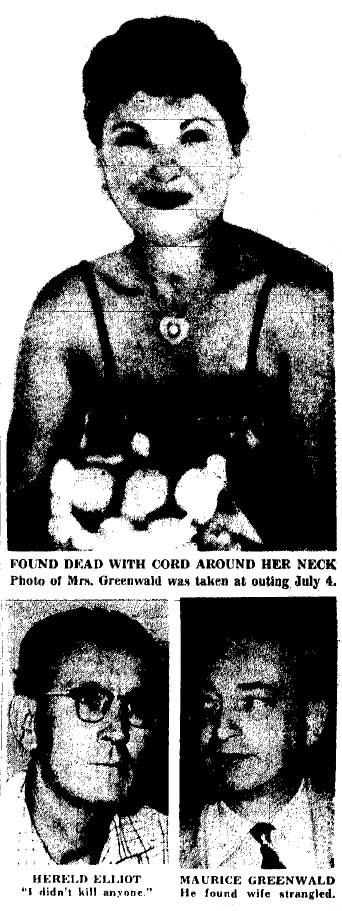
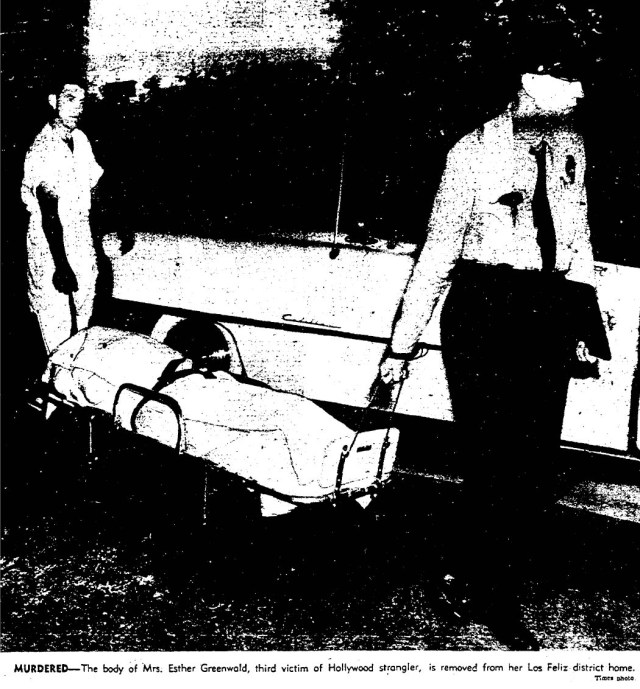
Notice that the front and back doors are locked. Here’s our victim. Her name is Esther Greenwald and she’s 52. Esther is lying face-down across the hallway with her head in a pool of blood on the bedroom floor and her feet in the bathroom. She’s wearing a blue nightgown, gray housecoat and red slippers and has been strangled with the cord from her housecoat. Someone doubled it and tied a simple knot in the back. (Police say that whoever killed Marjorie Hipperson and Ruth Goldsmith used square knots). She’s wearing two diamond rings.

Dr. Gerald K. Ridge, the medical examiner, says that death occurred sometime between 1:30 a.m. and 5:30 a.m. Margaret Chabolla, who lives behind the Greenwald home at 1950 Myra Ave., says she was reading when she heard two short, hysterical screams between 1:15 a.m. and 2 a.m.

Look at Esther’s face. The police are going to say she’s been so badly beaten that she could have died of head injuries while Dr. Frederick Newbarr, the other autopsy surgeon, says there are only a few bruises on her face.

The autopsy report is going to show that she “had a hemorrhage on the left temple and a wide variety of abrasions over the eyebrow and near the bridge of the nose. A groove on the right side of the nose was caused possibly by a fist with a ring.” The report also says she wasn’t raped.

Let’s go into the bedroom. Notice that her diamond wrist watch is on the dresser and there’s a fur stole in the closet. Take a look at the bed: Only one pillow has an indentation and the bed covers are only mussed up on one side.

She’s married to Maurice H. Greenwald, 49. He’s her second husband and works at a stationery supply warehouse. Maurice is going to be the one who finds her, somewhere between 5:55 p.m. and 7:30 p.m., depending on the newspaper account. He’s going to say that Esther was in her robe when he left at 7:15 a.m. and usually didn’t get dressed until noon.

Maurice’s story is that he and Esther were at the airport to see off some relatives who were flying to Hawaii. They stopped somewhere for bagels and coffee, and didn’t get home until 2 a.m. or 3 a.m. Interesting–Ridge says there was no solid food in her stomach. If Maurice left about 7:15 a.m., that means he got five hours’ sleep, at most.

Did you notice the laundry bag near the body? The first suspect police detain will be a 61-year-old delivery driver for a laundry. He will say that Esther complained about some wrinkled pillowcases and he assumed she dropped his service. His alibi will check out to the minute.

The next suspect they will arrest is an ex-convict named Harry Schwartz. He’s the brother of her former husband, a bail bondsman named Irving “Izzy” Schwartz, whom Esther married in 1928 and divorced in the 1930s. Although Harry will insist he hasn’t seen Esther in years, police will say that a polygraph shows he is lying. He denies knowing anything about the killing and tells investigators to check with about 40 jewelry clients he saw on the day of the murder.  Esther’s friends say he was extorting money from her.

The inquest is going to decide that Maurice killed Esther. A jury will find him not guilty, but unfortunately, The Times didn’t cover the trial, so we don’t know what happened. Maybe the prosecution had a lousy case, maybe the jury wasn’t sure, or maybe Maurice had a good attorney and didn’t do it, although his story doesn’t fit with the facts. I wish I knew.

Well, Maurice will be here any minute, we better get going. Maybe we should visit Esther at Beth Olam Mausoleum at Hollywood Forever Cemetery on our way back.

According to California death records, Maurice Harold Greenwald died Feb. 9, 1988.

Esther’s killing remains unsolved.

Map from the Marjorie Hipperson crime scene to the Greenwald crime scene.

Email me

Posted in 1957, Homicide, LAPD | Comments Off on Los Feliz strangler

Pepe Arciga

1957_arciga
Aug. 19, 1957

Here’s a short-short that I think you’ll like. It’s a story, though no
tale. The principal character is a woman. A woman of middle age,
slightly plump, gray-haired, bespectacled and, up to now, of no
traceable city of origin.

She is American by birth, Anglo-Saxon of race. We shall call her, for purposes of near identification, Mrs. Ethel M. Wallace.

This story–also her true story–begins at the office of the registrar, the University of Mexico Summer School, year of 1949.

It is the month of June, the month when the whole Valley of Mexico
enjoys bright, lucid sunshine in the mornings, torrential but brief
rains in mid-afternoon.

Mrs. Wallace enters the offices of the registrar along with 101
stateside American youngsters. She is just as eager as the rest to sign
up. However, she does not seek school credits and the like. What she
wants to learn is "Otomi."

1957_0819_coates
The kids take a liking to her because she seems so maternal. In no time
she is "Mom" to them. Also a symbol of something good and solid they
left back home with the old boy.

Within short weeks Mrs. Wallace reads, writes and talks beautiful
Spanish. The "other" Spanish–a patois sprinkled with double meanings,
often salted with off-color sayings–also becomes the property of Mrs.
Wallace.

Needless to say, Mom Wallace couldn’t be better fitted for the role of
ambassadress to Mexico of middle-aged American womanhood. In short, she
is loved by bootblacks, students, professors and wild cabdrivers.

Then one day, as the Spanish class sits down to begin their linguistic
pyrotechnics, they notice that the chair belonging to Mrs. Wallace is
empty.

Inquires are made. The family with whom Mrs. Wallace has been rooming
are at a loss to explain her disappearance. The Mexican Secret Police
is alerted. A consular official goes to work on the case and he
discovers that Mrs. Wallace’s home address in the Midwest is as phony
as wooden pesos.

Right about early September when the summer school courses begin to
disband and kids can’t wait to get their licks on home versions of
double burgers and malts, the registrar gets a postcard from somebody
buried deep in a village up the mountains of Hidalgo state.

It’s written in English and signed by–I guess you know who–Mrs. Wallace. The message is very curt and says this:

"Dear Mr. Registrar: I am here in the mountains of Hidalgo. I will
learn ‘Otomi,’ language of these silent, brave Otomi people. Then I will
translate it into Spanish. I am well and safe. Please do not worry."

Well, that was back in 1949. Eight years later, today, in 1957, Mrs.
Wallace has mission accomplished. For, recently, according to a story
in a Mexico City newspaper, the Sumer School Institute has published
the very first Spanish-Otomi, Otomi-Spanish dictionary.

And it is the work of one Mrs. Wallace, perhaps from the Midwest, U.S.A., whose real past probably nobody knows about.

Posted in Columnists, Pepe Arciga | Tagged , , , | Comments Off on Pepe Arciga

California baseball!

1957_0819_giants_2

Posted in Sports | Tagged , , , | Comments Off on California baseball!

The vexations of research


1957_0818_wells

1910_0914_wells
Aug. 18, 1957

Los Angeles

Nearly a century ago, Los
Angeles had the wisdom and foresight to appoint the first policewoman
in the United States–or was she? Alice Stebbins Wells is usually given
that distinction today, but the record is contradictory.

Although The Times covered Wells’ appointment, she never appeared
in another feature story. In fact, the paper only documented one arrest
by Wells, and that was in 1911, when she charged a man with ogling. The
newspaper did not interview her upon her 1940 retirement, although it
published a story saying that she was going to retire. As a result, The
Times has very little material on Wells between her first day on the
job in 1910 and her death in 1957," an oversight that grieves the heart
of a historian.

I would almost assume that Wells was extremely tight-lipped, except that The Times frequently
mentions her appearances as a luncheon speaker, discussing the role of
the Police Department and her experiences on the force. Art Sjoquist’s
brief entry on her in his "History of the Los Angeles Police
Department" also notes that she "was apparently a most charismatic
speaker." But for some reason, The Times never covered even one of her
speeches.

Perhaps she received such rude, condescending treatment in 1910
from reporters, who considered her nothing but a joke, that she refused
all later interviews. I wouldn’t blame her.

A Times editorial praised her appointment, but noted: "Naturally, Mrs.
Wells had hardly pinned her shield when she had to run the gauntlet of
interviewers. Judging by their comments she proved herself to be a
sensible woman. She resisted all attempts to see humor in her
appointment and in fact is described as being stern and earnest."

A Sept. 14, 1910, Times feature treated Wells as a mere curiosity,
saying that Police Chief Alexander Galloway "pinned the big shield on
the new officer’s shirtwaist and bade her to sally forth and ‘do her
dooty.’ "

1910_0913_wellsWells said: "This is
serious work and I do hope the newspapers will not try to make fun of
it. I think police work is a great work. I think it is worthy of the
respect of anybody and the position which has been given [illegible]
will enable me to reach into a [illegible] that men could not enter
without finding themselves greatly handicapped. I am only appointed on
probation, you know, of course, but I mean to [illegible] hard and I am
sure I can do a great deal of good."


"Will you carry a gun and club the irreverent" one asked. 

"Oh, no. I will not need anything like that," said Mrs. Wells very seriously. 

"But you will need a pair of handcuffs, will you not, and a flashlight?" 

"Oh, now, please don’t," she said and closed the discussion right there.

"Do you believe in votes for women?" was another question fired at her. 

"Now, here," she said with
determination and dignity,  "I am a police officer and while I may have
some ideas of my own about these things I cannot discuss them as an
officer.  I am sure that the time will soon come when women will be
frequently appointed on the police force of every city in the country
for there is a certain work to be done that only they can do."

Wells posed a problem for The Times from the beginning: The paper was
unsure how to refer to her, so it called her "the first woman
‘policeman’ " and humorously puzzled over whether to call her an
officer or an "officeress." In other stories, The Times snidely called her
"Officerette Wells."

Noting that she would not wear a uniform
or carry a baton, The Times said: "It is her purpose here to make
inspections of the dance halls, rinks and other places where young
people congregate, in an effort to perform preventive service against
immorality."

As the editorial  pointed out, Wells faced a considerable challenge in
fighting vice and corruption. Anyone who assumes that Los Angeles in this
period was a sedate cow town is badly mistaken. In fact, the city was
riddled with crime and crooked politicians. [See the 1947project for further information ].

As
for Wells’ only documented arrest, it concerned James Gibbons, whom she
detained at the Central Police Station. According to The Times, Wells
was standing in front of a movie theater on Main Street when Gibbons
passed. Although Wells believed Gibbons had winked and ogled her,
Gibbons’ wife said that he suffered from a nervous disease. "She did
not doubt that Gibbons’ eyes had twitched when he was on the street as
he at intervals is seized with such nervousness that he cannot correct
himself," The Times said.

Wells and Gibbons took a stroll in
which she led him to the police station and charged him. The line
between legal and illegal behavior was so fine that Police Judge
Frederickson had taken the case under advisement, the paper said
without ever reporting its outcome.

1911_0228_taxi
Another 1911 story says
that Wells reportedly complained to authorities about an
immoral play at the Mason Opera House, leading City Prosecutor Eddie
Guy to shut down "The Girl in the Taxi."

"It is entirely too sensuous
and is opposed to good morals and I shall take steps to prevent its
further appearance, as I cannot conscientiously permit a play on the
boards that is not in accord with good morals," he said.

Was Wells the first policewoman in the United States? Here’s what we find:

The 1910 editorial praising Wells’ appointment notes: "It is stated
that she is the first woman on the Pacific Coast to get such an
appointment. New York has one, the Middle West has one, it is fitting,
therefore, that the Coast should get in line."

The Times also has other early entries on policewomen:

  • A May 30, 1907, story reports that the police chief in Brussels,
    Belgium, wanted to experiment by appointing policewomen. They had to be
    widows or spinsters between the ages of 40 and 50.
  • More to the point, a June 9, 1907, Times story reports that Mrs. Julia Goldzier
    of Bayonne, N.J., "is making strenuous efforts to establish the
    policewoman as a permanent American institution." The Times added: "She
    has designed a uniform for her policewoman and appeals to all
    municipalities to at least make the experiment of appointing women to
    the force."
  • On April 7, 1909, a story from Bayonne reports that "policewomen
    are to be a reality here." The nine volunteers will not wear uniforms
    or make arrests, The Times said, but will police a local park,
    encouraging youngsters to be polite. They were to be called "guardian
    mothers" rather than police officers.
  • And on Oct. 24, 1909, The Times reported that "Mrs. Josephine
    Sullivan is the first policewoman of Chicago. She was sworn in the
    other day  and invested with all the  authority and privileges given
    to special policemen of that city."


1948_0626_wells

We will have to put an asterisk next to Wells’ claim at the first
policewoman in the U.S. It would appear that women in Chicago and New
Jersey preceded her. But a June 28, 1910, Times article says that Wells
had already done "rescue police work" in the East. Therefore, the
record remains unclear.

Here’s a final quote from a Dec. 13, 1910, story by The Times’ Sydney Ford:  "Mrs. Alice
Stebbins Wells, Los Angeles’ first woman police officer, touched a
vital point when she told the Ebell Club women of Highland Park the
other day that if housework were looked upon as something equal in
dignity to stenography, clerking or the 101 other occupations of women
who are not professional, it would bridge over the chasm between
mistress and maid with the result that more intelligent and capable
girls would be willing to work in the home."

A footnote to history: Mrs. S.E. George, a rural mail carrier, also
applied for the job of Los Angeles’ first policewoman, according to a
Aug. 9, 1910, story.

Email me

*In case you’re wondering, I forgot to mention her age. She was 84.

Posted in Downtown, LAPD | Tagged , , , , | Comments Off on The vexations of research

Paul Rosenfield on Merv Griffin

Here’s a two-part feature on Merv Griffin published in The Times in August 1981. And a letter from Griffin in response.

Part 1

1981_0809_griffin01

Part 2

1981_0809_griffin02

Part 3
1981_0816_griffin01

Part 4

1981_0816_griffin02

Letters

1981_0823_griffin

Posted in broadcasting, Film, Hollywood, Television | Tagged , , | Comments Off on Paul Rosenfield on Merv Griffin

Confidential: Tells the Facts and Names the Names

Here’s the Confidential magazine article about Maureen O’Hara that prompted her lawsuit and the testimony about the alleged tryst at Grauman’s Chinese Theater. From the March 1957 issue. (Note: O’Hara successfully proved that she was out of the country when this alleged incident took place).

Part 1

Confidential_1957_03_01

Part 2

Confidential_1957_03_02

Part 3

Confidential_1957_03_03

Posted in #courts, Film, Hollywood | Tagged , , , , , | 1 Comment

Grauman confidential–Part II

Aug. 18, 1957
Los Angeles

Maureen O’Hara says through her lawyer that it was impossible for her to have engaged in the alleged tryst at Grauman’s Chinese Theater because at the time it supposedly occurred she was out of the country filming "Fire Over Africa," also known as "Malaga."

Oops.

Part 1
1957_0818_ohara1

Part 2

1957_0818_ohara2

Posted in #courts, Film, Hollywood | Tagged , , , , , , | Comments Off on Grauman confidential–Part II

Paul V. Coates–Confidential File

Paul_coates
Aug. 17, 1957


In baseball, it’s "Take two and hit to the right."

In football, it’s "Hit ’em low, hit ’em hard, when they get up, hit ’em again."

But in the narcotics pushing trade, they’ve got their own credo:

"I see the dough; then you see the stuff."

No matter how individual pushers paraphrase it, the "law" is the same:
No buyer gets his hooks on the dope until his account is paid in full.

Because a man supporting a habit isn’t a good credit risk.

1957_0817_ads
No rule, of course, is complete without an exception.

And today’s tale deals with a local undercover narcotics agent who gambled that he could be exactly that.

With $3.65 in his pocket, he walked into a pusher’s home to make a $175 purchase.

It started when the agent was formally introduced to the pusher as a
prospective buyer. The go-between was one of those modern-day rarities:
an ex-user who kicked the habit and decided to throw in with the law.

The pusher was also somewhat of a rarity. He was a young man who came
from a good family with a good home in a "good" community where bad
things like narcotics just didn’t exist.

He’d been peddling, the agent figured, for about a year and a half.

At the first meeting, the subject swung casually to girls.

And the agent observed that the young pusher’s interest suddenly perked.

So he threw in the remark that he just happened to have a couple of young ladies "working" for him.

"I’ll bring them around sometime," he promised.

"You really will?" asked the pusher.

"Maybe," said the agent, "I can even work you in on the deal."

Then the talk switched back to the purpose of the meeting.

The agent told his needs and the pusher set his price–$175.

The pusher was living with his parents, so a time was set when they wouldn’t be home. He gave the agent his address.

"If you’d like," said the agent, "I can bring the girls along."

1957_0817_porscheImmediately, the pusher agreed that it would be a fine idea.

After they parted, the agent concluded that while the young pusher
might be long on experience in narcotics, his experience was short with
the opposite sex.

So when the agreed hour arrive, the agent went to the peddler’s home–alone.

He knocked.

When the peddler answered, there was obvious disappointment in his expression.

"No girls?" he asked.

The agent smiled. "Later."

They walked into a back room where the "buy" was ready in a paper sack.

"The money?" asked the pusher.

"The girls got it. At the drive-in. I thought it would be better if they didn’t come here, so I told them we’d meet ’em."

The pusher started to object, but the agent interrupted.

"I got you fixed up, buddy. You DO want to meet them, don’t you?"

He did. He handed over the paper bag–"drugstore stuff"–10 or 11 bottles, from morphine to cocaine.

They walked out and the agent locked the bag in the trunk of his car. "Let’s go," he said.

They went.

In five minutes they were at the drive-in.

And 30 seconds later, two other agents had moved in for the arrest. The
accommodating pusher even carried an additional narcotic supply on his
person.

It was that simple.

The agent’s lone regret is that they all aren’t.

Posted in Columnists, Paul Coates | Tagged , , , , | Comments Off on Paul V. Coates–Confidential File

Grauman confidential


1957_0817_confidential_hed

1957_0817_confidential_deck
Aug. 17, 1957


Los Angeles

BY JACK SMITH

Actress Maureen O’Hara’s alleged love scene with a Latin in three rear
seats of Grauman’s Chinese Theater was re-enacted before a spellbound
audience here yesterday at the Confidential libel trial.

A witness and a buxom newspaperwoman, who volunteered her services,
entwined themselves in three courtroom seats while judge, jury and
spectators watched in fascination.

Opposing counsel hovered beside the players, giving conflicting directions.

"Her feet are on the floor!" protested one.

"We never said her feet were off the floor!" exclaimed the other.

Lee_belser_1958_1022
Miss Lee Belser (at right in 1958 photo with Otto the clown), a blond reporter for a wire service, played the part
of the flaming-haired actress, cuddling into the arms of the witness,
James Craig, a former assistant manager of the Chinese Theater.

Superior Judge Herbert V. Walker glowered sternly over the courtroom,
his ears attuned to the titters, ready to rap down with his gavel. He
had warned that he would let the show go on, but let no one think it
was a comedy.

Charges of blackmail, an emotional outburst by a defendant, and an
eyewitness account of Miss O’Hara’s alleged night of skylarking in the
theater brought the slow-starting trial to a racy pitch earlier
yesterday.

As the conflict shifted from the prosecution to the defense, the
multiple conspiracy trial was enlivened by a series of surprises.

Craig, flown here from London to testify for the defense, admitted he
told the O’Hara story to a Confidential agent for a mere 70 pounds
(about $200) [$1,433.06 USD 2006].

Hollywood producer Paul Gregory, appearing as a final and surprise
witness for the state, leveled a charge of blackmail against one of the
defendants, Mrs. Marjorie Meade, alleged queen of Confidential
magazine’s Hollywood scandal mill.

Red-haired Mrs. Meade broke up the proceedings with a convulsion of
tears and sobbing, but after a two-hour rest swept serenely back to
take the stand as first witness for the defense.

"I have never seen Mr. Paul Gregory before in my life," she testified.

"I have never had a conversation with Mr. Paul Gregory in my life," she concluded and then stepped down.

This attempt to impeach the producer’s testimony out of the way,
defense attorney Arthur J. Crowley showed his pattern of strategy by
setting about to prove the truth of one of Confidential magazine’s most
sensational yarns.

The witness was Craig, neat and crisp of manner after a long air trip
from London. Craig left Hollywood in 1954 to return to his native
England.

Craig said he was on duty at the Chinese Theater on a November night in
1953 when the green-eyed Miss O’Hara, according to Confidential,
"heated up the rear of the theater" with a Latino whose name remains
unknown.

1957_0817_meade
Craig said he was twice summoned from the foyer into the black
auditorium of the plush theater by an usher because of the scene in Row
35.

Craig said he investigated and found Miss O’Hara "leaning across three seats" in the Latin’s arms.

"She looked to be very disheveled, very untidy. I didn’t want to be
indiscreet," Craig recalled, so he got his flashlight and walked up and
down the aisle. Miss O’Hara then "took her own seat" he said, and he
assumed the incident was over.

At the usher’s second appeal, Craig said, he went forth again and found
"the gentleman sitting in a seat and Miss O’Hara sitting in his lap."

"I told them I thought it was best if they left the theater. The gentleman said they were leaving anyway."

Miss O’Hara soon came out alone to the foyer, Craig said, and asked to
borrow his flashlight, explaining that her friend had lost a cuff link.
Craig said he returned and found the missing article.

"It was definitely a diamond cuff link," he recalled.

Craig said he told the story to an old friend, Michael M. Smith,
Confidential’s London agent, and after its publication, received a
check for 70 pounds.

On cross-examination, Deputy Dist. Atty. William Ritzi assaulted
Craig’s version of the O’Hara story piecemeal. Perhaps never has a bout
of spooning been so thoroughly dissected four years after its
occurrence.

Ritzi even asked the witness to take chalk and draw a diagram of the
part of the theater which allegedly was the arena of the episode and
prosecutor and witness jousted back and forth in effort to place each
arm, leg, trunk and foot in its proper place according to Craig’s
memory.

At one point, the exasperated prosecutor–a Sunday school teacher–blurted out:

"To put it bluntly, sir, where was her rear end?"

"Her rear end," the solemn witness answered, "was on the edge of Seat No. 2."

Also present as a witness for the defense was Smith, to whom Craig gave his story. Smith was flown in from London with Craig.

1955_0510_mitchum
Until Craig entered with his recitation of the O’Hara incident, Mrs.
Meade and Gregory had played front and center in the trial, the
producer naming her as the woman who kept a rendezvous with him two
years ago and offered to kill a scandalous story for $800 to $1,000.

He said she told him the proposed story was "scandalously injurious"
and could be ruinous to him and his associates, including Charles
Laughton and Laughton’s wife, Elsa Lanchester.

The prominent producer was brought forth at the last moment as a
surprise witness of the state in the jury trial of Confidential and
Whisper magazines and Mrs. Meade and her husband, Fred.

Shortly after Gregory stepped down from the witness stand in the courtroom, the state rested.

Then Mrs. Meade collapsed. Tears gushed from her wide eyes and sobs
filled the courtroom as Judge Walker left the bench and strode to his
chambers.

The red-haired defendant stood, stumbled and fell back into her chair
as her strapping husband rushed forward to her aid. Her weeping
apparently uncontrollable, she was led into an anteroom by her husband
and a bailiff.

A medical attendant, summoned from the County Jail Hospital in the Hall
of Justice, examined Mrs. Meade and said she was "emotionally upset."

When the 15-minute recess ended, defense attorney Crowley advised Judge
Walker his client was unable to appear. Judge Walker then recessed the
morning session.

Mrs. Meade earlier had expressed outrage and disbelief when Gregory
gazed at her and said he was "absolutely positive" she was the woman
who called herself "Mrs. Dee" and offered to stop publication of a
Confidential story if he would pay the "author’s commitment" of $800 to
$1,000.

Gregory said he told "Mrs. Dee" he regarded it as "character
assassination and blackmail" she was up to and refused to go along with
her. Nevertheless, he testified, the threatened story never appeared.

The producer said the woman known to him as Mrs. Dee first made contact
with him, by telephone on Aug. 22, 1955. He flipped the pages of a
large red leather date book for a page that had a note of the date.

He said the woman proposed a meeting with him which could help him
"avoid injurious scandal to me and my associates." He was then
associated in a producing venture with Laughton, he added.

Asked by prosecutor Ritzi if he later met the woman whose voice he
heard on the telephone, Gregory answered that he had, and that woman,
he said evenly, "was Mrs. Meade."

At this Mrs. Meade whipped off her horn-rimmed spectacles and registered horror.

Gregory went on to testify that Mrs. Dee telephoned again on Sept. 16
and he agreed to meet her in a Beverly Hills cafe at 2:15 p.m. that day.

When he entered the cafe he saw a man and two women sitting in a booth, Gregory testified.

"A woman approached me and said, ‘Are you Paul Gregory?’ I said I was and she said, ‘I’m Miss Dee.’ "

"Now," asked the prosecutor, "do you recognize here in this court the woman who introduced herself to you as Miss Dee?"

Gregory fixed steely eyes on the red-haired woman at the counsel table.

"Absolutely," he said.

"Mrs. Meade?" asked the prosecutor.

"It is indeed," said Gregory.

He and the woman then sat apart from her friends in another booth, the
producer said, and after he declined a drink he asked her to get on
with her business.

"She said she could stop this story if I would pay the author’s
commitment. I asked how much that involved and she said $800 to $1,000.

"I asked her what the story was about. She said it was scandalously
injurious and could very well put me out of business if it were allowed
to be published."

It was then, Gregory said, that he accused Mrs. Meade of character assassination and blackmail and terminated the interview.

Gregory also testified that before his contact with Mrs. Dee his
secretary was harassed by numerous telephone calls from a "Miss Ann
Smith" who warned that "something terrible was going to happen to my
business associates if I didn’t do certain things."

1957_0817_gregoryGregory said he finally had a recorder plugged into his telephone and
made a recording of one of Miss Smith’s calls. It was placed in the
hands of the court yesterday. Gregory said he was certain, however,
that Miss Smith was not the same woman as Miss Dee.

Attorney Crowley struck back bitingly when he took the producer on
cross-examination, trying to shake his identification of Mrs. Meade and
impeach his testimony as a product of bias.

Pointing to Mrs. Meade, the attorney asked Gregory if he were
"positive" she was the same woman he met in the restaurant Sept. 16.

"I am most assuredly positive," said the witness.

"You don’t like Confidential magazine, do you?" the lawyer demanded in an earlier attack.

"Oh," answered Gregory, "I don’t dislike it."

Crowley took up a copy of the magazine, opened it to a splashy spread
titled "The Lowdown on Paul Gregory," Yes, Gregory said, he had read
the story.

"Is one of the reasons you are testifying here because of this article?" demanded Crowley.

"Not at all, sir."

Under cross-examination, Gregory also explained that the story
mentioned by Miss Dee was not one already listed in the trial record as
"The Robert Mitchum Story."

It was in this Confidential tale that Mitchum allegedly masqueraded as
a hamburger–naked and catsup drenched–at a dinner party given by
Gregory. Laughton also was among those present.

The story had already been published, he explained, when he met Mrs.
Dee. Outside the courtroom, however, Gregory took the opportunity to
brand the earlier story a complete fiction.

"No such thing ever happened," he said. "There were 10 guests who will come down here and testify to that."

The trial resumes at 9:30 a.m. Monday.

Posted in #courts, Film, Hollywood, Jack Smith | Tagged , , , , , | 3 Comments