Fried Rice


1957_0829_rice

Aug. 29-30,
1957


Los Angeles

1957_0829_rice_mug
The poor thing died as hardboiled as she had lived: Renting a junky
room in an old house that had been cut up into apartments. The landlord
said she’d been sick for the last week. He was another writer, like
her, and I wonder if he took her in because he felt sorry for her.

She got her long line of names from a long line of husbands: Georgiana
Ann Randolph Fallows Ferguson Lipton De Mott Bishop. She met the last
one, another writer, on her second trip to Camarillo, where her
daughter put her to see if they could boil her out.

Everybody knew her as Craig Rice, author of "Having a Wonderful Crime,"
"Trial by Fury" and "The Lucky Stiff." Sometimes she used another pen
name, Daphne Sanders.

The landlord of the house at 457 S. Serrano, R. DeWitt Miller,
said she had been sick in bed for about a week and had taken a bad fall
earlier in the day. She told him she was having an attack of malaria
and asked him to get some quinine from the drugstore. He told her she
should call a doctor, but she refused.

Two tenants found her sprawled across the bed and frothing at the
mouth. James McNamara, a news editor at a radio station, and Richard
Terry, an ad man, said they tried to revive her after calling an
ambulance but she was dead when it arrived.

The whole place was strewn with cigarette butts and burned-out kitchen
matches, and her purse was in a wicker hamper near the door, spattered
with blood, The Times said. A globe of the world had fallen to the
floor along with a open book: "A Family Treasury of Children’s
Stories."

Her pink eyeglasses were lying on a copy of her latest book, "Knocked
for a Loop," next to her portable typewriter on a desk cluttered with
more junk: A stuffed rabbit, Madonna and Child, and an empty vodka
bottle. Beneath her ashtray were two bad checks, one for $60, the other
for $410, returned for insufficient funds.

There was a wobbly pile of books on her nightstand and a
painting of her mother on the wall, hanging above a fake mantel. "A somber oil portrait of a lovely woman of
another era," The Times said.

She showed an early flair for drama, having been born in a carriage at
Michigan Avenue and 12th Street in Chicago. She began writing poetry
when she was 9 and got her first newspaper job when she was 18. Along
the way, she wrote songs, publicity, a gardening column (she won a
prize for her petunias), movie scenarios and had three children.

1957_0830_rice_desk

Dr. Frederick Newbarr, the medical examiner, said more tests were
needed to determine the cause of death. The Times never reported on
the results.

Georgiana
Ann Randolph Fallows Ferguson Lipton De Mott Bishop, author of "My Kingdom for a Hearse," was 49.

Bonus fact: Earl Derr Biggers, the author of the Charlie Chan mysteries, lived at 2000 E. California Blvd., San Marino.

Email me

Posted in #courts, books, LAPD | Tagged , , , | 1 Comment

Remedy for road rage

Aug. 29, 1957
Los Angeles

So that’s why we have platinum spark plugs….

1957_0829_platinum

Posted in Freeways, Science, Transportation, travel | Tagged , , , | Comments Off on Remedy for road rage

True confessions

Florabel_muir02

Photograph by the Los Angeles Times

Los Angeles reporter and columnist Forabel Muir with a copy of her book, "Headline Happy."

Aug. 30, 1957

Los Angeles

What’s with all these marriage quizzes? How about some blood and gore?

Believe it or not, I’m no crime fan and it’s draining to dig through the details of a gruesome case like the Judith Mae Andersen killing. I needed some comic relief.

But since you asked, here’s some stories we’re following:

  • The Confidential magazine trial. Most of the scandal magazine’s
    dirt comes prostitutes, ex-lovers and  other lowlifes. But film
    director Michael Todd, the husband of Elizabeth Taylor? Actually, yes.
    But he can explain.
  • The fatal beating of San Pedro attorney Milo S. Smith,
    who was found bound and bloody and was "kneed or kicked to death," The
    Times says.
  • A hearing for James Merkouris, who was once confined to a
    soundproof box because of his courtroom outbursts. The proceedings were
    conducted while he was spread-eagled on his back with five deputies
    holding him down.
  • The Dodgers aren’t satisfied with 200 acres in Chavez Ravine. They want 350 acres, but the city doesn’t own all that land.

Stay tuned…..

Email me

Posted in #courts, @news, Dodgers, Film, Hollywood | Tagged , , , | Comments Off on True confessions

How to Get–and Keep–a Husband

1957_0829_constance

Aug. 29, 1957

Los Angeles

If it’s true that a woman without a man is like a fish without a
bicycle, then author Kate Constance wants every salmon to have a
Schwinn. She’s written a book on the subject, "How to Get and Keep a Husband," which is being serialized in the Mirror.

Part 4 is the installment I’ve been waiting for, because Constance
finally addresses the male part of the equation. It’s not pretty, dear
fish, because now that you’re ready for a bicycle, the task is to pick
the right one. And, between us salmon, it’s not easy. There are lots of
bad bicycles out there!

This is what to look for so that
you get a 10-speed and not some clunker, because
if you’re wasting time with that old beater bike, some nice beach
cruiser is getting away!

Or as Constance says: "Many lovely girls have suffered damaging
emotional upset because of long and fruitless romances with men who
selfishly monopolize their social time, driving away other possible
suitors, yet never get around to proposing. The effect upon a woman’s
ego can be pitiful."

"Remember — there are thousands of single male delinquents in our
country who are shams foisting their spurious attentions upon women
whom they have no intention of marrying." [Ouch!! It hurt my fingers
just to type that–lrh].

How do you pick a bicycle? Ask yourself: Is he fish-worthy?

1957_0829_beck021. Is he a cheapskate? We’re
not talking about Mr. Constance, who "practically popped with gratitude" when
Constance suggested an economical night on the town. No, Mr. Tightwad
asks you out for a late date so he doesn’t have to spring for dinner.
Ice cream and a drive are more his speed. Even worse: "He never sends
flowers or candy or a book but borrows good literature and even the
evening paper!"

2. Does he blow his dough? Mr.
Easy Come, Easy Go is just as bad as Mr. Tightwad, Constance says. He
can’t be cured, "and the woman who ties her destiny to him is taking a
very long chance!"

3. Is he a boudoir bum? You
know what I mean, dear fish. This is the bicycle that will take and
take and take and never come across with an engagement ring. Mr. BB
doesn’t want love, he doesn’t want marriage and he most certainly does
not want children, Constance says. Mr. BB always has "some hopeful
female on the string to give him all the sexual attention he wants. She
yields to him in the hope that their physical relationship will foster
enough love to induce him to propose.

"Poor, foolish female!"

4. Is he a perfectionist? Mr.
Perfect is always frustrated because nothing else in life–especially
you, dear fish–is perfect. Is the furniture a bit dusty? A sin! Is the
seam on your stocking crooked? Even worse! Does he correct you when you
mispronounce words? Run like the wind!

5. Is he, errrrrr, uhhhhh, ummmm gay? Of
course, this is 1957, so Constance phrases the question a bit
differently. Is he "abnormal?" "A type sometimes harder to recognize
than you may believe," Constance says. "Some are highly social and give
the outward appearance of being good marriage prospects, but never
carry a romance forward toward marriage. They like to escort pretty
women in public as a social shield.

"Men of this type are selfish cheats taking up a woman’s valuable time and arousing false hopes in her heart.

"How can a woman discern the truth in a situation of this kind? If such
a suspicion enters her mind, she might enlist the services of another,
trusted man friend. Usually men can recognize telltale characteristics
forever hidden from a woman’s perception."

6. Is he Jack Daniels’ best friend? Maybe you can work a miracle
but why handicap yourself, because Mr. JDBF is going to have lots of
other problems to go with the drinking.

Here’s some bikes worth riding:

1. New and not broken in yet. If you’re a young fish, getting a young and inexperienced bicycle is the best, "so you can grow and build together"

2. The old, carefully maintained bike.
You may need to be patient, dear fish: "Even if they have become set in
their ways, a woman’s love and patient guidance eventually can lead
them into the broadening path of family life."

Sometimes the older bike is good because he’s already housebroken,
Constance says, at least if he’s a widower. But the man who has been
divorced several times, "is not a matrimonial prize."

Some final thoughts: "A woman must overlook age, physical appearance
and small faults in favor of character, dependability and kindness."

[Note: In case there is any doubt, let me add: As with the horoscopes, this is for entertainment purposes only.–lrh]

Email me

Posted in Uncategorized | Comments Off on How to Get–and Keep–a Husband

Paul V. Coates–Confidential File

Paul_coates_2
Aug. 29, 1957

Lynn Stuart didn’t fall into a terror machine.

She jumped in, voluntarily.

When she did so, she was living in an outwardly quiet and clean Santa
Ana community. She was married to a truck driver. She was raising two
infant sons.

The neighbors liked her. The police didn’t even known she existed. And
those who operated in the dark corners of her town just plain ignored
her.

But, almost overnight, all of that changed.

She took a job as a waitress in a small cafe not far from her home. She met and mixed with a bad crowd.

She learned the "language" they spoke. And shortly afterward she began dealing in the products.

She started making "buys"–of pills and marijuana and heroin.

What her new associates thought of her is hard to say.

But the feelings of her neighbors and friends, and of the police, were not hidden.

The police began staking out on her home, shaking her down when she left work. A few times, they threw her in jail on suspicion.

1957_0829_powers
The neighbors and friends were more subtle. They just stopped talking to her.

To this point, Lynn Stuart’s story differs little from the stories of dozens of others who became involved with narcotics.

But there is a major difference.

Lynn Stuart became entangled in the horror-web of dope out of a feeling of civic duty.

She was neither an addict nor a pusher.

She was, instead, an undercover narcotics agent.

Her nonpaying job began in 1951. She appeared at the sheriff’s
narcotics investigation bureau and stated, innocently, that she had
heard about the seriousness of the problem and wanted to do something
about it.

She had two infant sons, she explained, who might someday be affected.

The sheriffs checked her background, warned her of the dangers and put
her to work. Assignment No. 1 was to become a waitress in her
neighborhood cafe–a suspected hangout.

At the time, she didn’t know marijuana from dried cabbage, but her ignorance worked beautifully to her advantage.

Who would suspect you of being a narco agent if you couldn’t even use the jargon?

Everything worked almost too well, in fact.

Because Lynn Stuart became so successful, so deeply involved, that she practically cut off any personal retreat.

She made all the parties. She took trips to Tijuana with "friends"
who’d tie 50-pound sacks of marijuana under their cars, or hide a few
ounces of "H" in a secret stash compartment under the dashboard.

She attended the big weekend parties in Balboa and Newport. (Both communities were loaded with narcotics, she told me).

And she continued making "buys" up to $300.

Lynn Stuart’s husband was the only outsider who knew of her job. He
wasn’t enthusiastic about it, but he didn’t try to convince her to
quit. He trusted the sheriffs, who gave her every protection possible.

The Stuart’s house was ransacked a few times after she had made some
substantial "buys"–to disprove rather plainly the old bit about honor
among thieves.

But while Lynn Stuart minimizes the dangers to herself and her family, it’s obvious that they were always there.

Because during her six years of undercover work, she supplied information to catch and convict nearly 30 pushers.

That’s not easy to do without arousing heavy suspicions.

I talked to Lynn Stuart (a pseudonym) yesterday. She’s through now–just a plain housewife, bringing up two sons.

Her experiences were pretty terrifying, she admits. But she wouldn’t trade them.

"When I was in a tight situation," she told me, "I was afraid till I got out of it. Then it was over.

"But what used to send me home crying was watching the kids–the teenagers–get hooked.

"They could have been my kids in a few more years.

"Helping put some vicious people out of circulation–I guess that’s what made it so worthwhile."

Posted in Columnists, Paul Coates | Tagged , , | Comments Off on Paul V. Coates–Confidential File

Paul V. Coates–Confidential File

Paul_coates
Aug. 27, 1957

SUBJECTS’ NAMES: Trudy, 6, Terry, 9, and Kim, 11, Ingram.

SUBJECTS’ DESCRIPTIONS: All have blue eyes, light brown hair. Trudy and Terry, stocky build. Kim, slender.

Anyone with information as to their whereabouts is asked to contact Harvey Ingram, 1132 S. Holt Ave., Phone, WE bster 1-1501

Harvey Ingram’s three children disappeared 14 months ago.

Today, he doesn’t even know if they’re dead or alive.

But in police language, they’re not "missing persons." They aren’t, because they disappeared with their mother.

To the police, Harvey Ingram’s problem is (or was, until recently) a
domestic one. If he ever wants to see them again, it’s up to him to
find them.

That’s the official attitude of our law enforcement bodies.

It’s a harsh one, but, in a way, it’s a very necessary one. Because if
the police found themselves dragged into every domestic entanglement in
which participants sought their aid, they’d have little time for
anything else.

The problem faced by Harvey Ingram is not unlike that of dozens of other husbands who emerge from California’s divorce courts.

With rare exception, the mother–if at all fit–gets custody of the
children. And from there, she has little difficulty slipping out of
sight and leaving her ex-husband with two unpleasant surprises.

He can conduct an often expensive personal search and if he locates
them, return to court (more expense) to request that his visitation
privileges be absolutely enforced.

Or he can wait with the unlikely hope that someday they’ll reappear.

Harvey Ingram selected the first.

1957_0827_coates

And so far, his reward has been only additional expenses.

Ingram, a food distributor, and his wive, Vivian, were married in 1945.
They separated eight years later and received their interlocutory
decree in November of 1955.

It was a clean divorce. No scandal.

And Ingram, who didn’t contest his wife’s suit, came out of it better
than most men do. He had been a good provider, and a clergyman
testified that he’d never seen a stronger relationship between father
and children.

The court psychologist recommended maximum visitation rights.

And the judge awarded him alternate weekends, certain holidays, plus
half of the summer. Ingram was to pay $120 a month child support. His
wife’s alimony request was denied.

But then, according to Ingram, the trouble started. He says that on
several occasions his wife wouldn’t live up to the visitation order.

He adds: "I would have to have been a millionaire to go back to court
on each violation." He, of course, was stuck with both attorneys’ fees.

Then, on June 24 of last year, his wife and three children disappeared.

Immediately, Ingram sought help. He was turned down by the police and
sheriff’s office. It was a month before he could get the court to issue
a subpoena on his wife. A deputy tried to serve it at her last known
address. Naturally, she wasn’t there.

It couldn’t be served through her attorney, either, because she had withdrawn her papers.

When it became evident that the only way the subpoena could be served
was if Ingram personally located his wife, he began a painstaking
search.

He traced her and the children to Tucson, Ariz., lost the trail, picked
it up again. But he never found her. He checked with city and county
schools here. He checked with the state motor vehicle department. He
checked lots of places.

Finally, last month, he got the court to issue a bench warrant for her arrest.

But it’s just a piece of paper until the police accidentally stumble
across her, or his continued search finally pays a dividend.

Ingram talks like a man who’s very devoted to his children.

He talks like a man who won’t quit searching till he finds them.

And maybe, someday, he will, in spite of some California divorce laws which almost make the state a party to his misfortune.

 
Posted in #courts, Columnists, Paul Coates | Tagged , , , | Comments Off on Paul V. Coates–Confidential File

How to Get–and Keep–a Husband


1957_0828_constance

Aug. 28, 1957

Los Angeles

If it’s true that a woman without a man is like a fish without a
bicycle, then author Kate Constance wants every salmon to have a
Schwinn. She’s written a book on the subject, "How to Get and Keep
a Husband," which is being serialized in the Mirror.

In Part 3, she asks: Are you made for marriage? And she cautions fish
on the difference between getting a marriage proposal–and being
propositioned.

Constance is blunt: "If you are 30 years old and aren’t married,
something is wrong. That something is not necessarily wrong with you.
Perhaps it is in your environment or circumstances.

1957_0828_constance_pix
"But very likely it is you–your attitudes, your personality, your objectives or your appearance."

Because for every fish that’s ready for marriage, there is a bicycle
waiting to be ridden, she says. But are you ready? Here’s the Made for
Marriage quiz:

1. Are you over 30? Are you
having a pity party because you aren’t married? Are you "drowning your
disappointment in work, reading, all-girl activities and family
interests?"

2. Do you have physical deficiencies? "If you are burdened with a deformity or defect, do you almost hate yourself for it and envy those who are happily married?"

3. Not have an education? Does
your lack of learning keep you in a bad job and exclude you from
situations where you might meet eligible men? Or do you avoid social
situations because you are afraid you’ll say something stupid?

4. Are you broke? Do you think that money will solve all your problems and do you envy people who have more than you?

5. Are you homely? "Is your
face or your figure so unbecoming that you cringe when you look in the
mirror?" Worse yet, do you think men make fun of your looks?

6. Are you a 5 in a world of 10s? Are you so fed up with trying to look good, feel good and be good that you want to give up and become a slob?

If you answered yes to any of these questions, you are not a fish who is ready for a bicycle!

Because many of the things you want so much don’t matter to men, Constance says.

To be sure, she says, money, youth and a good figure get male
attention. But more often than not, the fish won’t get a marriage
proposal–she’ll get propositioned!

Constance warns: "Too many women, finding it difficult to win a
husband, resort to every available physical means to arouse and satisfy
the males they attract. In so doing, they destroy the very codes and
standards they would prefer to live by." Or as Charlie Chan might say:
"Girl who do everything under sun get everything sunburned."

And Constance says looks are less important than you imagine. Because regardless
of what you think, a bicycle will ask a beautiful fish up to his apartment, but not down the aisle.

"Men shy from married life with a woman who is too
good-looking, fearing that she may overshadow him, that she will prove
to be selfish and spoiled, and that she may be unfaithful," Constance says.

"The sad truth is that a beautiful woman too often feels that character
and personality are unnecessary, and that she has all she needs to get
by–until age creeps up and takes her most precious asset."

And age is truly unimportant, Constance says. The problem is that some
fish have an inferiority complex because they are over 30.

What do bicycles want from fish? "Emotional maturity, poise,
considerateness, intellectual stimulation and efficient homemaking."
None of which have anything to do with money, looks or age!

Her final advice: Be your better self.

[Note: In case there is any doubt, let me add: As with the horoscopes, this is for entertainment purposes only.–lrh]

Email me

Posted in Uncategorized | Tagged , , , , | Comments Off on How to Get–and Keep–a Husband

Not on Netflix

1957_0828_colossal

Aug. 28, 1957
Los Angeles

Incredibly enough, The Times failed to review this double feature from American International Pictures. Take my word for it, though: Bad things happen.

How did AIP come up with such classics? In 1958, The Times’ Philip K. Scheuer interviewed James H. Nicholson and Samuel Z. Arkoff to find out. Nicholson and Arkoff said the typical AIP feature was shot in eight to 10 days for about $150,000 ($1,074,792.57 USD 2006). In a reverse of conventional thinking (drawing a wide audience with two diverse films) they released double bills that would appeal to the same audience, a lesson Nicholson learned in reissuing "Grapes of Wrath" and "Tobacco Road."

Here’s some tips for the next Tarantino.

Nicholson:

"Our pictures are made primarily for the 8-to-21 groups. Science fiction and horror, about 50%; war films also; teenage stories.

"We do our planning backwards: Get what sounds like a title that will arouse interest [Think: "Dragstrip Girl" and "Night of the Blood Beast"], then a monster or gimmick; then figure what our advertising is going to consist of.

"Then we bring in a writer to provide a script to fit the title and concept.

"Now we bring in the producer–though he may have been in during the writing of the script earlier. Four of our producers are also writers and one, [Roger] Corman is also a director."

Arkoff:

"In the whole organization, many double in jobs. Basically we’re merchandisers, so it’s easier when we work with fewer people, the ones we know can match the concept we have in mind."

Nicholson:

"The titles are simple and don’t leave any doubt what the picture is about." [Think: "Attack of the Puppet People."]

Arkoff:

"Titles, monsters and gimmicks are the stars. If these can’t attract, we have missed the merchandising boat."

Nicholson:

"But we must keep coming up with different ideas than heretofore."

Nicholson and Arkoff like science fiction because "there is no other form of storytelling for which you can call upon your imagination."

But their favorite double bill so far?

"Machine Gun Kelly" and "The Bonnie Parker Story."

Email me

Posted in Film, Hollywood | Tagged , , , , | Comments Off on Not on Netflix

How to Get–and Keep–a Husband

1957_0827_constance_hed

Aug. 27, 1957

Los Angeles

Now that a fish has landed a bicycle,
how does she hang on to it? Kate Constance gives the answers in the
second installment of "How to Get and Keep a Husband" being serialized
in the Mirror.

Remember this is getting and keeping a husband, 1957-style, so her
advice has nothing to do with "The Wild Thing That Will Keep His Coming
Back for More!" as featured in all those Cosmo cover stories. Her rules
are more along the lines of "don’t nag," "don’t ogle other men while
your husband is around" and "lose the extra pounds, ladies."

Constance portrays men as simple creatures:

"Every man has in the back of his mind a vision of the kind of woman he would like to have for a wife.

"No matter what people say, men are idealistic. Each of them can
imagine the girl whom he considers the complete woman for his
particular way of living.

"As a guide for the single woman who would like to play that role in a
man’s life, here are 11 attributes which–with some variations to suit
the individual taste–most men want their wives to posses."

1957_0827_constance_quiz1. Don’t compare him to your ex-bicycle (and
I’m paraphrasing here) at least not in any good way. The happy fish who
wants to keep her bike lets her husband "know that no other love in her
life has equaled or surpassed his love. She tells him that he is
superlative as a lover." 

2. Feed his ego. Let your bicycle know that he is "strong, wonderful, handsome and smart." Final tip: "He eats up praise."

3. Be a cheap date. Don’t go to
the most exclusive nightclub or restaurant in town and order the most
expensive thing on the menu–unless your bicycle offers.  "When I was
dating the wonderful man I later married, I insisted that we bypass the
lavish night spots…. He practically popped with gratitude," Constance
says.

4. Maintain your looks and health, and for goodness’ sake don’t whine.
Constance’s advice: "Many women endanger their wellbeing with too
little sleep, too much drink and tobacco, plus a frenzied attempt to
keep up too many activities and probably a weakening diet thrown in."

She offers a case study in failure: "They dated for three years, then
he married another girl. Why? He got tired of hearing Betsy complain of
her nervous headaches and her worn-out feet and aching side. Her
constant complaining cast a shadow over his enthusiasm."

5. Be sure you are compatible before it’s too late.
To offer a modern example, if you don’t care about sports, you may not
understand why your bicycle finds fantasy leagues, old baseball cards
and vintage memorabilia endlessly fascinating. "And if you marry him,
determine to go along with his preferences, with enthusiasm and
perseverance." A brief honeymoon isn’t enough.

6. Don’t nag. "Nagging seldom
improves a man (We need improving? I detect a troubling subtext here).
It only tends to irritate and set him in the opposite direction.

"I have seen innumerable romances crumble before a woman’s destructive
tongue. If the truth were known, it is likely that a good percentage of
the great number of men who are missing each year leave home to escape
a nagging wife.

"Yes, you are entitled to express your opinions. But once you voice
them and discuss the matter, don’t go back and rehash the issue."

7. Be nice–and don’t get jealous. Maybe
your bicycle has a few little faults–like always being late for your
dates, bringing one of his buddies home for dinner or giving his mother
some money in an emergency (my, how have times changed).  Let them
slide.  "It is far better to give too much understanding than too
little. And control that natural little streak of jealousy."

8. Don’t be possessive.  Do you
ask prying questions about where your bicycle has been and what he’s
done? Do you check up on him? Are you jealous if he pays attention to
anyone else? Do you hate it when he spends too much time at the office?
Well, stop it, Constance says.

9. Don’t fool around–and practice your faith.
A bicycle doesn’t want his beloved riding any other bikes. "A man
yearns for a woman whose moral standards are beyond question,"
Constance writes. "As for spiritual strength in a woman, most men are
not consciously seeking it and actually do not hope to find it. But
when they do, it is a bonus for the relationship."

10. Look good. Work with what nature gave you to be "as lovely and charming as possible."

11. Cook and clean. Tough words from Constance: "To marry and foist upon a man a life of indigestible meals and an unkept house is a fraud."

I could make many observations, but will offer only one: Nowhere, so
far, has Constance even alluded to the man’s role in any of this. The
assumption appears to be that the burden for a successful marriage lies
entirely on the woman. I would love to know what Mr. Constance is like
in all of this.

And in case there is any doubt, let me add: As with the horoscopes, this is for entertainment purposes only.

Email me

Posted in Uncategorized | Tagged , , , , | Comments Off on How to Get–and Keep–a Husband

Judith Mae Andersen

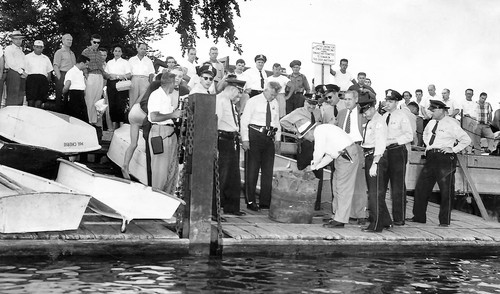
Montrose Harbor, Chicago, Ill., August 1957, showing where a 55-gallon drum and a 5-gallon bucket containing the remains of Judith Mae Andersen, were found.   

1957_0831_trib_lake_2

Montrose Harbor, 50 years later, from Google Earth.

Montrose_harbor_gearth

Note: Investigators eventually determined that the bloody rags and hatchet referred to in the top photo were unrelated to the killing.

Posted in Homicide, Judith Mae Andersen | Tagged , , , | 1 Comment

Paul V. Coates–Confidential File

Paul_coates Aug. 26, 1957

The first time Johnny contacted me was about a year ago.

He called to tell me that he and this other guy were about to have a showdown over a girl. "The other guy's got a roscoe but I don't care," he said.

The second call was a few months ago–in person. He'd been stamped in a fight and wasn't working. He didn't want a handout. Just some legal advice, which, naturally, I couldn't give him.

Time No. 3 was yesterday.

"Something's gotta be done fast," he told me. "We been trying everything with no go, or I wouldn't bother you."

As he talked, I remembered him as the kid (maybe 22, 23) who had told me he hitchhiked out from New York. He was a graduate of orphanages and institutions and the streets.

"It's not me that needs anything," he said. "It's Mrs. Ryan and Mrs. Cruz."

He stopped talking long enough for me to ask, "What about Mrs. Ryan and Mrs. Cruz?"

Then he started:

"Well, since I seen you last, I been eating. Got a job. Got hurt. Drawing $25 every two weeks. Took this apartment on Hoover, near the university.

"I did things, you know–to make it nice. Now I'm manager. Pay 19 bucks a month instead of 34. Get 15 knocked off for looking after things.

1957_0826 "So walking past the mission the other day, I seen these two women on the sidewalk. Crying. They was holding babies.

"Naturally, I asked them what was the problem. They said the mission was gonna throw them out.

"So I told them to wait.

"And I went and called the landlady. I had a couple open rooms.

"I guess the landlady thinks I'm crazy. In the first place, no women and kids are allowed here. Plus they don't have no money.

"But I talk and talk. I'm good at it. God gave me a mouth to talk. Sometimes it's been the only thing I've ever had. My mouth to talk.

"If I use my hands I get into too many fights.

"So finally I tell the landlady I'll pay the rent if she'll let the kids and women in. I do, too. I pay it.

"That was a couple of weeks ago and they try and get food from the city and county, but they won't give them none. Maybe just a little for a day. And the babies are hungry.

"Every day, Mrs. Cruz's husband looks for work, but he can't read and write and he doesn't talk too good. That makes it tough. I know.

"In the Army I used to write letters for the hillbillies and they used to do my shooting. I don't shoot too good.

"But anyway, I give them some food, and I collect some. Milk, bread, a few cans–things like that.

"But food keeps running out.

"Now rent's overdue again. Food'll be gone tomorrow and they barely got clothes.

"Could take my 20 bucks out of the bank. I suppose I will. But sure hate to. I been saving for quite a while.

I wanna get married and should have a little money. Even now she–my girl–thinks we should wait a while till I get a little better fixed.

"I guess she's right."

Johnny paused for his first breath. But he broke it fast.

"Hey," he said. "You KNOW the girl. Same one I was going to fight over a year ago. Never did fight the guy.

"But–you know what–she's still my girl!"


Posted in 1957, Columnists, Paul Coates | Tagged , | Comments Off on Paul V. Coates–Confidential File

How to Get–and Keep–a Husband

1957_0826_constance

1957_0826_quiz
If it’s true that a woman without a man is like a fish without a
bicycle, then author Kate Constance wants every salmon to have a
Schwinn. She’s even written a book on the subject, "How to Get and Keep
a Husband," which is being serialized in the Mirror.

For Constance, the plight of the "manless woman" is a bitter, hopeless
life. Before she landed a husband, she was an outcast at dinner parties
where the married guests chatted about their children, houses and cars.

"I was just another working girl with an apartment and a job," she
writes. "What did I have in common with their busy, meaningful lives?
They wouldn’t have hurt me intentionally for anything, but they could
not avoid impressing me with the fact that really, after all, I did not
belong."

She was humiliated when she tried to charge something at the department
store and was told she had a $200 limit ($1,433.06 USD 2006), while
married women could run up as big a bill as they liked.

Even worse was the time she and a friend were turned away from a supper
club because, "We, my friend and I, were two women without a man!"

And there was the fearful stigma that a single woman with an apartment
was a threat to every happy marriage in the building, she said.

Why do unmarried women have such a difficult time? Because their priorities are wrong, wrong, wrong, she said.

"Many single women approach their problem of finding a mate with the
wrong attitude," Constance writes." They fail to use their talents for
happiness but instead drift into bitter hopelessness, that insidious
paralysis of the soul."

Alas, there is no shortage of unsuitable suitors: A woman friend lists
her prospects and they are grim indeed. Mr. Inge, for example, is 20
years older. And too fat! Bob isn’t good marriage material either–her
friend earns more than he does! The man who lives in the country and
raises oranges and bees? Mere laughter. "Oh no, not that–not that!"

But that’s no excuse. The problem, Constance, emphasizes, is that women are seeking the wrong things.

"A great many are looking for a man with money first; prestige, second;
looks, third; love–well last and maybe not at all if money comes along
without love," she writes.

Her advice? Use the dateless solitude for reflection.

And don’t aim so high, bachelorettes!

"There is no such thing as ‘ideal’ in choosing a mate," Constance
writes. "When a woman sets up a list of requirements beyond basic
compatibility she is doomed to single loneliness or married
unhappiness. If she carries in her mind a hard-and-fast idea of what
she wants and thinks she deserves in a man she probably will fail to
find him."

Now the manless woman shouldn’t necessarily plan to accomplish her task
alone. "For her own wellbeing, the woman with a husband should do
everything in her power not only to hold her man but to help her single
sisters find husbands of their own," Constance writes. (Presumably by
marrying off all the single women on the planet, they will no longer be
potential home-wreckers).

Let me summarize again. Constance writes: Don’t be so picky! If you only get 50% of what you want, that should be enough!

"If more of our women would see the fallacy of holding out for Mr. Just
Right–the man with the nice bank balance, movie star looks, plenty of
lovemaking and social position–and put good character, compatibility
and industriousness at the top of the requirement list, thousands of
our ladies on the sidelines could find happy marriage possible,"
Constance says.

Email me


Posted in books | Tagged , , | Comments Off on How to Get–and Keep–a Husband

Pepe Arciga

Aug. 26, 1957

In a recent issue of Variety, columnist Dave Kaufman sends off his piece with an opening paragraph sure to be an eye-catcher. It concerns racial prejudice and the way some writers are unsuccessfully trying to peddle their written wares on same — to big business.

This is what Kaufman reports: “Racial prejudice is too strong a subject for television… Rod Serling, one of TV’s top scripters, wrote a teleplay for U.S. Steel… He was ordered to dilute it.

“This year he wrote a similar story but changed it so that instead of Negroes, the yarn would revolve about Mexicans.

“It was designed for ‘Playhouse 90’ and producer Martin Manulis was enthusiastic about it… Not so the sponsors, all but one of them rejecting it.”

Kaufman went on to explain Serling’s holy displeasure because the story wasn’t accepted. Reportedly, Serling is supposed to have remarked that it was a story of “prejudice as it exists,” that “he was tired of fighting this” and — bless his crusading soul — “that he would let someone else do the fighting.”

Personally, I’ll go on record in saying that “Playhouse 90” is very admirable TV fare, certainly one of my top choices.

Of Serling, there can be no middle ground for discussion. He and Paddy Chayefsky lead the race a mile ahead.

But — and this is where big business showed a big sense of values — racial prejudice, whether “diluted” from Negroes to Mexicans or to Jews, or to Manchurians or what have you (if it is generally rampant at all), is not the kind of commodity one bandies around with a price tag. And hoping for the big slice.

If U.S. Steel declined to buy Serling’s tale of prejudice for national showings in the quiet of, in the intimacy of, the American home, I, for one, cannot blame them. No, not in the least.

National television, in my way of thinking, cannot and should not be placed in the same category as hardcover book production, paperbacks or cheap pulps.

P.S. “Serling,” concludes Kaufman, “did get paid for the story that won’t be seen.”

Here’s a list of Serling’s 10 scripts for “Playhouse 90,” from the Serling archives at Ithaca College.

Continue reading →

Posted in broadcasting, Columnists, Countdown to Watts, Pepe Arciga, Temple City | Tagged , , , | Comments Off on Pepe Arciga

Judith Mae Andersen

Photographs courtesy of the Chicago Tribune

Investigators examine the oil drum containing the remains of Judith Mae Andersen
that was found Aug. 22, 1957, in Lake Michigan.

Aug. 28, 1957
Chicago

Seek and ye shall find, and so it is with the Judith Mae Andersen case. Delving into the archives of the Chicago Tribune revealed answers to some of my questions, but although the information brings certain details sharply into focus, others have been covered with a frustrating veil of shadows.

Judith, 15, disappeared about 11:15 p.m. on Aug. 16, 1957, after leaving the apartment of a girlfriend, Elena Abbatacola, 16, to walk home.  Boaters found a 55-gallon drum containing Judith’s torso, minus the head, right arm and left hand, floating in the Montrose Harbor area of Lake Michigan on Aug. 22, 1957. A 5-gallon bucket containing the missing body parts was found in the harbor Aug. 24. The remains were in an advanced state of decomposition from being in the water and from being exposed to the hot sun as the metal containers floated in the lake.

Police failed to find anyone who definitely saw Judith after she left the Abbatacola home. Alleged sightings at other locations not on her route were eliminated by police. Continue reading →

Posted in 1957, Crime and Courts, Homicide, Judith Mae Andersen | Tagged , , , | Comments Off on Judith Mae Andersen

Windy City

"The average Chicago night produces many apparent screams and shots, which turn out to be of the harmless variety."

Chicago Tribune, Sept. 2, 1957

Posted in Homicide | Tagged , , | Comments Off on Windy City

Cold case

Aug. 28, 1957
Chicago

1957_0828_trib_andersen

To be continued….

Posted in Homicide | Tagged , , | Comments Off on Cold case

Cold case


1957_0825_hed

Aug. 25, 1957
Chicago

1957_0825_andersen_portrait Chicago police recovered the torso from a battered, cut-down 55-gallon drum floating in Lake Michigan. A 5-gallon metal bucket containing the head, hands and one arm were found in the lake two days later. The victim had been shot in the head at least once, maybe four times. It's difficult to tell from news accounts.

Given the location–Chicago–and the advanced method of disposal–victim shot in the head (apparently with a .32-caliber pistol), dismembered, put into metal drums and dumped in Lake Michigan, you might assume that the subject was a low-level mobster. You would be wrong. She was 15-year-old Judith Mae Andersen, who disappeared late one Friday night, Aug. 16, 1957, while walking home from visiting a girlfriend.

This unsolved killing is what Sherlock Holmes would have called a three-pipe problem. Unfortunately, the news reports don't help and in fact hinder the dedicated and impartial inquirer. For at least the last 20 years, police and news reports have focused exclusively on an individual who has never been charged and may have no link to the killing.

The facts in the case are depressingly few and incredibly tragic.

1957_0825_map On the night of Aug. 16, 1957, Judith Mae Andersen, 15, was supposedly watching TV at the home of Elena Abbatacola, 1019 N. Central Avenue. Judith was the only daughter of Ralph W. and Ruth A. Andersen, who also had three sons, and lived at 1520 N. Lotus Ave. She was about to enter her junior year at Austin High School. Because she was identified through fingerprints recovered from a picture of Jesus in her room, we can infer that she had no police record and that she was at least somewhat religious.

About 11 p.m., Judith called her mother to say that she and her friend were watching a movie on TV and asked to stay until it was over.

Her mother said no, so Judith began walking home, a distance of 0.8 of a mile. She never arrived.

1957_0825_andersen_pix3

On Aug. 22, a cut-down 55-gallon drum containing a torso was found at Montrose Harbor. Two days later, the head, hands and an arm were found in a 5-gallon bucket recovered from the same area.

1957_0825_andersen_pix2 According to The Times, despite the fingerprint evidence, Judith's father, Ralph, refused to believe that the victim was his daughter because the body did not bear traces of a smallpox vaccination on her left arm.

The killing touched off a massive investigation involving large numbers of detectives. Many people called in tips (there were various reports of people hearing shots and screams) but nothing ever proved to be conclusive and the case went into hibernation for lack of leads. Attention eventually focused on a convicted sex criminal identified in 1987 and 1991 articles in the Chicago Tribune. However a recent story in the Tribune withholds the man's identity. He was never charged in the case.

In googling this killing, I discovered a website devoted to the case. It's prudent to be extremely skeptical of websites devoted to actual crimes, so I'm going to limit myself to what appear to be accounts from the original investigation.

According to a 1957 news account, on the night Judith disappeared, she visited the home of Nancy O'Brien, 222 N. Kenneth Ave. According to the Chicago Sun-Times, Nancy and Judith had been dating a sailor named  Kenneth Blevins stationed at the Norman, Okla., Naval Air Station while he was on leave in Chicago. Nancy said she and Kenneth were going to get married and called Kenneth in Oklahoma to prove it. Kenneth told them that he loved Nancy but told the Sun-Times that he loved Judith.

In attempting to reconstruct her last day, newspapers also found that Judith was at the Dairy Bar, 5156 W. North Ave, but accounts of her visits are conflicting and problematic.

Judith's father supposedly called the Abbatacolas to check on Judith when she failed to come home. When no one answered, he went to the house, but no one came to the door–at least according to an unverified account on the Internet. He supposedly searched the neighborhood without success and finally roused someone at the Abbatacola household at 2:30 a.m. He was allegedly told that Judith planned to take the bus home.

According to testimony at the inquest, Elena Abbatacola contacted three boys after Judith's disappearance and told them not to reveal that they spent the evening together.

1957_0825_andersen_detective All right, armchair sleuths (especially those of you living in Chicago–you know who you are), I expect some help. Let me preface this by emphasizing that superficially, at least, this seems to be an extremely elaborate disposal.

(At right, Detective James Hennigan, who is assigned to the case, with some of the files on the investigation).

Here's what the killer has to do:

He (and I'm going to assume this was a man–maybe two) must get control of a 15-year-old girl, shoot her in the head several times, find a location where he can safely cut up the body, dispose of the blood, put the remains in two metal drums, seal or close the drums, load them into a vehicle, drive to Lake Michigan and dump them in Montrose Harbor. All without getting caught. And I would say that the killer must have had a good reason for going to all of that trouble instead of simply driving out to rural DuPage County and throwing the victim in a culvert.

Here's a few of the things we don't know. (Keep in mind that the remains had been in the water for about a week, so presumably some questions can't be answered, for example, whether she was sexually assaulted or had suffered any injuries other than being shot).

For starters:

  • What kind of firearm was used in the killing? Forensics should be able to tell us not only the caliber but identify the brand of handgun used in the slaying. One news account says the gun was a .32-caliber revolver.
  • Where was she shot? News accounts say she was hit one to four times in the head, once in the temple. Why shoot someone four times in the head when once should do the job?
  • What kind of implement was used to dismember her?
  • How skillfully was she dismembered? Was it amateurish and clumsy or well-executed?
  • We know the original investigators tried to determine the origin of the two metal drums. Where did they come from?  How was the 55-gallon drum cut down? With a welding torch? How were they sealed to keep the remains from escaping?

We may not know the killer's identity, but we can be certain he had a gun and a vehicle, and because of the elaborate disposal we can probably rule out somebody acting on the spur of the moment who suddenly finds himself with a dead teenager on his hands. It is also reasonable to assume that the killer was familiar with Montrose Harbor and knew he could dump two drums in the water without being caught. I would also imagine he's either fairly strong to be able to lift the drums in and out of a car with a big trunk (or maybe he had a truck)–or perhaps he had help.

Frankly, this killing seems quite professional and if the victim were a 30-year-old man instead of a 15-year-old girl, I would suspect an execution by someone in organized crime. The fact that nobody has ever come forward with information might again argue for a link to organized crime. But it's absurd and irresponsible to speculate with so little information.

The tragedy, of course, is that there is no resolution to what became of Judith Mae Andersen. Maybe at this late date, someone will come forward and provide some answers.

Photographs courtesy of the Chicago Tribune

Email me

Posted in 1957, Crime and Courts, Homicide, Judith Mae Andersen | Tagged , , , , | Comments Off on Cold case

Paul V. Coates–Confidential File

Aug. 24, 1957

There are two basic rules for pretty girls who wish to set Hollywood on its pink, shell-like ear.

The first is to meet the right people.

This one has nothing to do with me, so I’ll dismiss it.

The second is to get their names in the columns.

And here, I’m directly concerned. Because I — like certain other people in town — am a columnist. I, in a manner of speaking, write.

Adjectives, verbs, nouns –I’ve got a basket of ’em.

Struggling young starlets (or their struggling young press agents) begin lining the hallway in front of my office door every morning at dawn — each with some fantastic personal experience which happened to them, personally, which is really true and which they made up on the way over from Schwab’s.

They come in bath towels, bikinis, serapes and/or motorcycle boots. Anything to stand out from the mob.

As they’re ushered in, one by one they tell me of their fights with octopi, their subjugation into white slavery, their secret uranium mines.

I listen, intensity written all over my kindly face.

I agree 100% that theirs are stories that should be known.

“But,” I add sorrowfully, “it’s just not quite my type of story.

“Now the man who’d really appreciate a scoop like yours is Matt Weinstock.”

Dutifully, they thank me.

And move along toward Weinstock’s office.

With the exception, that is, of the 50% whom he referred to me.

They insert, I’ve been told, a Mexico angle and go see Pepe Arciga.

Except for the 50% whom HE referred to me.

It’s a nice, time-devouring game.

But every now and then you run into an aspiring starlet who throws the whole operation out of kilter.

Like yesterday.

When Sanita Pelkey walked in.

She was a tall, healthy-looking girl — dressed modestly in boxer’s trunks and a sweatshirt labeled, if memory serves me, “Property of the Beverly-Wilshire Health Club.”

She smiled, graciously, and I smiled. Graciously. “Your story?” I asked. “What happened to you?”

She looked at me blankly. “Me? Nothing. Yet.”

“Yet?”

“Yet! I’m here,” she said, “to break into Hollywood.”

I nodded. “Break, then.”

She laughed, stiltedly, like she wished it had been a funny remark so she could have laughed naturally.

“I’ve been told,” she said, “that it helps to get your name in the columns. That’s why I’m here.”

“The man you should see…”

“I was Miss New York in the Mrs.–excuse me–Miss Universe contest. Semifinalist. I went home afterward, but decided to come back and…”

“is a chap named…” I interrupted.

But she interrupted right back. “I like dancing, swimming, ice skating, acting. Maybe I should put acting first. More diplomatic.”

“Weinstock,” I said. “Matt Wein…”

“I’ve also worked the Town and Country — that’s the largest nightclub in Brooklyn — the Ice Review, Guy Lombardo’s Arabian Nights at Jones Beach…”

“Weinstock is a personal friend…”

“And I don’t believe all those rumors about a career and marriage not working out. It depends on the individual. If I find the right man I wouldn’t hesitate…”

“of mine,” I continued doggedly.

“Besides which, I’ve won 13 other titles. Miss Potato Salad, Miss Jet Age, Miss Stetson Hat, Miss Smiles, Miss Fluidless Contact Lens…”

She took a deep breath and went on.

“I was once Miss Salami…”

“Were you the one?” I asked.

“Sanita nodded. “They gave me a Kosher salami as a prize. About three feet long.

“That,” she added, “ought to make a good story for you. Write it up.”

[Note: “Ghost of Dragstrip Hollow,” one of Sanita Pelkey’s few screen appearances.]

Posted in Columnists, Matt Weinstock, Paul Coates, Pepe Arciga | Tagged , , , | Comments Off on Paul V. Coates–Confidential File

Kiss and Tell


1957_0824_confidential

Aug. 24, 1957

Los Angeles

And where does our favorite scandal magazine get
such high-quality dirt?  (Oh, I know, people only read it at the beauty
parlor and the barbershop). It turns out that in Hollywood, money will
unseal lips that are locked tightly–at least when it comes to the
printed word if nothing else.

The reasons: Payback (mostly) and publicity (occasionally). The canceled checks tell the tale.

Let’s turn to one of my favorite issues, March 1957. That was the saucy little number with the story about Maureen O’Hara’s tryst at Grauman’s –except she was out of the country at the time.

Confidential_1957_03_turner01_2
The March 1957 issue also has the jaunty tale of the night a humble bartender pitched a double-header to Lana Turner and Ava Gardner. Turns out that the gals weren’t keeping score as the game went into extra innings–but Donald L. Bledsoe certainly was.

Canceled
checks written by Hollywood Research Inc. and introduced as evidence in
the Confidential magazine trial showed that Bledsoe was paid $1,000
($7,165.28 USD 2006) to report his earned run average from the
encounter.

The checks also showed:

  • Robert Tuton, the maitre d’ at a Hollywood cafe, received $750,
    plus a loan of $100, to confirm information "about his affair with Joan
    Crawford." Tuton also recruited Stella Shouel, an ex-prostitute who was
    a prolific source of information, including stories on Dan Dailey,
    Walter Pidgeon, Fredric March and Dane Clark, the Mirror said.
  • Jane Cameron was paid $500 for information she learned as a nanny at the home of Dean Martin’s ex-wife.
  • 1950_shouel
  • Allan Nixon received $300 for material on ex-wife Marie Wilson and several other people.
  • Vera Frances was paid $250 for a story about her affair with John Jacob Astor and another $250 for an article about Edward G. Robinson.
  • In
    addition to being paid for information on Donald O’Connor and Mickey
    Rooney, former jockey William Chaney received a capper’s fee for
    introducing two more informants, one of whom was Gloria Wellman. The
    estranged daughter of Hollywood director William Wellman was paid $300 for information on a nude pool party at the home of John Carroll.
  • Interior decorator Paul Corday received $300 for information on Denice Darcel, a  now forgotten actress who appeared in  "Dangerous When Wet" and  "Flame of Calcutta."
  • Press agent Bruce Jones got $500 for information on a story about Lex Barker. Jones said he represented a starlet who needed the publicity. Apparently this was Jeanne Carmen, who appeared with Barker in "War Drums"  and was featured in the July 1957 article: "The Gal Who Had Lex Barker Up a Tree."

Bonus facts:

In 1950-51, Shouel appeared in a series of stories about her legal
fight to regain custody of a daughter, Nancy Ann, whom she put up for
adoption. Identified as a TV singer and model, Shouel attempted suicide
during the litigation against adoptive parents Harry and Beverly Jo
Levy, who eventually conceded to return the girl. Shouel died Dec. 22, 1962. She was 33.

Email me

Posted in #courts, Film, Hollywood | Tagged , , , , , , , | Comments Off on Kiss and Tell

The plight of the ‘manless woman’

1957_husband_promo

Posted in Uncategorized | Tagged , , , | Comments Off on The plight of the ‘manless woman’