
The Times Building in "Act of Violence," 1948, pointed out by my colleague, Steve Hensch.

The Times Building in "Act of Violence," 1948, pointed out by my colleague, Steve Hensch.
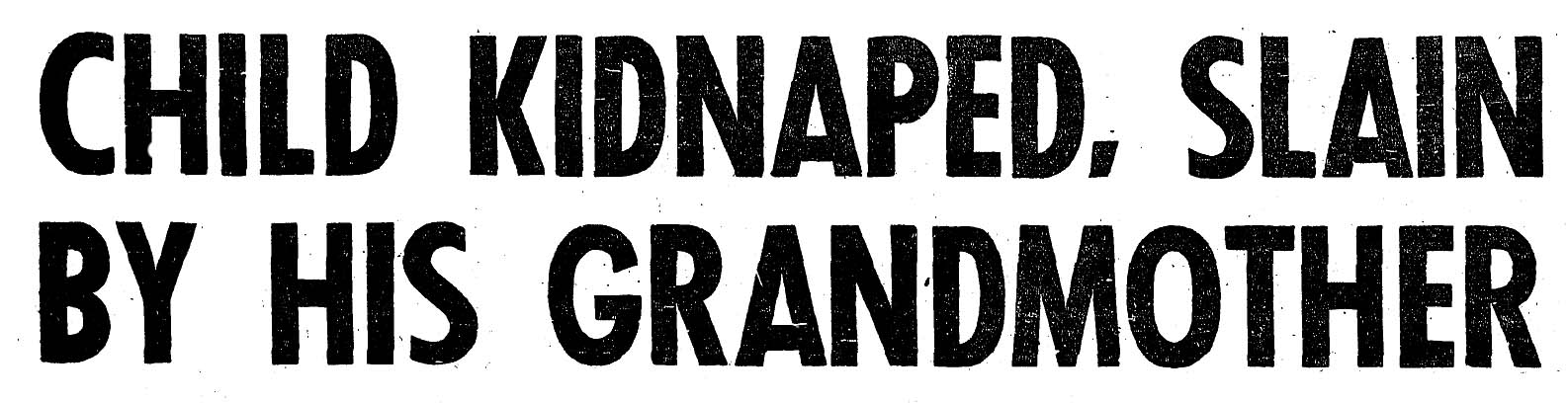
Oct. 4, 1957
Los Angeles
I’ve read any number of horrible stories in the old papers, but this is
one of the worst in terms of senseless tragedy. The facts, such as they
are, don’t even begin to explain what happened. But then how can anyone
explain absolute madness?
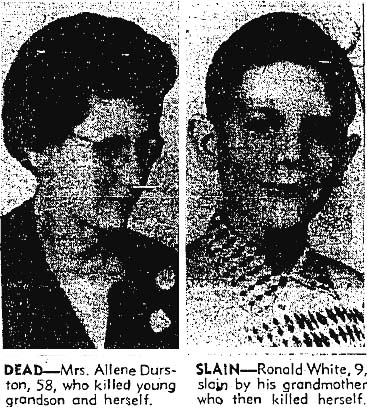 Allene Hall Durston, 58, was dying of bone cancer. Of all the people in
the world, the person she loved the most was her grandson Ronald
“Ronnie” Barrett White, who lived with his parents, Evelyn and Thomas, and a younger sister at 6836 Sylvia Ave., Reseda.
She had been living with the family until July 24, when she kidnapped
Ronnie and left a note for her daughter, Evelyn Durston White, saying that she
was “taking the boy for my own” and “going on a long trip.” Police
found Allene and her grandson in a taxi an hour later. She wasn’t
charged, but her relatives told her to move out. First, she lived at 6410 Van Nuys Blvd., and then she moved to a motel on Ventura Boulevard. Continue reading
October 4, 1957
Los Angeles
Every day, I visit a friend who is recovering from cancer surgery at Glendale Memorial Hospital, so I took a short detour and visited the boyhood home of Caryl Chessman, the "Red Light Bandit."

Photograph by Larry Harnisch / Los Angeles Times
3280 Larga Ave., Atwater Village, Calif.

Photograph by Bob Jakobsen / Los Angeles Times
Caryl Chessman, left, with Detective E.M. "Al" Goossen, Jan. 23, 1948. At the time, Chessman was living at the home on Larga and had been arrested 6th Street and Shatto Place after a high-speed chase. He was convicted on eight counts of robbery, four counts of kidnapping, two morals charges, one count of attempted robbery, one count of attempted rape and auto theft. He was sentenced to the gas chamber on two counts of kidnapping and was executed in 1960.
Goossen worked many prominent cases of the 1940s and ’50s, including the gang slaying of Tony Brancato and Tony Trombino and the murder of Gladys Kern, a real estate agent who was killed while showing a home in Los Feliz. He worked as a private investigator in the San Fernando Valley after retiring from the LAPD.
Sept. 30, 1957

Ever since returning from my vacation I’ve been thinking about an eerie
piece of information I picked up while driving along Highway 395 near
Big Pine.
Riding along was Sid Parratt of the Department of Water and Power
office in Independence. Sid probably knows the area better than anyone
and he pointed out places of interest and their historical backgrounds.
This is mountain country with strange formations–immense areas of
black lava rock, huge buttes which seem out of place, an occasional
green spot in an immense wasteland.
Just north of the little town of Zurich, Parratt pointed to the right
and said, "See that clump of trees way over there?" I did, far in the
distance.
A highly unusual project was being built there, he said. Last year some
uncommunicative men from Caltech had scouted the Owens River country,
he said, looking for a suitable site for some kind of laboratory. It
had to be in the wide-open spaces where the air was always clear. They
finally settled on 275 acres and leased it for 25 years from the
department.
As Parratt understood it, they were building a laboratory to detect radio signals from outer space.
However, there was fantastic speculation about the project. Imaginative
folk were saying it had something to do with tracking guided missiles.
You have to keep in mind that the people in the section see brilliant
flashes of the Nevada atomic blasts and some of them are nervous about
radioactivity and other things they don’t understand.

This is to report there’s nothing mysterious about the project. It is
known as a radio astronomy installation. It is headed by John G. Bolton
of Caltech and is sponsored by the Office of Naval Research.
The buildings are almost completed and work is going ahead on the
railroad tracks on which two huge antennas can be moved to capture
signals from outer space. It will be a year before the first antenna is
complete, another year before the second is in operation.

The project was inspired by the realization that astronomers have gone
about as far as they can with visual inspection of what’s out there.
They hope through radio astronomy to gather additional evidence of such
things as the shape and configuration of galaxies. They know already
that gas clouds emit certain signals and sensitive equipment elsewhere
has recorded radio waves bouncing off the moon and additional
information on Jupiter.
To put it another way, the radio astronomy people do not anticipate
that they’ll intercept any hot flashes from little green men on Mars.
Let’s hope that if there’s anybody out there, they’re not checking on our misbehaving planet, either.
DURING A LULL a
pharmacist on duty at a San Fernando Valley super drugstore phoned a
bookie and placed some bets. (I know there aren’t supposed to be any
bookies, but there are).
He was dictating the name of the horse he wanted in the seventh race
when the assistant sales manager excitedly dashed up to him and
exclaimed:
"What in the devil do you think you’re doing? It’s all over the store!"
The pharmacist had inadvertently rested his elbow on the store’s
intercom switch and his bets were going out over the loud speaker.
INEVITABLY, no matter how serious the situation, the jokesters take over. Perhaps it’s a good thing thus to temper a crisis with humor.
For instance, some made fellow at Disney studio keeps calling and
asking, "Have they sent the freedom balloons down through the Cotton
Curtain yet?"
If not, he says he has a message to put on them: "Peace, it’s wonderful!"
And as Hugh Brundage, KMPC newscaster, came into the Naples restaurant, Pat Buttram looked up from his lunch and said, "Hi, Hugh, what’s new? Have they fired on Ft. Sumter yet?"
AROUND TOWN–A
City Hall worker who likes to disconcert people in elevators with
irrelevant remarks said to Tom Mannix the other day, "I wish payday
would get here–I’m tired of eating at the Midnight Mission."
Several passengers quivered noticeably…George Fedor, pixy Vine Street
bartender, says he just rented a new house. No furniture in it, but
wall-to-wall floors.

Oct. 2-3, 1957
Los Angeles

OK, let’s go get a cup of coffee and talk about our friend "The Money Man."
We can just drive up Central Avenue until we find some all-night place.
I’m not really hungry. I can never eat after being at a murder scene
anyway.
How about here? Looks like we have the place to ourselves.
There’s two things I forgot to tell you about Max "The Money Man"
Shayne. The medical examiner said he’d been dead about four hours. That
would make the time of death about 11 p.m. I’ll get to the other one in
a minute.
What do you think? An obvious robbery and homicide? Nothing unusual?
Maybe I’m too suspicious, but I don’t like it. Not at all. We’ve had
half a dozen stranglings in L.A. in the last six months. All women.
Every one of them put up a terrific fight. Here you’ve got "The Money
Man," a big beefy guy who’s been in the joint and there isn’t a mark on
him. Strangled with a hankie? C’mon.
Yeah, it sure looks like robbery. He always carried a stack of $100
bills. And it looks like someone rummaged through his clothes, because
we found the address book, business cards and that insurance policy on
the floor of the car.
You want to know about the insurance policy? That’s what I forgot to
tell you. He took it out Sept. 10 with a $2,295 initial premium. And
the first newspaper accounts had the amount wrong. It was for $250,000
($1.7 million USD 2006).
Here we’ve got a guy with a criminal record, facing a prison sentence
for fraud. He’s a scam artist who takes out a big insurance policy and
less than three weeks later he’s dead. And he doesn’t put up a fight.The details are murky but he’d also been fooling around with a couple of other life insurance policies in the last month.
Yeah, it bothers me. But not as much as it bothers the insurance
company. You see, there’s a suicide clause in that policy. If the
individual kills himself within two years, all you get back is the
premiums you’ve paid.
I’ll take a refill, thanks.
The cops will pick up a guy named Earl Fernando Matlock, a 35-year-old
laborer. It seems he’s been passing a lot of $100 bills recently. It
seems he can’t explain where he got the money.

Matlock says Shayne came by his home, 10719 Weigand Ave., on the afternoon of the killing.
This is his story:
"We rode around for quite a while and I kept saying I had to go home to
take care of my children. Finally Shayne said he wanted me to rough up
a couple of fellows for him. I said I wouldn’t do it.
"He talked about some trouble the government was going to make for him
but that it didn’t make much difference to him because he had only six
months to live.
"He said he wanted to die and I told him to get some cyanide if he wanted to do something like that.
"Shayne said: ‘No, it can’t look like suicide.’ "
He offered Matlock $1,000 to help him kill himself. When Matlock wouldn’t do it, Shayne threatened to get him, Matlock said.
"I kept trying to get out of the parked car and he would keep pulling
me back. My shirt got torn and he scratched my face when we were
struggling.
"So I pulled the strap from the back seat around Shayne’s neck but
released it when he slid down into the seat to avoid being seen by a
passing car.
" ‘Why don’t you go ahead and finish it?’ Shayne asked.
"I thought then that I’d better do something so I pulled the strap
tight again, intending to just make him unconscious so I could leave.
When he went limp, I wiped my fingerprints off the car and left."
He says that while they were struggling, Shayne shoved the billfold and some jewelry in his pockets.
Matlock was convicted of first-degree murder and sentenced to the gas
chamber. The only problem is that the judge barred any testimony about
Shayne’s insurance policy and the suicide clause, so the case was
appealed. He was retried and sentenced to life in prison.
In 1960, Molly Shayne sued Beneficial Standard Insurance for payment of
the policy and the company countersued, saying that the death was a
fraud. She finally got a settlement in "five figures," according to The
Times.
Matlock died in 1964 in Marin County. He was 42.
Time to go. It’s nearly sunrise and the breakfast crowd will be coming
in. We should leave a good tip, we’ve been here a long time.
In 1969, The Times sent one of its best and most respected writers, Art
Seidenbaum, on a tour of California college campuses: UCLA, USC,
Stanford, UC Berkeley and someplace called San Fernando Valley State.
The resulting series for West magazine was later published in
Seidenbaum’s book "Confrontation on Campus."
So in honor of all those who are taking their kids back to campus for
the fall, here’s the final part of Seidenbaum’s "The Troubles With Students" in
which he visits UC Berkeley and discusses the "Majorca or fight" syndrome: "If we don’t bring down the university this year, then I’m going to Majorca and paint…. If we haven’t radicalized this campus by the end of the quarter, then I’ll accept the goddam fellowship at Cambridge." The dress code is Army
fatigues and beards for the men; serapes and tights for the women. And
lots of revolutionary self-righteousness. Don’t worry, man. It’s cool.
We’re all pass/fail here. (Hey, isn’t that Larry Magid?)

Click below to read the rest of the article.

Sept. 30-Oct. 1, 1957
Los Angeles

It’s almost 3 a.m. and we’re parked on 134th Street between Water Way
and Central Avenue in Compton. In two years, there will be houses all
along the north side of the street. It’s hard to make out in the dark,
but that’s a big, orange Cadillac in front of us. Our victim is in
there. Ready? Let’s take a look. Keep your hands in your pockets and
don’t move anything.
That’s him behind the wheel. Max "The
Money Man" Shayne, 43. He’s heavyset, bald and wears glasses. Strangled
with a man’s linen handkerchief, otherwise there’s not a mark on him.
There’s the cutoff end of a woman’s silk stocking near the body.
Pockets are turned inside-out and papers, business cards and an address
book are on the floor of the car. He usually carries a stack of $100
bills, but his wallet is missing. He’s got 20 cents on him. According
to these business papers, he has a piece of two Anaheim cafes and
carries $175,000 in life insurance.
Kind of a shady customer. Shayne was arrested in Berwyn, Ill., in 1937
for receiving stolen property and sentenced to a year in prison. He and
his brother Irving are out on bail while they appeal a conviction for
defrauding the Federal Housing Administration. Prosecutors said the
Shaynes used the Money Man agency to arrange home improvement loans
that were used to pay off bills instead.
His widow, Molly, says she wasn’t aware of any threats and said he
hadn’t been worried about anything recently. Got a son named Sherwin
and a daughter named Sheila.
We better get moving. Officers A.E. Wise and R.L. Brown of the Compton
Police Department are making their rounds and they’ll be here soon.
Nothing more to see here, anyway.
To be continued.
As a child of the 1950s, it’s a treat for me to see the old comics, with the large panels and fine draftsmanship. Some don’t hold up terribly well but others remain classics, like “Li’l Abner,” which has been featuring a bald female spy named “Jewel Brynner.” Continue reading

Oct. 1, 1957
Los Angeles
No, I haven’t forgotten about Confidential magazine. The jury is still out.
The correct answer is Caryl Whittier Chessman. A very impressive showing by Duane Laible. I didn’t expect anyone to guess so quickly.
Meet the boy bandit gang, which terrorized Los Angeles with a string of robberies and shootings in early 1941. The gang formed while the young men were assigned to county road camps for stealing cars.

Los Angeles Times photo
From left, William Taylor, Caryl Chessman, Robert Tollack, Andrew Rutledge and Donald Abbott, Feb. 7, 1941.
"[William] Taylor and I were in Road Camp No. 7 in Las Flores Canyon," Chessman said. "Auto stealing. You pick up ideas there. We did. And here we are."
Gordon Klee, who was later eliminated as a suspect, said: "The rest of us were in Camp No. 1 in Soldedad Canyon. Same rap. I’ve known Chessman all my life. We went to school together. So when we got out last autumn, we just naturally drifted together."
Before they were arrested, the gang stole cars and robbed service stations and liquor stores across Los Angeles. Several gang members, sitting in a stolen car in Flintridge, got the drop on a pair of sheriff’s deputies who stopped to question them, and stole their patrol car.
A Times reporter asked why they committed the robberies.
"Lucrative," Chessman said.
Here’s a 1948 picture of Chessman:

Photograph by Bob Jakobsen Los Angeles Times
David H. Knowles, left, and Caryl W. Chessman.
Bonus fact: Chessman lived at 3280 Larga St.
The answer to the last mystery photo was guessed in an hour. I hope this one will be more of a challenge.
Our famous mystery guest is one of the young men in this photo. He wrote a number of books that were translated into many languages. The other four men, as far as I can determine, are forgotten.

Guesses so far:
We have a winner!
Caryl Chessman in the middle. Duane Laible
Sept. 30, 1957
Los Angeles
Sept. 30, 1957
SUBJECT’S NAME–Judy Smith or Judy Burris
SUBJECT’S DESCRIPTION–Age 30. Height, 5 feet, 5 inches. Weight, 125 pounds. Dark brown eyes. Light brown hair. Slight scar on left side of jaw.
Any person with information as to subject’s whereabouts is requested to contact her mother, Mrs. Dessie Fentiman, 15138 Banderia Ave.,* Paramount, Phone: MEtcalf 3-6611.
It was midafternoon and sticky warm and I stopped in a dull and empty cafe to make a phone call.
The booth was across from the soda counter–about 10 feet from the
jukebox, which was silent. As I stepped into the cubicle the waitress
looked at me and gave a shrug of her shoulder, significant of I don’t
know what.
I closed the door and dialed.
A woman answered.
"Hello," she said, slowly.
"Mrs. Fentiman?" I asked.
She said yes, it was. Speaking. I explained that I had received her letter. "About your missing daughter."
"Oh yes," she said. The words came slowly, in monotone.
Then our question-and-answer session began. She told me that it had been more than seven years.

"August of 19 and 50," she said. She explained that her daughter had lived with her in Hot Springs, Ark., until the age of 18.
"Then she married and came to California," she said. "Lived in Oakland
and Grass Valley. That’s where she separated from her husband–Grass
Valley. Then she came to Long Beach."
(A couple of times, I glanced at the lone waitress. She was staring at me, disinterestedly. Like there was nothing to stare at).
Mrs. Fentiman continued to answer my questions.
"She wasn’t much of a hand to write," she told me, "so I was about the only one who heard from her.
"She’d done waitress work and done beauty operator. Liked to dance a lot."
(The waitress, maybe 25, walked toward the jukebox).
"A son of mine," Mrs. Fentiman continued, "saw her in San Pedro not
long before she stopped writing. She told him she was going to marry
this boy Johnnie and go to Alaska."
I asked her if she knew Johnnie.
"No," she answered. "Judy wrote me about him, though. She worked
keeping house for his parents in Long Beach. A very nice boy, she
always said." Her voice came sadder, now.
(The waitress was walking away from the jukebox. Voices and music
jumped out after her. In rock ‘n’ roll beat they cried: "Gonna find
her… Gonna find her...")
"I never did know," Mrs. Fentiman continued, "what Johnnie’s last name was.
"If I just only knew their names."

(The music was loud–too loud. "I’ve been searchin’… I’ve been searchin’ ev’ry which way…")
"Mrs. Fentiman," I asked, talking over the music, "what did your daughter’s last letter say?"
"That she was coming to see me. In two weeks. Finally a couple years later, I came out here.
"Police been looking, but we can’t find a trace."
(The beat of the song was building. "And if she’s hiding up on
blueberry hill… Am I gonna find her, child… You know I will…")
"I can’t believe she’s living or she’d write me," Mrs. Fentiman sighed.
"I hate to feel that way but I can’t help it."
(The record was finishing up. "No matter where she’s hiding… She’s
gonna hear me coming… I’m gonna walk right down that street… Like
Bulldog Drummond…")
I told Mrs. Fentiman that I’d see what I could do and I hung up. I stepped up from the phone booth and nodded to the waitress.
She nodded back. "The Coasters," she said.
I smiled, wondering what she was talking about.
"The Coasters," she replied, motioning toward the jukebox. "Really rock, don’t they?"
ps. Dessie L. Fentiman died July 25, 1976, in Shasta County, according to California death records. She was 71.
*Banderia has since been renamed Hayter Avenue.
Sept. 29, 1957
Los Angeles
Fifty years ago, The Times included Bible stories in the Sunday comics with a strip titled "Tales From the Great Book," drawn by John Lehti. This is a sample of his work, telling the story of Ruth and Boaz.

Greg Armento, history librarian at Cal State Long Beach, dropped me a
note about early uses of "smog" in The Times. He noted that on March 29, 1914, The
Times said:
"[Kokomo Times:] The esteemed Weather Bureau has sprung a
new
one. It is the word ‘smog,’ and it means smoke and fog. The bureau
explains
that very frequently there are times when this mixture is
apparent in the
atmosphere, and it considers the new word a great
little idea."Very
well, ‘smog’ let it be. But why end there? Let’s call a mixture of
snow and
mud ‘smud.’ A mixture of snow and soot ‘snoot,’ and a mixture
of snow and
hail ‘snail.’ Thus we might have a weather forecast:"Snail today,
turning to snoot tonight; tomorrow smoggy with smud."

Of course Proquest is a wonderful tool for such research on language.
And with just a bit of digging, we can find even earlier references to
smog. A July 30, 1905, article in the Chicago Daily Tribune credits the
word to Dr. Des Voeux of London’s Coal Smoke Abatement Society.
According to the wire service article from the New York Herald, Des
Voeux proposed the word at a public health congress held in London to
discuss the city’s polluted air. According the article, Des Voeux said
the name of London should be changed to "Smog" because the air was so
dirty.
"If the obsolete kitchen fire were abolished there would be less smog,"
the article says. "In fact, Des Voeux professed to be able to detect
three distinct diurnal smogs–breakfast, lunch and dinner smogs." His
novel solution was to use the London underground as a gigantic exhaust
system to pump out pollution and bring in fresh air.
Des Voeux is sometimes given credit for coining the term, but alas, as
soon as we crown him with this accomplishment, we must snatch it away,
for there are even earlier usages.
A Jan. 19, 1893, article in the Los Angeles Times credits an unidentified "witty English writer":
"The fact that the death rate of
London has recently almost doubled, going to over thirty in the
thousand, is sufficient attestation of the evil effects of the dense,
black fog which hung over that city for six consecutive days not long
ago.These visitations, which a witty English writer once designated by the
name "smog," represent a condition of the atmosphere when it is
saturated with moisture and charged with soot and the fumes of sulfur
and carbonic acid gas from the chimneys and smokestacks of the great
city. It has long been known that they are harbingers of disease.Not long ago, a story writer of the grewsome school published a
sketch in which he had all the people of London suffocated in one of
these fogs, with the exception of one man who made his escape by using
a Yankee device for manufacturing ozone."
As interesting as all this may be, the waxing and waning popularity of
the "N-word" in The Times over the years is a far more fascinating and
relevant pursuit. I hope to write more about the "N-word" in a later
post, for it went in and out of fashion regularly, nearly disappearing from
the paper during World War I and vanishing for several years during World War II.


