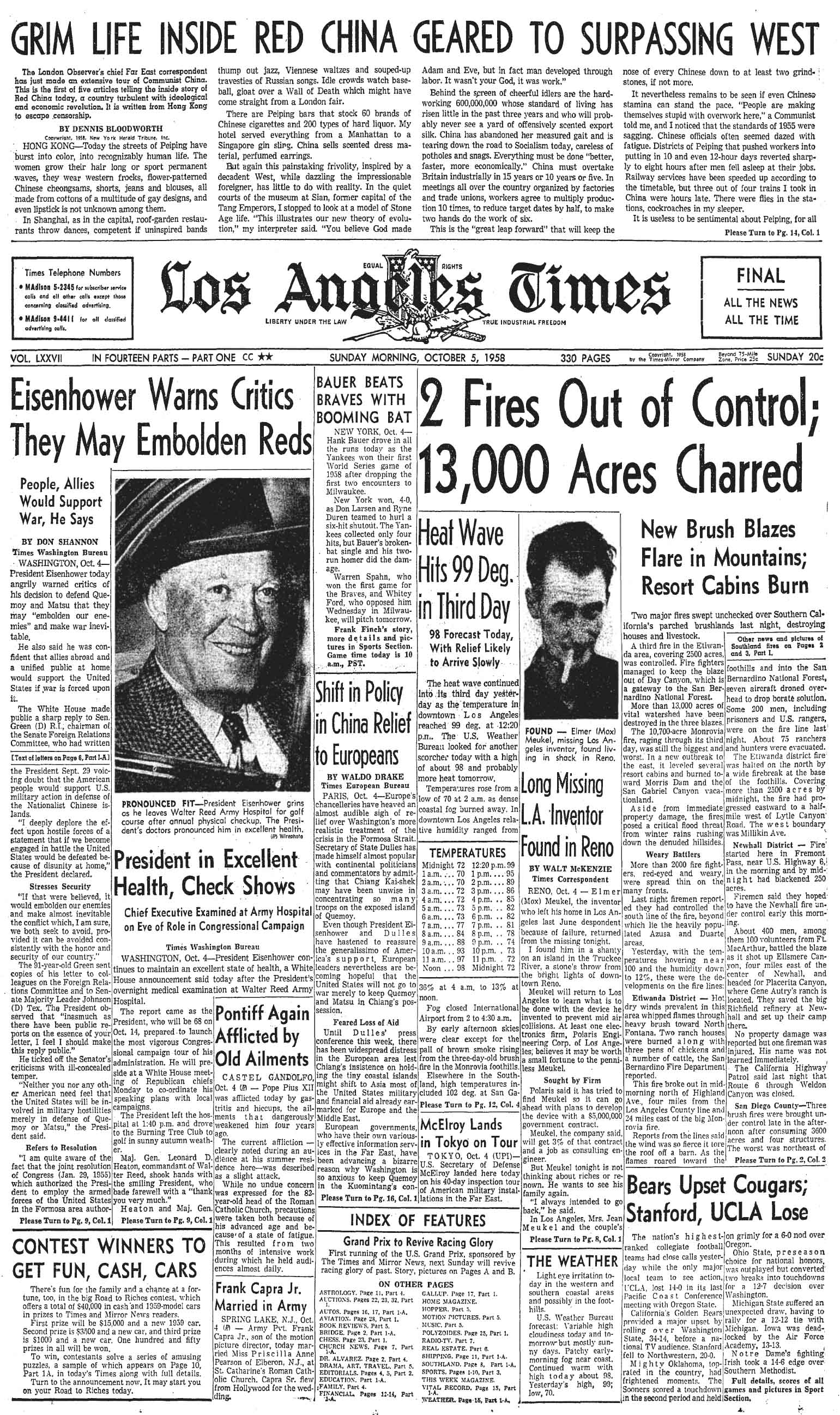
Los Angeles History: Nuestro Pueblo


1938_0803_nuestro

Eagle_rock_google_earth

Above, Eagle Rock as seen via Google Earth.


I don’t recall reading anything about a cross at the base of Eagle Rock, but there it is. According to The Times archives, a cross of electric lights was placed on Eagle Rock at Easter sunrise services in the early 20th century, but that’s all I could find.

Posted in Nuestro Pueblo, Religion | Tagged , , , , | Comments Off on Los Angeles History: Nuestro Pueblo

Movie executive hurt in crash; Cards beat Dodgers, August 5, 1958


The Dodgers lose to the Cardinals, 3-2 … Willie Mays hits a home run to help the Giants beat the Cubs … Producer Jack L. Warner is badly hurt when his car hits a truck in France … Syria seals its border with Jordan.

1958_august_05_cover_2

Film executive Jack L. Warner, 66, is hospitalized in Cannes after his Alfa Romeo hits a truck … King Hussein of Jordan breaks off relations with the United Arab Republic and seals Jordan’s border with Syria … Officials begin inquiries into a rise in crime … And a Teamsters business agent who had been called to testify in a crime investigation is soaked with a flammable liquid and set on fire.   


1958_august_05_sports
The Redskins scrimmage at Occidental … Pittsburgh beats the Braves with a home run by Roberto Clemente … The Floyd Patterson-Roy Harris fight won’t be broadcast on radio or TV because the bout is being filmed for closed-circuit viewing in movie theaters.
Posted in #games, @news, broadcasting, Current Affairs, Dodgers, Film, Front Pages, Sports | Tagged , , , , , | Comments Off on Movie executive hurt in crash; Cards beat Dodgers, August 5, 1958

Lila Leeds: Movie star mystery photo


2008_0804_mystery_pix
Photograph by the Los Angeles Times


To be fair, this week’s mystery movie star is more of a starlet. But you knew that, right? Can you identify her and, better yet, where the mystery photo was taken?

Gosh, people really know their pictures of Lila Leeds! Steven Bibb guessed almost immediately that this is Leeds at her home after the raid in which Robert Mitchum was arrested, showing that it’s not a marijuana shack. Also guessing correctly were Alexa Foreman, Richard Heft, Mary McCoy, Alan K. Rode and Charlie O’Brien. Congrats!

2008_0730_mystery_pix
About
last week’s mystery guest. Nobody guessed who he was, so he will return for another 15 minutes of fame later this year. There were some great guesses but, alas, none of them was right.

Lila_leeds_1948_1208_crop
Los Angeles Times file photo

It was interesting to go through Lila Leeds’ photos. This is the earliest one, from December 1948, when she was fined $5 for stopping traffic.


Lila_leeds_1961_0615_crop

Photograph by Bob Martin / The Mirror

And this is Lila Leeds in 1961, 13 years later, showing newspaper clippings about her relationsip with Erwin "Bud" Arvey, the son of Illinois Democratic leader Jake Arvey. She was trying to get child support payments from the Erwin Arvey, saying that he was the father of her son.

Lila_leeds_1949_0107_police

Photograph by the Mirror

An enterprising Mirror photographer took this picture through a window, showing two crime scene investigators at Lila Leeds’ home, Jan. 8, 1949.

Lila_leeds_mitchum
Los Angeles Times file photo

Deputy Marjorie Kellog, left, escorts Lila Leeds and Robert Mitchum to jail after their sentencing to 90 days for marijuana, Feb. 9, 1949.


Lila_leeds_1949_0829_delmar_watson

Photograph by Delmar Watson / The Mirror

Lila Leeds in a gag photo from the Los Angeles Press Club, Aug. 29, 1949. Front row, from left, Mirror reporter Roger Beck, Leeds and Mirror photographer Bob Martin. Back row, Mirror reporter Bob Buhr and Mirror photographer Loren Smith.


Lila_leeds_1956_0125_crop

Los Angeles Times file photo

Lila Leeds appears with her two unidentified attorneys after being charged in Chicago with soliciting, Jan. 25, 1956. She denied the charges, was convicted and fined $10.


By 1974, Leeds had become a minister with a Hollywood group called Spiritual Mission, Inc., Laymen’s Evangelist or SMILE, which operated a church on Western Avenue. In 1976, she was making personal appearances to promote one of Richard Lamparski’s "Whatever Became of…" books. According to imdb, she died in 1999. Apparently, neither The Times nor any other major newspaper published an obituary on her. 
Posted in Film, Hollywood | Tagged , , | 20 Comments

Dodgers win 8-6, August 4, 1958

The Dodgers split a double-header with the Reds, winning 8-6 and losing 3-1 … the Braves win a double-header over the Giants … and gunmen rob a Malibu restaurant.

1958_august_04_cover

Two gunmen break into the living quarters above the Malibu Sea Lion Restaurant, 21150 Pacific Coast Highway, gag and bind the owner’s wife and children and wait for him to come upstairs with the day’s earnings … Soviet leader Nikita Khrushchev and China’s Mao Tse-tung call for a summit meeting on the Middle East crisis.

 
1958_august_04_sports

Elmer Valo’s single scores Carl Furillo in the 10th … Warren Spahn throws the 43rd shutout of his major league career … Al Wolf profiles boxing manager Lou Viscusi.

Posted in Dodgers, Front Pages, LAPD, Robberies, Sports | Comments Off on Dodgers win 8-6, August 4, 1958

Giants win over Cubs, August 4, 1938


The Giants beat the Cubs, 8-3 … Pittsburgh wins against Boston … Bronko Nagurski flattens Gus Sonnenberg in wrestling … beautifying downtown Los Angeles … and Mayor Frank Shaw dismisses the upcoming recall recall election.

1938_august04_cover

Imagine this: There was a time when the north side of 1st Street between Spring and Broadway wasn’t a bombed-out moonscape. Fit only for renegade skateboarders, the moldering foundations and remnants of pavement are the one place in downtown Los Angeles that makes Pershing Square look like Yosemite.

 
1938_august_04_sports

 
Bronko Nagurski wrestled? Who knew? King Kong Kashey? Dr. Patrick O’Callahan? These names are unfamiliar to me … And Maxie Rosenbloom is in training for a "ten-round boxing ballet" against Broadway Bob Pastor.
Posted in #games, City Hall, Front Pages, Politics, Sports | Tagged , , , , , | 1 Comment

Author: Alexander Solzhenitsyn


Articles by Soviet author Alexander Solzhenitsyn from the Los Angeles Times. 

July 13, 1975, excerpts from a speech by Alexander Solzhenitsyn:

"My friends, I’m not going to tell you sweet words. The situation in the world is not just dangerous, it isn’t just threatening, it is catastrophic."

1975_0713_solzhenitsyn01

 
1975_0713_solzhenitsyn02_2


May 24, 1976, Alexander Solzhenitsyn says KGB agents tried to discredit him by forging a letter that allegedly showed he was an informer.

1976_0524_solzhenitsyn


"The aim of life for each of us is not to take boundless pleasure in material goods, but to take our departure from the world as better persons than we we arrived at it, better than our inherited instincts would have made us; that is, to travel over the span of life on one path or another of spiritual improvement."   

— Alexander Solzhenitsyn, June 13, 1976

1976_0613_solzhenitsyn01_2

1976_0613_solzhenitsyn02

Posted in @news, books, Front Pages | 1 Comment

Dodgers win 3-2, Aug. 3, 1958


1958_0803_cover

Above, the U.S. government formally recognizes Iraq … the U.S. sends
more troops to Lebanon … and Lebanon’s next president survives an
assassination attempt.   

Below, Dodger Joe Pignatano’s two-run homer sinks the Reds, making the Dodgers tied with the Cardinals for seventh place.  

 
1958_0803_sports

 
Posted in @news, Dodgers, Front Pages, Sports | Tagged , , , , , | 1 Comment

Dodgers win in ninth: Aug. 2, 1958


1958_0802_garand02
Take a look at the little arsenal you could make for yourself 50 years ago. An M-1 Garand for $125 ($910/96 USD 2007). You could probably pick up half a dozen Victory Model Smith & Wesson .38s while you were at it.

1958_0802_cover

Above, the U.S. Embassy demands the release of two Marines being held by Iraq.  

 
1958_0802_sports

 
Dodgers win in the ninth over the Reds. Read the jump page below.

Continue reading

Posted in #courts, @news, Current Affairs, Dodgers, Front Pages, Sports | 6 Comments

Spring Street revisited


Spring_realign_1928_crop

Photograph by the Los Angeles Times

This picture shows the later stages in the realignment of Spring Street. Demolition workers have sheared off the fronts of several buildings.


Spring_realign_1928_crop_hall_recs

One of the most recognizable downtown landmarks–the Hall of Records (1908-1973).

Spring_realign_1928_crop_court


Barely visible behind the Hall of Records is the courthouse, demolished after the Long Beach earthquake, and the Hall of Justice at Temple and Broadway, which has survived. Today, of course, Spring goes just east of the Hall of Justice.


Spring_realign_1928_light


I missed this the first few times I looked at the photo. Here’s a fellow in the middle of the picture next to an older style streetlight. Recall that by 1928, when City Hall opened, the streetlights looked like this. These 1920s style streetlights also appear in the 1920s farther south on Spring.

According to the City of Los Angeles Bureau of Street Lighting, this is a five-globe Llewellyn, a style that was installed about 1900.

Interestingly enough, the bureau’s website includes a photo of a carbon arc light from 1882 to 1885. The bureau says about 30 of these lights were installed on 150-foot poles. I’ll have to reexamine some of the photos I have posted to see if I can find any of them.

Spring_realign_1929_crop

Photograph by the Los Angeles Times

Here’s another view of Spring, published May 19. 1929. Notice that we now have the newer style streetlights–and that one of the buildings has disappeared.

Spring_realign_1929_crop_records

Here’s a better view of the Hall of Records.


Spring_realign_1929_semaphore

Spring_realign_1929_crosswalk


What else do we find in 1929? Aha! At left, traffic semaphore (and you thought they only existed in cartoons). And above, a crosswalk. I do not recall seeing a crosswalk in any earlier pictures I have examined of Spring, Broadway or Main. I’ll have to do a little more digging. 


Spring_realign_1929_posters02

For a moment, I was thrilled because I thought these posters were advertising Erich von Stroheim’s "Greed" (wouldn’t that be cool?). Unfortunately, no. These posters are advertising auto dealer Perry H. Greer, who was running for mayor in 1929. Note the posters for the other candidates: Porter and Quinn.

1929_0304_greer

At left, Perry H. Greer, local Hupmobile and Chrysler dealer who wanted to bring his business skills to city government. Greer ran fourth in the May 1929 primary, after John C. Porter, William Bonelli, John R. Quinn.

Porter was elected mayor in June 1929. Bonelli went on to write a little book called "Billion Dollar Blackjack."

Email me

Posted in Architecture, City Hall, Downtown, Transportation | Tagged , , , , , , , , | 3 Comments

Spring Street revisited


Spring_st_1st_1928_crop

Moss Photographer, 315 W. Pico St. WE stmore 2301, Los Angeles, Cal.

Unfortunately, The Times’ Spring Street photo file has nothing that shows the transition at 1st Street in the critical period of the 1900s to the 1920s. Suddenly, we go from horses and buggies to what we recognize as a modern streetscape with vestiges of the past.


And for comparison, here’s Spring Street today via Google maps’ street view.
Spring_st_1st_1928_city_hall

The most prominent feature in our photo is City Hall, which opened in 1927. The city government formally transferred operations to City Hall on April 16, 1928. (A note on the back dates the photo to 1928).


Spring_st_1st_1928_scaffolding

Whatever the date, we find stacks of lumber in the street that could be for scaffolding or a reviewing stand.

Spring_st_1st_1928_bank

Notice that Spring Street still has a kink in it. The Bank of Italy, 225 N. Spring, just past of City Hall, skews off at an angle. (Bonus fact: The institution merged with the Bank of America of California in 1930).

According to The Times, demolition of the buildings between Temple and Sunset Boulevard to allow realignment of Spring Street got underway in late 1930. The buildings to be torn down included the old Hall of Justice and an old County Jail being used as a storehouse. The Times predicted that realignment of Spring would improve the flow of traffic.   

Spring_st_1st_1928_light


Spring_st_1st_1928_car


Notice that by now we have street lighting on Spring. There are similar streetlight fixtures on Spring today, but without the long extension at the top.

Above, a roadster convertible with the city seal and a large spotlight. Note that cars are lined up on both sides of Spring despite the "No Parking" signs.

Spring_st_1st_1928_buildings

The most striking element of the photo: Buildings blocking the street. Well, not for much longer. I haven’t been able to identify these structures. After the Phillips Block burned in 1912, a large hotel was proposed for the site, but clearly it wasn’t built.

Spring_st_1st_2nd_1920s
Photograph by the Los Angeles Times

I was surprised to see just how decrepit and seedy Spring Street had become by the mid-1920s. This is the 100 block of South Spring, about 1926. Email me


Posted in #courts, City Hall, Downtown, LAPD, Transportation | Tagged , , , , , , | 1 Comment

July 31, 1958

1958_0731_toyopet

A car made in … Japan? Built by some outfit called Toy-o-ta? You can’t be serious. Hm. "33 m.p.g." I wonder what that means. Email me

Posted in Freeways, Front Pages, Transportation | Tagged , , , , | 3 Comments

Spring Street revisited


Nadeau_hotel_crop

Above, the Nadeau Hotel (sometimes called the Hotel Nadeau) at Spring and 1st streets (now the site of The Times Building), in an undated drawing.


1889_0610_nadeau

An early ad for a business in the Nadeau, 1889.

Nadeau_demolish_1932_2
Photograph by the Los Angeles Times

Demolition of the Nadeau Hotel, 1932.

1932_0331_nadeau

Times columnist Lee Shippey writes about the sad farewells to the Nadeau, 1932.

1887_0116_nadeau

Dropcap_s_1915_2 peaking of Spring Street, here's a bit on the Nadeau Hotel, a Los Angeles landmark built by Remi Nadeau in 1882 as the Nadeau House. 

Nadeau was a Canadian who came to Los Angeles about 1867. He began in the freight business, hauling bullion from mines in Inyo County to Los Angeles and hauling goods from Los Angeles to the miners in Inyo County. According to The Times, Nadeau had a 2,400-acre vineyard, which the paper called one of the largest in the world. 

The hotel went through some difficult times after Nadeau died in 1887. It closed for several weeks in 1912 while it was in receivership and was again in receivership in 1916.

Over the years, it was the site of countless luncheons of political and social groups, and fraternal organizations, and occasionally the site of crimes and accidents, notably an employee who was crushed by the elevator.

Bonus fact: The site of the Nadeau Hotel was previously owned by Louis Roeder, a German immigrant who operated a blacksmith shop there. At his death in 1915 at the age of 80, he still owned an adjoining lot, The Times said.

Email me

1932_0221_nadeau


Posted in 1889, 1932, Architecture, Downtown, Lee Shippey | Tagged , , , , , , , | Comments Off on Spring Street revisited

Mystery photo


2008_0727_mystery_photo


Los Angeles Times file photo

2008_0730_mystery_pix

Some people have asked for another clew. Fair enough, how’s this?
I thought I’d take a break from the obscure starlet genre. Who is he? (And in response to a frequent question, if nobody guesses the mystery man/woman, the picture goes into the pile to be posted again in a few months. Of course, I could simply reveal whom these folks are, but what fun is that?)

Email me

  • Harpo Marx? Interesting guess. But no (and a hard-boiled egg).
  • Lawrence Welk? The lovely Lennon Sisters say, I’m afraid not.
  • Is that Ann Sheridan on the left wearing the hat? (Rotter) Yes it is! Very good.

Posted in Uncategorized | 40 Comments

July 30, 1938: Sex Crimes Clinic Opens

July 30, 1938: Times Cover

Dropcap The search is on for a candidate to face Mayor Frank Shaw in the recall election. The Times story mentions Councilman Stephen W. Cunningham, but more important, it says that Judge Fletcher Bowron and Supervisor John Anson Ford “have indicated their unwillingness to enter the race.”

Also note the story about the Police Department establishing a sex crimes unit and pay particular attention to the comment that “a psychiatric examination will be made of all sex offenders with the object of recommending to the court the proper correctional as well as the punitive procedure for their rehabilitation.”

Continue reading

Posted in Downtown, Freeways, Front Pages, LAPD, Politics, Transportation | Tagged , , , , , , , , , | 1 Comment

Spring Street revisited


Phillips_block_crop

C.C. Pierce & Co. Photographers, Los Angeles, Cal., U.S.A.

An undated photograph of the Phillips Block, 1887-1912.

 
1893_0514_ad

1888_0122_phillips

Dropcap_a_1901
After looking at the old photos of Spring Street over the last few days, I wanted to learn more about the Phillips Block, a seemingly lovely building north of 1st Street. The Phillips Block, designed by R.J. Reeve looked wonderful–but even before it was finished there were problems with the construction, see story below left.

In December 1888, developer Louis Phillips denied charges that, for example, "in Chicago or New York this building would be condemned in 20 minutes. He also denied that "the building is nothing but a shell and a very light earthquake might bring the whole thing to the street."

The Times lavished praise on the People’s Store, which opened in the building in July 1888.

1888_0701_peoples

1888_1202_phillips

1889_0120_peoples

Above, books on sale at the People’s Store, in the Phillips Block.

1899_0101_phillips_ad

1912_0330_phillips

Above, in the final days of the Phillips Block, after most of its tenants had left, including the Hamburger Brothers’ store, it housed an auctioneer.
Email me

1912_0414_phillips

By 1912, however, the Phillips Block was considered a deathtrap and the worst fire hazard in the city.

Below, possibly my most favorite fact in a very long while: In 1911 "mice and matches" were blamed for 12 fires in the city of Los Angeles.

1912_0414_phillips_runover


A few months after the 1912 article was published, the building, in fact, burned in what was believed to be arson. Fortunately, no one was injured in the blaze, which drew enormous crowds, The Times said. 

1912_1201_phillips_2

1912_1201_phillips_ro


Posted in Architecture, Downtown, Front Pages | Tagged , , , , , , , , | Comments Off on Spring Street revisited

Nuestro Pueblo


1938_0729_nuestro


Below, Ducommun and Garey streets, the general area where this picture was drawn, via Google maps’ street view. 


Posted in Architecture, Downtown, Nuestro Pueblo | Tagged , , , | 1 Comment

Lovers’ death pact at downtown hotel


Hotel_ramona

The Hotel Ramona on Spring Street.


I stumbled across this story while researching something else and it’s too good not to post. From The Times, Dec, 28, 1891. Email me

1891_1228_ramona


Posted in Downtown, Suicide | Tagged , , , , , | Comments Off on Lovers’ death pact at downtown hotel

Spring Street revisited


Spring_st_1st_1895_crop

C.C. Pierce & Co. Photographers, Los Angeles, Cal. U.S.A.

This picture was taken from Spring and 2nd streets about 1895, and shows the reverse angle of Spring and 1st, which we looked at yesterday.


Spring_st_1st_1895_courthouse

One of the most prominent buildings in this photo is the courthouse, which was at Fort (later renamed Broadway) and Temple.

Courthouse_crop

Above, the courthouse, which was torn down in 1935 after being badly damaged in the Long Beach earthquake, a phenomenon I call "seismic Darwinism." (Thanks to Brady Westwater, I now know that the 1888 cornerstone is outside the Criminal Courts Building). By the way, the two brass cannons that used to be at the courthouse, originally from Ft. Moore,  were to be installed in a park in Montebello to commemorate the Battle of Paso de Bartolo, according to a 1941 Times story.


Spring_st_1st_1895_nadeau

The Nadeau Hotel, now the site of The Times Building, at 1st Street and Spring. The Nadeau was built in 1882 by Remi Nadeau and demolished in 1932. Note that the gingerbread decoration at the top is false front and disappears in later photos.

Spring_st_1st_1895_phillips


We also have a better view of the Phillips Block, 1886-1913
. A Times article reviewing major Los Angeles buildings for 1886 attributed the Phillips Block to architect R.J. Reeve. The Times gives the dimensions as 120 feet on Spring Street, 131 feet, 6 inches on Franklin Street and a height of 120 feet at the main center of the building. Construction materials were brick, granite and iron, and the cost was $125,000 ($2,850,281.51 USD 2007). Stay tuned for more on the Phillips Block.

Spring_st_1st_1895_angle

And finally, we get a good view of the crazy angle in Spring Street. Today, of course, Spring has been realigned so that it’s straight, and it’s been widened.

And why was there a kink in Spring Street? The answer is complicated. At one time, Spring (originally Primavera when Los Angeles’ streets had Spanish names) went in a straight line from the early plaza. Instead of taking a bend at 1st Street as it went south, Spring originally angled through the site of the Nadeau Hotel, the corner of what is now Broadway and 3rd Street, Hill and 4th Street, and Olive and 5th Street.

Below, thumbnail histories of Los Angeles’ streets from 1896, including an explanation of why they were 28 feet wide. Warning: This story describes a bullfight in Los Angeles and refers to Calle de los Negros, later known as "N-word Alley."   Email me

1896_0323_streets

Posted in #courts, Architecture, Downtown, Freeways, Transportation | Tagged , , , , , , | Comments Off on Spring Street revisited

Spring Street revisited


Spring_st_1st_1896_crop_2
C. C. Pierce Photographer, 1572 W. Pico, Los Angeles

This photograph of Spring Street, looking south from Temple, is slightly later than the one in the previous entry and was taken about 1896. 

 
Spring_st_1st_1896_cable_car

Notice that our single-track, horse-drawn streetcars have vanished. Instead, we have parallel tracks for cars powered by–what's this? A cable! Also notice that Spring has been paved with bricks.
   

1889_1028_crash_2
According to The Times, the City Council granted a franchise to the Los Angeles Cable Railway Co. in 1887. The route began at Spring 200 feet south of 1st, went along Spring to Main, Upper Main Street, Alameda and San Fernando streets, and Downey Avenue to the intersection with Workman. The fare was not to exceed 5 cents per passenger ($1.14 USD 2007).   

At left, an 1889 accident involving a buggy that was caught in the tracks for the cable car. Notice that the team of horses ran away and one of them broke a window before being caught.


Spring_st_1st_1896_nadeau

Another detail from the photo shows the Nadeau Hotel at 1st and Spring (now the site of The Times Building). To the left is Jevne's grocery store. Also notice the tower at the center of the picture.

1882_1118_jevne_2
City_hall_bwy_crop_2
The tower visible in the center of the picture is City Hall, then located on Broadway. The building was demolished for a parking lot, but the annex remains as the Victor Clothing building.
Spring_st_1st_1896_clock

I think this pedestal clock is a wonderful detail from a 19th century streetscape. London Clothing Co. later became Harris & Frank.

1902_0627_dead_photog

The unhappy fate of photographer Lemuel S. Ellis, who worked for C.C. Pierce and died in 1902.

Spring_st_1st_1896_phillips_block

This imposing building is the Phillips Block and the location has an interesting history. Los Angeles' first City Hall was located here in what was known as the Rocha House, an adobe on Spring between Temple and 1st on an unnamed street.

In 1853, Juan Temple sold the house and lot to Los Angeles County, which in turn sold a share of the building to the city, according to a 1930 Times story. Because a building on the property was used as a jail, the unnamed street became known as Jail Street and, after neighbors' protests, was renamed Franklin Street in 1872.

According to the 1930 Times story, criminals were hanged from the portico of the Rocha House, including a murderer and his two companions on Nov. 21, 1863.

In 1883, the city sold the Rocha House to Louis Phillips and used the money to build another City Hall at Spring and 2nd.  Phillips demolished the Rocha adobe to make way for his five-story Phillips Block. The building, which housed the People's Store, was destroyed by a spectacular fire in 1912 and torn down in 1913, according to The Times.

Spring_st_1st_1896_boy
And finally, we find a young boy being led, presumably by his father. Are they headed for London Clothing to get a new outfit? We can only wonder.

Email me

Posted in 1872, 1887, 1889, Architecture, City Hall, Downtown, Freeways, Transportation | Tagged , , , | 2 Comments

Spring Street revisited


Spring_st_1st_1883_crop
Los Angeles Times file photo

When this photo was taken, about 1883, Spring Street took an oblique angle at 1st. We're looking north, possibly from the Nadeau Hotel at what is now the site of The Times Building. The curious angle is somewhat visible in the building on the left, labeled the Schumacher Block.

Spring_st_1883_schumacher

 
Spring_st_1883_horse
One of the most prominent details in this photo is the horse-drawn streetcar. Notice that there's only one track. How did the cars get around one another?

Spring_st_1883_pullout

Here's how: There was a little "pullout" in the tracks so that one car could get by the other.  Notice that the street is unpaved. Also note that we have a vehicle not staying to the right.

Spring_st_1883_wires

Although there's no street lighting, we have utility poles with overhead wiring. Notice the filigree on the large cable at the top of the image.

Spring_st_1883_wagons

More to the point, we find a chaotic jam of wagons outside the dry goods store. Notice that some vehicles are blocking others. I should also point out that the early editions of The Times are full of harrowing stories about runaway horses injuring themselves and their passengers.

Spring_st_1883_horse_flop

And, of course, with horses as the main mode of transportation, there will be horse flop. The Times once noted that unpaved streets were actually preferable in some ways because manure mixed with the dirt and "disappeared" while it accumulated and became an annoyance on paved streets. Email me

Posted in 1883, Architecture, Downtown, Freeways, Transportation | Tagged , , , , , , | 3 Comments