Israel Raids Egypt, Celtics Beat Lakers, April 30, 1969

April 30, 1969, Oh That Hair!

The 1960s were surely the hair decade. Ask your mom if she ever had a hairdo like this model in a Broadway ad. 

April 30, 1969, Cover

President Nixon urges "backbone" against student unrest.

April 30, 1969, Israeli Raid

Israel strikes Egypt.

Nixon plays "Happy Birthday" for Duke Ellington.

April 30, 1969, UCLA Official Resigns

A UCLA dean resigns over student militancy.

April 30, 1969, Metro  
An oil company packs up its drilling equipment after exploring for oil under City Hall and other buildings in the Civic Center … and a man is honored for chasing down a freeway gunman.
April 30, 1969, Censorship

School officials eliminate a song and some lines from a production of "The Fantasticks" being presented for high school students.


April 30, 1969, Sports After Game 4 of the NBA finals, the Boston Celtics talked about luck. The Lakers talked about losing.

Sam Jones' desperation, falling-down shot that somehow managed to go in was the difference in another close game, this time an 89-88 Boston victory. The series, once controlled by the Lakers, was now even at 2-2 and headed back to the Forum.

"I guess if the Good Lord wanted you to win, you'd win. … Maybe we deserved to lose," said Jerry West.

"Luck won out–no doubt about it. Those losses are the toughest kind to take when you have it won and it goes the other way," said John Havlicek.

Like most high-pressure games, there was controversy near the end. One Laker turnover was caused by an aggressive Boston double team or a foul that wasn't called, depending on your point of view. Another dispute centered on whether Elgin Baylor was out of bounds in the closing seconds. That call turned the ball back to Boston for Jones' final shot.

–Keith Thursby

Posted in #courts, Downtown, Environment, Fashion, Front Pages, Lakers, Richard Nixon, Sports | Comments Off on Israel Raids Egypt, Celtics Beat Lakers, April 30, 1969

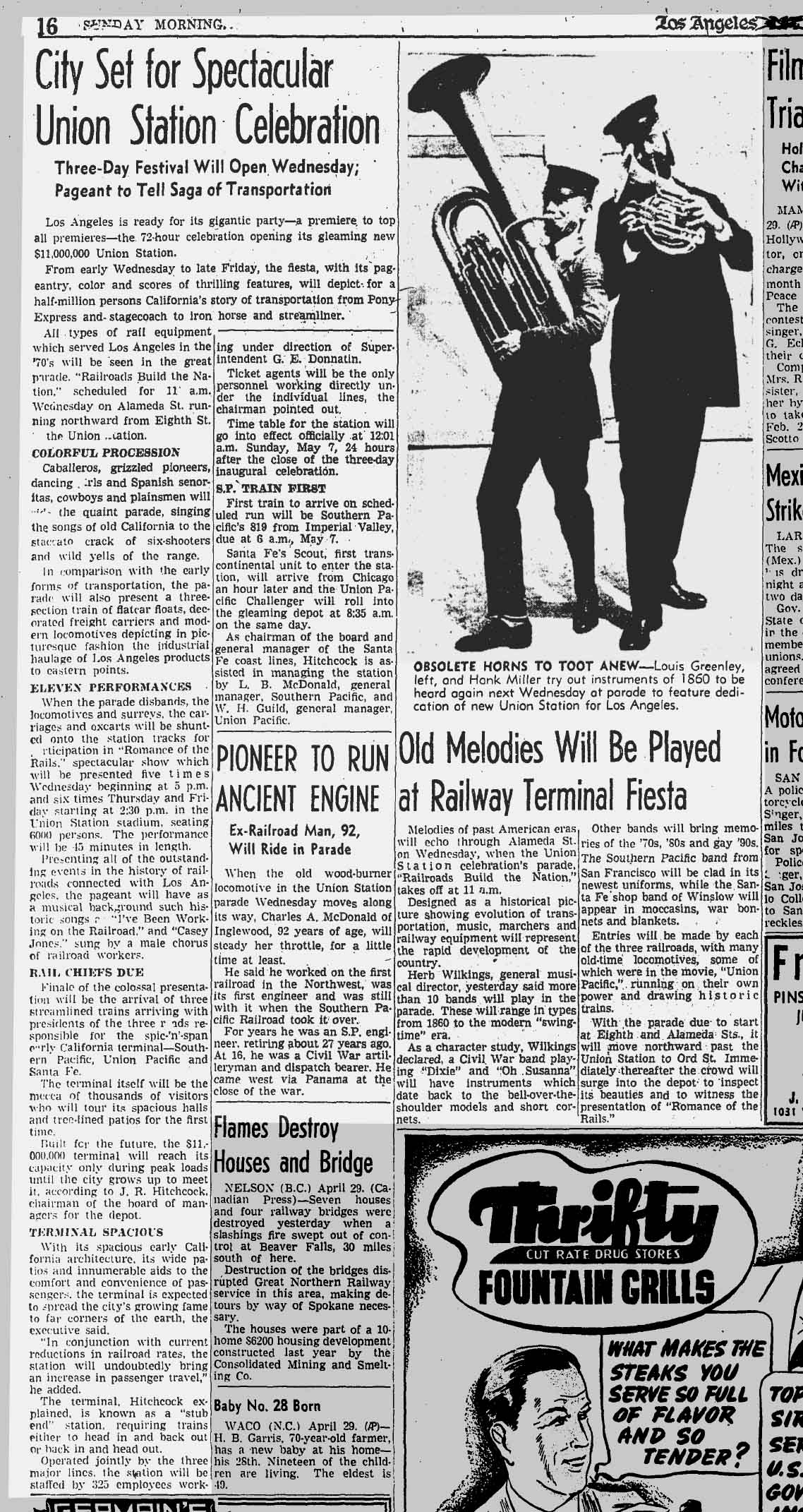
April 30, 1939: Los Angeles Prepares for Opening of Union Station

April 30, 1939: Los Angeles prepares for the opening of Union Station. Images of men playing brass instruments, and news story
The city made a special effort to examine and celebrate its past during the opening of Union Station. Officials mounted a much more elaborate “parade of progress” than I suspect we would see today.

Continue reading →

Posted in 1939, Comics, Countdown to Watts, Downtown, Music, Transportation | Comments Off on April 30, 1939: Los Angeles Prepares for Opening of Union Station

Found on EBay — Angels Flight

Angel's Flight EBay

This 1908 postcard of Angels Flight has been listed on EBay. Notice that it was originally next to the 3rd Street tunnel. Also notice the lookout tower at the top of Bunker Hill. Bidding starts at $3.99.
Posted in Architecture, Downtown, Transportation | Comments Off on Found on EBay — Angels Flight

Matt Weinstock — April 29, 1959


Money Troubles

Matt_weinstockdThe
bitter warfare between those who owe money and those who are trying to
collect it goes on and on, with extracurricular activity here and there.

A
mother received a call recently from a woman who said she was with an
advertising agency, which she named. Her son, she was told, had won a
two-week trip to Honolulu. If the mother would furnish his address the
tickets would be given to him.

The mother said he had
been unemployed but had gotten a new job out of town and didn't know if
he would be able to make the trip. The caller said the tickets or the
equivalent in cash were his anyway, but had to be presented personally. 

A
meeting was arranged at their home, and the young man drove down from
Fresno for his prize — only to have his car snatched. Seemed all this
was a ruse. There is no such advertising agency. The address is a loan
firm. The young man was several weeks behind on the monthly payment on
the car.

So, sadder and wiser but not happier, he took the bus back to Fresno.

::

April 29, 1959, Space Stewardess ONLY IN L.A.
— Adam W. Truty took an elderly friend into a deluxe saloon. He
ordered beer, his friend ordered coffee. The beer was 45 cents, the
coffee 25. High. They didn't complain, but another elderly customer
did, delivering an eloquent lecture on ethics. The bartender snapped,
"You're 86! No more drinks for you!"

Whereupon Adam's friend jumped up and said to his new-found advocate. "Are you 86? You don't look it! I'm 86, too!"

::

NO DISCOVERER, I

So they can't find the cap from that nose cone?

Now I feel somewhat less of a boob

When I can't, though I look all over,

Find the cap from my toothpaste tube.

— RICHARD ARMOUR

::

LET'S FACE IT,
North Young, Malibu artist, has a talent for eliciting secrets from the
most reticent of his rather odd friends. One of them, a cemetery
caretaker named Moss O'Learn, last week confided this tale:

April 29, 1959, Comics When
James Watt, the famous inventor, died, a large box was found among his
effects. There was no clue to its contents, only a warning in Watt's
handwriting that it was not to be opened until 1959.

 On
Jan. 1 of this year the box was opened and found to contain 300 dahlia
tubers, each wrapped in tissue and all in excellent condition. With
them was a note asking that the corms be planted all around his grave.
Relatives sent the box to Moss O'Leam, who planted them.

That
very night people passing the cemetery were astonished to see the
inventor's headstone bathed in light although there was no artificial
illumination in the vicinity.

"How do you account for the phenomenon?" the caretaker was asked.

"No phenomenon at all," he replied, "just those danged 300 Watt bulbs."

::

REMEMBER
the Finn twins, George and Charles, who have been at war with the
government for six years over possession of an Army surplus plane and
who have a penchant for making citizen's arrests?

April 29, 1959, Abby Well,
George has asked Atty. James F. Bolger to incorporate a Citizens'
Committee to Make Arrests Police Refuse to Make. The idea is to
indoctrinate citizens regarding their legal rights.

Things are likely to liven up any week now.

::

AT RANDOM —
E.N. Brandt, fiction editor of the S. E. Post, was in town briefly,
trying to lure local writers into the short-story fold. Said there's a
shortage. Of course, he meant the Post type of story. He also revealed
that the Post pays 50% more for a short story than for an article
…speaking of which, the new Erle Stanley Gardner serial in the week's
Post has an L.A. locale.

Posted in Columnists, Matt Weinstock | Comments Off on Matt Weinstock — April 29, 1959

Paul Coates — Confidential File, April 29, 1959

CONFIDENTIAL FILE

Pinball Machinery Tilts in El Monte

Paul_coatesI'm no crime-buster.

But
every now and then I come up with a morsel about some slightly illegal
activity being conducted under the noses of some slightly more than
indifferent officials in our cozy community.

And, going on the theory that the officials can read, I print details of the violation.

And, ever so gently, I suggest that maybe somebody with a little authority ought to open his eyes.

Buried
deep in the archives of The Mirror News there's a yellowing copy of one
of my penny lectures to public servants. It's in a column dated Nov.
12, 1957
.

The column dealt with a pinball-machine syndicate
which was operating with no apparent interference in a dozen cities
throughout Southern California.

The pinball games were nothing
more than thinly disguised slot machines, capable of gobbling up a
workingman's pay check in the space of a couple hours.

April 29, 1959, Cover In the
column I listed the names and addresses of some bars and cafes in the
town of El Monte, where the machines were doing land-office business.

An
assistant of mine toured a few of them and proved how simple it was to
drop $26 in two hours. He came back to the office with the additional
observation that adults weren't the only ones who were feeding nickels,
dimes and dollars to the syndicate.

High school kids — lots of them — were dropping their lunch money and allowances into the machines.

My column was strictly a reflection of my public spiritedness.

And, naive boy that I am, I figured that's how the city fathers of El Monte would take it.

They were incensed, all right. But not at the crooks who were taking money from the kids in their town.

Instead, the solons got mad at me. Me! I never did nothing to nobody (except hit them with a double negative if they weren't looking).

One city councilman pointed out to me a few days later. "Let's face it. Gambling is here to stay."

April 29, 1959, Chavez RavineAnd
a second council member added that he was positive that there weren't
any payoffs on the machines. "I asked some of the men who owned them,"
he said.

El Monte's police chief stood before the councilmen a week after my column appeared and begged them to outlaw the machines:

"I know they pay off," he said, "but I just don't have enough men to police every place that's got one."

But the majority of the city fathers were apparently very fond of the pinball operation. Staunchly, they did nothing.

About
a month later, though, some citizens started putting the heat on. Why
they demanded to know, was the City Council in favor of such a crummy
operation which could do nothing but hurt their town?

Neatly,
the councilmen about-faced. They didn't do anything so bold as to ban
the machines, as lots of other cities have done. But they did vote,
4-1, to put the issue before the people.

There the matter rested
until November of last year. Then, in a sudden reversal of course, they
brought it up again and voted, 3-2, to let the machines continue to
operate.

Finally, the people of El Monte took the matter into their own hands. Church groups, PTA's and other civic organizations began passing petitions early this year demanding the removal of the pinball games.

Things May Work Out

They
had the support of Mayor Dale Ingram, who's always been against the
machines. Two days ago, a group embracing many of the game operations
found a technical flaw in the presentation of the citizens' petitions,
but, with Mayor Ingram's help, the people of El Monte finally convinced
the City Council that private citizens should have a voice in what kind
of corruption they want in their town.

On June 23 a special
election will be held — and, at last, the people will be able to
decide for themselves whether they want their kids to contribute their
allowances to a gambling syndicate.

I'm not too worried about the outcome.

Posted in Columnists, Paul Coates | 1 Comment

Nashville Cuisine, 1964

Nashville-seasons

At left, 1964 Nashville is the latest destination of Mary McCoy's Cooking With the Junior League blog. (Mary,  the entertaining voice of This Book Is for You, is spending a year preparing meals from Junior League cookbooks).

Mary writes: Published in 1964 by the Junior League of Nashville, Nashville Seasons
has a split personality.  But then again, it was the 1960s, an
interesting time in the American culinary landscape where home cooks
were quite over casseroles and post-war convenience foods, but hadn’t
yet remembered what good food actually tasted like.  As a result, good
food was often confused with fussy food.

Read more>>>

Posted in Food and Drink | Comments Off on Nashville Cuisine, 1964

In the Theaters — April 29, 1983

April 29, 1983, In the Theaters
Posted in Film, Hollywood | 1 Comment

Union Station Turns 70

Union Station, Dec. 22, 1935

Los Angeles Times file photo

Los Angeles' Union Station formally opened May 3-5, 1939, with a three-day festival that included parades and displays of historic locomotives and streetcars. The Daily Mirror will be posting photos of the station's construction and the opening celebrations. 

Above, Union Station under construction, Dec. 22, 1935, with City Hall and the Hall of Justice in the background. The photograph shows the completed underground passageway from the depot to the tracks.


Posted in Architecture, Downtown, Transportation | 2 Comments

Mayor Slashes Budget for Libraries and Parks; Spring Training in Arizona, April 29, 1959

The Senate approves Clare Boothe Luce as ambassador to Brazil, but her husband, Time publisher Henry Luce, asks her to resign, saying that her prestige and authority have been impaired by a political vendetta. During her confirmation hearing, Clare Boothe Luce was harshly criticized by Sen. Wayne Morse (D-Oregon) for a remark during a 1944 campaign speech that President Franklin Roosevelt "lied us into war." Morse also challenged a 1952 political speech that left the implication that former President Truman was a "traitor," The Times said. 

April 29, 1959, Mafia Murders

April 29, 1959, Maywood

At left, the incomplete story giving Police Chief William H. Parker's list of alleged mob killings in Los Angeles. For some reason, the first part of the story was moved from Page 1, so all that was preserved is the runover. I used this material in the map of mob killings I posted previously.

Above, Ellis Allsop dries the dishes as his wife, Reva, leaves to be sworn in as the mayor of Maywood. And our lede? "Breaking precedent is nothing new for attractive career woman Mrs. Reva Allsop." A political maneuver removed her from office in less than a year.

April 29, 1959, Theater

Tony Randall and Debbie Reynolds in  "The Mating Game."

April 29, 1959, Comics

A mother tells her son that she and her husband are divorcing in "Judge Parker."

April 29, 1959, Sports Sometimes stories take a few decades to come true.

Braven Dyer's column suggested that the Chicago White Sox would be moving their spring training home to Arizona. Dyer said new White Sox owner Bill Veeck lived in Tucson and the team was discussing a deal to move out of Sarasota, Florida.

All this would interest Los Angeles readers because the White Sox apparently wanted another team to move with them to make it an even six teams in Arizona.

According to Dyer, former Dodger manager Leo Durocher was "working with the Arizona people" to get the Dodgers to leave Vero Beach for a spot closer to Los Angeles. Walter O'Malley, who knew quite a bit about moving a team from one side of the country to the other, didn't offer much hope: "Unless we trained in Southern California itself, I don't see any difference it would make where we train."

Dyer, on the other hand, saw lots of potential:

"Pish and tush, Walter. Don't you know that Arizona, California, Nevada and Florida are expected to have the largest population increase between 1955 and 1970? How many of those people will you lure to the Coliseum from Vero Beach? Sell that plant, go to Arizona and you'll find literally thousands of fans coming over to see your Dodgers after the regular season dawns."

Pish and tush?

–Keith Thursby

Posted in Comics, Film, Front Pages, Hollywood, Politics, Stage | 1 Comment

Coming Attractions — The Legacy of Allensworth

AllensworthAn upcoming conference
will focus on the legacy of Allensworth, a town financed and governed
by African Americans founded by Col. Allen Allensworth. The conference
is being promoted as the first in the Hidden Stories Series of the
California State Parks Foundation.

The conference will be held from 8 a.m. to 5 p.m. on May 4 at Doheny
Memorial Library. Registration is $60 and includes meals, an evening reception and membership
in the parks foundation.

Sessions include African Americans in the Gold Rush; recreation and
beach culture during the days of segregation; a keynote speech by
former Assembly Speaker Willie Brown, the former mayor of San Francisco; the history of African Americans
in San Diego; and workshops on ways to highlight African Americans'
contribution to California.

Information is here >>>

Register here>>>

Posted in Coming Attractions, Parks and Recreation | Comments Off on Coming Attractions — The Legacy of Allensworth

Matt Weinstock — April 28, 1959

Stop the Music

Matt_weinstockdIn the event
you hadn't heard, music is broadcast over the City Hall loudspeaker
system. Maybe not the best music, but music. Now an anonymous city
employee asks bitterly, "Why must we be submitted to this torture?"

In
a letter to councilmen and other city officials this disenchanted
person writes, "We are not workers doing monotonously routine and
repetitive tasks during which music would be welcome relief. We are not
patients in an asylum who must have music as therapy to rouse us from
our stupor or to calm us in our frenzy. We are not sitting in doctors'
offices to be soothed while we contemplate our ills and bills; nor are
we in some secluded rendezvous whiling away the time. We are in the
City Hall, eight hours a day, trying to do a day's work without
distraction."

THE DISSENTER
goes on, "Should you enter
our beautiful rotunda you are apt to be greeted with the strains of
'Embraceable You' or 'I Don't Want to Walk Without You, Baby' or 'It's
Been a Long, Long Time.' This is dignity in the City Hall?"

No, and come to think of it, dignity is pretty hard to find anywhere else in the joint.

::

April 28, 1959 Cover WHEN SHE arrived home after buying a few secondhand children's books at Westwood Elementary School's PTA luau, Mrs. Austin Kalish
noticed what appeared to be a bookmark in one of them. A closer look
revealed it was a piece of notebook paper on which was scrawled, "Be
sure and beat up Ronnie in the morning."

::

WARNING SIGNAL

No matter when I enter a yellow
Behind me comes some other fellow.

– KENNETH H. BONNELL

::

A MAN I KNOW
is on one of those starvation diets designed to remove excess weight in
a hurry. He took off eight pounds the first three days, 15 in two
weeks. He simply doesn't eat. Instead he takes with him wherever he
goes a thermos bottle containing a mixture of orange juice, milk, raw
eggs and salad oil, and several times a day gulps a slug.

On the
way home the other day he stopped at a friend's house and after a while
looked at his watch, waved his empty thermos and said despairingly,
"I've got to go. I'm hungry. It's time for my 3 o'clock feeding."

::

April 28, 1959, Comics QUOTE & UNQUOTE
— An expensively dressed middle-aged man leaving an Arcadia restaurant
was overheard saying to his companion, "Oh well, another day, another
23 cents after taxes!"… Lady named Hilda, turning off a rock and roll
program, commented, "If only they didn't sing them as if they were
sacred hymns."

::

OFFHAND, anyone would say that Webster's unabridged is above and beyond slang. Which makes all the more interesting Frances Hov's discovery that on Page 955 the word fishify is defined as "to change to fish; to make like a fish."

::

AT RANDOM —
Oops, the student-printed program for the play "Detective Story"
presented by the L.A. City College theater arts department noted that
the cast was "directly supervised and assisted by the Faulty Staff."
The faculty is laughing … Understand a man inToluca Lake bought a Scoutarama ticket for $1 from a Boy Scout, then tried to turn it in on some mints when a Girl Scout came to the door … Photog
John Gaines saw a bunch of colleagues as he went into the Redwood House
and said, "Give all those fellows a drink and gave the religion editor
a glass of water and let him perform a miracle" … Received a
five-page press release from Philadelphia dedicated to the proposition
that diapers are more important than you think. Sometimes a person in
the business gets the feeling that it won't be long now.

Posted in Columnists, Matt Weinstock | Comments Off on Matt Weinstock — April 28, 1959

Paul Coates — Confidential File, April 28, 1959

CONFIDENTIAL FILE

A Fellow to Whom We Should Subscribe

Paul_coatesNormally, I don't go around hawking newspapers.

Especially other people's newspapers.

But today, I make an exception.

Right now, this minute, I'm hustling sheets. At no commission.

Like I say, it's not The Mirror News I have tucked under my arm.

It's
smaller. Only a four-page weekly. It's put out in the little
Mississippi town of Petal. (If you've heard of Petal, you're a well
traveled individual.)

The paper, appropriately, is called "The Petal Paper."

It's a one-man operation — written, edited and printed by 37-year-old native Mississippian by name of P.D. East.

1959_0428_gaysNot so appropriate is the fact that the paper's readership in Petal is, according to today's Audit Bureau of Circulation, zero.

Five years ago, it was 2,300.

 But it was shortly after that, that Mr. East began writing the news as he saw it — not as his advertisers wanted him to see it.

News that included some pretty shocking copy about the "rights" of Negroes in his home state.

With naive honesty, he reported the facts. All of them.

And,
when he felt that his fellow townspeople were becoming overly emotional
to the point of mob violence about certain race issues, he told them
so, editorially.

That's how he fell out of favor.

He was branded a traitor, damnyankee and a few other things not quite so genteel.

But
P.D. East kept on cranking his printing press. And, gradually, he built
up a circulation outside of Mississippi. It's back to the 2,000 mark
now.

Yesterday, I met P.D. East for the first time, and if you
want my first impression of the man, the folks down in Petal have
mislabeled him, Badly.

 Yet, I made a similar misjudgment. I called him a crusader.

"I'm not a crusader," he informed me indignantly.

"I'm not an integrationist, either," he added. "I'm simply against discrimination."

East
told me that his troubles began in 1954, right after the United States
Supreme Court ruled on integration in the public schools and he began
using his paper in the battle against racial hatred.

"And why the fight?" I wanted to know.

"Well,"
he began, "it was mainly a matter of conscience. I couldn't keep still
and let people tear down this country's constitutional government.

East
didn't make any home town friends when he published a picture of a
Mississippi school for white children alongside one for young Negroes
and asked his readers to guess which was which.

The answer was all too obvious. One was a bright new facility; the other little more than a dilapidated shack.

"What kind of social life have you led since you make your views public?" I asked East.

"On Christmas Day of 1956, my wife and I were invited out. That was the last time," he answered bitterly.

I asked him about old friends.

"There
are several people," he explained, "People I went to school with. They
won't even say hello when we meet on the street. "And I sure wish they
would," he added, "because I'd like the privilege of ignoring them."

Living Always Takes Eating

There are some who wonder how East has managed to stay alive. Why some rebel hothead hasn't mowed him down.

"I wonder myself sometimes," he confesses, but adds that he hasn't much time to consider threats of physical violence.

"But what about your wife?" I said.

"She just wishes the whole thing were over and done with. That everybody, including me, would shut up."

But P.D. has refused to be stilled. He wants to continue shouting in print. And he wants, most of all, your help.

He
wants you to join the other 2,000 subscribers. It'll cost you five
bucks a year, which seems a small price to pay for somebody else's courage.

Posted in #gays and lesbians, Columnists, Paul Coates | 1 Comment

Bob Oates on O.J. Simpson, October 12, 1973

Oct. 12, 1973, Bob Oates on O.J. Simpson

Oct. 12, 1973: The late Times sportswriter Bob Oates interviews O.J. Simpson, who was playing for Buffalo.

Oct. 12, 1973, Bob Oates on O.J. Simpson

Oates: You say ball carrying can't be taught. Do you mean this literally?

Simpson: You never hear a great running back say, "I'm going out to work on this or that." All he says is, "I'm going out to work out" or "I've been working out."

Posted in Sports | Comments Off on Bob Oates on O.J. Simpson, October 12, 1973

In the Theaters — April 28, 1980

April 28, 1980, In the Theaters
Posted in Film, Hollywood | Comments Off on In the Theaters — April 28, 1980

Celtics Defeat Lakers, April 28, 1969

April 28, 1969 Lakers Game 3 

1969_0428sportsRO The Celtics returned home to Boston Garden for Game 3 of the NBA finals against the Lakers and the change of scenery seemed to help the home team and tire the visitors. Boston won, 111-105, to trail 2-1.

Laker fans could point to bad shooting nights by Jerry West (24 points after 53 and 41 in the first two games) and Elgin Baylor (11 points) but the Celtics were the aggressors.

Larry Siegfried, a tough guard who had 24 points for Boston and helped supply more pressure on West, talked openly after the game about his image.

"I know there are rumors that I'm a dirty player but I think the fans confuse a hard player with a fearless competitor. Jerry West is a great player and I admire him and I wouldn't do anything to hurt him," Siegfried told The Times' Mal Florence. "But I can't play like he does. I have to dig out there all the time. Shots don't come easy for me.

"I'm sorry that people boo me in other cities. But I can accept that as long as they accept me as a human off the court."

Siegfried must have anticipated Fred Schaus' comments after Game 4 about the Celtics' physical play. Schaus, the Lakers general manager, was fuming over how his team was treated.

"It's the same thing every damn year. [The Celtics] are hacking, slashing and knocking people down," he said. "Look at [Larry] Siegfried. He's always shoving and pushing and gets away with it because they do it so consistently. It's a shame the way they permit them to play. … There are two sets of standards in the NBA: The Celtic system and the rest of the league."

Game on.

–Keith Thursby

Posted in Lakers | Comments Off on Celtics Defeat Lakers, April 28, 1969

Hitler Reviews Nazi Troops, Hollywood Celebrates Barrymore’s Birthday, April 28, 1939

April 28, 1939, Hitler

Sending photos in the old days: By ship.

April 28, 1939, Statue April 28, 1939, Cover

At left, you're wondering what a statue of a naked babe has to do with freedom of the press? According to news accounts, it represented "the unadorned truth." It was part of a group of statues at the World's Fair representing "The Four Freedoms," which also included Freedom of Religion, Freedom of Speech and Freedom of Assembly. There's supposed to be a figure of a child reading a newspaper, too.

April 28, 1939, Lionel Barrymore

Lionel Barrymore turns 61.

April 28, 1939, Hammer Attack

April 28, 1939, Comics

"Her emotions surged in alternating torrents. She loved this man; yet she hated him for the injury he had done her pride. She could kiss him or kill him, with equal delight." Gosh, "Tarzan" has some purple prose.

April 28, 1939, Sports

The Angels beat Sacramento 2-1: "A storybook finish that had Johnny Moore cast in the role of Frank Merriwell enabled our Angels to pull what looked like a certain defeat out of the fire after two were out in the ninth inning yesterday."

Posted in #courts, art and artists, Comics, Film, Hollywood, Sports | 1 Comment

Nuestro Pueblo

April 28, 1939, Nuestro Pueblo
Posted in Architecture, art and artists, Nuestro Pueblo | 1 Comment

Found on EBay — 1958 Dodger Tickets

1958 Dodger Tickets These 1958 Dodger tickets have been listed on EBay. Bidding starts at 99 cents.
Posted in Uncategorized | Comments Off on Found on EBay — 1958 Dodger Tickets

Matt Weinstock — April 27, 1959

Goleta's Great Day

Matt_weinstockdIn the
twilight of Monday, Feb. 23, 1942, a Japanese submarine a mile offshore
fired 25 shells from its 5-in. deck guns at the Elwood oil field inGoleta, a few miles north of Santa Barbara.

The
attack, which lasted 20 minutes, was reported in an atmosphere of
hysteria. There was wild, panicky talk that the firing was the prelude
to an invasion attempt.

A coast alert was sounded and the air-raid sirens didn't give the all clear until 12:20 a.m. Tuesday.

At
the time, it must be remembered, the Japanese had overrun the Pacific
islands. It was only a little more than two months after the holocaust
at Pearl Harbor.

HOWEVER, THE SHELLS did little damage.
Only one oil derrick was struck, causing about $500 damage. A refinery
was missed and most of the shells merely dug up sand or fell into the
sea. One whistled three miles inland and exploded harmlessly on theTecolete ranch. Another gouged a 5-foot. crater on the Staniff ranch. Some were duds.

April 27, 1959, Bestsellers Several
persons saw the submarine through binoculars. An oil-field worker said
it looked so big he thought it was a destroyer or cruiser.

That was 17 years ago but when I visited Joe Cavaletto, a family relative, in Goleta
a few days ago and strolled through his lush avocado and citrus groves,
the conversation naturally turned to the historic event.

One of
Joe's neighbors saw the Japanese sailors on the deck of the sub and to
this day swears he could have picked them off with a rifle. But hardly
anyone realized what was happening until they started shooting.

Joe
and his husky son, Mike, grow avocados and grapefruit as big as
cantaloupes on a farm that has been in the family for 150 years and
goes back to mission and land grant days.

April 27, 1959, Comics On his property there
is an old adobe barn that would make antiquarians drool. And like all
farmers he is concerned about rising taxes and encroaching subdivisions.

But Goleta
is submerged in the expanse of Santa Barbara. Not much happens and the
submarine incident of 17 years ago is cherished as if it had happened
17 months ago. It was the only timeGoleta ever got into the headlines importantly.

::

NOT LONG AGO it was mentioned here that writer Charlotte Armstrong started a novel while down with the flu. D. McAllister of KRCA-TV
apparently was subconsciously impressed. On his bedside writing pad
after a six-day siege with the bug he found the following:

"I am the Loch Ness monster, you think I don't exist. I don't think you do either, isn't that a twist?"

"Had Genghis Khan gone on and on, the end result is clear. He would have marched around the world and pounced upon his rear."

"In Xanadu did Kubla
Khan a stately Disneyland decree. They built to scale in great detail,
a lovely sight to see. And when in place were all the things, the
ducks, the mice, the crickets, there came, alas, a great impasse, no
one could print the tickets."

Concludes Mac: "Guess I had the wrong kind of flu."

::

April 27, 1959, Abby WHILE WE'RE in the nonsense league, this "Open letter to taxpayers" is circulating among city employees:

 "Occasionally
a friend asks what I do all day at City Hall. I reply that my work
frequently takes me to poorer sections. One day I rang the bell at an
old shack. A woman's voice answered and I told her the reason for my
call. 'Wait a minute,' she said, 'I want to slip on something cool.'
There was a loud crash. 'What happened?' I cried. 'I just slipped on
something cool, she said, 'an ice cube.' When she came to the door I
said, "This is certainly a tough neighborhood." I nodded toward the
pack of vicious dogs, cats and children waiting for me to come out into
the open. 'You said it,' she said, 'even our assessments are
delinquent.'"

::

LOOSE ENDS — That poisonous cliche, "But darling, I did it for you!" was on TV again the other night for the 372nd time …The Italian grocery store at Sepulveda Blvd. and Lassen has a sign, "If you can't smell it we haven't got it."

Posted in Columnists, Matt Weinstock | Comments Off on Matt Weinstock — April 27, 1959

Paul Coates — Confidential File, April 27, 1959

Confidential File

American Friends Service Committee

Paul_coatesYou just never know where you'll find a bunch of pioneers.

On wind-swept sand hills at Kitty Hawk, under the polar ice cap or in a quiet Los Angeles residential district.

I visited a rather remarkable "we're doing it first" group in the latter locale yesterday.

Its
members are former California prison inmates. Ex-cons, if you will. And
all are on parole. But unlike others of their number, they're living an
experiment conducted by the American Friends Service Committee.

Their
pioneering venture is built around a boarding house whose only
residents outside of the director, his wife and 16-year-old son — are
men who've made a mistake or more, paid behind bars and now want a
chance to prove they're fully capable of taking a productive place in
our society.

April 27, 1959, Mirror Cover And every man pays his own way. Eighteen bucks a
week for room and two home-cooked meals a day. If a man falls behind in
his rent, he's asked to move.

"We feel a man is more likely to
find himself when he assumes responsibility," explained Tom Nelson,
who, with his wife, runs the boarding house.

 "How many former convicts live here?" I asked him.

"We have six now," he replied. "We have another due tomorrow and one on the 30th. Our total capacity is nine.

"But since the project began a year ago, we've had about 25 guests," he added.

"And how many," I wanted to know, "have failed you?"

"Well," he began, "we've only had one man go back to prison in the year."

"That seems to be a pretty substantial statistic," I suggested.

"Oh, it's much too early to tell yet," Mr. Nelson said. "But we are certainly encouraged."

April 27, 1959, Beaches It
would be difficult to say just now many paroled convicts across the
nation return to prison during their first year of freedom, but some
penologists and law enforcement officers place the estimate as high as
70%.

But even if it's half that number, it seems clear that the Friends have made a good beginning.

 "Do you exclude men from the program because of any particular offense?" I asked Tom Nelson.

"No"
he said. "The Friends make no distinction in men. Whatever a man has
done — murder, narcotics, armed robbery — he's still a man. We don't
pin any labels on those who come here."

"How did your neighbors
react to the boarding home?" I wanted to know. "I mean, did they object
to the fact that they'd be living next door to ex-convicts?"

"Not
at all," he told me. "That was one of the big worries int he beginning
though. Members of the Friends Committee went to every house around
here before we got started.

Just to Break the News

April 27, 1959, Beaches "Not
to ask permission, you understand. Just to break the news. Instead of
objections, we found that people wanted to make us feel at home.

 "The
fellow next door, for instance. He's a former Army cook and mighty
proud of some of his menus. Came over one night and fixed spaghetti for
the boys. His wife played the piano."

"And do you consider that sort of help important?" I asked.

"We
certainly do. We are trying to provide a homelike atmosphere. If
there's one thing all of these men have in common, it's the lack of a
background which included a loving home."

The Friends are the first to point out that what they've done so far proves little.

Unless, that is, that you've got to start somewhere.

Posted in Columnists, Paul Coates | Comments Off on Paul Coates — Confidential File, April 27, 1959