
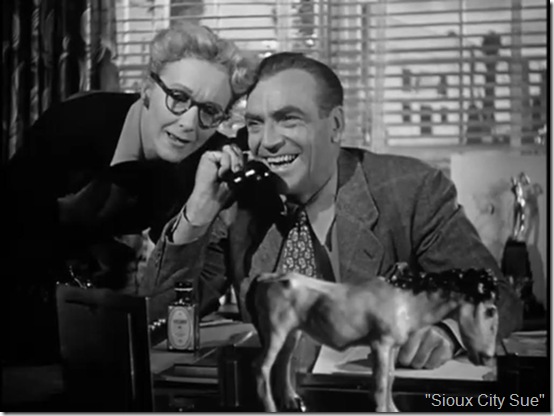
Photo: Dick Lane and Helen Wallace in “Sioux City Sue,” 1946.
Coming up Wednesday: Biographer James Curtis shares his interviews in L.A. Voices, beginning with Part 1 of a 1975 Q&A with actor Dick Lane.
Photo: Dick Lane and Helen Wallace in “Sioux City Sue,” 1946.
Coming up Wednesday: Biographer James Curtis shares his interviews in L.A. Voices, beginning with Part 1 of a 1975 Q&A with actor Dick Lane.
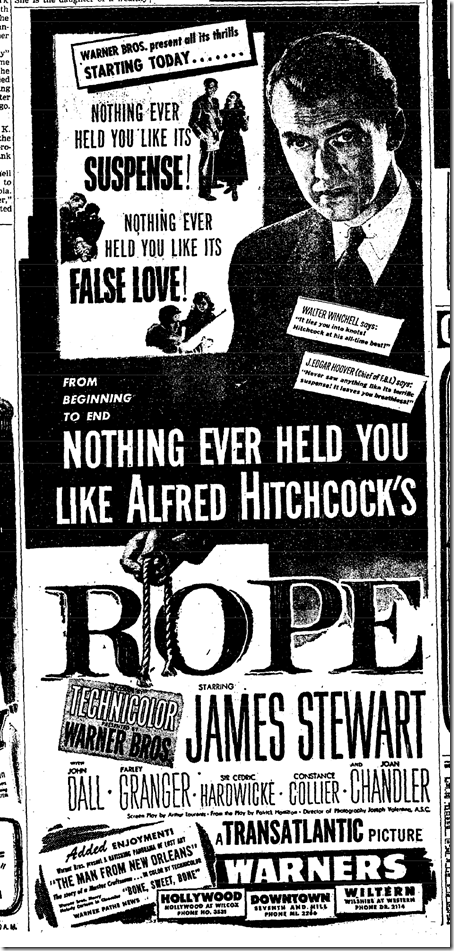
“Rope” opens in Los Angeles, Sept. 24, 1948. Credit: Los Angeles Times
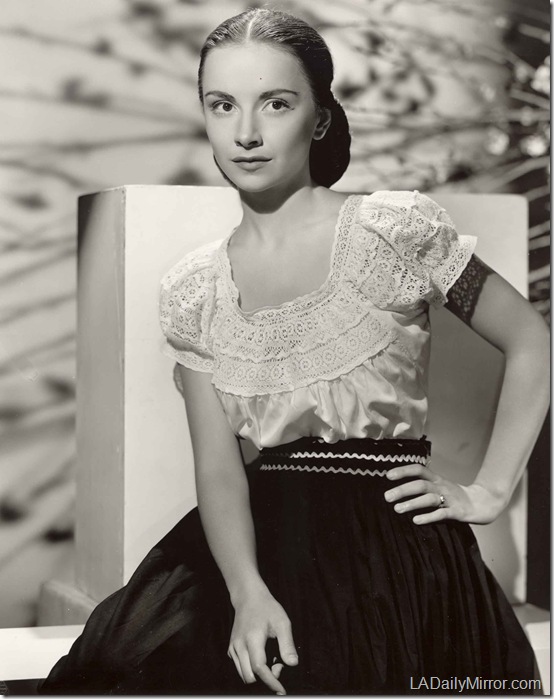
[Update: This is a 1949 photo of Joan Chandler (d. 1979), who appeared in Alfred Hitchcock’s “Rope.”]
Here’s our mystery gal!
There’s another photo on the jump!
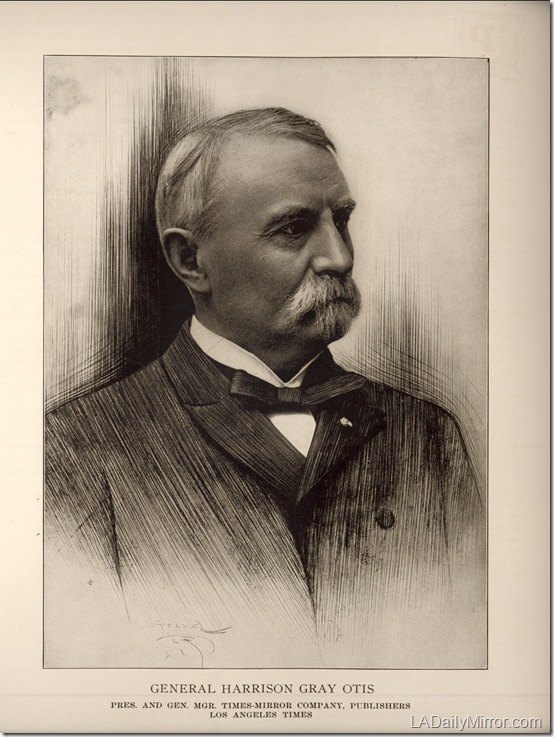
Photo: Times President Gen. Harrison Gray Otis. Credit: Press Reference Library, 1912
Gen. Harrison Gray Otis, the favorite pinata of Los Angeles historians, is the subject of a new biography by Mike “City of Quartz” Davis, now being serialized in the Los Angeles Review of Books.
Based on the first installment, it seems Davis has some things right – that no decent biography exists. But I don’t expect much more than a thorough hatchet job in the Morrow Mayo-Louis Adamic school:
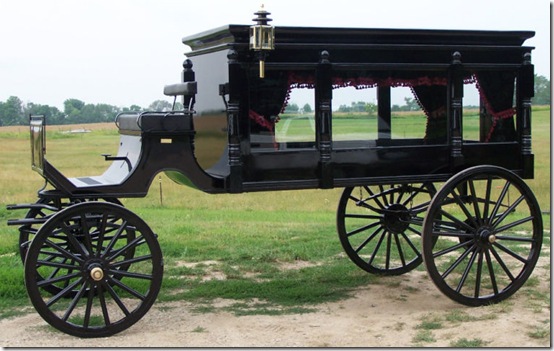
Photo: New, horse-drawn hearse for sale on EBay, $9,500. Credit: Justin Carriage Works
Queen of the Dead—dateline July 18, 2011
• All the silent movie stars are long-gone, now we are down to memorializing their children. Rex Bell, Jr., son of Clara Bow and Rex Bell, died on July 9, at 76. Like his dad, Rex, Jr., appeared in westerns (Young Fury, Stage to Thunder Rock), then went into politics. Junior became a district attorney and justice of the peace in his home state of Nevada, and in his obits everyone agrees that he was just about the nicest fellow ever (then again, they wouldn’t be quoting his blood enemies in his obits, would they?).
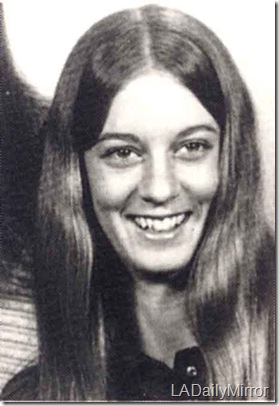
Photo: Leesa Jo Shaner
An attempt to resolve one of the nation’s most baffling unsolved crimes is quietly unfolding in federal court in Tucson: The mystery of Leesa Jo Shaner, who vanished May 29, 1973, on her way to the local airport, where she had gone to pick up her husband, Gary, a newly discharged serviceman returning from Okinawa.
Shaner’s father, James Miller, was an FBI agent in Tucson and the bureau quickly took over jurisdiction from the Pima County Sheriff’s Department. But despite years of investigation, little progress has been made since her remains were found Sept. 16, 1973, buried on the grounds of Ft. Huachuca, Ariz., a remote military base more than an hour’s drive from the airport, through miles and miles of unoccupied desert.
Continue reading
 |
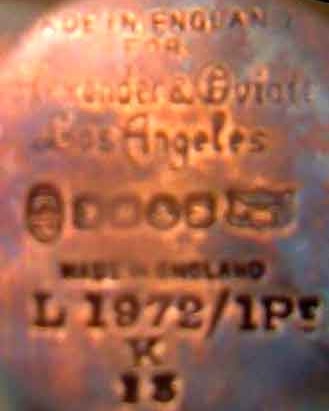 |
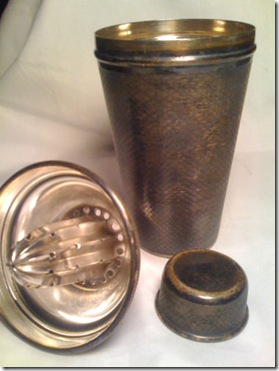
We’ve been rambling about “navy blue ghosts” and otherwise reciting “Facade” at the Daily Mirror HQ after finding this cocktail shaker from Oviatt’s on EBay. Bidding starts at $99.99.
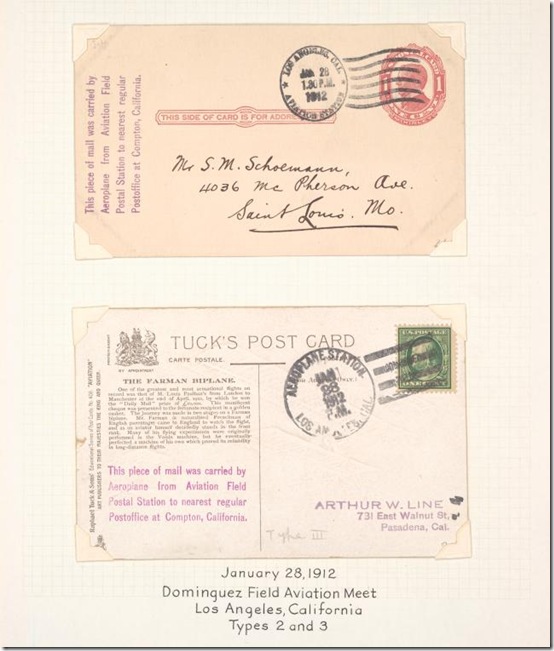
Photo: Mail sent by airplane from the 1912 Aviation Meet at Dominguez Field. Credit: New York Public Library
7|17|2011
DEATHS
Ardis Butler James, 85, co-founder of the International Quilt Study Center & Museum at the University of Nebraska. Margalit Fox in the New York Times.
SPOTLIGHT
How to preserve Lady Gaga’s meat dress for the Rock and Roll Hall of Fame. Bob Pool in the Los Angeles Times.
White Sox manager Ozzie Guillen says he visits the Negro Leagues Baseball Museum in Kansas City at least once a year. Mark Gonzales in the Chicago Tribune.
BOOKS
Andrew C. Revkin reviews Tim Flannery’s “Here on Earth: A Natural History of the Planet” in the New York Times
STAMPS
A 1918 example of airmail from the New York Public Library, home of the in the Benjamin K. Miller collection of U.S. stamps. I also found some mail from the 1912 Aviation Meet at Dominguez Field. A neat surprise!
OPINION
The raw material of scholarship — books, diaries, documents, photographs and other material — is being digitized. But does putting so much resource material on the Internet “cheapen scholarship?” James Gleick in the New York Times.
The case against the Grand Egyptian Museum, by Mohamed Elshahed in Jadaliyya.
This is a provocative essay and I will only quote a bit of it.
Continue reading

Photo: The Dodge House. Credit: latimes.com
SPOTLIGHT
The New York Times’ Michael Kimmelman visits the Mütter Museum in Philadelphia. Kimmelman writes: Devised like most true collections from somebody’s crazy obsession, the Mütter dressed up good old ghoulish midway spectacle in the guise of civil service and medical instruction.
RECOMMENDED
Diane Haithman is interviewing L.A. art museum guards on The Times’ Culture Monster.
This is what Kimberly Strain of MOCA says about her favorite work: “Wish You Were Here.” “It’s a beautiful pastel painting across a very wide wall — it’s people at a party, and they’re dancing, and everybody’s eyes are closed and they’re just having such a good time. And they are African American — well, not African American, but they’re black — and it shows how we actually are, not just the thin, model types. It’s the folks that look like me, with the bulges and the dimples and everything.”
And here’s what LACMA’s Hylan Booker has to say.
::
Writing in The Times, Jeffrey Head looks at the Dodge House in West Hollywood, a home designed by Irving Gill in 1914 that was demolished in 1970.
Head writes: The graceful arches, the ahead-of-its-time mahogany paneling, the coved walls that prevented dust from collecting in corners, the stunningly beautiful sense of simplicity — they’re are gone. Beyond the vintage photography of Marvin Rand, all that’s left is an appreciation of Gill’s genius and the Dodge House’s cautionary tale.
::
The Huntington has audio of historian Matthew Roth on L.A.’s “Concrete Utopia.”Take the time to listen to this lecture. Roth makes the point that no freeway was built in Los Angeles without a tremendous fight and strong public opposition. It’s available on iTunes, along with other lectures at Huntington.
::
Edward Rothstein reviews the Skyscraper Museum (in the Empire State Building, of course) for the New York Times.
It is safe to say that visitors to the Empire State Building don’t really come to see the building. They come to see the city around it. This show, whose curator is Carol Willis, the founder and director of the Skyscraper Museum, redirects attention from what the building lets us see, to what we see in the building, which is considerable. On its opening on May 1, 1931, we are told, the Empire State “had broken every record in the book in terms of both size and speed of construction.”
::
In Wealth Matters in the New York Times, Paul Sullivan takes a fascinating look at the market for sports memorabilia.
Sullivan writes: Chances are pretty good that the sports memorabilia most people have is not worth much. All the balls, bats and pictures being sold at retail stores and online to commemorate Derek Jeter’s milestone fit into that category.
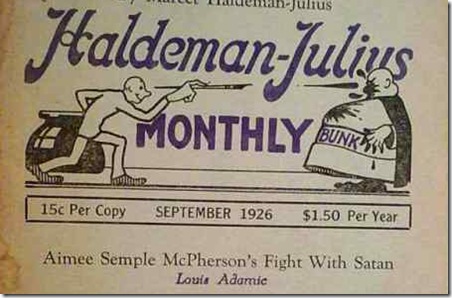
The disappearance and return of evangelist Aimee Semple McPherson made 1926 a prolific year for Los Angeles author Louis Adamic (d. 1951), best remembered today for his 1931 book “Dynamite.” Like Morrow Mayo and other writers in H.L. Mencken’s shock troops against the “booboisie,” Adamic had a biting wit, and McPherson offered an easy target for his sharp pen.
Some of Adamic’s works appear in Emanuel Haldeman-Julius’ trove of small pamphlets, but there was also a monthly (and for a while a quarterly!) where other polemics may be found. An EBay vendor has listed the September 1926 issue of the monthly, containing “Aimee Semple McPherson’s Fight With Satan,” which was apparently not republished as a pamphlet. (“The Morons of Los Angeles,” another blast at McPherson from the November 1926 issue, is republished in the Haldeman-Julius pamphlet “The Truth About Los Angeles.”)
Bidding on this rare item starts at $12. [And yes, the Daily Mirror HQ already has a copy, otherwise I would be sniping it myself.]
ALSO
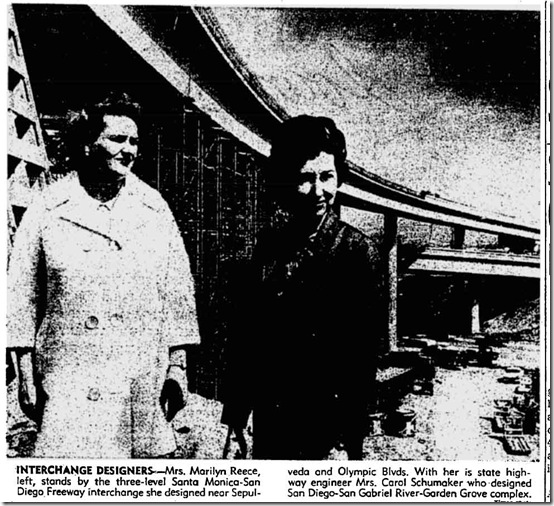
Speaking of CARMAGEDDON, here’s an April 6, 1964, profile by The Times’ Dorothy Townsend of freeway engineers Marilyn Reece, who designed the 405-10 interchange and Carol Schumaker, who designed and 405-605 interchange.
It may be a man’s world, but don’t worry, guys: “I go to market and wash and feel just like the girl who stays home all the time. You couldn’t tell the difference,” says Carol.
ALSO
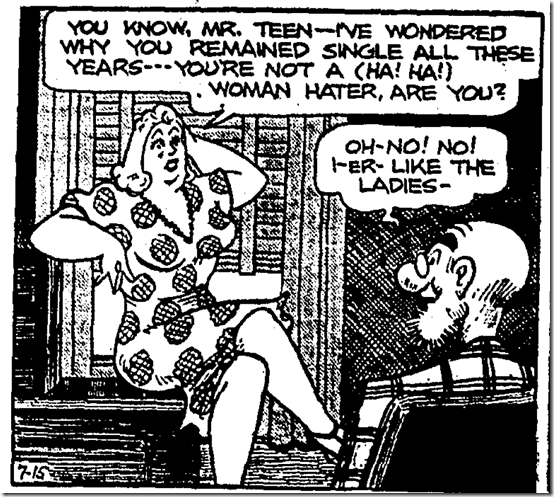
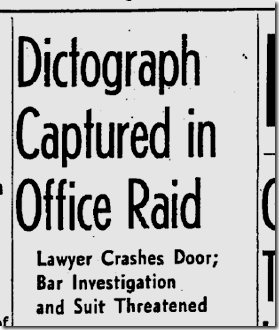
July 15, 1941: Defense attorney Samuel Rummel (shot to death Dec. 11, 1950) breaks a door and seizes a dictograph wired to a microphone in his office in the William Fox Building, 608 S. Hill. Rummel was defending Deputy Charles Rittenhouse on charges of taking bribes to protect a bookie operation in an unincorporated portion of Hollywood under county jurisdiction. Rittenhouse was found not guilty on July 8, 1942. To my knowledge, Rummel’s slaying was never officially solved.
Lee Shippey visits Big Bear and writes about some of the unusual characters living up there — and a dude ranch for dogs.
Tom Treanor, who was killed covering the liberation of France in World War II, reports on the frustrations of writing under censorship: “From the Pike at Long Beach, anyone could look out this day and see the battleship and two heavy cruisers which had just come in…. Yet, still and all, it is considered shameful to write the name of the battleship or the two heavy cruisers.”

Photograph by Larry Harnisch/LADailyMirror
Someone has hung this little figure from an overhead wire at Hill and College streets on the way into downtown. Until I got a good look, I thought it was Boris Badenov – and maybe it is. Or perhaps it’s some hipster thing. At least it’s not an old pair of gym shoes.
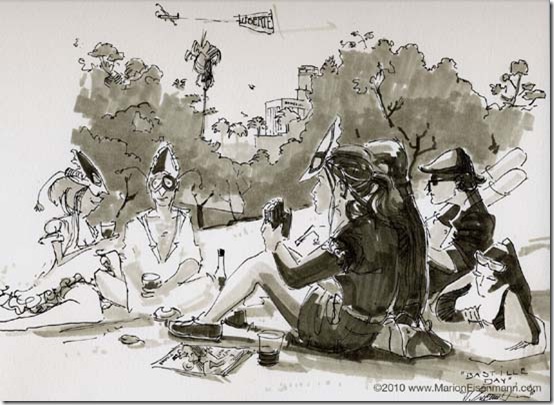
“Bastille Day” by Marion Eisenmann
It’s Bastille Day, so I thought I would repost a sketch Marion Eisenmann did a year ago during a gathering in Elysian Park.
July 16, 2010: Marion Eisenmann called Sunday and suggested we visit a Bastille Day celebration in Elysian Park. I practiced my rusty high school French on the way there with Marion quizzing me “How would you say ‘I’m hungry?’ ” (My teacher, Madame Royce, would be so pleased that I remembered).
This gallery contains 3 photos.
Here’s a better look at the courthouse at Temple and Broadway, where Wednesday’s photo of Broadway was probably taken. In what I call “seismic Darwinism,” the courthouse was demolished after being damaged in the Long Beach quake. The Hall of … Continue reading
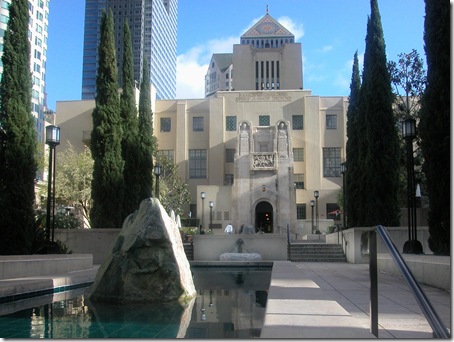
Photo: Los Angeles Public Library. Credit: LAPL
FEATURED
A celebration will be held at the downtown library on Monday at 9:30 a.m. as the L.A. library system restores Monday service at all branches. Sunday closures are continuing, however.
Saturday will be John Lautner Day at LACMA with more events to follow, celebrating the architect’s centennial.
RECOMMENDED
James Cuno gives an exit Q&A to the Chicago Tribune’s Lauren Viera before leaving the Art Institute of Chicago to become president and chief executive officer of the J. Paul Getty Trust.
The New York Times’ Michael Kimmelman muses on the current state of Leonardo’s “The Last Supper” and writes a thoughtful, provocative essay: And so the picture I found filthy but florid during the gritty days of late Fellini and the Red Brigade had been reborn into the fastidious age of soy milk and nanotechnology. In lieu of lone pilgrims and natural light, package tourists making online bookings joined artificial lights that flattened the image. Modernized in its new climate- and crowd-control environment, one of the most familiar pictures in the history of art suddenly seemed alien, like vacuum-packed heirloom tomatoes and no-smoking parks. Even the time limit, a courtesy of the modern hospitality industry, only discouraged visitors from getting to the bottom of the bottomless.
June Q. Wu of the Washington Post profiles Fenella France, a preservation scientist at the Library of Congress,
“There’s quite a lot of detective work in this,” said France, who joined the Library of Congress staff in 2007. “I can find something, like the smudge, and say here’s what we’ve got, here’s some extra text, and we’ll collaborate with historians to see if it’s relevant.”
My L.A. Times colleague Elaine Woo, who makes an art form of the obituary, has one on Theodore Roszak, who coined the term “counterculture.”
Woo writes: Roszak was an author and longtime professor at Cal State East Bay whose best-known work defined an era: He wrote “The Making of a Counter Culture” (1969), a nonfiction bestseller that popularized the word “counterculture.”
Drawing on the works of influential thinkers such as Herbert Marcuse, Paul Goodman and Alan Watts, the book examined the intellectual underpinnings of the social tumult that began in the mid-1960s and extended into the 1970s — the campus protests, love-ins, rock music and psychedelic drug fests that infected masses of young people and bewildered their elders. The youths comprised “a culture so radically disaffiliated from the mainstream assumptions of our society,” Roszak wrote, “that it scarcely looks to many as a culture at all but takes on the alarming appearance of a barbaric intrusion.”
Continue reading

OK, as long as we’re satirizing Carmageddon with a Hitler rant, here’s my favorite humorous video set on the 405. It’s by Bruce Branit and Jeremy Hunt.
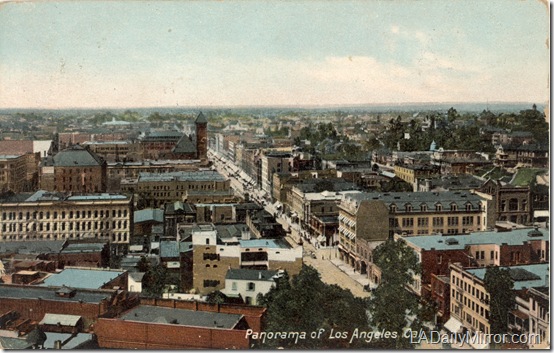
I got this postcard on EBay because the details are sharp and it shows The Times Building before it was blown up in 1910. The picture was most likely taken from the beautiful old courthouse farther north on Broadway that was demolished.
So I thought it would be fun to compare it with the way it looks on Google Earth.
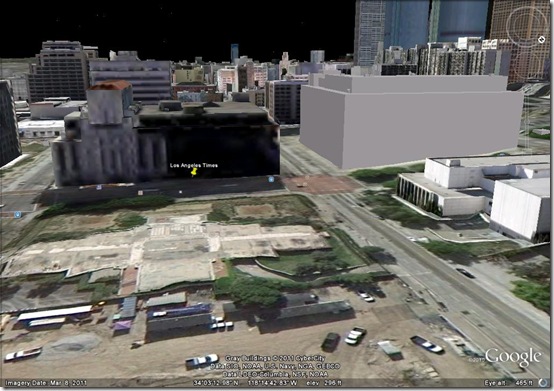
The gray “ghost” building on the right represents the Cold War monstrosity that was demolished after being damaged in the Northridge earthquake. At the moment, it’s a big hole in the ground that collects rainwater and is growing weeds.
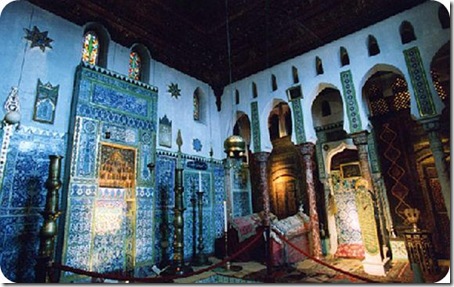
Photo: Pierre Loti’s house. Credit: Discover Poitou Charentes
RECOMMENDED
Elaine Sciolino’s new travel column Lumiere in the New York Times takes a look at the house museum of Pierre Loti.
Sciolino says: “On an unremarkable street in the unremarkable town, the Loti house museum — two attached bourgeois houses, really — is an alternate world where wildly divergent cultures and epochs are thrown together. Loti was an eccentric of his era, and would be considered eccentric even today.”
Continue reading
The Los Angeles Public Library will present a program on getting started in genealogical research. The free presentation will be from 11 a.m. to 11:30 a.m. on Saturday, July 16, 2011.
Folks should gather at the reference desk in the History & Genealogy Department on Lower Level 4. No reservations are necessary for groups of six or less. Larger groups should schedule an appointment at (213) 228-7400.
As we say at the Daily Mirror: Any day we can do research is a good day.
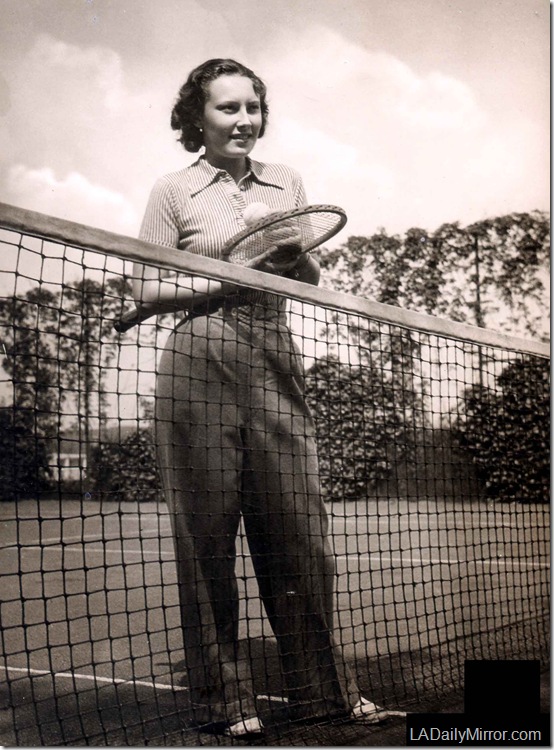
Here’s our mystery tennis player! Thanks to Steven Bibb for sharing this photo.
[Update: This is Lida Baarova. Please congratulate Jenny M, Don Danard and Rick for identifying her and her mystery companion Joseph Goebbels.]
There’s a new photo on the jump!
 ladailymirror.com