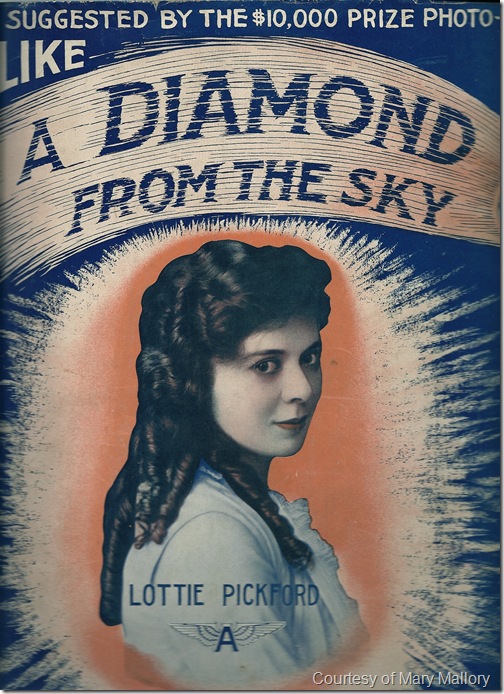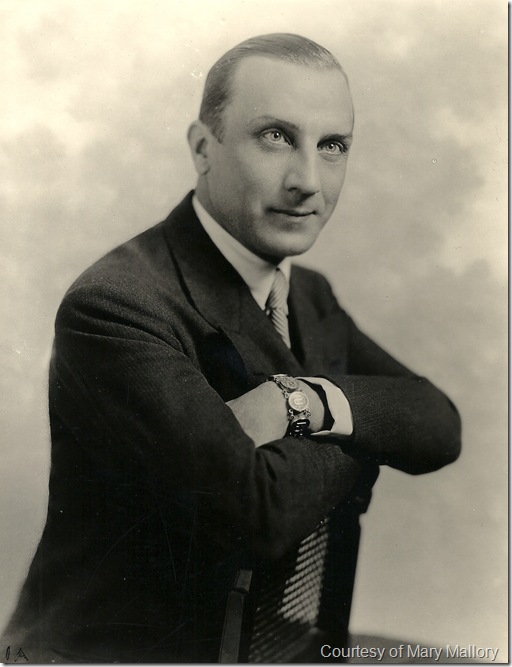
Today’s mystery folks are from the collection of Mary Mallory. Thanks, Mary!
Please congratulate Bob Hansen, Mike Hawks and Tim Doherty for identifying our mystery gal. And thanks to Mary for sharing a mystery photo.

Today’s mystery folks are from the collection of Mary Mallory. Thanks, Mary!
Please congratulate Bob Hansen, Mike Hawks and Tim Doherty for identifying our mystery gal. And thanks to Mary for sharing a mystery photo.

From the beginning of the motion picture industry, film companies devised all types of advertising to entice consumers to buy movie tickets. Posters, lobby cards and window displays, glass slides, sheet music and photographs could be employed by exhibitors to lure patrons to see new moving pictures. But how did theater owners learn about promotional materials to help grow their profits?


Jan. 13, 1943: The inquest in the death of Stanley H. Beebe, who was fatally injured in a beating by LAPD officers, is halted when Officer John Yates kicks Herald-Express photographer Edward Phillips in the groin. Recall that it was the police attack on another photographer, covering the 1956 wreck of the San Diegan south of downtown, that began unraveling the cozy relationship between the press and the police in Los Angeles.

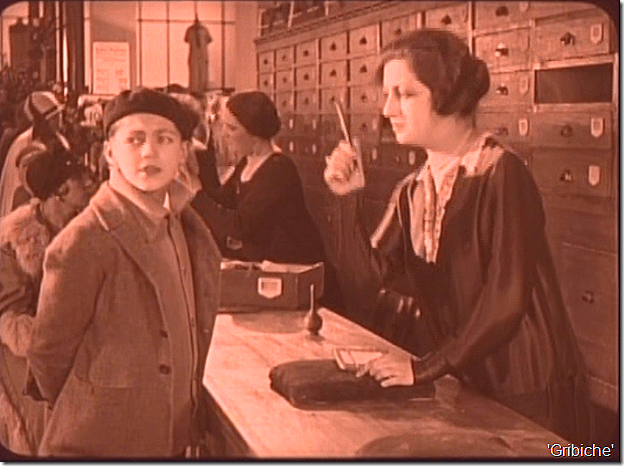
A little of Loretta Young (featured this month on TCM) goes a long way at the Daily Mirror HQ, but I noticed these shots of a department store in “Employees’ Entrance” and they reminded me of the sequence in “Public Enemy,” which was identified as being filmed at the May Co. These light fixtures certainly look familiar.

Jan. 23, 1913: Juggling, rope-walking seals! Little Miss Manicure and the Scarecrow Man!
On the jump, a couple of juicy divorces and Carl Warr, the dynamiter.

Read the entire Jan. 24, 1863, issue of the Los Angeles Star, scanned by USC from an original copy at the Huntington.
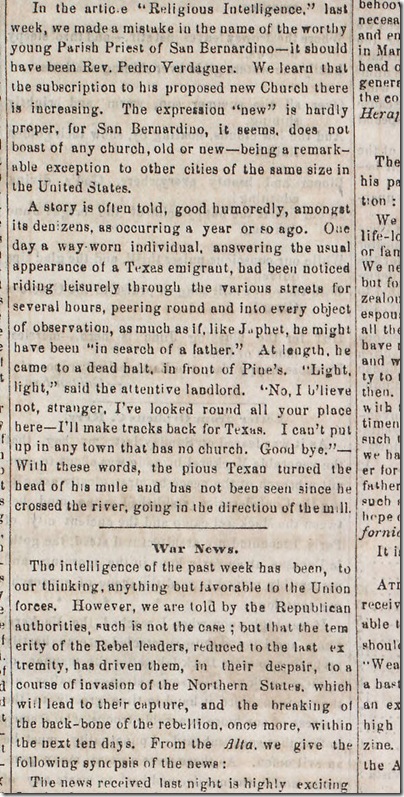
Jan. 24, 1863: Most of the Los Angeles Star is devoted to details about the progress (or lack of it) in the Civil War, but there are a few items of local interest. There’s a report of rain, the birth of a daughter to Mrs. Harris Newmark and the birth of a son to Mrs. Laubenheimer. Robert Barker married Melinda Ervin in a ceremony performed by Bishop Thaddeus Amat.
On the jump, in its continuing derision of the North, the Star says: “The redoubtable Thad. Stevens proposes a bill to enrol 150,000 Negroes to do the fighting down South for their white brethren. The climate down that way is becoming too hot for the Northern army, and hence an army, 150,000 strong, of African descent, inured to the climate, is to be formed.


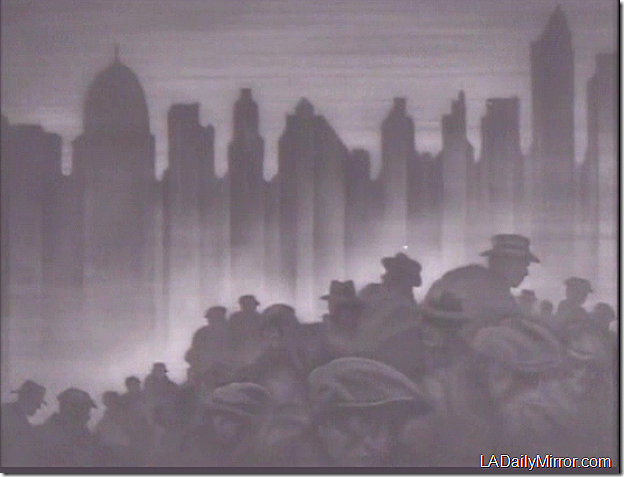
Here’s a mystery lad in a newsboy cap!
How to Wear a Hat – Newsboy Cap Edition
How to Wear a Hat — ‘Grapes of Wrath’ Edition
Movieland Mystery Photo – Newsboy Cap Edition I
Movieland Mystery Photo – Newsboy Cap Edition II
Movieland Mystery Photo – Newsboy Cap Edition III
Movieland Mystery Photo – Newsboy Cap Edition IV
Movieland Mystery Photo — Newsboy Cap Edition V
How to Wear a Newsboy Cap – Marc Chevalier Edition

Oct. 16, 1917: An architect’s rendering of Chaplin’s studios in The Times
Ninety-five years ago, comedian Charlie Chaplin constructed the first beautiful studio lot in Hollywood, the first to offer style to filmmaking. What had been merely an industry housed in utilitarian structures soon blossomed into one that featured elegance in its buildings.
Filmmaking was exploding around Los Angeles in the 1910s as filmmakers moved west for the sunlight, varied landscape and freedom from patents. Early studios were merely converted buildings; Nestor Film Co. converted the former Blondeau Tavern into a working studio in 1911 and in late December 1913, Lasky Feature Play Co. rented a little barn at Selma Avenue and Vine Street as their filmmaking site.
Soon, film companies began building their own plants, mostly plain, functional buildings. Actor/comedian Charlie Chaplin decided to join the building boom in 1917 and constructed his own studio in Hollywood. His would evoke class and beauty.
The Oct. 16, 1917, Los Angeles Times reported that Chaplin would construct his own studio where “the plant will be at once a workshop and a home for the movie idol….” Chaplin and his brother Syd acquired the R. S. McClellan estate at Sunset Boulevard and La Brea Avenue as the site for their facility. The estate, constructed in 1914, consisted of five acres of lemon and orange trees and the “sightly ten-room colonial house set in the midst of lawn and gardens.” This house would become their home, while the lower acreage would house the studio.
Architects Meyer and Holler’s plans, featured in the paper, presented a picturesque little English Tudor village of buildings lining La Brea Avenue, to be constructed by Milwaukee Building Co. for approximately $100,000. Meyer and Holler were recognized as one of the top architectural teams in Los Angeles, designing Ince and Goldwyn Studios, and later designing Grauman’s Egyptian Theatre, the Montmartre Cafe and the Hollywood Athletic Club.
Per the newspaper, obstructionists originally mistakenly believed the studio would be erected adjacent to and behind Hollywood High School, disrupting students from learning. Businessmen spoke out to the City Council supporting construction. Banker Marco H. Hellman and other businessmen spoke out forcefully in favor of the project, noting the importance of the film industry in providing jobs to Los Angeles. He also stated, “Mr. Chaplin has done more in the way of advertising Los Angeles than probably any other man.” The council voted 8 to 1 in favor of construction proceeding.
The Jan. 20, 1918, Times noted that the new lot opened for business on Tuesday, Jan. 15. Writer Grace Kingsley described the special tour a happy and jolly Chaplin himself gave her of the new facility. Chaplin told her, “See, here’s a lemon orchard back of the stage. Think lemons must be my lucky fruit – can’t escape ‘em – had a lemon orchard back of us at Essanay and one at the Lone Star – hope they keep the lemons in the orchards, though.” Chaplin stated that “the fellow that couldn’t be happy here would be the fellow that would write a want ad in heaven.”
Kingsley found the comedian charming, especially in his description of his uniform of baggy old clothes as his “salary.” She understood the exacting nature of his work. “Charlie’s comedy seems entirely spontaneous – that’s its wonderful charm. But beneath it all he has the mathematics of merriment, the logarithms of laughter, at his finger’s ends.”
Chaplin spent many happy years making films at 1416 N. La Brea Ave., before being denied reentry to the United States in 1952. The studio stayed busy, however, appearing in the film Hollywood Story in 1951, and acting as the home for many filmmakers. Stanley Kramer employed the location in 1954, American International in 1960, Red Skelton in 1962, and A & M Records in the 1970s and 1980s. Today, Henson Productions occupies the site, and a giant Kermit the Frog adorns the roof, clad in oversized clothes and bowler hat, an homage to the Little Tramp.
I thought it would be fun to compare “Chickens Come Home” and “Politiquerias,” which aired recently on Turner Classic Movies.
A shot-by-shot comparison shows that even though they use the same plot and camera setups, the English- and Spanish-language versions differ markedly. Notice that Art Lloyd was the cinematographer in the English version and Jack Stevens did the Spanish-language version. And even though both versions were edited by Richard Currier, they are cut quite differently. The Spanish version uses more close-ups and there are some gags that only appear in the Spanish version. Most important is a long entertainment sequence at Ollie’s home featuring Cantu the magician (Abraham J. Cantu) and the Senor Ali (Hadji Ali).
In the English-language version, Ollie’s old girlfriend is played by Mae Bush. In the Spanish-language version, she is played by Rina De Liguoro.

Cantu the magician in “Politiquerias,” in what appears to be his only film, according to imdb.

Mr. Ali – a very thirsty man.
Here’s the first seven minutes of both films:
| “Chickens Come Home” is missing the MGM lion! |
“Chickens Come Home” |
“Politiquerias” |
![]() |
|
![]() |
![]() |
![]() |
![]() |
![]() |
![]() |

Hobart Bosworth’s previously unknown role as Bob the Tomato.
Jan. 18, 1983: Gay men are “known to be at increased risk of acquiring a mysterious and often fatal new disease that suppresses the body’s immune system” so the National Hemophilia Foundation is seeking to bar them from donating blood, Times medical writer Paul Jacobs says.
Several other organizations, including the Red Cross, oppose the ban, saying that it’s ineffective in stopping the spread of AIDS.

Mary Mallory notes that today is Mack Sennett’s birthday. Read Mary’s post on Sennett here.


Here’s another mystery photo, courtesy of Mary Mallory. Thanks, Mary!
This is Gloria Dickson, who burned to death in a fire in 1945.


Jan. 17, 1943: District attorney’s investigators question Police Sgt. James F. Martin about the arrest of Stanley H. Beebe, who died after being beaten by LAPD officers.
Martin said that he got a bloody nose and two broken ribs in his struggle with Beebe after Martin boarded a streetcar and 3rd and Hill. The conductor asked Martin to remove Beebe, who was drunk and disorderly, but Martin wanted to wait until the car got to 1st, near the old Central Police Station.
“It took every ounce of strength I had to get Beebe off the car,” Martin said.

Here’s another mystery photo, courtesy of Mary Mallory. Thanks, Mary!
Nobody guessed our fellow — let me see if I can find more photos of him before revealing the answer.

A lot of material belonging to Ferdinand Earle (d. 1951) has been listed on EBay. Earle was an art director, writer and director in the silent era. The photo above is from “Womanhood,” on which he was art director. He also directed “A Lover’s Oath,” which is considered lost. The items are listed as Buy It Now for $1,200. As with anything on EBay, material and the vendor should be evaluated thoroughly before submitting a bid.
Yes it’s Jan. 15. I remember it very quietly by trimming my roses.

Read the entire Los Angeles Star of Jan. 17, 1863, courtesy of USC and the Huntington Library.
Jan. 17, 1863: The Star notes that after a year of being banned from the U.S. mails for publishing treasonous articles in support of the Confederacy, it will once more be available through the mail.
Mr. Humphries, who lives near San Gabriel, celebrates having the entire family, “down to the youngest grandchild” together “under the paternal roof.” “Dancing was kept up with great spirit until daylight.”
Joseph Winston is married to Dona Maria J. Bauchet.
Gov. Stanford, in his message to the Legislature, wants to raise the tax by 23 cents on $100. The Star does not approve.
A sample of the Star’s editorial:

Here’s a mystery chap courtesy of Mary Mallory. Thanks, Mary!!
This is Felix Knight. Please congratulate Mike Hawks and Bob Hansen for identifying him!

Photo: Walter Wanger, left, and Jerry Giesler. Courtesy of Mary Mallory.
Long before Johnnie L. Cochran Jr., Richard “Racehorse” Haynes, or F. Lee Bailey hit the scene, soft-spoken, circumspect Jerry Giesler iced his competition as Los Angeles’ top criminal defense lawyer. Representing everyone from gangsters Mickey Cohen and Ben “Bugsy” Siegel to such celebrities as Charles Chaplin, Errol Flynn, Marilyn Monroe, Busby Berkeley, Robert Mitchum, and Lili St. Cyr, Giesler mowed down his competition with smarts, over-preparation, and working the system.
Giesler spent big sums hiring detectives to hunt down evidence, screen witnesses, and perform surveillance work. Film studios lavished huge fortunes for him to defend their world-famous stars from scandal and scathing publicity. High-profile personalities utilized his services in messy personal matters to overpower and muscle their opponents. Giesler excelled at putting the prosecution and its own witnesses on trial.