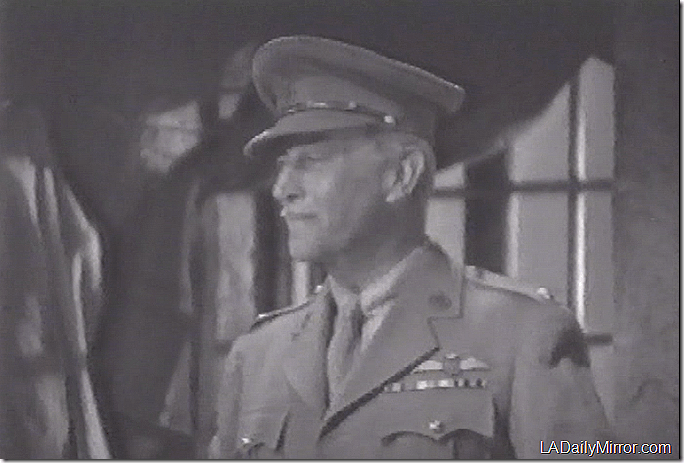
And for Friday, a mystery chap, courtesy of Christopher McPherson.
Thursday’s mystery guest, Alice Joyce, was identified by Laura, Mary Mallory, Eve Golden, Joan Myers, Bob Hansen, Kent, Mike Hawks and Maedez. Congrats!
And for Friday, a mystery chap, courtesy of Christopher McPherson.
Thursday’s mystery guest, Alice Joyce, was identified by Laura, Mary Mallory, Eve Golden, Joan Myers, Bob Hansen, Kent, Mike Hawks and Maedez. Congrats!

Nov. 22, 1963: The Times publishes an extra.
I recently attended graduation exercises for a local college and the commencement speaker spent quite a while talking about how the 1963 assassination of President John F. Kennedy was a watershed moment in her life.
As she was speaking, I studied the faces in the audience — the family and friends of people in their early 20s who were graduating from college — and wondered: “What on Earth do these kids make of this? Does it resonate at all?” Actually, no. Not in the least. And why should it?
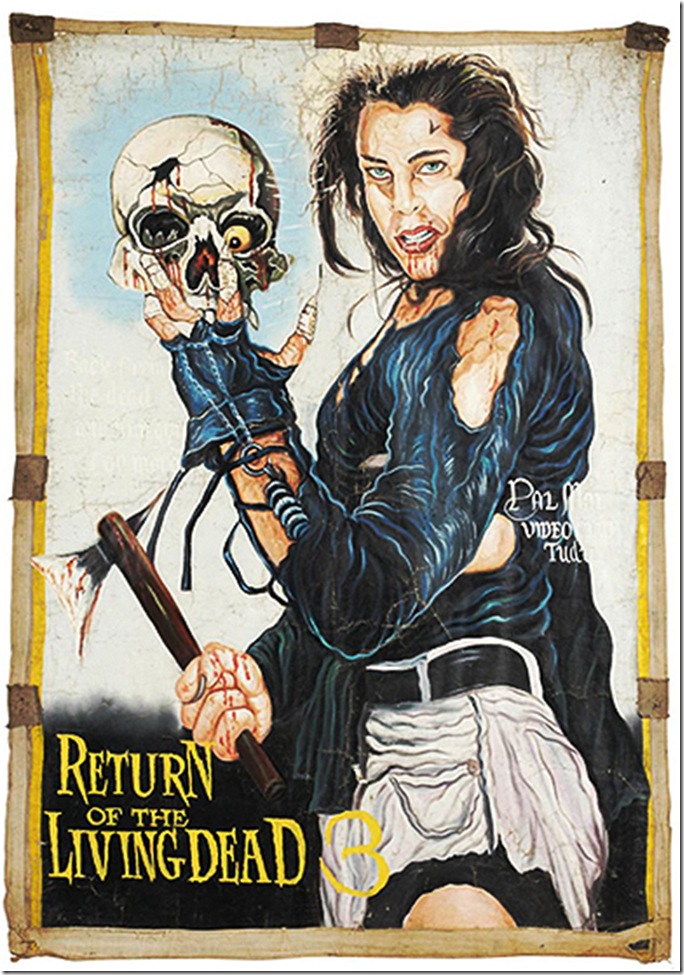
“Return of the Living Dead 3” as interpreted by an artist in Ghana.
The Ernie Wolfe Gallery at 1653 Sawtelle Blvd., in West Los Angeles is presenting a show titled “The Horror, The Horror,” curated by Brandon Boyd featuring hand-painted movie posters from Ghana. The artists’ interpretations of Hollywood films are quite amazing. The show continues through Dec. 8.
Here’s a sample: Michael Jackson in “Thriller.” | “Critters 2.” | “Return of the Living Dead.”
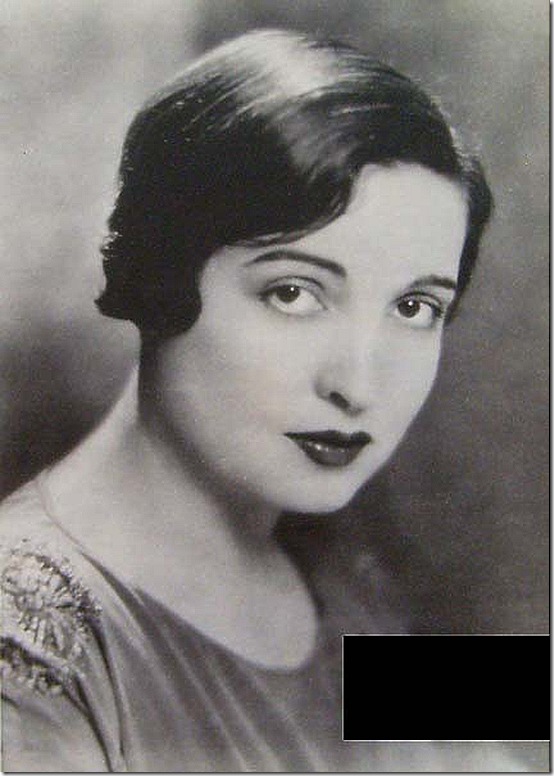
And here’s Thursday’s mystery guest, courtesy of Christopher McPherson. Please congratulate Mary Mallory and Mike Hawks for identifying yesterday’s mystery chap.
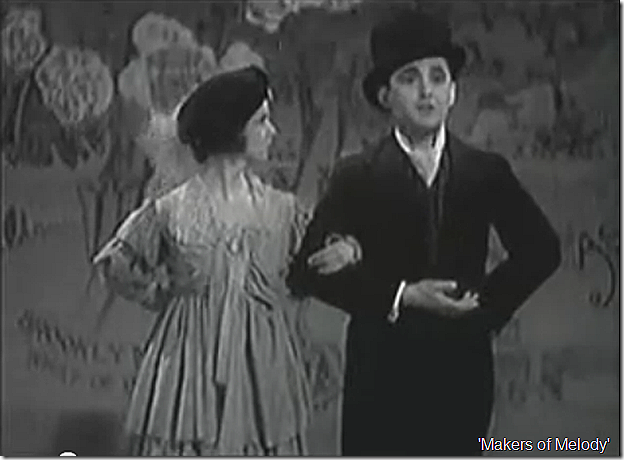
Ruth Tester and the mysterious Allan Gould sing “Manhattan” in “Makers of Melody.”
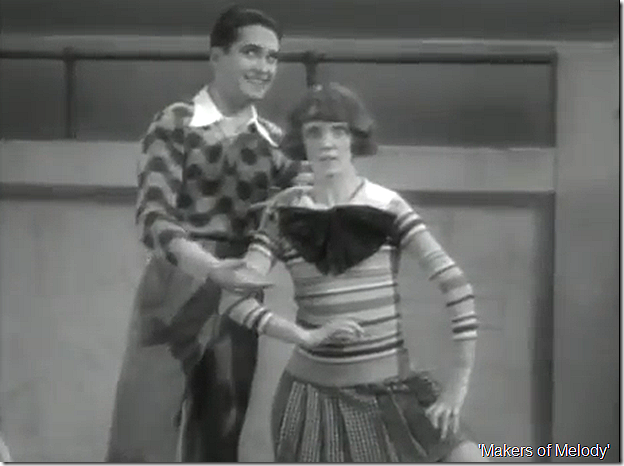
The mysterious Allan Gould with Inez Courtney in “The Girl Friend.”
We have the illustrious Eve Golden to thank for this mystery. The other day, Eve forwarded me a link to the YouTube clip “Makers of Melody,” a 1929 short subject featuring Richard Rogers and Lorenz Hart talking about how they wrote their Broadway tunes.
Stephen Holden of the New York Times described the film in 1991:
Like many of the other shows in the series, which is beginning its 21st year, the program offered some fascinating bits of esoterica. Somehow, Mr. Levine had dug up a bizarre 1929 two-reel film, “Makers of Melody,” in which Rodgers and Hart appeared as themselves horsing around like Dean Martin and Jerry Lewis and gleaning ideas for songs from their absurd, scripted banter.
That’s a pretty harsh and unfair assessment. Granted, “Makers of Melody” may seem a bit stiff compared to the exploding hardware of the recent 3-D opus “Gravity,” but taken in the context of early talkies, it does provide an interesting view of performance practices as they were in 1929.
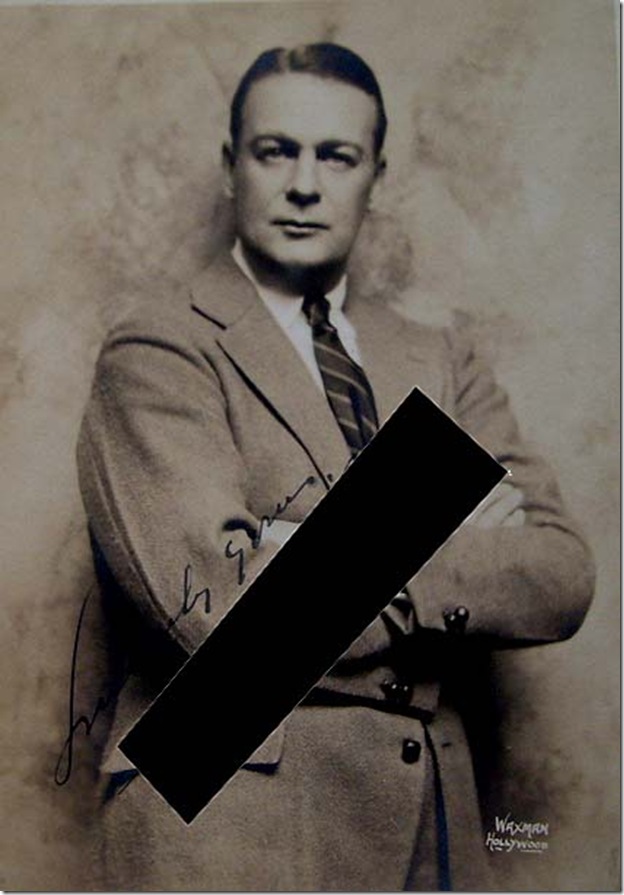
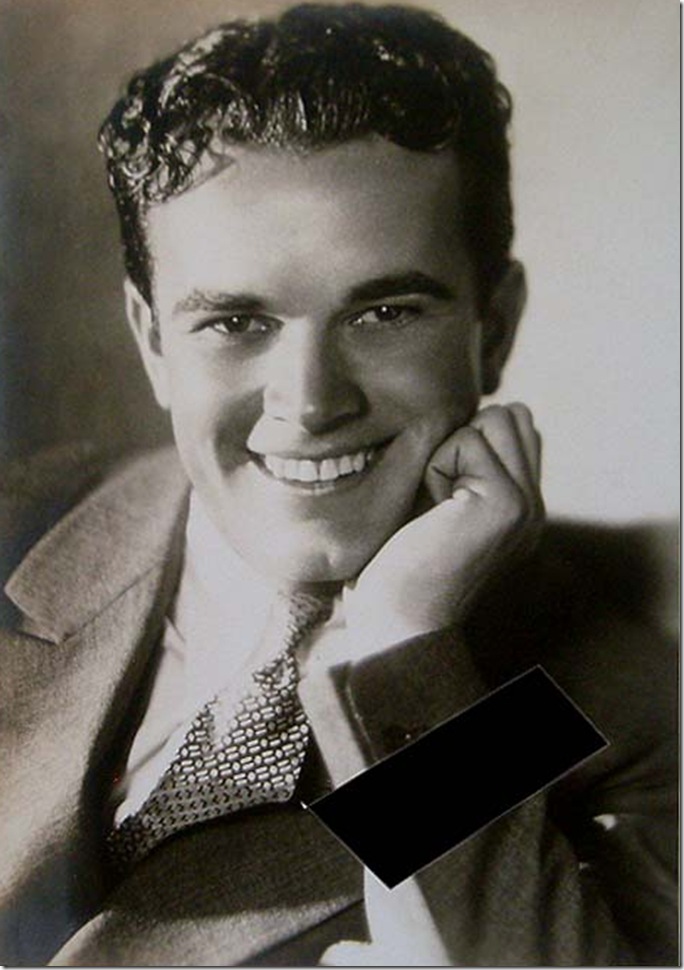
Here’s another mystery photo courtesy of Christopher McPherson. This is from the Waxman studio, a name I don’t recall encountering before. The annoying black box is where our mystery guest inscribed his photo.
Please congratulate Bob Hansen for identifying Monday’s mystery fellow as Alexander Gray; and Patrick, Mary Mallory and Cat Murray for identifying Tuesday’s mystery guest as Alberta Vaughn.
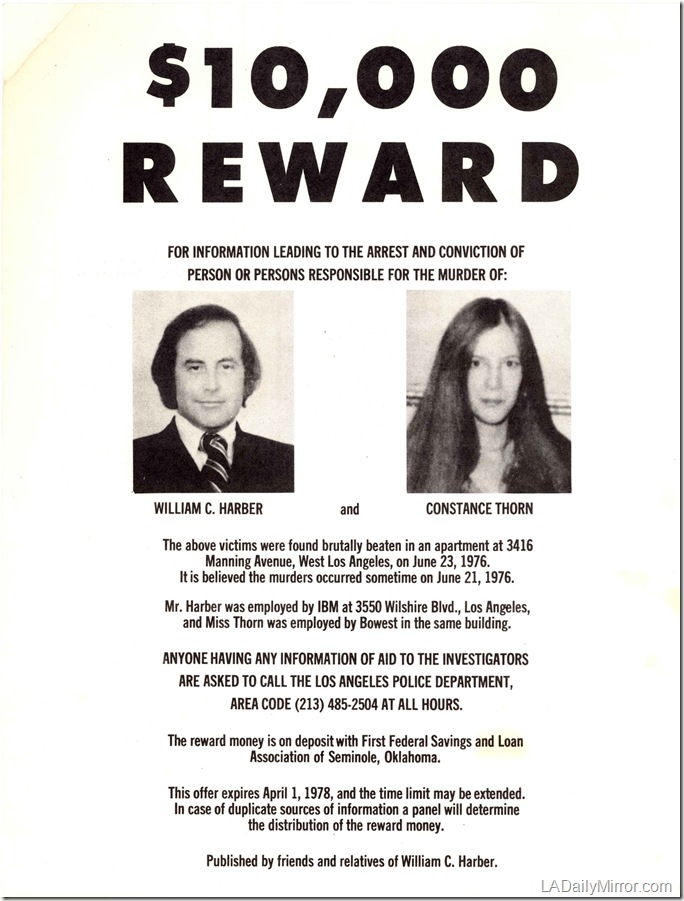
June 23, 1976: William C. Harber and Constance Thorn are found beaten to death in an apartment at 3416 Manning Ave. The case has never been solved.
Several weeks ago, I was given a box of material that was cleaned out of the old press room at the LAPD’s Parker Center headquarters, sometimes called “the cop shop.” The box was a jumble of press releases, photographs, artists’ sketches and other items dating from the late 1960s to the early 1980s. I am organizing and cataloging the material and I’ll be posting selected items on a weekly basis.
March 29, 1977: This is a haunting case and curiously enough, not much was written about it. I only find two articles in The Times.
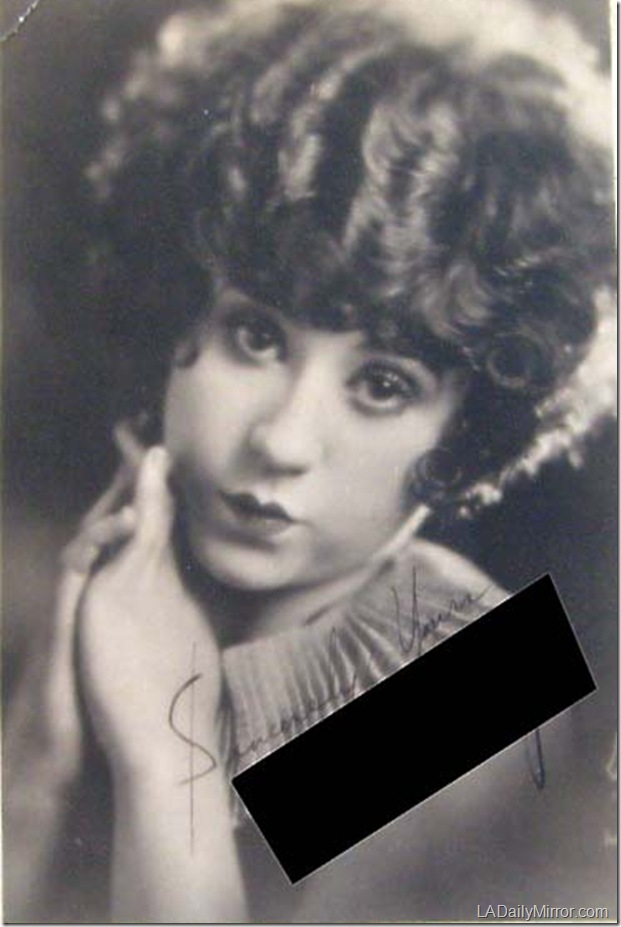
Here’s our second mystery guest, courtesy of Christopher McPherson. The annoying black box is where our mystery woman left her autograph.

Jan. 6, 1936: In this installment of Rediscovering Los Angeles, Times artist Charles Owens and columnist Timothy Turner visit Borgia Studio, on Sunset Boulevard near the Plaza. This is a particularly nice post by Turner about the way photo studio portraits reflect the changing times:
They don’t pose as they did a decade ago, either. The bridegroom no longer sits in the ornate carved chair while the bride stands with her hand on his shoulder, a posture denoting loving possession as well as triumph at having caught her man. Now, she sits while he stands or they both sit — either chivalry or equality. Now they look like cinema stars posting for a press “still.”

Several weeks ago, the Daily Mirror asked for suggestions about mystery photos. Writer and novelist Christopher McPherson responded with a large number of photographs, which he shared with us. Here’s the first one. The annoying black box to the left covers the spot where our mystery chap autographed his picture and the little black box at the right covers the code number. Thanks, Christopher!

Before CNN, the worldwide web, and the 24-hour news cycle, most persons received their only news of outside world and national events through newspapers. Most cities possessed multiple newspapers pitched to different audiences, some focusing strictly on hard news, some featuring the tabloid, to cater to this important need.
With the invention of moving pictures, films became an integral part in relaying the visceral and emotional impact of news events. In fact, they sometimes shaped news and influenced national policies. J. Stuart Blackton re-created and reenacted battles of the Spanish-American War with the “The Battle of Santiago Bay” and “The Battle of Manila Bay” in 1898, inflaming prejudices and inflating American action. The 1912 short “Saved From the Titanic,” filmed just weeks after the actual sinking of the great ship, reenacted the terrible disaster. While people searched out documented histories of important events in newspapers, many also desired visual representations of these happenings.
Mary Mallory’s “Hollywoodland: Tales Lost and Found” is available for the Kindle.
Note: This is a story I originally wrote in 2006 for the 1947project and I’m reposting it for newer readers.
Nov. 16, 1907: Mrs. Amanda Cook (she is also identified as Jennie and Mary) came to Los Angeles from Boston in 1906 with two of her children in search of her husband, Frederick, a union plasterer and bricklayer. She advertised in the newspapers without success and finally took a job as a cook at the Juvenile Detention Home.
Persuaded by her cousin to seek a divorce, she hired attorney George W. MacKnight, who sought out her errant husband and began divorce proceedings.
One day, after being threatened with divorce, Frederick appeared at the juvenile home and upon seeing his wife, said: “What the hell did you come out here for? Why didn’t you stay with your folks in Boston?”
At his office, MacKnight attempted a reconciliation. When asked if he thought he should support his children, Frederick said: “Yes, but I blow in my money with the boys and cannot save a dollar for the kids.”
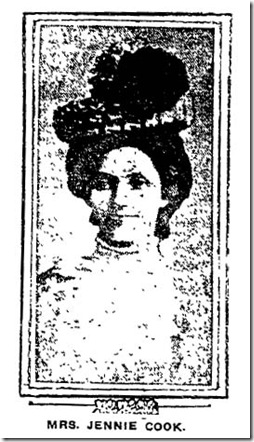 Frederick said he didn’t want to get a divorce, so MacKnight asked Amanda if she would take her husband back. “Fred, you know I’ll do that in a minute,” she said. Frederick agreed to rent a house for them as long as MacKnight dropped the case—but the lawyer refused until Frederick made good on his promise.
As soon as the Cooks got into the hallway, Frederick said: “Do you think I’m going to be damn fool enough to support you and those kids?”
His wife replied: “Oh, Fred, you don’t mean that. Why, you just promised to take us back and get a little house for us all together.”
“Well,” Frederick replied, “if you don’t make the lawyer of yours dismiss this case I’ll kill you and him and the judge, too, and if the bum police ever catch me, I’ll kill myself.”
Amanda got a divorce, telling her lawyer: “I’m not afraid of him because he has threatened to cut my throat or blow out my brains a thousand times.”
Frederick began plotting to kill her. His first idea was to murder her at juvenile hall by shooting through a hole he cut in a screen, but he fled after being caught putting a pistol in the opening.
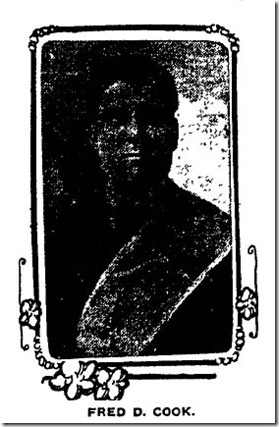 The next idea was far more cunning.
A champion roller-skater, Frederick went to a hairdresser on South Broadway, where he bought a false mustache and had his hair dyed, explaining that he was so well known in roller contests that he was prevented from entering.
On Aug. 27, 1906, he found Amanda on the fast streetcar from Santa Monica, sat next to her and shot her in the forehead, then stood up and shot her twice more. Several passengers grappled with him and got the gun, but Frederick swung free of the moving streetcar “near the Hammel and Denker ranch,” The Times said, and escaped.
Amanda’s bloody body was left between the seats as the car completed its rounds, slowly sliding down until “only the pathetic, shabby little shoes stuck out into the aisle to haunt those who made that terrible ride,” The Times said.
Frederick surrendered a year later in Fort Worth, Texas, claiming the shooting was authorized by “unwritten law” because he caught his wife with another man.
In 1908, he was convicted and sentenced to life in prison at San Quentin. As for the Cooks’ three children (an older child had been left with relatives in Boston) no record can be found.
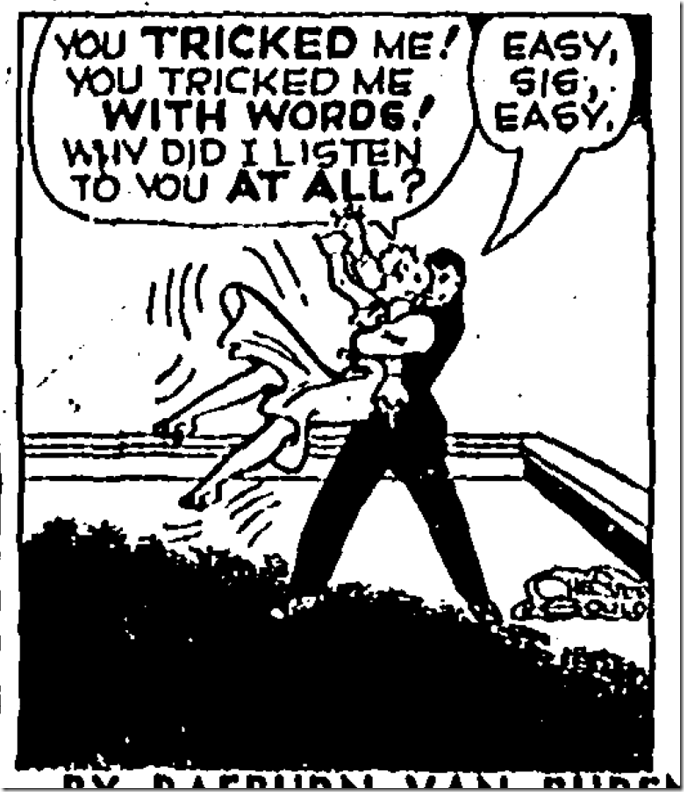
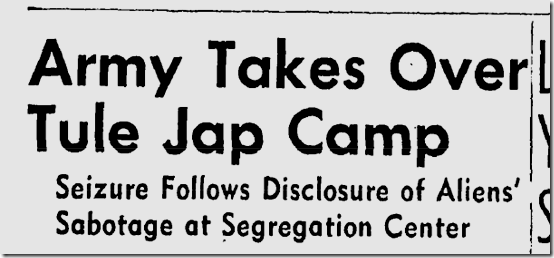
Nov. 3-16, 1943: It’s almost impossible to get a clear idea from these stories of what was actually occurring at the internment camp at Tule Lake. Early in the saga, one official said “there’s nothing to it,” but later on there are accounts of a riot that may have been staged “on direct orders from Tokyo” and allegations that Japanese at the camp “buried thousands of pounds of fresh pork and used tractors to play polo.” No, really!
In editorials , and in news accounts by Kyle Palmer, The Times had encouraged the evacuation and internment of Japanese in the strongest language. One editorial included below alleges that Dillion S. Myer, head of the War Relocation Authority, was a squishy soft liberal New Dealer (another bete noire of The Times) who refused to take a hard line with “disloyal” Japanese and says that the camps should be put under Army control.
The Dies committee, named for Rep Martin Dies Jr. (D-Texas), referred to in some stories will become better known as the House Un-American Activities Committee. You may have heard of it. If you haven’t, you certainly will.
Opening soon: “Lassie Come Home” and “Young Ideas” at Grauman’s Chinese, Loew’s State, Fox Uptown and Cathay Circle.
Saturday was, in case you had forgotten, the one-year anniversary of Buster the Wonder Dog’s frolic at the Sowden House in a search for evidence to link Dr. George “Evil Genius” Hodel to the Black Dahlia killing. You may recall that Buster “alerted” at several locations and that soil samples were taken for testing for possible human decomposition.
The supermarket media and reporters who specialize in one-source stories have had their fun with “Ex-Homicide Cop Says Evil Dad Killed the Black Dahlia ” and moved on to whatever will pump up TV ratings or is trending on Google, “Victoria’s Secret Fashion Show” being today’s likely topic.
Let’s recap the media frenzy:
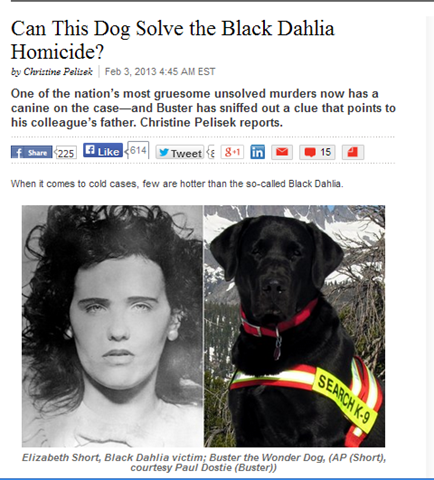
Feb. 3: “Can This Dog Solve the Black Dahlia Homicide?” by Christine Pelisek in the Daily Beast.
And to quote the Pasadena Star-News of Feb. 1 (Author: Cadaver dog discovered Black Dahlia death scene at Hollywood home by Frank C. Girardot):
The Nov. 9 search of the historic Sowden House on Franklin Avenue in Hollywood was set up in conjunction with the TV show “Ghost Hunters.” Although it was filmed, the segment with Buster never aired.
“It certainly seems like someone was murdered there,” Dostie said. “Something happened.”
But the L.A. Daily Mirror has a long memory and we have posted on the matter regularly, inquiring about the results of soil tests, which were expected, according to Pelisek’s article:
Back at the Hodel house last November, Buster was turned loose to search for scents related to human decomposition—and he perked up, or “alerted” as Dostie calls it, at several potential clues in the basement. Soil samples were taken and results are expected next week.
We waited. Next week came and went. And the week after that.
And the week after that.
Months went by.
Nothing.
Now, I hope you aren’t disappointed or surprised, because Steve Hodel and Buster’s owner, retired Sgt. Paul Dostie, went on a show called “Darkness Radio” on Nov. 5 for its “True Crime Tuesday” feature. And at the 34:38 mark, Dostie says:
At that point we sent the samples off, and unfortunately we’ll probably not get analysis on that. (slight laugh) It’s been almost a year now. And it’s really unfortunate. But we can get some from outside…
In other words, the producers of “Ghost Hunters” took Hodel, Dostie and Buster to the Sowden house, filmed Buster engaging in activity that they described as “alerting” to human decomposition and didn’t use it in the show. Then the tape was aired on KNBC-TV Channel 4, on Feb. 1, kicking off sweeps month, when TV stations go into hyperdrive, broadcasting their most lurid, sensational stories in an attempt to boost their Nielsen ratings.
Executive summary: Buster the Wonder Dog’s frolic in looking for Black Dahlia “evidence” at the Sowden House was all about KNBC trying to boost its ratings for sweeps month. It was a nothing story, which is why “Ghost Hunters” didn’t use it. And now we have proof.
Another good story ruined by the L.A. Daily Mirror.
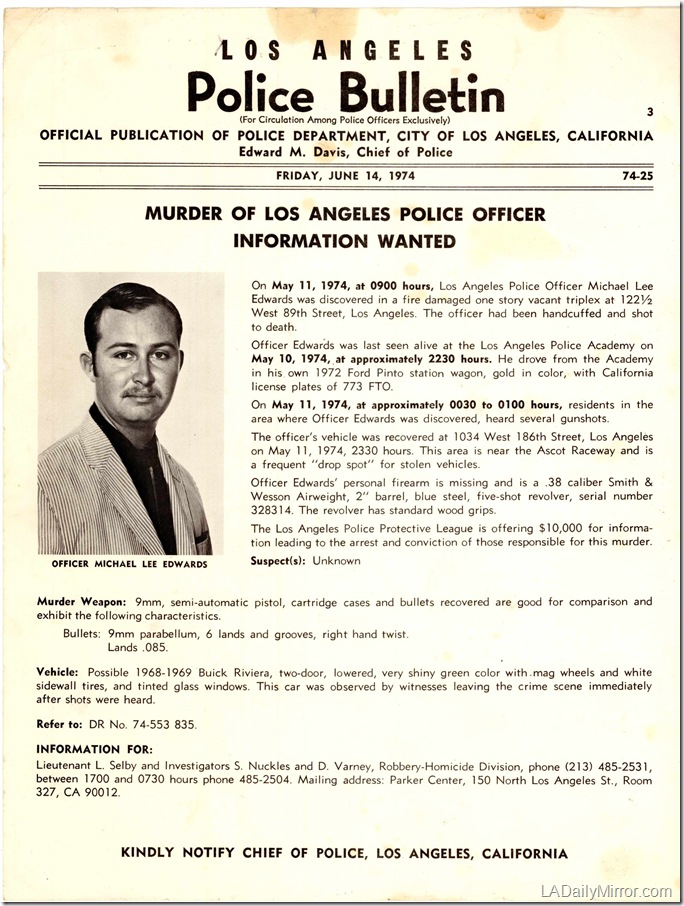
Several weeks ago, I was given a box of material that was cleaned out of the old press room at the LAPD’s Parker Center headquarters, sometimes called “the cop shop.” The box was a jumble of press releases, photographs, artists’ sketches and other items dating from the late 1960s to the early 1980s. I am organizing and cataloging the material and I’ll be posting selected items on a weekly basis.
The majority of the material is from the LAPD, but there are a few items from the Sheriff’s Department, the Fire Department and other agencies. The photos, showing police officers, suspects and victims, are particularly challenging because many of them are undated and unidentified. Some police officers only have badge numbers or serial numbers. Some victims and suspects are only identified by a DR number or a booking number. And some have nothing.
I’m starting with the 1974 killing of Michael Lee Edwards (DR 74-553-835), the only unsolved murder of a Los Angeles police officer.
Here is 2002 story on the case by former Times reporter Anna Gorman.
And the “77th Street Requiem” by Wendy Hornsby sounds suspiciously like the Michael Lee Edwards case. (Sorry, I originally had “99th Street Requiem.”)
Surely there must be at least one gun enthusiast among the Brain Trust who can tell us what kind of 9 millimeter pistol has six lands and grooves with a right-hand twist.
Note: In 2006, I devoted a daily blog to fact-checking Donald Wolfe’s “The Black Dahlia Files” on a molecular level. The project was so time-consuming – and “Dahlia Files” is such junk – that I stopped about Page 96 and began taking requests to fact-check various remaining sections of the book.
I recently noticed that my blogging of the Wolfe book had received new interest and thought it would be valuable to repost the index to all the items, cleaned up a bit. The links lead to another old blog of mine, which looks completely different. Such is the nature of the Internet.
The blog begins: People keep asking me: “Have you read the Wolfe book?” meaning Donald H. Wolfe’s “The Black Dahlia Files: The Mob, the Mogul and the Murder That Transfixed Los Angeles.” My answer is always the same: I bought a copy but I haven’t read it yet.
Still, people keep telling me it’s a wonderful job and solves the murder, usually prefaced by the statement that “I don’t know anything about the case, but…”
So here we go, in excruciating detail, with frequent detours, asides and references to the five-foot shelf of Black Dahlia books. Since I have to read this turkey, you might as well suffer right along with me. If you’re not interested in Black Dahlia minutiae you will find this a painfully tedious process, which is why I don’t read other Black Dahlia books—they’re junk
Update: And in case you are wondering, I still haven’t heard from Wolfe about the faked document (Part 72). Not that I really expected to.
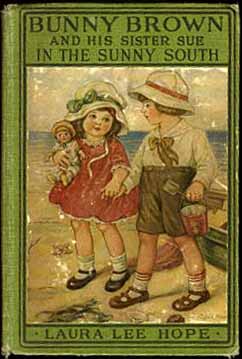
And this, not the Wolfe book, but something more enduring, an installment in the “Bunny Brown and His Sister Sue” series, one of my mother’s childhood favorites.
Larry Harnisch (described by James Ellroy as a Dahlia scholar/Dahlia freak, take your pick) is blogging in real time as he reads Donald H. Wolfe’s “The Black Dahlia Files: The Mob, the Mogul and the Murder That Transfixed Los Angeles.”
Part 1, Blogging the Wolfe Book
Part 2, The Monster
Part 3, Extra! Extra!
Part 4, Sniff Test
Part 5, Weather Report
Part 6, The Boy on the Bicycle
Part 7, A “C” From the Health Inspector
Part 8, Neutral Milk Hotel
Part 9, A Moment of Silence, Please
Part 10, The Riddler
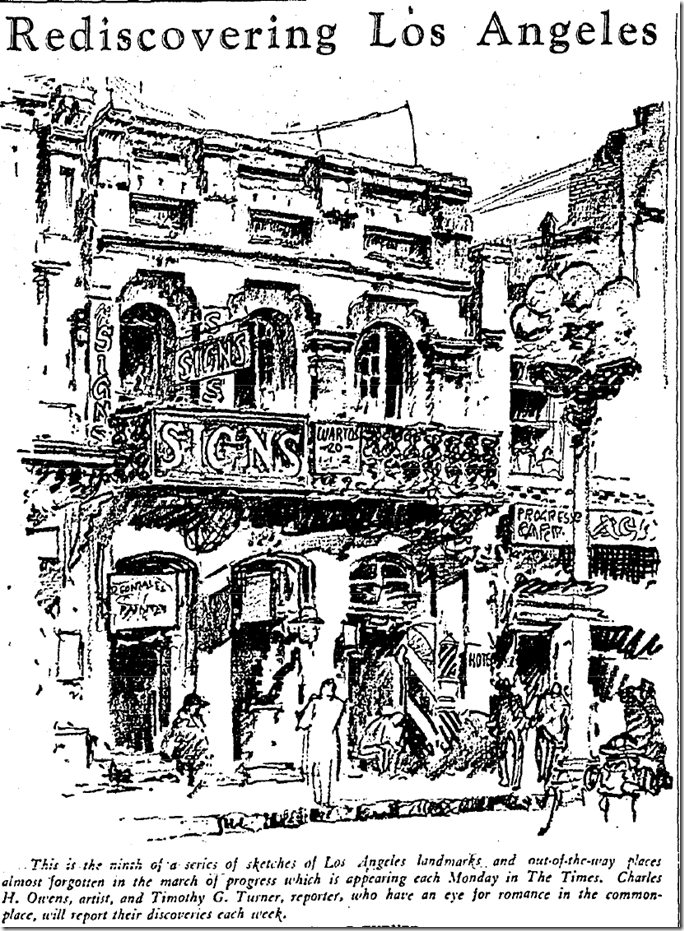
Dec. 30, 1935: For this installment of Rediscovering Los Angeles, Times artist Charles Owens and columnist Timothy Turner visit Los Angeles’ former Masonic Hall, a building from the 1870s on Main street “on the east side just south of the Plaza.” Unlike the later series by Owens and Joseph Seewerker, published in book form as “Nuestro Pueblo,” these features were never reprinted. It’s interesting to note that even in the 1930s, Los Angeles was being rediscovered.
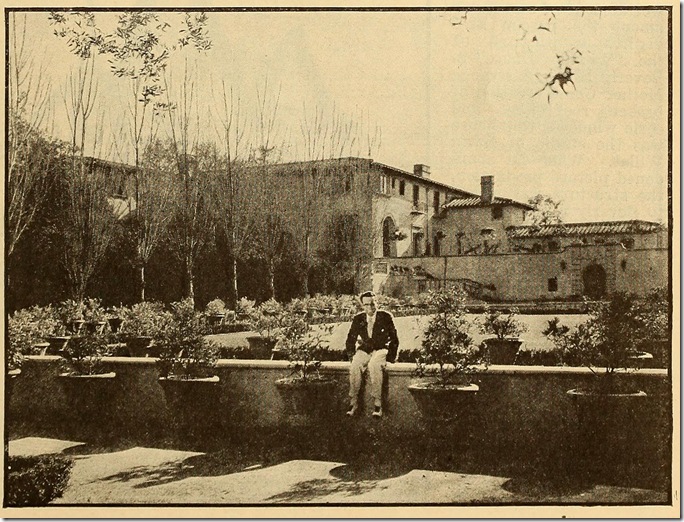
Harold Lloyd and Greenacres in New Movie Magazine.
At the beginning of the fledgling motion picture industry, actors and other creative types earned adequate salaries, in line with middle-class jobs. They lived in modest bungalows, residential hotels, apartments or rented small homes.
When star names sold films at the box office, salaries began skyrocketing. As salaries rose, so did the quality of personal residences. Some actors lived in style at the Alexandria Hotel, Los Angeles Athletic Club and other quality hotels and apartments, while several stars began buying or building elaborate homes to display their wealth and stature in areas like Los Feliz, Hancock Park and Whitley Heights.
Douglas Fairbanks and Mary Pickford renovated a modest hunting lodge on Beverly Hills’ Summit Drive into the lovely estate Pickfair, the de facto Buckingham Palace of Hollywood royalty. Producer Thomas Ince constructed Dias Dorados in Beverly Hills’ Benedict Canyon. Mack Sennett intended to build a lavish estate above and behind the Hollywoodland sign in 1925, killed by financial pressures. Comedy superstar Harold Lloyd soon followed in constructing his own residential palace.
Mary Mallory’s “Hollywood: Tales Lost and Found” is available for the Kindle.
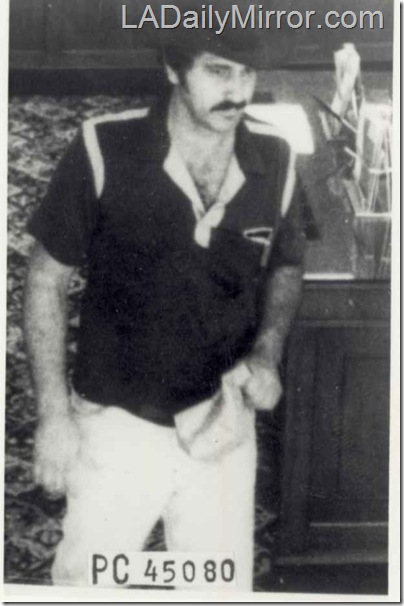
Here’s an example of what I’m talking about. This anonymous fellow was captured by a bank security camera and the photo is marked PC 45080. Often in these cases, the PC number will be rendered PC 450 (80), in which the last two numbers apparently signify the year. The matter is further complicated because some of the bank robbery photos have FBI numbers (which begin 91-123456) and others have LAPD DR numbers.
(And yes, there are lots of men with hairy chests in these pictures. It was the era.)
By the way, the LAPD apparently changed its numbering system to this protocol about 1983: The first two numbers are the year. The next two are the LAPD area. The rest are the sequential numbers issued through the year. So 83 01-23456 would be an incident that occurred in 1983 (83) in LAPD’s Central Area (01) and given the number 23456
Here’s another example: