Somebody bought a ticket for the July 29, 1939, midnight show at the Follies Theatre and got to see Betty Rowland, “the ball of fire.”
The ticket stub is listed on EBay for 99 cents.


Somebody bought a ticket for the July 29, 1939, midnight show at the Follies Theatre and got to see Betty Rowland, “the ball of fire.”
The ticket stub is listed on EBay for 99 cents.

Over the years that I have been researching the Black Dahlia case, I have seen Elizabeth Short remembered in all sorts of ways. Some people buy “Justice for Beth” buttons on EBay. Others leave cigarettes and bottles of liquor at her grave — although she had asthma and didn’t smoke, and rarely drank.
Instead, I encourage people to make a donation in her name to a charity that works with homeless or abused women. My preferred organization is Heading Home, which helps the homeless in the Boston area. But truly, a donation to any organization that works with women who are homeless or victims of violence is a better way to honor her memory.
I’m sending off my check today. I hope you will too.

“Memo From Darryl F. Zanuck,” selected and edited by Rudy Behlmer.
Jan. 19, 2016, update: When I began my “sabbatical” last year, I had a backlog of a few unpublished posts on the making of “Laura.” At the time, it seemed like a good idea to push those off until January 2016 with the idea that I would resume them now. Unanticipated events have changed my plans and although I won’t be writing any new posts on “Laura,” I will publish the ones that I had finished a year ago.
On Nov. 1, 1943, Twentieth Century-Fox head of production Darryl F. Zanuck issued a stinging critique of Jay Dratler’s first draft of “Laura,” which is quoted by nearly everyone who writes about making the film.
Several things are clear in this memo: First, Zanuck had apparently read Vera Caspary’s novel rather than referring to a synopsis. He says: “There was a good thing in the book, which you have eliminated here, and that was the point that fashionable Park Avenue murders were not Mark (McPherson’s) dish.”
The Making of “Laura” Part 1 | Part 2 | Part 3 | Part 4 | Part 5 | Part 6 | Part 7 | Part 8 | Part 9 | Part 10 | Part 11 | | Part 12 | Part 13 | Part 14 | Part 15 | Part 16 | Part 17 | Part 18 | Part 19 | Part 20 | Part 21 | Part 22 | Part 23 | Part 24 | Part 25 | Part 26 | Part 27 | Part 28 | Part 29 | Part 30 | Part 31 | Part 32 | Part 33 | Part 34 | Part 35 | Part 36 | Part 37 | Part 38 | Part 39 | Part 40 | Part 41 | Part 42
James Ellroy to script remake of ‘Laura’
Update, Jan. 19, 2016: I had forgotten that Ellroy was supposed to write a remake of “Laura.” One can only imagine how awful it would be. I can’t find anything recent on the project, so I assume it’s at the bottom of the ocean two miles off Point Fermin.

This illustration by Los Angeles artist Jeffrey Smith appeared in the New York Times on Jan. 16, 2016, accompanying a story about an elaborate hoax that occurred in 1941. Who can spot the mistake?

This week’s mystery movie has been the 1946 picture “Cloak and Dagger,” starring Gary Cooper, Robert Alda, Vladimir Sokoloff, J. Edward Bromberg, Marjorie Hoshelle and Ludwig Stossel, and introducing Lilli Palmer. The screenplay was by Albert Maltz and Ring Lardner Jr., from a story by Boris Ingster and John Larkin, “suggested by the book by” Corey Ford and Alastair MacBain. The movie was directed by Fritz Lang.

Released by Warner Bros., the movie was the first production by Milton Sperling’s United States Pictures Inc. and was the first of five independent films he originally planned for 1946.
The New York Times’ Bosley Crowther wrote (Oct. 5, 1946) that the film “is highly suspenseful in a slick cinematic style. Apart from the realm of realities, it is fast entertainment on the screen.”
And yet he quibbled with the plot: The filmmakers “loaded the whole thing down with the baldest and most familiar of the spy-thriller cliches.”
The film opened in Los Angeles on Oct. 11, 1946, at the Wiltern, and the Warners Hollywood and Downtown. Writing in the Los Angeles Times on Oct. 12, 1946, critic Edwin Schallert said it was almost a documentary, calling it “a thrilling adventure narrative that simultaneously is illumined by good strong highlights in the dialogue.”
“Cloak and Dagger” was suggested as a mystery movie by Earl Boebert and set off an unusual quest to defeat Google’s image search function. For some curious reason, much of the film turns up on Google’s image search — at least in some circumstances. Earl did extensive research on why he and I were getting different results from Google. The simple explanation is that Google personalizes my results as “a movie guy” and customizes his results something else. Cloak and Dagger indeed!
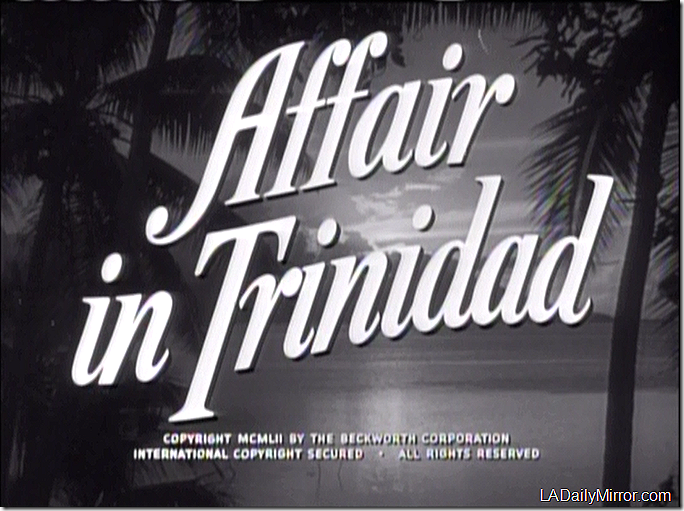
The movie is available from Amazon.

Priscilla Dean and her tam, Photoplay, January 1921
The entertainment industry mastered the use of publicity and cross promotion from its very beginnings, creating elaborate ballyhoo campaigns to build word of mouth and huge box office receipts. It quickly realized that joining together with other organizations, businesses, and mass communications allowed a wider dissemination of the news to audiences at a much cheaper price, thereby helping both institutions or groups in the process.
Universal Feature Film Manufacturing Company deployed an extremely effective and relatively inexpensive cross promotional exploitation campaign in 1920 and 1921 for the Priscilla Dean film, “Outside the Law.” Employing a fashionable tam-o’shanter sold under the Pricilla Dean name, the stunt successfully spread the word of the film among female audiences, leading to high theatre grosses around the country.
“Hollywood Celebrates the Holidays” by Karie Bible and Mary Mallory is now available at Amazon and at local bookstores.

Jan. 16, 1910: The Times recaps Aviation Week.
A Week of Aviation Triumphs, Jan. 16, 1910
Library Officials May Remove Books on Making Alcohol, Jan. 16, 1920
TV Writers Go on Strike Over Residuals, Jan. 16, 1960
Matt Weinstock, Jan. 16, 1960

Apparently nobody fell for this photo the first time around, so a vendor on EBay has listed it again. For $499.99. Seriously.
The vendor (ONE OF THOSE PEOPLE ON EBAY WHO HAS NO IDEA HOW TO TURN OFF THE CAPS LOCK) claims to have gotten this “rare” photo of Elizabeth Short at an estate sale of “A WWII VETERAN.”
“I DID SOME RESEARCH AND FOUND OUT IN 1945 SHE DATED A SOLDIER FROM WWII AND WHO WAS FROM NEW JERSEY. SO I DID MORE RESEARCH AND HAD THE PHOTO LOOKED AT BY MULTIPLE PEOPLE FROM A FORENSIC DETECTIVE TO MIKE FROM THE SHOW ODDITIES. ALL SAY IT IS HER. ”
Well that is certainly conclusive evidence — that some people can’t see what is in front of them.
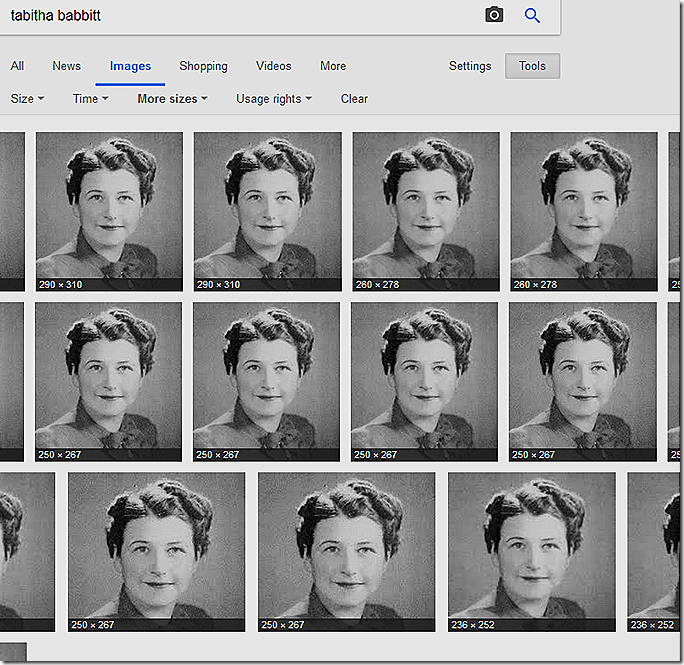
This isn’t Elizabeth Short, it’s just some random woman from the 1940s. Really.
The price has gone up. The last time it was listed, bidding started at $99.99.
Today is Jan. 15, and the Daily Mirror marks the anniversary of Elizabeth Short’s death by pruning back the roses.
We were saddened to learn from B.J. Merholz that his wife, Julie, has died.
B.J. writes: “Julie was a long-time fan of the Mystery Photo and determined contributor who followed it as long as her health permitted. After a recent steep decline, she died yesterday.”
We will miss Julie’s contributions to the Daily Mirror. We were lucky enough to meet her and B.J. during a gathering of the Brain Trust at the pre-renovation Clifton’s Cafeteria. We mourn her loss and extend the Daily Mirror’s condolences to B.J. and the Merholz family.

This week’s mystery movie has been the 1952 MGM picture “Above and Beyond,” starring Robert Taylor and Eleanor Parker, with James Whitmore, Larry Keating, Larry Gates, Marilyn Erskine, Stephen Dunne, Robert Burton and Hayden Rorke. The screenplay was by Melvin Frank, Norman Panama and Beirne Lay Jr. from a story by Beirne Lay Jr. The music was by Hugo Friedhofer and conducted by Andre Previn. “Above and Beyond” was produced and directed by Melvin Frank and Norman Panama.
“Above and Beyond” is available from Warner Archive for $12.49.
William Hoover, left, doubled for Edward Arnold, Silver Screen, August 1939.
Since 1927, the Academy of Motion Picture Arts and Sciences has recognized best acting performances in motion pictures by male and female stars. They began recognizing best supporting performances in 1936. Directors, writers, cinematographers, costume designers, and production designers are also honored, not only by the Academy but by each of their individual guilds, and now by critics’ groups, festivals, and even by the people.
Long forgotten by the industry and even audiences, stand-ins fought to be recognized for their own contributions to the creation of motion pictures. For a short time in the 1940s, this little acknowledged group handed out their own awards. Instead of being able to say, “I’d like to thank the Academy,” they could thank the stars for whom they tolled under hot lights and conditions.
“Hollywood Celebrates the Holidays” by Karie Bible and Mary Mallory is now available at Amazon and at local bookstores.

The Ambassador Theater, as shown in the Exhibitors Herald, 1921.
On February 9, 1919, the Los Angeles Times reported that the California Hotel Company would soon begin construction on a luxurious hotel on twenty one acres adjoining Wilshire Boulevard between Catalina and Eighth Streets. This resort-like property would cater to the upper classes, with bungalows, ballroom, billiards, card rooms, swimming pool, and an arcade of shops catering to every whim of the wealthy clientele. Often overlooked in the hostelry’s many high-end amenities was the plush Ambassador Theatre, intended both as rental facility, host to conventions, and movie theatre.
D. M. Linnard, owner of the California Hotel Company, announced on April 4 that architect Myron Hunt had been employed to design something along classic Italian lines for the $5 million project. The proposed design showed buildings in a giant H shape with a combined 1000 rooms between the main building and annexes. The proposed project also included tea house, casino, and a convention hall with pipe organ and stage. Construction began in June 1919 for the massive project after demolishing the former Ruben Schmidt farmhouse on the property. The hotel’s name changed from California to Ambassador in March 1920 as well.
“Hollywood Celebrates the Holidays” by Karie Bible and Mary Mallory is now available at Amazon and at local bookstores.

This week’s mystery movie has been the 1931 RKO picture “Way Back Home,” which was based on a popular radio program starring Phillips H. Lord, who later created the radio shows “Gang Busters” and “Mr. District Attorney.” It was directed by William Seiter, written by Jane Murfin and photographed by J. Roy Hunt. It featured Phillips H. Lord, Effie L. Palmer, Frank Albertson, Bette Davis, Frankie Darro, Dorothy Peterson, Stanley Fields, Oscar Apfel, Sophia M. Lord, Bennett Kilpack and Raymond Hunter.

Note: This is a repost from 2013.
Just in time for New Year’s, we’ll take a look at a “lost drink,” making a brief inquiry into San Francisco’s Pisco Punch, made famous by Bank Exchange saloon owner Duncan Nicol (often spelled Nichol or Nicoll), who died in 1926 without revealing the recipe.

Note: This is a repost from 2013.
Dec. 20, 1934: In case you doubted me (but you wouldn’t, would you?), here’s a recipe for the Bronx Cocktail, from the Amsterdam Evening Recorder, courtesy of FultonHistory.com.
In case you plan to mix one up, a Bronx Cocktail is one part Italian vermouth, three parts brandy and a dash of orange bitters. Shake well!
Notice that there are also three variations of the Manhattan.


Note: This is a repost from 2013.
Yes, the Manhattan cocktail once had competition from drinks named for the other boroughs. Here’s a recipe for the Brooklyn Cocktail, from the Brooklyn Daily Eagle, March 7, 1937. The Brooklyn Cocktail as made by Brad Dewey consisted of
Two parts Jamaica rum
One part lime juice
Dash of grenadine
We won’t be toasting the new year with the Brooklyn Cocktail (we’re working) but if someone is brave enough to try one, let us know how it is.
And in case you are wondering, research shows that there was also a Bronx Cocktail. Evidently it, too, has fallen out of favor.

A vintage 1972 iron-on transfer of Harvey Wallbanger himself, on EBay for $12.
Note: This is a repost from 2013.
We have been looking at some historic drinks for this holiday season. To the millennials in the audience: This is what mom and dad used to drink (along with the Tequila Sunrise) when they went out in the 1970s.
Return with us now to the thrilling days of yesteryear:
1 ounce of vodka
4 ounces of orange juice
half an ounce of Galliano.
Poured over ice in a highball glass.
Cue Grand Funk Railroad’s “Gimme Shelter” or Carole King’s “It’s Too Late.”

A recipe for the Tom and Jerry from the San Francisco Call, June 30, 1912.
Note: This is a repost from 2013.
Over on Facebook, Christopher McPherson asked whether the Tom and Jerry was named for the MGM cartoon characters. I said I suspected the opposite was true, rather like Disney’s Chip ‘n’ Dale being named for Chippendale furniture.
All the old newspaper stories give credit for the drink to bartender Jerry Thomas, who according to one account was born in New Haven, Conn., in 1825 (or Watertown, N.Y., in 1830).

This week’s mystery movie has been the 1957 MGM picture “I Accuse!” The film stars Jose Ferrer (who also directed), Anton Walbrook, Viveca Lindfors, Leo Genn, Emlyn Williams, David Farrar, Donald Wolfit and Herbert Lom. The screenplay was by Gore Vidal, from a book by Nicholas Halasz.
“I Accuse!” It has never been commercially released on VHS or DVD.

The film was photographed by F.A. “Freddie” Young, who won Academy Awards for “Lawrence of Arabia,” “Dr. Zhivago” and “Ryan’s Daughter.” It was released in CinemaScope with “process lenses by Panavision.”

According to the IMDB entry, “I Accuse!” was filmed in standard Academy aspect ratio and then printed in CinemaScope with the images cropped as the “process lenses by Panavision” would tend to indicate. I’m not an expert on the matter and will leave it to others to investigate this matter further.