June 21, 1947: ‘The Drunkard,’ L.A.’s Favorite Melodrama


The Drunkard


Note: This is an encore post from 2005 and originally appeared on the 1947project.

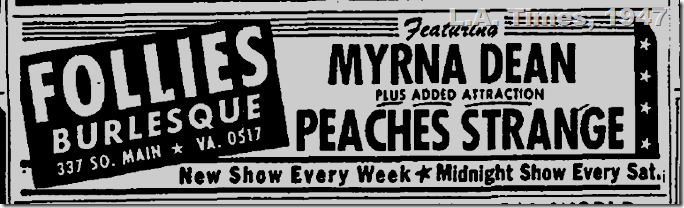
In the summer of 1933, expecting nothing but a brief run and modest ticket sales, two theater people from Carmel, Preston Shobe and Galt Bell, hatched the idea of staging P.T. Barnum’s 1843 artifact of the temperance movement, “The Drunkard” by W.H. Smith. In keeping with the “meller drammer” atmosphere, the producers removed the theater seats and installed tables so the audience could drink beer and eat a buffet meal while hissing the villain, cheering the hero and singing “There Is a Tavern in the Town.”

The men had more ambitious plans for the theater, including historic Italian plays and a Russian version of “Uncle Tom’s Cabin” recast as anti-capitalist propaganda. But for reasons none of them understood, “The Drunkard,” which opened July 6, 1933, kept drawing huge audiences and was selling out weeks in advance.

Continue reading

Posted in 1947, Food and Drink, Hollywood, Stage, Theaters | Tagged , , , , , , | 5 Comments

Black L.A. 1947: Lottie Grady, Pioneering Black Actress in Theater and Film, Visits Los Angeles

Dat Lovin Rag
“Dat Lovin’ Rag,” courtesy of the University of Colorado Boulder Music Library.


June 19, 1947, Los Angeles Sentinel

June 19, 1947: Lottie Grady, one of the first African American actors to perform on Broadway, visits Los Angeles and is interviewed by the Sentinel.

Grady performed on Broadway in “Captain Rufus” (1907); “The Husband” (1907); “Mr. Lode of Koal” (1909); and “Three Plays for a Negro Theater (1917). She also appeared in “The Pullman Porter” (1912), credited as the first movie with a black cast and black director.

Continue reading

Posted in 1907, 1947, African Americans, Film, Hollywood, Stage | Tagged , , , , , , , | 2 Comments

Jan. 20, 1947: ‘Good Night. Sleep Peacefully With Compliments of Jacks’


florabel_muir_headline_happy

Note: This is an encore post from 2005 and originally appeared on the 1947project.

I was talking with Siegel about seven o’clock on the Friday evening of his death. He called me at the office of Hollywood’s Daily Variety, for which I was then writing a column. He said he wanted to thank me for a review I had given the floor show at the Flamingo that week.

“I’m planning a whole new advertising campaign and am using your description, ‘the fabulous Flamingo,’ prominently in all the ads,” he told me. “I’m cutting prices in the rooms, too, and have just signed the Ritz brothers to open in September. I’m paying them $25,000 a week ($236,604.65 USD 2005), but I think they’re worth it.”

Continue reading

Posted in 1947, Books and Authors, Crime and Courts, Homicide | Tagged , , , , | 1 Comment

June 20, 1947: Dinner at Jacks at the Beach

Jacks at the Beach
Note: This is an encore post from 2005 and originally appeared on the 1947project.

Good evening, Mr. Siegel. Welcome to Jacks at the Beach.

I’ll be your waiter tonight. Would you like to start off with a drink?

Here’s a complimentary copy of the Los Angeles Times you can look over while you wait for your meal.

Posted in 1947, Crime and Courts, Food and Drink, Homicide | Tagged , , , , | Comments Off on June 20, 1947: Dinner at Jacks at the Beach

June 20, 1907: Salesclerks Fight to Keep Shortened Work Hours on Saturdays


Note: This is an encore post from 2006.

June 20, 1907
Los Angeles

The salesclerks of Los Angeles are steaming—and not over the warming temperatures. Beginning last summer, all the department stores agreed that instead of closing at 10 p.m. on Saturdays, they would close at 12:30 p.m., giving the staff a half-day off with pay.

But the new manager of the Bon Marche, J.W. Eccleston, decided he could increase business by remaining open, incurring the anger of every other merchant—and clerk—in town. Eccleston said: “We have the matter under advisement. We have not determined that we will not close, but we will probably not do so on next Saturday night. We have our side of the story; our employees are unanimously with us and I don’t see that we need any outside sympathy.”

Continue reading

Posted in 1907, Labor, Streetcars | Tagged , , | Comments Off on June 20, 1907: Salesclerks Fight to Keep Shortened Work Hours on Saturdays

Black L.A. 1947: ‘Why Negro Girls Stay Single’ by Pauli Murray

Update, March 28, 2023: Pauli Murray’s essay in Negro Digest is online at Archive.org.

June 19, 1947: The Sentinel publishes a few paragraphs on Pauli Murray’s essay, which appeared in the July 1947 issue of “Negro Digest.” Murray’s essay is frequently cited, but it doesn’t appear online.

According to the Sentinel, Murray said that “economic insecurity and emotional immaturity of the Negro male” are two reasons “Why Negro Girls Stay Single.”

Continue reading

Posted in 1947, African Americans, Books and Authors, Crime and Courts, Education | Tagged , , , | 3 Comments

June 19, 1907: Soothing Music Helps Cures Insanity, Doctor Says


Note: This is an encore post from 2006.

June 19, 1907
Los Angeles

What shall we do with the insane? Don’t give them drugs… give them music! (Well, some music).

Dr. E.C. Dent of the hospital for women on Ward’s Island in New York says: “I firmly believe in the curative power of music for insane patients and those who suffer from nervous diseases, but I do not say that music in itself is a cure. It is true that music is now a regular part of the treatment in this hospital systematically employed in reaching and stimulating the brain.”

Continue reading

Posted in 1907, Food and Drink, Medicine, Music, Streetcars | Tagged , , , , | 1 Comment

Napoleon

Note: This is an encore post from 2006.

Posted in Uncategorized | Comments Off on Napoleon

Movieland Mystery Photo (Updated + + + +)

The Mouthpiece
This week’s mystery movie has been the 1932 Warner Bros. film “The Mouthpiece,” by Frank Collins, directed by James Flood and Elliott Nugent. The film features Warren William, Sidney Fox, Aline MacMahon, John Wray, Mae Madison, Ralph Ince, Morgan Wallace, Guy Kibbee, J. Carroll Naish, Walter Walker, Stanley Fields, Murray Kinnell, Noel Francis and William Janney. The screenplay was by Joseph Jackson with adaptation dialogue by Earl Baldwin, photography by Barney McGill, art direction by Esdras Hartley, gowns by Earl Luick, and the Vitaphone Orchestra, conducted by Leo F. Forbstein.

Yes, this is the previous version of last week’s mystery movie, “The Man Who Talked Too Much.”

“The Mouthpiece” is available from Warner Archive in Volume 10 of “Forbidden Hollywood.”

Continue reading

Posted in Film, Hollywood, Mystery Photo | Tagged , , | 31 Comments

June 18, 1947: Actor Jon Hall Says Tale of Being Shot Down in Plane Was a Hoax

June 18, 1947, Jon Hall

Note: This is an encore post from 2005 and originally appeared on the 1947project.

The day before, The Times reported a curious incident in which a bullet tore into the propeller of the plane shortly after it took off for Tulare, Calif., and had reached an altitude of 600 feet.

Police detained 14-year-old Ronald A. Husner, 3468 Greenwood Ave. in Mar Vista, who admitted being in the area shooting rabbits, but said he wouldn’t have been able to hit the plane with his .22-caliber rifle.

Continue reading

Posted in 1947, Aviation, Hollywood | Tagged , , , , | 2 Comments

June 18, 1907: Immigration Agent Accused of Poisoning Neighbor’s Dog


Note: This is an encore post from 2006.

June 18, 1907
Los Angeles

The victim: A collie named Baby

The plaintiff: Hazel G. (or Ella M.) Schurger, 1156 S. Flower.

The suspect: J.J. Brady of the Immigration Bureau, a next-door neighbor.

Continue reading

Posted in 1907, Animals, Black Dahlia, Books and Authors, Crime and Courts, Fashions, Immigration, LAPD, Streetcars | Tagged , , | Comments Off on June 18, 1907: Immigration Agent Accused of Poisoning Neighbor’s Dog

Mary Mallory / Hollywood Heights: Mary Andrews Clark Home Provides Affordable Housing

image
306 Loma Drive, via Google Street View.


Long a beautiful site at 306 Loma Drive in Los Angeles, the Mary Andrews Clark Memorial Home has been a site of affordable housing for more than 100 years. Built by Sen. William Andrews Clark as a memorial to his mother, the home provided attractive and safe housing to young working women, at a time when middle and working-class people strained to make ends meet, then as now.

Mary Andrews Clark was born in Pennsylvania in 1814, living a simple, quiet live. She married farmer John Clark in 1837 and raised a large family before they moved to Iowa in 1856. After her son William began making his fortune, the family moved to Los Angeles in 1882. Sen. Clark worked his way through mining, trading, and various professions, eventually becoming a copper baron known as one of the Copper Kings of Butte, Mont. As such, he owned mines, railroads, banks, and newspapers, as well as later serving as a senator from Montana from 1901 to 1907, bribing members of the Montana Legislature in return for their votes when earlier running for senator. Clark doted on his mother, a lifelong Presbyterian who devoted her life to her family, friends, charities, and helping others.

Mary Mallory’s latest book, “Living With Grace: Life Lessons from America’s Princess,” will be released June 30.

Continue reading

Posted in Architecture, Hollywood, Hollywood Heights, Mary Mallory | Tagged , , , , | 3 Comments

Sept. 30, 1886: ‘An Orgie Such as Even the Most Salacious Pen of Ancient Rome Never Dared Describe’

L.A. Times, Sept. 30, 1886
Sept. 30, 1886: We decided to dig out the original quote from Joe Mozingo’s history of the Los Angeles Times in Sunday’s paper. And let it be said that the editorial pages of frontier newspapers were not known for their decorum. A little context: Virtually all frontier newspapers wrote like this in the 19th century and are most entertaining.

But summoning a photographer “for an obscene purpose” to take a picture of the exhausted (and presumably passed out) survivors of a night of debauchery? Nothing is new, is it?

On the jump, the entire, unsigned, editorial, plus a little technical difficulty delays deliver of The Times.

Continue reading

Posted in 1886, Photography, Politics | Tagged , , , , , , , | Comments Off on Sept. 30, 1886: ‘An Orgie Such as Even the Most Salacious Pen of Ancient Rome Never Dared Describe’

June 17, 1947: Bank Robber Shot in Head During Gunfight With LAPD Officers

June 17, 1947

June 17, 1947

Note: This is an encore post and originally appeared in 2005 on the 1947project.

In the spring of 1968, Times reporter Charles Hillinger went up to San Luis Obispo for a story about a prison facility for elderly convicts, like John D. “Frenchy” Florence, 82, whose felony was unrecorded, and a thief named Simon Birdow, 78.

Gardening was particularly popular among the men, and Jesse Houston, 70, showed off his snapdragons, lilies of the Nile and hollyhocks, as well as his orchard of peaches and nectarines. Houston, Hillinger noted, had been the facility’s shuffleboard champion for three years.

Continue reading

Posted in 1947, Crime and Courts | Tagged , | Comments Off on June 17, 1947: Bank Robber Shot in Head During Gunfight With LAPD Officers

June 16, 1947: LAPD Officers Hidden in Bar Kill Watchman Stealing Liquor

June 16, 1947, Watchman Shot


Note: This is an encore post from 2005 and originally appeared on the 1947project. This was a follow-up to Kim Cooper’s original post on Wanzy Patterson, an unfortunate watchman who was helping himself to liquor while guarding a bar. Two LAPD officers hid in the bar and confronted him. Officers said Patterson made a move toward his pistol, so the “riddled his body with bullets, 11 shots being fired,” according to the L.A. Times.

Looks like an off night for The Times and a certain unfortunate watchman whose name was indeed Wanzy. One of the officers in question was actually Clarence Albert Stromwall, all the more confusing since his father was Detective Lt. Albert C. Stromwall of the robbery detail and appears in The Times fairly often.

The mangled address was actually Quan Yin Court, named after the goddess of mercy. Alas, while Quan Yin Court and Quan Yin Road are listed in the usually reliable Thomas Bros. 1945 edition (Grid 44, E-2)—and Quan Yin Road appears in the 1951 reverse directory—the streets are not to be found. A check of the 1944 and 1949 Yellow Pages in search of the bar was equally unhelpful.

While making my search, I was more than a little surprised to discover “Negro Alley” still appearing on the Thomas Bros. map of downtown in the 1940s, however. This infamous 19th century lane, sometimes referred to as “Calle de los Negros,” led from Aliso to the Plaza, east of Los Angeles Street, and figured in the Chinese Massacre.

Upon his retirement in 1967 after 21 years with the LAPD, Clarence Stromwall became a municipal judge and ran for the Superior Court in 1978 against incumbent Florence Picard. He died in 1996.

Bonus factoid: the 1949 Yellow Pages lists bars under “Beer Parlors.”

Posted in 1947, Crime and Courts, Food and Drink, LAPD | Tagged , , , , | 3 Comments

June 16, 1907: Lawyer Edith Foulkes Handles Her Own Divorce Case

Note: This is an encore post from 2006.
June 16, 1907
Los Angeles

Despite the old saying—a lawyer who represents himself has a fool for a client—Edith Foulkes is a smart woman, at least in the courtroom. She can’t make the same claim about her trip to the altar, however, which is what brings before Judge Bordwell.

Although she had known her husband, Ralph, for eight years, they were only engaged for a week before they got married in 1905. His family was coming to visit and he wanted to be married when they arrived, he said.
Continue reading

Posted in 1907, Crime and Courts, Fashions, Homicide, LAPD, Streetcars | Tagged , , , | Comments Off on June 16, 1907: Lawyer Edith Foulkes Handles Her Own Divorce Case

June 15, 1947: Visiting the Edgar Kaufmann House in Palm Springs

Edgar Kaufmann House
Note: This is an encore post from 2005 and originally appeared on the 1947project.

Tract developments may be sprawling across the Valley, but The Times’ Sunday Home section for June 15, 1947, features an unusual house designed for the California desert.

“With the miracles of modern technology of building materials opening this landscape for our enjoyment, modern architects are bringing the elusive, mysterious and compelling land of the desert to their own terms,” The Times says.

Continue reading

Posted in 1947, Architecture | Tagged , , , , | Comments Off on June 15, 1947: Visiting the Edgar Kaufmann House in Palm Springs

June 15, 2005: Remembering UCLA Professor Eric Monkkonen

Note: This is an encore post from 2005 and originally appeared on the 1947project.

The Times reports the death of UCLA professor Eric Monkkonen, who spent years studying murder in the U.S. and focused on Los Angeles. Among his many findings was that the homicide rate in Los Angeles decreased after World War II.

As Times writer Elaine Woo notes:

Continue reading

Posted in 2006, Crime and Courts, Homicide, LAPD, Obituaries | Tagged , , , , , | Comments Off on June 15, 2005: Remembering UCLA Professor Eric Monkkonen

June 15, 1907: Grieving Widow Cuts Off Hand to ‘Free Husband’s Soul’


Note: This is an encore post from 2006.

June 15, 1907
Los Angeles

Helen Hurley paused at the doors of St. Vibiana’s Cathedral. In pain, she shoved her left wrist inside her dress so that it wouldn’t show as she went in to pray during Mass.

But the pain was too great and she fled the cathedral for her room at the Ramona lodging house on South Spring Street.
Continue reading

Posted in 1907, Religion | Tagged , , | Comments Off on June 15, 1907: Grieving Widow Cuts Off Hand to ‘Free Husband’s Soul’

Black L.A. 1947: The Sentinel’s Hotel Listings

Golden West Manor

The Golden West Manor Motel, 3700 S. Western, via Google Street View.


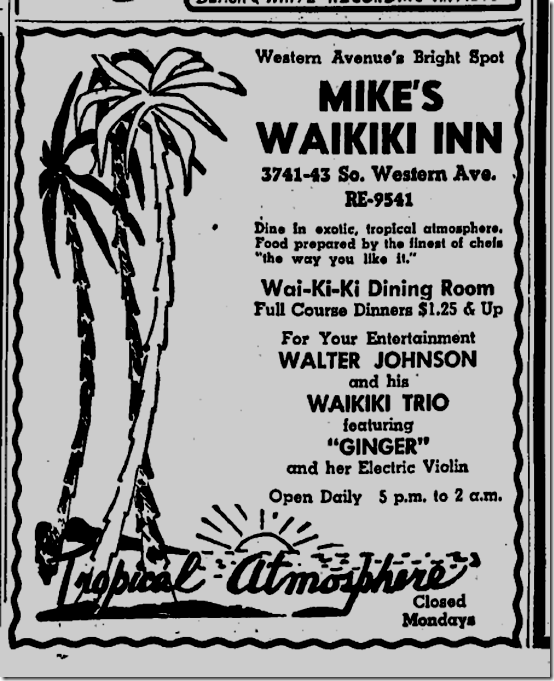
June 12, 1947: The Western Motel, at 37th Street and South Western Avenue, advertised in the Sentinel that it was “clean, comfortable, modern” with “special accommodations for theatrical artists.”

Western Model, 1947

Continue reading

Posted in 1947, African Americans | Tagged , , , | Comments Off on Black L.A. 1947: The Sentinel’s Hotel Listings