Matt Weinstock

Matt_weinstockdJuly 2, 1957

You simply have no idea of the hazards of journalism.

The city desk got a call from a woman on East 6th Street who proudly announced that she had become a great-grandmother at 48.

This was indeed unusual and worthy of words, a picture and perhaps a subsequent appearance on TV, which was probably what great-grandma had in mind.

Unfortunately, a checkup of the facts disclosed that the new great-grandchild's mother, 15, hadn't quite received a proposal of marriage from the father.


Posted in 1957, Columnists, Matt Weinstock | Comments Off on Matt Weinstock

Paul V. Coates–Confidential File

Paul_coates
July 2, 1957

This is a twist story–a reverse mystery.

I’ve been presenting, for the past few months, weekly missing persons
cases on file with local sheriffs and police. Each started with a
living, active person, surrounded by apparent normalcy.

Next came the disappearance. And last, the search–into the subject’s background, personal habits, likes dislikes, associates.

On investigation, the missing person nearly always becomes a very known quantity.

Today, however, comes the switch.

To start, go back to the afternoon of April 7, 1957, when four boys
were scrambling along the brush incline of the Crestmore Cement Co.
property, three miles west of Riverside.

They were on their way fishing, but their plans met sudden interruption.

They stumbled upon a body. And they went, instead, to the Riverside County sheriff’s office.

1957_0702_ad
That was three months ago.

Immediately sheriff’s investigators determined that the victim had been
dead about three weeks. And that cause of death was a gunshot blast in
the chest.

Two days later, when enough data had been collected, an emergency all-points bulletin was sent out.

The victim was described as male white American, late 20s or early 30s, 5 feet 10 inches, 160-170 lbs.

It was determined that the victim had brown hair, but the body’s
advanced state of decomposition left the color  of eyes and complexion
unknown. No discernible scars or moles could be found.

There was also broadcast, however, the description of physical evidence at the scene:

The victim wore a white T-shirt and blue Wrangler pants. He wore socks
but no shoes. Wrapped around his head was a pink military-type shirt. A
bed pillow had been placed on his chest and then the entire body had
been wrapped in a white muslin sheet and a green chenille bedspread.

Brown electric light cord bound his head and feet. A small braided rope was wound around his waist.

So where’s the clue?

Riverside sheriff’s deputies, directed by Det. Cmdr. Robert Presley, began a patient investigation.

From the start, they knew it would be a tough one.

Clue by clue, they attacked it.

CLOTHING: No laundry marks. In
the pink shirt there was a ballpoint pen with the words "Cisco Ice
Blower Service, Cisco, Tex."  A check with the sheriff of Eastland,
Tex., revealed that some 800 similar pens had been distributed by the
company, mostly to truck drivers.

FINGERPRINTS: Lab tests showed that the victim’s hands had been encased in cloth containing lye in an effort to destroy prints.

But eight out of 10 prints were established and print copies were
immediately circulated locally, at the state level, to the FBI, to
Canada. No luck.

MISSING PERSONS: Local and
state bureaus were checked. Hotels and rooming houses were checked to
see if a guest had departed without notice, or possibly leaving some
property behind around the 17th of March. Local papers published the
victim’s description. No response.

TEETH: The following description was included in the all-points bulletin:

Some evidence of pyorrhea. Dental restorations appear to be well done,
carved and finished. Space between the upper front teeth. Upper left
first molar is an alloy in the mesial and distal pits. Lower left
second molar has an occlusal buccal filling. Lower right first and
second molars have occlusal fillings. One huge cavity upper right third
molar.

Such information will possibly serve well later for positive identification after tentative identification is made.

"A false dental plant solved one for us last year," Lt. Presley told
me. "Through it, we identified the body of a woman 13 months after we
discovered it.

"And," he added positively, "we found her killer, too."

Posted in Columnists, Homicide, Paul Coates | Tagged , , | Comments Off on Paul V. Coates–Confidential File

Faith journey


1957_0702_hed

1957_0702_loudd_mug
July 2, 1957
Los Angeles

I wonder what the preacher told worshipers at Mount Tabor Missionary Baptist Church
in Miami about his faith journey. Did he talk about his years with the
San Diego Chargers and the Chicago Bears? Or maybe it was his time with
the Patriots, becoming the first African American assistant coach in
the American Football League.

He could have spoken of his time as head of the Florida Blazers in the
World Football League. Or being a football star at Blackshear High
School in San Angelo, Texas; or Jefferson High School in Los Angeles.
He might have talked about being an All-City player or making
All-American at UCLA.

The minister might have talked about being the "All-Pro Pastor" who
hosted a sports show broadcast on closed-circuit TV at the Miami-Dade
County Jail.

The Rev. Rommie Lee Loudd Sr. might well have talked about serving
three years in prison on drug charges. Maybe Loudd even spoke of his
six months in jail for molesting three teenage boys in 1957 when he was
working as a counselor at Juvenile Hall.

The newspapers–and certainly The Times–were squeamish about certain
types of sex cases and did very little reporting on this incident.
There are few details, and if Loudd hadn’t been a football star, the
paper probably wouldn’t have reported it at all.

According to The Times, he and another suspect, Benjamin F. Kelly, were
working at Juvenile Hall when they were arrested, along with Lindsay M.
Gerren, on charges of abusing three boys, ages 12, 13 and 15.


1957_0702_loudd_pass

He was arrested April 1, 1957, at 2630 S. Bronson Ave. along with two men who were apparently his roommates and were later released. Kelly was identified as living at 1779 W. 22nd. St. and Gerren lived at 4627 Saturn St.

Loudd "assertedly intimidated the boys with his identification card,
which he had not surrendered, according to Detectives Kay Sheldon
Cuttrell and George Kellenberger," The Times said. Loudd and Kelly were
given six months in jail while Gerren was given 90 days in jail and two
years’ probation.

We don’t know how Loudd summed up his life. Maybe he talked about repentance… and forgiveness… and salvation. But when Loudd died in 1998
at the age of 64, the Rev. George McRae of Mount Tabor said: "He was an
example of how a person can fall and get up and fall again and get up
again and keep moving."

Email me

Posted in #courts, LAPD, Religion, Sports | Tagged , , , , , , , , , | Comments Off on Faith journey

Pepe Arciga

July 1, 1957

1957_arciga_3In the midst of clapping castanets, kicking
heels and flying Spanish skirts during a whirlwind visit to La
Golondrina one night last week, I asked a question of Mexico’s attorney
general, Lic. Jose Aguilar y Maya.

"Senor Procurador, in view of
Mexico’s aggressive road-building program, do you think there’s a
possibility of your government enacting legislation which would exclude
visiting Americans from landing in jail if involved in automobile
collisions?"

The attorney general, native of the romantic city
of Guanajuato and certainly one of Mexico’s ablest men of law, did not
answer that one right away.

He adjusted his glasses and, in the
semi-darkness, I could see that here was a man whose face indicated
kindness and understanding. Also, it seemed, here was a man who could
walk out of a spot, smilingly, and with no effort at all.

"Don
Pepe Arciga," he said after one swallow of his drink, "as you know,
Mexico is undergoing right now the greatest expansion program of its
history.

"Many things are happening today to the country.
Progress is outdistancing everything, everything, including many facets
of federal and state legislations.

"In some areas of Mexico,
traffic laws receive from authorities certain interpretations. In other
areas, traffic laws also differ."

And just as I began to relate
an incident in which two Angelenos and personal friends of mine–Arturo
and Juanita Castro–were forced to pay exorbitant fines plus damages,
plus medical fees after  HAVING BEEN HIT broadside at an intersection
in Guadalajara by a man driving a military jeep, Senor Jose Aguilar y
Maya broke in:

"Indeed, these are unfortunate incidents. I will
make every personal effort, upon my return, to explain to the proper
authorities the need for corrective measures."

Within minutes, the distinguished visitor and his party of friends got up and left.

I’m sending this column, of course, to Licenciado Jose Aguilar y Maya, Procurador General de la Republica Mexicana.

If it serves to remind him of our conversation, I’ll be content.

If it serves to help in establishing the "corrective measures" he spoke about, who could ask for more?"

Mientras tanto, Senor Licenciado, fue para mi un gran placer haber conversado con vosotros!

Posted in Columnists, Pepe Arciga | Tagged , , | Comments Off on Pepe Arciga

In Rome, II

July 1, 1957
Los Angeles

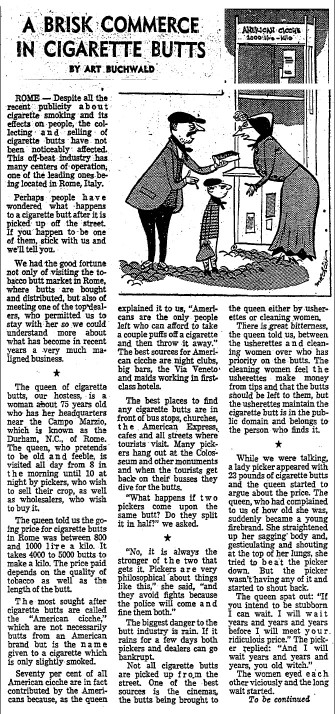
The late Art Buchwald, continued.
1957_0701_buchwald

Posted in Columnists | Tagged , , , | Comments Off on In Rome, II

Literary diversions

On the Fourth of July, 1910, in Reno, Jack Johnson defeated James J.
Jeffries to become the first African American heavyweight champion of
the world. In 1931, at the age of 53, he was working out every day and
spending his evenings at the Maxime,  Central Avenue at 41st Street.

Rex Beach wrote of Johnson’s victory: "He who had never been knocked down, was knocked down repeatedly. He who had never been knocked out, was knocked out."

Here’s Johnson’s version of the fight:

Page 1

1931_0705_johnsona

Page 2
1931_0705_johnsonb

Posted in Sports | Tagged , , , , , | 1 Comment

Prowler terrorizes L.A.


1957_0701_prowler

July 1, 1957
Los Angeles

Detective Sgts. W.R. "Bud" Schottmiller and J.B. Close of the Hollywood
Division have little to go on after a prowler broke into an apartment
to rape a young woman somewhere on Irving Boulevard (the newspapers,
incredibly, did not give the victim’s address this time–more about this later).

Maybe he was the same man who killed Marjorie Hipperson, or the one who killed Ruth Goldsmith–and
maybe not. Maybe he was even the same man who broke into an apartment
on Fountain and struggled with a woman before leaving.

All police know is that he came up the fire escape and broke in through
French doors about 3:30 a.m. There are some fingerprints on a 10-inch
steak knife that he left in the apartment, officials say, but only
enough to eliminate or implicate possible suspects.

To be continued…

Email me

Posted in Hollywood, Hollywood Division, LAPD | Tagged , , , , , | Comments Off on Prowler terrorizes L.A.

June bride

June 30, 1957
Milwaukee

Mary and Leeland met while taking summer courses at Harvard and are so in love that they want to get married.

But while Leeland loves Mary, his parents hate her. She “shot holes through our heart,” Leeland’s mother says.

In fact, Leeland’s family hates Mary and her parents so much that they have brought a $500,000 lawsuit against them for alienating Leeland from the Catholic faith. Mary’s family, you see, are Lutherans.

Arnold J. Werner, a Milwaukee industrialist, and his wife presented Mary in a June wedding. The 165 guests at St. Matthew’s Lutheran Church did not include Leeland Cummings Sr. and his wife, who said they wouldn’t recognize the marriage “under any circumstances.”

The Cummings family of Wyncote, Pa., accused the Werners of luring Leeland away from his religion by paying his Harvard tuition and offering him a job. Leeland denied all the accusations and said his
father was trying to extort money from the Werners. Eventually, all litigation was dropped after the Werners filed a countersuit.

A rocky start to a storybook romance?

Sadly, no.

A year later, according to Time magazine, Mary filed for divorce, saying that in the month they lived together Leeland threatened her, quit his job at her father’s business and said that if she didn’t
support him, he would find someone who did.

Email me

Posted in #courts, Religion | Tagged , , , , | Comments Off on June bride

Child beater

June 29, 1957
Los Angeles

Here’s a formula for disaster: Take an unemployed 19-year-old who was booted out of the Marines after going AWOL and slashed his wrists when he was caught. Hook him up with a 21-year-old girlfriend who’s working a double shift as a waitress  in a cafe. Throw in her 2-year-old daughter and put them all in a trailer at 7025 Chanslor Ave. in Bell.
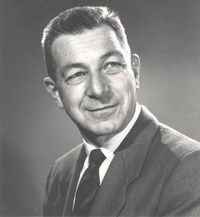
The ex-Marine’s name is Girard Joseph McNulty, who said: “The way we had to live like animals just seemed to get me down. Half the time we didn’t know what to do about rent or for food or anything else and it just hit me all at once.”

His girlfriend was Laura Irene Donnelly and she had known McNulty about two years. They had arrived from Colorado about a month earlier.

The youngster is identified as Joyce Ellen Meyer in one story and Joyce Donnelly in another.

“I don’t really know why I hit her but when I hit her she just hit the wall with her head and then I heard her crying and rushed her to the hospital,” McNulty said. Joyce was hospitalized with a black eye, bruises on her abdomen and cheek, and a possible concussion.

McNulty was arrested on charges of felony child beating and arraigned, but The Times never pursued the story. He died in Texas in 1992, according to the Social Security Death Index. No further information is available about Laura Donnelly or her daughter Joyce.

Email me

Posted in #courts | Tagged , | Comments Off on Child beater

Matt Weinstock

June 28, 1957

Rehabilitation can come in curious ways. Let a man who occasionally
checks in here tell his story of self-appraisal and reinstatement in
society.

One day he picked up a book, “Blood on the Boards,” by William Campbell Gault, and read:

“Slopping through life with no discipline, no goal! And they find
themselves 40 and empty, and go looking for what they missed in a
bottle.”

The words hit him, he says, with the impact of a sledge hammer. Nothing had ever made such an impression on him.

He stopped and reread them. He has reread them many times. He has made copies of them.

At the time he asked himself two questions:

“What have I lost that is so important to me?” “What do I want?”

Both answers came within seconds.

“I am now well on my way to achieving what I desire to do,” he says,
“and recovering what I lost. And I haven’t had a drink from that moment
to this.”

IN THE MAIL Monday
an employee at Gibraltar Savings & Loan Association of Beverly
Hills came upon an envelope containing $5,000 in $100 bills with no
clue to the identity of the sender.

On Wednesday, a customer appeared, claimed the money and directed that it be deposited in a savings account.

He explained he’d been in an all-night poker game and had been filling
full houses and inside straights like crazy. At the height of his run
of luck he’d stepped outside, stuffed his winnings in an envelope and
mailed it to Gibraltar, then returned to the game.

Will all gamblers who wish they’d done the same at one time or another please bow their heads in reverence to the man who did.

MISCELLANY — Note on
the bulletin board at the Valley Elementary District Board of Education
office: “I pledge allegiance to the City of Los Angeles and to the smog
under which it stands. One city, invisible, with eye drops and cough
drops for all.”

Posted in Columnists, Environment, Matt Weinstock | Tagged , , , | Comments Off on Matt Weinstock

Cold case file–the Pied Piper

Tyler Marshall’s Column One (known at The Times as a “nondupe) on the Pied Piper is one of my favorites. And since the presumed anniversary of the incident is in late June, it seemed like a good time to share the story with a new generation of readers. As it appeared in The Times, June 22, 1984:

Part 1 Continue reading →

Posted in Uncategorized | Tagged , , , | 1 Comment

Orchestra wives

June 28, 1957
Los Angeles

It’s a tough life for orchestra wives. Consider the case of Joy
Windsor, bandleader Charlie Barnet’s 10th wife. In May, Barnet had
assured her that his days of touring were over. “I was on the road a
lot in the old days,” he said. “One-night stands. The way a musician
travels on the road is tired, dirty and drunk. Doesn’t make for a good
marriage.”

“The band business has changed now. There’s not much road any more…. You don’t have those one-night stands.”

Maybe the band business had changed, but Barnet hadn’t. Windsor’s
complaints echoed those of his previous wife Betty Reilly, who said
Barnet left her for days at a time and refused to tell her where he had
been.

In fact, Barnet had been married so often that even The Times lost
count, calling Windsor Barnet’s ninth wife in some stories and 10th
wife in others.


The wives of Charlie Barnet, with his comments, as listed in 1955:

    1. A showgirl–It lasted about eight months.
    2. A singer–Artie Shaw was the best man. “We had a horrible fight after the ceremony and she went her way and I went mine.”
    3. A showgirl–Her divorce wasn’t final, so the marriage was annulled.   
    4. A singer–“It lasted a couple of years.”
    5. An actress. “She was my favorite. We were married about six years.”
    6. “Just a plain li’l ol’ gal. It only lasted a week.”
    7. A singer–“A couple of years.”
    8. An artist–“My divorce from No. 7 wasn’t final, so that one was annulled too.” 

Among Barnet’s wives are:

  • Rita Merritt (1947), probably wife No. 5.
  • Harriet C. Barnet
  • Betty Reilly (1953)
  • Linda Joyce Johnson (1956)
  • Joy Windsor (1957)

Wife No. 5 said in 1955: “Sorry I married him? Not a bit. If I marry again, I’d like to marry a fellow exactly like Charlie. He’s a
fascinating man and certainly not a bore.  In fact you never knew what was going to happen next. But being a musician he was on the road a lot and we really didn’t get a chance to establish a home. It just wasn’t conducive to a good marriage.”

Bonus fact: In researching Charlie Barnet, I stumbled across the sad story of vocalist Ann Richards, who married bandleader Stan Kenton in 1955. She won the Downbeat poll
as the No. 1 band vocalist in 1956, but left her career to be a mother, rejoining the band in 1961. After divorcing Kenton, Richards married William Botts, although she later separated from him. It was Botts who discovered her body in the bedroom of her Hollywood Hills home in 1981.Unable to find work after she ended a 10-year engagement at the Bel-Air Hotel, Richards shot herself in the head, leaving two children, Dana and Lance Kenton. Richards was 46.

(You may recall Lance Kenton was arrested in 1978 in a scheme to kill attorney Paul Morantz, who won a lawsuit against Synanon, by putting a rattlesnake in his mailbox).

Here’s some Charlie Barnet.

And some Stan Kenton.

Email me

Posted in #courts, #Jazz, Music, Nightclubs | Tagged , , , , , , | Comments Off on Orchestra wives

They said it

June 27, 1957
Los Angeles

"The Lord made distinctions between the races in the beginning of time. This idea of amalgamation of races and one world and all that is of the devil."

J.H. Seal, chairman of the board of trustees, Normandie Avenue Methodist Church, explaining why all the white members of the congregation were leaving to protest the appointment of an African American minister.

Nope, this was not the deep South. This was L.A.

Email me

Posted in Countdown to Watts, Religion | Tagged , , , , , | Comments Off on They said it

Sports Arena

June 27, 1957
Los Angeles

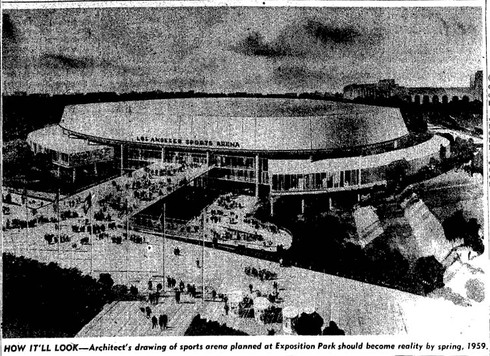
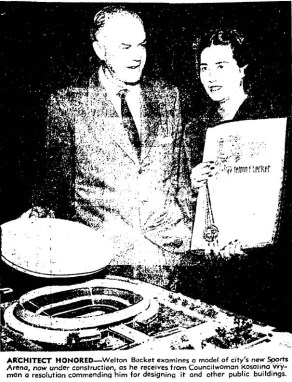
Here’s one plan that was actually built: The Los Angeles Memorial Sports Arena. Designed by the firm of Welton Becket, the arena was intended to be a 19,000-seat facility built for $5.7 million ($40,842,117.48 USD 2006).
“This is the greatest challenge my office has ever had,” said Becket, whose firm designed the Capitol Records Tower, the Theme Building at LAX and the Cinerama Dome. “Although the plans exceed the limits in every case that was given to us, we still would have presented this same plan if we $11,000,000 to work with,” he said.

The arena was opened by Vice President Richard Nixon on the Fourth of July, 1959. It hosted the Lakers (1960-1967), Clippers (1984-1999) and
USC basketball (1959-2006) and was the site of the 1960 Democratic National Convention.

The arena is featured in the exhibit “Housing the Spectacle.”

Email me

Posted in Sports | Tagged , , , , , | Comments Off on Sports Arena

Smog alert

June 27, 1957
Los Angeles

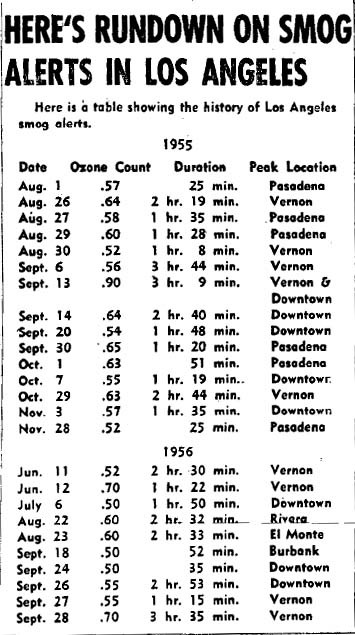
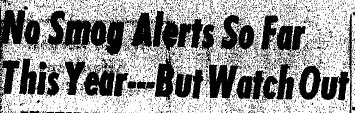
Everybody knows that Los Angeles suffered terrible smog in the 1950s, but without statistics, all we have are stories and photos of toxic clouds obscuring the landscape.

In fact, for the unfortunate people living in Los Angeles in 1957, what was deemed a Stage 1 alert (0.5 parts per million of ozone) would be a Stage 3 alert today. (In a Stage 2 or Stage 3 alert today, all non-emergency driving is discouraged and schoolchildren are banned from outdoor activities).

Now for the really ghastly facts: In 1957, a Stage 2 alert was 1 ppm and a Stage 3 alert was 1.5 ppm. The Mirror notes that  no Stage 2 or 3 alerts had ever been issued, but that in a Stage 3 alert, the governor was authorized to declare a state of emergency.

One of the most polluted days in Los Angeles history was Sept. 13, 1955, when the city reached 0.9 ppm of ozone in Vernon and 0.85
ppm downtown.

Dr. Clarence Mills of the University of Cincinnati said: “The Los Angeles situation is so severe and so fraught with health dangers that any pollution control program should be put on compulsory basis.” Mills urged that a Stage 1 alert be issued at 0.2 ppm, which is, in fact, the current level. Using that figure, Los Angeles had four Stage 1 alerts in the first six months of 1957.

When someone told Mills that his lower figure would have Los Angeles County at a Stage 1 alert for most of the year, he replied: “That’s the way it should be.”

The California Air Resources Board link is here.

Email me

Posted in Downtown, Environment | Tagged , , , , | Comments Off on Smog alert

In Rome

June 26, 1957
Los Angeles

The late Art Buchwald always struck me as one of the least amusing humor columnists America has ever produced. But as this piece shows, he was a pretty fair writer when he wasn’t trying to be funny.

Posted in Columnists | Tagged , , , | Comments Off on In Rome

Boxer dies

June 26, 1957
Los Angeles

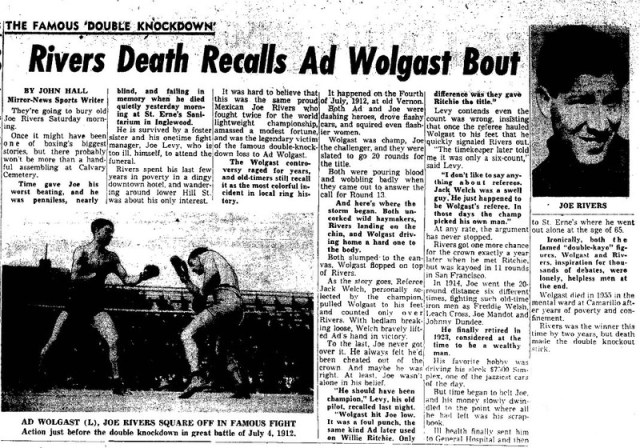
I’m pleased to present the work of John Hall, a columnist for the Mirror, The Times and the Orange County Register. In this piece, he recalls the late boxer “Mexican” Joe Rivers and his fight with Ad Wolgast. (Note that Wolgast is in the International Boxing Hall of Fame and Rivers isn’t.)

Posted in Columnists, Downtown, Sports | Tagged , , , , | 2 Comments

Lawyer drowns in pool


June 26, 1957
Los Angeles

The lawyer drove up to the cabin in Tick Canyon, north of
Saugus, in his Cadillac. He should have been home in Beverly Hills by now, but he phoned his wife, Mary, that he was having dinner with a client.

He parked the Cadillac next to the cabin and left his jaunty straw
“boater” hat in the back seat. Maybe he sat in one of the chairs next to the pool for a while–perhaps all night. Then he put his glasses under the chair, took off his coat, with $109 in loose bills in the pocket, and laid it on the chair, along with his white shirt and tie, and a folder containing his identification cards.

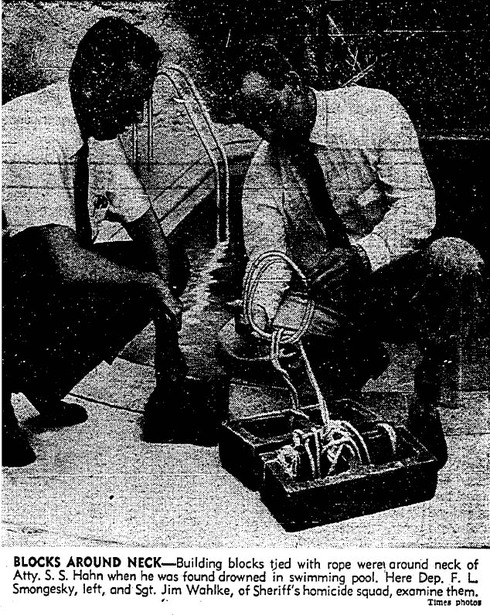
Then he tied one end of a rope around his neck, threaded the other end through two concrete blocks and jumped into the deep end of the pool. That’s where he was found by 17-year-old Bob Nelson, a
neighbor who had been hired to do some chores around the cabin.

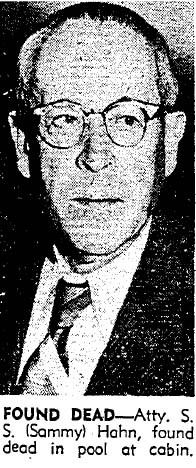
Sammy “S.S.” Hahn, 68, a Russian immigrant, is an obscure figure today, but at the time of his death, he was a well-known attorney who handled some of the most famous clients in Los Angeles, including Aimee Semple McPherson and murderess Louise Peete, one of only three women to be executed in California. A graduate of USC’s law school, Hahn was originally known for his defense work in high-profile criminal cases but later specialized in divorces.

He earned his nickname, “The Corporal,” during a sharp courtroom exchange with Col. William H. Neblett, who protested when Hahn continually referred to him as “Mr. Neblett” instead of “Col. Neblett.” “Your honor, Hahn said, “if my opponent insists on his military rank, so shall I. Henceforth, I respectfully request that I be addressed as Cpl. Hahn.”

Hahn’s apparent suicide puzzled his many friends and devastated his wife, Mary, whom he married in September 1954. Hahn’s wife of 36 years, Teresa, had died in May 1954. Some people speculated that Hahn’s death was not a suicide, especially because he left no note, but medical examiner Dr. Gerald K. Ridge found that his death was an uncomplicated case of asphyxiation.

Mourners attending his funeral at Forest Lawn in Glendale, conducted by Rabbi Samson Levey, included attorney Jerry Giesler and Judges Thurmond Clark, Henry Draeger, Larry Doyle and Mark Brandler. Pallbearers were members of American Legion Post 253 of Beverly Hills.

Email me

Posted in #courts, Suicide | Tagged , , , , | 1 Comment

Voices

I remember well the Paul Coates program on TV, Channel 11, when it was owned by The Times.  Never understood anything he was talking about when he was on, but I remember the stark blackness of the set
behind him.

I was born on a rainy February morning in 1950 in old Methodist Hospital downtown, on the 50th anniversary of Adlai Stevenson’s birth, also in LA.  Throughout the ’50s, 60s and 70s, lived in Hermosa Beach, Manhattan Beach, Redondo Beach, Torrance (I walked to kindergarten and 1st grade on a dirt road bordered by tall eucalyptus and pastureland where we kids would slip thru the barbed wire fence to taunt the bulls hanging with the cows—yes, Torrance, CA 1955-57), Buena Park, La Sierra, Riverside, West Covina, Upland, Palm Springs, Panorama City, Simi Valley, Westwood (UCLA, History, 1972), then lit out for literally greener pastures in the late ’70s to New England, Mass, NH and Vt, where I live now.  I visit L.A. occasionally, see no difference in the traffic flow (I always knew what time of day to take certain roads to zip thru traffic) and much less smog today—and the place looks cleaner, shinier
even, and always try to coincide my trips with a game or two at Dodger Stadium.

What prompted me to write is your story on the dismantlement of the backyard incinerators.  I remember very clearly this first step in smog reduction.  As a 7 yr old in ’57 i paid little attention to smog, other than how it stung and made my eyes water, and remember the haste with which my dad went from getting a notice some official was coming to inspect the fact the incinerator in the backyard would be no more.  This would be in Buena Park, where from the summer of ’57 to ’61 i enjoyed, no, deeply fondly loved the best 4 years of my childhood, as my friends and I would play with the horney
toads which populated the looong-gone orange groves a couple of blocks away, and every Saturday morning I would walk to Knott’s Berry Farm, when entrance was free and it was a quiet, wonderfully smelling place, of eucalyptus (again) and boysenberry, to stroll around in the ersatz-but-real Huck Finn environment, and jump the tracks and dodge the old steam train as it would chug by.

Anyway, I remember my dad burning stuff, paper and dry tree limbs, in the little cement incinerator for the last time before the official came to verify the thing was laid flat, the four sides of the object
left lying where it stayed for years, and the talk that this would reduce the smog.  It did, but little did we know the magnitude of the problem from cars.

Nothing exciting, really, just another fond
little memory you piqued from my childhood.
~  Craig Hill / Montpelier Vt

Posted in Uncategorized | Tagged , , | Comments Off on Voices

Note to farflunglounge.com

I’m glad you folks are linking to me, but I’m quite curious as to what you’ve said as your site is restricted.

Email me

Posted in Hollywood | Tagged | 1 Comment