Matt Weinstock

July 16, 1957

Matt_weinstockd Account 727-1 in the auditor's office of the Southern Pacific is known within the company as the "Conscience Fund."

It consists of money sent in by people for services rendered but unpaid for. An average of $200 a year is contributed, mostly anonymously.

Many such conscience cases are of long standing. Recently, a man sent in $250 as restitution for tools he took from the company in 1896.

A more typical donation came from "A Patron"– a $1 bill for a train ride beyond the point called for by his ticket.

Another made good the freight charge on a bicycle he sneaked aboard a train.

Last month, this letter came from a woman of 83:

"In the late summer of 1887 with an uncle and aunt who were supporting and caring for me, I came from East Portland, Ore., to Pasadena, Cal., tourist or second class. I came on a half-fare ticket. My birthday was in December 1874, making me between 12 and 13. If the conductor had asked for full fare for me I think my uncle would have paid it. He died many years ago. I wish a clear conscience concerning this. Kindly inform me what amount for restitution will be satisfactory to you."

Messerschmitt57 After checking, the SP wrote her that the difference between the fare paid for her and an adult ticket in 1887 would have been $17.82. She promptly forwarded a check for this amount.

Realizing these people find it important to clear their minds of such obligations, the company accepts these contributions and, when names and addresses are given, commends them.

A NEW PROGRAM on mental illness, "Focus on Sanity," will be presented tomorrow on KNXT.

While at Patton State Hospital documenting the series, a camera crew focused on a woman patient who had been committed in 1908 and was singing. Another patient approached her and asked her for a cigarette.

The new "star" looked witheringly at her old buddy and said, "Don't bother me now–I'm on television." The fever gets them all.

AROUND TOWN –As Jacquelin Molinaro passed Wilshire and Western the other night a workman on a ladder changing the marquee on the Wiltern Theater called out to the driver of a red Messerschmitt (a sample, above). "Hey, bub, what is it going to be when it grows up?"

Photograph from sixtiescity.com

Posted in 1887, 1957, Columnists, Matt Weinstock, Transportation | Tagged , , , | Comments Off on Matt Weinstock

Paul V. Coates–Confidential File

Paul_coates
July 15, 1957

SUBJECT’S NAME: Mildred Dolores Hall.

SUBJECT’S DESCRIPTION: Age, 42, height, 5 feet, 6 inches. Weight, 118 lbs., Red-blond hair. Brown eyes. Slim-medium build.

Any person with information as to the subject’s whereabouts is
requested to contact the Missing Persons Section of the Los Angeles
Police Department.

Mildred Hall is not a simple person to explain.

She was born of theatrical parents and she knew the business well.
Stars and industry pioneers of 25 years ago were personal friends of
hers.

And she herself came as close to becoming a name actress as anyone can without–that is–actually doing so.

Whether she would have made it is foolish to argue.

Because at the peak of her beauty, Mildred Hall quit the business to become a wife.

It was the role she wanted. And, for the last 18 years, she apparently
played it well. She found many friends and was an active and devoted
mother to her four children.

She was, until eight months ago: Nov. 15, 1956.

What happened on that date, or since, nobody knows.

In an effort to learn–to find a logical theory–I contacted more than a dozen of her close associates and friends.

1957_0715_missing_hall
All told me what they knew. Many had personal theories. But each one’s report made the puzzle even more complex.

It was as if Mildred Hall were 12 different persons.

I’ll throw out the supposition and present what I believe to be fact.
And I hope that somewhere in it lies the key to the case of the most
complex missing person I have yet encountered.

Mildred Hall’s movements on the morning of Nov. 15 are established:

Shortly before 8 o’clock, she drove her three oldest children to
school. Then she took her youngest boy, Tommy, 4, shopping with her.

She bought groceries and a pair of shoes for her 16-year-old. She went
to the bank and drew out $100, apparently to do her Christmas shopping.
she returned home between 10 and 11.

Tommy went out to play and Mrs. Hall’s husband, Harold, who had worked the night before, was asleep.

He awakened shortly after noon and was told by his son that Mildred had gone back to town again.

Hall says he still has the note which his wife left for him on the kitchen table.

"I have an appointment uptown at 12:30 p.m. Shouldn’t be more than an
hour at most. I have something very important to talk to you about.
Lots of love, Millie."

Mildred Hall never had the "very important" talk with her husband.

Five weeks later, her car was found. It was parked in the 2000 block of
South Genesee Street, some three miles from her Palms home at 3666
Keystone Ave
.

Police report that the keys were in it, and so was her wallet with all
her identification. There was no money found, but on the floor lay her
Christmas shopping list.

Thorough investigation of the vehicle revealed no other clues.

Hall reports one other discovery which struck him as strange. "When she
disappeared she left her wedding ring home on the dresser. Never
before, to my knowledge, had she taken it off."

He also says that his wife never suffered loss of memory or blackouts in his presence.

Other friends say that they had witnessed her blackouts. But that they started only shortly before she disappeared.

But strangest of all was the following report by Hall:

"It was pure coincidence.

"About two hours after she left had left home–before, of course,
anyone had any reason to suspect she’d be missing–a friend of ours saw
her shopping.

"The friend walked up to her and addressed her by name.

"But Millie just looked kind of blank. And she turned and walked away."

[Note: To be continued–lrh]

Posted in Columnists, LAPD, Paul Coates | Tagged , , | 1 Comment

Meltdown


1957_0716_reactor_hed2

1957_0716_reactor_pix
July 16, 1957

Los Angeles

At a field lab in the Santa Susana Mountains, an
experimental nuclear reactor has begun generating electricity for San Fernando Valley housewives, thanks to our friend,
Mr. Atom, the Mirror says.

Housewives "wouldn’t know it if it sparked before their eyes, for
electricity is electricity the world around," the Mirror says. "It’s
just that the source of the heat which generates the juice is
different." The reactor "marked a peacetime application of a terrifying
scientific fact–that when you split an atom, a lot of power, a lot of
heat is generated."

After explaining how a nuclear reactor works, the Mirror noted: "The
small amount of uranium in the reactor will last three years!"

Of course, it’s impossible today to say "Santa Susana Field Lab" without adding "Superfund site," a subject far too complex for this humble blog.

But let’s take a look the Sodium Reactor Experiment that began in 1957.
Before it was deactivated in 1966 and eventually dismantled at an
expense of $13 million (more than twice its original cost), the reactor
suffered a meltdown in 1959 that released 260 to 459 times the
radioactivity spilled at Three Mile Island.

Oops.


1957_0716_meltdown

According to a story from 1979, when officials of Atomics
International–a division of Rockwell International–acknowledged the
20-year-old meltdown, "13 of the reactor’s 43 uranium fuel rods
ruptured or suffered some degree of melting in the July 13, 1959,
accident."

Although technical publications had discussed the incident for years, the meltdown was never reported in the news media.

"It was a messy accident, but I’m not aware of any evidence that it endangered the public," Theodore B. Taylor of the President’s Commission on Three Mile Island, said in 1979. "It was nothing like Three Mile Island."

(I’m assuming Taylor was not referring to the magnitude of the release but the fact that the spill occurred at a remote site rather than in a populated area).

Briefly, the reactor’s coolant system became clogged due to a leak, the
fuel rods overheated and spilled a "massive" amount of radioactive
fission products, The Times said in 1979.

"Despite numerous indications that something was wrong inside," The
Times said, "Atomics International continued to run the reactor at low
power for two weeks after the accident, shutting it down July 26, 1959.

Many original documents on  Santa Susana Field Lab are available here.

Email me

Posted in Environment, San Fernando Valley | Tagged , , , , , | Comments Off on Meltdown

You, the jury, Part I


1957_0716_schiers_hed

1957_0716_schiers_pixb July 16, 1957
Los Angeles

Ladies and gentlemen of the jury, you have heard the witnesses and seen the evidence. Now you must decide whether to find Wallace LeRoy Schiers, 34, guilty of second-degree murder in the killing his wife, Lillian, 39, on or about Feb. 12, 1957.

Let me summarize the case briefly:

Wallace and Lillian Schiers (shown at right) were married Feb. 18, 1952. (Mr. Schiers had been married at least once before and Mrs. Schiers had three previous marriages). On the evening of Feb. 11, 1957, shortly before their fifth wedding anniversary, Wallace and Lillian Schiers had been drinking heavily in a bar, then went to their home at 10914 Gaynor Ave., Granada Hills, where they drank a fifth of Scotch, a pint of Scotch and a six-pack of beer.

Mr. Schiers also testified that he and Mrs. Schiers had been working on their income tax returns that evening. Witnesses have testified that Mr. and Mrs. Schiers recently took out a $2,800 loan ($20,062.79 USD 2006) to put a sunken living room in their home and have said that the Schierses frequently argued about money.

Mr. Schiers and Mrs. Schiers kept separate bedrooms. Mr. Schiers, a foreman at the Bendix plant in North Hollywood, testified that he went to bed about 1 a.m. on Feb. 12, 1957, and left for work about 6:30 a.m. without checking on Mrs. Schiers. Mr. Schiers testified that when he went to bed, Mrs. Schiers was in the bathroom.

Two friends, Louise Peterson and Mildred Butcher, described finding Mrs. Schiers' body after she did not answer repeated phone calls. Mrs. Peterson and Mrs. Butcher said they entered the Schierses home about 9 a.m. through an unlocked side door after seeing Mrs. Schiers' car in the garage. They found her nude body sprawled on the floor of her bedroom with her arms outstretched. There was no signs of a struggle and detectives speculate that Mrs. Schiers may have been killed in her sleep.

Detectives said Mrs. Schiers had been beaten in the head with a heavy instrument like a lug wrench or a hatchet. Her bed was soaked with blood and there were blood spatters on the floor and ceiling. Medical experts testified that death occurred about 11 p.m. and was caused by a wound to Mrs. Schiers' left temple 2 inches long and 1 1/4 inches wide. 

Investigators did not find any blood residue in Mrs. Schiers' bathroom, but found evidence of blood in Mr. Schiers' bathroom. Investigators also said that tests for blood on Mr. Schiers were positive.

Mrs. Ramona Allen, who lives in the home adjoining the Schierses' property, said that about 7:30 a.m. on the morning of the killing, she found the gate to the fence separating the two lots had been battered down. Mrs. Allen testified that about 3 a.m. that morning, she heard "a lot of commotion as if someone was prowling in her garage. "I heard an awful crash," she said. Her husband went outside to check, but didn't see anything. Mrs. Allen said that dogs in the neighborhood barked for about an hour.

Mrs. Schiers' mother, Mrs. Sally Johnson, testified that when she visited the home after the killing, she noted that two heavy glass candlesticks were missing from her daughter's bedroom and a massive green bottle was missing from the kitchen. Medical examiner Dr. Frederick Newbarr testified that the wounds on Mrs. Schiers' body were star-shaped, the same design as the missing candlesticks.

Mr. Schiers has insisted that he is not guilty of killing his wife and defense experts note that the positive test for blood is imperfect and will also register false positives for a variety of other common substances.

In addition, a polygraph test administered to Mr. Schiers by the Los Angeles Police Department was inconclusive. However, a police officer testified that Mr. Schiers was told that the test showed he was guilty and Mr. Schiers answered that there was something wrong with the machine.

Please recall that the defense objected to police testimony about the polygraph results because they are inadmissible in court.  The judge has instructed you to disregard any testimony about the polygraph results.

Your verdict?

Email me

Posted in #courts, 1957, Crime and Courts, Homicide, LAPD, San Fernando Valley | Tagged , , , | 2 Comments

Matt Weinstock

Matt_weinstockd July 15, 1957

Farther and farther go the freeways, preceded by roaring monsters which sweep aside or reduce to rubble everything in their paths, then claw and shape the earth. But all is not lost.

Every Tuesday, Lenard Kester takes his art class sketching. For this month's subject, he selected the quickly disappearing old houses in the path of the new San Diego (Sepulveda) Freeway south of Santa Monica Boulevard.

The first week all was serene as his pupils, mostly housewives, worked at their easels.

Last Tuesday, the second session, Lenard noticed that a group of neat little cottages with orderly gardens several blocks south of their location had been pushed into huge piles of unrecognizable rubble. Meanwhile, a chugging bulldozer half a block from where they were painting gave portent of evil things to come.

Clearly, the houses and backgrounds his students had half-finished would be gone before this week's session.

But during the afternoon the contractor on the freeway job came by to see what they were doing. He ventured the opinion that one pupil's painting looked like a Van Gogh.

Upshot was that he gave orders that the section was not to be disturbed until the paintings were completed.

I DIDN'T REALIZE it until John Grover, the gourmet, told me, but L.A. has long been a tripeless desert.

But you know how gourmets are–sneaky. So John, a tripe lover from way back, has wheedled Rocco Guarino, cook at Anthony's across from City Hall, into putting tripe on the menu one day each week.

"This is definitely a cultural breakthrough," gloats John.

Me, I can't tell the difference between trip and octopus.

AT RANDOM–A man about to board an elevator in a Spring Street building asked Ann, the operator, "Is this the champagne flight?"

Posted in 1957, art and artists, Columnists, Downtown, Freeways, Matt Weinstock, Transportation | Tagged , | Comments Off on Matt Weinstock

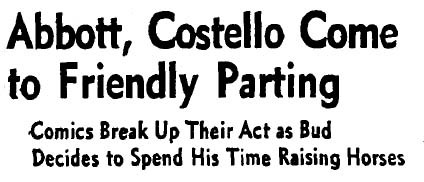
July 15, 1957: The laughter dies

July 15, 1957: Abbott, Costello Come to Friendly Parting


July 15, 1957
Los Angeles

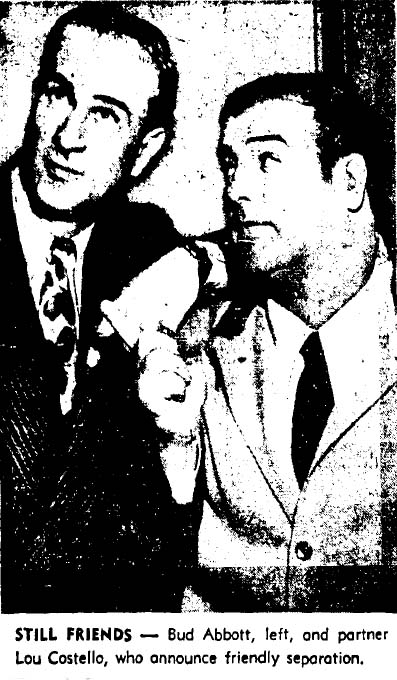
July 15, 1957: Abbott and Costello, breaking up the actThey had been through triumph and tragedy, and spent more time together
than many married couples. But it was time for a change. The scripts were lousy and getting worse. One of them wanted to keep working and the other wanted to quit and raise thoroughbreds.

So Bud Abbott and Lou Costello split the act. Abbott, the straight man, was going to retire to his ranch in Ojai. Costello, the pudgy comedian, was going solo–he didn’t want to work with anyone else.

Soon it was Abbott vs. Costello in a $222,465 lawsuit over money from a
TV contract, although the men apparently remained friends.

And in less than two years, Costello was gone. He was hospitalized after he collapsed in an apartment at 4222 Ethel Ave., where his family was living while a home was being built at 3322 Longridge Terrace, Van Nuys. At the time of his death, Costello had some TV dates on Steve Allen’s show and was to appear at the Dunes in Las Vegas. Continue reading →

Posted in 1957, Film, Hollywood | Tagged , , | 5 Comments

In the News


1957_0715_time_chandler

July 15, 1957

The painting on the cover of Time speaks to us a bit
differently now than it did to the readers of 1957. There
is little room for subtlety in an illustration intended to compete on
newsstands with so many other magazines, forcing artist Henry Koerner to convey a simple message that could be grasped immediately.

There is Norman Chandler, a captain of Southern California industry,
with the visual shorthand for Los Angeles that has become such a
cliche: City Hall, palm trees and the mountains. Looking dignified and
eminently trustworthy, with his hair parted down the middle like the baritone in a barbershop quartet, he is holding a copy of the Los Angeles Times
folded into a sailor’s hat as if he were about to play with one of the
younger members of the next crop of Chandlers.

There are several messages we can see today that might have eluded the
harried newsstand customer of 1957: The inference that the Los Angeles Times
was best used for something other than reading (the article, in fact, calls it "neither a
great paper nor a poor one") and perhaps that Chandler was a tin-pot
Napoleon not to be taken seriously — at least nowhere outside crazy
Southern California. We might even surmise that The Times was nothing
but an expensive plaything for the Chandler family.

The anonymous cover story
conveys a similar message with just as little subtlety. Bristling with
biased and unnecessary adjectives (beaches are not merely beaches but
"the very Pacific beaches") and occasional odd metaphors (Gen. Harrison Otis
"began to carve his name in the sand with his editorial cannon balls,")
Time paints the portrait of a noisy, shrill city that could be accompanied by
hustle-bustle music and staccato notes from a xylophone, like one of "The March of Time" newsreels:

Nourished by a generous soil and a benign climate, this open-toed,
pastel empire last week beat with a great hum-thrumming vitality. On
Wilshire Boulevard, rivet guns prattled into the fresh steel of new
office buildings. The reiterated whop of the hammered nail rang out in
a 6,000-house development on San Fernando farmland, in a 17,000-house
subdivision in the tawny hills 40 miles to the southwest in Palos
Verdes—and wherever bulldozers sliced down citrus groves to make room
for more.

From the swarms of workers in electronics and aircraft plants
came one big, tumultuous earache. And millions of nerves throbbed with
the nightmare of 3,000,000 cars (one for every 2.2 people v. Detroit’s
one for every 3.2) cascading over 204 miles of multilaned freeways.   

Added to this was the arrival in Los Angeles last week of 4,200 popeyed
newcomers (25 every hour of the year). Like the ever-moving,
ever-changing populace that moved aside to make room for them, the new
Angelenos eagerly got set to join the scurrying rhythms and busy
polyphony: to work more change, to make more moves, more money, new
houses, new businesses—and to crowd out of the way of next week’s
horde of 4,200.


In this bouncing scenery, the one unchanging force
is the Los Angeles Times. Each morning it drops with a thick,
self-assured plop on 462,257 doorsteps from Anaheim to Azusa,* like a
faintly welcome striped-pants uncle (wealthy but voluble). Neither a
great newspaper nor a poor one, the Times, from its downtown limestone
monolith, serves as an unshakable herald, chronicling the region with
loving detail, goading Angelenos toward the megalopolitan destiny
ordained by Harrison Otis.


The Times proudly announced the upcoming article in a Page 2
story–full of quotes and without a single quibble–as if the Chandlers
were thrilled that the East Coast news establishment was writing about
them at all.

1957_0715_time_hed

From our perspective, the Time article is not terribly flattering but noteworthy for several reasons. It certainly falls into
the trap of portraying the Chandler family as a dynasty of visionaries and mavericks who boldly and single-handedly shaped the
ever-sprawling city, ruthlessly attacking all opponents. (Also see "Thinking Big").
And like most articles about Los Angeles, the report takes a slap at Hollywood, crackpot preachers, Forest Lawn, refugees from Iowa and a vain, superficial, suntanned populace that is making its fledgling attempts at culture.

Gen. Harrison Otis is depicted as a cantankerous, eccentric old coot shouting orders as if he were eternally under siege, so forceful a personality that it seems like the entire article is about him, although he constitutes only a third of the story. Harry
Chandler, in contrast, is the shrewd power-broker operating quietly behind the scenes. One
of the most telling quotes is this: 


"The difference between Harry and Norman," says one
old-time Angeleno, "is that Harry sat in his office and ruled this city
like a king. Norman doesn’t rule; he isn’t interested in ruling. What
he wants is to become an institution."

Norman Chandler comes off as an unimposing
milquetoast compared to his predecessors and must share the limelight with his wife, Dorothy "Buff" Chandler, portrayed as a terrifying
uber-clubwoman, gadding about the city in her little Simca, meddling in
civic and cultural affairs and nagging her husband to "do
something" about that nasty smog.

If it were no more than this, the story would merely be a dusty curio, worth little more today than the few statistics we can
glean from it. But the parallels between past and present, hidden in
the Time story, are fascinating. Even breathtaking. Beneath the boilerplate
analysis of a crass, frenzied Los Angeles lurks a telling reality:

Compare this, from 1957:

Yet in a town where the Times is
one of the few enduring institutions, Norman Chandler knows better than
to try to wield an overpowering political club. Today’s Los Angeles is
too amorphous for one man to rule, one newspaper to command,* or even
one political organization to anneal.

And this, from a March 26, 2006, article by Peter H. King and Mark Arax:

Those who study Los Angeles today employ terms like "horizontal" and
"diffuse" to describe the city’s power structure. They talk of a power
vacuum and note that, with so many of its old Fortune 500 companies
dissolved, bought up, relocated, Los Angeles has become something of a
"branch city." Whether this represents a good or bad development is
open to interpretation.

"Today there is no single node of power in the city," said Mayor
Antonio Villaraigosa. "It’s diffused geographically, diffused among
important stakeholders — business, labor, for instance — and also
racially and ethnically…. There is a devolution of power today that
is more grass-roots and more focused on specific neighborhoods."

Simply said, the past is far more complicated and layered than we realize and much more like the present than we care to admit. There are no quick descriptions of Los Angeles–and no easy answers–that are of any use; the city is too big and too diverse for a thumbnail sketch. Only the broadest canvas will do and even then the city bleeds over the edges.

I like this final quote from Time:

"Sums up Buffie Chandler: "I don’t say Los Angeles is the most beautiful
place on earth, or even the most desirable. I love San Francisco, for
instance. But I could never live there, because everything that needed
doing has long since been done. In Los Angeles, things will always need
doing, things will always need to be made better. Los Angeles is a
place for the kind of people who are willing to try something new. It’s
a place for people who want to build a new world."

Email me

Posted in @news, City Hall, Current Affairs, Downtown | Tagged , , , | 1 Comment

Dodgers Staying in Brooklyn

July 15, 1957
Los Angeles

Not so fast, Los Angeles. The Bums aren’t coming!

1957_0715_dodgers

Posted in Dodgers, Sports | Tagged , , , , | Comments Off on Dodgers Staying in Brooklyn

Literary diversions

Carey McWilliams, the author of "Southern California: An Island on the Land," catalogues a few morose, quirky poets in The Times, Aug. 9, 1931.

1931_0809_mcwilliams

Posted in books | Tagged , , , | Comments Off on Literary diversions

Branding

July 14, 1957
Los Angeles

The very name connotes elegance in home electronics: The Granada Hills.

Really. And an early American TV at that, back in the days when television sets were supposedly to look like fine furniture instead of big black boxes. And if you’re really fancy, you might want the Palmdale.


1957_0714_granada_hills

Here’s the entire ad:


1957_0714_tvad


Posted in Television | Tagged , , , | 3 Comments

The Nina mystery

July 11, 1957
Los Angeles

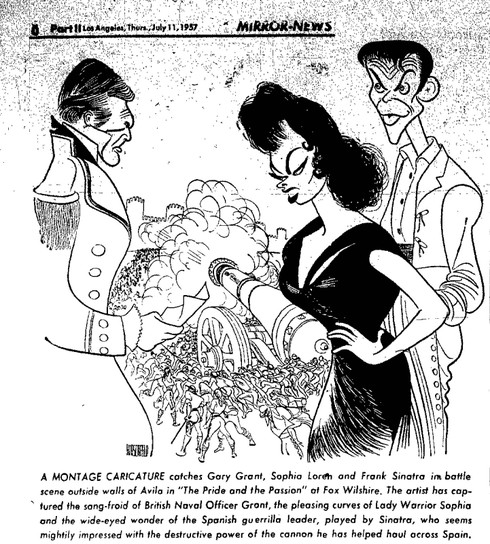
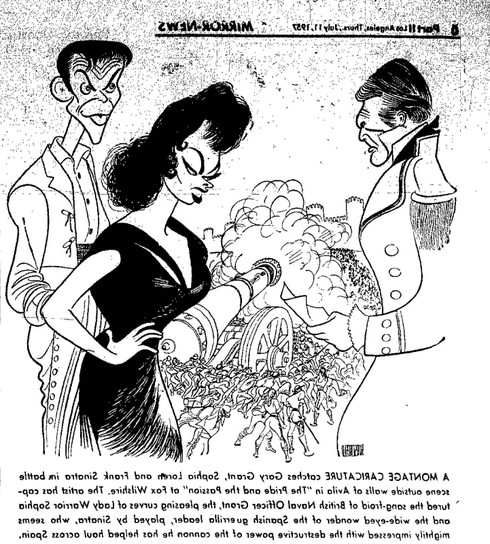
Here’s a vintage Al Hirschfeld drawing done for “The Pride and the Passion,” starring Frank Sinatra, Sophia Loren and Cary Grant. Hirschfeld is famous not only for being a fabulous artist but for hiding the name of his daughter Nina (born in 1945) in his drawings. In later years, he placed a number next to his name so people would know how many “Ninas” there were, but since this is an earlier drawing, there’s no number to guide us.

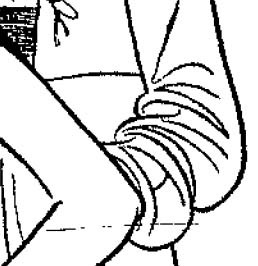
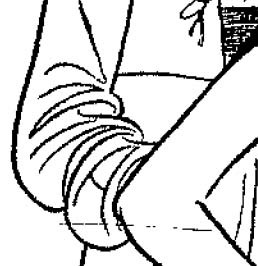
There is at least one “Nina” in this picture, but it’s reversed. The question is whether Hirschfeld flopped the artwork before adding his name or hid the “Ninas” as mirror images. (This is the only flopped “Nina” I have ever seen).

The original

The closeup

The closeup flopped

And the original flopped.

Was Hirschfeld saying that Frank Sinatra had something up his sleeve? I wish we could ask him. Note that the caption doesn’t even identify Hirschfeld but refers to him as “the artist.”

See any more? Let me know.

Email me

Posted in art and artists, Film | Tagged , , , , | 2 Comments

One for the books


1957_0714_foy_hed

1957_0714_foy_pix July 14, 1957
Los Angeles

At 95, Mary Foy has the formula for longevity: Watch your health, keep mentally active and be Irish. 

The Times catches up with Foy and her "double cousin," Ella Foy O'Gorman, as the women celebrate their 95th birthdays in the home they share at 1706 S. Menlo Ave.

Foy is of special significance because she became the city's first librarian–in 1879–and where would we researchers be without librarians?

Born on July 13, 1862, Foy was the first of 10 children, The Times said in 1933, the daughter of Samuel Calvert Foy, a saddlemaker, and Lucinda Macy, who learned the alphabet while crossing the country to Los Angeles in a covered wagon in 1850. Foy was born in the family home at Macy and Main streets. Her family moved to 7th Street and Figueroa about 1904, then moved again to San Rafael Heights in Pasadena.

Foy was the sole employee of the library when it was above a saloon at Main and Temple streets, at a monthly salary of $74 ($1,512.56 USD 2006). "Miss Foy once recalled that patrons of the saloon often came to her and her books to settle their arguments," The Times said in her 1962 obituary.

Five years after graduating from Los Angeles High School, she returned as a teacher and became the principal before resigning in 1901 to fight for women's suffrage. She also attended law school. A lifelong Democrat, Foy served as a national committeewoman to the Democratic National Convention in 1919 and ran for Congress in 1934. She helped found the pioneer organization that became the First Century Families of California and was active in the Native Daughters of the Golden West.

For her, the most interesting time in local history was 1867 to 1876, when "Los Angeles awoke from being a sleepy pueblo and began to grow into a modern American city," The Times said.

At 95, she and her cousin were "smart as paint and wise as serpents," living in a home full of books, manuscripts and artifacts of the past, The Times said. "The orderly little house is neat and workmanlike, with a marked mental aura. The cousins betray a persisting love of adornment with their bright dresses with pleated ruffles at the necklines, strands of pearls and brooches."

As for never marrying, Foy said: "I wasn't prejudiced against it" (one story, in fact noted that she was "much too pretty to be a bluestocking"). "I was too busy to think of it."


1957_0714_foy_school

In the 1940s, she led the unsuccessful fight to preserve the 1873 Los Angeles High School on Fort Moore Hill, which was demolished in 1949 to make way for the Hollywood Freeway. The redwood building was too expensive to move, the group decided. The wrecking company planned to cut part of the building into sections to be sold as storerooms.

Foy died Feb. 18, 1962, and was buried at Evergreen Cemetery after lying in state at City Hall. She was the oldest living graduate of Los Angeles High School.

I'll leave you with two memorable quotes:

When asked about their social lives, Foy and O'Gorman said they went out occasionally even at the age of 95, "However our constant companion is right in this house. It is the dictionary," they said.

"I've lived through dozens of depressions," Foy said in 1933. "Whenever the rains failed we had 'em for one thing. Californians have faced disaster too often to be scared about this one. We always bounce back."

Email me

Posted in 1957, books, Cemeteries, City Hall | Tagged , , , , , , | 1 Comment

Time warp to 1910

Dec. 10, 1910
Los Angeles

I came across this article in looking for something else and found it too fascinating not to share. That’s why I love research.

1910_1210_2

Email me

Posted in #courts | Tagged , , , | Comments Off on Time warp to 1910

Sea bag murder


1957_0712_sea_bag

1957_0713_covel
July 12-13, 1957

Los Angeles

Two men from the Harbor Department were picking trash out of the main
channel at Terminal Island when they saw the big canvas bag–twice the
size of a Navy sea bag–drifting against the pier of Berth 233, so heavy that they could barely pull it aboard.

The bag was slit and they could see a human head. Upon investigation,
police found the nude body of woman who had been tied with cord and put
in the bag, which was filled with rocks and the weights from a set of
barbells.

She was 35 to 40 years old, 5-feet-5, 117 pounds, with brown eyes and
dark hair streaked with gray, officials said. She had been in the water
about three weeks, they said. "A half-inch cord looped around her neck and knees
jackknifed the body almost double," The Times said. "A second cord was
wound around the body."

There were no bullet wounds or cuts and nothing was found beneath her fingernails to indicate a struggle, authorities said.

In response to news reports, police were contacted by a harbor guard who told them about a woman who
had been missing from her job at St. Mary’s Hospital in Long Beach. She was Virginia Covel, 42, a nurse’s aide who had previously
worked at Harbor General Hospital in Torrance. The Torrance hospital
provided Covel’s last
known address, 419 S. Walker St., San Pedro, and a set of fingerprints that matched the body.

Further investigation found that the house on Walker Street had been
rented by Knute Berg, 43, a marine firefighter. Berg told police that
Covel had been involved with a fisherman named Hilding Fridell, but
left him because he went into jealous rages.

1957_0713_fridell
When Fridell, 50, returned to his home at 2225 S. Gaffey St., San Pedro, and found Officers Hayward Johnson and Charles Burgin waiting, he broke into sobs.

"I loved her, but she was running around with another fellow," Fridell said.

Fridell said he beat Covel to death on the Fourth of July, took 60
sleeping pills in a suicide attempt, but woke up in the morning next to
her body. He bought the canvas bag and weights at a San Pedro war
surplus store and dumped the body off the end of Berth 233 on July 6.
Pretending to be her landlord, Fridell called St. Mary’s Hospital and
said Covel had made an emergency trip to Logan, Utah, to see her
mother, Vada Blair.

According to police, Covel was the daughter of an Army colonel and had
worked at several Bay Area hospitals before coming to Southern
California.

Fridell pleaded guilty to manslaughter, but The Times never reported
his sentencing. No trace of him can be found in public records.

Email me

Posted in #courts, Homicide, LAPD | Tagged , , , , | Comments Off on Sea bag murder

A bill of goods


1957_0712_suicide

July 12, 1957

Los Angeles

Harold D. Jensen was apparently quite a salesman, because he certainly sold his fiancee a bill of goods.

Before marrying Barbara Jean Burton, 26, 8343 Clarence Ave., Jensen
wrote a prenuptial agreement promising her a new car, $337,000 ($2,414,700.63 USD 2006) , a new
diamond ring, $1 million on the birth of her first child and sole
ownership of a dress shop in San Marino.

And for good measure, he threw in $3.5 million in uranium holdings in
Guatemala, plus half of all the oil, mineral and lumber interests he
had there. Which was zero.

In reality, Jensen was a former World War II flier who managed a
lumberyard in Eureka until it was destroyed in a fire a year earlier.

Burton was one of his co-workers at the lumberyard, but left Eureka for
San Gabriel when the business burned down. She had been studying at the
Loretta Young Way modeling school, 233 1/3 Colorado Blvd., Pasadena,
and working as a photographers model when she married Jensen July 9,
1957, in Las Vegas.

Their bodies were found in a 1956 T-bird on Route 66 three miles south of
Victorville. Jensen had shot Burton with a .22-caliber rifle and killed
himself. It was unclear how long they had been there, their heads
resting next to one another.

San Bernardino County Sheriff’s Detective R. H. Waite said Jensen’s prenuptial agreement was "ridiculous on the face of it."

Macabre note: Searching Proquest for "newlyweds found dead" brings up
an array of gruesome stories:

  • "Hollywood Newlyweds Found Dead in Utah"
    (Oct. 30, 1947), cause of death under investigation.
  • "Carbon Monoxide
    Fumes Kill Newlywed Couple" (Jan. 21, 1948).
  • "Four Meet Death as Plane
    Crashes Into Residential Area" (July 18, 1952), a private plane crashed
    in Hawthorne.
  • "Newlywed, 20, Found Hanged" (Aug. 24, 1957), a recent
    bride was found hanging in a closet with her hands tied at her sides
    with leather belts.
  • "Newlyweds’ Bodies Go Back to Iran" (Jan. 16, 1985),
    the groom killed himself after the bride suffocated as he was trying to
    smuggle her into the country in a suitcase.

And what of Clarence Avenue? It’s been renamed Sheffield Road. San Marino, you know.

Email me

Posted in Homicide, Suicide | Tagged , , , | Comments Off on A bill of goods

Matt Weinstock

Matt_weinstockd
July 11, 1957

There was a traffic tie-up at the Harbor turnoff the other day as
Inspectors Ed Walker and Bob Houghton were traveling inbound on the
Hollywood Freeway.

They threaded their way through it and came upon a woman behind the
wheel of a T-bird, stopped on the Hollywood Freeway about 50 feet
beyond the Harbor turnoff.

"Anything wrong, lady?" one asked, thinking she might be ill.

"No," was the determined reply. "I’m waiting for traffic to clear so I can back up–I want to go on that other freeway!"

PEOPLE ARE always
asking Jamaica Elwood, who observed her 18th birthday on July 4 last
week, about her unusual name. The answer is this corner’s hot weather
story of the month.

1957_0711_ads
Jamaica was born in Chicago. The family had been pressuring her mother
to name her Camille Theodora after relatives. Her mother had resisted.

Came the day when mother and child were to go home. The weather was
sweltering. The hospital asked the baby’s name. The mother said she
hadn’t decided. The hospital people said she had to name it, for their
records, before she could take it home.

Perspiring profusely, Ma picked up a copy of Esquire magazine and
became an enchanted by a beautiful ad showing a tall, cool drink made
with Jamaica rum. And that’s how Miss Elwood, girl Friday at the
publication Motor Racing on North Western Avenue, got her name.

THINGS ARE a little tense around the stables at Hollywood Park, a spy whispers, since the scandal over doping horses.

Owners and trainers wear identification badges now, you know, and those
who frequent the place are aware they are under scrutiny by a corps of
operatives assigned by the Horse Racing Board.

These gentlemen are derisively referred to as the Keystone Gestapo.

Stable habitues contend a horse can be hopped if someone so desires no
matter how closely he is watched. And you know what they call a race in
which a hopped horse runs? The Drugstore Handicap.

AT RANDOM–Baffling
fragment of conversation overheard in a Broadway lunchroom, one young
woman to another: "I don’t know him, but I know his brother and his
brother is better looking."

Posted in Columnists, Downtown, LAPD, Matt Weinstock, Sports, Transportation | Tagged , , , , , | Comments Off on Matt Weinstock

Another plan for the Ambassador

July 11, 1957
Los Angeles

Yes, it’s another architectural plan, this one for the site of the Ambassador Hotel. And no, it never got built, either. Somewhere in Los Angeles, there’s a small library of designs that were shelved over the last century.

Perceptive readers may wonder if the David Schine mentioned in this story is the G. David Schine from the McCarthy hearings. The answer is, as a matter of fact, yes.

1957_0711_ambassador

Posted in Uncategorized | Tagged , , , | Comments Off on Another plan for the Ambassador

We get queries

Someone keeps landing on the blog because they’re trying to find out when the palm trees were planted on Sherman Way.

Luckily, I have Proquest at hand, so let’s see.

Hm. Someone apparently didn’t like the palms because they were cutting
them down, according to a 1985 story. Apparently half a dozen 60-foot
Mexican palms disappeared one weekend from the south side of Sherman
Way between Balboa Boulevard and Louise Avenue.

In 1970, Councilman Donald Lorenzen fought to save the 40-year-old
palms on Sherman Way in Winnetka when a gasoline company sought to cut
some of them down for access to a service station. Lorenzen sounds like a
colorful character who was good for quotes. He apparently once said
that homeowners had been against been against progress "since they
drove the Indians out of the Encino hillsides."

A 1962 story says the palm trees were planted on Sherman Way in 1932.
"We were trying to imitate Pasadena," according to Dick Speer of the
Canoga Park Chamber of Commerce.

And here, in 1935, palm trees about to be planted.


1935_0226_palms

Bonus facts: Antonio Sanchez was killed in 1959 when he crashed into a
palm tree at Sherman Way and Sepulveda Boulevard. In 1953, Dorothy
Roberts was killed when she hit a palm tree at Sherman Way and Haskell
Avenue. In 1942, a car full of youths overturned while circling a palm tree in the 15100 block of Sherman Way, killing 12-year-old Ronald
Case.

There ya go.

Email me

Posted in San Fernando Valley | Tagged , , | Comments Off on We get queries

Paul Weeks, in memoriam

I am informed that Paul Weeks, whose stories appear on the Daily Mirror blog, notably his profile of Police Chief William H. Parker, has passed away at the age of 86 due to liver cancer. Services are pending.

He leaves a widow, the former Barbara Rasmussen, whom he married in 1990, and his
first wife, Ruth Looney, the mother of his two children, Bill Wells and Barbara
Huntington. He also leaves four grandchildren and two great-grandchildren.

Posted in @news | Tagged , | Comments Off on Paul Weeks, in memoriam

Bar brawl


1957_0710_sica_hed

1957_0710_sica_times
July 10-11, 1957
Los Angeles

There isn’t much in doubt about what happened that night in North
Hollywood; the only mystery comes much later. That night, Frank “Puggy”
Sica, 40, and Salvatore Di Giovanni, 39, were having a few drinks with
Ronnie Kopp at the Club Shobah, 4923 Lankershim Blvd.

As it turned out, Kopp was a waitress at the club and neglecting the rest of her customers while chatting with Sica, a man with no convictions and many arrests, and Di Giovanni, who had been convicted of burglary.

Unable to get Kopp’s attention, Ann T. Burgess, 23, approached Sica’s table and requested some service.

According to police, Di Giovanni punched Burgess twice and knocked her out. Then
he told Kopp: “If you be a witness to this thing remember you have two kids and I’ll take care of them.” Authorities said Kopp resisted Di Giovanni’s attempt to drag her out of the Club Shobah, so he knocked her down and he and Sica kicked her.

Police had been to the bar earlier that night but were told there was no trouble.  Before they
arrived a second time, Mike Sboto, the bartender, pulled a gun from under the counter and fired several shots because the men were kicking Kopp. Di Giovanni punched Sboto and Sica threw a drink at him, police said.

1957_0710_sicaa
In response, Sboto punched Di Giovanni and Sica. “I hit them with everything I could lay my hands on,” he said. Di Giovanni had two black eyes, and “one detective had to chase the terrified Sica two blocks before he caught up with him,” the Mirror said.

The Times, meanwhile, said that when police arrived, Di Giovanni had Sboto under a shuffleboard table and was punching him in the face.

Burgess signed a complaint against Di Giovanni. And then, of course, all the witnesses got amnesia. The bar was mysteriously burglarized and trashed. Without
witnesses’ statements, the district attorney’s office was forced to file misdemeanor charges accusing Sica and Di Giovanni of battery, disturbing the peace and being drunk.  They pleaded guilty and  were fined $100 each.

Two years later, Sica began trying to get a piano bar at his restaurant, Sir Sico’s, 8351 San Fernando Road, in Sun Valley, but he always ran into trouble because of his record and because his brothers, Joseph and Fred, were involved in organized crime.

Not until 1967, after numerous hearings and appeals, did a judge order the Police Commission to approve a piano bar at Sica’s restaurant.

The real mystery is what became of Frank Sica,  who vanished from the pages of The Times about 1970. California death records list three men named Frank Sica. Frank A. Sica, born in 1909, died  in 1976 in Los Angeles County. Frank Ralph Sica, born in New Jersey in  1917, died  in Los Angeles County on April 4, 1987. (This is presumably the Sica in question). Frank Rocco Sica, born in 1926, died Sept. 19, 1999, in El Dorado County.

The site of Sir Sico’s is apparently occupied by La Herradura Restaurant, according to Google. The site of the Club Shobah is occupied by the Lodge, which appears in “Reservoir Dogs,” (thank you, Google). 

No further trace can be found of Mike Sboto or Ronnie Kopp.

Update, Dec. 18, 2008: Michele Kamleiter writes:

I can across this article accidently while looking for an obituary on my neighbor.  I believe (based on the picture) that my neighbor was the Mike Sboto, bartender, of your article.

Mike was a retired stage hand who had worked on a number of productions including the original Grease movie.  For at least the last 15 years, he had lived in Las Vegas.

He was a true gentleman and a kind soul who passed suddenly on December 2, 2008.  He will be deeply missed.

Email me

Posted in #courts, LAPD, San Fernando Valley | Tagged , , , , , | Comments Off on Bar brawl