Attack in Griffith Park

July 27, 1957
Los Angeles

I’m going to describe a neighborhood and you guess where it is:

Gay women living together, speaking Armenian and working for nonprofits. (OK, I’m exaggerating slightly). Also lots of foreign-born urbanites and “makin’ it singles.”

That’s right, Los Feliz, at least according to Zillow.

And “They tend to have a modest income relative to housing cost.”

Los Feliz?

I’m looking up 2000 N. Berendo because strange things are afoot at the Dunn household. Very strange.

Nine years after her mother, Eleanor, vanished, Lynn Eleanor Dunn, 18, says a man forced her to drive to Griffith Park and attacked her following a series of threatening letters and lewd phone calls.

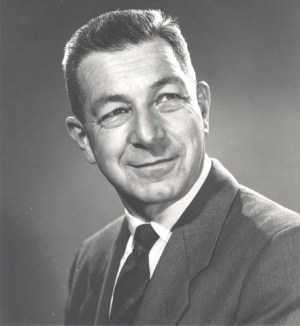
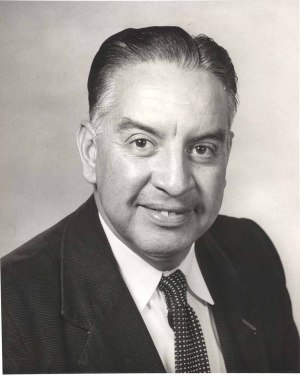
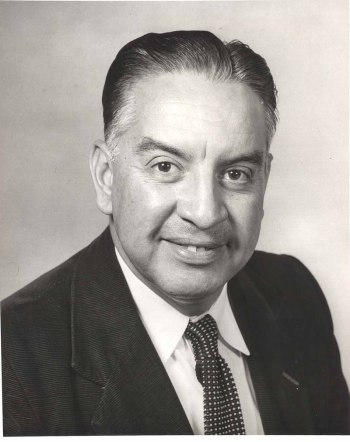
Just to make things interesting, her father is Linwood G. Dunn, special effects cinematographer who worked on “King Kong,” “Citizen Kane” and many other films.

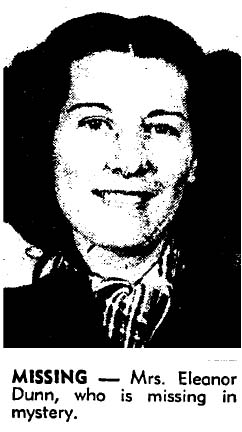
Let’s go back to May 28, 1948. Eleanor Winifred Dunn, 35, the mother of four children, got in a cab at Fairfax  Avenue and Sunset Boulevard, never to be seen again. She was wearing a gray suit and green coat, and wasn’t carrying any money, The Times said. There are no further stories about her, so we don’t know if she was ever found.

In 1957, Lynn Dunn, who was about 9 when her mother vanished, told police the following story: She had been receiving threatening letters, one a week for the last five weeks. The first letters threatened her life while the later ones made “indecent proposals,” according to The Times. She also began receiving anonymous phone calls from a man who asked her to meet him in Griffith Park.
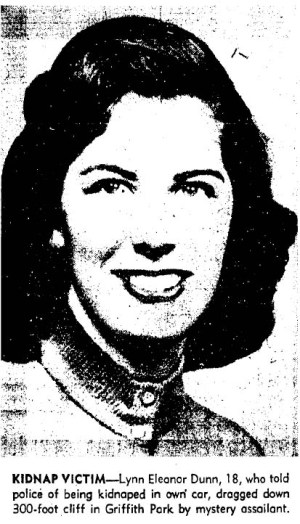
On July 26, 1957, she was returning home from her job as a telephone service representative when a gunman allegedly jumped into her car while she was stopped at New Hampshire and Finley avenues. Dunn said the man forced her to drive to Griffith Park, dragged her down a 300-foot embankment, beat her, kicked her, ripped her clothes, gave her some yellow pills and tried to attack her but apparently changed his mind.

She fainted when the man fled and was found four hours later by her brother-in-law, James George, 4706 Ambrose St. Her fiance, Don Hendricks, 23, 5333 South St., Glendale, discovered her car parked on Mount Hollywood Drive half a mile west of Griffith Observatory.

Authorities were looking for leads in the Marjorie Hipperson and Ruth Goldsmith killings, so in an attempt to catch the attacker, she agreed to meet a man who called her. She drove to Griffith Park with an FBI agent hidden in the trunk (recall that this is Los Angeles in July), but the man never appeared.

There are no more stories about Lynn Dunn. On Nov. 3, 1957, The Times list of marriage licenses included a Hendricks and Dunn, so they presumably went ahead with their wedding plans.

Beyond that, we simply don’t know. It’s easy to guess that Dunn’s missing mother would resurface if she saw the news stories about the attack, but there’s nothing to show that she did.

Linwood Gale Dunn died in 1998 at the age of 93.
Email me

Posted in 1957, Film, LAPD | Tagged , , , , | Comments Off on Attack in Griffith Park

Voices–Lew Irwin

Longtime broadcaster Lew Irwin operates Studio Briefing, an Internet-based daily digest of entertainment industry news. This is his story about reporting on the NAACP brutality lawsuits against the Police Department.

I
was working for KPOL… I was the news director there… and what I was doing was hanging out
with those people. The guy was the attorney from the NAACP [presumably George L. Vaughn Jr.–lrh]. I’d had a
bunch of meetings with this guy. He had been feeding me stories for a
long time. But I can’t remember what they were about. But I do remember
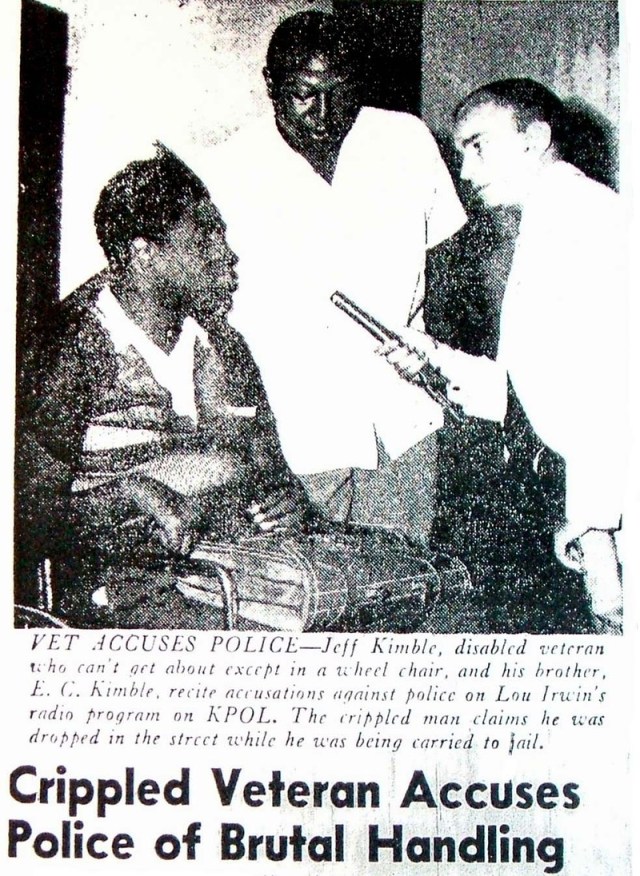
one guy I interviewed. The poor guy was a disabled American veteran who had been pulled out of a car, thrown to the ground, beaten up by the police.

Beyond that I can’t remember much.

The sales
manager knew [Police Chief William H.] Parker and Parker called the
sales manager. Being a good reporter, I called to
get a comment from the LAPD, so Parker called the sales manager. I
can’t recall what he said but he certainly didn’t want to see the
thing going on the air. I’d finished it. I was about to put it on the
air
without a comment from the LAPD. And he called the sales manager. The
sales manager talked
to the rest of the people.

It was not unusual in those days.
Especially back then… I remember doing a story about the John Birch
Society. I couldn’t say that Robert Welch, who was the head of the
organization, I couldn’t say he called Eisenhower an agent of the
Communist conspiracy because
Eisenhower might sue. Stuff like that. All kinds of stuff. I was hauled
into the manager’s office.

That was kind of the nature of the business.

During
the Watts riots I was out there every single day about 24 hours a day.
I was traveling around with some kids and we had a deal that
if we got stopped by any gangster types that I would tell them I was
married to one of their sisters… I did a lot of that kind of
reporting. I was hanging out. Almost everybody I knew was a source. I
was really young, so that’s all I was doing.

Fun times.

Posted in broadcasting, Countdown to Watts, LAPD | Tagged , , , , , | Comments Off on Voices–Lew Irwin

Random shot

A fully functional Union 76 ball at La Brea Avenue and 6th Street.


Photograph by Larry Harnisch Los Angeles Times

Posted in art and artists | Tagged , , | Comments Off on Random shot

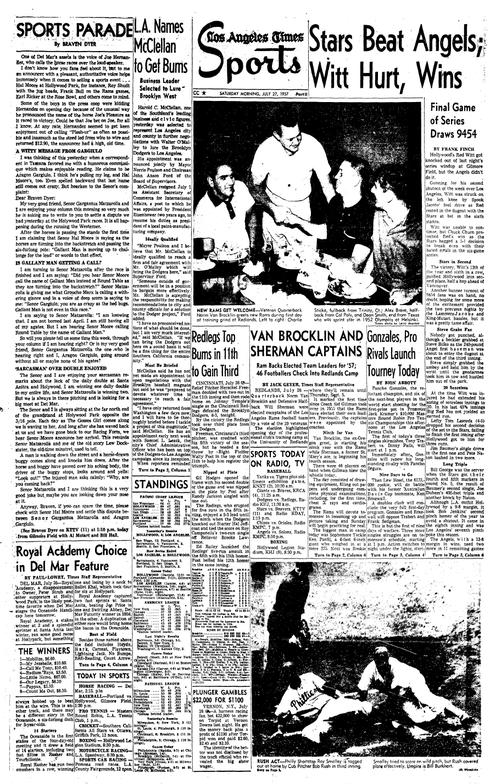
The day in sports

July 27, 1957
Los Angeles

Page 1

Continue reading →

Posted in Sports | Tagged , , , , | Comments Off on The day in sports

Matt Weinstock

July 26, 1957

This is to report that the Swiss family Caserini has held its annual
picnic at Steckel Park near Santa Paula and it is now OK for things to
get back to normal.

Caserini is a generic term for a bunch of people of that name, also
Giacomazzi, Falcinela, Montemaro, Cavaletti, Guidotti, Confaglia,
Murphy, Fitzgerald, Christianson, Brown, Lucas, Rupp, Clement and
Weinstock–all more or less remote descendants of Juan Batista Caserini
and his wife, Marian, who came to Southern California from Switzerland
in the last century.

Present, accounted for and looking fine were the three surviving
daughters of old Juan Batista–Caroline Giacomazzi, 86, Apolonia
Falcinela and Ava Caserini. Caroline and Ava live in Gardena. Apolonia
in Culver City.

You don’t do much at these things except gorge on fried chicken, potato
salad and cake and make the rounds, chatting with members of the family
you haven’t seen since last year’s picnic and trying to identify the
children.

Celestino Giacomazzi of Gardena, son of Caroline, observing some fifth-generation sprouts racing around, remarked:

“Pretty soon these things will be only for the youngsters.”

Henry Confaglia of Los Alamos was asked about the grasshoppers which
recently swarmed into his territory. His farm was spared but he knows
others which were badly hit. He watched the locusts devastate a
beanfield and he said it was awful. You can always expect grasshoppers,
he said, when there is no rain in March.

Pete Cavaletti of San Marcos Pass generously distributed some of the
most delicious oranges ever tasted by those present, all experts But
his crop wasn’t worth picking this year, he said.

The stream that runs through Steckel Park is quite full this year and I
made my customary safari in quest of frogs and tadpoles, demonstrating
to small children how fearless I was of red and blue dragonflies.

We didn’t see any frogs or polliwogs but in several pools about 2 feet
deep we stirred up some trout, several about 7 inches. They resent the
intrusion but were apparently resigned to it.

As for my horseshoe pitching, my game was off badly. Furthermore, I
suspect some of the farm boys have been practicing all year. I was shut
out in the preliminaries.

Picnics in our many-splendored Southern California parks, with or
without five generations, are herewith highly recommended. They bring
out the best in people.

Posted in Columnists, Matt Weinstock | Tagged , , , | Comments Off on Matt Weinstock

Matt Weinstock

July 23, 1957

There have been so many homicides lately it’s almost impossible to remember one from another.

But David Swaim, the news photog, won’t soon forget an incident in
connection with a slaying he covered in Baldwin Park a few days ago
.

He got his snapshots as a painter accused of strangling another woman
embraced his wife. Then he went to a house across the street and asked
if he could use the phone. Permission was granted.

He called his office–collect–and was about to depart when the neighbor said severely, “Put some money on the table.”

Dave explained he had called collect but the neighbor said, even more ominously, “Put a dollar on the table.”

Dave asked what for.

“For the defense of that poor man across the street,” was the reply.

Dave donated and he hopes his paper will be equally cooperative when
the item, “Accused slayer’s defense fund $1,” appears on his expense
account.

SCIENCE is being wonderful again, this time in Westwood, reports Al Hicks, science writer.

He reports that Dr. Edwin Leete, UCLA chemist, is raising radioactive
tobacco. Deliberately. The purpose is to trace the formation of
nicotine in the plant through radioactive compounds.

Of course, the wags are busy. One suggests Dr. Leete’s “hot” tobacco
plant might result in a new smoke called Cures–the cigarette with the
built-in radiation treatment for the lung cancer it helps give people.

SINCE THE cancellation
of the Navaho guided missile contract
and laying off of thousands of
workers, there’s a gag going around North American Aviation about the
definition of an optimist: A man who brings his lunch to work.

AT RANDOM–Sudden
realization: With the widespread acceptance of the ballpoint pen, the
old-fashioned blotter has become virtually extinct. Do I hear an ode to
the decline of the otterblay?

The Appel (pronounced apple) family on Curson St. has three little appels–Candy, Taffy and Penny.

Posted in @news, Columnists, Matt Weinstock | Tagged , , , | Comments Off on Matt Weinstock

Paul V. Coates–Confidential File

July 26, 1957

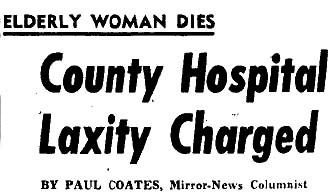
Mrs. Mary McAlpin, of this city, died less than 48 hours ago.

There are powerful and conflicting versions as to why.

The lone agreement comes in that the story of her death began six weeks ago.

On June 15, she fell down at the home of her daughter, Mrs. Edna Logan, 20249 Walnut Drive, Walnut, Calif. She broke her left hip.

A few hours later she arrived at General Hospital in Los Angeles

Andafter four days more, when she had been built up physically for surgery, a pin was placed in her femur. The operation was reported asuccess.

In Ward 380 of General Hospital, Mrs. McAlpin began her recuperation period.

But what happened then is difficult to say.

There are those who believe she died, at 77, from the effects of old age.

And there are those who believe that she died as a result of indifference on the part of members of the hospital staff.

According to Robert Thomas, director of General Hospital, Mrs. McAlpin began to get bedsores on the day following her operation.

The record of her 38-day stay, he reports, shows that she received special care 54 times. Thirty of the written entries of this care make direct reference to the fact that she was “turned and moved” to prevent
further damage to her body.

There are other reports, however.

One is from John Oftedal, M.D., of Pomona who examined Mrs. McAlpin immediately after her family removed her from General Hospital.

He states:

“Just to look at her turned my stomach.

“There were decubitus ulcers (bedsores) all over her body–her sides, her back, her knees, her hips.

“Some were the size of hen’s eggs. Gangrene had sent in.

“Never had I seen anything like it.”

He concluded:

“Bad bedsores are nearly always the result of poor nursing. They need a lot of attention–antibiotic therapy, cleaning, changing dressings, light treatment.”

The doctor’s words were “nearly always the result of poor nursing.”  It left room for the exception to the rule.

So I talked to a fellow patient of Mrs. McAlpin. Her name is Sammilee Ross. This is what she told me:

“I was with her for five days. There were no bandages on her sores. I listened to the nurses argue about who should feed her. So finally I started feeding her myself.

“Only once did I see a nurse actually feed her.

“The last two days I was there they didn’t even change her bed–and it was dirty. I can assure you.

“I could hear them in the hallway, though, saying: ‘All right, who’s going to turn the big, fat slob over.’ ”

Sammilee Ross told me that the nurses often neglected to empty the bedpans, so she took the chore herself.

“I’d do it at night, too. Only I’d scald them to sterilize them.  The nurses wouldn’t.”

Anyone who knows the conditions at County General Hospital knows there’s a
shortage of nurses. Were there enough in Ward 380 to do the required work?

Mrs. Ross says yes. “A good example is when the nurse brought a book of mine back which had been missing from my bedstand.

” ‘I took it to read,’  she told me, ‘because I didn’t have anything else to do.’ ”

Every night, Mrs. McAlpin was visited either by her son, Clarence McAlpin, or her daughter, Mrs. Edna Logan, or both.

Mrs. Logan told me:

“We’d beg them to give her something for the pain. To bathe her sores. We volunteered to clean them ourselves.

“One doctor told us we couldn’t touch her. Another finally said it was OK. When other patients told us that the nurses weren’t feeding her, we took food with us–liquids and custards.”

Clarence McAlpin told me:

“Frequently the covers were off of her. Once, when she was sweating very much and I
complained, the nurse told me, ‘If you want her to have extra service, get her a private room.’ ”

Last Monday, Mrs. McAlpin was removed from General Hospital by her children. She was taken by ambulance to the Pomona Rest Home of Mrs. Cora Cozad.

“The poor woman was full of holes and sores. And so hungry,” Mrs. Cozad told me. “I took one look at her and called Dr. Oftedal.”

The doctor arrived within 10 minutes. He told me afterward that he checked the patient’s heart and blood pressure and they were fine. But, he added, he had never seen anything as dreadful as the bedsores.

General Hospital Director Thomas explained to me that flesh varies with individuals and that Mrs. McAlpin’s skin continued to break down despite good treatment.

“We were on the horns of a dilemma,” he said. “Fracture cases shouldn’t be moved. Bedsore cases should.

“I believe our staff did everything possible. The nurses don’t record every service to a patient, so she undoubtedly received more attention than the record shows.”

Dr. Harold Kade of the county coroner’s office, who investigated the death yesterday, concurred with Thomas.

“It’s not an unusual case,” he said. “I listed the death causes as general arterial sclerosis and fracture of the left femur.”

I checked also with a private physician, highly respected in medical circles here.

“If, as the report said, Mrs. McAlpin was moved 30–or even 60–times in 38 days, it wasn’t enough,” he stated.

“Bedsores are always a danger with elderly patients. And patients should be turned every four hours.”

And, as the police officer who answered the “dead body” call reportedly remarked at the scene:

“Somebody goofed.”

Posted in Columnists, Paul Coates | Tagged , , | Comments Off on Paul V. Coates–Confidential File

Never seen again

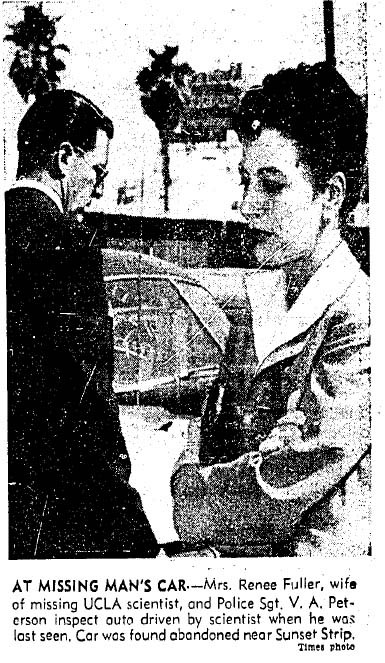
When Dr. George Ripley Fuller vanished,
he left few clues and countless questions. What we don’t know about him
would fill a book while the facts cover a page or two at most.

We know he was 27 when he disappeared, the youngest of three successful
brothers born to Mr. and Mrs. Walter Fuller of New York. We know he
graduated in 1953 from Cornell University’s medical school in New York.
And we know he was a research physiologist attending UCLA under a
one-year grant from the U.S. Department of Health.

We know he was married to a psychology student named Renee, whom he met in medical school.

Most important, we know he was a driven, tightly wound man whose life
centered on his work and that he had begun seeing a psychiatrist about six
months before he disappeared.

A week before he vanished, he and Renee made a trip to visit his
parents in New York. There was a violent argument, The Times said, in
which Renee sided with his parents. Renee later described this as a
“family spat,” but there were never any details on what the argument
was about.

The Fullers returned to Los Angeles on May 27, 1956, four days before he disappeared.

On May 31, 1956, Fuller received his paycheck. He also cashed a $20
check ($143.31 USD 2006) at UCLA Medical Center’s cashier’s office.
News accounts of the disappearance say that Fuller’s bank accounts were
untouched since he vanished.

At 7 on the evening of May 31, Fuller went to the medical center
for a seminar, but found that it was canceled. While he was there, he
invited several people to an informal seminar the next night at the
Fullers’ apartment.

He was never seen again.

On July 20, 1956, Fuller’s abandoned, dust-streaked 1949 Chevrolet
two-door sedan, California license JSR 808, was found  across from 1220
Sunset Plaza Drive. The driver’s window was rolled down and the keys
were missing. The car had apparently gone 75 miles since it was
serviced May 22, 1956, nine days before Fuller vanished.

According to Renee Fuller, nothing was missing nor was there anything
new. “I know of no reason why he would be in that area,” she said.

Dr. Charles H. Sawyer, head of the anatomy department at UCLA, said: “I
have worked closely with him and seen him under tremendous pressure
during important experiments–pressure I am not sure I could
withstand–and Dr. Fuller has never shown any signs of cracking or
instability.”

Perhaps the most remarkable aspect of Fuller’s disappearance is that
his family took absolutely no interest in it. Neither of his brothers,
one living in Maine and the other in Florida, nor his parents set foot
in Los Angeles as far as I can tell and apparently they had little
interest in solving what became of him.

Aside from the fact that Renee Fuller received a hoax phone call
demanding ransom money, we know very little more about her. The Times
and public records are silent on what became of her. They apparently
had no children.

Charles H. Sawyer died in 2006 of Alzheimer’s disease. He was 91.

Email me

Posted in LAPD, Science | Tagged , , | Comments Off on Never seen again

Champagne flight II

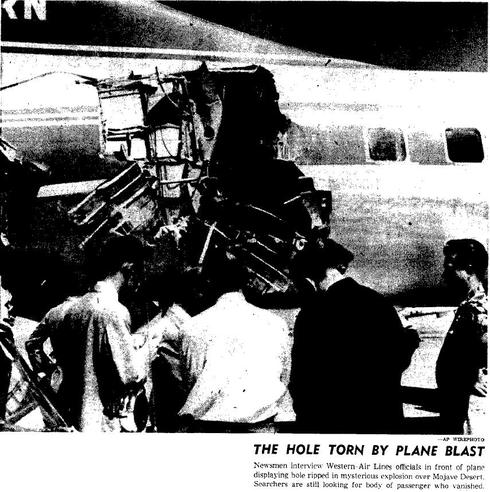
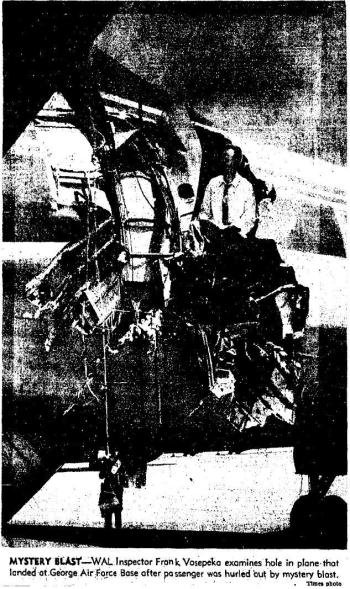
Another picture of the damaged Western Air Lines plane, showing a detail of the hole made by
the explosion.

Posted in Suicide, Transportation | Tagged , , , | Comments Off on Champagne flight II

Pepe Arciga

July 25, 1957

Superlatives, to be frank, don’t come easy to anyone about to comment on the true merits of most bullfight filming efforts.

In months past, Hollywood movie makers have pulled pretty hefty
boo-boos when confronted with the challenge of putting on film the
essence of bullfighting. Their attempts, however worthy, have always
fallen short because of one inescapable fact:

Bullfighting is tragedy, it is art, it is brutality, it is savagery, it
is a rite of sublime expressions all rolled into a neat little package
of splendor. This, so it seems, Hollywood cannot capture, at least
commercially.

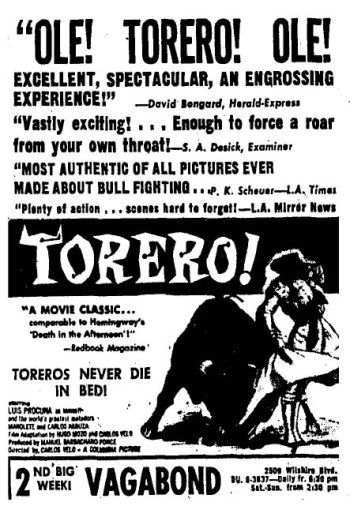
Last Friday, at the Vagabond Theater, Columbia Pictures released a documentary-biography based on the life of Luis Procuna called “Torero.” All done in black and white.

Most of it was shot in Mexico by an international crew of more than half a dozen photographers of various nationalities.

Produced by the Barbachano organization and directed by Carlos Velo,
we have in our hands, beyond possible doubt, the most powerful attempt
yet made to put on celluloid the shockingly conflicting things about
bullfighting.

In a roundabout way, it also is the the most clear-cut filmed version on what is, really, the Mexican “school” of tauromachy.

Luis Procuna and Silverio Perez are, or rather have been, the best two exponents of such a school, such techniques.


In “Torero,” you see why topflight Mexican matadors–in this case Procuna–always either were capable of sending crowds into pitches of ecstasy or putting the look of lynchers in their eyes.

You are to see, as well, the unrehearsed scene of a matador’s face
twisted by an incredible panic which tells him that it is madness to
try to make another pass.

Veteran of at least three feature-length Mexican movies, Luis Procuna,
as photogenic as they come and possessor of the friendliest grin in
bullfighting, gives an effortless performance as various cameras catch
him in the role of playful father, devoted husband, maniacally inspired
bullfighter, brazenly cowardly, idol, etc.

You will see, for brief seconds, the faces of people who make and kill toreros.

You will see, as well, the basic differences which characterize Mexican
and Spanish bullfighting–the Mexicans being suicidal, gay, supremely
dramatic; the Spaniards masterful, mechanical and sophisticated even
when bouncing, like balls, over the bull’s horns.

There are many memorable scenes which will be hard to forget. Particularly one of the very last sequences in which Luis Procuna, with his admirable muleta, drives 60,000 hoarse-throated yelling fans into complete submission.

When shirt-sleeved fans pour into the circle of sand to carry off the triumphant Procuna on top of their shoulders, they don’t stop to look at the bull. In the beast’s hump is the sword embedded to the hilt.

As Procuna
is carried off bodily, suddenly, at the bottom of the screen, you see
the bull stagger to his feet momentarily and then, plump, the beautiful
animal falls dead with legs kicking.

This scene is revealing because it proves, once and for all, that true
aficionados are more concerned with artistry of the cape, the banderillas and the muleta than having a torero execute the perfect kill.

And don’t be surprised if momentarily you get carried away and shout,
from left field, all kinds of bravos. I did. To be frank, I wasn’t a
bit embarrassed by it at all when the lights were turned on.

And when the lights were turned on, what was it that I saw? That the
greater number of patrons were men and women in their early 20s.
Significant. Very significant.

Carlos Vera Cañitas, Félix Guzmán and Luis Procuna, 1941

Posted in Columnists, Film, Pepe Arciga | Tagged , , , | Comments Off on Pepe Arciga

Matt Weinstock

July 25, 1957

You know how some newspapermen are–gay and carefree.

Well, a reporter–let’s call him Mac–was driving home the other day
after suitably observing the decline of common sense with a few
literate friends.

Two blocks from his home, he was nudged to the side by a policeman who inquired, “What’s the idea of driving in second gear?”

Mac, unaware that he was in second gear and figuring he’d had it,
replied, “Oh, I do that all the time. Frequently I drive home in
reverse just so I won’t get in a rut.”

The officer told him to get out and stand up. Mac said it would be silly for him to try, he couldn’t.

The officer told him to park his car at the curb and take a cab home.
Mac told him he would be glad to but he was broke. However, if the
officer would lend him $1–.

“All right,” said the officer, “I’m going to let you drive the two
blocks to your home. I’ll be right behind you. One wrong move and I’m
taking you in.”

Mac said that was mighty nice of him and asked how come. “I figure
anyone with your gall isn’t as drunk as he thinks he is,” replied the
officer.

Mac made it home fine and no one better say nasty things to him about L.A. policemen.

AT RANDOM–The
enigmatic sign in Pershing Square Garage stating the escalators are for
pedestrians only is no longer the most observed in town. No. 1 seems to
be the one on Magic Cleaners on 3rd Street near Western Avenue–“Ladies
who drive up and drop off their clothes will be given prompt and
courteous attention….”

The Reseda Chamber of Commerce is sponsoring a David Keith Gibbs
Memorial Fund for the 11-year-old son of pilot James Keith Gibbs, 32,
who was killed July 1 when he guided his bomber out of heavily
populated San Fernando Valley and crashed into unoccupied territory.

Posted in @news, Columnists, LAPD, Matt Weinstock | Tagged , , , | Comments Off on Matt Weinstock

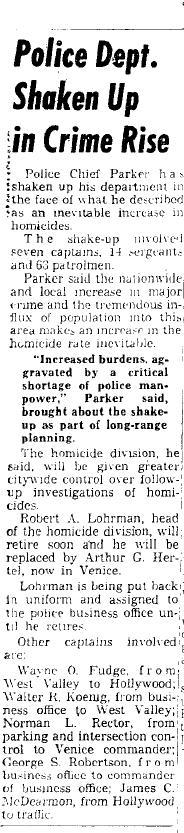
Police shakeup

July 25, 1957
Los Angeles

As surprising as it seems now, there was a time when the Los Angeles newspapers actively covered top-ranking personnel at the LAPD. Most readers would be hard-pressed to name the current head of Robbery-Homicide (Capt. Kyle B. Jackson), but in the 1940s and ’50s, the papers routinely
tracked retirements, transfers and promotions.

In the summer of 1957, Capt. Robert A. Lohrman, who had headed the Homicide Division since 1951, was transferred to the business office because he was planning to retire. The new head of Homicide was Capt. Arthur G. Hertel.

Lohrman’s term as head of Homicide included the L. Ewing Scott case, the alleged abduction of Marie “The Body” McDonald and the Barbara Graham case, which was made into the movie “I Want to Live.” He also
handled Busby Berkeley’s 1946 suicide attempt.

Hertel died of an infected pancreas in 1961, while he was still head of Homicide, at the age of 46. Lohrman died in 1999.

Email me

Posted in Homicide, LAPD | Tagged , , | Comments Off on Police shakeup

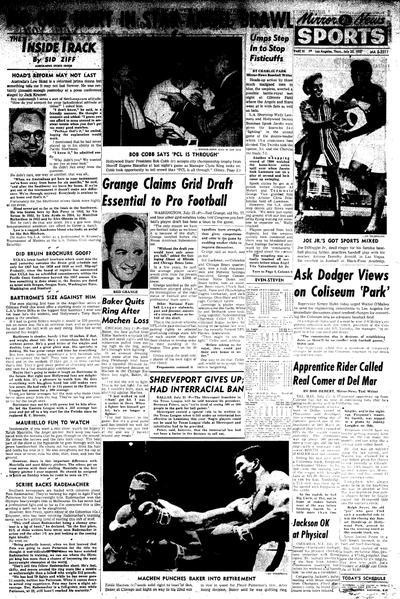
Brawl at Gilmore Field

July 25, 1957

The Angels vs. the Hollywood Stars

Page 1

Continue reading →

Posted in Sports | Tagged , , , | 2 Comments

Countdown to Watts

July 25, 1957
Los Angeles

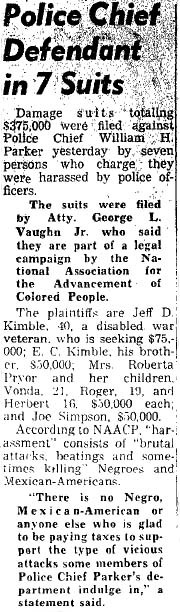
To The Times, a class-action suit accusing the Los Angeles Police
Department of brutality simply wasn’t newsworthy. The Mirror did a bit
better: a few paragraphs on Page 12.


And these were juicy stories:

  • A Baptist minister who was arrested after reporting an assault.
  • A disabled veteran in a wheelchair who was dropped in the street as officers were carrying him into a police station.
  • A teenager who was shot in the stomach and the back as he stood
    on a street corner after complying with officers’ orders to take his
    hands out of his pockets.

It gets worse. Lew Irwin of KPOL-AM was the only white newsman to
profile the lawsuits in depth, but the station’s management killed his story as a personal favor to Police Chief William H. Parker.

Instead of quietly preserving the status quo, the white news media’s conspiracy of silence only fueled the anger and distrust that would erupt in the Watts riots.

Because for the California Eagle, a weekly serving the African American community, the brutality suits were Page 1 news.

None of the individuals had police records, “not even a traffic
ticket,” the Eagle said. The NAACP chose the cases from many others
because they were the most flagrant.

According to the Eagle, eight of the cases occurred between June 3 and July 4, 1957. The ninth occurred earlier in the year.

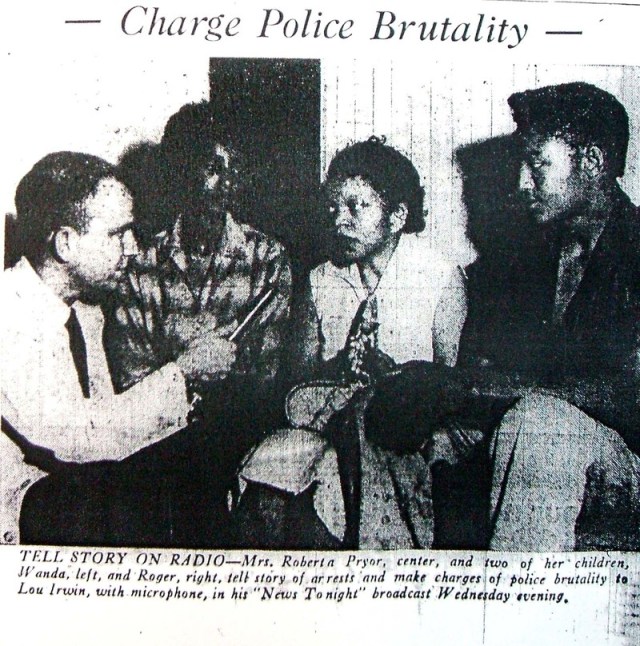
The most recent incident was reported by Roberta Pryor, 637 E. Vernon, and her children, Roger, 19, Wanda, 17 and Herbert, 16.

Pryor told the NAACP that on July 4, she noticed a youth in the back of
a police car as she was walking through a parking lot near her home.
Pryor said she asked police why they were holding the youth. Her son
Roger joined them and police began questioning him.

The officers “apparently didn’t like the answers he gave and reportedly
knocked him to the ground, addressing him with obscene words,” the
Eagle said. “When he protested the language in the presence of his
mother, one of the officers reportedly threw his arm around the youth’s
neck, choking him.

“When the younger son came up, the police reportedly roughed him up
also, then took the two boys, the sister and the mother down to the
police station. Roger was booked on suspicion of grand theft auto, held
for two days and then released, the NAACP attorneys claimed.”

Disabled veteran Jeff Kimble, 6339 Estrella Ave.,
and his brother, E.C. Kimble, were arrested after bank authorities
became suspicious when E.C. Kimble tried to deposit some cash and
government checks. “The two of them were taken to the station. Since
there was no wheelchair lift available, two men lifted Jeff Kimble from
the car and started carrying him. Partway to the entrance, they
apparently lost their grip and let the crippled man drop,” the Eagle
said.

The brothers were eventually released when the Treasury Department confirmed that the checks were indeed Jeff Kimble’s.

Another case involved the Rev. Simon Washington, 7027 S. Denver St., a Baptist minister who worked as a salesman for Supreme Liberty Life Insurance.

Washington said he had an appointment to meet a client at 2nd and San
Pedro streets when another man “came up to him and began molesting
him,” the Eagle said. Washington called officers, who arrested him on
charges of being drunk. Washington said they beat him en route to the
station and that the charges were eventually dropped.

Raymond Korengay, 3668 S. Normandie Ave.,
said he was arrested after police came to his home in search of his
brother, who was wanted on a traffic warrant. Kornegay said that
although his brother wasn’t home, police brushed past him without a
warrant, beat him and although he was bleeding profusely, drove around
for two hours before taking him to the Georgia Street Receiving
Hospital. He was charged with interfering with an officer.

Herman Johnson, 17, 669 E. 40th Place,
said he was standing on a sidewalk when police approached and told him
to take his hands out of his pockets. He was hospitalized after being
shot twice, the Eagle said, and was recuperating on a farm in Arkansas.

To be continued….

Email me

Posted in Countdown to Watts | Tagged , , , , , , | Comments Off on Countdown to Watts

Champagne flight

July 25, 1957
Las Vegas

There was no room for retired jeweler Saul F. Binstock, 62, on the chartered flight to Las Vegas, so he boarded a Western Air Lines plane at Burbank. As always, he bought insurance naming his wife, Eva, as
the beneficiary.

In addition to the round-trip flight, his getaway package included limousine service from the airport to the Hacienda Hotel, dinner, champagne and $5 in gambling chips. Although Binstock called Eva to tell her he was looking at some watch shops, he remained at McCarran Field and gave his coupon booklet to one of the agents, saying: “Maybe you can use this.”

At 2:50 a.m., Binstock got on Western Air Lines Flight 39 after turning down a seat on a plane
chartered by the Hacienda. Witnesses said he tore up a few pieces of paper just before boarding. As soon as the Convair CV-240 took off, Binstock went to the lavatory in the rear of the aircraft.


Maybe he thought of his wife over the next 47 minutes. Perhaps it was his son, Sydney, a dentist; or his daughters Muriel and Joyce (or Joyann). Maybe he thought of the Canoga Park jewelry store he recently sold or the family home at 5739 Rhodes Ave. Mostly, I imagine, he thought about the explosives in his left
hand–blasting caps according to the Civil Aeronautics Board and dynamite according to other sources–and how he planned to set them
off.

Several passengers became worried about Binstock’s extended absence and asked the flight attendant to check on him. As she
walked to the back of the aircraft, there was what one passenger called: “A hell of a blast.” At 3:33 a.m., Saul F. Binstock, who had
spent his life repairing small, precious  mechanisms, blew a car-sized hole in the airplane, which was flying at 10,000 feet. He was the only victim.

Capt. Milton L. Shirk, 37, and co-pilot Seth
Oberg, 25,  landed the plane safely at George Air Force Base after radioing that they had an emergency.

Binstock’s body was found in the Ord Mountains after an intense search. Three fingers of his left hand
were blown away. One of the two $62,500 insurance policies he purchased in Burbank had a suicide clause that voided any payments and the insurance company said it would not pay a benefit on any claim submitted for his death. A private investigator for the family said Binstock “was in good health and financially OK.”

Rabbi Aaron Wise of the Valley Jewish Community Center conducted the funeral at Groman Mortuary Chapel. Binstock was buried in Pittsburgh.

Convair N8406H was repaired and continued flying.

Here’s a photo from 1959.  And here’s one from 1961.

Email me

Posted in Suicide, Transportation, travel | Tagged , , , , | Comments Off on Champagne flight

Paul V. Coates–Confidential File

July 22, 1957

SUBJECT’S NAME–Dr. George Ripley Fuller.

SUBJECT’S DESCRIPTION–Age, 28. Height 5 feet, 10 inches. Weight, 150 pounds. Blond hair. Blue eyes. Slight horizontal scar upper lip on right.

Any person with information as to subject’s whereabouts is requested to
contact Missing Persons Section, Los Angeles Police Department.

Much has been written concerning the strange disappearance of Dr. George Fuller, brilliant young UCLA physiologist.

But there’s been a lot, too, that hasn’t.

And that’s what I’m just about to tell today.

Maybe the new facts can start the year-old mystery unraveling. And
maybe–hope the doctor’s parents–once the unraveling process has
started it won’t end until the case is solved.

Dr. Fuller disappeared from his home at 470 Midvale Ave., near UCLA on May 31 of last year.

He left the house at 7 p.m. He told his wife, Renee, that he was going to attend a seminar on campus.

The seminar was called off. And Dr. Fuller never returned home.

Because of Fuller’s position and brilliance, both the police and press
considered the case a “hot” one. They investigated it thoroughly and
publicized it widely.

But they found no substantial clues.

And no solid, logical explanation.

Fuller’s wife told police that her husband had driven off with a few
dollars, at most, and few extra clothes, if any. She added that he had
always been considerate in telling her where he was going.

Seven weeks after Fuller’s disappearance, police found his car. It was
parked on North Sunset Plaza Drive, not too distant from his home. In
it were his ice skates and camera and a book entitled “Adventures in
Good Eating.”

But any immediate clues possibly contained more negative value than
positive. Because it’s more than feasible that the real explanation of
Dr. Fuller’s disappearance began years before he was bodily missing.

The young doctor was the last of three sons born to Mr. and Mrs. Walter
Fuller. His two older brothers were college graduates and successful in
their professions when he was still a teenager.

He admired them greatly. Maybe, the parents admitted when I talked to
them last week, he placed his brothers on too high a pedestal–before
embarking on a personal campaign to emulate them.

Because from the time that young George graduated from high school in
New York he permitted his desire to be the best in whatever he
undertook to become an almost compulsive force.

Definitely, he was brilliant. After three years of college he applied
for and was accepted by three medical schools. He won one of New York
State’s highest scholarships.

He graduated from Cornell Medical College in 1953 and was asked to
remain as a fellow in physiology there. He did, for two years.

Then he and his wife, whom he married in his first year of med school, drove west.

“George,” his mother told me, “was attracted to UCLA by Dr. Magoun. He
knew him by reputation only, but wanted very much to work under him.”

Dr. Horace W. Magoun, then chairman of the department of anatomy, is recognized as one of the world’s top neurophysiologists.

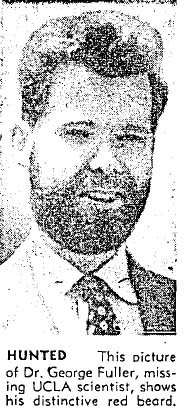
On the trip to California in June of 1955, Fuller grew the beard which
later became his trademark. It was a jutting  bright red, in contrast
to his blond hair.

“But,” his mother told me, “I suppose he’s shaved it now.”

Friends say that, once here, Fuller permitted his work to swallow him
more completely than ever. His conversations, his friends, his
life–all revolved around his research.

But possibly it began getting to him.

Because half a year before he vanished the young doctor phoned his
mother in New York to say he was visiting a psychiatrist here.

The psychiatrist later told Mrs. Fuller that George had expressed the wish to visit his parents in New York.

Then, just a few months before he vanished, he wrote a few most unusual letters to his parents.

“They were extremely critical of us,” his mother told me, “but it’s hard to say exactly how. Or why.

“Like his disappearance, it just didn’t make sense.”

[Was Fuller ever found? Stay tuned for more–lrh]

Posted in Uncategorized | Tagged , , , , | 3 Comments

CSI–2007

I had the good fortune to attend the first day of the International Assn. for Identification convention in San Diego yesterday and although most of the sessions are focused on new technologies, I was there to talk about the past, the 1947 Black Dahlia case.
One of the conference’s features is a crime scene contest set up in a room at the Town and Country Resort and Convention Center. (The contests always have a local theme. The convention in Dallas, for example, featured a “Who Shot J.R.?” crime scene).

About half a dozen four-member teams are competing against one another to see what they can learn during their allotted 45 minutes at the crime scene. The contestants, a combination of investigators and students from across the country, take the competition quite seriously. To win the contest, a team must collect nine pieces of a Black Dahlia jigsaw puzzle over the course of the convention and score points for noticing bits of evidence in the room. They must also present a report and diagram of the scene.

Since the contest doesn’t end until later this week, I won’t say anything more about it except that the crime scene is wickedly devious and the teams are extremely competitive.

I attended two sessions that would have fascinated the men who investigated the Black Dahlia crime scene: Ray Pinker, head of the LAPD crime lab; Leland “Lee” Jones, the other half of the crime lab; and Gilbert Laursen, an LAPD photographer.

The first session was on using gun bluing to reveal fingerprints on bullet casings and other metallic objects. It’s a simple, low-tech process that can develop a print. Gun bluing is old technology. The new part is being able to make a digital photograph of the print and run it through AFIS. (The Automated Fingerprint Identification System, for those of you who’ve never heard of it). Jack Webb would have loved it.
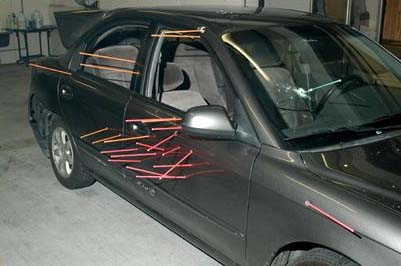
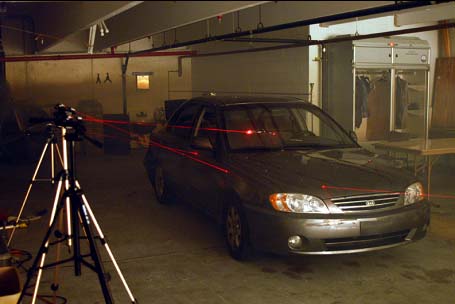
The other session involved using lasers and plastic rods to trace bullet trajectories. The session presenters, King C. Brown, M. Dawn Watkins and Rus Ruslander, put on a great light show with relatively inexpensive lasers sold as torpedo levels in stores like Home Depot, Lowe’s and Harbor Freight. It is impressive to see lasers or plastic rods retracing the bullet paths in a car that’s been shot up with an AK-47.

One other thing that struck me was the wide range of people attending the conference. I met a high school teacher who gives CSI classes and there was half a dozen investigators from Colombia who brought a translator and participated in a session by using wireless headphones. Federal, state and local agencies were heavily represented.

The convention is going on all week in San Diego. Here’s the information.

Back to 1957….

Email me

Photographs courtesy King C. Brown.

Posted in #courts, @news, books, Crime and Courts, Current Affairs, Homicide, LAPD, Robberies, Science | Tagged , , , , , , | Comments Off on CSI–2007

KFWB–980

July 24, 1957
Los Angeles

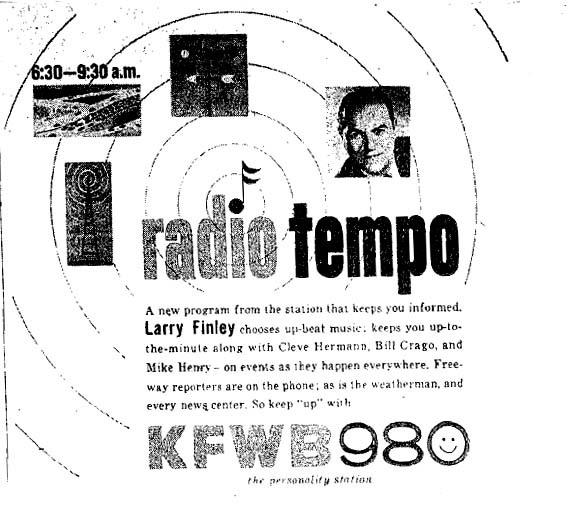
You mean there was a time when KFWB didn’t have an all-news format? Yes, indeed. Read about Larry Finley here. More (much, much more) about Boss radio here.  Vintage air checks from KFWB (and many, many other radio stations) here (a subscription site).

A smiley face in 1957? That’s a new one on me.

Email me

Posted in @news, Music, Rock 'n' Roll | Tagged , , , | Comments Off on KFWB–980

Matt Weinstock

July 22, 1957

This is to report that a distressing situation has arisen in MacWestlake Park.

Certain pigeons–just a few of the hundreds in the park, mind you–have
adopted a decidedly unmilitary attitude toward the recently dedicated
statue of the General of the Army Douglas MacArthur. Apparently they
believe he’s just another Beethoven. (Note: This is a reference to the
statue of Beethoven in Pershing Square across from
what used to be Philharmonic Auditorium and is now a vacant lot at Olive and 5th
thanks to a hurried developer with big plans–lrh).

There stands the general, erect, imperious, fastidious, hands to sides, as was intended.

But these uncouth, subversive pigeons have taken to bathing themselves
in the stagnant water in the enclosed forecourt surrounding the statue
and one of them sits by the hour on the peak of the general’s cap,
preening itself. Others flutter about him with careless disregard of
his welfare. They’re smart, they realize he can’t fight back or censor
their criticism.

Clearly this is a moment for a command decision. Fortunately there’s a
man in our midst with the know-how to cope with this crisis–Fred Beck.

Beck has proposed that funds be raised or appropriated for a statue of
a pigeon 15 feet high. The idea is that any generals passing through
L.A. would be given carte blanche to perch on the statue of the
pigeon–in reprisal.

I know just the place for this overgrown pigeon. Alongside.

AS BACKYARD barbecue addicts know, the big switch lately has been to the small, compact hibachi.

Paul Drus went looking for one but the stores in his neighborhood in
South Los Angeles were sold out. So he went to Little Tokyo and found
one in a store near 1st and San Pedro streets.

As the store owner wrapped it, he said: “Used to sell three, four
hibachis in one year. Now all buy and hard to keep in stock. Japanese
cook on hibachi three thousand years. Whatsamatter? Los Angeles just
learning to cook?”

Posted in Columnists, Downtown, Food and Drink, Matt Weinstock | Tagged , , , | Comments Off on Matt Weinstock

Pepe Arciga

July 22, 1957

Usually, advance press releases dealing with anyone’s mammoth or secretly puny celluloid projects begin this way:

So-and-so Productions take pleasure in announcing the filming of
another 12-reeler to star so-and-so…. It might be pointed out that
our producer, So-plus-So, has had much affinity with the people where
the picture is being filmed…”

That is how run-of-mill press releases go. Sometimes they wind up
forgotten in wastebaskets. Now let’s look in on still another fanfare
which struck closer to home. Me.

Here’s what it says:

“Dave Crown’s Coronado Productions is preparing a telefilm, late this
summer, based on the dramatic and colorful career of Kenneth Beldin. An
innovation will be the usage of Spanish and English language.”

After several checking attempts I’m unable to tell whether “Dave Crown’s Coronado Productions” is or ain’t.

On the matter of Kenneth Beldin, I don’t have to check. Years ago I met this man. To the end of my days I will never forget him.

He is tall, very gaunt and not unlike movie character Mischa Auer. His
face always had the look of a man tortured or consumed by inner powers
telling him to go out into the wilds and look for something.

I first met him around 1939. At the time I was employed by the National
Railways of Mexico in Mexico City. Desk and field job interpreting for
visiting Americans.

He had been hired by the railway to cook up suitable travel brochures
which would help attract more turistas from the Eastern Seaboard, then
considered lush territory.

So he was hired. Overnight he disappeared from sight. For days none of
his acquaintances or bosses heard anything about Beldin. Police were
alerted. The American Consulate as well.

Nearly two weeks later he popped up sporting a beard about the same size as that which now hangs from Ernest Hemingway.

His complexion, originally a pale tan, had turned yellowish. His
cheekbones seemed to have increased in bulk and the man’s light brown
eyes were crisscrossed with countless little red veins.

Kenneth Beldin, the writer-researcher, had done what few brochure
writers ever do when amassing material for their travel pitches. He had
actually thrown caution to the winds and set up shop in the
gosh-darndest villages in the state of Guerrero, where civilization was
something the dwellers wanted no part of.

And to complete the job of going native, not only had he picked up Spanish but also a good smattering of Zapotec dialects.

Indians, to Beldin, were the most fascinating thing in life. For hours
he would sit on his veranda talking to them, trying to solve their
inscrutability and making every effort to be liked by them.

His obsession was to prove, beyond a single scientific doubt, that
Mexican Indians had settled in Mexico after centuries of migration from
the Orient.

Now married to an Indian maiden named Xochitl, Kenneth Beldin has
earned for himself a niche that weighs–and then some. Recently the
official organ of the medical profession in Mexico told this:

“Scientists from the U.S. and other countries travel to exchange ideas
with him (Beldin). He has the undying gratitude of generations of
children in our nation. He will go down in history as “The Apostle of
Sesame Meal.’ “

Posted in Uncategorized | Tagged , , | Comments Off on Pepe Arciga