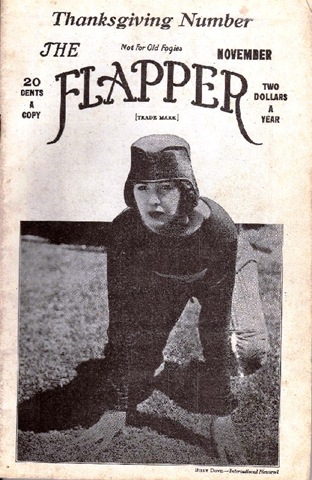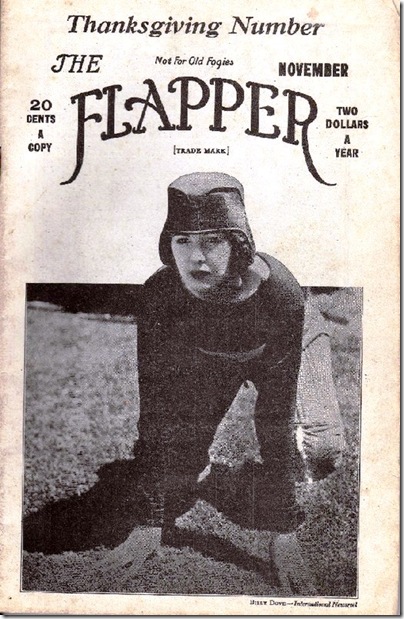
The Flapper – via Wikipedia.
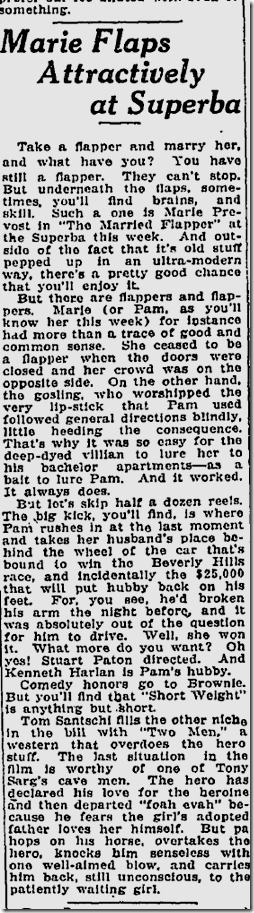 Note: This is an encore post from 2013.
Life changed quickly in the United States post-World War I. Nowhere was this more evident than in the role and actions of young women emancipating themselves from the corseted way of life to more boldly act in self-expression. The war gave more opportunities for them to come and go as they pleased, work in new jobs, experience nightlife. Women gained the right to vote in 1920, and along with it, began bobbing their hair, smoking, rolling stockings, shortening hemlines, drinking, dancing the Black Bottom, partying, and romancing.
A new term was coined to refer to these mainly young women; the flapper. Webster’s Collegiate Dictionary at the time defined a flapper as, “A young girl, esp. one somewhat daring in conduct, speech and dress.” In February 1922, The Los Angeles Times quoted “Bath-house John,” a Chicago First Ward Alderman, describing these young women in somewhat more disparaging terms. “A flapper is a youthful female, beauteous externally, blasé internally, superficially intelligent, imitative to a high degree. Her natural habitat is the ballroom, the boulevard and the fast motor car. She browses about the trough of learning, picking as her tidbits smart phrases which she glibly repeats without sensing their meanings. She comes from all walks of life and has for her main requirement nerve, a face and figure, either actually beautiful or susceptible to artistic effort.”
Popular culture spoke to these young women and helped shape a new consumer culture. Illustrators and movies evoked their sometimes wild and flashy style, and helped launch new idioms of speech. These flappers would help create America’s first sexual revolution, celebrity culture, and what it meant to be hip in the Roaring Twenties.
Continue reading →