Matt Weinstock

Sept. 13, 1957

Matt_weinstockd Every Friday after work, Roy Huerta, 38, drives to Tijuana and spends the weekend with his beloved family–his wife, Manuela, 32, and their three girls and two boys.

It is an unsatisfactory arrangement but it can't be helped.

Roy and Manuela met here in 1947 and were married. Their enforced separation dates to a black day in 1949 when they took a trip to Tijuana.

At the border on the way back, they were asked the usual questions. Roy had no trouble. He was born in Johnstown, Pa., served three years in the Army, including 18 months in New Guinea, the Philippines and Japan, and came to Los Angeles after his discharge.

Manuela, who was born in Zacatecas, Mexico, and speaks little English, panicked. She said she had never been in the United States, then said she had. She was detained and accused of having entered this country illegally.

A hearing was set and Manuela was notified, but she never mentioned it and didn't appear, compounding her guilt. She was convicted of perjury and forbidden under the McCarran Act to reenter this country.

And so for the last eight years Roy has made a weekly pilgrimage to Tijuana. He takes along groceries, clothes and gifts for the children.

1957_0913_letters_3 During the week he lives in an apartment here with a brother. He works as a cook at the Bull and Bear Restaurant, 655 S. Spring St. In the three years he has been there, says the owner, Ridley Billick, who admires him greatly, Roy has missed only one day.

For a time, his eldest daughter, Gloria Jean, who will be 9 next month, attended school in L.A. but she became lonesome and rejoined the family in Tijuana.

Conscientious, disciplined Roy Huerta does not complain. But he has never stopped hoping that somewhere, somehow, the immigration laws may be modified or his case receive attention so that he may be reunited on a full-time basis with his family.

YOU MAY BE vaguely conscious that MGM is bringing out a picture titled "Raintree County" but I am dynamically aware of same. I happen to be sitting in the shade (fluorescent lighting shade, that is) of an 8-foot tree in a heavy 5-gallon tinfoil-covered can incongruously placed alongside my third-floor desk by persons unknown.

The job of hauling it there easily constitutes the most muscular press agentry of the year.

What kind of tree is it? A rain tree, of course.

TODAY MARKS the 10th anniversary of the Great Books Foundation, and representatives of the 52 study groups in the area will gather at 8:30 p.m. at Beverly Hills High to observe it.

The path to literary culture has not always been easy.

Not long ago a Pasadena group which had been meeting in a hall on Green Street arrived to discover the building locked. It had changed ownership and they had not been notified.

After a curbstone conference they went to the only available place nearby, a bar, and, Bibles in hand, went on with their assigned discussion, the Book of Job.

TODAY IS ALSO Downtown Felt Hat Day and a little lore goes with that too.

It is traced to Daniel Desmond, who opened the city's first men's hat shop at New Commercial and Los Angeles Streets prior to 1870. It was the forerunner of Desmonds, Inc.

Prior to that, hats, mostly toppers and bowlers, were sold in general stores.

Old Dan was quite a fellow. He organized the city's first band, was a member of the volunteer fire department and when business was slack strolled over to the city jail and chatted with the inmates.


Posted in 1957, Columnists, Matt Weinstock | Comments Off on Matt Weinstock

Paul V. Coates–Confidential File

Sept. 13, 1957

Paul_coates
The night was made for love, according to such perpetual sentimentalists as Lanny Ross.

But not according to me.

At my advanced age, the night was made for such prosaic chores as getting to the column you didn’t write during the day.

Unobserved, you can sit around in your shorts, stare at the typewriter
and sip hot milk until, touched by inspiration or desperation, you
begin to write.

That was the depraved condition I was in at precisely 2:29 a.m. when suddenly the phone rang.

I flipped it from its cradle to my ear.

"Coates here," I informed briskly.

A rather unsteady voice mumbled, "Geez, I dialed an old British movie."

"Can I help you?" I asked.

"Paul?" he inquired uncertainly.

"Right!"

"Well listen. I got a hot one for you."

"A hot one what?"

"A story, buddy," he explained. "Hot story."

I set aside my warm milk and fumbled for a pencil.

1957_0913_forbidden_planet
"Shoot," I snapped.

"What?"

"Shoot, buddy," I explained. "Let’s have at it."

He cleared his throat and said:

"All right now, get this. It’s an expose. I’m in Gardena."

"And you lose?" I suggested.

"I lose a little," he admitted. "But I’m not complaining. They take me on the emmis."

"Then what’s the beef?"

He snorted into the phone. "What’s the beef? I’ll tell you what’s the beef. You ready? Take this down."

The caller paused dramatically.

"They," he said, after a moment, "won’t give me nothing to eat."

I shifted the phone to my other ear. The right one. It’s my good one.

"And I’m willing to pay," my caller went on. "I don’t want no charity from no one."

"They," he continued, "know that I had a drink."

"A few drinks," he added.

"A lotta drinks," he finally cried, "an’ I am drunk. If I don’t eat something soon I won’t sober up."

He took a deep breath.

"What’s what they want. They want me to get arrested for drunk driving."

"Why?" I asked.

"So I won’t tell what I know," he replied.

"What do you know?" I asked.

"That they won’t let me in their restaurant to get something to eat,"
he said patiently. "I been trying for a half of an hour. But every time
I come up to the door, they tell me to go away."

He sighed.

"Listen, Paul. Send a photographer out."

"For what?"

"To take a picture of them not letting me in."

"Can’t do it," I told him.

"Why not?"

"Can’t take a picture of something that’s not happening," I explained.

"I thought so," he said bitterly. "You’re like all the rest. You write
about the downtrodden. Then when someone calls you up with a problem
you just give him a brush. A brush-off. A cold shoulder."

"You," he said accusingly, "are a phony."

"I’m sorry you feel that way," I said, "but…"

"You don’t care what happens to me. If I don’t get something to eat I’m
going to be drunk, but nobody cares. You’re just like all the rest. And
I might as well be damned."

"Might as well," I agreed.

"Might as well what?" he challenged.

"Be damned."

"That does it!" he snapped. "I don’t have to take profanity from anybody."

Then he hung up. I picked up my lukewarm milk, stared at the typewriter
and tried to figure out what to write for today’s column.

Posted in Columnists, Paul Coates | Tagged , , , | Comments Off on Paul V. Coates–Confidential File

College fashions, II

In 1969, The Times sent one of its best and most respected writers, Art
Seidenbaum, on a tour of California college campuses: UCLA, USC,
Stanford, UC Berkeley and someplace called San Fernando Valley State.
The resulting series for West magazine was later published in
Seidenbaum’s book "Confrontation on Campus."

So in honor of all those who are taking their kids back to campus for
the fall, here’s Part 2 of Seidenbaum’s "The Troubles With Students" in which he visits what is now Cal State Northridge. Put on your
wire-rim glasses and burn your draft cards. The dress code is Army
fatigues and beards for the men; serapes and tights for the women. And
lots of revolutionary self-righteousness. Don’t worry, man. It’s cool.
We’re all pass/fail here.

1969_0413_seidenbaum01


Continue reading →

Posted in Uncategorized | Tagged , , , , , , | 1 Comment

Hat squad


1957_0913_hat_pix

Sept. 13, 1957
Los Angeles

Remember the straw hat you bought back in May? Get rid of it, gentlemen, straw hat season is over! It’s time to get back to felt in wide array of colors, from gray to blue-gray.

I must say, I always enjoy those rare occasions when I see a man in downtown Los Angeles dressed in a suit and hat, usually around 7th Street and Figueroa. There are men in L.A. who know how to wear a hat. I’m not one of them, but I do enjoy seeing other guys decked out. It’s different than the people in vintage clothes you see at some of the L.A. Conservancy events. Those are costumes. These men really have the look.

And yes, I know "hat day" was strictly a strictly commercial event dreamed up by the merchants. In fact, Matt Weinstock will talk about it in a column later today.

 
Email me

Continue reading →

Posted in Uncategorized | Tagged , , , , | Comments Off on Hat squad

On the menu: domestic strife


1957_0913_goldforth

Sept. 13, 1957

Los Angeles

1957_0913_blond
Information on Gene Leonard Cornforth is a bit sketchy, but he certainly had interesting taste in women.

Take the first Mrs. Cornforth, Maureen. After she and Gene divorced,
her boss at Hughes Aircraft, David L. Fohl, got her drunk at a
Christmas party, kidnapped her and forced her to marry him in
Ensenada.  When they got home, Fohl held her prisoner for 10 days
before she could escape, according to testimony at her 1955 divorce
hearing. 

1957_0913_cornforth
But that was nothing compared to the second Mrs. Cornforth, Dona.

Dona and Gene were having a slight disagreement at their restaurant,
the Golden Rooster, 2139 Westwood Blvd. Dona ended the fight by chasing
Gene in the family car and finally ran him over in a vacant lot next to
the restaurant.

Attendants from a nearby gas station jacked up the car and Gene was
taken to Santa Monica Hospital in serious condition. Dona was charged
with assault with a deadly weapon.

Unfortunately, The Times never followed up on the case so we don’t know
the ultimate disposition. Gene survived his injuries and according to
California death records, died in 1989 at the age of 63.

This is what makes reading the Mirror so interesting. Notice that the headline writer has zeroed in on the fact that she is a blond. (Trust me, it’s in the first paragraph of the story, otherwise known as the "lede").  Apparently, the reporter assumed her hair color somehow explained why she ran over her husband with a car, i.e. "You know blonds. Put them behind the wheel of a car and anything can happen."

Now look at her picture. I can’t imagine how anyone would consider her a blond. Granted, the reproduction is hardly the best. But I mean–really! A blond?

And what did she tell the police? "Oops!" (More or less). "This is all a mistake. I just don’t know how to drive very well." As Nathan Marsak would say: "OK, sister."

Dona and Maureen Cornforth (she went back to her previous married name
after divorcing Fohl) vanished without a trace. The Golden Rooster was
still in operation in 1977, as shown below, and was a great place to watch Monday Night
Football, according to The Times.


1977_0927_rooster

Email me

Posted in LAPD | Tagged , , , , , | Comments Off on On the menu: domestic strife

College fashions

In 1969, The Times sent one of its best and most respected writers, Art
Seidenbaum, on a tour of California college campuses: UCLA, USC,
Stanford, UC Berkeley and someplace called San Fernando Valley State.
The resulting series for West magazine was later published in
Seidenbaum’s book "Confrontation on Campus."

So in honor of all those who are taking their kids back to campus for
the fall, here’s Part 1 of Seidenbaum’s "The Troubles With Students." Put on your
wire-rim glasses and burn your draft cards. The dress code is Army
fatigues and beards for the men; serapes and tights for the women. And
lots of revolutionary self-righteousness. Don’t worry, man. It’s cool.
We’re all pass/fail here.

1969_0330_seidenbaum01

Continue reading →

Posted in Uncategorized | Tagged , , , , , , | Comments Off on College fashions

Student body president, eh?

Flash forward to May 9, 1968:

1968_0509

"Education is the destruction of innocence"–graffiti at White Plaza on the Stanford campus, 1969.

Posted in Uncategorized | Tagged , | Comments Off on Student body president, eh?

Runaway


1957_0912_pix

Sept. 12, 1957

Los Angeles

1957_0912_horse
There’s no telling what spooked Ben, but the horse was frightened and
galloped toward Nordhoff Street and Tobias Avenue in what was then the rural San
Fernando Valley.

The rider, Carol Goetzinger, 13, tried to
control him, but Ben dashed into the intersection and was hit by a
passing car with such force that the saddle was ripped from his back
and landed on the hood.  Ervy Zeke Gill, 29, the driver of the
Chevrolet that struck Ben, said he swerved but was unable to avoid
hitting the animal.

Carol, 14931 Community St., Van Nuys,
was taken to Valley Hospital for treatment of bruises and a broken leg.
She sobbed when she was told that Ben, whom she had for six months, had
died.

Did she ever ride again? Did her parents ever buy her another horse? It would be interesting to know.

Email me

Posted in San Fernando Valley | Tagged , , , | Comments Off on Runaway

‘Mommie told me to get the gun’


1957_0911

Sept. 11, 1957

Los Angeles

Everett Robert Ayala’s last words on earth were: "Go ahead, shoot me,"
spoken to his 8-year-old foster daughter as he resumed beating his
wife, Pauline.

So Linda Louise Narez, who was holding a .30-caliber deer rifle, killed him instantly with a bullet to the chest.

1957_0911_pix
Linda
had been raised from infancy by her aunt, Pauline Ayala, 29, and uncle,
Everett Ayala, 28, a construction worker. About 9 on a Tuesday night,
Pauline came home to 870 1/2  W. 9th St.
in Pomona and Everett began beating her after accusing her of having a
boyfriend. The brawl went from the kitchen to the bedroom and back to
the kitchen.

Finally, Pauline shouted to Linda to get the deer rifle from the closet and shoot Everett.

"Mommie told me to get the gun. Daddy told me to go ahead," Linda testified at the inquest. "I didn’t know what to do."

Everett
went to the closet, got the deer rifle, loaded it, gave it to Linda and
said: "Go ahead, shoot me" as he resumed beating Pauline in the
bedroom.

Linda screamed "I can’t!"

And then she pulled the trigger.

At
first, Pauline told Pomona police that she had killed her husband, but
after hours of questioning, the truth came out. The coroner’s jury
returned a verdict of justifiable homicide.

Officially, the
case was closed, but that was only the beginning of the story. What
becomes of an 8-year-old who kills an abusive father? Unfortunately,
The Times offers no further information. Linda would be 58 now. I
wonder what the rest of her life was like.

The Social Security
Death Index lists a Pauline Ayala who was born Jan. 25, 1924, and died Nov. 19,
2002, but it’s unclear whether this is the same woman.

Flashback to May, when 15-year-old Lester Johnson killed his drunk, abusive father.

Email me

Posted in Homicide | Tagged , , , | Comments Off on ‘Mommie told me to get the gun’

Mystery guest revealed


Anthony Brancato, killed Aug. 6, 1951, 1648 N. Ogden Drive, Hollywood, along with Anthony Trombino in the “Two Tonys Murder.” Jimmy “The Weasel” Fratianno eventually confessed to the killings. Continue reading →

Posted in #courts, Hollywood, Hollywood Division, Homicide, LAPD, Mickey Cohen | Tagged , , , , , | Comments Off on Mystery guest revealed

Mystery photo VII


Mystery_photo_no2_2


If you can’t guess the unfortunate mystery guest from this, I’ll just have to tell you….

(C’mon, folks, this is a famous Los Angeles incident of the 1950s! You Ellroy freaks should know this.)

Mystery_photo_no9

Posted in Uncategorized | Tagged | 3 Comments

Stag film raid

Feb. 10, 1957
Los Angeles

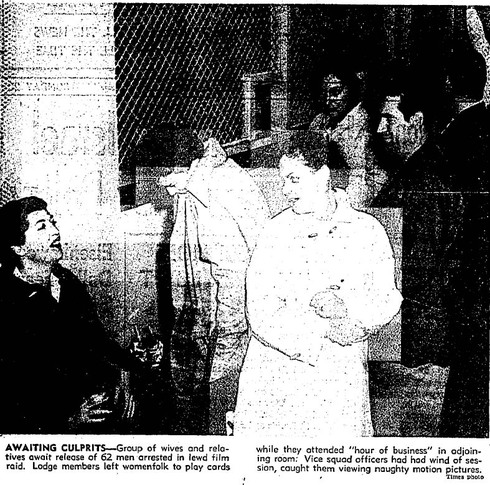
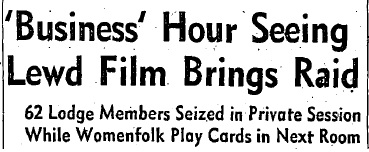
I stumbled across this story while researching yesterday’s post on South-Central vice raids and it was too wonderful to ignore. It sounds almost like one of the “Honeymooners” episodes involving Ralph Cramden, Ed Norton and the International Order of Friendly Sons of the Raccoons.

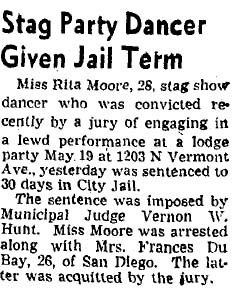
Apparently some lodge member had a perfect plan: “Our wives are always complaining about us going out to lodge meetings at night, so we invite them, OK?  After some refreshments, our wives go play bridge while we have a business meeting! ” So 62 of them rented the Hollywood Eagles Hall, 1203 N. Vermont Ave., for an evening.

But instead of holding a business meeting once the wives left,
the members of the unidentified lodge rolled out a projector and began watching stag films.

(At right, the result of a 1951 raid on the Eagles hall.)

And although the wives weren’t aware of the scheme, the police knew all about it.

Police Lt. W.C. Nemetz and the Central and Hollywood vice squads stationed themselves around the hall, “peered through bamboo blinds when the movies began and then crashed the ‘business meeting,’ ” The Times said.

” ‘Follow us down to the Police Building. Your husbands will need help to bail out,’ vice squad officers informed the women as they roared off into the night with their convoy of lodge members,” The Times said.

The men were charged with suspicion of viewing lewd films and bail was set at $500 ($3,582.64 USD 2006).

The Times apparently didn’t follow up on the case. The domestic turmoil is best left to our imaginations.

Email me

Posted in Film, Hollywood, LAPD | Tagged , , , , , | Comments Off on Stag film raid

Mystery photo VI


Mystery_photo_no1

Lots of guesses so far: Telly Savalas (2 votes!), Mickey Cohen, Sammy
Cahn, Billy Wilder, Mel Blanc, Neil Simon, Jack Dragna, E.H. Land,
Harry "Big Greenie" Greenberg, Johnny Roselli, Frank DeSimone, Bugsy Siegel, Matt Weinstock and Dustin Hoffman.

But none of them are right.

Maybe you have become fond of our mystery guest or wondered what he was like. Unfortunately, the end of his life was not pretty.


Mystery_photo_no7

Posted in Uncategorized | Tagged | 6 Comments

Mystery photo V

OK, you’ll have to work for this one.

Click here.

Posted in Uncategorized | Comments Off on Mystery photo V

A moment in history

June 17, 1905. The last time advertising appeared on the front page of the Los Angeles Times.

1905_0617

Until today.

2007_0909_page1


Posted in @news | Comments Off on A moment in history

Literary diversions

Louis L’Amour, Oct. 23, 1960.

No, I don’t consider Louis L’Amour a great writer. I don’t even consider him a good writer. But I’m dedicated to presenting a variety of voices and not necessarily those I agree with. And he has some interesting things to say about the West.

P.S.: Note the similarity between Wyatt Earp and James Ellroy.

1960_1023_lamour

Posted in books | Tagged , , , , | Comments Off on Literary diversions

South-Central Vice


1957_0909_vice

Sept. 8-12, 1957
Los Angeles

1957_0830_skidrow_2 Let's suppose you are the mayor of the nation's third-largest city. Let's further suppose that your wife has received several letters complaining about rampant crime in a heavily minority neighborhood. You might turn the complaints over to the Police Department.

Then again, you might not.

Because if you're Mayor Norris Poulson, you won't bother with the LAPD. You'll hire a couple of private investigators to look into the situation on South Central Avenue, which, according to Albertha J. Callahan, is "full of bookies by day and at night it's full of women on the street."

Nor did Police Commission President Michael Kohn contact anyone at the LAPD about the allegations. Instead, Kohn disguised himself in work clothes and drove down to Central Avenue in an old car.

"The situation was appalling," Kohn told the Mirror. "At Vernon Avenue and Avalon Boulevard I found groups of four or five girls on each corner waving at cars."

"Groups of four or five women cruised in cars and waved at men. Others stood on corners and when traffic stops for a red light, they 'come out to your car and knock on the windows,' " Kohn said, according to The Times.

By now, you're probably wondering why Poulson didn't contact Chief William H. Parker and say something like, "Oh, by the way, Bill, old chum, how exactly are things down in the 'hood?"

1957_0207_skidrow The answer: Poulson figured the police either couldn't do the job or were on the take. He had complained to the department before, he said, "but we were always told there was nothing to it. They would tell us the persons making the complaints were troublemakers or that their reports were exaggerated. The police were paying no attention to these complaints."

He told the Mirror: "We have been making inquiries through usual channels about vice conditions and getting the usual replies that everything was hunky-dory. I took it upon myself to look into the situation."

Poulson said his inquiry showed that: "Flagrant vice conditions exist in this area. Prostitution, gambling, bookmaking and illicit traffic in narcotics are allowed to flourish without apparent restraint. A condition of this sort indicates either that vice is operating with protection or reflects inadequate law enforcement in the area."

If you know anything at all about Parker (or even if you don't), you can imagine his reaction to being ambushed at a hearing, especially because Poulson didn't make his charges in person, but had Kohn read a letter while he was out of town.

Parker heatedly denied charges that the department was corrupt. Instead, he blamed a lack of officers, the higher cost of patrolling Newton Division (now known as "Shootin' Newton"), an increase in criminals who had been chased out of skid row by urban renewal, lax courts that freed suspects on low bail and recent judicial decisions that hampered the police by granting rights to suspects.

"You can't put people in jail without evidence any more,"  Parker said. "We're going to have evidence to justify arrests and I'm not going to violate anyone's civil rights and I don't want it done by anyone in the department."


1957_0910_skidrow

"We know who a lot of these people are, but we can't arrest them just for walking down the street," said acting Newton Division commander Lt. Walter Baker. "Not until they commit some overt act can we nab them. What's more, we think we've been doing a pretty good job as it is."

The criminals were clever, Parker said: "We have a wolf pack situation where a number of prostitutes work together. If one doesn't recognize one of our vice officers, one of the others will."

And there were more of them: Arrests for prostitution in Newton Division were up 24% from 1956 and gambling arrests increased 34.7%. Why? The demolition of skid row, police said. In the previous two years, nearly 500 buildings were destroyed, The Times said.

Police also complained that the jails had revolving doors when it came to vice arrests. Police Commission member Emmett McGaughey cited the case of a prostitute who had been arrested six times in a year, but only fined $200 ($1,433.06 USD 2006).

In response, Parker assigned Deputy Chief Richard Simon to examine the problem, along with Police Inspector James Lawrence (an obsolete rank that was between captain and deputy chief).

The LAPD sent more motorcycle officers and police cars to the area and assigned photographers to document the situation, the papers said.

1957_0909_negroes

And what about the residents? The Times didn't look into the local reaction to the vice crackdown, but the Mirror did, interviewing several African American leaders.

Dr. J.A. Somerville, a dentist and former Police Commission member, complained: "An investigation of any neighborhood, regardless of its racial complexion, will disclose prostitution in some form. The trade carries no racial label. To point out the Vernon and Central Avenue districts as a vice area because colored people live there, without naming other sections where similar conditions exist, seems biased to me and designed to discredit Negroes."

The Rev. B.O. Byrd of New Hope Baptist Church, Central Avenue and 52nd Street, said: "There is vice in almost every section of our city. In some areas, however, they are financially able to cover it up better."

What did the California Eagle and the Los Angeles Sentinel say about the LAPD's vice crackdown? Looks like a trip to the microfilm is in order.

Stay tuned….

Email me

Posted in 1957, Countdown to Watts, Downtown, LAPD | Comments Off on South-Central Vice

Architectural ramblings

Here’s the home at 457 S. Serrano Ave., where mystery writer Craig Rice died.

457_serrano

Photograph by Larry Harnisch Los Angeles Times

Posted in books | Tagged , , , | 1 Comment

Police and the courts

I missed this op/ed piece when it came out July 19, 1957. It was certainly a different era for the police.

1957_0719_police

Posted in #courts, LAPD | Tagged , , , | Comments Off on Police and the courts

Mystery photo IV

Here’s the fourth picture of our mystery guest from The Times photo archives. The second photo of him is here. The third one is here.

(Hint:
He’s not Arnold Stang. He’s also not Telly Savalas (2 votes!), Mickey Cohen, Sammy
Cahn, Billy Wilder, Mel Blanc, Neil Simon, Jack Dragna, E.H. Land, Harry "Big Greenie" Greenberg, Johnny Roselli or Frank DeSimone).

And, in case you’re wondering, he’s not Phil Silvers or the Dalai Lama.

It must be the glasses. You can see in this picture he was a dapper dresser. What do you think about our mystery gentleman? Does he seem like a pleasant fellow? Intellectual? Would you want to have a cup of coffee with him? Think he has a family? What sorts of stories do you tell yourself about him? Clearly, if The Times took this many pictures of him he must be someone. Is he a blacklisted playwright? Some sharp producer? Does he own a restaurant on Hollywood Boulevard or an appliance store in the Valley?

And not Matt Weinstock, who looks like this:

Mystery_photo_no5

Posted in Uncategorized | Tagged | 3 Comments