Grocery store of tomorrow, January 4, 1959

1959_0104_grocermat
Hey, look! It's the 7-Eleven from "The Jetsons!" Actually, it's not. Instead,
The Times published an artist's concept of grocery shopping in the years ahead. The "futurism" of the past always fascinates me. Notice that cars will still have tail fins.   
1959_0104_ads
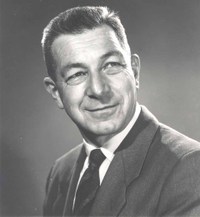
In the 1950s, Westerns such as "Gunsmoke," above, filled the airwaves and men like Bob Bowman, below, brought quick-draw contests to real life.

1959_0104_bowman


You won't see stories about African Americans in The Times or the other mainstream newspapers of the 1950s, but you can find them and other minorities in the classified ads.

1959_0104_sfv
A typical San Fernando Valley page: One feature with lots of art, surrounded by government stories.
1959_0104_sports
Football coach Earl "Curly" Lambeau says the split-T offense is dead. He also thinks college ball should put the goal posts back on the goal line!   
Posted in 1959, @news, broadcasting, Film, Food and Drink, Front Pages, Hollywood, Politics, San Fernando Valley, Sports, Television | 1 Comment

A. Victor Segno — “How to Live 100 Years”

“This lesson is written especially for people who have passed the age of 35 and have begun to show signs of approaching age; people who have begun to lose strength and vigor and those who feel that they have lost their grasp on youth.”

–A. Victor Segno,
“How to Live 100 Years,”
Los Angeles, 1903
Posted in books, health | Comments Off on A. Victor Segno — “How to Live 100 Years”

‘Pretty Woman’ car for sale

Pretty_lotus


  The 1989 Lotus Esprit driven by Richard Gere in "Pretty Woman" is being offered in Hemmings Motor News for $54,998.

Posted in Film, Freeways, Hollywood, Transportation | 1 Comment

November 22, 1930: Voices — Christine Collins

November 22, 1930: The Rev. R.P. "Fighting Bob" Shuler urges parole for Walter Collins.
The Rev. R.P. “Fighting Bob” Shuler urges the parole of Walter J. Collins.

Posted in #courts, Changeling, Film, Hollywood, LAPD | Comments Off on November 22, 1930: Voices — Christine Collins

Fierce fighting in Cuba, Los Angeles Open begins, January 3, 1959

1959_0103_cover
 
The Soviets are winning the space race and communism establishes a foothold at America’s doorstep. These were worrisome times for the nation.

1959_0103_metro

Cheryl Crane visits Lana Turner.

1959_0103_comics

"Li’l Abner," "Rick O’Shay"
and "Moon Mullins."

1959_0103_mra

Moral Re-Armament and the Young Americans for Freedom were two
major institutions for conservative Baby Boomers. (In college, many YAFers discovered they liked to smoke dope and became Libertarians).

1959_0103_sports
Johnny Bulla of Phoenix leads
the L.A. Open.

Now playing: "Some Came Running."


America in the days before the Gun Control Act of 1968although you can still go into Big 5 and buy antique military rifles. ($9.98 in 1959 is $70.26 USD 2007 vs. $89 today for a M91/30 Russian Mosin Nagant in 7.62 millimeter).

1959_0103_rifles_2

Posted in @news, art and artists, broadcasting, Current Affairs, Fashion, Film, Front Pages, Hollywood, LAPD, Sports, Television | Comments Off on Fierce fighting in Cuba, Los Angeles Open begins, January 3, 1959

Broadcaster looks at the future of TV sports

1949_0103_harmon_pix

1949_0103_harmon01 The story posed a simple question: Would television hurt or help sports attendance?


‘Television is only a very good substitute for the actual game. The camera cannot cover all of the interesting factors. And to the real sports addict, yelling "Kill the umpire!" at the television tube is small satisfaction for his feelings.’


The Times published a piece by former college football star Tom Harmon, who in 1949 was the sports director of KFI-TV (an early version of Channel 9 in Los Angeles).

He believed television would introduce people to new sports and draw them to the games.

1949_0103_harmon02"Television is only a very good substitute for the actual game," Harmon wrote. "The camera cannot cover all of the interesting factors. And to the real sports addict, yelling ‘Kill the umpire!’ at the television tube is small satisfaction for his feelings."

Harmon also discussed how television would change the announcer’s role: "The announcer must have the memory of an elephant and know what he’s talking about. … The announcer cannot make a mistake."

Wonder what Harmon would think if he spent a day in 2009 watching sports from local to cable.

–Keith Thursby

Posted in broadcasting, Downtown, Sports | Comments Off on Broadcaster looks at the future of TV sports

Found on EBay — Bullock’s Wilshire

Bullocks_tank
Bullocks_tank_tag
At left, a Dinky Toys set with the original box from Bullock’s Wilshire has been listed on EBay. Bids start at $115.


Posted in #games | Comments Off on Found on EBay — Bullock’s Wilshire

Paul Coates — Confidential File, January 2, 1959


Puts Ego Factor Into Poll 

Paul Coates Tries Out New Survey-Taking Theory

Paul_coates_3
Now don’t misunderstand me. 
 
I’m not looking to start anything with Mr. Gallup. There’s enough petty
bickering going on around here without us getting into a hassle.
 
Besides, he’s bigger than I am. He could take one poll and consign me
to oblivion or some other faraway place where columnists go when their
readership ratings die.
 
But a kind of gnawing remnant of
integrity forces me to state publicly that ever since the Literary
Digest goofed I haven’t put much faith in surveys.
 
The Ego Factor

Their flaw, I think, is that they fail to take into consideration the ego factor in all of us. 
 
If you go to a man’s door with a clipboard in hand and ask: "Do you
feel we should support Quemoy?" he’s not likely to admit that he
doesn’t even know who Quemoy is.
 
At least. I’m not likely.
And, except for a few spectacular neuroses having to do with things
like early rejection feelings, toilet training and bottle feeding, I
consider myself an average citizen.
 
And to us average
citizens, ignorance is not bliss, it’s embarrassing. We don’t want any
pollsters in Brooks Bros. suits putting us down as dopes. Ask us
something about anything and we’ll give you a carefully considered
answer, even though we don’t fully understand your question.
 
1959_0102_king_ro
I’m firmly convinced for example, that when Mr. Gallup’s doorknockers
go around asking: "Do you think the President should attend a summit
conference?" a majority of the people who give a "No" response are
opposed on ground that the high altitude might be bad for Ike’s health.

 
To test this theory, I formed a small survey company of my
own. A couple of days ago my secretary and I polled 150 people in the
county of Los Angeles.
 
Their names were selected from the
phone book. The calls were made over a period of two days between the
hours of 11 a.m. and 4:30 p.m., giving us a good sampling of housewife
reaction.

  Want to Repeal

After identifying ourselves as the "Los Angeles Survey
Institute" and inquiring if the voice at the other end was a registered
voter, we pose the question:
 
"Do you think the Mann Act
deters or helps the cause of organized labor — and if you feel it
deters, would you vote for its repeal?"
 
The results are in. And they’re astonishing. 
 
It will shake the very foundations of the PTA to learn that 38% of
American housewives want to repeal the Mann Act which, since 1910, has
made it socially unacceptable and highly illegal to take a woman across
state lines for immoral purposes.

A percentage breakdown is as follows: 
 
38% — For repeal of the Mann Act. 
10% — Opposed to repeal. 
28% — Don’t know anything about it. 
6% — Don’t know enough about it. 
12% — Either know the Mann Act or suspect it has something to do with white slavery.
4% — Can’t be bothered 
2% — Never discuss politics. 

One lady said we got her out of the bathtub. We didn’t bother to make her a statistic. 

Some of Replies

1959_0102_freeway
The reasons given by those in favor or against repeal indicate
the public temper of our times. Or something equally fraught with
meaning. Here, for the benefit of any sociologists among you, are a few
of the ladies’ replies:

– "We need the Mann Act. Labor would just go wild without it." 

– "It should definitely be repealed. My husband’s in the union and I’m for anything that helps the working man."

– "Repeal the Mann Act? Dearie, don’t you know what the Mann Act is?"

– "I haven’t been feeling too good lately, so I haven’t kept up with what’s in the papers."

– "Yes, it should be repealed. We’re strictly against that act in our family."

– "I don’t know what it is. Is it a socialist thing? Then we should get rid of it."

– "No. It certainly should not be repealed. Hoffa gets away with too much as it is."

– "I have no opinion. I don’t care what they do about the Mann Act. They’re all a bunch, of grafters, anyway."
 
In all fairness, I should point out that since my survey company was a
fly-by-night organization we were not as thorough as we could have
been. We didn’t sample representative racial groups, economic levels or
educational backgrounds.
 
The only other question we asked
was each participant’s age, which came to an average of 25 years. But,
since we were surveying women, I don’t believe that either.

Posted in Columnists, Freeways, Paul Coates, Transportation | 1 Comment

Matt Weinstock — January 2, 1959


Reader’s Choice

Matt_weinstockd_2
A man in the VA hospital in West L.A. writes, "Lying here, a person has time to think of many things, especially things he has missed. I am writing to ask what you think is the most interesting book to read, one that would benefit the person reading it."

Anyone in his right mind would walk away from that one. No one book, except possibly the Bible, has everything. 

But, I feel a little lightheaded with the new year and all, I gave it the old college try. 

Presuming the man in the hospital seeks wisdom, universality or serenity, dramatically presented, I phoned some writers and library people.

Shuddering slightly at such an impossible request, they nevertheless came through with the following: "The Education of Henry Adams," Boswell’s "Johnson," Will Durant’s "Story of Philosophy," Mark Twain’s "Huck Finn," "Tom Sawyer" or "Life on the Mississippi," the complete works of Shakespeare, the one-volume Columbia Encyclopedia, Fielding’s "Tom Jones" and Benjamin P. Thomas’ "Abraham Lincoln."

1959_0102_kingMe? Barlett’s Quotations.

THE SEASON’S nod for nonchalance goes to a man who came into George Caterer’s restaurant on west 8th Street, ordered coffee and opened his newspaper to the want-ad section. After a moment he exclaimed, "Now here’s just the job for me!" He asked George to dial the number, then invited the man who had placed the ad to come over and interview him while he had his coffee.

ET TU?

Resolutions hard and fast-
Ten to one they will
not last.
Is it that I lack acumen,
Or mainly that I’m
only human?
        -PAT SHROYER

SHORTLY BEFORE Christmas a year ago a friendly stranger came into a big downtown office and offered 50% off on handsome new kitchenware. He took a number of orders, the merchandise was delivered and everybody was pleased.

A couple of weeks ago he showed up again at the same office, this time with two cases of a well-known brand of Scotch whisky.  He offered them for $20 each and they were snapped (schnapped?) up immediately, amid moans from others who would have liked to have been in on the bargain.  "Oh, I can get more," he said. 

He took orders for many more cases, collecting around $1,000, and said the stuff would be delivered between Christmas and New Year’s. Neither he nor the Scotch has been seen since. 

The moral is clear. Never trust a con man with your money.

A MAN planning a trip to Europe next summer with his wife phoned the steamship line with which they have reservations and asked the size of their stateroom.

The man at the steamship line, an old, conservative firm, didn’t know but volunteered savagely, "It won’t be so small that you’ll feel like sardines and it won’t be large enough for you to dance." Thereby confirming the couple’s fears that the day of good manners is passing.

But they’re going anyway. They don’t particularly enjoy sardines or dancing.

A TIRED LOOKING woman with three small children found their path on South Barrington Avenue blocked by a ladder against a building.

"Don’t walk under!" the boy, about 6, said sharply, "It’s bad luck!"

The woman, glancing despondently at the kids, "It’s too late to worry about that."

AT RANDOM — Now let’s get it straight. The voice of the Old Pro in the animated Falstaff TV commercials is that of Eddie Mayehoff. The voice of Mr. Magoo, the W.C. Fields caricature, was that of Jim Backus. And Burgermeister’s Bashful Guy is Eugene Bollay, who used to be a TV weather man . . . Yes, it has come to this. Changing Times magazine advertises an upcoming article titled, "How to Spend an Evening Without TV" . . . Add unsung claims to fame: Tom Dixon of KFAC is one of the few nonresidents who can find his way out of the Parklabrea maze of the streets . . . The silly season is still with us. An unsigned note bears the postscript, "Please do not use my name (which I shall not give you)."

Posted in Columnists, Matt Weinstock | Comments Off on Matt Weinstock — January 2, 1959

Voices — Christine Collins, November 14, 1930

November 14, 1930: Borton letter

Posted in #courts, Changeling, Film, Hollywood, LAPD | Comments Off on Voices — Christine Collins, November 14, 1930

Body of writer’s daughter found off Mulholland; bidding war for Alcindor, January 2, 1969


1969_0102_cover_2


1969_0105_habe
Elizabeth Marina Habe was home on Christmas vacation from the University of Hawaii and staying with her mother, actress Eloise Hardt, at 8962 Cynthia Ave., in West Hollywood. Her parents were divorced and her father, author Hans Habe, lived in Switzerland.

Elizabeth had been on a double date with John Hornburg, 22, a longtime family friend, and left the Hornburg home, 13326 Sunset Blvd., about 3:15 a.m. Dec. 30, in her sports car.

About 3:30 a.m., her mother was awakened by a car with a noisy muffler. She looked out the window, saw a man run toward a black car and yell "Go!"

They found Elizabeth’s car in the driveway with the handbrake set so firmly that police doubted she had the strength to do it.

A couple walking on a fire road off Mulholland Drive discovered Elizabeth’s purse about 2 p.m. on New Year’s Day. Investigators found her in heavy brush 30 feet down a slope in the 8800 block of Mulholland near Bowmont. She was wearing brown capris, a white turtleneck and a brown coat. Elizabeth had been stabbed repeatedly in the chest, but not raped, police said. Her killing was never solved. She was 17.


1969_0102_sportsThe bidding war for Lew Alcindor has begun.

"If Lew Alcindor comes to the American Basketball Assn. it will
guarantee the success of the league," said Rick Barry, who jumped from
the NBA to play and part-own the Oakland Oaks. "But if he goes to the
NBA it will make it a long, tough haul."

Alcindor figured to be the top pick in the NBA draft, but the ABA
was going to change its rules to try and get him to sign. The Times ran
a AP story on Jan. 28 that said the ABA would
let Alcindor pick his own team.

Commissioner George Mikan said most of the teams were in favor of
letting the UCLA star choose where to play and most teams favored
pooling resources so the league could afford his salary. The story
suggested that New York might be his first choice because he grew up in
New York City. But the Nets were playing in "a drafty arena in Commack,
Long Island, about 40 miles from Manhattan." They hoped to move into a
new arena being built in Long Island.

So what might have happened if Alcindor (Kareem Abdul-Jabbar) had
picked the Nets? Might he have teamed with Julius Erving, the league’s
biggest star who was traded to the Nets in 1973. Interesting to imagine
how good that team might have been. Maybe good enough to help the ABA
survive.

–Keith Thursby

Posted in books, Film, Front Pages, Hollywood, Homicide, Sports | Comments Off on Body of writer’s daughter found off Mulholland; bidding war for Alcindor, January 2, 1969

Movie star mystery photo

2008_1229_mystery_photo
Los Angeles Times file photo

Here’s our last mystery star of 2008!

2008_1230_mystery_photo
Los Angeles Times file photo
Lots of guesses, but
none of them were correct. Our mystery guest has more than 30 credits
on imdb and  figured in the investigation of a famous murder case.

Update:
Please congratulate William (westpv) for correctly identifying our
mystery woman as Jewel Carmen. Very impressive! I’ll keep posting photos to see who
else recognizes her.

Update: Sam (sammathtchr) also recognized her. Congratulations!

2008_1231_mystery_photo

Los Angeles Times file photo
Here’s another photo of our mystery woman, now with a mystery co-star!

Update: This is Kenneth Harlan in a scene from "Nobody."

2009_0101_mystery_photo

Photograph by the Los Angeles Times

And here’s our mystery gal a few years later. I think her sunglasses are great.
2009_0102_mystery_photo

Photograph by the Los Angeles Times

1935_1218_todd

And here she is in 1939. Our mystery woman is Jewel Carmen. She figured in the Thelma Todd case because she  was married to Roland West and owned the buildings where Todd operated her restaurant, including the garage where Todd’s body was found. Carmen told investigators that Todd had heart disease and believed she only had a few years to live.

Posted in Film, Hollywood, Mystery Photo | 20 Comments

Movie comedian Stan Laurel accused of planning to bury wife in backyard


1938_1229_laurel

Stan Laurel and wife No. 4 Illiana (or, according to a revised count, wife No. 3)

1938_0426_laurel
They drank, they fought and they got arrested. Such was the whirlwind
year of marriage for Stan Laurel and Tovera Ivanova Shuvalova, a
Russian singer who performed under the stage name Illiana (or sometimes Illeana).

When
they met, Illiana, born Sept. 24, 1912, was 25 and the film comedian
was 43 and freshly divorced. In fact, he was so recently divorced from
Virginia Ruth Laurel (wife No. 2) that on Jan. 1, 1938, she stopped by
the hotel where the newlyweds were staying to "consult with her
ex-husband," according to The Times. Understand that this wasn’t in Los
Angeles but at the Del Ming Hotel in Yuma, Ariz.

Judging by news
accounts,  it wasn’t a friendly call: "While others may have viewed the
situation with a smile, says Laurel, it did not seem funny to him when
Mrs. Laurel disturbed his honeymoon at Yuma, Ariz., with his recent
bride … with loud knocks at his hotel door and threats to have him
arrested as a bigamist."

Everything was untangled, the divorce
was upheld and in February, just to make sure, Stan and Illiana
returned to Yuma to be married a second time. 

1939_0413_laurel
What followed
was about a month of bliss, then in April there was a lawsuit by Lois
N. Laurel (wife No. 1, 1926-1933). [Note that Lois is sometimes listed
as wife No. 2, but in 1937, Mae Laurel, Stan’s longtime vaudeville
partner, entered into an
agreement in which she promised to drop all contentions that they
had a common law marriage from 1919 to 1925].

Lois wanted $1,355
($19,751.14 USD 2007) a month support for their 10-year-old daughter,
including $100 a month each for a chauffeur, governess and cook, $35 a
month to entertain friends and $10 a month to visit beauty shops. 

Despite
two ceremonies, Illiana wanted a traditional wedding, so in April 1938,
the Laurels took out a marriage license and got married again in a
Russian Orthodox ceremony.

And then the storybook marriage became more of a Grimm’s fairy tale.

lliana was sentenced to jail for hitting two parked cars in Beverly Hills while she was driving without a license.

Then
it was Stan’s turn in court for a drunk driving charge, which he blamed
on being upset over Illiana rather than being intoxicated.

Before
he was arrested, Stan said, he and Illiana had a fight in which she
tried to hit him with the handset of a telephone, threatened him with a
skillet full of potatoes and threw sand in his eyes. In the struggle,
he put his arm through a window, Stan said.

"She has a terrific temper," he told the court.

By
the end of 1938, Illiana sued for divorce, saying that Stan drank too
much, "repulsed her efforts to show him affection, behaved rudely
toward their friends and on several occasions remained away from home
for several days at a time without explanation," The Times said.

The
couple reconciled and Illiana began 1939 with a day in jail for the
reckless driving charge, soon followed by an arrest for being drunk and
disorderly in a nightclub "while loudly discussing the Russian
situation with herself."   

By March 1939, Illiana renewed her
divorce case. She charged that Stan’s account of their fighting was
invented to avoid a drunk driving conviction that would cost him his
movie contract. In fact, she said, on the night in question he planned
to bury her alive in the backyard of their San Fernando Valley home.
She said she was rescued by friends and that Stan was coming after her
when he was arrested for driving on the wrong side of the road.

Their
divorce was granted in May 1939 and they finalized an agreement in 1940
in which Illiana agreed to never publish anything about their
relationship and that he had sole rights to dramatize "their stormy
married life," The Times said.

Postscript: In 1942, Illiana was rescued after a fire broke out at the Radio Center
Hotel in New York’s Times Square. She had fled to the roof and was
about to jump when firefighters saved her, The Times said. No further
trace can be found of her.

In 1941, Stan remarried wife No. 2, Virginia Ruth, who filed for
divorce in January 1946. On May 6, 1946, he married Ida Ketiva (Kitaeva) Raphael,
widow of an internationally known concertina virtuoso named "Raphael
Raphael Raphael."


Posted in #courts, Film, Hollywood, San Fernando Valley | Comments Off on Movie comedian Stan Laurel accused of planning to bury wife in backyard

Voices — Donald E. Westlake, 1933 – 2008


Book Review

Playing Politics With a Master of Dialogue
VICTORIES By George V. Higgins Henry Holt & Co.: $19.95; 298 pp.)

December 2, 1990

1972_0507_westlake
By Donald E. Westlake

Westlake is a novelist and screenwriter. His most recent book is "Drowned Hopes" (Mysterious Press), and his latest screenplay adaptation is "The Grifters," due out next month.

Probably the worst thing that ever happened to George V. Higgins was success. When "The Friends Of Eddie Coyle" was published in 1972, it was that rarest of things under the sun, something new, and readers gobbled it up like the fresh taste it was.

Unfortunately, however, Higgins wound up praised and remembered for the wrong accomplishment. What people saw was an ex-prosecutor who had listened to and was reporting on criminal speech in an excitingly different and realistic way. This elliptical rump-sprung dialogue, overheard by the reader but not directed at him, full of half-revealed mysteries and unexpected depths of duplicity, seemed like the real thing at last, and catapulted Higgins to fame.

If that were the whole story, if Higgins were merely another guy with a stylistic stunt, like Jeffrey Farnol or Damon Runyon, there would soon have been little reason left to read him. Once you know the stunt, once you can hear the music in your head even before you open the book, why open the book? And other guys–Elmore Leonard, most noticeably–were using similarly bumpy dialogue rhythms for reasons of their own.

But that wasn’t the whole story. Higgins was never trying to be merely a hard-boiled crime novelist, one step to the right of the private-eye people; what he was trying to do was write novels. And what linked the characters of his various books was not the world of the criminal but a love of talk.

Higgins’ characters wallow in narration and description and mere jazzing around. Stuck together in a car on a long drive across New England, they tell one another stories, recounting in detail the dialogue from those previous adventures. Faced with a decision, they talk it out together, reminding one another of possibly useful parallel situations from the past, worrying the issue with a flood of words.

Since it wasn’t really crime stories Higgins was trying to write, his interest from the beginning was never in the caper itself. His interest was a novelistic one: What do his characters want? What are they willing to do to one another to get what they want? How do they manipulate, struggle, excuse? Why do they want what they want, and what happens inside them when they either do or do not get it?

As Higgins, in later novels, moved away from the world of Eddie Coyle, following his true interests into the lives of other characters in other settings, critics and readers alike were annoyed and disappointed. Where were the wonderful romantic losers? Where were the great bouquets of overheard dialogue in grimy smoky bars, the cheap betrayals glancingly alluded to, the flop sweat sheening on those sallow, doomed faces? From his sudden initial burst of success, Higgins soon ebbed into a middle range of unexcited acceptance, publishing roughly one book a year, all of them rewarding but none frantically anticipated.

It may be time to reassess Higgins, and "Victories", his 22nd book in 22 years, just may be the proper vehicle for it. Beginning with the title. Anyone with even the slightest acquaintanceship with the Higgins world will know that within it there are no total victories, that it would be impossible for Higgins to refer to victory without an ironic edge. And his whole career has been an ironic victory, has it not?

Henry Briggs, the reluctant hero of "Victories," is a retired ballplayer, a onetime relief pitcher, a star but never a superstar, now sharing a small-town New Hampshire home with a shrewish wife. He’s semi-estranged from his grown son and daughter, and through a local politico has taken a job as game warden, which he treats seriously and fairly. Now is 1967, with anti-Vietnam feeling just beginning to show its political muscle, and the local Democratic pols persuade Henry to run for Congress against the entrenched Republican officeholder. Henry doesn’t know it, but the pols fully expect him to lose. He’s merely the sacrificial lamb, put out there to protect the regulars from the growing power of anti-war radicals within the Democratic party.

There have been any number of political novels written in this politics-besotted nation, but rarely if ever one with the particular angle of view of "Victories." On a narrow canvas–the struggle over one minor House seat in New Hampshire–and using a limited palette of dialogue and reflection and simple action–no big-league chicanery, no smoking guns of any kind–Higgins lays out as clearly as anyone ever has just how this hopeful hopeless buoyant ridiculous self-governing scheme of ours operates. It probably would be a good idea for the Russians en masse to read this book, to learn before it’s too late just what sort of new game they’ve decided to learn to play.

If Higgins has a major flaw, and he does, it is in his portrayal of women. Apparently he has never been in the presence of an actual woman; how else explain the clumsy failures of this normally brilliant observer? Women are more than a mystery to him, they are blank spaces with names.

One of the most telling ironies of "Victories" is surely an unconscious one: The female character who grates the least is mute. This from a master of dialogue. And the most awful character is a New York woman, a political fund raiser, who marches on for one scene of dreadful monologue–thudding bricks of prose, no cross-pollination of chat from the other characters at all–and then marches away again, dragging a whole lot of the novel’s credibility with her.

In order to keep his hero from seeming too good to be true, Higgins assures us he’s a womanizer, but not once do we see what that means. Not once does Henry interact with a woman as though he has any interest in her at all. Far from being the womanizer Higgins claims, his Henry is clearly sexless, a nice guy who’s polite to the ladies, operates on equal terms with men, and tries to behave decently.

For a writer whose goals are high and honorable, it must be a tragedy to be so totally unable to cope with half the human race. It has to harm every serious attempt he ever makes, and suggests he’s best off after all in those smoky male-only bars.

Which is a pity; what he sees, he sees with wonderful clarity. For a nitty-gritty study of politics at ground level, you will not find a better novel anywhere than "Victories." 

Posted in books, Film, Front Pages, Hollywood, Obituaries | Comments Off on Voices — Donald E. Westlake, 1933 – 2008

January 1, 1959: Matt Weinstock

Unsung Heroines

Matt WeinstockToday the focus is on that thriving city north of South Pasadena.  The bands will play, the crowds will roar, the traffic will snarl.

But in all the gigantic gymkhana there will be no mention of those unsung heroines, the nameless little old ladies of Pasadena who have also done so much to bring fame to their city.  So let us pay tribute.

Historically they don’t rate much, but sociologically they have had a great impact on civilization.

THEIR ORIGIN is blurred, but legend has it that around 1934 an ad appeared somewhere stating, “For Sale–1924 Marmon. Like new, Used only to drive to church on Sunday by retired old lady in Pasadena.” Continue reading

Posted in 1959, Columnists, Downtown, LAPD, Matt Weinstock | Comments Off on January 1, 1959: Matt Weinstock

January 1, 1959: Paul Coates — Confidential File

Confidential File

Looking Back at ’58; Looking Ahead to ’59

Paul Coates, in coat and tieIn this business, all years go by fast. But ’58, somehow, seemed to be out to break records.

It just doesn’t seem like a year ago this week that I sat down with Tim Moore, TV’s fabulous Kingfish, after his famous shotgun feud with his in-laws.

He told me then: “A man who’s got three score and 10 years behind him ought to retire, and that’s what I’m going to do.

“I’m going to go home to Rock Island,” the veteran showman said. “I’m going to sit down on the porch. And I’m going to loaf.

“And,” he added, “I’m going to do it slowly.”

But Kingfish never quite made it home.  He died in General Hospital just before Christmas. Continue reading

Posted in #courts, 1958, 1959, Columnists, Paul Coates | Comments Off on January 1, 1959: Paul Coates — Confidential File

Day in the Life of a Rose Queen, 1959


1959_0101_rose_queen

Meet Pamela Prather of San Marino, the 1959 Rose Queen. She mows the lawn, bakes a cherry pie and is president of the Pamphile Sorority at PCC. She hopes to be a psychiatric social worker.
Posted in Front Pages | Comments Off on Day in the Life of a Rose Queen, 1959

Rose Parade Photos

Jan. 2, 1960, Rose Parade 

Quaker Oats’ entry wins the Grand Prize with a float showing Sinbad the Sailor. Chevrolet makes its debut in the parade and wins the President’s Trophy with a float depicting a soapbox derby.

Jan. 2, 1960, Rose Parade 

“The city of Los Angeles depicts its future growth as a city of skyscrapers with this float, which was awarded the Queen's Trophy.”
Jan. 2, 1959: Glendale’s float, “Adventures in Fantasy,” wins the Sweepstakes Prize in the Rose Parade. 

Posted in broadcasting, Television | Comments Off on Rose Parade Photos

Pasadena crowds cheer Rose Parade, 1909

1909_0102_cover
 

1909_0102_quote04_2
 

1909_0102_rose_parade01
 
1909_0102_coronado

1909_0102_rose_parade02
1909_0102_rose_parade03

1909_0102_pig

1909_0102_kill
Posted in Fashion, Front Pages, Homicide, LAPD | 1 Comment

Happy New Year, 1959!

The rest of the world may peer into a darkened crystal ball, but at the Daily Mirror, we know what the future has to bring.

In 1959, Los Angeles won the series and we lost Errol Flynn and Raymond Chandler. Nikita Khrushchev paid us a call. Schoolchildren designed 50-star flags to welcome Hawaii and Alaska into the U.S. And a municipal judge named David Williams wonders why the LAPD mostly arrests African Americans for gambling; 5,210 blacks compared with 482 whites for 1958.

It’s going to be quite a year–stay tuned!

Flynn discusses his 1959 trip to Cuba.


Raymond Chandler’s obit
runs on Page 4 of The Times.
Baby Boomers rotted their minds with “Clutch Cargo.”
While their parents listened to Miles Davis–or Arthur Godfrey.
And Jack Kerouac turned up on Steve Allen’s TV show.
Posted in #courts, #Jazz, Blues, books, broadcasting, Coming Attractions, Current Affairs, Dodgers, Downtown, Film, Front Pages, Hollywood, LAPD, Television | 1 Comment