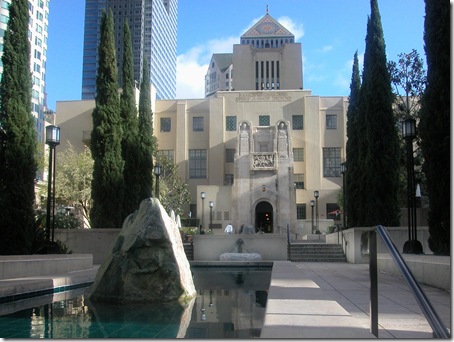
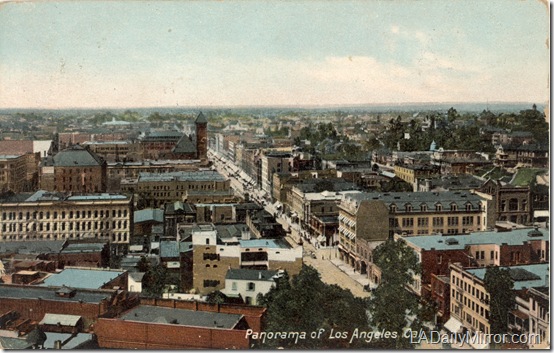
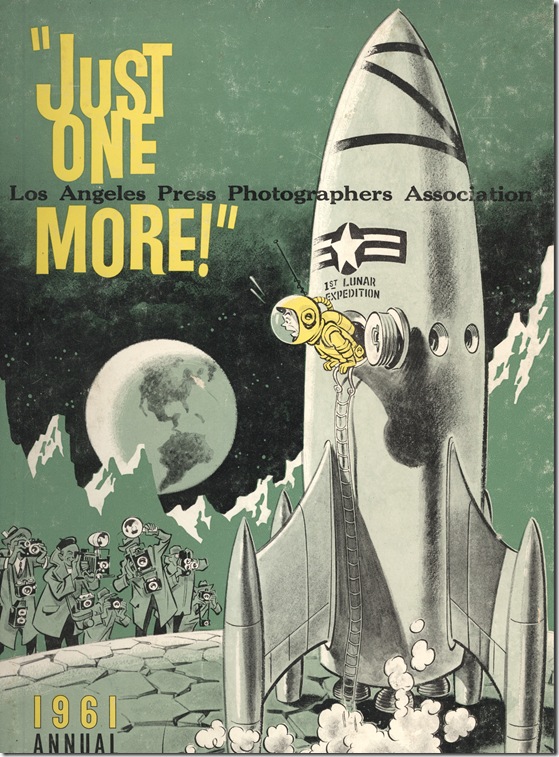
Photo: Los Angeles Public Library. Credit: LAPL
FEATURED
A celebration will be held at the downtown library on Monday at 9:30 a.m. as the L.A. library system restores Monday service at all branches. Sunday closures are continuing, however.
Saturday will be John Lautner Day at LACMA with more events to follow, celebrating the architect’s centennial.
RECOMMENDED
James Cuno gives an exit Q&A to the Chicago Tribune’s Lauren Viera before leaving the Art Institute of Chicago to become president and chief executive officer of the J. Paul Getty Trust.
The New York Times’ Michael Kimmelman muses on the current state of Leonardo’s “The Last Supper” and writes a thoughtful, provocative essay: And so the picture I found filthy but florid during the gritty days of late Fellini and the Red Brigade had been reborn into the fastidious age of soy milk and nanotechnology. In lieu of lone pilgrims and natural light, package tourists making online bookings joined artificial lights that flattened the image. Modernized in its new climate- and crowd-control environment, one of the most familiar pictures in the history of art suddenly seemed alien, like vacuum-packed heirloom tomatoes and no-smoking parks. Even the time limit, a courtesy of the modern hospitality industry, only discouraged visitors from getting to the bottom of the bottomless.
June Q. Wu of the Washington Post profiles Fenella France, a preservation scientist at the Library of Congress,
“There’s quite a lot of detective work in this,” said France, who joined the Library of Congress staff in 2007. “I can find something, like the smudge, and say here’s what we’ve got, here’s some extra text, and we’ll collaborate with historians to see if it’s relevant.”
My L.A. Times colleague Elaine Woo, who makes an art form of the obituary, has one on Theodore Roszak, who coined the term “counterculture.”
Woo writes: Roszak was an author and longtime professor at Cal State East Bay whose best-known work defined an era: He wrote “The Making of a Counter Culture” (1969), a nonfiction bestseller that popularized the word “counterculture.”
Drawing on the works of influential thinkers such as Herbert Marcuse, Paul Goodman and Alan Watts, the book examined the intellectual underpinnings of the social tumult that began in the mid-1960s and extended into the 1970s — the campus protests, love-ins, rock music and psychedelic drug fests that infected masses of young people and bewildered their elders. The youths comprised “a culture so radically disaffiliated from the mainstream assumptions of our society,” Roszak wrote, “that it scarcely looks to many as a culture at all but takes on the alarming appearance of a barbaric intrusion.”
Continue reading →






 ladailymirror.com