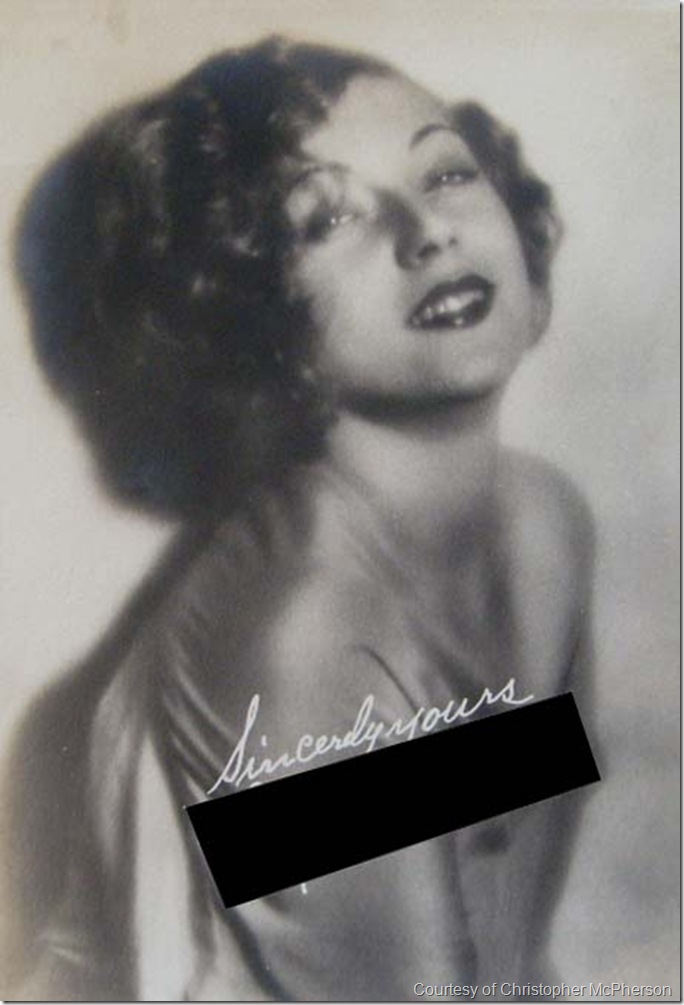
And for Monday, a mystery woman.

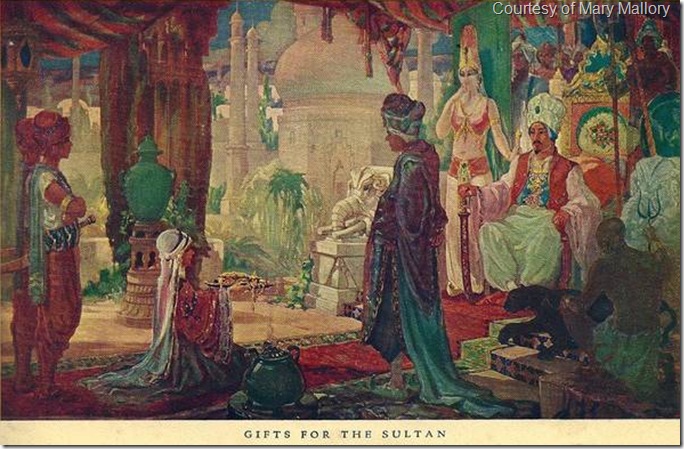
A magic lantern slide for the Gloria Swanson film “Her Gilded Cage” (1922), listed on EBay with bids starting at $89.
Before movie studios employed trailers to raise audiences’ awareness and interest in attending films, they used lantern glass slides to pitch coming attractions. These slides could promote movies, stars, products and even local businesses.
Primitive cinema in the early 1900s mainly advertised moving pictures through lithographic posters, employing strong graphic images to capture the public’s attention. Companies sprang up to mass produce these posters, but small town theaters often handmade their own creations instead of purchasing professionally produced items in order to save money.
As film studios became more organized in their own form of mass production, they also became more professional in the use of advertising and publicity to sell their product. The use of glass slides and lobby cards employing poster key art as marketing materials became firmly established in 1913.
ALSO BY MARY MALLORY
Franklin Pangborn
Erich von Stroheim’s ‘Paprika’
Einar Petersen, Forgotten Artist

Benito Mendivil Jr., 19, 10606 El Dorado Ave., had left his Pacoima gang for a rival one in San Fernando.
On the night of Sunday, July 14, 1963, he had just driven away from his home in a car carrying his aunt and girlfriend when a car full of youths from his former gang pulled in front of him and forced him to stop, The Times said.

A copy of Nils T. Granlund’s “autobiography,” written with Sid Feder and Ralph Hancock, has been listed on EBay. What makes this copy somewhat unusual is that it was apparently owned by Cecil B. De Mille.
Granlund was impresario at the Florentine Gardens and although much of the book is set in New York, a portion of it deals with his time in Hollywood.

The cover has some tears and staining, but the vendor says it is signed by De Mille. (Note the bookplate). The book is listed as Buy It Now for $175. As with anything on EBay, an item and vendor should be evaluated thoroughly before submitting a bid.
Jan. 6, 1924: The Times publishes a photo of an Oakland car that was driven up to the Hollywood sign.
Parade magazine claimed in its July 7, 2013, issue that the completed Hollywoodland sign premiered July 13, 1923, but provided no documentation. After investigating the question this week, I believe I have solved when the sign was actually completed, late November 1923.
No newspapers or books from the period contain stories or photos of the Hollywoodland sign from the year 1923, save the Los Angeles Times, which contained a Dec. 30, 1923, story recounting how an Oakland motor car ascended to the Hollywoodland electric sign, and displayed a photo of the car below the sign on Jan. 6, 1924.
Newsreel outtakes do show construction of the Hollywoodland sign, as men and tractors drag material up the hill, and workers wave from the letter H. I consulted Greg Wilsbacher, director of the Fox Movietone Newsreel Collection at the University of South Carolina, to see what the records pertaining to this footage say about when it was shot or delivered to Fox.
Also by Mary Mallory
Keye Luke
Auction of Souls
Busch Gardens and Hogan’s Aristocratic Dreams

This 1921 architectural photo of Loew’s State Theater under construction at 7th Street and Broadway has been listed on EBay. Bidding starts at $24.

Notice the signage for Bullock’s in the background.

A celebration of the life of Anne Baldwin Knudsen, the former Herald Examiner photographer who died of cancer in May, is being held at 10 a.m. July 28 at Huddart County Park, 1100 Kings Mountain Road in Woodside, Calif. The celebration will be held at the Madrone Picnic Area, Peninsula Memorial Grove, with a potluck picnic to follow.
Guests are asked to bring “memories, stories, songs (with lyrics for sing-along, if you wish), instruments, poems to share” and are requested to bring photos for a memory book for Courtney, Anne’s daughter.
Those who are unable to attend may send their recollections to Paula Heegaard, or 3781 Nathan Way, Palo Alto, CA 94303.


July 12, 1963: Curtiss A. Adams, the only man to survive the Jan. 31, 1957, crash of an F-89J and a DC-7B over Pacoima, testifies in a lawsuit between Douglas, which made the transport, and Northrop, which built the F-89J.
The crash killed the pilot of the F-89J and the four-man crew of the DC-7B, and rained debris on Pacoima Junior High, killing three boys and injuring 67 other students, The Times says.


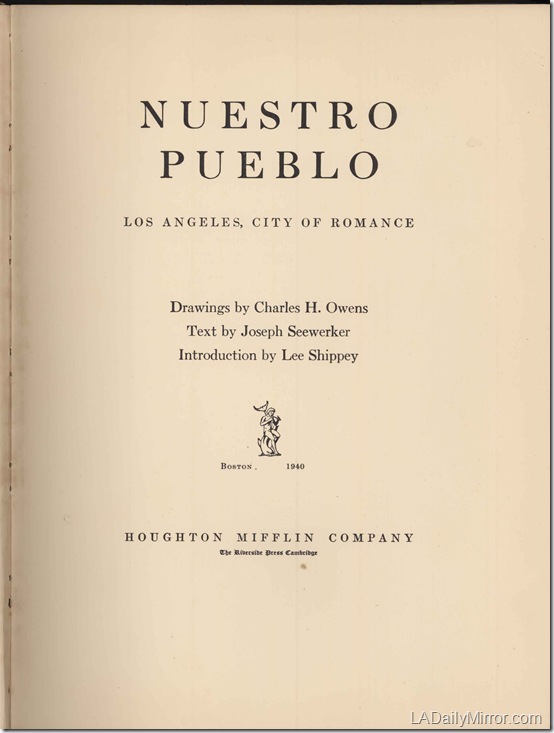
The Times publishes artist Charles H. Owen’s map of the Sicilian invasion. Owens’ artwork is featured in “Nuestro Pueblo,” one of my favorite books on Los Angeles.
July 11, 1943: LAPD officers and state narcotics agents raid an apartment at 3071 W. 7th St. being used as a marijuana distribution center. Authorities confiscated 35 “sacks of marihuana” that were to be repackaged for sale to dealers (price $10 or $134.65 USD 2013).
The “Greatest Generation” paid $1 ($13.47) to $2 ($26.93) for a joint, The Times says.
Notice the mention of LAPD Capt. Francis J. Kearney, future head of the Homicide Division.
Local pianist Zadel Skolovsky will be performing with the Robin Hood Dell orchestra under the direction of Pierre Monteux after winning the the 1943 Robin Hood Dell young American artists’ competition in Philadelphia. Robin Hood Dell was the summer home of the Philadelphia Orchestra for many years.
Continue reading

Zocalo repeats the old bromide that “once upon a time” the streets of Los Angeles were empty and getting around was simple.
Nothing could be further from the truth. After years of reading old newspapers, I can say with authority that congested traffic is a century-old problem in Los Angeles and everything we take for granted today – right turns on a red light, one-way streets, no parking zones, freeways, widened and realigned streets – were all designed to alleviate traffic. The best description of traffic control in Los Angeles is “running as fast as you can to stay in the same place.”

New straw hats at Mullen & Bluett, Broadway and 6th Street. Straw hats are “jaunty, clever, correct.” But we knew that, right?
July 10, 1913: Sex “hygiene” will be taught in the Chicago high schools after a vote by the Board of Education. Chicago becomes the first city in the nation to teach the subject, The Times says.
The skeleton of a man about 35 years old is found across from 1203 E. 8th Street by a workers from the Southern California Gas Co.
The remains were buried at a depth of about three feet in what was once a private lot but taken over by the city for the street, The Times said.

June 26, 1953: A big, screamer headline in The Times.
Glenn Elbert Kingsbury, shot in the chest by an LAPD vice officer, staggered backward into the Roost Cafe, which he had just robbed, and collapsed on the floor, moaning: “Oh my God! Not this way! Not this way!”
Kingsbury, 31, had been living with his brother Harry T. Kingsbury Jr., in an apartment at 672 S. Rampart Blvd. after getting out of prison.

A postcard of Hamburger’s Department Store is listed on EBay as Buy It Now for $2.99.
The classy, oversize May Co. Department Store located at 801 S. Broadway in downtown Los Angeles is up for sale. Today, the mostly empty Broadway Trade Center hosts makeshift swap meet stalls on the first floor in this once celebrated building, the largest department store west of the Mississippi River. Once known as Hamburger’s Department Store, the facility later operated as the May Co. Original owner Hamburger’s was a more elegant and upscale Wal-Mart, hosting every type of business under its roof, even a movie theater.
Hamburger’s Department Store ranked as one of Los Angeles’ premier shopping centers in the early 1900s. Asher Hamburger and his son David immigrated to Los Angeles from Sacramento in 1881, establishing the 20 x 100 foot People’s Store at Main Street and Requena. This department store featured mass but quality goods at fair prices, popular with penny-pinching consumers.
Also by Mary Mallory
Keye Luke
Auction of Souls
Busch Gardens and Hogan’s Aristocratic Dreams
Also on the Daily Mirror
On Location, the May Co.
Movieland Mystery Photo – Architecture Edition

July 5, 1983: Calendar writer Judith Michaelson has a most enjoyable story about De Forest Research, founded in 1952 by Kellam de Forest and located on the Paramount lot in Hollywood. At that time, the company had seven researchers, 16,000 books, as well as magazines and photos.
De Forest’s work was divided between research on factual questions and “script clearance,” such as checking to be sure characters’ names, license plate numbers, addresses and other details didn’t wrongly identify an actual person.
The firm had many industry clients, Michaelson said, although Universal and Columbia had their own in-house research staffs. It charged $150 for a half-hour sitcom to $4,000 to $5,000 for a feature film, Michaelson says.

This photo labeled as the Central Police Station has been listed on EBay as part of a collection of photos from the estate of former Deputy Chief Cleveland Heath, who died in Phoenix in 1956 at the age of 71. The current high bid is $29.99.

The complete July 4, 1863, issue of the Los Angeles Star is available from USC, which scanned a copy at the Huntington.
July 4, 1863: Los Angeles plans to celebrate the Fourth of July with a 34-gun salute and a fireworks display in the evening. A ball was planned at the Willow Grove House in the afternoon and another ball in town in the evening.
The Star, a staunch supporter of the Confederacy, said: “This Declaration is being now reenacted. The same soil which sent forth its heroes to do battle for these fundamental truths is again called upon to endure a baptism of blood in their vindication.”
The Star also reports on a measure in Sacramento “requiring foreigners to show their papers before voting.”

This kitsch masterpiece from the 1940s has turned up on EBay. This is one of the Abbotwares radios, which were made in Los Angeles. Abbotwares produced a whole series of these bronze figurines with radios, but my favorite is the hula girl. This radio is listed as Buy It Now for $399.99. As with anything on EBay, an item and vendor should be evaluated thoroughly before submitting a bid.

The latest in women’s apparel at Hale’s Good Goods, 541, 543, 545 S. Broadway. Young women, you are slaves to fashion!

541-545 S. Broadway via Google Street View.
July 3, 1913: A rabid dog runs through the streets of Tucson, biting four children and a man. “Police rounded up every dog in town suspected of having been bitten by the mad animal and drowned them,” The Times says.
J.A. Flicher, Sacramento’s finance commissioner, is finally able to say the word “damn” because the city’s only woman commissioner, Mrs. A.J. Johnston, had completed her term, having been defeated for reelection.
Dr. Calvin S. White, secretary of the state Board of Health, bemoans the decadence of society.
“One of the principal causes of unhappiness,” White says, is “the foolish fashion in which women now bedeck their bodies.”
One cause of our moral decay is that the good, solid home life of the old days has been abandoned. “Now, after the dinner, instead of gathering around the table, the sons and daughters go out for the night, and very probably, the parents go out also,” White says.
White also cites: “the desire of girls for the so-called ‘good time,’ which, interpreted by them, means dress, dinners, late hours and amusements which surround them with temptations.
“There are a hundred temptations today besetting boys and girls to one that existed 25 years ago,” White says. “The old-fashioned home life is gone.”
Also to blame: “craving for excitement, suggestive plays, billboard displays and other similar temptations.” Oh yes, and people are reading cheap dime novels instead of “good, clean stories of other days.”

The entire Los Angeles Star for June 27, 1863, is online at USC’s digital library, scanned from a copy at the Huntington.
Jan. 27, 1863: As usual, this issue is mostly devoted to the Civil War. But the Star reports that the Rev. Pedro Verdaguer is taking up a collection to build the first church in San Bernardino.