
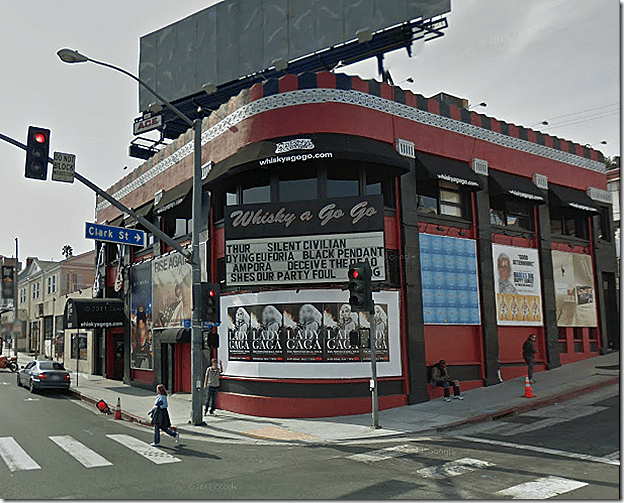
The Whisky a Go Go at Sunset Boulevard and Clark Street via Google Street View.
Trentham Roberts, the proprietor of “The ‘60s at 50” blog, has an entry on the opening of Whisky a Go Go on Jan. 15, 1964.
The Whisky a Go Go at Sunset Boulevard and Clark Street via Google Street View.
Trentham Roberts, the proprietor of “The ‘60s at 50” blog, has an entry on the opening of Whisky a Go Go on Jan. 15, 1964.
Jan. 13, 1944
It’s Thursday in 1944, and today we have:
— “Forgery and Murder” on “Challenge of the Yukon.” Courtesy of Archive.org.
— “The Adventure of the Mischief-Maker” on “Ellery Queen, Master Detective.” Courtesy of Archive.org.
— ‘Kraft Music Hall” with Bing Crosby singing “The San Fernando Valley,” with guest George Murphy. Lots of jokes about the housing shortage. And we’re doing to be hearing a lot of the hit song “Shoo, Shoo, Baby.” Courtesy of Archive.org.
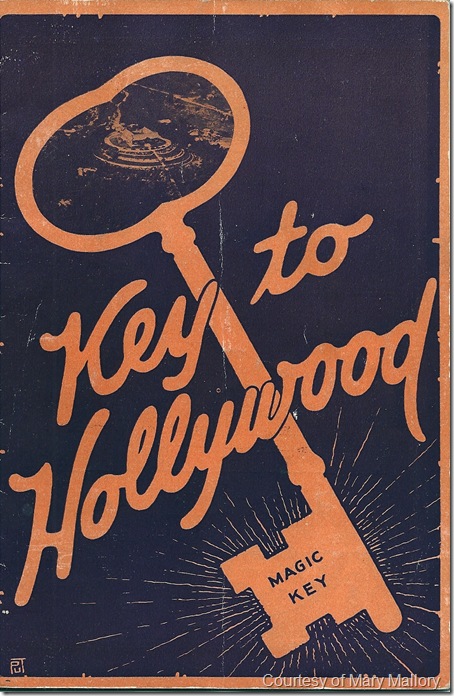
Sightseeing has long been the lifeblood of Hollywood and Los Angeles. Long before Gray Line Tours or even any of its poorer knockoffs came along, companies offered sightseeing around these areas, particularly those neighborhoods where movie stars or celebrities were known to live or work. Many companies printed and sold maps listing homes of the stars. Some sold lovely little lithographic brochures giving history, statistics and stories of the area, along with addresses and representative photographs. “The Key to Hollywood” was one such tourist souvenir, trying to promote a little more high-class tour of attractions.
The Los Angeles Chamber of Commerce issued its first publication in December 1888 playing up the area, called “Los Angeles County — Facts and Figures From the Chamber of Commerce.” This bland, straightforward item soon gave way to elaborately produced, eye-catching images and brochures filled with hyperbole, luring tourists and hopefully residents to the golden city. Local organizations distributed and mailed out this colorful literature for decades, creating the myth of the ideal location in which to settle, filled with perfect weather, abundant citrus and other crops, and an exciting place to put down roots, as Tom Zimmerman elaborates in his book, “Paradise Promoted: The Booster Campaign That Created Los Angeles 1870-1930.”
Mary Mallory’s “Hollywoodland: Tales Lost and Found” is available for the Kindle.
Jan. 12, 1944: Here’s Kay Kyser and the Kollege of Musical Knowledge. Courtesy of Archive.org.
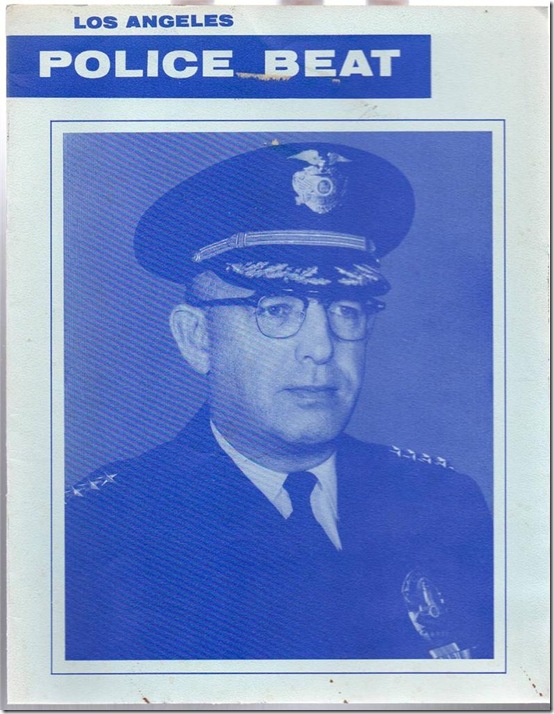
An Ebay vendor is selling random issues of the LAPD’s Police Beat magazine from 1962 to 1967, including this issue featuring Chief William H. Parker, presumably honoring Parker after his death in 1966.
Jan. 11, 1944:
Today we have
—“Fibber McGee and Molly” in which Fibber tries to calculate his income tax.
Courtesy of Archive.org.

I dug into some old boxes over the holidays and found this Business section cover from 1989, which I had used to wrap something. Here it is, compared to the Jan. 10, 2014, business cover. We all know that newspapers have gotten smaller, but this makes a good illustration of how much space has been cut.
Jan. 10, 1944:
Today we have
—“Information Please,” hosted by Clifton Fadiman with John Kieran, Franklin P. Adams, Christopher Morley and Rep. John M. Coffee of Washington.
—“The Constant Nymph” on Lux Radio Theater with Charles Boyer, Alexis Smith and Maureen O’Sullivan.
—“Watch on the Rhine” on Screen Guild Theater with Bette Davis and Paul Lukas.
Courtesy of Archive.org.
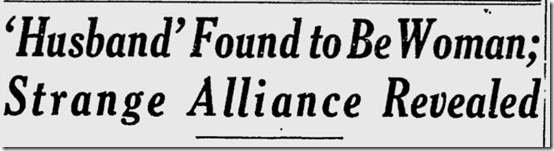
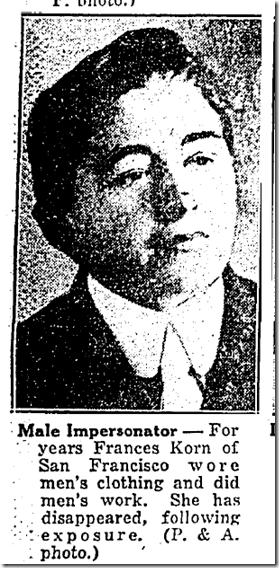 There is much that we do not know about Frank Korn, even what became of him. For that matter, we don’t know much about his grandmother, Frances/Francis Klocker (sometimes spelled Kloecker).
What we do know is that on Sept. 12, 1928, Klocker complained to juvenile authorities in San Francisco that Frank Korn was actually Frances (or Francis) Korn and had been living as a man for many years, having married and adopted two children. Klocker explained that at the age of 90, she had found “her courage at last in her desire to shield the child,” the Reading (Pa.) Eagle reported.
(An adopted girl had been given to another relative after the death of Korn’s wife about 1916, but he retained custody of a boy named Bernard, who was then 11).
According to the Reading Eagle’s account, Klocker had been raised in Germany and her daughter had been married to a nobleman who demanded that she have a son. When she gave birth to a girl, the husband left.
The baby girl was named Frances, but “as a small child she expressed the childish wish to ‘be a boy,’ ” the Eagle said. “The desire grew and grew until it became an obsession and at the age of 16 it became a fact, so far as the world knew, for Frances put on man’s clothing, never to wear any other.”
According to The Times account, Frances Korn was highly educated. She was trained as a singer and spoke three languages.
However, Korn secretly studied navigation, obtained papers as a first mate and embarked on life at sea, The Times said.
The Eagle reported that Klocker came to San Francisco in 1903 and Korn arrived in 1905.
In 1911, Korn told Klocker that she had married Annie Leary, explaining “I want to marry her for the sake of company.”
“Annie was happy too,” Klocker said.
The couple adopted two children and Leary apparently died about 1916. Newspapers informed readers that Leary never suspected Korn’s secret and that Korn married “for companionship.”
Korn had been working for the last three years in a machine shop, identified as Pacific Gear Co., but apparently quit once her story became known.
The Times reported that Klocker sought police protection, saying that Korn had threatened her life because she had exposed Korn’s “17-year-secret.” Klocker feared that Korn might commit suicide, the Eagle said.

According to California death records, Francis Klocker died Feb. 1, 1929, at the age of 90, not long after the story broke.
A search of early California newspapers reveals several citations of a Frank Korn in San Francisco, but it’s unclear if it’s the same person.
A San Francisco Call article from Aug. 18, 1907, refers to a Frank Korn taking part in a performance by the Eastern Star, the Masonic group for women. The Sausalito News for June 1, 1911, also refers to a performer named Frank Korn.
Many of us are familiar with the story of Billy Tipton, who was born a woman and took on the identity of a male bandleader. And I once wrote a post (which I can’t locate at the moment) about two women in the 1940s who were living as a married couple. There’s even the story of Maud Effinger, who dressed up as a man to attend a boxing match in 1910.
But this is the earliest account I can recall of a woman living as man for years, being married, adopting children, etc.
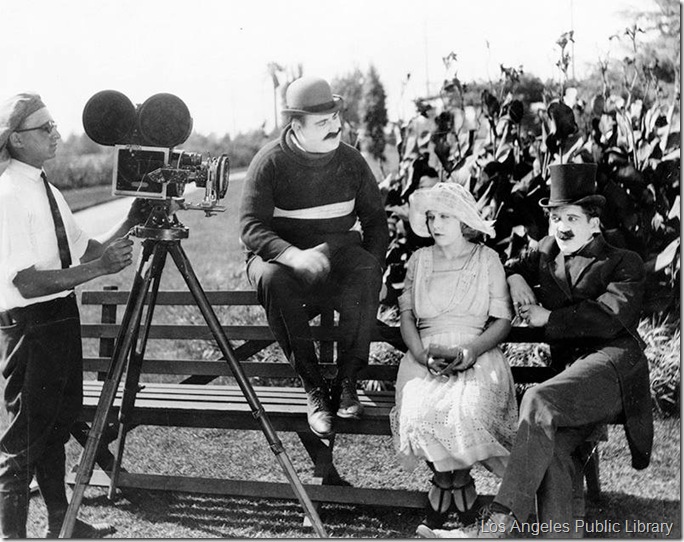
Christina Rice, photo archivist at the Los Angeles Public Library, sends along another unidentified photo. She’s hoping someone in the brain trust will recognize these folks.
Jan. 9, 1944
— “Texaco Star Theater” with Fred Allen and Portland Hoffa.
—“The Great Gildersleeve” with Harold Peary.
Courtesy of archive.org.

Jan. 9, 1944: The news report from CBS, sponsored by Admiral Radio, courtesy of Archive.org.
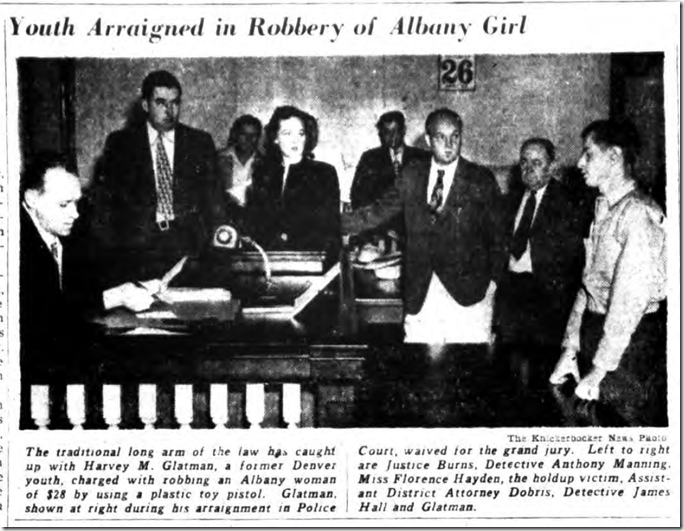
Aug. 26, 1946: Harvey Glatman is arraigned, published in the Knickerbocker News of Albany, N.Y.
In case you just tuned in, I did quite a bit of research on the early years of serial killer Harvey M. Glatman for an upcoming TV show and thought I would share it on the L.A. Daily Mirror.
The story so far: Harvey Glatman’s mother took him to stay with relatives in New York after he was arrested in Colorado on charges of attempted robbery. Police said he was suspected of “terrorizing girls on Capitol Hill in Denver” by accosting them, undressing them and tying them to trees.
On Aug. 17, 1946, he set off on a plan to commit holdups in what he later called “the outlying sections,” taking some clothesline, a penknife and buying a toy gun for 35 cents.
On the morning of Aug. 18, 1946, he awakened after spending the night in the woods around Yonkers, having stabbed Thomas Staro, who got free of his bonds while Glatman was tying up Staro’s woman companion, Doris Thorne, during an attempted robbery. Yonkers detectives identified Glatman through a dry cleaner’s mark found on the jacket he left at the crime scene.

Christina Rice, photo archivist at the Los Angeles Public Library, is looking for help with this undated, unidentified photograph, so I said I would ask the brain trust.
Although the image is part of the library’s collection, it is for sale elsewhere on the Internet (hm) and dated 1914.
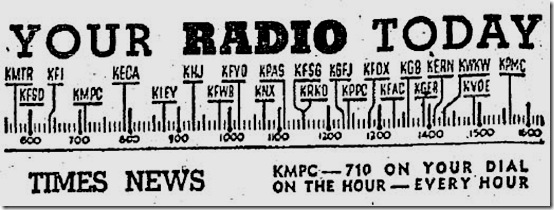
Jan. 8, 1944: Today we have four features:
–“The Death Laugh” on “Inner Sanctum Mysteries.” Notice the creaking door.
–“City of the Dead” Part 1 on “Adventures by Morse.” Featuring Capt. Friday!
—“Abie’s Irish Rose” via WMAQ Chicago. (The sound is crummy at the beginning of the disc).
–Carmen Miranda, Shirley Ross, Veronica Lake and Harry James on “Command Performance USA,” an Armed Forces Radio Service program.
Courtesy of Archive.org.
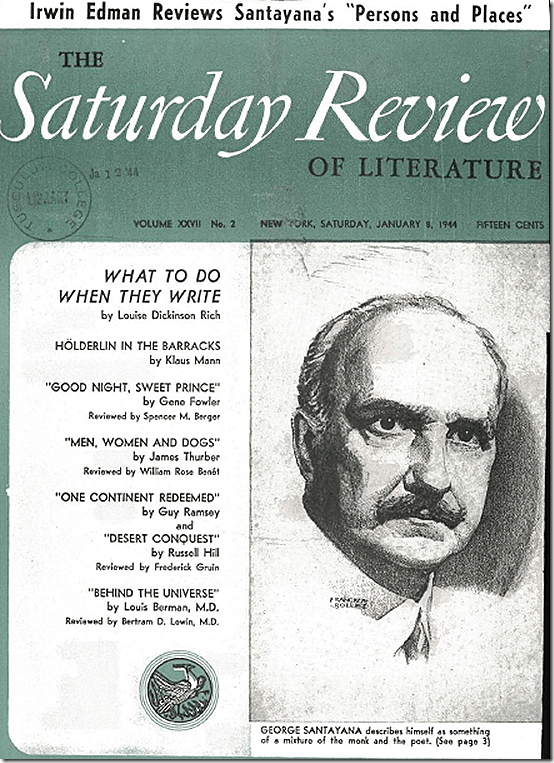
Jan. 8, 1944: This issue has reviews of Gene Fowler’s biography of John Barrymore, “Good Night Sweet Prince” and James Thurber’s “Men, Women and Dogs.”
Also: Collier’s Weekly, Jan. 8, 1944
Courtesy of Unz.org
 The story so far:
In the summer of 1946, Ophelia Glatman received permission from the Colorado courts to take her son, Harvey, to stay with relatives named Feldman in New York.
Harvey Glatman had been arrested in Colorado in 1945 on charges of attempted robbery and was suspected of “terrorizing girls on Capitol Hill in Denver” by accosting them, undressing them and tying them to trees. According to 1946 news accounts, the Feldmans lived at 1565 Townsend Ave. in the Bronx and operated a summer concession in Rockaway.
On the afternoon of Aug. 17, 1946, Glatman, 18, left the Feldmans’ apartment, telling his mother he was going to see the Marx Bros. “A Night in Casablanca.” Before Glatman left, he took a length of clothesline and was carrying a knife.
After seeing “A Night in Casablanca” in Manhattan, Glatman bought a toy pistol for 35 cents and took the subway to Woodlawn. From there, he boarded a trolley and then another trolley to get to Saw Mill River Road in Yonkers, N.Y.
Above right, the Yonkers Herald Statesman, Aug. 26, 1946.
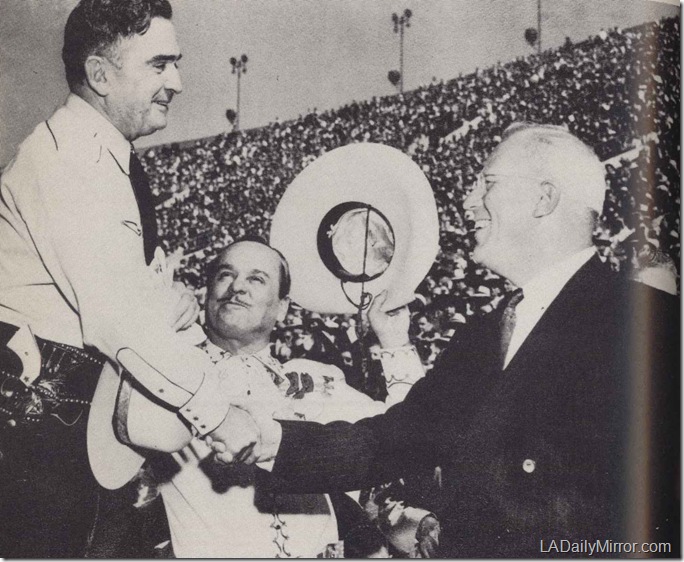
Los Angeles County Sheriff Eugene Biscailuz, left, actor Leo Carrillo, center, and Gov. Earl Warren from “Biscailuz: Sheriff of the New West.”
The impending retirement of Los Angeles County Sheriff Lee Baca is a good time to dip into the archives.
Eugene Biscailuz, above, who died in 1969, was sheriff of Los Angeles County until his retirement in 1958. Biscailuz became undersheriff in 1923. He was appointed in 1932 to replace Sheriff William I. Traeger, who was elected to Congress. Biscailuz was elected to the post in 1934, winning reelection in 1938, 1942, 1946, 1950 and 1954.
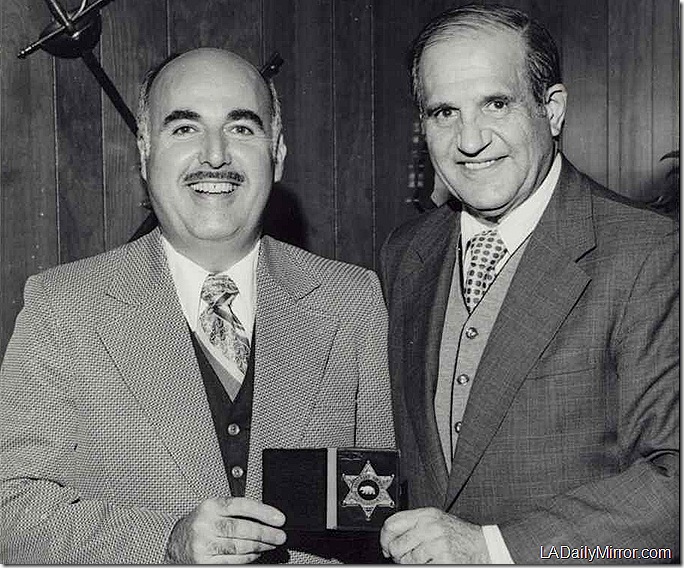
Sheriff Sherman Block, left, and former Sheriff Peter J. Pitchess in an undated photo, probably taken about 1982.
Biscailuz retired in 1958 and was replaced by former FBI Agent Peter J. Pitchess, above right, who became undersheriff in 1953 and was elected sheriff in 1958 with Biscailuz’s endorsement. (The Times also endorsed Pitchess). Pitchess won election by more than 150,000 votes in the June 1958 primary against rancher John Doran.
Pitchess, who died in 1999, stepped down in early 1982, and the Board of Supervisors appointed Undersheriff Sherman Block, above left, as his successor. Block died in 1998 during a campaign for his fifth term in a race against Lee Baca.
Jan. 7, 1944: Time for “Amos ‘N’ Andy” with guest Pat O’Brien. I debated with myself about posting this show, but coverage of 1944 wouldn’t be complete without it, given its popularity. Courtesy of Archive.org.
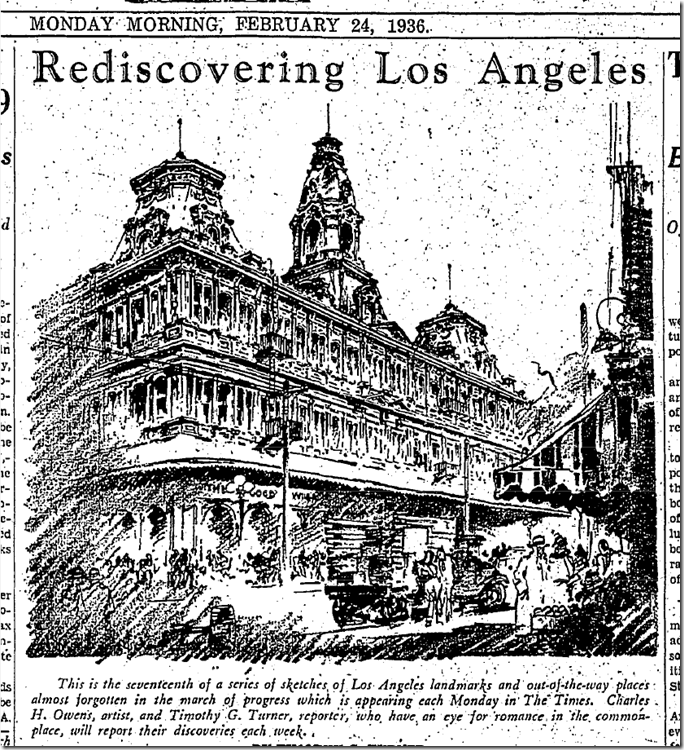
Feb. 27, 1936: This week, Times artist Charles Owens and columnist Timothy Turner visit the Baker Block, one of the huge gingerbread buildings that flourished in downtown Los Angeles, like the Hall of Records.
The Baker Block, at Main and Arcadia, was demolished in 1942 after being occupied by Goodwill Industries for many years.
 ladailymirror.com