

July 2, 1944
Hedda Hopper says that some of the greatest of Hollywood veterans have been around so long that nobody takes them seriously anymore. Like Charles Laughton.
July 2, 1944
Hedda Hopper says that some of the greatest of Hollywood veterans have been around so long that nobody takes them seriously anymore. Like Charles Laughton.

Here’s what they actually do in the Bradbury Building.
This ad popped up after a thrilling round of Words With Friends. Could it be the Bradbury Building? Indeed it is.

An undated photo of LAPD officers from SkyscraperCity.com, which reposts images from all over the Internet (including mine), often without acknowledgement.
I recently learned that this photo, published in Capt. Art Sjoquist’s “History of the Los Angeles Police Department” as “The first Los Angeles Police Department, 1876” has been dated incorrectly.
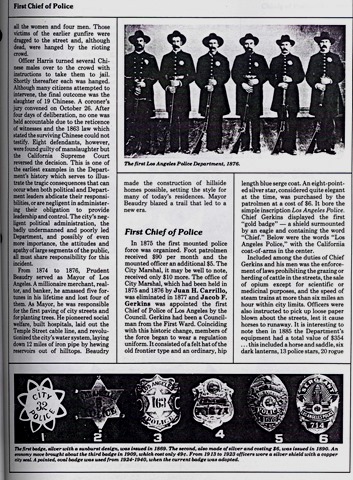
Sjoquist’s “History of the Los Angeles Police Department,” published in 1984, is an outgrowth of Sjoquist’s 1972 master’s thesis “From Posses to Professionals: A History of the Los Angeles Police Department.” Both of these volumes are essential research tools but hard to obtain, particularly “History of the Los Angeles Police Department,” which is almost impossible to find at any price. (The Los Angeles Public Library index lists both books).
Glynn Martin, executive director of the Los Angeles Police Museum, has done more recent research that questions the traditional date of this photo. Martin notes that a copy of the picture is displayed at the museum with a plaque reading “LAPD First Paid Officers, 1869.”
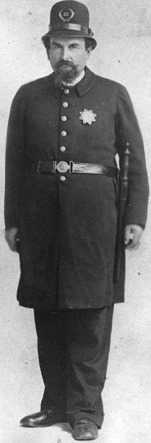
In his 2006 blog post, Martin says that one of the officers in the photo has been identified as H.W. Marden, who wore Badge No. 21.
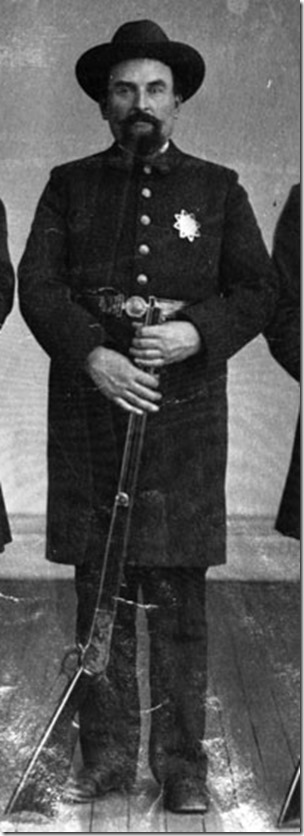 Above, Officer Henry W. Marden in an image taken from the group photo. At right, Marden in a photo dated 1889, courtesy of the Los Angeles Police Museum. Above, Officer Henry W. Marden in an image taken from the group photo. At right, Marden in a photo dated 1889, courtesy of the Los Angeles Police Museum. |
 |
As best as I can determine, the photo of the six officers was taken between 1887 and 1888.
Here’s the first part of my research, which tells us the following:
First of all, the men are wearing the Series 1 badge. Sjoquist’s history indicates that the badge was in use from 1869 until it was replaced by the Series 2 badge in 1890. A collector says that they were in use from 1876 to 1890. Either way, the Series 1 badges indicate the photo was taken no later than 1890.
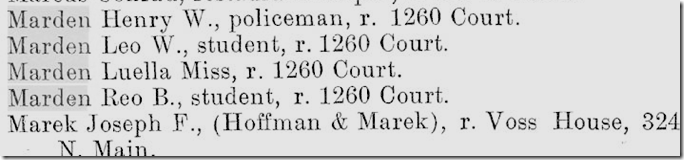
Now for Police Officer Henry W. Marden, whom we find in the 1894 Los Angeles City Directory, courtesy of the Los Angeles Public Library:
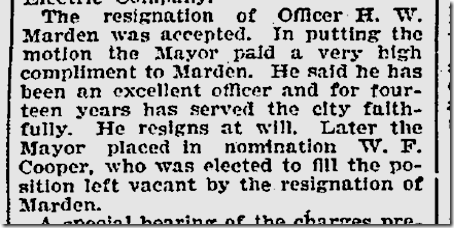
The Times reported on March 27, 1901, that Marden resigned from the LAPD after 14 years with the department:
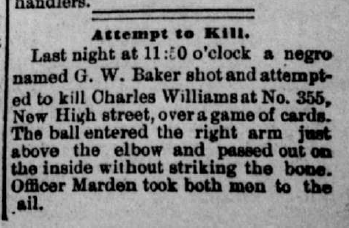
He is mentioned in a Dec. 8, 1887, story in the Herald.
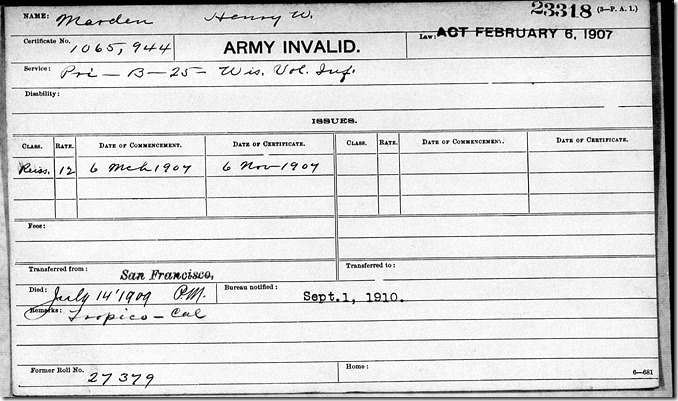
And further research reveals that he was a Civil War veteran who died in 1909 at the age of 68. He is buried at Inglewood Park Cemetery.
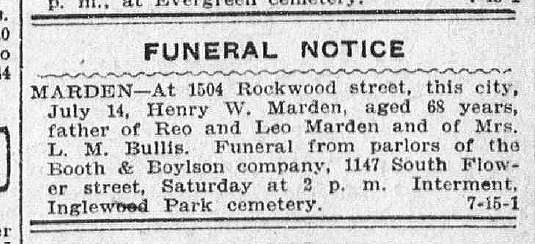
Los Angeles Herald, July 15, 1909.
Veterans Administration records show that he was a private in Company B of the 25th Wisconsin Infantry.
To be continued.


July 1, 1944
Louella Parsons is on vacation and instead of running her replacement, Dorothy Manners, I thought I would switch to dear, old Hedda. I’m not a Hedda fan, so she won’t last long, but I thought she would make an interesting contrast with Louella, Walter Winchell and Sidney Skolsky.
Judge William B. McKay opens an investigation into charges of police brutality in Glendale and Burbank after the arrest of a 21-year-old man who says he was beaten by police and moved from jail to jail so he authorities couldn’t be served with a write of habeas corpus.
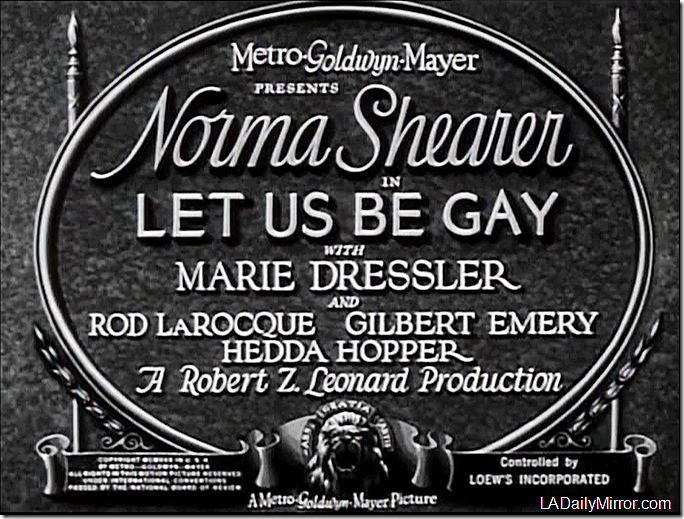
This week’s movie is “Let Us Be Gay” (1930).
A March 4, 1930, article in the Los Angeles Times about the making of the film said that some sequences were to be in Technicolor. “It may, in fact, be done entirely in color,” The Times said. (Obviously wrong).
The Sept. 13, 1930, review by Philip K. Scheuer called it an inferior variation of Norma Shearer’s previous film, “The Divorcee” (1930), which had a similar plot, but suffered from being rather stagey, having been adapted from a play by Rachel Crothers. And yes, Scheuer noted that leading man Rod La Rocque was miscast. “Mr. La Rocque’s self-consciousness remains acute through the picture, destroying the verisimilitude of the scenes,” Scheuer said.
And apologies for overlooking Mandiemarie20, who identified our mystery lad.
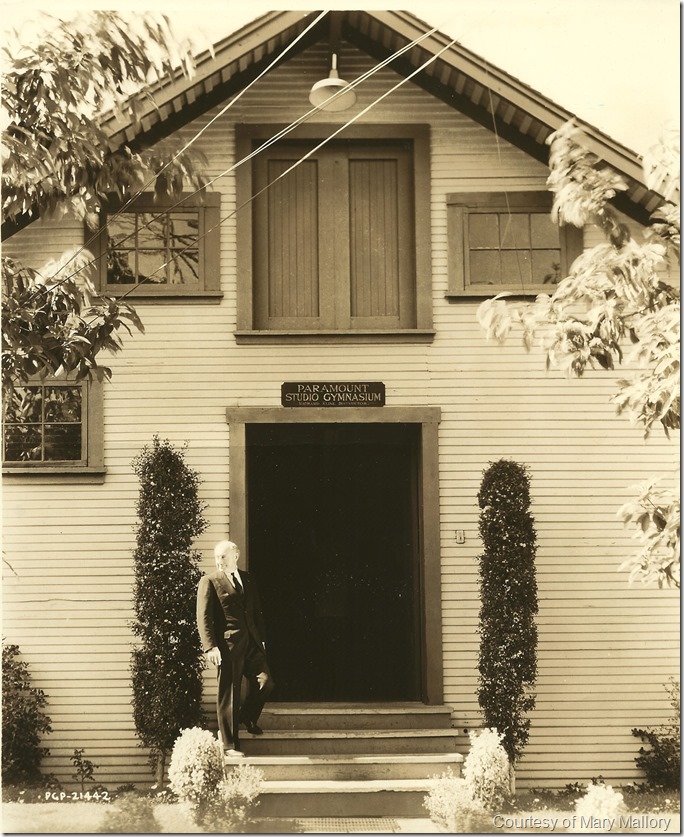
Cecil B. DeMille on the steps of the barn, which Paramount was using it as a gym, photo courtesy of Mary Mallory.
Most visitors to the Hollywood Bowl probably don’t realize the historic significance of the little gray barn sitting across Highland Avenue in Parking Lot D. Cecil B. DeMille directed his first feature film, “The Squaw Man,” outside this tiny structure a century ago, making it the West Coast birthplace of what is now Paramount Pictures. Countless stars have walked through its doors over the years, and the building has appeared in many films and television shows. For more than 112 years, this small barn has witnessed the evolution of Hollywood from sleepy village to filmmaking capital.
In 1901, businessman and investor Robert Northam erected a grand mansion costing $10,000 at the southwest corner of Prospect Avenue and Vine Street for his young bride, Leotia. Across the street and south of Selma Avenue, the tycoon constructed a homely barn to board horses and farming equipment. Northam sold the property in 1904 to real estate developer Jacob Stern, who employed the stable as a garage for his large touring car, one of the first in Hollywood. Within a few years, a new industry would spring up around the Stern property.
Note: To highlight the Lasky-DeMille barn and “The Squaw Man” centennial, the Hollywood Chamber of Commerce is hosting a celebration Tuesday, July 1 from 5 p.m. to 8 p.m. in the parking lot outside the Hollywood Heritage Museum, featuring beer and wine, ice cream photo stations, vintage cars, face painters, games, horses and a fire engine. Tickets cost $10. Parking is available entering from Odin Street. Marc Wanamaker and Mary Mallory will be giving a presentation in the barn on the building and filmmakers’ history.
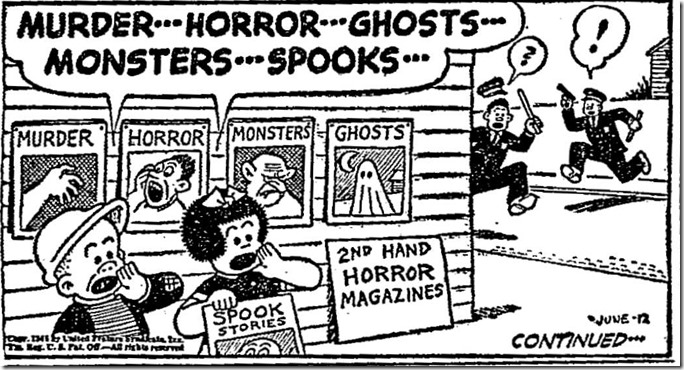

June 12, 1944
Note: This is a post that was on the clock but failed to go live. Here it is, two weeks later.
The Greatest Generation does not seem to be interested in conserving gas, tires, their automobiles or anything else and they ignore the federal 35-mph speed limit. In fact war workers are the worst offenders, according to the American Automobile Assn.
“Hundreds of thousands of these war workers are driving cars for the first time,” the AAA’s Thomas P. Henry said. “They are accorded top priority in cars, tires and gasoline and apparently proceed on the assumption that they have a divine right to replacement if a car is demolished or a tire destroyed.”
As part of a crackdown on bad driving across Southern California, police in Los Angeles cited 2,038 motorists for violations including DUI, speeding and defective headlights.
In the theaters: “Cobra Woman” and “Timber Queen.”
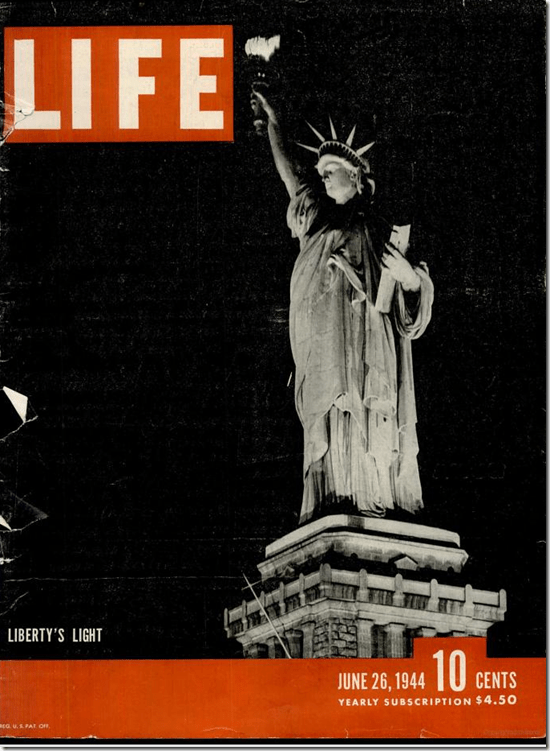
June 26, 1944
Oh my, what is the Greatest Generation up to?
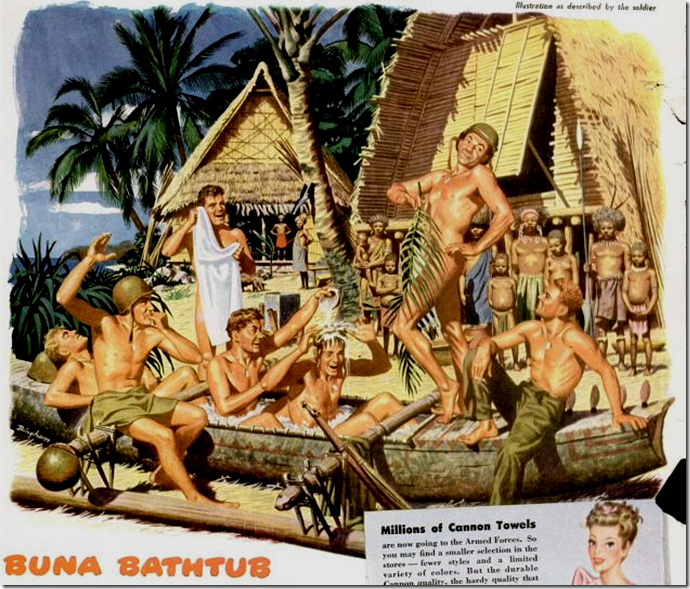
On the jump, a feature on war photographers.
And a look at movie stars and their stand-ins, including Mary Lou Isleib (Shirley Temple) and Jack Robbins (Bob Hope).
June 26, 1944: Return with us now to those thrilling days of yesteryear! “The Lone Ranger” with Billy the Kid. Courtesy of otronmp3.com.

The Google car (not self-driving) was at 2nd Street and Broadway the other day.
June 25, 1944
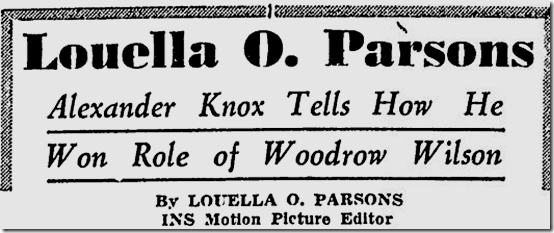
HOLLYWOOD, JUNE 24 — A studious appearing quiet young man is gray eyed Alexander Knox, who, out of hundreds of applicants, was chosen by Darryl Zanuck to play “Wilson.”
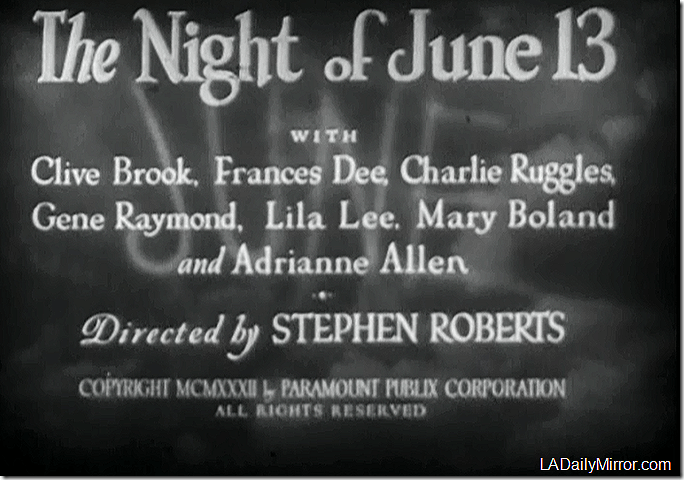
In case you just tuned in, I am using Louella Parson’s May 15, 1944, item on Rouben Mamoulian being replaced as the director of “Laura” to take a detour into the making of the film.
We have looked at the life and early career of author Vera Caspary, whose novel was the basis for the film, and I decided that before delving into “Laura” it might be useful to look at some earlier films based on Caspary’s stories.
In her autobiography, she bragged of writing eight different versions of the same story (“Suburb”) starting in 1932 and selling them to the studios before she was finally confronted by Paramount and told to stop or risk charges of plagiarism. Paramount’s position is understandable. In addition to the matter of paying for the same story again and again, at least one of the films was made by a rival studio — Fox. In this post, we’ll take a look at some of those films, because as unlikely as it seems, they provide some of the foundation for “Laura.”
The Making of “Laura” Part I | Part II | Part III | Part IV | Part V | Part VI
Warning: Spoilers ahead.

June 24, 1944
I rarely run Hedda Hopper, but since Beachgal said Hedda would have never fallen for Warners’ publicity on Dennis Morgan, here she is, leading her column with… guess who.
Hedda Hopper says: Dennis Morgan has come up so fast in the last two pictures, especially “Harvest Moon,” that Warners have handed him the part of Tony Pastor in “The Life of Tony Pastor” opposite Ann Sheridan.


June 24, 1944
Dorothy Manners, filling in for her boss Louella Parsons, says:
HOLLYWOOD, JUNE 23 — A sudden shuffle in the casting of “Experiment Perilous” brings out some interesting news. George Brent will play the hero role opposite Hedy Lamarr in the RKO movie instead of Gregory Peck, originally scheduled for the part. As it stands now the lineup is Brent, Hedy and Paul Lukas.
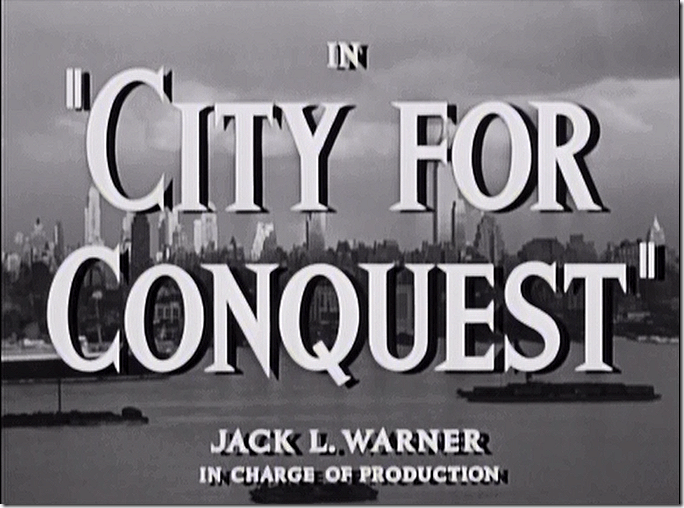
This is “City for Conquest,” produced by James Cagney’s brother William. Directed by Anatole Litvak, with cinematography by Sol Polito and James Wong Howe.

“Body Building With Bar Bells and Dumbbells” by Richard Kline, listed on EBay as Buy It Now for $29.99.
Long before the advent of personal trainers, workout gyms, weight lifting and cross-training, some movie stars worked out to get in shape, stay slim and trim, or to be prepared for active roles. Action hero Douglas Fairbanks exercised multiple hours a day, sculpting his body into a fine physical specimen capable of handling complicated stunts. Others worked to maintain slim figures.
Richard Kline, the first physical instructor and manager of the Paramount Studios gym, in what is now the Hollywood Heritage Museum, developed exercises to focus on problem areas of the body as well as created exercise routines to “streamline the stars,” as the Los Angeles Times called it. He could in effect be called the first personal trainer for the entertainment industry.
Note: To highlight the Lasky-DeMille and “The Squaw Man” Centennial, the Hollywood Chamber of Commerce is hosting a celebration Tuesday, July 1 from 5 p.m. to 8 p.m. in the parking lot outside the Hollywood Heritage Museum, featuring beer and wine, ice cream photo stations, vintage cars, face painters, games, horses and a fire engine. Tickets cost $10. Parking is available entering from Odin Street. Marc Wanamaker and I will be giving a presentation in the barn on the building and filmmakers’ history.
Per Picture-Goer magazine, Kline was born in Maine in 1906, and as a young man, the strong Kline could lift any two boys his size. Lying about his age and joining the Marines at 14, he studied physical culture and calisthenics. Upon discharge, Kline joined the Chautauqua Circuit, acting as a strongman before landing in Atlantic City. In 1925, he sold city officials on teaching physical exercises to giant classes on Atlantic City beaches. Kline was discovered by a Paramount executive acting as a strongman on the vaudeville circuit and brought him west to manage the studio gym, “the famous Lasky barn, where Jesse Lasky produced, and Cecil B. DeMille directed, “The Squaw Man.”

Did you think Amazon was the only website with fake reviews? Maybe not.
Here’s a current ad on Craigslist.

And for $40 you can get a review on two other websites as well!
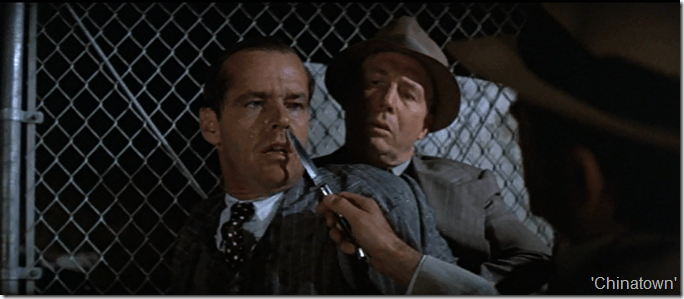
One of the most famous scenes in “Chinatown,” which is celebrating its 40th anniversary, occurs when Jake Gittes (Jack Nicholson) has his nose slit by director Roman Polanski.
What many people don’t realize is that something like this actually occurred at a party in 1944 during a brawl between actor Jon Hall and bandleader Tommy Dorsey on the balcony of Dorsey’s apartment at 1220 Sunset Plaza Drive. Hall, who was attacked by several men, needed 50 stitches to his head and face. His nose was broken, one of his nostrils was slit, he was stabbed in the throat and bruised on the back in the area of his kidneys, The Times said.


As if you didn’t already know the truth about Amazon’s “reviews.”
Author Tony Horwitz writes in the New York Times.
Except there didn’t seem to be a “team,” just an outside publicist who was busy on other jobs. She circulated a hasty press release and wrote a glowing review of “Boom” on Amazon, the main retailer of Byliner titles. Byliner urged me to “game the system” by soliciting more such “reviews” from friends and relatives, and issued a few tweets touting “Boom.” Then silence.
I’m shocked! Shocked! to know that Amazon reviews are bogus.
And if you want to pick up a little pocket money, you can write them too!

June 20, 1944
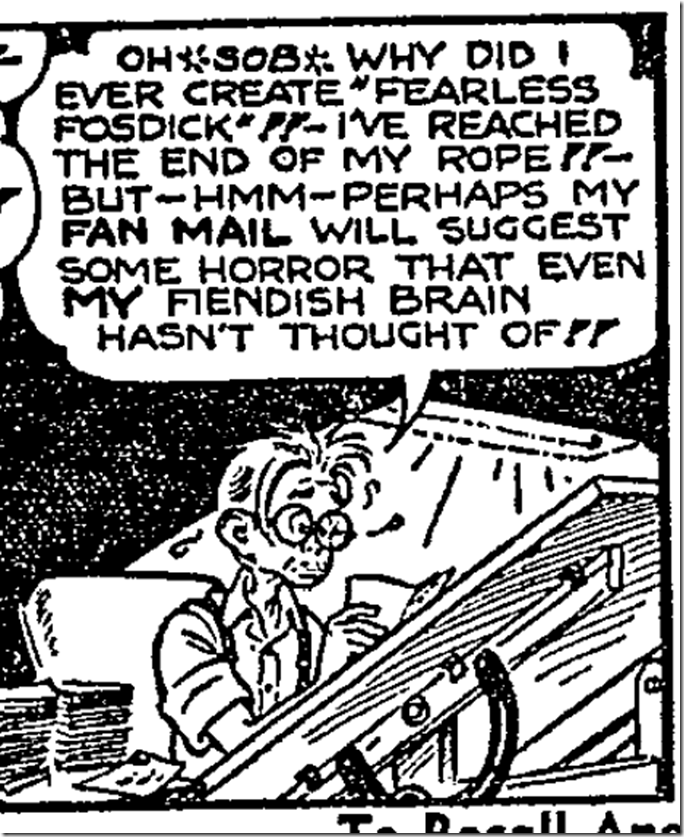
HOLLYWOOD, JUNE 19 — Seein’ is believin’ as the saying goes, and the other day I saw figures of the actual breakdown on the Warners fan mail. Lo and behold, leading all the others was Dennis Morgan. I am going to admit I am surprised. Not that Dennis isn’t a good actor and a handsome gent, but he has never had the cream of Warners’ stories, and I think the studio would be the first to admit that.
 ladailymirror.com