July 10, 1947: The Sentinel devotes a significant part of its front page to the San Diego slavery trial with a story by Clinton M. Arnold. The Sentinel said it was the only black weekly in the U.S. devoting so much coverage to the case.

July 10, 1947: The Sentinel devotes a significant part of its front page to the San Diego slavery trial with a story by Clinton M. Arnold. The Sentinel said it was the only black weekly in the U.S. devoting so much coverage to the case.

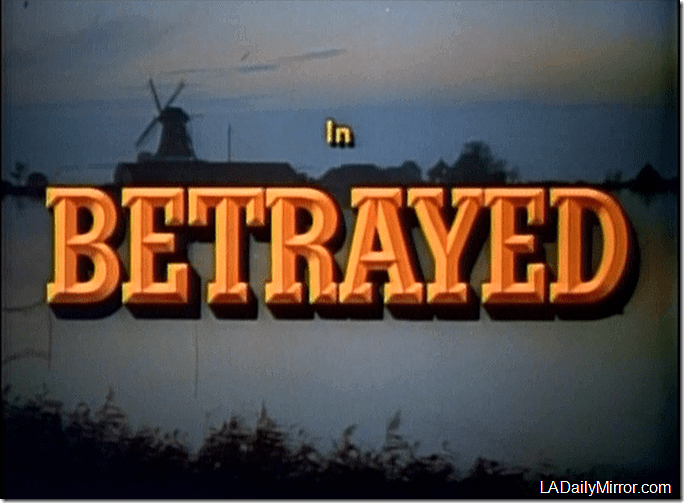
I suppose you prop guys at Warner Bros. think this is very funny.

“California Today,” by Tim Arango and Charles McDermid, presents a strange bit of nonsense: The Mirror (the sister paper of the Los Angeles Times published in the afternoon) folded “partly because the old streetcars went away as the city embraced the automobile.”

Note: This is an encore post from 2006.
July 12, 1907
Los Angeles
Gas Co. employees found a man scalded over the lower half of his body wandering the yards at Center and Aliso after he fell into a vat of boiling water produced by the carbon pit. The man, who was unidentified but believed to be J. Cochran of 232 E. 1st St., was so badly burned that much of his skin tore away when he ripped off his clothes.

Here’s another shot of the California State Building lobby and the bank of elevators as Hugh Marlowe exits.

July 10, 1947: The Sentinel publishes a picture of Newton Joshua, who discovered the body of Rosenda Mondragon. I don’t recall ever seeing his name in coverage of the killing.

Note: This is an encore post from 2006.
July 11, 1907
Los Angeles
Among the presentations at the current educators convention is a seminar on teaching the arts. If you have ever attended a colloquium on arts education or listened to arts educators, these comments from another era sound depressingly familiar, and for all the progress that may have been made, we have learned so little.


Jan. 9, 1947: The Sentinel reports on the rise in lynchings in 1946 in data compiled by the Tuskegee Institute. The institute said six African Americans were lynched in 1946, contrasted with one in 1945.
“The offenses charged were stealing a saddle, one; stabbing a man, one; and breaking into a house, one,” according to Dr. F.D. Patterson, head of Tuskegee.
Note: This is an encore post from 2005 and originally appeared on the 1947project.
In the days when I lived in Hecate County, I had an uncomfortable neighbor, a man named Asa M. Stryker. He had at one time, he told me, taught chemistry in some sooty-sounding college in Pennsylvania, but he now lived on a little money which he had been “lucky enough to inherit.”

Note: This is an encore post from 2005 and originally appeared on the 1947project.
Finger-pointing gestures and assurances that the State Department and other higher echelons will hear protests were features of an “international incident” yesterday when Dr. Francisco Villagran, Mexican Consul General, assertedly was treated discourteously by customs officials when he greeted Jaime Torres Bodet, Mexico’s foreign minister, at Los Angeles Airport.
In the verbal melee, Bruno Newman, vice president of the Police Commission and representative of Mayor Bowron in greeting the distinguished visitor, also found his police badge without effect in impressing U.S. customs officers.

Note: This is an encore post from 2005 and originally appeared on the 1947project.
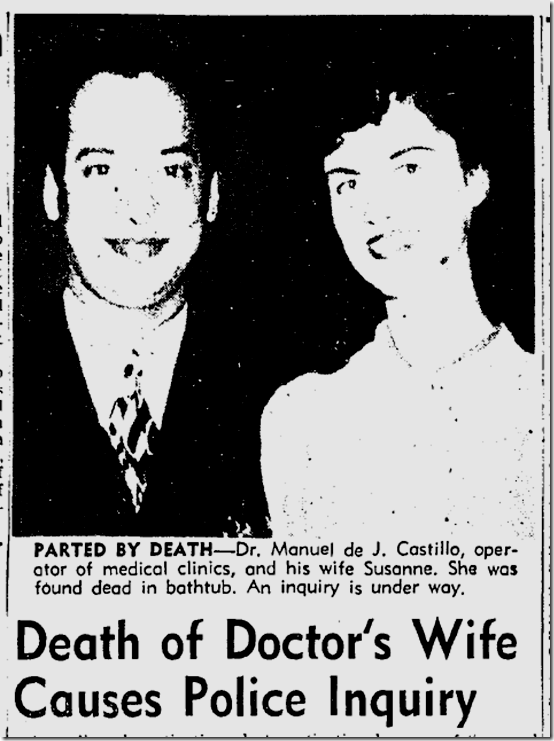
Here’s a perfect illustration of the difference between The Times and the Examiner, which has a completely different version of Antonio Mondragon’s actions on the night of the murder:
According to the Examiner, Mondragon told detectives he was awakened after midnight and served with divorce papers. He and his wife, Rosenda, who was drunk, argued until she left at 2:30 a.m.

Here’s the footprint of the demolished California State Building, as seen from space in 2011 via Google Earth.
Our crime buddy Nathan Marsak also took a tour of the remains, posted on SkyscraperPage.com.

Here’s a shot of the bank of elevators in the California State Building. Edward G. Robinson gets out of an elevator…

July 10, 1947: Earl Griffin, the Sentinel’s Hollywood Spotlight columnist, writes of a press premiere of “Black Narcissus” at the Carthay Circle Theater and notes that “the Negro press has been conspicuous by their absence (not being invited).”
Griffin salutes Bette Davis for opposing racism in an article published in The Californian magazine. He also recommends Mark Hellinger’s “Brute Force.”

Note: This is an encore post from 2006.
July 10, 1907
Los Angeles
Among the features of an educational conference being held in Los Angeles is a group of Native American students brought by Francis E. Leupp, the commissioner of Indian Affairs.
A Times editorial praised Leupp, saying: “He appears to be guided by great common sense and good judgment while actuated by a sincere affection and regard for the noblest savage race that ever inhabited the Earth.”

If you are cursed with the memory of having seen “Gangster Squad,” you may recall this ridiculous shot of Spring Street from City Hall. In last week’s mystery movie, “Illegal” (1955) we have the actual location, now occupied by Grand Park.

At the left, we have the California State Building, the Hall of Records and the Hall of Justice.

“The Sins of Hollywood,” via Archive.org.
Note: This is an encore post from 2015.
From its very beginnings, the motion picture industry has endured protests and censorship attacks from conservative members of the American public, those scandalized at seeing women given the right to be heroines, use of spirits or drugs depicted on screen, accurate depictions of romantic or sexual relationships, and dramatic depictions of violence. At the same time, many of the same people complaining about these visceral images on screen were eagerly partaking of scandal sheets and tabloid newspapers filled with muck, sensationalism, and gossip. These hypocritical individuals failed to realize that one form of entertainment was just as bad as the other, but they allowed journalism to partake of First Amendment rights, but not the entertainment industry.
As early as 1905 to 1907, many persons began calling for censorship of moving pictures, and by 1909, many cities and states possessed censor boards which approved or disapproved films for public exhibition. Though they would censor film product for its licentiousness, these same public officials felt no need to alter or disapprove of scandalous printed forms of entertainment. Conservative voices increasingly voiced their opposition to film depictions whenever scandal erupted in the motion picture industry.
Mary Mallory’s “Hollywoodland: Tales Lost and Found” is available for the Kindle.

This week’s mystery movie has been the 1939 RKO picture “Fixer Dugan,” with Lee Tracy, Virginia Weidler, Peggy Shannon, Bradley Page, William Edmunds, Edward Gargan, Jack Arnold, Rita LaRoy, Irene Franklin, John Dilson and Edythe Elliott. Photography was by J. Roy Hunt, art direction by Van Nest Polglase, special effects by Vernon L. Walker. Screenplay by Bert Granet and Paul Yawitz, adapted from the play “What’s a Fixer For?” by H.C. Potter. Produced by Cliff Reid and directed by Lew Landers.
“Fixer Dugan” is available on DVD from Warner Archive with three other RKO pictures: “Criminal Lawyer,” “Behind the Headlines” and “Crashing Hollywood.”

Note: This is an encore post from 2006.
July 9, 1907
Los Angeles
Grace Methodist Episcopal Church on Hewitt Street was barren; the pastor had gone away and the congregation had moved on. And so the City Council, in struggling to house inmates at the crowded, filthy prison on West 4th Street, decided to lease the old church for $100 ($2,052.36 USD 2005) a month as a temporary jail until a larger facility could be built “more nearly adequate for a city of the size of Los Angeles,” The Times said.
In discussing the move, Councilman Wallace berated his fellow lawmakers for neglecting the jail and said the council members were far worse criminals for their neglect than anyone housed in the crumbling structure.

“Hey, Johnny, what are you rebelling against?”
“What’ve you got?”