

If you’re watching “I Am the Night” on TNT, you may be tempted to read the Wikipedia entry on “evil” Dr. George Hodel.
Here are a few warnings:
If you’re watching “I Am the Night” on TNT, you may be tempted to read the Wikipedia entry on “evil” Dr. George Hodel.
Here are a few warnings:

Photo: Barbara Stanwyck in “Lady of Burlesque.”
This is an encore post from 2012. See note below for correction.
While being tops in your field can be exciting, an ambitious or intellectually curious person always looks for new ways to grow. This was particularly true for stripper Gypsy Rose Lee. A national star for years for her creative striptease act, Lee hoped to spread her wings into more respectable and challenging fields.
Born January 9, 1911, in Seattle to parents John Olaf and Rose Hovick, Ellen June Hovick saw her name changed to Rose Louise when her younger sister Ellen June was born. After her parents divorced, mama Rose and the girls took to the vaudeville stage. June was the star of the family, supported by her older sister, until Louise ran away and got married at the age of 15. Louise gained her first success when a shoulder strap broke on a dress as she performed on stage, and the crowd went wild. She quickly became a headliner, engaging in witty, classy, and creative strip teases, with the act as much about teasing, imagination, and the possibility of more. Louise changed her name to Gypsy Rose Lee, and began starring in shows at Minsky’s and other burlesque houses.
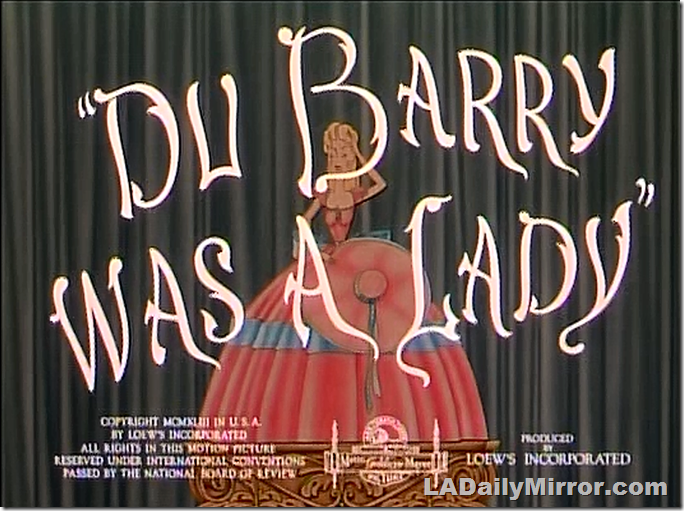
This week’s mystery movie was the 1943 MGM film “Du Barry Was a Lady,” with Red Skelton, Lucille Ball, Gene Kelly, Virginia O’Brien, “Rags” Ragland, Zero Mostel, Tommy Dorsey and His Orchestra, Donald Meek, Douglass Dumbrille, George Givot and Louise Beavers. Produced by Arthur Freed. Directed by Roy Del Ruth.
Screenplay by Irving Brecher, adaptation by Nancy Hamilton, additional dialogue by Wilkie Mahoney, based on the play produced by B.G. DeSylva and written by Herbert Fields and B.G. DeSylva with music and lyrics by Cole Porter, words and music by Cole Porter, additional songs by Lew Brown, Ralph Freed, Burton Lane, Roger Edens, E.Y. Harburg, musical adaptation by Roger Edens, musical direction by Georgie Stoll, orchestration by George Bassman, Leo Arnaud, Alec Stordahl and Sy Oliver, musical presentation by Merrill Pye, dance direction by Charles Walters. Photographed in Technicolor, director of photography Karl Freund, Technicolor color director Natalie Kalmus, associate Henri Jaffa, recording director Douglas Shearer, art director Cedric Gibbons, set decorations by Edwin B. Willis, associate Henry Grace, costume supervision by Irene, associate Shoup, men’s costumes by Gile Steele, makeup by Jack Dawn, special effects by Warren Newcombe, film editor Blanche Sewell,
“Du Barry Was a Lady” is available on DVD from Amazon.
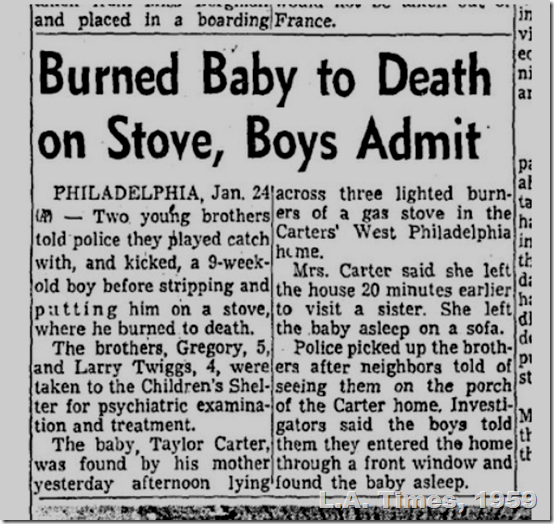
Jan. 25, 1959: Do remind me that the past was “a kinder, simpler time.” I think not. Absolutely horrific..
The entire post originally appeared on latimes.com and is available via Archive.org.
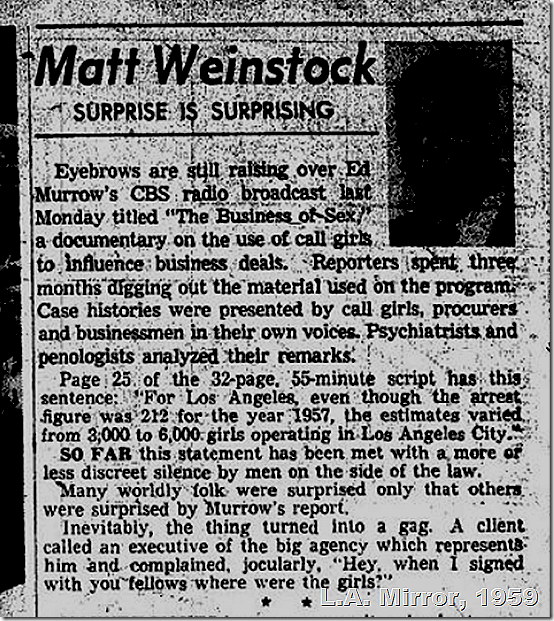
Jan. 24, 1959: Matt Weinstock has an item on an Edward R. Murrow broadcast “The Business of Sex.” Murrow said that “For Los Angeles, even though the arrest figure was 212 for the year 1957, the estimates varied from 3,000 to 6,000 operating in Los Angeles City.”.
Also poetry, gags, funny stories and the usual bullet items.
Weinstock’s column originally appeared in the L.A. Mirror in 1959 and was republished on latimes.com in 2009. It is available via Archive.org.

Jan. 24, 1959: One of the best parts of doing the blog at latimes.com was having UCLA and Cal State Northridge interns who, among other tasks, transcribed the Paul Coates and Matt Weinstock columns. Sometimes I transcribed them myself (this in addition to my full-time job at The Times). Still other times, I just ran a scan of the columns in the belief that the news value outweighed the funky presentation.
And in this case, it is. Coates has a followup on the shooting of Carl ‘Alfalfa’ Switzer, who was killed in a fight over a $50 reward for a lost dog. The dispute was between Switzer’s parents, who wanted to claim the body, and Switzer’s ex-wife, Dian, who had the rights to Switzer’s body under California law.
This column originally appeared in the L.A. Mirror in 1959 and was republished on latimes.com in 2009. It is available via Archive.org.
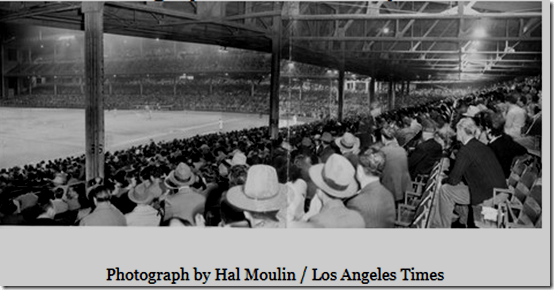
Keith Thursby says: John Hall wrote a couple of columns bidding farewell to Los Angeles’ Wrigley Field.
“It was another time, another place. It was Wrigley Field, 1925-1969, may it rest in peace. The demolition crews are at work and the creaky old place at 42nd and Avalon will soon be nothing but a vacant lot, ” Hall wrote..
The post originally appeared on latimes.com in 2009 and is available via Archive.org.
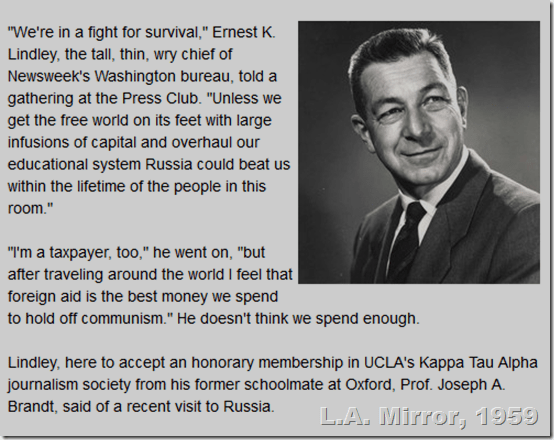
Jan. 23, 1959: Matt Weinstock covers a speech by Newsweek Washington Bureau Chief Ernest K. Lindley. “Foreign aid is the best money we spend to hold off communism,” Lindley said.
The best way to get from Westwood to Burbank by bus? “Buy a car.”
Also: Toe-walking may mean schizophrenia and by Paul Popenoe “Why Does Married Male Enjoy Burlesque Show?” Popenoe was active in the Human Betterment Foundation, a eugenicist organization in Pasadena that inspired the Nazis. No, really. That was a thing.
Weinstock’s column originally appeared in the L.A. Mirror in 1959 and was reposted on latimes.com in 2009. It is available via Archive.org.
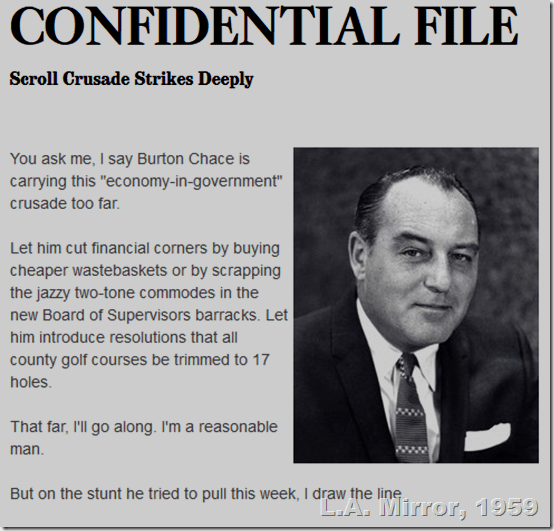
Jan. 23, 1959: Paul Coates is all (or mostly) in favor of ceremonial honors. On the jump, Bobbie Long is found strangled with a nylon stocking a few feet off a dirt road that runs off Don Julian Road between Seventh and Eighth Avenues southwest of the City of Industry. The Mirror News notes the similarity to the killing of Geneva Ellroy in June 1959.
Coates’ column appeared in the L.A. Mirror in 1959 and was republished on latimes.com in 2009. It is available via Archive.org.
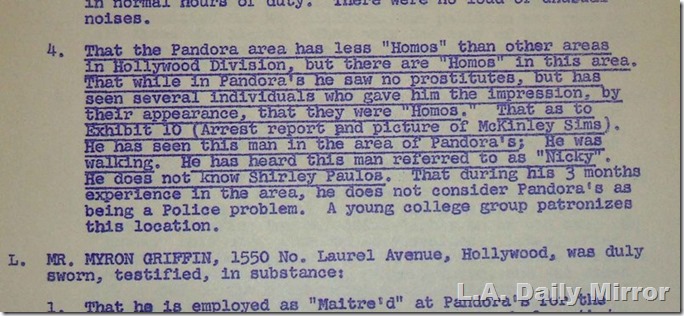
This was a fun post on Pandora’s (later Pandora’s Box), 8118 Sunset Blvd., that I completely forgot. The material is in the agenda packets of the Police Commission.
The club was under the jurisdiction of the LAPD’s Hollywood Division Vice Squad and reflects the mind-set of 1959. Sample: “The Pandora area has less ‘homos’ than other areas in the Hollywood Division, but there are ‘homos’ in this area.
For further digging, the entire file is at the Los Angeles City Archives. On the jump, the arrest of a sex worker identified as Shirley Paulos/Shirley Richards. I didn’t get into the later history of the club because so many stories and only one Larry Harnisch.
The post originally appeared on latimes.com in 2009 and is available via Archive.org.
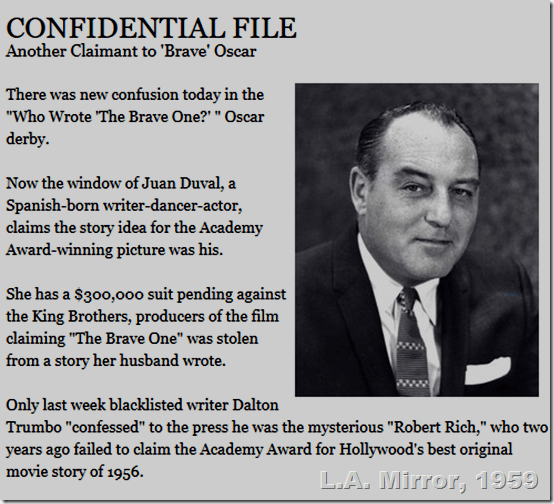
Jan. 22, 1959: Dalton Trumo (blacklisted and using the name Robert Rich) wrote the script for “The Brave One,” but there was a claim by the widow of Juan Duval. The previous entry is here.
Coates’ column was published in 1959 in the L.A. Mirror and reposted in 2009 on latimes.com. It is available via Archive.org.

The FBI file perpetuates the error that Elizabeth Short’s middle name was “Ann.” She had no middle name.
Note: This item was originally posted on lmharnisch.com in 2005.
Here’s a quick guide to the most frequent errors made in writing about the murder of Elizabeth Short:
Myth: Her name was Elizabeth Ann Short.
Fact: Her mother testified at the inquest that she had no middle name.
Origin: A Los Angeles Times story in the 1970s erroneously added a middle name, which now appears in seemingly reputable sources on Los Angeles history. To add the semblance of authenticity, the middle name has even made its way into her FBI file. Whenever you hear someone call her Elizabeth Ann (like “Black Dahlia Avenger”) you can be sure they don’t know what they are talking about. A headline with the same story erroneously said there were hundreds of confessors. As the story says, there were hundreds of suspects.
Myth: The newspapers nicknamed the case.
Fact: Elizabeth Short got the “Black Dahlia” nickname in a Long Beach drugstore. The Los Angeles Herald-Express tried to nickname the case the “Werewolf Murder,” but dropped it after several days.
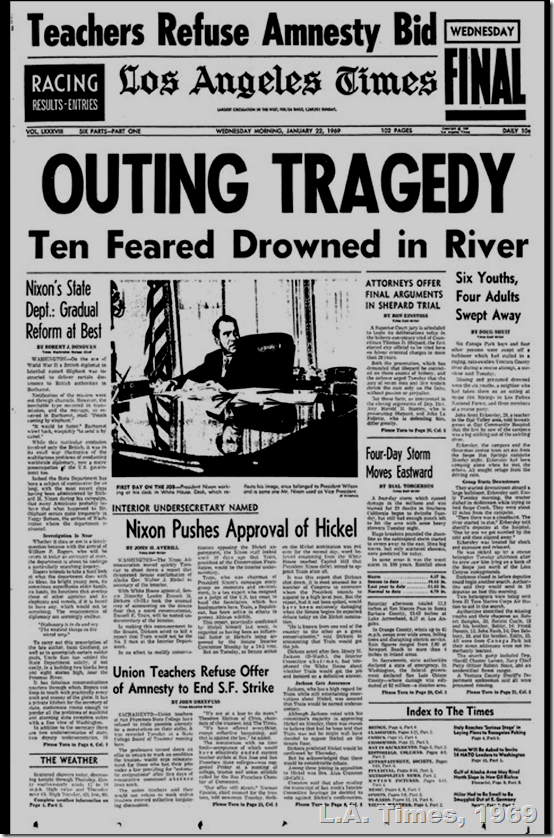
Keith Thursby has the story of baseball player Lee Meyers, who was was making a comeback, hoping to get a job with the first-year Kansas City Royals. Meyers was married to Mamie Van Doren (1966-1969)..
Note: This post originally appeared on latimes.com in 2009 and is available via Archive.org.
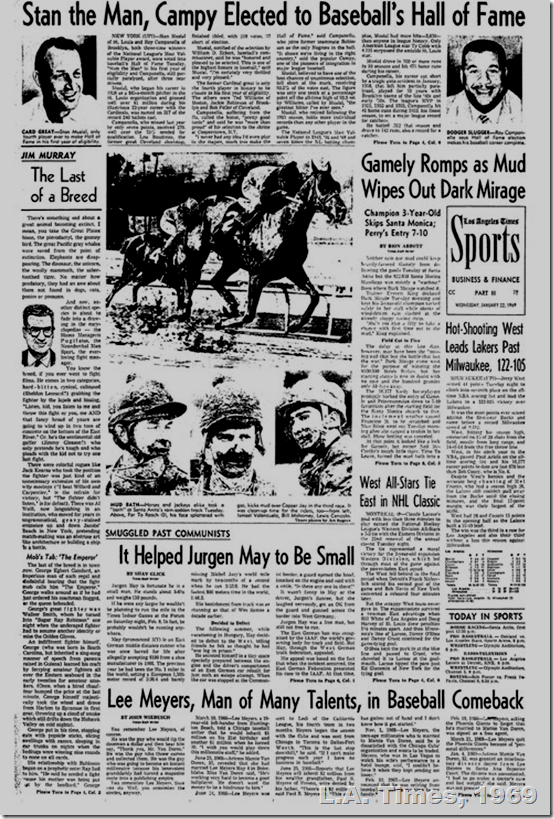
Jan. 22, 1969: Stan Musial and Roy Campanella are voted into baseball’s Hall of Fame. Campanella became only the second black player in the Hall of Fame, after Jackie Robinson.
This post originally appeared on latimes.com in 2009 and is available via Archive.org.
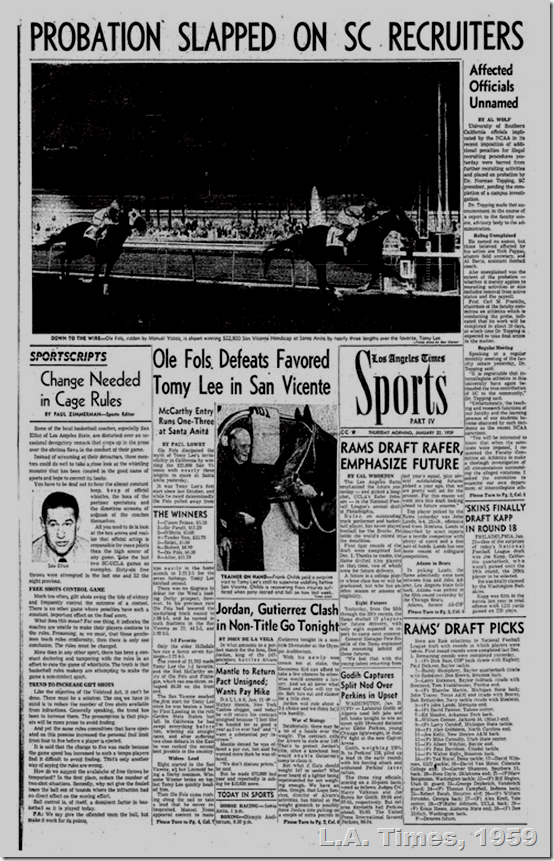
Keith Thursby writes: The Rams picked a real winner in the NFL annual draft.
Rafer Johnson would become world famous in 1960 by winning the gold medal in the decathlon at the Rome Olympics. He already held the world record in the event and when not competing in track was playing basketball at UCLA.
This post originally appeared on latimes.com in 2009 and is available via Archive.org.

Jan. 22, 1959: Carl ‘Alfalfa’ Switzer is shot to death in a fight with Moses Samuel Stiltz. According to police, Switzer borrowed a dog belonging to Stiltz, then lost the dog. Switzer paid $50 for the return of Stiltz’s dog. Switzer decided Stiltz owed him the money and a fight ensued. Somewhere there should be the line: “both had been drinking heavily” and here we have it: “Switzer had three beers and a Martini.” The shooting occurred at the home of Rita Jane Corrigan, former wife of Ray “Crash” Corrigan.
Keith Thursby writes: I finally found a Times story in which the paper talked about people living in the Chavez Ravine area. Cordell Hicks’ short story told of some local kids who tried to find a place in their neighborhood to play baseball.
Hicks wrote: “They were out in force yesterday with pick and shovel and a burro named Jenny Lind intent on clearing a portion of the site they hope will be a 40-acre youth recreation center promised by [Dodger owner Walter] O’Malley. ‘We can’t wait forever,” they said.”
Father Raymond Reha, director at Queen of Angels school, said the boys “have grown strong and quick climbing these hills and scrambling in and out of the arroyos. They could be the baseball players on tomorrow.”
Note: This post was published in 2009 on latimes.com and is available via Archive.org.
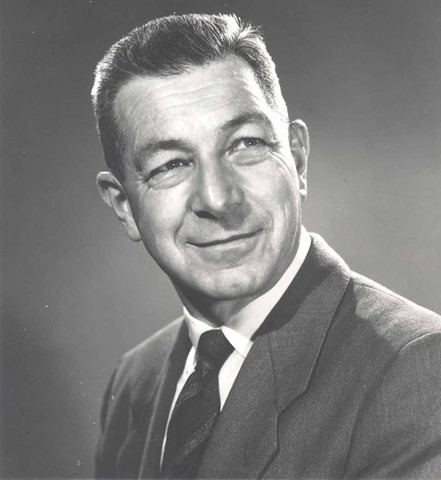 Now that Anastas Mikoyan has returned whence he came, a lady named Natasha Smith would like a few unkind words.
She was born and reared in Russia and barely escaped with her life during the revolution. She speaks and understands the language.
She watched TV interviews in which Mikoyan answered questions through an interpreter. She knew what he and the interpreter said. She found Mikoyan very sharp and admired his sense of humor.
She is certain, however, that Mikoyan understands some English and used the time taken to translate to figure out his answers, usually evasive or retaliatory.
The reason she is sure of this is that she caught him a couple of times answering questions before they had been fully asked.
Jan. 21, 1959: Matt Weinstock has a roundup of light items, including the visit of Soviet leader Anastas Mikoyan, some poetry, pranks and funny stories. A perfect way to end the day.
Weinstock’s column was published in 1959 in the L.A. Mirror and reposted on latimes.com in 2009. It is available via Archive.org.

Jan. 21, 1959: Paul Coates takes a look at the way pornography (and pretty light stuff at that) was peddled in the 1950s, when it was illegal to send such things through the mail.
Coates’ column was originally published in the L.A. Mirror in 1959 and reposted on latimes.com in 2009. It is available via Archive.org.
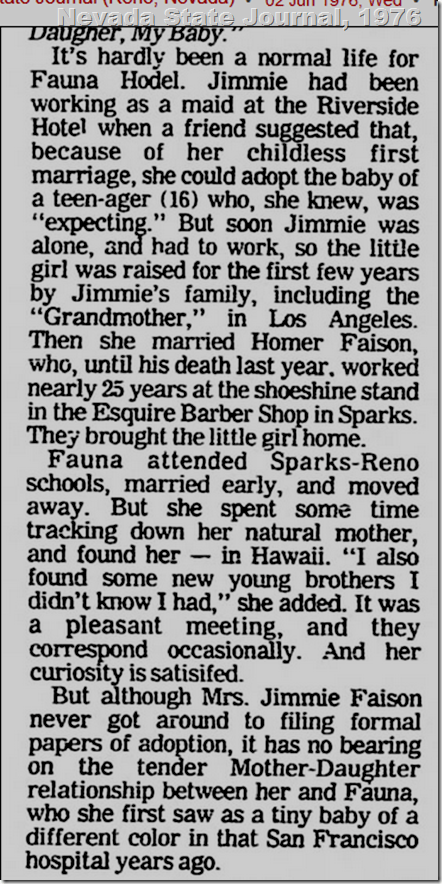
Before TNT airs “I Am the Night,” (“inspired by a true story,”) I’m digging for references to Fauna Hodel, George Hodel and the Black Dahlia. So far, it’s not going well..
On June 2, 1976, the Nevada State Journal published a story about Fauna that says she tracked down “her natural mother and found her — in Hawaii. ‘I also found some new brothers I didn’t know I had,’ she added. It was a pleasant meeting and they correspond occasionally. And her curiosity is satisfied.”
In a later story, Fauna would describe Tamar Hodel as “the hippie of the year.”
What she apparently did not find is anything about her grandfather George Hodel or the Black Dahlia. And Fauna’s unfinished 1990 biopic also didn’t mention the Black Dahlia or George Hodel.
Maybe we should call “I Am the Night” “inspired by a new story.”

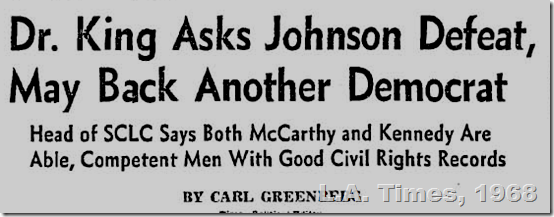
March 17-18, 1968: The Rev. Martin Luther King Jr. calls for the end of the Vietnam war in appearances at the Disneyland Hotel and Second Baptist Church in Los Angeles.
This post originally appeared on latimes.com in 2008 and is available via Archive.org.
 ladailymirror.com


