Kill crazy


1957_0614_hed


1957_0614_dodd

1957_0614_joyce_barlow

June 14, 1957
Los Angeles

Charles Hilbert Dodd was eager to kill someone. If he couldn’t find his
estranged wife, Dolores, then he’d shoot whomever he could get.

Armed with a 16-gauge shotgun, Dodd, 47, of 6415 Balcom Ave., Reseda, showed up at the home of a casual acquaintance, Charles A. Barlow, 35, 13005 Chandler Blvd.   "You’ve got to make a telephone  call … got to help me find my wife," Dodd said.

When Barlow told Dodd that he couldn’t come in the house until he put
down his shotgun, Dodd fired, hitting Barlow in the hand, then
barged into the living room and fired twice more, shooting Barlow in
both legs.

Dodd waved the shotgun and told Barlow and his wife, Joyce, 23, "drive
me somewhere and be quick about it." Dodd pushed the couple outside,
but let Joyce go back into the house to get the car keys. As Dodd
forced Barlow to walk to the corner where Dodd’s car was parked, Joyce
called the police. [Note: I know none of this makes sense, but the man was out of his mind–lrh]

In the meantime, Barlow got a cane out of Dodd’s car and began hitting
him with it. Joyce Barlow returned and began wrestling with Dodd over
the shotgun, but he pushed her away and shot her husband in the
abdomen.

Then he shot himself in the head.

Joyce, a recent immigrant from England, told police that although they
didn’t know the Dodds well, Dolores Dodd had briefly been to their home
shortly before Dodd arrived. Police said Charles Dodd had been charged
with domestic abuse and on June 4 was sentenced to a year’s probation.

What became of Joyce Barlow and Dolores Dodd? No further information is available.

Email me

Posted in Homicide, LAPD, San Fernando Valley, Suicide | Tagged , , , , | Comments Off on Kill crazy

You Have Got to Be Kidding Me

June 13, 1957


1957_0613_argus

Posted in Uncategorized | Tagged , | Comments Off on You Have Got to Be Kidding Me

Traffic forecast

They said it:

City Councilman Edward R. Roybal: Chavez Ravine is "the worst possible
place for a major league park." Roybal said he favored Wrigley Field or
a location in East L.A., predicting that putting a baseball stadium in
Chavez Ravine would lead to terrible traffic.

Posted in Dodgers, Downtown | Tagged , , , , , | 1 Comment

Visions of tomorrow

1957_0613_desalt

June 13, 1957
Los Angeles

There was a time when IBM’s standard office equipment included signs that said "THINK." Although  William B. Thompson was an economist with Prudential Insurance, rather than IBM, he was certainly thinking about the future. He couldn’t have been more wrong, but at least he was thinking.

Thompson predicted that by 1990, California would be desalinating sea water using electricity generated by atomic power ("as plentiful as the water," the Mirror said).

In fact, the reclaimed water would be so plentiful that the "Colorado River Aqueduct may eventually have the function of delivering converted sea water inland, rather than carrying water to the coast," Thompson said.

The initial price, 12 cents per 1,000 gallons, would be too costly for farmers, but affordable for cities, Thompson said.

And with the assuredness of true visionary, Thompson said: "At the very least, we can expect the freeing of water from the Owens and Colorado rivers for agricultural purposes."

Email me

Posted in Science | Tagged , , , , , , , | Comments Off on Visions of tomorrow

Paul V. Coates–Confidential File

Paul_coates
June 12, 1957

"Marijuana," you don’t say out loud.

You whisper it.

Because, in the last few years, it has become a hysterical word.

And the hysteria has reached a point, today, whereby guilt can be decided by association.

But the danger of any tight control is that it can envelop innocent people.

People like Al Hoffman, a licensed radio engineer whose story was brought to my attention yesterday.

On April 24 of this year, Hoffman’s car was taken by an actress friend.
And while he was sleeping, she was arrested with a friend of hers on
charges of violating the State Health and Safety Code.

They were several miles from Al’s house when picked up, but they were
in Al’s car. Police say that the actress’ friend was smoking marijuana.
Both the actress and her friend were booked.

It happened at 5 a.m., and by 6 detectives were at Al’s home.

They woke him up, he says, and searched his place. Then they took him to the station for questioning.

Here’s what has happened to Al Hoffman since then:

1957_0612_ad
His car, a 1953 Lincoln, has been confiscated by the state of California. There’s a good chance that he won’t get it back.

He is no longer a Miami, Fla., special deputy constable. His
credentials were revoked, Al says, when police here contacted the Miami
constabulary and explained that he was "mixed up in a narcotics mess."

His automobile insurance was revoked. "I notified my insurance company
about what had happened and they immediately canceled my policy."

Al’s story sounded slightly incredible to me.

But I checked it out with the attorney general’s office and it adds up.

Section 11610 of the State Health and Safety Code states that if an
occupant of a vehicle, or the vehicle itself, possesses narcotics, the
vehicle will be seized and turned over to the Bureau of Narcotics
Enforcement.

It will be kept by the bureau until forfeiture is declared or release ordered.

That the owner permitted his car to be borrowed in complete innocence makes no difference.

The state can legally steal his car.

Hoffman’s car was taken seven weeks ago. He has been trying, vainly, to get it back ever since.

Yesterday, I discussed the case with an agent of the attorney general’s office forfeiture section.

He said that a forfeiture complaint was being issued against Hoffman’s
car and that such complaints usually took between eight and 12 weeks.
"I think Hoffman’s forfeiture is being issued today," he said. "But
understand, it’s not against Hoffman. It’s against the car."

After the complaint has been issued, Hoffman has 20 days to interpose an answer. To say why his car shouldn’t be seized.

If he doesn’t, he loses his car. If he does, the case must be tried within 30 days.

But even then he stands a good chance of losing his vehicle to the state. He wouldn’t be the first person to do so.

He could appeal, of course. But by carrying his case up to the Supreme
Court, he’d soon find that legal expenses were running twice the value
of the car itself.

There’s a good possibility, I’ve been told, that such forfeiture is unconstitutional.

But so far, no public-spirited citizen has been willing to invest a
couple grand to find out if he could win back a thousand-dollar car.

Economically, it’s unsound.

The forfeiture law was effected because narcotics traffickers were moving around with frightening ease.

But it’s webbing innocent bystanders, and even car dealers–conditional sellers.

I asked a narcotic agent yesterday what effect it was having on the movement of the pushers themselves.

He shrugged. "Now they drive $50 clunks. Cars they can afford to lose."

Posted in Columnists, Paul Coates | Tagged , , , | Comments Off on Paul V. Coates–Confidential File

Hollywood’s peeping Toms

June 12, 1957
Los Angeles

1957_0612_peepers

Posted in Hollywood, Hollywood Division, LAPD | Tagged , , , | Comments Off on Hollywood’s peeping Toms

Frank Gehry, please note


1957_0612_downtown_hed

Downtown Los Angeles: Huge, efficient and beautiful with 52-story skyscrapers and subways, the hub of a developed area stretching from the Mexican border to Pismo Beach.

Part 1

1957_0612_downtowna

Part 2

1957_0612_downtownb

Email me

Posted in Downtown | Tagged , , , , , | Comments Off on Frank Gehry, please note

Sex slaying suspect


June 12, 1957
Los Angeles

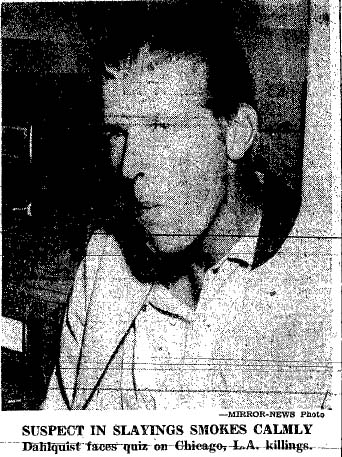
An illegal U-turn at Sunset Boulevard and Virgil Avenue at 1 a.m. led to the arrest of Charles Lawrence Dahlquist, a 6-foot-5, 211-pound fugitive from Chicago wanted for questioning in the sex slayings of three boys in 1955.

In searching the car, Officers Mel Tousseau and A.J. Sauro found a stolen license plate. Under questioning, Dahlquist, who had been working as a golf caddy, admitted stealing the car in Hollywood four months earlier.

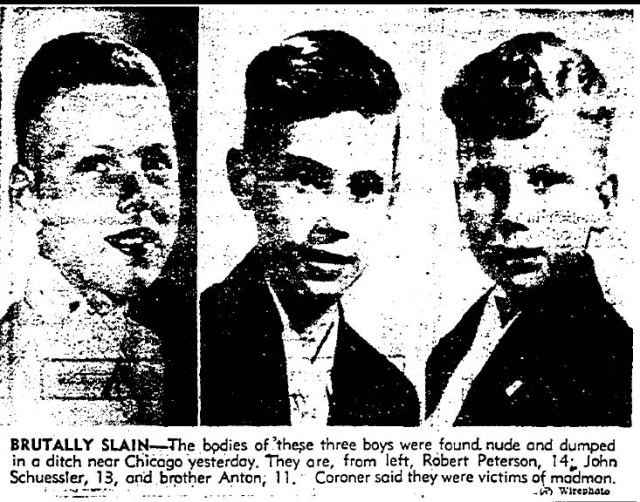
Dahlquist, of 1735 W. 6th St., fled Chicago while free on $4,000 bail in a case involving the molestation of a 15-year-old boy. While a fugitive, he was indicted in that molestation case and became a suspect in the sex slayings of John Schuessler, 13,  his brother Anton Jr., 11, and their friend Robert Peterson, 14. Anton
Schessler Sr. died of a heart attack less than a month after the killing.

According to Chicago investigators, police chemists identified material under the slain boys’ fingernails as peat moss and fertilizer as is used on golf courses. The Cook County Sheriff’s Department said that the boys’ bodies “were thrown like bags of potatoes” into a ditch, which “would suggest that at least
two persons or one very powerful person did it,” according to the Mirror.

The Times never followed up on the Dahlquist story. However, in 1995 a former stable hand named Kenneth Hansen was convicted in the killings. Hansen was retried and convicted again in
2002. His case is under appeal.

Retired Chicago Detective James A. Jack wrote a book about the case titled: “Three Boys Missing.” Elmer H. Johnson and Carol Holmes Johnson have also written a book on the case: “Shattered Sense of Innocence.” Gene O’Shea, meanwhile, has written “Unbridled Rage” on the case.

Important warning: I have not read any of these books and list them merely for informational purposes. Given my experiences on the Black Dahlia case, I am highly suspicious of anything purporting to be a “true” crime book. Such works are often highly fictionalized, full of mistakes and usually not worth the paper they are printed on.

Email me

Posted in #courts, Hollywood, Homicide, LAPD | Tagged , , , , , | Comments Off on Sex slaying suspect

1957 Chevy

1957_nomad_crop

In February 1957, after adding 300,000 square feet, the General Motors' Van Nuys plant (note: it's really in Panorama City) began making station wagons and convertibles.  A spokesman says the plant is producing 150 cars a day in five different models and shipping them to dealers in eight Western state.

A Bel Air Nomad for sale on EBay provides a nice example of how to decode the 1957 Chevrolet VIN tag, which was welded to the driver's door pillar post. (You always wanted to do this, right?)

In this case, the car's VIN is VC57J211710.

So we have: VC, which means the car was originally a 2400 model with a V-8 engine.

57 is the year the car was made.

J indicates where the car was assembled, in this case, Janesville, Wis.

211710 is the car's serial number. 

Chevrolets made in Los Angeles were indicated by an L. In other words, if the car had been made in Los Angeles it the tag would read: VC57L

Thanks to Danchuck Manufacturing for the information.


1957_0612_chevy


Email me

Photograph courtesy of Sakowski Motors

Posted in 1957, Freeways, Rock 'n' Roll, San Fernando Valley, Transportation | Tagged , , , , , | Comments Off on 1957 Chevy

Random shot

Figueroa Street, Highland Park

Highland_park

Photograph by Larry Harnisch Los Angeles Times

Posted in Uncategorized | Tagged , | 1 Comment

Paul V. Coates–Confidential File

Paul_coates

June 11, 1957

Our national concern for the plight of soldier William Girard has, from the start, struck me as oddly misplaced.

As
well as I can understand it, we’re upset because the United States has
failed to stand behind the young soldier. And has, instead, given a
foreign country permission to decide his fate.

Suddenly, it’s a matter of monumental importance.

And absurdity.

Because if soldier Girard’s personal well-being were the issue, common sense would tell us to stop worrying right now.

And be thankful that Japan, rather than the United States Army, is going to handle the case.

Now
that the soldier’s killing of a Japanese housewife has achieved global
notoriety, whoever gets the case will be forced into a backbreaking
lean toward justice.

If Japan tries him, that country will be in
the delicate position of having to prove to us, and the world, that its
justice is pure and impartial.

It’s an interesting fact that
since the U.S.-Japan treaty permitting the latter country to try our
soldiers went into effect, American servicemen have committed more than
14,000 infractions of Japanese law.

And that all but about 400 of them were turned over to the U.S. military for trial.

Of
even greater interest, however, is the fact that there are, at present,
some 40 U.S. servicemen in Japanese prisons, convicted by Japanese
courts.

They are there for crimes as serious as murder and rape.

But the most severe sentence yet passed on any of them was eight years’ imprisonment.

It’s fairly obvious that Japan has made a conscious effort to prove to us that its justice is tempered with mercy.

1957_0611_girardBut what would happen if Girard were suddenly thrown back to us–and his fate became our responsibility.

The whole big mocking world would be watching us.

Especially Asia.

And it would be our obligation to prove that we play no favorites, either.

The tendency, I fear, would be to throw the book at Girard.

And he would end up as a martyred pawn for our desperate effort for friendly foreign relations.

It’s
my personal feeling that American soldiers, when told to serve on
foreign soil, should be disciplined by our own government.

But we made a treaty with Japan, granting that country certain judicial rights.

And
a review of American history shows that when we sign a piece of paper,
we do so with the intention of living up to our signature.

Japan’s national bitterness in the Girard case, coupled with the recent trouble in Formosa, is worth a pause for thought.

Can we, who try so hard to be liked, be botching matters up so badly in Asia?

I asked the question of Dr. Bob Pierce, president of World Vision Inc., this week.

Pierce,
a frequent Far East visitor and the man directly responsible for the
establishment of a permanent aid program for 8,600 Korean orphans,
denied that we were.

"It might be more accurate," he said, "to call us victims of the rise of nationalism now sweeping Asiatic countries.

"In Japan, for example, the people can once again see possibilities for national achievement."

"Are we," I asked, "standing in their way?"

Pierce nodded uncertainly. "In a way. They still remember us as conquerors, and as such, we’re a hindrance.

"They want to be leaders in their part of the world, but they figure the first necessary step is to impress us.

"Exaggerated incidents like the Girard case are expressions of the cumulative frustrations of the people"

I asked Pierce for his opinion on the treaty which will let Japan try Girard.

"Missionaries," he answered, "must be prepared to accept the consequences of foreign laws.

"But with soldiers, it’s not the same. They’re not necessarily there because they asked to be."

Posted in #courts, Columnists, Paul Coates | Tagged , , , , | Comments Off on Paul V. Coates–Confidential File

Strangler attacks


1957_0611_hed

1957_0611_hipperson
June 11, 1957
Los Angeles

We’re parked outside a two-story apartment house at 3737 Los Feliz Blvd.
It’s late, after 1 a.m. I’ll warn you before we go in: I hate this
case. I can’t say I like any of them, but this one I hate. It’s pitiful
and tragic and I wouldn’t blame you if you wanted to go for a cup of
coffee instead.

You sure? OK, come on then. That’s her sedan parked at the curb.

This whole area is a hot spot for peeping Toms: It’s all apartment
houses with bedrooms at the back facing dark alleys. About half a dozen
women live here and they all say they have seen men at their windows
and that someone has been rattling their doorknobs in the middle of the
night. The landlady filed a report not long ago that somebody was
stealing underwear off the clothesline and about a year ago, a woman in
Apartment 6, next to the murder scene, said some prowler slid a note
under her door:

"If you are lonely and want some company, why don’t we get
acquainted. I am not trying to scare you. I think you and I could have
a good time together.


"I’m young and so are you, so let’s not waste our time. A friend, I hope."

Another neighbor says a man broke in and choked her last September, but that he ran away when she started screaming.

I figure the guy may have been watching our victim and knew she was
living alone. Until a few days ago, she had a roommate–another
nurse–but the woman moved out because the victim was getting married
to a doctor. She had just come home from a wedding shower when she was
killed.

I told you it was nasty.

Notice the front door is locked and chained. She was careful. Not quite
careful enough, maybe, but pretty careful. The roommate, Margot
Wright,  says that about six months ago, a young man barged into the
apartment while she was lying on the bed. Wright told police that she
grabbed her purse off the nightstand and the man laughed and ran.

Our victim is named Marjorie Lucille Hipperson, 24, and she’s a nurse
at Hollywood Presbyterian Hospital. A few hours ago, the staff gave a
wedding shower for her and her fiance, Dr. Walter Deike, who’s an
intern so he spends a couple nights a week at the hospital. In fact, he
got called away from the party, so Marjorie wrote him a note before she
left:

"Dear Walter: I hope you don’t have too tough a night. Get a lot of sleep.

I love you.

Marjorie."

Let’s go around the back. Here’s where he got in: She left the kitchen
window unlocked. Police will find the screen over in the garage of a
neighbor who lives at 3745 Los Feliz. Let’s go in. Don’t touch anything. They’re going to find prints all over the place. Notice the apartment hasn’t been trashed as it would be if there was a burglary. 

She was a tidy one. Here’s the sweater she wore to the party, washed
and stretched out to dry on the drainboard. The rest of that outfit is
hanging in the closet. OK, here’s the living room. You can see she’s
laid out her clothes for the wedding trip to Chicago and is getting
ready to move. The rent runs out in a couple of days and the telephone
has already been disconnected.

You sure you don’t want to turn around? OK, let’s go in the bedroom.

Well, that’s her, poor thing. You can see her arms and legs are
bruised from fighting with him. Her hands might have been bound at some
point, but they’re not tied now. White nightgown bunched up around her
neck, left arm doubled up behind her back and her right arm stretched
out. She’s been strangled with a nylon and gagged with a blue washcloth
held in place with another nylon, just like the Ruth Goldsmith case, remember? Yeah, she was raped. He apparently didn’t steal anything. There’s loose money on the bureau and in the drawers.

Nope, nobody heard a sound.

We better get going. In a little while, Dr. Deike is going to start wondering why she hasn’t shown up for work. Remember, the phone is disconnected. He’s going to come over. He’ll see her car at the curb and know she’s home. When she doesn’t answer the door, he’ll come around back and crawl in the kitchen window.

And then he’ll find her here.

Walter will remarry–eventually. A woman named Joan. But five years later, he’ll be gone too. He’s going to go out swimming in Mendocino Bay and drown.

I told you, I hate this case.


1957_0611_hipperson_funeral

Let’s drop by Mountain View Cemetery in Altadena on our way back and pay our respects.

To be continued….

Email me

Posted in Hollywood, Hollywood Division, Homicide, LAPD | Tagged , , , , | 1 Comment

Suicide on Crenshaw


1957_0610_deport

1957_0610_norris June 10, 1957
Los Angeles

Elsa Klumbis O’Neil saw no hope. The 37-year-old woman wanted a divorce
from her husband, Mark, who was due back in a few days from a voyage with the
merchant marine. But since she wasn’t a U.S. citizen, she
was afraid of being deported to Lithuania.

Officer T.R. Norris (at right in 1948, with a robbery suspect) arrived at O’Neil’s apartment, 1821 S. Crenshaw Blvd.,
after landlord Eugene Smith reported a disturbance. Norris had been
called to the apartment once before for the same reason and after
talking to O’Neil, he went out to the hallway to speak with Smith while
Smith’s wife kept an eye on O’Neil to keep her from killing herself.

Seeing her chance, O’Neil ran to the bathroom, locked the door and
jumped from the second-story window. She was pronounced dead at Georgia
Street Receiving Hospital.

Email me

Posted in LAPD, Suicide | Tagged , , , , | Comments Off on Suicide on Crenshaw

Literary diversions

Ray Bradbury, Jan. 19, 1958
1958_0119_bradbury

Posted in books | Tagged , | 1 Comment

John Fante file

March 5, 1980

Page 1
1980_fante_warga01

Page 2

1980_fante_warga02

Posted in books, Downtown | Tagged , , , | Comments Off on John Fante file

Detour to 1904


1904_0115_organ

1906_eben_smith
Saturday’s New York Times features

an article by Craig R. Whitney about the enormous pipe organ at Macy’s in Philadelphia, a massive instrument from the 1904 St. Louis
World’s Fair that was built in Los Angeles.

And indeed, the Los Angeles Times wrote about the achievement of the Los Angeles Art Organ Co. of East 7th Street, noting that once it
was installed it would be the world’s largest pipe organ.

"It is a church itself in size," The Times said, "as large as a
four-story dwelling house, 30 feet wide and 63 feet long. Climbing
about in it, one is almost lost in the maze of stairways, ladders,
pipes and bellows."

Some of the pipes were 50 feet long and weighed 1,500 pounds each, The Times said.

In a performance by Arthur Scott-Brook of Stanford,
the building was  "shaken to the foundations by the notes of this
organ." In a preview for ministers and reporters, "a goodly
representation was present during the afternoon and stood spellbound
while the heavy chords vibrated through the immense room, causing
little thrills to creep up and down the spines of the listeners."

In addition to a keyboard console, the organ was equipped with an
automatic player. "The rolls of paper are first stenciled and are then
cut by hand," The Times said. "One piece of music for this organ makes
a roll about two feet in diameter."

Unfortunately, the principal stockholder, Eben Smith, died in 1906 and
the massive organ and several other instruments built by the Los
Angeles Art Organ Co. were subject to bitter legal actions.  The Times
reported in 1907 that title to three expensive organs moldering in a
Los Angeles warehouse had passed to the Wirsching Organ Co. of Salem, Ore., noting that a patent infringement lawsuit had prevented delivery of the instruments to purchasers.

Information on the Wanamaker Organ is here.
Friends of the Wanamaker Organ is here.

Bonus fact: Eben Smith was a remarkable character who made a fortune in
mining, then invested heavily in wireless telegraphy, seeing it as the
dawn of a new era in communications.

Email me

Posted in Music | Tagged , , , , , | 1 Comment

Suicide note


1957_0609

June 9, 1957
Los Angeles

James R. Shepard decided it was better to kill himself than be
prosecuted for a crime so shameful that it could not be published in
The Times. A few hours after  the 32-year-old insurance investigator
was arrested in a bar at 850 N. La Brea Ave. in Hollywood, he shot
himself in the head.

Shepard was found on the floor of his apartment at 238 N. Cordova St.
in Burbank by Charles W. Barrickman, 8333 Spingford Drive, Sun Valley.
He had left a note insisting that he was in the bar as part of an
insurance investigation but couldn’t prove it. "I do not have the name
or money that Mr. Mickey Cohen had, so I cannot fight the Los Angeles
Police Department," he wrote.

What was Shepard’s offense? "A morals charge," The Times said. He was free on $500 bail pending a hearing in Municipal Court.

Given The Times’ silence on the details of the alleged crime and
Shepard’s suicide over being arrested, it’s easy to infer that he was
gay. Unfortunately, it’s impossible to locate the name of the bar at
that address or find any further information on him or his friend
Barrickman.

All we know is that whatever happened, his death was a tragedy. Rest in peace, James R. Shepard.

Email me

Posted in #courts, #gays and lesbians, Hollywood, LAPD, San Fernando Valley, Suicide | Tagged , , , | Comments Off on Suicide note

Paul V. Coates–Confidential File

Paul_coates
June 8, 1957

Maxwell Spencer knows more drunks, habitual and occasional, than most men know sober people.

But he is a man of strong constitution. So far, he hasn’t permitted his associations to drag him down the neck of a bottle.

And he has, through it all, maintained a level sense of humor. And justice.

By trade, Spencer is a public defender.

Not long ago, he spent a year in pursuit of his work at Lincoln
Heights, where he was entrusted with the fate of as many as 450 drunks
a day.

At present, he’s working in Division 32, Van Nuys, where, he reports
proudly, his wobble-kneed clientele has slimmed down to some 30 to 50 a
week.

"It’s an outstanding community," he admits, almost pompously.

It is general knowledge around the courts there that Spencer handles his now-limited clientele with dedication.

Even though most of his cases plead guilty, he works hard to earn a sympathetic ear from the judge.

1957_ad_something
And frequently he does.

As example, I cite his brilliant recent plea for a man whom he had the honor of defending more times than he can recollect.

Police records showed the man with some 88 drunk arrests and revealed
that he had completed a 90-day sentence only hours before he was back
in court with Spencer at his side again.

"In view of this man’s past record," Spencer spoke out ably, "I think he deserves a suspended sentence."

And the stunned judge, I’m told, concurred.

Then, a short time later, there came another frequent repeater.

Except, he didn’t exactly come.

He was too far under the weather to make it from the jail to the courtroom.

So, after conferring with his client in jail, Spencer stood alone against the court.

"My client wishes to enter a plea of guilty," he spoke in a brave voice, "but he is too ill to make an appearance.

"My client," Spencer’s voice was now shaky with emotion, "is a victim of toxic poisoning."

The understanding judge didn’t quite understand.

"Toxic poisoning?" he questioned.

"Spencer nodded. "A preliminary medical investigation shows that he has an overabundance of alcohol in his blood."

More sympathetic than ever, the judge gave the ailing man 10 days to recover.

But last week there came a case, and oratory by Spencer, which could
easily stand for years as the high point of his legal career.

The accused was a small, thin man of 50 hard winters. Hanging from his
shoulders was a piece of cloth which might once have been recognizable
as a shirt. His trousers bagged and the thin legs covered by them
knocked against each other uncertainly.

His hair was wispy and uncombed and a three-day stubble grew at random around his face.

"It was quite possible," Spencer related later, "that a strict judge
might have observed that my client wasn’t wearing a necktie.

"And permitted it to influence the harshness of his decision."

But the judge was Martin Katz, a magistrate noted for tempering justice with mercy.

And immediately he took a personal interest in the man’s plight.

"What," he asked, "is your occupation, sir?"

The man grabbed unsteadily for the railing. His stoplight eyes blinked open and shut.

Bewildered, he looked around the court and asked:

"Did that man up there say something to me?"

The judge started to speak again, but Public Defender Spencer broke in:

"I’m sorry, your honor, but my client is hard of hearing."

Then, pushing his mouth against the client’s ear, he shouted:

"What is your occupation?"

Beaming, the client shouted back:

"I pass bills sometimes."

Without hesitation, Spencer turned again to Judge Katz.

"My client," he said solemnly, "is a legislator."

Posted in #courts, Columnists, Paul Coates | Tagged , , | Comments Off on Paul V. Coates–Confidential File

John Fante file

Aug. 8, 1933
Logo_leeside

1933_0808_fante

The Los Angeles Examiner scooped The Times on John Fante. Read the story from Aug. 7, 1933. Thanks to Richard Schave.  

Posted in art and artists, books, Columnists, Downtown | Tagged , , , , | 2 Comments

Barbershop bombed


1957_0607_bomb_hed

1957_0607_bomb
June 8, 1957
Los Angeles

Someday a sociologist at USC (you know who you are) will make a study
of the fad of bombing Los Angeles barbershops, which began about 1952
and ended about 1971 with the advent of long hair.

The bombings occurred across Los Angeles in an apparent attempt to
force barbers to adopt union prices. W.H. Siebert, whose Compton
barbershop was destroyed in 1954 by a bombing, said:

"At one time three guys who said they were from the union visited me
and told me, ‘You’ll either get up to our prices or else.’  On another
occasion I was picketed for eight weeks. Then they used to park 20 cars
bumper to bumper in front of my place and that was stopped when the
area was rezoned to one-hour parking." Siebert charged 95 cents ($6.92
USD 2006) for a haircut instead of the union price of $1.50.

Union officials said they picketed Seibert’s shop in 1953,
but denied any knowledge of a bombing. "We do not countenance that sort
of action in any form," the union’s Frank LeCain said.

Richard A. Mills, whose Sherman Oaks shop was bombed in 1954, said he
originally tried to charge union scale, but that he couldn’t get
customers so he cut his price to $1. "They said I’d better get back up
to the $1.50 price," Mills said of the union. "They kept reminding me
of what happened to ‘that fellow up the street,’ " apparently referring
to a shop at 4824 Van Nuys Blvd., that was bombed in 1952.

In the June 1957 bombing, barbers Gene Franks and his father, Artie, were charging $1.25, a quarter less than the union price.

After an 11-year gap, the attacks resumed, with an unidentified bomber
setting his arm on fire as gasoline spilled from the Molotov cocktail
he threw into a barbershop at 10855 Magnolia Blvd., in North Hollywood.

The last documented bombing occurred in Azusa at an address published
in The Times as 323 N. Seninoke Ave., which does not exist.

In the following years, the advent of long hair put many barbershops out of business and the bombings ceased.

Here’s a map.

Email me

Posted in San Fernando Valley | Tagged , , , , , | Comments Off on Barbershop bombed