
Aug. 13, 1957
Los Angeles
Swedish massages, photo models (they even provide the camera) and lots of lonely people. Take a look at the Daily Mirror’s personals (click on the image for the full listings):

Aug. 13, 1957
Los Angeles
Swedish massages, photo models (they even provide the camera) and lots of lonely people. Take a look at the Daily Mirror’s personals (click on the image for the full listings):

 Aug. 4-12, 1957
Mooresville, N.C.
A reporter and a photographer from a small
North Carolina weekly were hacking their way through the woods along the Catawba River for a story about a hydroelectric project when they
came to a clearing and saw her. In that moment, Dorothy Brown’s life was changed forever.
Writer Tom McKnight and photographer Fletcher Davis of the Mooresville Tribune
found the 16-year-old drawing water from a well outside her family’s two-room cabin.* She was barefoot, wearing a cotton shirt tied at the
waist and her father’s cutoff jeans.
“She is tall and lithe and willowy and very beautiful,” McKnight wrote. He called her a
“statuesque young girl carved from the classical pattern of a Greekgoddess…. Her hair is deep brown like the rich earth and her eyes blue like the sea and her teeth are even and shine in the sun.”
The third of nine children, Dorothy had dropped out after seventh grade to help take care of her younger brothers and sisters, and because she had no clothes to wear to school, the papers said. Continue reading

I was listening to the prayers of the
people during today’s church service and was shocked to hear "Jean
Spangler" among the names. I told myself it could be a coincidence.
Maybe it was someone else named Jean Spangler, or for all I know, it
could have been Gene Spangler, not necessarily the actress who vanished
without a trace.
 Aug. 12, 1957
Los Angeles
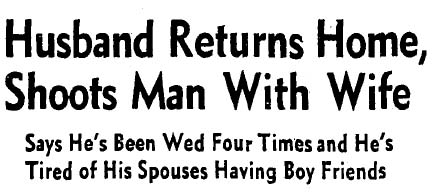
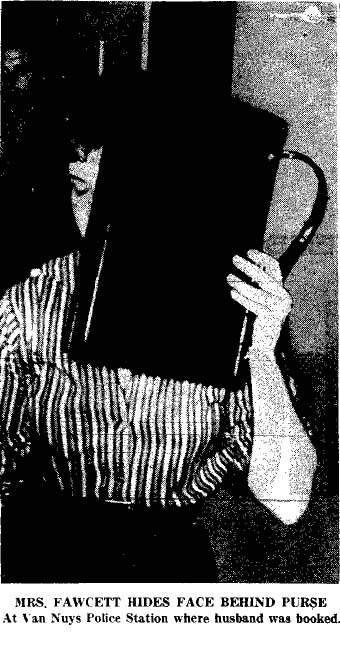 John Gordon Fawcett, 42, had enough. His last three marriages had ended
with his wives getting boyfriends and so when he found his fourth wife
in the bedroom with another man….
“This happens every time,” he said. “I got just a little tired of it.”
At 28, Janet Fawcett was 14 years younger than her husband. I suppose if she’d been more mature she could have asked John a few questions before marrying him. Something like, “Have you been married before?” or more to the point: “Do you keep a loaded .45 semiautomatic
around the apartment?” (The answer to both those questions was: Yes).
But from what she told police about the shooting, she doesn’t sound all that bright–or at least she didn’t think through what might happen if her husband found her with another man in their bedroom.
Aldous Huxley, July 20, 1952
"Horror stories implying neglect and incompetence, especially by nursing personnel, are heard regularly."
"We all came with such high hopes. Can we provide high-quality healthcare in the ghetto? I’m not sure. It’s very spotty so far."
"I have never seen so many sick people. We never catch up."
"We’ve got difficulties, but nothing we can’t handle. We’ve come a long way."
Times staff writer Harry Nelson did a terrific job with this story. He captures the challenges, the hopes and the incredible frustrations of King/Drew. And this was 32 years before it lost federal funding. Take the time to read this story. It’s worth the effort.
The Times, March 23, 1975.
Part 1

Part 2


Aug. 11, 1957
Princeton, N.J.
I’ve intentionally avoided politics so far, but hindsight is a
wonderful way to judge 50-year-old attempts to forecast the future, in
this case, the 1960 presidential election.
Let’s see how George Gallup did with the Democrats.
The front-runner for most of 1957 was Sen. Estes Kefauver of Tennessee,
followed by Sen. John F. Kennedy of Massachusetts, the eventual winner.
Although Kennedy had a slight lead in June, Kefauver began and
ended the year as the top Democratic candidate, according to Gallup.
In February, Kefauver led Kennedy among all Democratic voters 49% to 38%,
Gallup said. (Among Republicans, Vice President Richard Nixon outpolled Sen. William F.
Knowland of California 63% to 23%). The problem with Kennedy, Gallup
found, was that he did not have national prominence–26% of Democrats
said they didn’t know who he was.
In June, the two men traded places, with Kennedy over Kefauver 50% to
39%. Gallup again found that Kennedy lacked national recognition–among
Democrats, 28% didn’t know who Kennedy was.
By August, however, Kefauver was back on top, although by a closer
margin (Kefauver 29% to Kennedy’s 23%). The remaining six candidates
were:
More important, Kennedy and Kefauver were almost evenly matched among independent voters (25% vs. 24%), Gallup found.
Although Kefauver led Kennedy 26% to 19% in November, the ultimate tests, at least for our purposes, came in August 1957.
Kennedy easily defeated Knowland in a hypothetical presidential race, 51% to 37%, Gallup found.
As for a hypothetical race against Nixon, Kennedy was the winner 48% to
43%, Gallup found. And as Gallup noted, Nixon prevailed slightly in
every part of the country except the South, which handed Kennedy a huge
margin of 64% to 25%.
The popular vote, as reported by The Times on Nov. 11, 1960:
50.2% for Kennedy, 49.8% for Nixon. It was the closest election since
1888, The Times said.
To be continued…
Oh don’t do this to me.
OK, kids. "Gunsmoke" was an incredibly popular TV show that went off
the air in . . . 1975. (What? Could this be right? Surely it wasn’t
that long ago). It was something called a "Western," which was the
staple of TV programming in the 1950s and what we had before "Star
Trek" was invented. In fact "Star Trek" was originally conceived as a
knockoff of another Western and was pitched as (Lord help me) " ‘Wagon
Train’ to the stars."
No, I’m serious.
What was "Maverick?"
Oh you kids these days.


Aug. 10-15, 1957
Los Angeles
In testimony that was at times as colorful as its red and yellow
covers, the Confidential magazine trial continued with an appearance by
its former editor in proceedings that were all the more interesting
because of celebrities who were trying to avoid appearing.
One of the more prominent reluctant witnesses was Tab Hunter, who
ultimately did not testify but earned his way into the headlines by
trying to escape publicity.
Hunter was the subject of a
September 1955 article implying that he was gay. His plea was that
because the article was not part of the prosecution’s case against
Confidential his testimony was unnecessary. Defense attorney Arthur J.
Crowley’s strategy was to subpoena as many stars as possible to prove
that Confidential’s stories were accurate and said he needed Hunter
because he wouldn’t know until the trial got underway whose testimony
might be required.
Although Errol Flynn, below right, came to Los Angeles in hopes of testifying
against the magazine, many celebrities left town to avoid being
called. "We’ve been covering certain nightclubs and premieres," in
hopes of serving subpoenas, said former LAPD Officer Fred Otash, a
private detective often employed by Confidential. "Some of these people
are lying pretty low."
The main witness for the prosecution
was Howard Rushmore, a former staffer of the Communist Daily Worker and
onetime member of the Communist Party who became editor of Confidential
in October 1954.
Rushmore testified that Confidential
publisher Robert Harrison hired him out of frustration because the
magazine’s stories weren’t racy enough.
"Mr. Harrison told me
our stories were too tame," Rushmore testified. "He said we needed
stories that would make our readers whistle and say: ‘I never knew that
before.’ "

The first task was to get scandalous material.
Rushmore said Harrison didn’t like the stories submitted by Los Angeles
newspaper reporters because they were too tame. Instead, Rushmore was
to develop a stable of informants who could provide a higher caliber of
dirt. I’ve already looked at Ronnie Quillan’s
checkered career as a Confidential informant, but the main source of
information was Francesca de Scaffa, an actress who was briefly the
third wife of actor Bruce Cabot. Rushmore described De Scaffa as "our
chief Hollywood source."
"She said she had access to almost
every home in Hollywood and she could get a lot of stories," Rushmore
testified. "She said she would get material even if it involved affairs
for her with male subjects."
However, De Scaffa proved
unreliable, Rushmore said. "When an article based on her information
resulted in a lawsuit, she changed her original story and admitted that
she had not been present," he testified. "This gave me concern as to
her reliability."
(To complicate matters, De Scaffa attempted
suicide in May 1957 while hiding in Mexico City to avoid the
Confidential trial. She was eventually deported to Cuba as "an
undesirable visitor," The Times said).
In many cases, the
details were unimportant, Rushmore said. "Harrison often overruled his
attorneys on the matter of whether articles were too dangerous to print
and expressed the opinion that in the case of film people articles
could be printed without documentary proof," The Times said.
To be continued.
Note: According to Who’s Who in France, De Scaffa married French envoy and politician Raymond Offroy, who died in 2003.
(I suppose you are wondering why The Times used Marilyn Monroe in a Page 1 headline on a story that barely mentioned her. So am I. Like many articles in Proquest, this story is incomplete because it changed between editions. Sometimes the jump from Page 1 is lost or in other cases all that remains is the jump of a story. In this case, Monroe is mentioned in the lede and nowhere else. Such are the mixed rewards of research. Bonus fact: On Aug. 1, 1957, Monroe, who was married to playwright Arthur Miller, was rushed to Doctors Hospital in New York, where she suffered a miscarriage.)

Aug. 9, 1957
Los Angeles
Top shows for the first two weeks of July 1957:
The All-Star baseball game (American League 6, National League 5 ) was the top-rated show for the period, with 12,896,000 TV sets tuned in, The Times said.
TV writer Cecil Smith noted that only one NBC program–the game show
"Twenty-One"–was in the top 10. He attributed the poor showing to the fact that the network had recently announced
55% of its fall shows would be new, including programs starring
Eddie Fisher, George Gobel, Dinah Shore, Rosemary Clooney, Jane Wyman and
Gisele MacKenzie, plus "The Court of Last Resort" based on a series by Erle
Stanley Gardner, a sitcom starring Joan Caulfield titled "Sally" and
three unidentified westerns.
About "Twenty-One." In early 1957, the shows featured a bright fellow named Charles Van Doren. Maybe you’ve heard of him.

 Aug. 9, 1957
Los Angeles
The Times ran a series of brief stories in 1957 on the braceros, workers brought from Mexico to the U.S.
In January, it noted that 460,000 to 470,000 braceros would be working in the U.S. in 1957, up from 432,618 in 1956.
Later that month, The Times said that in 1956, a record of 161,603 laborers were processed in the U.S. Foreign Labor Reception Center in the Imperial Valley. The center picked up the braceros in Mexico and allocated them to farms in California, Oregon, Washington, Arizona, Utah, Nevada and Idaho. The previous record, set in 1955, was 119,659.
In fact, the U.S. was importing so much labor that Mexico began a public works program and an irrigation project to keep at least some of the men home, The Times said.
Of course there were problems, The Times noted. Atty. Gen. Pat Brown (the future governor) was fighting with the federal government to allow the braceros to bring their families, noting that the camps of single men were prone to prostitution and drugs. The U.S., however, said the families would add too much demand for housing, hospitalization and relief (i.e. welfare).
 And there were other complications. The Imperial Valley farmers disliked the Labor Department's bureaucracy in handling the braceros and wanted the program transferred to the Department of Agriculture, which supervised it until World War II. One reason: The Labor Department had too much paperwork and moved slowly, threatening crops that had to be processed quickly. And, the farmers said, the Labor Department was too "industry minded."
Still, the braceros were working their way into American culture. In fact, The Times ran a page of "bracero recipes" made popular in the camps of Fullerton and urged Orange County housewives to try some of the spicy bracero dishes. (Yes, one calls for "Jap chiles.")
The Times said:
"The men in the Fullerton housing unit … are mainly fed their native diet because they cannot be expected to adjust to American foods and customs during their short-term contracts in this country. American foods are added, however, to improve the nutritional balance of each meal."
A year-end report noted that the number of braceros processed in El Centro declined slightly in 1957 to 159,000. U.S. officials said a crackdown on illegal immigration had spurred an increase in the bracero program, but that it had leveled off in 1957.
I do not intend to delve further into the topic of immigration and foreign labor (in fact, searching The Times for "braceros" reveals far too many stories about Gov. Ronald Reagan, Cesar Chavez and the UFW, with well-known bylines, for yours truly to go wading).
But I have to note that although The Times reports the nuts and bolts of the braceros, it deals only slightly with the need for the program:
"The braceros are brought into this country as temporary farm workers to fill labor needs that cannot be met with domestic workers."
Translation: Americans won't do these jobs.
What became of the bracero program? The law establishing the program expired in 1964.
Aug. 8, 1957
Los Angeles
Los Angeles men: You’re slobs, surpassed only by your male counterparts in Houston and Fort Worth. You should let your wives pick out your clothes, or so says Francis DeWitt Pratt of the American Institute of Men’s and Boys’ Wear.
And this is in the day when the average corporate president in America owned 14.3 suits, 29 shirts, 30 pairs of socks, 10 pairs of shoes, four hats, 65 neckties, two overcoats, two topcoats, 1.5 raincoats, 3.9 sports coats, seven sets of cuff links and 5.8 pairs of pajamas.
Long before a battered baseball cap and a fanny pack were the height of men’s fashions.


Aug. 8, 1957
Los Angeles
Prosecutors opened the case against Confidential and Whisper by
charging that the magazines used prostitutes to lure movies stars into
compromising situations and published the incidents in scandalous
articles. The magazines, Publishers Distributing Corp. and Hollywood
Research Inc. were charged with printing lewd, obscene materials and
advertising abortions and male rejuvenation.
The first order of business for Assistant Atty. Gen. Clarence Linn and
Deputy Dist. Atty. William L. Ritzi (who will be the judge in the Patty
Hearst case) is to show the close financial ties between the magazines
and Hollywood Research Inc., run by Fred and Marjorie Meade.
Noting that Marjorie Meade was the niece of Robert Harrison, the
publisher of Confidential and Whisper, Linn said: "Records will show
that they [the Meades] bought stories from people of the night life,
questionable characters, private detectives."
Linn added: "We will show that the printed material was lewd and
obscene, that it had a substantial tendency to corrupt and that an
attempt was made to impeach the honesty and integrity of living
persons. We will not attempt to turn this court into an animated
Confidential."
Defense attorney Arthur J. Crowley replied: "The evidence will show
that these stories are not innuendo but that the real stories behind
the articles are far worse than the stories that are printed."
Insisting that articles such as "Don’t Take Those Abortion Pills" were
a public service, Crowley said: "There was no intent here to crucify
any individual for one slip off the straight and narrow. There was
never any desire by Harrison or anyone else to injure anybody."
The American Civil Liberties Union, meanwhile, submitted a brief to the
U.S. Court of Appeals seeking to keep Atty. Gen. Pat Brown from barring
distribution of the scandal magazines during the trial.
Attorney A.L. Wirin said that although the ACLU had no sympathy with
Confidential or Whisper, "it does support the right of any publication
to be free of censorship" until the prosecution of the magazines was
finished, The Times said.
To be continued
Nov. 8, 1970, Los Angeles Times

The world mourns one of film’s greatest comedians, Oliver Hardy, who died in North Hollywood on Aug. 7, 1957. He was 65.
Part 1

Part 2

The Mirror, Page 1 (Note the price of gas, 23.9 cents a gallon, is $1.71 USD 2006)

Page 2


Aug. 5, 1957
Los Angeles
In eight years (the headline above is from The Times, Aug. 12, 1965), Los Angeles will explode in the Watts
riots and many people will wonder how it happened. Here’s part of the
answer. This article from the Mirror is so appalling that I’m running
it in its entirety. (And no, The Times didn’t even cover the problem).
Here are the highlights:
The reason, according to county school Supt. C.C. Trillingham: Timid school officials and an apathetic public.
Did I mention that there was a teacher shortage as schools prepared to
open for the fall? The Mirror said there were 300 unfilled positions
and roughly 150 black teachers who couldn’t get jobs (assuming that the figures were largely unchanged from 1956).
And L.A. couldn’t do the math.


Aug. 7, 1957
Los Angeles
Professional photographer David Sutton, 8426 1/2 W. 3rd, tells the Mirror that he spoke with missing model Judy Ann Dull an hour before she disappeared with a photographer calling himself Johnny Glinn (or Glynn).
Sutton said he had been subpoenaed by her husband's attorneys in their child custody case.
"Apparently her husband's lawyers had a notion that I had photographed her in the nude," Sutton said. "That is entirely wrong. Judy Ann was a high-type girl, absolutely straight. She was working to make enough money to keep her baby."
Dull made an appointment to pose for Sutton after she finished her modeling job with Glinn, but she never returned.
Sutton worked for such prominent magazines of the day as Life and Look, and photographed John Wayne many times over their 20-year professional relationship, according to an online biography.
Aug. 6, 1957
New York

I wish I could find the story that went with this picture, but I haven’t been successful so far. I’ll keep digging. There’s a wiki entry on Hubert Schiffer.
The picks from KWFB-AM (980), Aug. 3, 1957.
I actually recognize most of these tunes; "Old Cape Cod" and "Gold Mine in the Sky" are new to me, but at least I’ve heard of Patti Page and Pat Boone. Alas I can’t find a clip of Helen Grayco doing "Black Coffee"–or anything else. Anyone care to identify "Happy Pierre in Hi-Fi?"


Aug. 5, 1957
Alhambra
Robert D. Smallfield and his former wife, Wilma, have a novel
arrangement. Divorced after 17 years of marriage, Robert rents a room
from Wilma at their former home, 1222 S. Marengo, Alhambra, so that he can pay her monthly alimony of $60 ($429.92 USD 2006).
He has enough money to buy himself a new Chevrolet and, since he’s
single, has begun dating, sometimes bringing his dates over to dinner
with his ex-wife.
This does not go well.
And so Wilma Alice Smallfield, 44, gets behind the wheel of her 1949
Buick and vents her fury with her ex-husband, his girlfriend and his
new Chevrolet.
The fight begins at home when Wilma sees the girlfriend in Robert’s new Chevy.
"She rammed the car on
Valley Boulevard at Westminster Avenue and Smallfield sped away," The
Times said. "But she caught him again, with another blow, on Valley
Boulevard at Charnwood Avenue. At the Lillyvale Avenue intersection,
she scored the third time."Smallfield felt his chances of
escape would be better in the hilly section of town, so he took off for
the highlands. He lost her, too. He waited a while then sneaked back
onto Valley Boulevard. But there she was, waiting in ambush at the
Borland Rose crossing, and the duel began again with another smashup.
"In desperation, Smallfield ducked behind a warehouse at 5359 Valley Blvd., where he works, and this was the final battle scene, where the husband’s car was battered at least five more times.
"As Smallfield got out of his car, he said, his wife tried to pin him between his car and the building.
"Mrs. Smallfield got out of her car, brandishing a 2×4 club, but Smallfield outran her after tearing out the wiring of her car."
During her arrest and in jail, Wilma insists she meant Robert no
harm: "I didn’t want to kill him. You can’t understand how much I love
him. I just wanted to scare him."
And that’s it for the "Hey, Martha!" story in The Times. So let’s keep
digging. Wilma was given a one-year suspended sentence and a $250 fine.
But Robert wasn’t at liberty terribly long. He died July 2, 1963, at
the age of 48. Wilma lived to be 60, dying in 1973. She apparently
never remarried. None of the stories mention any children.
And what became of the girlfriend? The Times is curiously silent on the matter.


