Jan. 1, 1958


The Los Angeles Times, Jan. 1, 1958.

1958_0101_cover

You can sure tell it’s the era of the TV Westerns: Guy Madison and Andy Devine from "The Adventures of Wild Bill Hickok," Richard Boone from "Have Gun — Will Travel" and William Boyd of "Hopalong Cassidy." Also note: Sheriff Eugene Biscailuz and–of course–Montie Montana.

Posted in @news | Tagged , | 2 Comments

Countdown


City_hall_1962_crop

Photograph by Wayne F. Kelly / Los Angeles Times

I’m a few years ahead of myself, but I couldn’t find the photo from 1958. So just pretend.
Happy New Year from the Daily Mirror! (Hey, it’s Guy Lombardo and His Royal Canadians! They’re playing "Auld Lang Syne.")

Posted in Uncategorized | Tagged , | Comments Off on Countdown

Julian Eltinge

I had never heard of Julian Eltinge until I came across some material for sale on EBay. I dug out his photo file and over the weekend found his former home in Silver Lake.


Julian_eltinge_1937_0912_file

Los Angeles Times file photo


Here’s Eltinge in his prime in an undated picture. He performed frequently in Los Angeles and appeared at the Mason Opera House in a play titled "The Fascinating Widow," which received rave reviews. In fact, the critic compared it favorably to the annual New Year’s show at the Jonathan Club.


Julian_eltinge_1913_1028_file
Los Angeles Times file photo

Julian Eltinge in "The Fascinating Widow," 1913.


Julian_eltinge_1913_1029_boxing


He was also a boxing fan.


Julian_eltinge_house_1918

And he built this house in Silver Lake.

Julian_eltinge_home_2007Photograph by Larry Harnisch / Los Angeles Times

Here’s the former home of Julian Eltinge, 2328 Baxter St. Warning! Baxter is one of those extremely steep streets around Silver Lake.  Because of the mature trees,  it is quite difficult  to see the home from the street. But it is still there. Note: In his later years, he lived in North Hollywood. He died in New York in 1941, somewhere in his mid-50s. The Times noted that he was a "lifelong bachelor," a vintage code phrase for "gay."   

Email me

Ps. The Times clips are full of interesting accounts about Eltinge. I’ll try to post a few as I get time. So many stories, only one Larry Harnisch.

Posted in #gays and lesbians, Stage | Tagged , , , | Comments Off on Julian Eltinge

110 revisited


1912_map

I realized I got more than I bargained for as soon as I found this map among The Times pictures of the Pasadena Freeway. As this 1912 map shows, the Arroyo Seco Parkway was originally intended to link Elysian Park to the area north of Devils Gate Reservoir in what is now La Canada Flintridge. But what’s this off to the left? A parkway linking Elysian Park to Silver Lake? And what is this Silver Lake Parkway connecting Wilshire Boulevard to Griffith Park? Also, please note the reference to a "proposed boulevard from the mountains to the sea."

You might ask why the city was taking its first steps toward freeways as early as 1912, when autos and auto travel were primitive to say the least.  My goodness, the question of transportation in Southern California gets complicated quickly, doesn’t it?

Stay tuned.

Posted in Freeways, Transportation | Tagged , , , | 2 Comments

Mystery photo


2007_1231_mystery_photo_2Los Angeles Times file photo

Here’s a vintage photo of our mystery guest. Some artist at The Times
cut it down years ago, but left part of the autograph intact. And yes,
I cropped out the signature. No point in making this too easy.

  • Mary Pickford? (Interesting guess. But no).
  • Julian Eltinge? (Carol Gwenn). Absolutely right! Bravo

This is Julian Eltinge, the leading female impersonator of his day.

Email me

Posted in Uncategorized | Tagged | 3 Comments

Dec. 31, 1957


1957_1231_mirror

Posted in @news | Tagged , , , , | Comments Off on Dec. 31, 1957

Company town III

Robert Birchard writes:

    Saw your blog on Francis Boggs and early filmmaking in Los
Angeles
.

 
    Perhaps one of the reasons you’ve never found the laundry except in the
earlier fire reference is that it is nearly always misidentified as the "Sing
Loo" laundry, when in fact it was the "Sing Kee" laundry and it shows up in city
directories of the time. 
 
    The laundry, of course, was not part of the 1907 expedition, but was a
temporary Selig studio active in April and May of 1909.  Boggs left Los Angeles
for location work in Yosemite, the Hood River Valley and Oakland before
returning to set up a permanent studio in Los Angeles in Edendale in October
1909.
 
    The "rooftop" studio is somewhat problematic.  "Monte Cristo" has
recently been found and restored.  All of the film, except for the emergence of
Dantes from the sea, is shot on interior sets.  There is no Selig "Carmen," or
anything that might resemble it for that matter, in the release records of the
Selig Polyscope Company, and it is highly unlikely that Lillian Haywrd would
have worked with Boggs ca. 1906-1907 (although she certainly worked for Selig
after Boggs’s death) because they were just recently divorced and Boggs was
remarried to May Hosmer.  Hayward was also a new mother, having given birth to
an illegitimate daughter in Dec. 1906 and only returning to work on stage in San
Francisco later in 1907 after "a lengthy illness."
 
    The fellow who gave the photo of the rooftop studio to Hobart Bosworth
claimed it had been taken in 1906 when he was appearing in a show in Los
Angeles.  I need to do additional research on this to confirm the show (if
possible) and its play dates, but I suspect that the rooftop studio does indeed
date from 1906, but that Francis Boggs wasn’t involved at that time.  It is my
suspicion that Thomas Persons blurred the rooftop studio and the Monte Cristo
shoot in his memory many years later. 
 
    The first account I’ve found of the Monte Cristo shoot is in a 1916
article by Charles E. Van Loan that quotes Persons, but which may have been
slightly embellished for effect. 
 
Best,
 
Bob Birchard
Posted in Downtown, Film, Hollywood | Tagged | Comments Off on Company town III

The 110 revisited


1939_0723_grand

Photograph by the Los Angeles Times, July 23, 1939

He looks out from the bridge as if he is gazing toward the future. Not
that this is what the photographer intended. Like The Times "Scout
Car," a new 1939 Oldsmobile, the unidentified fellow in the suit and
two-toned shoes was added as visual interest to an otherwise static
shot of Southern California’s first six-lane "superhighway" being built
from Los Angeles to Pasadena.

But what did our friend see when he looked away from the camera and
faced Orange Grove Avenue? The future of transportation? The
ultimate solution to the region’s intractable problems with congested
streets? Did he, or anyone, ever envision long lines of cars backed up
on the Orange Grove off-ramp at the evening rush hour? How about
freeway signs, shrouded in an attempt to protect them from graffiti?


1940_1230_sally_stanton_lat

Photograph by the Los Angeles Times

The year after that picture was taken, 1940 Rose Queen Sally Stanton,
aided by Gov. Culbert L. Olson, cut a ribbon just east of Fair Oaks in
South Pasadena, opening six "glass-smooth miles" of the Arroyo Seco
Parkway from the Figueroa tunnels to Glenarm Avenue. The era of the
Southern California freeway had begun.


1938_0323_cheryl_walker_lat02

Photograph by the Los Angeles Times

Cheryl Walker at the 1938 groundbreaking for the Arroyo Seco Parkway.

But our story doesn’t
begin with our friend on the bridge, nor with the Dec. 30, 1940,
ribbon-cutting. Nor does it open two years earlier, when 1938 Rose
Queen Cheryl Walker started a tractor at Sterling Place and Arroyo
Boulevard in South Pasadena to move the first mound of dirt for the
"speedway between Pasadena and Los Angeles."

As The Times noted
in March 1938, the groundbreaking was the culmination of a 20-year
effort. Indeed, even a little research reveals plans for a landscaped
route along the Arroyo Seco as early as 1907.

With the 70th anniversary of the groundbreaking a few months away,
and a large folder of Times archival photos on my desk, I’ve decided to
use the Pasadena Freeway as an instrument to examine the larger
question of traffic and transportation in the Los Angeles region. Is
traffic a new problem that can be easily fixed with a few more buses or
a couple of toll roads? Or, like the line from "Alice in Wonderland,"
has it taken all the running we can manage to stay in the same place
over the last century?

Like most Southern Californians, I have a personal relationship with
this subject. The Pasadena Freeway is literally my backyard and my
house was moved from Sterling Place to make way for the project. (And
yes, although I personally oppose the 710 extension, I’ll make every
attempt to write about it impartially).

More than that, with the exception of a few years when I lived in the
San Fernando Valley, I’ve used the Pasadena Freeway nearly every day
since 1988. As I tell my fellow commuters, driving a freeway is like
running a river; you learn where the rapids are and where you are
likely to get caught in an eddy. After seeing dozens of three-car
pileups in the same sharp curve, I have learned to slow down and say a
little prayer for people who speed on by.

Today, despite years of tinkering, the freeway is as outdated as our
friend’s two-toned shoes and his 1939 Oldsmobile, which had a
230-cubic-inch, six-cylinder engine, a 120-inch wheelbase and weighed a
bit more than 3,000 pounds. The builders could have never imagined a
dressed-out Hummer H2 with a 133-inch wheelbase and a 393-horsepower
V-8 that weighs as much as pair of 1939 Oldsmobiles. And yet the
highway continues to serve its intended function: moving cars between
Pasadena and downtown Los Angeles.

One might say that the freeway was conceived the first time someone
mounted a horse and rode to town. I don’t plan to go back quite that
far. Nor do I intend this to be a linear history of the Pasadena
Freeway. For that, I’ll post Patt Morrison’s marvelous 1990 nondupe on
the freeway’s 50th anniversary. Instead, over the next few months I’ll
be revisiting some of the locations in the old photos to see what
lessons we have learned–and perhaps what lessons have eluded us. (Note the absence of a center guardrail in the 1939 photo. A bloody lesson to be sure).


1939_0723_grand_3


2007_1229_grand_orange02

Photograph by Larry Harnisch / Los Angeles Times

And like the Pasadena Freeway, this will be built in chunks and strung
together, then modified as I see what works and what doesn’t.

Hope you enjoy the ride.

Email me

Posted in Freeways, Transportation | Tagged , , , | 1 Comment

Dec. 30, 1957


1957_1230_cover

Posted in @news | Tagged , , , , , | Comments Off on Dec. 30, 1957

Van Nuys Boulevard

Dec. 29, 1957
Los Angeles

1957_1229_van_nuys

Isn’t this building cool, in its weird 1950s Space Age way? This is a wonderful detail from a Times ad for the opening of a Van Nuys Savings and Loan office at 8201 Van Nuys Blvd. The building is still there, but unfortunately, it doesn’t look anything like this anymore. I’ll try to get out to Panorama City for a shot in the near future. And here’s a shout-out to the Van Nuys Boomers blog. Thanks for reading!

Email me

Update: It’s unclear to me just how much the building has changed since 1957. Before I wrote the post, I found one online image that indicated the building had been fairly compromised by later remodeling. Richard Hultman sent me some satellite images that make it appear to be more intact. A field is definitely in order. Stay tuned!

Posted in San Fernando Valley | Tagged , , , | 1 Comment

Vaudeville days

I stumbled across this story while looking for something else. Notice that it mentions the Main Street Gym and the Hippodrome. As published in The Times, Oct. 2, 1983.


1983_1002_mardo01

Continue reading →

Posted in Downtown, Stage | Tagged , | 1 Comment

Heidi Fleiss

Given the interest in Ivan Nagy, here’s the original Times front page story on Heidi Fleiss by Shawn Hubler and James Bates, with a headline by yours truly that worked hard to tell the story without saying anything. (Good Lord, was it really 1993?)

Heidi’s Arrest Is the Talk of Tinseltown
Vice: Celebrities are rushing to help or distance themselves from
alleged madam to the stars.

SHAWN HUBLER; JAMES BATES
TIMES STAFF WRITERS
3244 words
1 August 1993

Los Angeles Times

Home
1
English
(Copyright, The Times Mirror Company; Los Angeles Times 1993 All Rights Reserved)

No wonder California was in the poorhouse, she wisecracked after
the arrest-they had sent three police agencies and two canines to
nail a 115-pound party girl. The cops leaped from her shrubbery as
she was taking out the trash. “LAPD!” they barked. “Which one of
you is Heidi Fleiss?”

It surprised her that they had to ask. Everyone who was anyone
in Hollywood knew Heidi. Gliding right in to the best booths at
Jack Nicholson’s place, the Monkey Bar. Clubbing with Billy Idol
and Peter Sellers’ daughter, Victoria. Hobnobbing with Robert
Evans, the producer of “Chinatown.” And wasn’t it at Fleiss’ house
that they held that bash for Mick Jagger?

And now what a ruckus her arrest has raised.

She’s not an actress, not a director, not even a producer, but
she has surely been a player in this town. Most of the summer, her
case has captivated the entertainment industry on both coasts and
ignited speculation-lists of celebrity clients, heads rolling at
studios, a mysterious tape-recording that names names.

For although formal charges have yet to be filed, police say
that Fleiss, the 27-year-old daughter of a prominent pediatrician,
has for the last three years filled a time-honored niche: madam to
the stars.

Within a week of Fleiss’ arrest-according to her, her friends
and a tape-recording of her phone conversations-four major
producers had called directly to express their condolences. Eight
more producers and entertainment industry executives had friends
call on their behalf. Six big-name actors checked in, as did an
international financier, a Sunset Strip rock impresario, a Texas
real estate heir and a Beverly Hills real estate agent calling on
behalf of an Italian multimillionaire who, for sentimental reasons,
wanted to buy Fleiss’ $1.6-million Benedict Canyon home.

Some called out of friendship. Others, Fleiss said, were
concerned that the names in her big black book may come out when
she goes to court Aug. 9. “A lot of people are nervous,” one
well-known producer said. “She . . . fixes everybody up (and) there
are a lot of married people in this town getting some booty.”

As long as there has been a Hollywood, there has been a
Hollywood madam. But rarely has one arrest offered such a ready
window into the world whose unspoken motto has been “discretion,
discretion, discretion.”

“I have warned her, you cannot mention johns, not even
privately-it ruins careers,” sighed Elizabeth (Madam Alex) Adams,
whose 20-year reign as Beverly Hills madam ended with her arrest in
1988 and who has known Fleiss for at least the last five years.

But, from Fleiss’ standpoint, the potential for leaks of her
client list could be a benefit.

Two well-known producers, according to a tape-recording of one
of Fleiss’ phone conversations that she confirmed, have anted up
several thousand dollars apiece toward her legal bills. Meanwhile,
two other producers and a screenwriter have inquired about the
rights to “The Heidi Fleiss Story.”

“It’s self-explanatory,” said screenwriter Matt Tabak, who
called Fleiss to offer his help and ask for a 30-day option,
minimum $300,000 on her end.

“How does someone go from being a nice Jewish girl whose father
is a doctor to being arrested as an alleged Beverly Hills madam?
How does that happen? It’s gotta be an amazing story.”

*

She was raised in a Spanish-style home in affluent Los Feliz,
the third of six children born to Dr. Paul Fleiss and his now
ex-wife, Elissa, an elementary schoolteacher.

Success ran in the family. Dr. Fleiss lectured at UCLA’s School
of Public Health. Elissa Fleiss specializes in teaching gifted
children. Their eldest daughter is a veterinarian. Their elder son
is in medical school.

But Heidi-although charming and popular-was somewhat less than a
model student. Pressed to earn straight A’s at John Marshall High
School, she found herself unable or unwilling to compete.

“I was always in the classroom staring at the blue sky,
thinking, `Gotta go, gotta go’,” the green-eyed brunette said.
“After a while, I hardly went to school at all. I’d cut class and
go to the beach or the racetrack.”

Hoping to challenge her, her parents enrolled Fleiss at the
local parochial high school, Immaculate Heart, but she flunked out
after one semester, school officials said. By her senior year, she
had become so alienated that she dropped out, telling her parents
she wanted to get a GED and start college early.

But that summer, there was an automobile accident. Fleiss was
driving, and her sister was injured, nearly losing an arm. The
guilt, her family said, sent her into a tailspin. “It was July 10,
1984,” said her sister, Shana, 26, “and after it happened, it
changed everyone’s lives.”

The next year, Fleiss and a crowd of friends went to work
waiting tables at a trattoria on Sunset Boulevard. One night after
work, a friend invited her to a big party at the Greystone Mansion
in Beverly Hills, and Fleiss-at all of 19-embarked on a four-year
affair with her then 57-year-old host: the jet-set financier Bernie
Cornfeld.

“We weren’t really a couple in that sense-it’s not my thing-but
we were good friends. We saw a lot of each other,” Cornfeld said
from his London home.

He took her to Europe, the Caribbean, his 12th-Century castle in
France. But Cornfeld, she said, “was much older and not
monogamous”-and neither was Fleiss. By the time the relationship
ended, Fleiss had a new attachment, a Hungarian director named Ivan
Nagy.

Like Cornfeld, Nagy was older-50 to her 23-and on a downswing in
his career. Though he had a steady string of credits-TV movies and
action shows such as “Starsky and Hutch”-it had been several years
since his last job.

Their romance was brief and harsh; their breakup was protracted.
They still beset each other with restraining orders and speak of
each other in hostile terms. At one point in 1991, they were
convicted on misdemeanor bookmaking charges, the result, Nagy says,
of an informal betting circle that got out of hand.

But that, Fleiss contends, was the least of it.

Nagy, she said, introduced her to Adams, the Beverly Hills
madam. But Nagy remembers it differently. The day he told Madam
Alex about his new love, he said, he got a surprise.

“She said, `Yes, she is working for me,’ ” Nagy said.

At any moment, police say, there are perhaps no more than 150
women working the topmost echelons of L.A.’s call girl trade.

They are the Chanel-clad bombshells on the arms of foreign
dignitaries and tycoons, the tawny “good friends” of producers at
studio parties and movie openings. Some are centerfolds, some model
sportswear. Some turn only one or two tricks in a year; others make
a brief career of it.

The strong and the lucky move on to security-rich husbands, film
careers. The weak ones are less fortunate, police say. The demand
is for variety, and few johns want to see the same woman more than
a time or two. So the longtimers bounce from madam to madam,
descending through the escort services to the bachelor party
circuit and into the realm of $100 tricks.

It is a rough, dehumanizing road, even at its upper end. And,
according to police and prostitutes, it does not take long to
encounter the city’s more notorious tricks: The big-name producer
who defecates on women. The high-tech entrepreneur from the East
Coast who horsewhips them. The independently wealthy crack addict
who orders women to his house two at a time and overpays, just to
have company while he gets high.

“It’s a dirty, degrading, coercive business,” LAPD
Administrative Vice Capt. Glenn Ackerman said, “and there are all
kinds of ways to hook the girls-money, dope, promises of fame. You
can mouth platitudes about it being the oldest profession and a
victimless crime, but the fact is that prostitution is always at
the center of a whole cluster of criminal behavior.”

But for those first few times the downside seems remote.

“I was making $10,000, $20,000 a month,” said “Karin,” a
22-year-old bit actress who met Fleiss through a man who followed
her into a check-cashing office on Hollywood Boulevard one day. “He
said he was a photographer. It turned out he would go out and find
girls to introduce to Heidi, for a fee.”

It took more than a year, she said, but one day, desperate to
move out of her mother’s apartment in Westlake Village, she allowed
herself to be persuaded to visit Fleiss.

“I was like, `OK, but no fat guys and if they’re gross, I won’t
do it. Only if I want to, OK?’ ” said Karin, who spoke on condition
of anonymity. “She just started laughing. A week later, she called
me and said, `I have a trip to London for you.’ And that was it.
Within a month, I had $25,000, a new car, a lotta, lotta money and
an apartment of my own in the city.”

For the next year, she said, her life was a parade of Middle
Eastern dignitaries and middle-aged American men who specified her
type-petite, curvaceous and blonde. Some dates were unforgettable.
An elderly Saudi paid her $1,000 for nothing more than dinner at
Morton’s and a kiss on the cheek. A local high-roller took her to
Las Vegas for a prizefight, 10 girls and five guys on a private
jet. At a birthday party for a young actor, she was the $1,000
present.

But eventually she got out, she said. “I had no life of my own.”

*

Adams reclines, phone at hand, in her Beverly Hills-adjacent
boudoir. Sixty years old and diabetic, she rarely leaves her
antique blue and white bed. She has even dictated her memoirs, the
forthcoming “Madam 90210,” from its pillowy depths.

Still, she manages to keep in touch. For two decades, she was
the bawdy empress of L.A. vice, serving millionaires and movie
stars and sheiks. Now, after a 1991 pandering conviction, she gets
a hearty kick out of the battle for her throne, and spends hour
upon hour dishing the exploits of her would-be heiresses.

“Ivan brought Heidi here in 1989,” she confided in a world-weary
rasp. “He turned her out. He made her work for me to pay off a $450
gambling debt. I can’t remember who I sent her to-Jesus, it was
years ago-but I think it was a very wealthy Texan.”

Fleiss said she was Adams’ assistant, not a “working girl.” But
in a June 9 search warrant affidavit, LAPD Administrative Vice
Officer Patricia A. Corso alleges that Fleiss “was Elizabeth Adams’
No. 1 `girl’ until she broke off . . . to start her own
prostitution business.”

At first, police say, Fleiss operated out of a quiet cottage off
Melrose Avenue. Neighbors there recall the parties and the fancy
cars-the Rolls-Royce convertibles and Porsches and Corvettes.

According to a law enforcement affidavit on file in Municipal
Court, the prostitutes charged customers $1,500, and Fleiss
received 40% of the money. Women who said they worked for Fleiss
said they were paid not only in cash, but also with checks, some of
them drawn on real estate corporations and movie production
companies.

Soon she moved to a sprawling ranch house off Benedict Canyon
Road in one of the wealthiest neighborhoods in Los Angeles. Records
show it was bought last summer from actor Michael Douglas and the
deed shows Fleiss’ father as owner.

Fleiss’ father refused to comment on the purchase or allegations
against Fleiss. Other relatives said that the family until recently
believed that Fleiss made her living from real estate.

The Benedict Canyon home became a sort of bachelor women’s club.
Actress Victoria Sellers, daughter of the late British actor, moved
in with Fleiss. Together, they became a fixture of L.A. night
life-Sellers hosting three nights a week at On the Roxx, a trendy
Sunset Strip bar, and co-hosting parties at Fleiss’ house.

“There was one party for Mick Jagger, and the house just got
thrashed-there were women climbing up the side of the hill to get
in,” Sellers laughed.

“She knows major, major people,” she said. “But I never asked
what was going on in that, um, other part of her life. I figured
that was her private thing.”

*

The police operation was complicated, like so much in Fleiss’
life. But what triggered it was simple, the LAPD’s Ackerman said:
“Her own big mouth.”

When it comes to vice enforcement, the Police Department
prioritizes according to “the three Cs”-commercial, conspicuous and
complained about. Fleiss was all three and then some, police said.

She lived lavishly. Gossip columns made references to her;
tabloids sent paparazzi to take her photograph. And, police said,
there were complaints aplenty about her from rival madams, jealous
boyfriends and spurned employees.

“When I came in, Heidi became one of my priorities,” said
Ackerman, who took over the department’s Administrative Vice
Division in December. Within months, a multi-agency law enforcement
task force had been assembled to investigate Fleiss, drawing
officers from the LAPD, Beverly Hills Police Department, the state
Alcoholic Beverage Control Agency and the state attorney general’s
office.

According to search warrant affidavits, authorities got their
big break April 6, when Beverly Hills Detective Sammy Lee heard
that Fleiss would be at a party at the Rangoon Racquet Club. Posing
as a Honolulu businessman, he pulled up in a Ferrari Testarossa,
accompanied by a state undercover agent. They sat down next to a
table full of women who had come with Jennifer Young, an old friend
of Fleiss and the daughter of the late actor Gig Young and Elaine
Young, the Beverly Hills real estate broker.

According to a law enforcement affidavit, the following ensued:

“I can’t believe that I lived with her for that long and didn’t
know what she was doing,” one woman laughed as Fleiss walked by.

Later, when Fleiss passed, Lee had Young introduce him.
Haltingly, he told Fleiss that he was a businessman who needed to
“arrange entertainment” for Japanese clients.

When Fleiss said she could help, Young rattled off Fleiss’ phone
number. Lee jotted it down. Two months later, Fleiss and Lee met at
the Beverly Hilton to arrange the deal: One night of partying at
the hotel, $1,500 a girl, no group sex, U.S. dollars only, condoms
all around.

And nothing kinky. “I don’t want to see a llama coming through
the house,” the officer said. To cap the negotiations, Fleiss had
Lee describe his “dream girl.”

The next night four women showed up at the Beverly Hilton,
police said. One was the dream girl-Samantha Burdette, a Colorado
model who resembled the late Natalie Wood. Another was 22-year-old
Brandi McClain, a tall, athletic blonde in a black and white blazer
and slacks.

“The guys didn’t say anything,” McClain recalled. “They were
supposedly Japanese and didn’t speak English and I thought, `Well,
this’ll be easy.’ Then all of a sudden, I hear, `OK, party’s over.’
And there were about 12 more people in the room than there were
before.”

Burdette was arrested on misdemeanor prostitution charges.
McClain-a San Diego County community college student who said she
worked weekends for Fleiss-was questioned and released. Police told
her they “wanted the big cheese.”

It wasn’t until that moment, she said, that she realized her
predicament. “I realized it was illegal, but I never thought
anything could happen to me.”

Within minutes, records show, authorities swept into Fleiss’
house, seizing 13 grams of cocaine and other evidence, including
travelers checks signed, according to Fleiss, by a well-known
actor. She was arrested on felony pimping, pandering and narcotics
charges.

Deputy Dist. Atty. Alan Carter said he still has not completed
his review of the case to determine whether to prosecute Fleiss. He
declined to discuss the case.

An affidavit in support of the search warrants alleged that
Fleiss had admitted to an undercover agent and in police interviews
that she was a madam. “In the history of this business, in one
year, no one has ever been able to do what I do,” Fleiss allegedly
said.

Other madams, she added, couldn’t hope to compete. “You get what
you pay for,” she said.

*

Rumors started within days of her arrest: Studio executives had
been paying Fleiss with movie development funds and corporate
credit cards. Veteran vice officers said such rumors have
circulated for years, but no hard evidence has emerged. Contrary to
reports in gossip columns, sources say the FBI is not investigating
the matter.

In a more tangible twist, however, a tape surfaced, containing
some of Fleiss’ phone conversations after the arrest.

Dan Hanks, a private investigator who has previously served as a
police undercover operative, said he made the tape by monitoring
transmissions from an apparent wiretap of Fleiss’ phone. “I thought
maybe I can . . . sell a story to the tabloids or `A Current
Affair’-if I could catch a celebrity with her (and) get some
pictures,” he said. “It could be happenin.’ ”

Fleiss, who is out on bail, said she bought a copy of the tape
from Hanks and intends to use it in her defense, provided that
charges are filed. Her attorney, Anthony Brooklier, declined to
comment.

Meanwhile, who actually tapped into Fleiss’ conversations
remains a mystery. Authorities said they are aware of the tape but
it was not culled from a law enforcement wiretap.

But the tape, played for a Times reporter, alludes to a number
of rich or famous people who know Fleiss. And as their names have
begun to leak out, some have rushed to distance themselves from
her. Others acknowledged knowing Fleiss but said they were only
social acquaintances or friends.

“I haven’t spoken to her for some time. Call my press agent,”
said “Sliver” producer Robert Evans. His publicist described Fleiss
as a family friend.

Bob Crow, heir to the Texas-based Trammell Crow real estate
empire, said: “We knew each other pretty well-frankly, I had a
little romantic interest in Heidi at one time, but she is sort of a
businesswoman.

“I haven’t seen her in months,” he added. “I gotta skedaddle
now.”

Billy Idol’s personal publicist, Ellen Golden, said: “He’s been
to (On the Roxx) and met her, but doesn’t know her well.”

Elliot Mintz, a well-known media handler for rock stars,
acknowledged chatting with Fleiss shortly after her arrest. “She’s
a casual friend,” he added. “I’m not in her social loop.”

As for Fleiss, she has only one thing to say when asked for
details about her alleged business: “Talk to my lawyer.”

Posted in Film, Hollywood, LAPD | Comments Off on Heidi Fleiss

Dec. 29, 1957


1957_1229_cover

Posted in @news | Tagged , , , | Comments Off on Dec. 29, 1957

LAPD HQ


2007_1227_lapdhq
Photograph by Larry Harnisch / Los Angeles Times

Los Angeles Police Department headquarters under construction, Dec. 27, 2007.

Posted in Downtown, LAPD | Tagged , , | Comments Off on LAPD HQ

Before YouTube

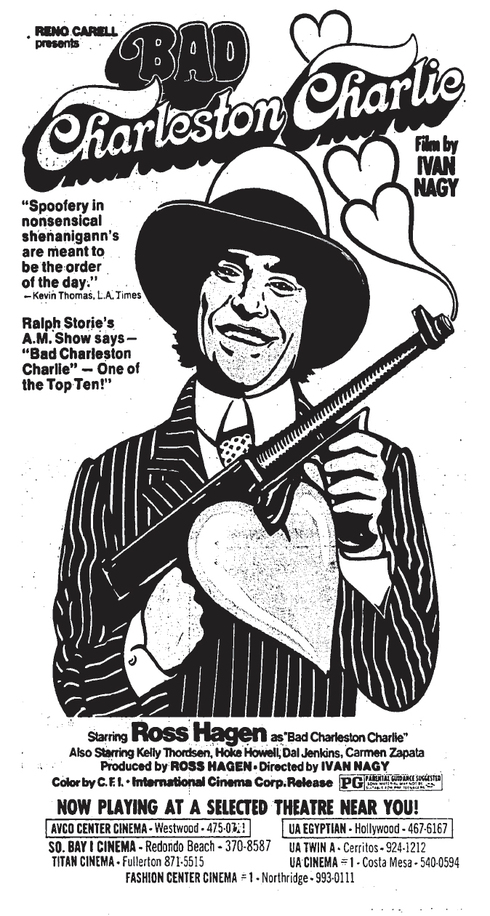
You may be wondering why you are looking at a poster of the 1973 film
“Bad Charleston Charlie.” (And what a poster: the hair… the bloated
lettering… the hearts… that suit! If this doesn’t say “lousy 1970s movie” I don’t know what
does).

I can explain.

You see, I had planned to use the last days of the year to get caught
up on a few stories that slipped through the cracks before we rolled
over into 1958. (Yes, that’s what we’re going to do at the Daily Mirror).

Today, I was going to write about the introduction of videotape. Except
that the subject of videotape, though it revolutionized broadcasting,
is about as interesting as staring at a Betamax cartridge for an hour.
(Hey, Grandpa, what’s a Betamax? Oh, you kids).

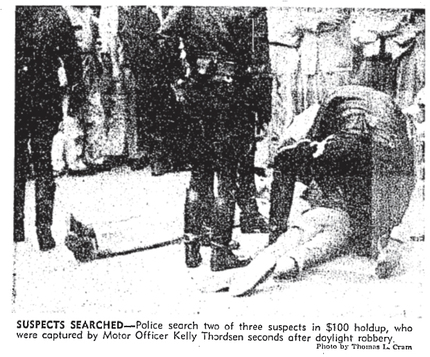
In researching a post on videotape (which is about as much fun as it sounds) I came across the name of Kelly Thordsen,
a former LAPD motorcycle officer who became an actor. Thordsen turns up
in many films and TV shows from the 1950s into the 1970s, including
1957’s “Fuzzy Pink Nightgown.” He often played a police officer in
contemporary films or a lawman in period pieces.

According to The Times, Thordsen began
his show business career after serving as master of ceremonies at an
LAPD benefit that featured William Bendix. After the performance,
Bendix complimented Thordsen and suggested that he turn pro. By 1960,
Thorsden had appeared in many TV shows, including such hits of the era
as “Yancey Derringer” and “Tales of Wells Fargo.” He also was a member of SPEBSQA.

Thordsen was never the subject of a Times profile, but as a character
actor he often ended up in three-bullet items at the bottom of a
column, working regularly in projects such as “The Ugly Dachshund” and
“Texas Across the River.” And, five years before his death in 1978,
“Bad Charleston Charlie.”

So here’s to you, Kelly Thordsen, actor and police officer. The Daily
Mirror salutes you for capturing three robbers single-handedly in
1953–with only one pair of handcuffs.

As for videotape, NBC President Robert W. Sarnoff said in 1957 that the
new recording medium would free television from
the clunky technology of the day: kinescopes. NBC built what it called
the Western Tape Center at its Color City in Burbank to house 11
videotape recorders, The Times said. NBC planned to go to videotape for
the switch to Daylight Saving Time in 1958 to contend with the
challenges of broadcasting shows in different time zones across the
country.

Did I mention that “Bad Charleston Charlie” is out on videotape (but
not DVD)? See, I knew I could pull this together if I thought about it.

Email me

Bonus factoid: As several people have noted, “Bad Charleston Charlie” was directed by Ivan “Izzy Sleeze’s Casting Couch Cuties” Nagy, remembered today for his role in the case of Hollywood Madam Heidi Fleiss. Of course there are many claimants to the title “Hollywood Madam,” including Madam Alex, and much earlier, Ronnie Quillan and Brenda Allen.

Posted in broadcasting, Film, Hollywood, LAPD | Tagged , , | 1 Comment

The Astrodome

I ran across this Jim Murray column and thought I’d share it. As published in The Times, April 29, 1965:


1965_0429_astrodome01

Continue reading →

Posted in Sports | Tagged , , , , | 3 Comments

Dec. 28, 1957


1957_1228_cover

Posted in @news | Tagged , , , , , | 1 Comment

Ted Thackrey

Aug. 13, 2001
Los Angeles

 In Memory of a Rewrite King With a Truly Soaring Imagination


By Al Martinez,

   They told me Ted Thackrey was dead, and I said yeah, sure, right.
They said he had written his last 1,000 words with the kind of blazing
speed that characterized his kamikaze style, and when he’d finished, he
just closed his eyes and died. I said tell me another one and went back
to work.

   But then, as it happened, I discovered this Thackrey story was true.
There was an obit in the small weekly newspaper where he once worked and
then a memorial service. Even Thackrey wouldn’t have gone that far,
pretending to be dead, then popping up somewhere after all the tears and
rituals were over.

  It would be hard even for Ted to fake his own cremation. He was dead
all right.

   When I became convinced of it, I began thinking back to the guy who,
if you’ll forgive the arrogance of my conclusion, was newspapering’s last
great rewrite man. A hard drinker, a storyteller of the Baron Munchausen
school and a man who wrote faster than a hurricane in hell, he defined a
breed of journalists that no longer exists.

  They were the ones who rarely left the office and whose bylines you
didn’t often see. They took notes over the phone from reporters in the
field, shaped them into tight, readable stories in the chaotic final
seconds before deadline, then went back to smoking and complaining until
the phone rang again.

   They were right out of "Front Page."

   Thack worked here for a lot of years, terrifying young reporters even
as he tutored them, demanding no less from himself than he did from them.
He was known to simply hang up on lazy beginners who came to him with
incomplete information and quietly praise those he couldn’t intimidate.
He was part of a rewrite row that included guys like Jack Jones, Dick
West, Jerry Cohen and acid-tongued Jerry Belcher, the quickest wit south
of San Francisco. I was part of the crew until I drifted off to other
pursuits, leaving the frantic last-minute stuff to the guys who loved it.

   "They wrote with grace and language," a former editor says of them.
"They were fast, but they were literate. A Ted Thackrey doesn’t exist
anymore."

   Thack and I shared the same desk for years. I’d use it during the day
and he’d take over at night. We wrote, in those pre-computer days, on
Remingtons that were old when I got there in ’72 and broke down when you
needed them most. After everyone had gone home at night, Ted would
cannibalize other typewriters in the office and steal their parts in
order to make ours the fastest, loosest and most efficient machine of
all.

   Stories about the man, a big, bald, wry kind of guy, are the stuff of
make-believe. One has Ted contributing to the creation of a fictitious
character they named Victor Frisbee in the old L.A. Examiner. An inside
joke, Frisbee would pop up in stories as the eternal bystander, sometimes
a sportsman, sometimes a philanthropist. When the Ex folded, a brief,
front-page piece said simply, "Victor Frisbee, sportsman and
philanthropist, died today."

   Rewrite guys were a different breed. They yelled a lot and drank a lot
and had bursts of temper that were legendary. Thackrey could slam-dunk a
typewriter into a wastebasket in a fight with an editor and roar at slow
or clumsy reporters in a voice that rattled windows. West, built like a
bull, could, and occasionally did, express himself by knocking someone on
his can when the mood took him, as fast with his fists as he was with a
typewriter. Belcher could attack editors with the fury of a tiger shark,
leaving them emotionally dead, then go back to writing the cleanest
stories I’ve ever read in a newspaper.

   When he wasn’t setting a Remington afire with his awesome writing
speed or teaching lessons in newspaper prose, Thack was a storyteller
with a soaring imagination. According to him, he’d been a pilot with the
Royal Air Force in World War II, a soldier in both the Korean and Biafran
wars, a government agent in Vienna and an airline pilot in Southeast
Asia.

   In between, or so he always said, he’d been Ernest Hemingway’s
secretary and sparring partner, a phone psychic, a kind of ghost-buster
and a pastor. He also wrote novels, short stories and may, or may not,
have written one of the best science-fiction pieces ever, called "Arena."
He churned out 1,000 words a day on his own, right up until two days
before he died of cancer at age 82. Or maybe 84.

   We never knew which of his many lives were real, concluding somewhere
along the way that no one person could have lived them all. His widow,
Diana, says she knew that most of his stories were true but wasn’t sure
about some of the others.

   We’ll have to settle for that, I guess. Sometimes his penchant for
fiction crept into his news stuff, and it was ultimately the reason for
his leaving The Times. He tried to create another Victor Frisbee at the
wrong time, in the wrong place. As we said goodbye, this giant of rewrite
row, humbled by his own deed, said simply, "It’s a lousy way to end a
career."

   The program at Thack’s memorial service listed his name as Thedor
Georg Wilhelm Friedrich Thackera Olwyn von Refrau und zu Holsten. Maybe
there were two Thackreys, one of them Ted, who loved newspapering and
reigned over rewrite as its once and future king, and the long-named guy
who, like Baron Munchausen, told one story too many. It doesn’t matter.
Not really. The Thack I knew was unique to an era of journalism that
exists only in the memories of those of us who were there.

   Ted Thackrey is truly dead, but the legend lives. He is survived by us
all.

Posted in Uncategorized | Tagged , | 1 Comment

Ewing Scott


Ewing_scott_1980_0519_con_keyes

Photograph by Con Keyes / Los Angeles Times

Convicted killer L. Ewing Scott, 1980, at the age of 83.

1957_1227_scott

In 1986, bedridden, frail and slowly dying in a Silver Lake convalescent home,
89-year-old Leonard Ewing Scott agreed to see a visitor, Times reporter
David Johnston. Scott had been freed from San Quentin in 1978 after
serving 20 years, released without supervision because the
prisoner–one of the oldest in the state’s penal system–refused to
agree to parole as it would imply that he had truly killed his wife,
Evelyn, in 1955.

Johnston was running down details for a story about new book. It
seemed that where all the investigators had failed, a young writer
named Diane Wagner had gotten a tape-recorded confession in 1984 for a
manuscript she was writing, "Corpus Delecti."
Scott told her that he killed his wife by striking on the head with a
rubber mallet, wrapped the body in a tarp and buried it near Las Vegas.

The reporter asked Scott if he knew Wagner. Of course, said Scott, who was sometimes disoriented and edging toward senility, she
was his third wife. In fact, he told another reporter, they went on a
honeymoon to South America.

Had he seen the book, Johnston asked. No.

Johnston read the transcript of the confession as the convicted killer
lay in bed, eyes fixed on his guest. Scott started to say something,
then stopped.

"What do you want?" Scott asked.

What made him acknowledge the killing after all these years?

"Acknowledge it? I’d be a damn fool to acknowledge it–they never found the body."

As far as the California Department of Corrections was concerned, Scott
was freed in 1978, but he remained in a prison of his own–a prison of
denial–for the rest of his life.

Officials had tried to release him in 1974, but he wouldn’t leave. Not
that he didn’t want to get out, for he spent most of his days in his 4
1/2-foot by 9-foot cell typing letters and legal appeals. They never
found the body, he insisted, as he had since first fell under suspicion
in his wife’s disappearance.

More important, during the trial, prosecutor J. Miller Leavy hammered
away at Scott for failing to testify. It was proof, Leavy insisted
again and again, that Scott was guilty and afraid to take the stand. In
a 1965 ruling in the case of Griffin vs. California, the U.S. Supreme
Court found that such remarks violated the 5th Amendment. But the court
did not make the ruling apply retroactively to cases such as Scott’s.
As far as the state was concerned, he had no grounds for an appeal. He continued his legal fight, but without success.

Then, in the fall of 1974, when he was 78, the state attempted to parole him for the first time.

"They pulled out a piece of paper and said, ‘Here, sign this,’ " he
said. "I read it over and said, ‘From just what in  the hell do you
propose to parole me? You know I’m being held here illegally, without a
valid conviction.’ Well, they were flabbergasted. They’re all used to
guys saying, ‘Yes sir, no sir, whatever you say, sir.’ But I won’t do
that."

The state made a second attempt to parole him in early 1978. Again, he turned it down.

A few weeks later, he sent a letter to Times reporter Gene Blake, who covered the trial in 1957.

"I told you some time ago that you would be the first to be given
information when I leave this hellhole. I always try to abide by my
promises," Scott wrote.

After refusing to be "suckered into accepting a parole," Scott said, prison officials told him he was being released. He slowly cleaned out his cell, which was filled with 500 pounds of legal files.

On March 17, 1978, 81-year-old Leonard Ewing Scott limped out of San
Quentin, leaning on a cane after breaking his hip in a fall, and still
wearing his prison denims with $200 from the state in his pocket. As he
was released to some friends who ran a mobile ministry for truck
drivers, Scott said his first act of freedom would be to sue his wife
for divorce. She was still alive, he insisted, and had been arrested
twice in Mexico for drunk driving. His first meal after being freed was a Big Mac, The Times said.

Two years later, Blake found him living on Social Security at a
downtown Los Angeles hotel, having moved from Santa Monica because the
rent "got too stiff."

"That’s what I’m getting by on," he said of his Social Security
payments. "It’s not a hell of a lot. That’s the reason I moved down
here." And at 83, he was continuing to fight his conviction. "There was
no legal reason for it," he said.

When Wagner began working on her book in 1983, she found Scott living
in a seedy mid-Wilshire apartment, The Times said. She interviewed him
repeatedly and he always told her the same story–he didn’t kill his
wife.

On Aug. 5, 1984, he called and asked to see her one more time, Johnston said. She went there the next day and he told her:

"Well," he said suddenly, "I arrived in Las Vegas about dusk…. I hit
her in the head with a mallet, a hard rubber mallet. Just once. On the
head, right on top."

According to Johnston’s story, Scott said he wrapped his wife’s body in
a tarp, put it in the trunk of a 1940 Ford and drove to the desert six
miles east of the Sands Hotel in Las Vegas. He dug a grave, dumped the
body, drove around to cover his tracks, then "went to sleep the car for
a while. Then I drove back to Los Angeles."

As his health declined, Scott moved into the Skyline Convalescent Home
in Silver Lake.* Reporters dropped in now and then, hoping that he
would finally admit the killing. Tom Towers, who covered the trial for
the Examiner, was a regular.

"I always felt that he did it, but I was just unable to bring all the
pieces together to finalize my own conviction because there was no
body," Towers said. "I visited him repeatedly because, like a lot of
newspapermen, I felt if he is going to cop out he’d cop out to me."

Not that anyone believed his confession. Leavy, Towers and Arthur
Alarcon, a federal judge who had been assistant prosecutor in the case,
dismissed the idea that Scott could have killed anyone with a single
blow from a rubber mallet, Johnston wrote in 1986.

"The important thing is he acknowledged he killed her," Leavy said.

Scott died Aug. 15, 1987, and his body lay unclaimed at the Los Angeles
County morgue for more than a week, The Times said. He was 91 and left
no survivors. Except for his single conversation with Wagner, Scott
adamantly denied killing his wife. Why did he confess to Wagner? He
told her it would make a good epilogue to her book.

Email me

* According to Scott’s 1987 obituary by Ted Thackrey Jr., whose byline should be a red flag for careful researchers.

Posted in Homicide, LAPD | Tagged , | 4 Comments

Smith on Wry


Marvin_miles1

Photograph by the Los Angeles Times

I love this picture of Times reporters Jack Smith and Marvin Miles, in coats and ties, of course, flying a kite. I don’t know the story behind this picture, but I’m sure there is one.

Early next year, the Huntington Library will open "Smith on Wry: Jack
Smith, Columnist for Our Times
," drawn from his papers and other
materials donated to the San Marino museum. Exhibits will will include
"string books," letters, photos, awards and, yes, his columns. I was quite impressed by the large turnout for a 2005 panel discussion at the museum with Curt and Doug Smith, and columnist Al Martinez. Nearly 10 years after his death, Jack Smith still filled the room. Not many columnists can make a claim like that.

"Smith on Wry" will be on display Feb. 15 through May 12 in the Library’s West Hall.

Posted in books, Jack Smith | Tagged , | Comments Off on Smith on Wry