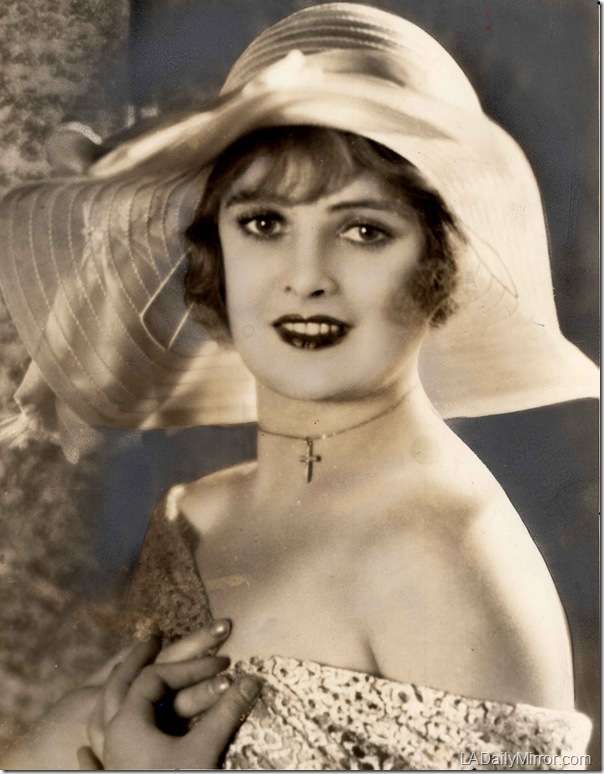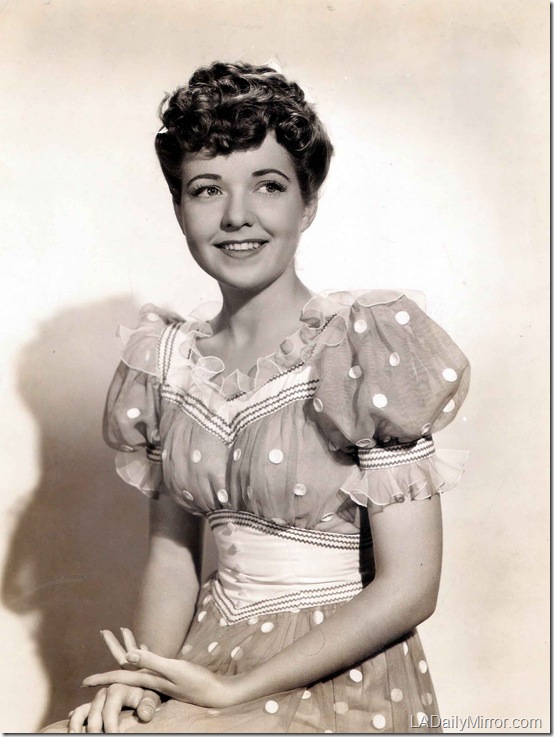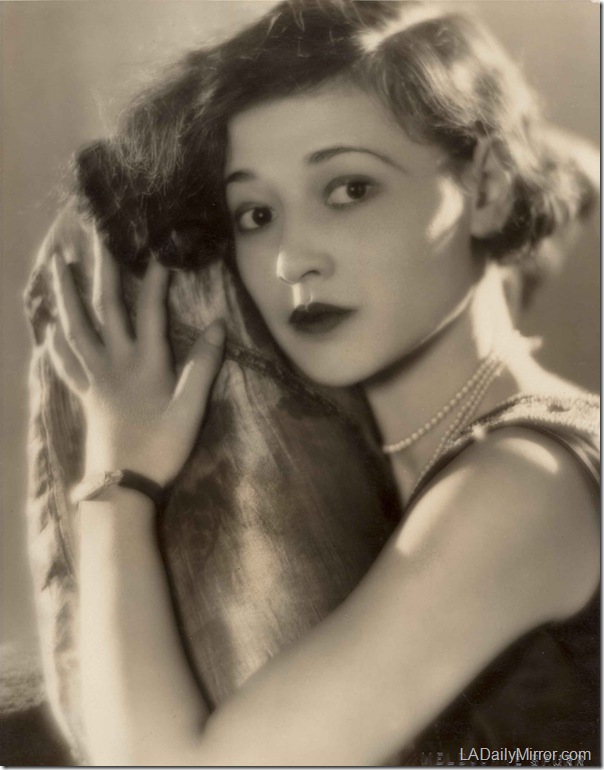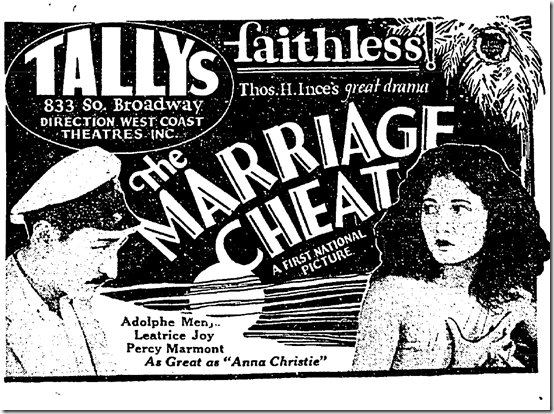
[Update: This is Helene Costello (d. 1957). And yes, that is quite a bracelet.]
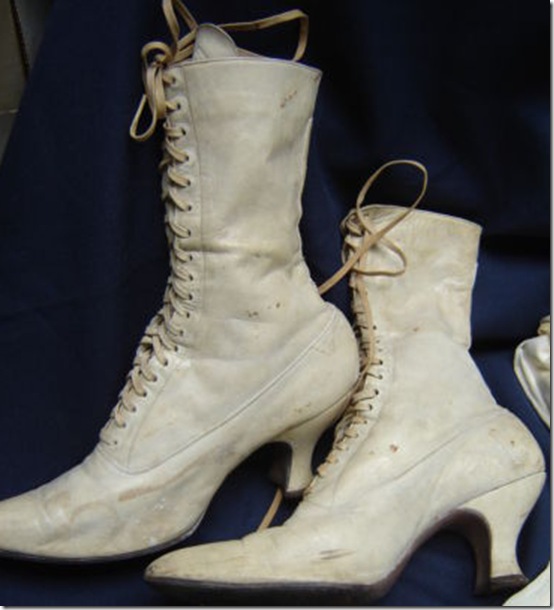
Here’s a photo of a mystery woman and some mystery jewelry, courtesy of Steven Bibb!

[Update: This is Helene Costello (d. 1957). And yes, that is quite a bracelet.]
Here’s a photo of a mystery woman and some mystery jewelry, courtesy of Steven Bibb!
Photo: 130 W. 30th, via Google maps’ street view.
SPOTLIGHT
David W. Dunlap, writing in the New York Times’ City Room, tells the story of Congregation Beit Simchat Torah, sometimes called the “gay synagogue,” which is moving into a building with an Assyrian motif.
NEWS
Google is helping to fund the restoration of one of the buildings at Bletchley Park, the famous site of World War II code-breaking. The machines built to help crack the German Enigma codes are often viewed as the some of the earliest computers. BBC
BLACK DAHLIA
Marilyn Manson’s paintings of the Black Dahlia will go on display Nov. 12 as part of the Theatrification event at the Million Dollar Theatre. The event also features David J’s “Black Dahlia” song cycle, written for the film “The Chanteuse and the Devil’s Muse,” which will be used in a staging that tells the story of Madi/Mady/Mattie/Matty Comfort. Comfort, in case you have forgotten, became part of the confusing myths surrounding the Black Dahlia case because she was photographed by Dr. George “Evil Genius” Hodel. Hodel, at least according to his son’s book franchise, supposedly committed every unsolved killing in Los Angeles for decades, plus the Zodiac murders, designed the Edsel and discovered Milli Vanilli.
The L.A. Daily Mirror and L.A. Crime Beat gathered from Twitter feeds and prepared to the most exacting specifications by the bots at paper.li.


The home of Julian Eltinge at 2328 Baxter Street in Silver Lake is barely visible from the street.
Note: While trolling EBay, I found yet another article that had been cut from a magazine, in this case, the Architectural Record of February 1921. I will say again: Vandalizing books and magazines for such purposes is an abomination. And besides, the article question – a visit to the home of Julian Eltinge – is available online for free from Archive.org.
Eltinge (d. 1941) was perhaps the preeminent female impersonator of his era. His lavish home is at 2328 Baxter St., but virtually impossible to see from the street.
By ELMER GREY
HE who attempts to reach the main entrance gates of Mr. Julian Eltinge’s house by automobile atleast the gates which were originally intended to be the main entrance gates takes his life in his hands. Three persons only have so far attempted the feat and they were reckless drivers. When we visited this enchanting spot, we therefore left our car at the bottom of the hill and climbed the rest of the way on foot ; and we could easily have imagined ourselves mounting to some mediaeval
baron’s home or to some impregnable fortress that had been so placed for defensive purposes.

Photo: Colonel Harland Sanders, 1976. Credit: KFC
The Edgar Allan Poe House in Baltimore is threatened with “Nevermore.” Kate Taylor in the New York Times.
KFC has launched a website to collect people’s stories about Colonel Sanders.
[Update: The L.A. Daily Mirror and L.A. Crime Beat from Twitter feeds, prepared to the exacting standards of the bots at paper.li.]
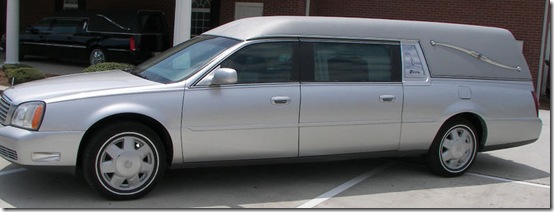
This 1939 Packard Hearse has been listed on EBay. Bidding starts at $16,000, but there is a reserve.
Queen of the Dead—dateline August 8, 2011
• Milly del Rubio, the last of the amusingly camp del Rubio Triplets, died on July 21. She was 89. The del Rubios seemed to “get the joke,” which I always admire in any celeb. Edith, Elena and Mildred were born in 1921, and “even though we knew we didn’t have any talent, we wanted to be in show business,” as Milly told People in 1988. With their showgirl looks, honking voices, and sense of sheer fun, the triplets played cruises, clubs and cut the occasional record from the 1950s through the early ‘80s—by which time they were reduced to playing old-folks’ homes. But with the ’80s came retro camp, and the del Rubios were discovered by booker and songwriter Allee Willis, who turned them into New Wave stars: they appeared on Pee-Wee’s Christmas Special and The Golden Girls, cut new albums (covering hits by the Beatles, Devo and the Doors). They continued performing till Eadie’s death in 1996; Elena died in 2001.

Photo: LAPD homicide detectives in a gag photo, Christmas 1946. Ed is on the left in the back row. Credit: Ed Jokisch
I received word Saturday that my friend, retired Police Capt. Ed Jokisch, has died at the age of 96. I’ll write more about him later. But here’s Part 1 of an interview I did with him several years ago.
In the interview, Ed discusses serving in the Navy in the 1930s, joining the Police Department in 1940, World War II, Chief of Detectives Thad Brown, and working in the Homicide Division under Capt. Jack Donahoe after World War II. Ed also critiques Steve Hodel’s book “Black Dahlia Avenger.”

Photo: Norm’s. Credit: Carlos Lozano.
Note: My friend Carlos Lozano, the state editor at The Times, passed along one of the essays he calls Sunday Journal and gave me permission to post it here.
BREAKFAST AT NORM’S
The place is packed this morning. Norms is always busy, even during the week, when you can get the Four Deuces special — 2 hotcakes, 2 bacon strips, 2 eggs and 2 link sausages — for $3.99. The Monday through Friday crowd is older, mostly retirees, regulars who have lived in the neighborhood for years. But Saturdays and Sundays are different. It’s packed, shoulder-to-shoulder, nose-to-nose, egg-to-egg. And it’s a different crowd. They’re workers, they’re tired and they want someone else to flip their pancakes on the weekend. It’s also a younger crowd. You can hear the kids screaming and crying the minute you walk in. It’s all part of a familiar soundtrack, which today includes an army of waitresses barking orders in Spanish to an overworked chef named Juan, the clattering of empty plates all around and the sound of endless strips of bacon sizzzzling on the football-field size grill. Above the din can be heard the occasional refrain: “More coffee?”
Los Angeles Times file photo
Louisa Northcott, the mother of Gordon Northcott, isn’t portrayed in “Changeling,” but played a key role in the actual case. Above, she’s booked in jail. |
||
|
||
Los Angeles Times file photoLouisa Northcott, December 1928. She was paroled in 1940. |

A German poster for the lost film “London After Midnight” has been listed on EBay. Notice that the vendor is in Spain. Also notice that it is listed as Buy It Now for $14,000. As with anything on EBay, an item and vendor should be evaluated thoroughly before submitting a bid.

Photo: Mark Twain. Credit: Library of Congress.
RECOMMENDED
Kim Palchikoff has a fascinating op-ed piece in the New York Times about some family icons that survived the atomic bombing of Hiroshima on Aug. 6, 1945.
Edward Rothstein of the New York Times reviews the North Carolina History Center in New Bern, N.C., and compares it with Tryon Palace, completed in 1770.
Could there be a more startling contrast? The new history and the old confront each other not in the form of academic debate or historiographical argument, but in the form of experience: one history is here, another there. And visitors — whose number has doubled to about 200,000 a year since the new center opened last fall — can’t miss the juxtaposition. On the one hand, there is a 20-acre complex of historical buildings and gardens, which opened in 1959 as Tryon Palace: an ambitious development project inspired by John D. Rockefeller’s re-creation of Colonial Williamsburg in Virginia. A highway had to be rerouted, a bridge rebuilt, property acquired and buildings moved so that these places could re-establish New Bern’s claim to historical importance.
NEWS
Donna Gregor, a controller at the Mark Twain House and Museum, admits embezzling more than $1 million. Shelly Banjo in the Wall Street Journal | NBC Connecticut
Robert B. Townsend of the American Historical Assn. writes about changes in institutional review boards intruding on historical research such as oral histories. “Any historian who uses oral history methods, or supervises students who conduct interviews, should speak out and demand change,” Townsend writes.
The L.A. Daily Mirror and L.A. Crime Beat lovingly prepared from Twitter feeds by the bots at paper.li.
Photograph by Tony Rivetti Jr. / Universal PicturesAbove, Colm Feore as Police Chief James Davis, “Changeling,” set in 1928. |
||||||
![]() Los Angeles Times file photoAbove, Police Chief James Davis, 1926. |
||||||
|

This souvenir photograph from the Florentine Gardens has been listed on EBay. Most of these pictures come in a cardboard holder that’s stamped with a date. This one isn’t marked, oddly enough, but a comparison with my reference file indicates that it’s probably from 1942. The club, which was managed by Nils T. Granlund, was known for having its showgirls tease the customers, as this woman is doing. I suspect she is Marie Van Schaack, better known as Lili St. Cyr, who was one of the regulars at the Florentine Gardens. If anyone can verify her identity, thought would be great. Bidding starts at $19.50.


Photo: A page of Woody Guthrie’s scrapbooks. Credit: Robin Carson, the Woody Guthrie Archive
Eve M. Kahn of the New York Times examines efforts to preserve Woody Guthrie’s fragile, crumbling scrapbooks. The Woody Guthrie Foundation received an $80,000 grant from the federal Institute of Museum and Library Services to conserve the material. If you have ever examined an old scrapbook, you know just how easily this material disintegrates. [Bonus fact: Guthrie was briefly a suspect in the Black Dahlia case. No, really!]
Reed Johnson, in the L.A. Times’ Culture Monster, visits an event at the Hammer Museum that marks the unofficial beginning of Pacific Standard Time, a festival that will examine and celebrate art in Los Angeles from 1945 to 1980.
The L.A. Daily Mirror and L.A. Crime Beat lovingly prepared from Twitter feeds by the bots at paper.li
The “Enigma Boy” who fooled police into believing that he was Walter Collins is identified as Arthur Hutchins Jr. of Iowa.Read Part I of The Times reports on the story that formed the basis of “Changeling.” |
||||
|


Jan. 30, 1937: Leroy Broomfield and Aurora Greeley perform at the Ubangi Club.
[Update: This is Aurora Greeley, and if you have never heard of her, you have lots of company.]
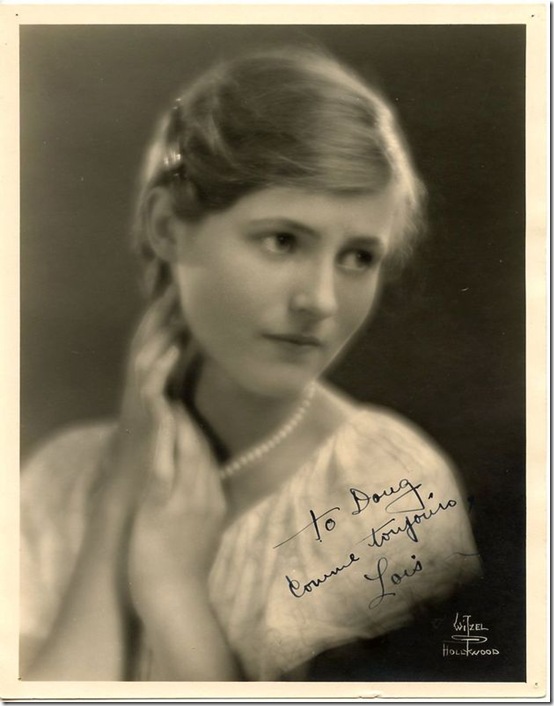
Here’s a Witzel photo that truly is a mystery….

Photo: Retired Lt. Col. Leo R. Gray with “The Spirit of Tuskegee.” Credit: Jahi Chikwendiu / The Washington Post
Jacqueline Trescott of the Washington Post writes about “The Spirit of Tuskegee,” a Stearman trainer that has been acquired by the National Museum of African American History and Culture. The biplane was restored by Air Force Capt. Matt Quy after being used as a crop duster and eventually wrecked.
The Victoria (Texas) Advocate has a story by Jennifer Preyss about a research odyssey that began when Jack Hodge discovered the World War II dog tag of Capt. Wesley P. Vordenberg in his frontyard.
The L.A. Daily Mirror and L.A. Crime Beat lovingly prepared from Twitter feeds by the bots at paper.li
![]() “Outside the Edison,” by Marion Eisenmann. |
| Note: I’m reposting the sketches that Marion Eisenmann did on the former incarnation of the Daily Mirror blog. This is from 2010. I thought it would be fun to write about the crowds that have revived downtown nightlife in the last few years, so late one Friday, Marion Eisenmann and I strolled up 2nd Street from The Times and studied the people waiting to get into the Edison. It’s an ultra-hip club with an entrance in the alley and lots of arty-industrial metal stairs going down to what used to be the boiler room in the basement of the Higgins Building.There’s usually a long line on the sidewalk on Friday nights and sometimes a stretch limo is parked nearby. The flashy young crowd lined up for half a block and the packs of bicyclists that take over the streets are quite a contrast to the many nights when I left The Times Building to find that I had downtown to myself.Marion says: “It was easy to determine the color mode for this illustration. It was night, and the people lining up for the club were dressed in black or black and white.”Note: In case you just tuned in, Marion and I are roaming Los Angeles in a project inspired by Joe Seewerker and Charles Owens’ Nuestro Pueblo.Anyone who’s interested in Marion’s artwork should contact her directly. |
![]() Police Capt. Jones and LAPD officers search the lake in Lincoln Park for the body of Walter Collins, Los Angeles Times, April 6, 1928. |
||||||||||
|
![]()
Photo: President John F. Kennedy and Stan Musial. Credit: Cecil Stoughton, John F. Kennedy Presidential Library and Museum
Washington Post columnist John Kelly has a terrific story about author Harvey Sawler, who is looking for two boys, one white, the other African American, from the Washington Metropolitan Police Boys Club who joined President Kennedy for the July 10, 1962, All-Star Game. Harvey has found Dennis Marcel, the white boy in the picture, but is still looking for Frank Brown.

Photo: “The King of Pop.” Credit: Rosanna Xia
Seaton Brown’s portrait of Michael Jackson in soda cans has been sold for $7,500 to Ripley Entertainment, which operates Ripley’s Believe It or Not! museums. Mike Boehm in the Los Angeles Times’ Culture Monster.
The L.A. Daily Mirror and L.A. Crime Beat lovingly crafted from Twitter feeds by the bots at paper.li