Eve Golden: Queen of the Dead

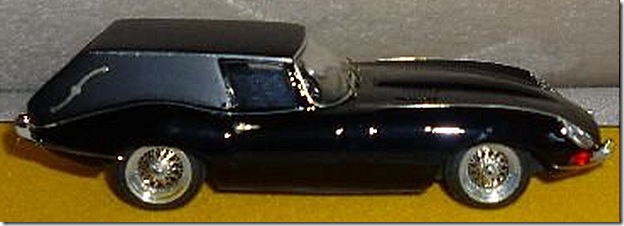
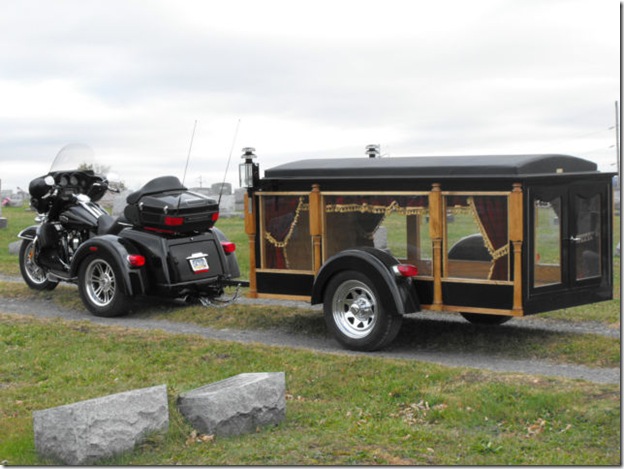
1937 Oldsmobile Hearse

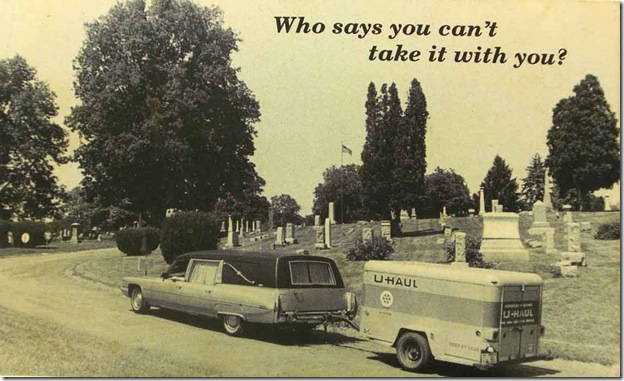
Photo: 1937 Oldsmobile customized hearse listed on EBay at $7,550.


Queen of the Dead – dateline January 16, 2012

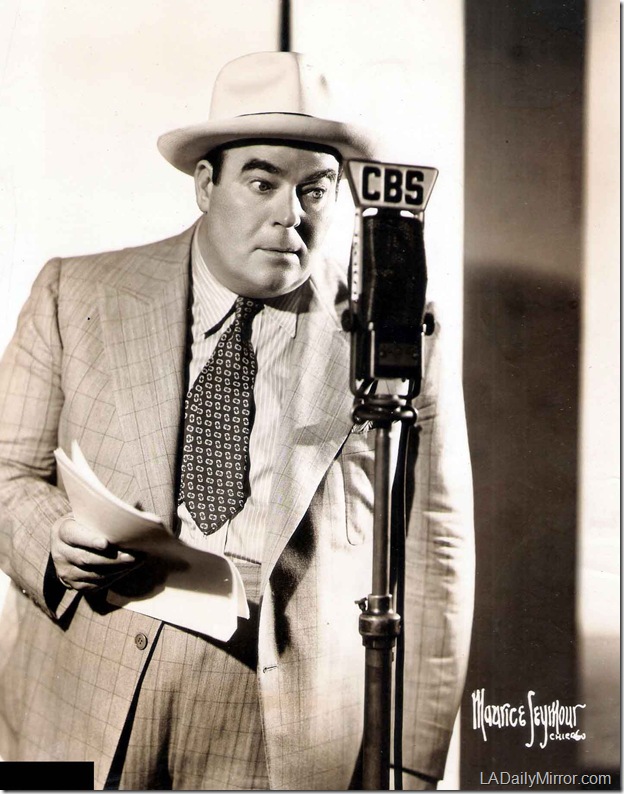
•  Singer and actress Betty Jane Rhodes, 90, died on December 26. A radio and recording success as a child, she was signed by Paramount in 1936 and through the 1940s she acted (and frequently sang) in such films as Jungle Jim, Stage Door, Having a Wonderful Time, Along the Rio Grande, The Fleet’s In, Sweater Girl (in which she introduced “I Don’t Want to Walk Without You”), Star Spangled Rhythm, and You Can’t Ration Love. After leaving films, she continued recording, and singing in nightclubs. From 1945 till his death in 1993, Rhodes was married to Willet H. Brown, co-founder of the Mutual Broadcasting System.

Continue reading

Posted in Cold Cases, Eve Golden, Film, Food and Drink, Found on EBay, Hollywood, Music, Queen of the Dead | Tagged , , | 3 Comments

The Black Dahlia at 65

Biltmore Hotel

Photo: Lobby of the Biltmore Hotel, Jan. 9, 2012, 6:30 p.m. Credit: Larry Harnisch/L.A. Daily Mirror.


I wandered over to the Biltmore on Monday night to keep my annual appointment. I’m not compulsive about being there, and I don’t bother when the date falls on a weekend, but if it’s convenient, I manage a stroll through the building about the time Elizabeth Short walked out the doors in 1947 and into the infinite fog of memory and myth.

By 5:30, the streets of Los Angeles are cold and dark this time of year. The merchants who run the little dress shops and electronics stores on Broadway were getting their displays off the sidewalks and the last few customers were straggling out of Grand Central Market. Hill Street around Angels Flight was a sea of red taillights as cars headed home – or at least tried to get out of downtown.

In the dim light, I cut across the broad, sloping apron of black asphalt where Philharmonic Auditorium used to be. In the distance, a man’s voice announced “Pershing Square” from a bus picking up passengers on 5th Street, like the ghostly chatter at Disneyland late at night, when the park is closing and the shrieking laughter and songs from all those rides echo across the empty Main Street of the Happiest Place on Earth. 

Long after Christmas, the tree trunks in Pershing Square are still wrapped in red and green lights, and big snowflakes hang across the entrance to the ice skating rink set up for the holidays. Outdoor ice skating in sunny Los Angeles? Well, it is the land of make-believe.

Outside the Biltmore, one of those human scarecrows from skid row, dressed in rags and a stocking cap, was begging for money as he roamed among cars stopped for the traffic light at Olive and 5th. I crossed the street and was nearly run down by a panicked lady with a shopping bag rushing to catch a bus, doing that clumsy, awkward jog that women do when they try to run in heels. If I was on a journey into the past this night, I was certainly making it alone.

::

Los Angeles in the 1940s is another Fantasyland, cooked up by a thousand two-bit Raymond Chandlers pounding the keys of their crinkled black Underwoods and Remingtons like Steinbeck’s chimpanzees, knocking out pulp detective thrillers and cheap B movies while they dreamed of making enough money to retire with the wife and kids to a safe little cul-de-sac in Encino and finally writing that big Hollywood novel. 

In Chandlerland, all the cops are crooked and all the politicians are on the take. All the men are Humphrey Bogart or Alan Ladd and all the women are some starlet who was supposed to be the next Virginia Mayo. 

Everything here happens at night. Daylight is only good for making shadows in this fictional land of nightclubs and alleys, cheap diners and seedy rooming houses; too much sun reveals the painted backdrops, the phony rain and the leading man’s toupee.  


I wandered onto the set of Chandlerland in 1996, the earnest reporter searching for the truth — not about Rosebud, but the Black Dahlia.

The basic myth is easy: Once upon a time in the long-ago 1940s, a pretty, naive young girl from back East comes to Hollywood, sleeps with everyone but Elmer Fudd and ends up mutilated, cut in half and left in a vacant lot. 

From there, people blend their own Black Dahlia martini from the gin of lousy books, the vermouth of Wikipedia, and an olive from one of those websites run by folks with tinfoil hats. They can even throw in the grenadine of George Hodel or the Kahlua of Orson Welles. As long as the last ingredient is the shot of bitters about her gruesome death giving her the fame she wanted all her life. And with a Black Dahlia martini, the facts are shaken
and stirred.

Running the AA in Chandlerland is the most thankless job I know. Try taking away someone’s bottle with a dose of reality and they fight and scratch and bawl like a drunk. With the reasoning of an alcoholic, they can talk any angle into being a straight line. Up is down, black is white and night is day. Was it Jack Wilson in the conservatory with a saw? Col. Mustard in the Sowden House with a wrench? Or Miss Scarlet in the Biltmore with a knife? It’s like playing “Clue” with actual people and a real body.  

::


Elizabeth Short isn’t forgotten. She’s worse than forgotten, exploited by fast-buck writers and overrun with crackpots; turned into the patron saint of “lost gurls” in black who leave cigarettes at her grave although she didn’t smoke and buy the Biltmore’s Black Dahlia martini — even though she was pretty much a teetotaler.

I wonder if I saw some of them the other night when I wandered through the Biltmore. There were a couple of young women —  in black, of course —  when I passed through the new lobby — the one that didn’t exist in 1947, despite its starring role in “Black Dahlia Avenger.”

In contrast, the old lobby was almost deserted when I wandered through on Monday about 6:30. Just one couple, a young man photographing a young woman in black. Was it for Elizabeth Short or was she just being fashionable? Should I tell her that Elizabeth Short never got the memo about always wearing black? Only if I want an argument.

I walked out the doors and back to work, marveling at the renaissance in downtown Los Angeles, which has changed so much since I arrived in 1988. The old, derelict buildings have been turned into lofts, and instead of the homeless and their cardboard condos, we have people walking dogs and pushing baby strollers. 

I guess the transformation proves the old line: We cannot forget the past. But we also cannot live there.

I usually prune back my roses on the anniversary of Elizabeth Short’s death. I used to do it on Valentine’s Day, but Jan. 15 is better for the roses and seems more appropriate. And I have a nice crop by her birthday, July 29, which I find a much better day to celebrate.


Posted in 1947, Another Good Story Ruined, Architecture, Black Dahlia, Books and Authors, Cold Cases, Crime and Courts, Donald Wolfe, Downtown, Film, History, Hollywood, LAPD | Tagged , | 24 Comments

The Bradbury Building and the Mystery of ‘China Girl’ [Updated +]

"China Girl"

"China Girl"

This is an establishing shot from the 1942 feature “China Girl,” which was obviously filmed in the Bradbury Building. Or was it?

[Update: If this is a set, as it appears to be, where did Twentieth Century-Fox build it? People talk about the height of the set for “Rear Window,” but this interior appears to be three or possibly four stories tall — although I would imagine there could have been some trickery involved, like forced perspective or matte shots.  A puzzlement.]

Continue reading

Posted in 1942, Another Good Story Ruined, Architecture, Downtown, Film, Hollywood, Mystery Photo, Photography, Uncategorized | Tagged | 26 Comments

The Black Dahlia: Princess Whitewing Follies

Jan. 29, 1947, Princess Whitewing

OK. Princess Whitewing fans, pay attention.

Continue reading

Posted in 1947, Black Dahlia, Crime and Courts | Tagged , | 1 Comment

Movieland Mystery Photo [Updated]

Mystery Photo

We have mystery chaps in a (not) mysterious location…..

Continue reading

Posted in Film, Hollywood, Mystery Photo, Photography | Tagged , , | 36 Comments

The Black Dahlia: Biltmore Hotel

Biltmore Hotel

bilt_lobby1lr

Photo 1: Biltmore Hotel, Jan. 9, 2012, 6:30 p.m. Credit: Larry Harnisch
Photo 2: Biltmore Hotel, 1940s


The top photo shows the old lobby of the Biltmore on Monday as it was on the anniversary of the night Elizabeth Short disappeared. This is how the lobby looks after being remodeled in the 1980s and the way it’s described in John Gilmore’s “Severed.” At least “Severed” doesn’t make the mistake of Steve Hodel’s “Black Dahlia Avenger” in describing the current lobby, which didn’t even exist in 1947.

The bottom photo shows the old lobby as it was in the 1940s.

If the Dahlia books blunder on these elementary facts, you can expect the rest of their claims to be even more ridiculous. People simply do not want to do the pick and shovel work of true research.

Stay tuned, there’s more to come.

Posted in 1947, Architecture, Black Dahlia, Books and Authors, Cold Cases, Crime and Courts, Donald Wolfe, Downtown, Film, Hollywood, Interior Design, LAPD | Tagged , | 19 Comments

Movieland Mystery Photo [Updated +]

image

Here’s a bit of fun trivia from a little documentary that aired on TCM the other day. It’s an early version of the directional signs used by movie crews. And “TWT” stands for?

CSI:NY
Photo: CSI:NY filming in downtown Los Angeles. Credit: Larry Harnisch


[Update: “TWT” stands for “They Went Thataway.” Since I’ve been in L.A., the signs for movie crews have gone from marker scrawled on poster board to professional signs printed on light plastic. Sometimes they use obvious initials (CSI:NY) or fanciful titles. “Bedford Falls” was quite the rage a few years ago. I don’t know what movie crews do in the rest of the civilized world but in L.A., they use these signs.]

Continue reading

Posted in Film, Hollywood, Mystery Photo, Photography | Tagged | 12 Comments

Pearl Harbor Survivor Kills Himself

image

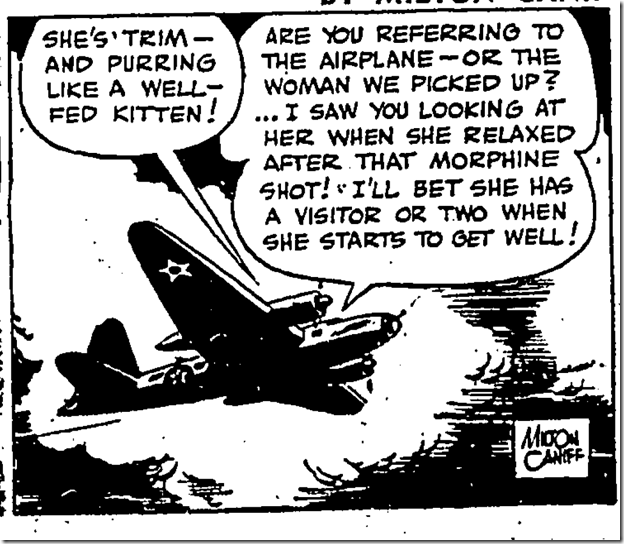
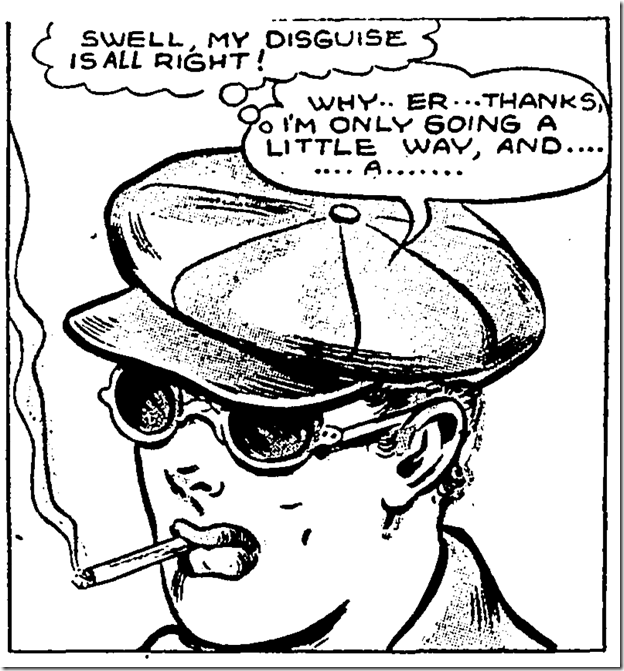
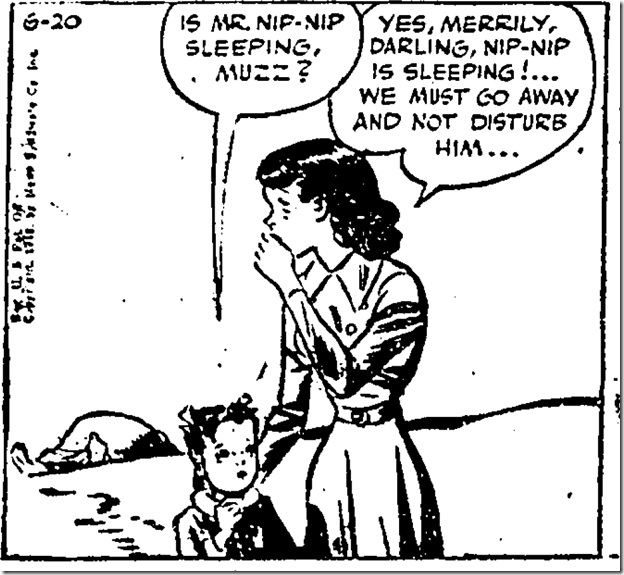
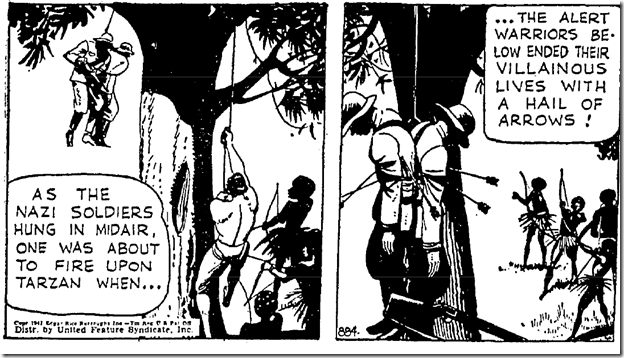
Jan. 10, 1942, Comics
Can’t draw? You too can be a famous cartoonist.


Jan. 10, 1942:  Pearl Harbor survivor William Parks kills himself in San Francisco after going AWOL. “His note to his wife indicated that the bombardment he underwent had upset him,” The Times said.

He was 19.

Aimee Semple McPherson preaches on “The Price of Power” at 10:30 a.m. and “Samson and Delilah” at 7 p.m. on Jan. 11 at Angelus Temple.

Tom Treanor recounts a story about tourists visiting L.A. “Do you want to see the orange groves? The Mt. Wilson telescope, the public library, the museum?

“Why,” said one of the rubbernecks, “we thought we’d like to drive down and see where all those people were killed last night.”

Immigration problems?The Times’ classified ads have a solution.

Jimmie Fidler says: Since the blackout, a woman and daughter have been seeking autographs outside the Mocambo, armed with flashlights.

Continue reading

Posted in 1942, Art & Artists, Columnists, Comics, Film, Hollywood, Immigration, Religion, Tom Treanor | Tagged , , , , , | 1 Comment

Movieland Mystery Photo

Jan. 9, 2012, Mystery Photo

Here’s another mystery photo from the collection of Steven Bibb.

Posted in Film, Hollywood, Mystery Photo, Photography | Tagged , , , | 10 Comments

Eve Golden: Queen of the Dead

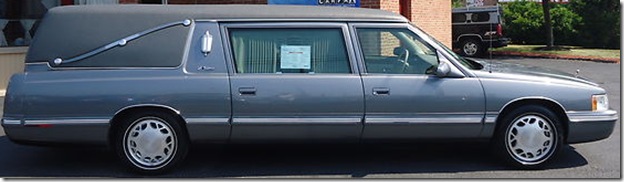
hearse_1929_cadillac_ebay01

Photo: This 1929 Cadillac hearse, exported to Argentina,  is listed on EBay at Buy It Now for $35,000.


Queen of the Dead – dateline January 9, 2012

•  Illustrators are right up there with starlets and socialites on the “people I am unhealthily obsessed with” list. The great Ronald Searle, 91, died on December 30. The British artist—with his cutely Satanic little beard—drew for The New Yorker and TV Guide, the British Life and Punch, did a series of St. Trinian’s girls’ school books which became a movie series; he did movie posters and title sequences—his swirly, detailed drawings are instantly recognizable (the Times compared him to Hogarth and the Telegraph to Bosch: “the humorist illustrator was a man of much darker vision who could find sharp things to say about global poverty, paedophilia or the war on terror”). Searle was a POW in Singapore during World War II, and later said, “it gave me my measuring stick for the rest of my life . . . all the people we loved and knew and grew up with simply became fertiliser for the nearest bamboo.”

Continue reading

Posted in Art & Artists, Environment, Eve Golden, Film, Found on EBay, Hollywood, Queen of the Dead | Tagged , , | 5 Comments

Found on EBay – Hotel Alexandria

Alexandria Hotel parmelee_dohrmann02

Sept. 9, 1906, Parmelee Dohrmann

A pitcher from the Hotel Alexandria at Spring and 5th streets has been listed on EBay. In the early 20th century, the Alexandria was one of Los Angeles’ most distinguished hotels. It has withstood several cycles of poverty and restoration, and the Long Beach, Sylmar and Northridge earthquakes, surviving to witness the astonishing downtown renaissance. Bonus: It’s across from the Last Book Store.

Parmelee-Dohrmann was originally at 232-234 S. Spring St., then moved to 436-444 S. Broadway. By 1930, the store was at 8th and Flower streets, with branches in Pasadena, Long Beach and San Diego.  Its last appearance in The Times is a display ad from December 1952, listing stores at 510 W. 7th St. in Los Angeles; 520 Pine Ave., Long Beach; and C Street at 7th Avenue in San Diego.

Bidding on the pitcher starts at  $9.99.

Posted in Downtown, Found on EBay, Interior Design | Tagged , , , | Comments Off on Found on EBay – Hotel Alexandria

Found on EBay – ‘Gwangi’

Gwangi

image

Photo: Gwangi! Gwangi!


I’m a sucker for any movie that has cowboys, dinosaurs and Freda Jackson warning “Gwangi! Gwangi!” So imagine my surprise to discover what an EBay vendor says is Willis O’Brien’s large preproduction model for an unproduced film from 1941 – later made by Ray Harryhausen as “The Valley of Gwangi.”  Bidding starts at $16,499, or Buy It Now for $19,499.

As with anything on EBay, an item and vendor should be evaluated thoroughly before submitting a bid.

Posted in 1969, Film, Found on EBay, Hollywood | Tagged , , , | Comments Off on Found on EBay – ‘Gwangi’

Movieland Mystery Photo

Mystery Photo

… and this movie would be?

Posted in Architecture, Film, Hollywood, Mystery Photo, Photography | Tagged , , , , | 9 Comments

Movieland Mystery Photo

Central Homicide

And this movie would be?

Perhaps you would like a hint….

Continue reading

Posted in Architecture, Film, Hollywood, Mystery Photo, Photography | Tagged , | 15 Comments

Girl ‘11 or 12’ Taken From 62-Year-Old Husband

Jan. 7, 1942, Child Bride

Jan. 7, 1942, Comics

Jan. 7, 1942: Whenever people give me this nonsense about the past being “a kinder, simpler time,” I always think of stories like Joe Downs and his “wife.”

President Roosevelt delivers his annual State of the Union address, which was praised by the Republicans in Congress. Yes, kids, there was a time when Republicans had the audacity to praise a Democratic president.

There are many interesting aspects of Roosevelt’s speech (on the jump) but I’m particularly struck by his conclusion. It’s difficult to imagine any contemporary politician invoking religion so forcefully.

Our enemies are guided by brutal cynicism, by unholy contempt for the human race. We are inspired by a faith which goes back through all the years to the first chapter of the Book of Genesis: “God created man in his own image.”

We on our side are striving to be true to that divine heritage. We are fighting as our fathers have fought, to uphold the doctrine that all men are equal in the sight of God. Those on the other side are striving to destroy this deep belief and to create a world in their own image — a world of tyranny and cruelty and serfdom.

That is the conflict that day and night now pervades our lives. No compromise can end that conflict. There never has been — there never can be — successful compromise between good and evil. Only total victory can reward the champions of tolerance and decency and freedom and faith.

Tom Treanor says: We didn’t save any rubber Sunday. If anything, the Sunday driving was heavier than usual. At the intersection of Riverside Drive and Los Feliz Blvd., cars were backed up at one time between a quarter and half a mile.

As I have said before, traffic in Los Angeles is not a new problem; it is a very old one that we are still trying to solve.

How Green Was My Valley”opens tomorrow at Grauman’s Chinese and Loew’s State.

Jimmie Fidler says: A casual line in a letter just received from Fred Allen set me thinking. Says Fred: “There are so many ‘anti’ campaigns today a guy with a good ‘for’ movement could clean up.

Continue reading

Posted in 1942, Art & Artists, Columnists, Comics, Film, Hollywood, Jimmie Fidler, Politics, Religion, Tom Treanor, Transportation | Tagged , , , , , , , , | 1 Comment

Movieland Mystery Photo

Mystery Photo
I was watching this movie the other night and thought: “Hey! Wait a minute. That’s…..”

The film shouldn’t be too hard to identify. But the location …  hmmmmmm. As I often say, living in Los Angeles is like living in a big movie set.  They film everywhere.

Continue reading

Posted in Architecture, Film, Hollywood, Location Sleuth, Mystery Photo, Photography | Tagged , | 28 Comments

Bonnie and Clyde Submachine Gun for Sale

Bonnie and Clyde Machine Gun

Photo: Thompson submachine gun, serial No. 4208, with detachable stock and ammunition drum. Credit: Mayo Auction and Realty.


This .45-caliber Thompson submachine gun 1921A, reputedly seized after a 1933 shootout with Bonnie and Clyde, is being auctioned, along with the couple’s Winchester 12-gauge shotgun on Jan. 21, by Mayo Auction and Realty of Kansas City, Mo.

The weapons have been in the possession of a police officer’s family for many years and were loaned to the Springfield, Mo., Police Museum from 1973 to 2011, the vendor says.

Presumably, any collector with enough money and interest to acquire this submachine gun knows the paperwork that is involved in owning one.

And in case you’re wondering, a submachine gun fires handgun ammunition (.45 caliber, in this case) rather than machine gun-caliber ammunition.

Posted in 1921, 1933, Crime and Courts, Film, Hollywood | Tagged , , | 1 Comment

Movieland Mystery Photo [Updated]

Jan. 5, 2012, Mystery Photo

Here’s another mystery photo from the collection of Steven Bibb!
[Update: This is Lois Butler in “The Boy From Indiana.”

Continue reading

Posted in Film, Hollywood, Mystery Photo, Photography | Tagged | 7 Comments

Examiner, Mirror Fold; L.A. Becomes Two-Newspaper Town

Jan. 6, 1962, Mirror Folkds
Jan. 6, 1962, Mirror Folds
Jan. 5, 1962: A dark, painful day in the history of Los Angeles journalism. Virtually overnight, the city becomes a two-newspaper town. The evening Mirror ceases publication Jan. 5, merging with The Times, and the morning Examiner merges with the evening Herald-Express on Jan. 7, prompting a congressional investigation of possible collusion.

A tearful Norman Chandler, president of Times-Mirror Co.,  tells Mirror employees: “This is to me the most difficult, heart-rending statement I have ever had to make. The Mirror was my dream — this paper was conceived by me. I believed in its reason for being. I had confidence in its ability to grow with the community and to mature as a successful metropolitan paper.”

“Unfortunately, the economics have proved to be such that my original concept has not worked out.”

Randolph A. Hearst, president of Hearst Publishing Col, says: “The conditions which force the Examiner to cease publication are the same conditions that have resulted in the demise of many other well-known newspapers throughout the country. Costs have risen far more rapidly than revenue. Continuing losses, with no foreseeable change in the trend, make discontinuance of the Examiner an economic necessity.”

Rep. Emanuel Celler (D-New York), head of the House Judiciary Committee, says “a city of 2 1/2 million people with a metropolitan area of almost 7 million will become a two-newspaper town.”

Discussing the consolidation of newspapers, Celler says: “This trend bodes ill for our much-vaunted freedom of speech and press and shackles such freedom. In many instances, both sides of the problems are never presented and the news as well as the editorials often become slanted. This must be forfended.”

The late Marty Rossman, who worked at The Times in 1962, told me: “The blood ran on the floor that day.” Some of the Mirror’s high-profile columnists and writers (Paul Coates, Matt Weinstock and Paul Weeks, for example) moved to The Times. Others were not so fortunate. The late Bill Kershaw, a slot when I started at The Times, lost his job and went to the Herald Examiner before rejoining The Times. The late Jerry Clark, a former Mirror employee, once said he asked Otis Chandler who decided to kill the Mirror. Otis replied: “I did. Next question.”

For people too young to recall afternoon papers or understand their function, here’s a brief explanation: The morning papers (or AMers) tended to be a straightforward reporting of the news of the day, and for much of the 20th century, there were multiple editions per day for home delivery, closing stock market figures, racing results, street sales, etc. The afternoon papers (or PMers) tended to be updates of breaking news stories, with more sensational treatment, stock market figures, racing results, features, serialized novels (a specialty of the Herald-Express) and that sort of thing.

As American lifestyles changed after World War II and into the 1960s, more people were getting their news from television, cutting into the circulation of afternoon papers until they slowly faded away.

The Examiner’s circulation was 381,037 daily; 693,773 Sunday. The Herald-Express’ circulation was 393, 215. I’ll have to do some digging to find the Times’ and Mirror’s circulation figures. The Herald Examiner folded in 1989 and many employees joined The Times.

Continue reading

Posted in 1962, Columnists, Front Pages | Tagged , , , | 15 Comments

Removal of Streetcar Tracks Leaves Ugly Mess in Redondo Beach

Jan. 5, 1942, Comics
Jan. 5, 1942, Nazis Quell Protest
Jan. 5, 1942: Nazi patrols plow through students protesting in Paris’ Latin Quarter, “firing a warning burst from machine guns over the heads of the crowd” and then proceeding to “clean up the situation,” The New York Times reports. “A separate report stated that at least 100 hostages had been ‘liquidated.’ ”

Japanese immigrants Henry Morishita and K. Goto try to establish their San Diego vegetable market as the headquarters of the Free Japanese Committee to Aid Democracy, which would raise money to help U.S. defense.

Times columnist Tom Treanor, who was killed covering the liberation of France, muses on what life will be like after the war.

“In the aircraft factories, employment of women, after a lull, is about to pick up again. Experience to date has shown that women can do what has heretofore been considered men’s work and do it satisfactorily. Many jobs they perform better,” Treanor says.

Redondo Beach Councilwoman Bernice Venable has come up with a play to beautify the many blocks of right of ways abandoned by the Pacific Electric Railway.

“When the Pacific Electric abandoned its right of way the removal of rails left broad stretches of unsightly, broken ground centering some of the city’s most scenic residential boulevards,” The Times says.

And yes, that means the streetcar system was already being dismantled before World War II. Are you surprised? Good.

Nathan Marsak, this is for you: Recent enemy submarine activity off the coast has restricted the movement of tankers, which in turn has curtailed oil production. The Times once covered the mining and oil industries, believe it or not.

Film director Fritz Lang is planning a lecture tour on “Fear Psychology.”

Jimmie Fidler says: Study in contrasts: Bouncing Betty Grable and sedate Judy Garland at adjoining tables at the Mocambo.

Continue reading

Posted in 1942, Art & Artists, Columnists, Comics, Environment, Film, Hollywood, Jimmie Fidler, Streetcars, Tom Treanor, Transportation, World War II | Tagged , , , , | Comments Off on Removal of Streetcar Tracks Leaves Ugly Mess in Redondo Beach