
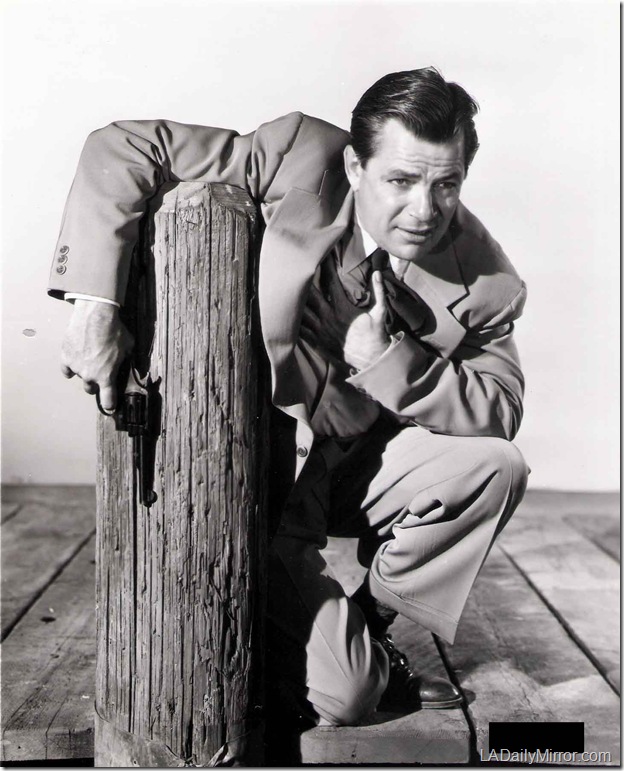
Here’s another mystery photo from the amazing collection of Steven Bibb!
Here’s another mystery photo from the amazing collection of Steven Bibb!
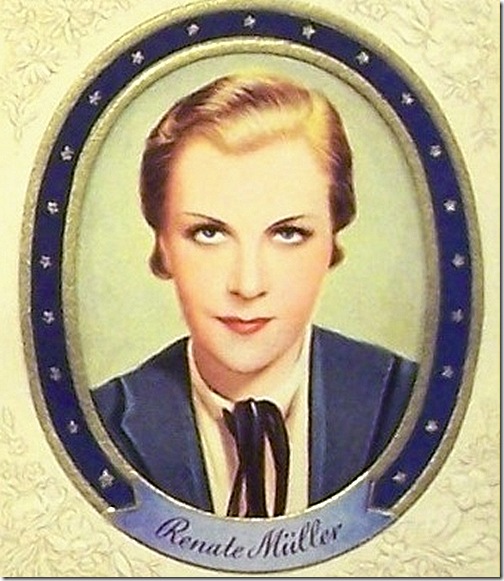
An cigarette card of Renate Müller has been listed on EBay as Buy It Now for $2.99.
Renate Müller
1906 – 1937
I’ve always gotten a frisson of enjoyment from Weimar-era Berlin culture, probably because like, in a good horror movie, we all know what’s coming. So my iPod is full of German jazz bands, and I also have (thanks to my German friend Bettina) a CD of Renate Müller’s recordings. Renate was the German equivalent of . . . hmmm . . . pre-Astaire Ginger Rogers would be the best example. Sassy but wholesome, a tough city gal with apple-cheeked good looks, and a terrific singing voice. But unlike Ginger, Renate vanished—quite mysteriously [she says, ominously]—by the end of the 1930s.
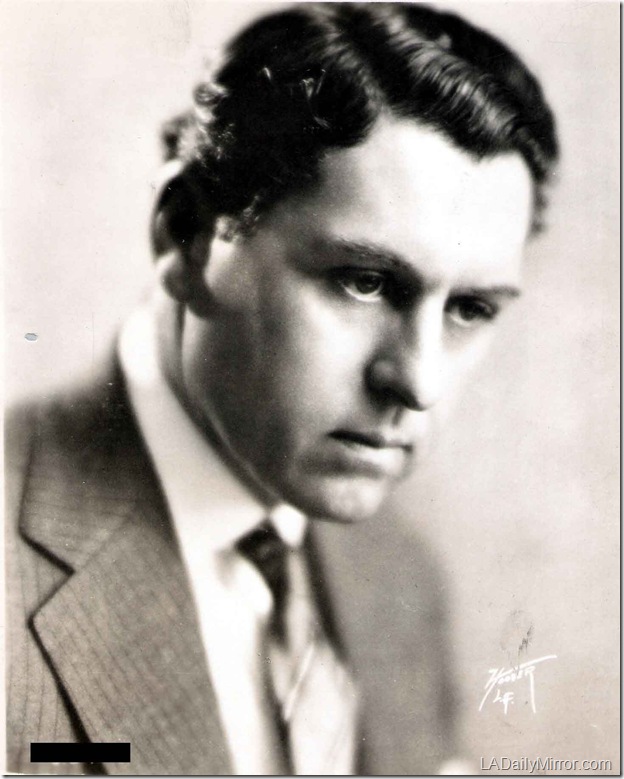
Here’s another photo from the amazing collection of Steven Bibb!

In the last forty years, movie collectors and photography connoisseurs have recognized the art and value of Hollywood still photography, most particularly in the gloriously lit and composed portraits of glamorous stars. For decades, however, many people, including industryites, failed to recognize the skill and talent of the many photographers shaping the public’s perception of celebrities through their skillful work behind the camera.
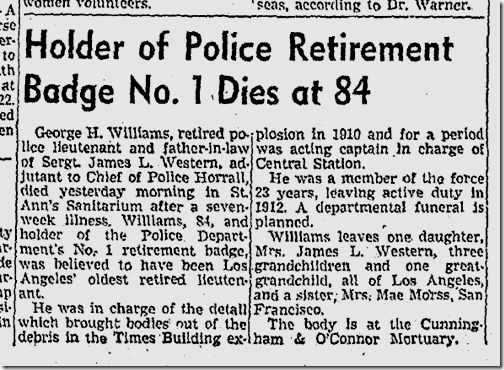
Sept. 13, 1942: Retired Lt. George H. Williams,who held LAPD retirement Badge 1, dies at the age of 84. He retired in 1912 after serving with the department for 23 years and was in charge of the detail that brought bodies out of the Times Building after the 1910 bombing.
Washington is testing “standsit” seats for its streetcars and buses to accommodate more passengers and use less steel, which is needed for the war.
Homicide Detectives Ray Varela and R.J. Hollis kill murder suspect Richard Emilio Diaz after tracking him to a downtown garage.
Bert Grossman dies at Cedars of Lebanon Hospital after telling police that two men “accosted him and forced him to drink from a bottle of ‘some bitter liquid.’ ”
“Panama Hattie” starring Ann Sothern is opening at Grauman’s Chinese Theatre and Loew’s State.
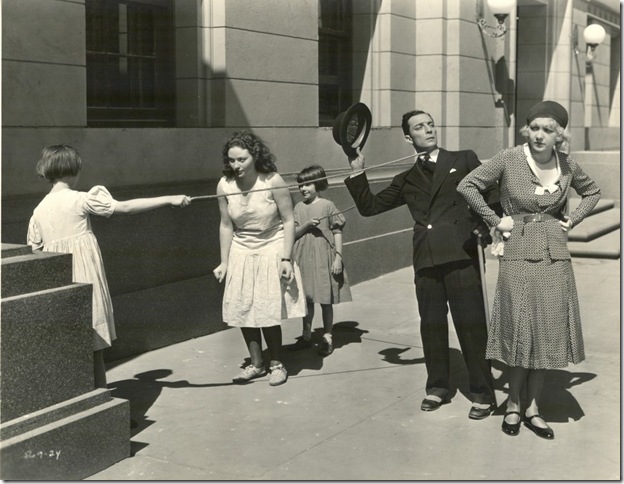
A photo of Buster Keaton in “Sidewalks of New York” has been listed on EBay. Bidding starts at $199.95.
James writes: Here’s another of those interviews I did during a random burst of energy in 1975. This one took place a couple of weeks before my previously-posted talk with Dick Lane, and my memory is that this one is probably a bit better because of the range of topics it covers.
JAMES CURTIS:After a series of films at Educational and some time out of work, Buster Keaton came to work for you for a while… Considering his background and stature, did you work with him in a special way?
JULES WHITE:No. More or less, we had a fixed way to work with everybody. As I said, first we’d get the idea from the writer. Then we’d talk it over and elaborate in conference. And then we’d get a first draft. And then we’d say, “Let’s do this and this and this and this, and then re-write that first draft. Now it’s in pretty good shape. And then we’d get the comedian in. And then we’d discuss it with him. And then—I dictated every script I ever shot—I dictated the shooting script. And in so doing, I shot the picture on paper. When I got on the set it was indelibly in my mind. So this was our process with everybody, including Keaton. Or anybody else. Keaton, too, contributed much.
JC: How was Keaton to work with at that time? He had had some bad luck, and I guess some bad times…
James Curtis’ interview with Jules White, Part 1 | Part 2 | Part 3 | Part 4 | Part 5
James Curtis’ interview with Dick Lane Part 1 | Part 2 | Part 3 | Part 4 | Part 5 | Part 6 | Part 7

An LP of Helen Kane “the Boop-Boop-a-Doop” Girl!” has been listed on EBay. Bidding starts at $59.99.
Helen Kane
1903 – 1966
Helen Kane is one of those performers you either love, or you want to strangle within 30 seconds. I fall into the first category (though I sympathize with the second—I have a baby-talking coworker who still lives only because I have an iPod to drown her out). Helen would be forgotten today if not for that thieving bitch Betty Boop, who pulled an All About Eve and stole Helen’s looks, her voice and her career. Next time (and this happens to you every day, I’m sure) someone says, “Helen Kane provided the voice for Betty Boop,” you have my permission to sock them right on the beezer.
Helen was a vaudeville star of the late 1920s, with a good strong singing voice; her scat interpolations (boop-boop-a-doop, vo-de-o-do and others) being her hook. Paramount grabbed her at the dawn of the talkies, and she made half-a-dozen films for them in 1929 and ’30, usually playing the heroine’s wise-cracking pal. And—for my money—she was adorable. Tough, sharp, funny, and a good singer and dancer (watch her hoofing a mean “Prep Step” in Sweetie).
Then in 1930—right smack in the middle of Helen’s movie career—Fleischer Studios decided to cash in and create a cartoon caricature, Betty Boop (who started out as a dog girlfriend for Bimbo; Betty soon became human and Bimbo remained a dog, their hot romance undimmed by what others might consider a handicap). A series of Betty Boop soundalikes were hired for the voice-overs; the most famous, Mae Questel, later admitted she was spotted while doing a Helen Kane impression.
Problem was, the Betty Boop cartoons were much better than any of Helen’s Paramount films: funnier, weirder, naughtier. By 1931, Helen was reduced to making short subjects and back touring in vaudeville, while the Betty Boops only got better and better (till the Production Code turned her into a wholesome cutie-pie and ruined everything—the series finally ground to a long-overdue halt in 1939). Helen, as any sensible person would do, sued the Fleischers’ asses, for appropriation of her image and her voice. Frustratingly, the trial notes no longer exist (and believe me, I looked, to the annoyance of the nice people in the New York court archives). But we know from newspaper coverage that the Fleischers and the voice-over actresses shamelessly perjured themselves (as Mae Questel later admitted), and the judge tossed Helen’s case out. Watching Helen Kane, and then watching a Betty Boop cartoon, you want to go back in time and smack the living daylights out of a certain Judge McGoldrick.
Helen Kane’s story ends in professional frustration but personal happiness. She retired from show business in 1935 and settled into a third, happy, marriage to restaurateur and man-about-town Dan Healy (not to be confused with Ted Healy, who unleashed The Three Stooges upon the world). The couple lived a paycheck-to-paycheck lower-middle-class life in Queens, surrounded by family (Helen’s niece sounds exactly like her). Through the 1950s and early ’60s, Helen tried for a comeback, doing the kind of character roles being played by Marion Lorne, Shirley Booth and Elizabeth Patterson, but ill health and her New York locale hampered her efforts. Still, she was funny and philosophical: I have a long taped interview she did late in life, and there’s not a touch of bitterness or regret.
Helen Kane died after a long bout of cancer in 1966, and Betty Boop lives on. I leave you with a YouTube clip of Helen (accompanied by one of my heart-throbs, the wonderful Skeets Gallagher) at her best, in her third film, Pointed Heels (1929): now, seriously, don’t you want to bust right into that courtroom and shout “what the hell do you mean Betty Boop was not based on Helen Kane, you idiots?!” http://www.youtube.com/watch?v=U1e3j30NnEs

Here’s another photo from the amazing collection of Steven Bibb!
Update: This is Dolores Moran and Macdonald Carey in “Count the Hours.”
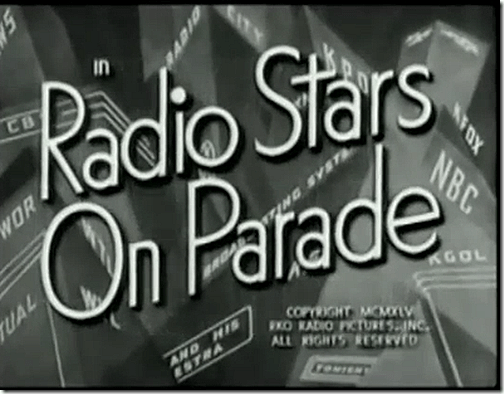
I had to look up scenes from a 1945 B-film called Radio Stars on Parade at work, and I noticed poor Jack Grey not just billed as Rear End of Horse, but Rear End of Horse (scenes deleted), which is the most pathetic thing I have ever read.
Plus, that was his last film: after 20 years, it was the point where his horse’s ass scene hit the cutting room floor that Jack Grey realized it was time to hang it up. He’d been in movies since the 1910s, and had played such diverse and memorable roles as Detective (Beast of the City), Bank Guard (Skyscraper Souls), Townsman (Fury), Courtesan (Marie Antoinette—do you suppose IMDB knows what a Courtesan is?), and Reporter (Mexican Spitfire’s Baby). Then came the heartbreaking debacle of Rear End of Horse, and it was all over for Jack Grey. What did he do for the remaining eleven years of his life? My next bio may be Horse’s Ass (Deleted): The Jack Grey Story.
Do you suppose Jack Grey took his wife and kids to see Radio Stars on Parade? “This is finally Daddy’s big break—oh, no, where’s my scene?” Then back—silent in the car the whole way—as Jack Grey realized it was Just Not Going to Happen for him, he would never be the next Bill Frawley.
And Charlie Hall, the sonofabitch who played the front end of the horse? He went on to act for another ten years, including a prime job as Man With Pool Cue on Alfred Hitchcock Presents. I’ll bet Jack Grey went to his death cursing the name of Charlie Hall. “Man With Pool Cue? I could have acted the hell out of that.”
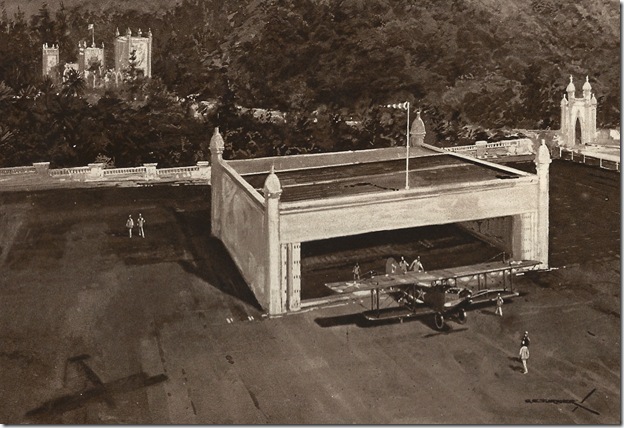
“Aerodrome Replacing Country-House Garage,” Illustrated London News, Oct. 29, 1921, Courtesy of Mary Mallory
Unique thematic architectural homes stand out all around the Los Angeles area, like Yamashiro and Frank Lloyd Wright’s Barnsdall, Freeman, and Storer residences, just to name a few. Glendale possesses another exotic specimen, Leslie C. Brand’s mystical El Miradero, which is now known as the Brand Library. Built as the family residence in 1904, Brand deeded the estate to the city to become a park and library, a jewel in local area recreation spots.
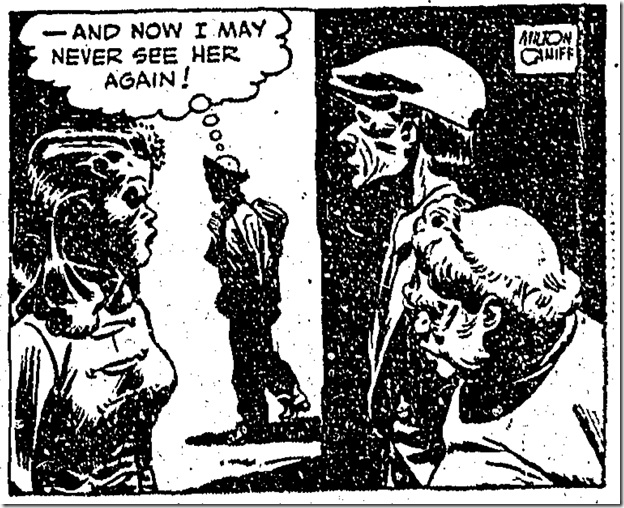
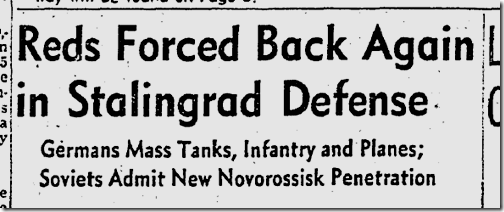
Sept. 9, 1942: Two people died when they were trapped in a burning car on the Arroyo Seco Parkway in South Pasadena after the gas tank exploded in a fiery crash at the Fair Oaks Avenue exit.
John Lucas and Irene Somerlott of Pasadena were in a car driven by John R. Nalon of San Fernando, who was thrown from the vehicle when it hit a light pole, skidded up the Fair Oaks exit ramp and plunged back onto the freeway, catching fire.
Scotty Haskell of South Pasadena told police he tried to rescue Lucas and Somerlott from the burning car, but the flames were too intense.
Note especially the death of John Banks, Negro. In case you didn’t know, newspapers in the 1940s commonly identified African Americans in stories in this manner.
Tom Treanor, who was killed in a Jeep accident while covering the liberation of France, files a report from Cairo about the Long Range Desert Group, who want to know if Clark Gable is serious about getting in on the fighting or just a Hollywood phony.
“The Talk of the Town”opens today at the Pantages in Hollywood and the RKO downtown.

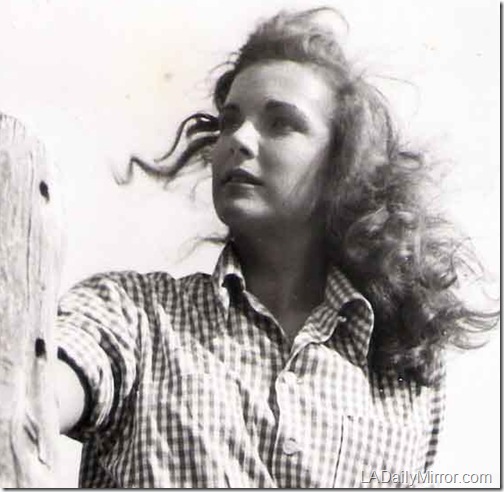
Here’s another photo from the collection of Steven Bibb!
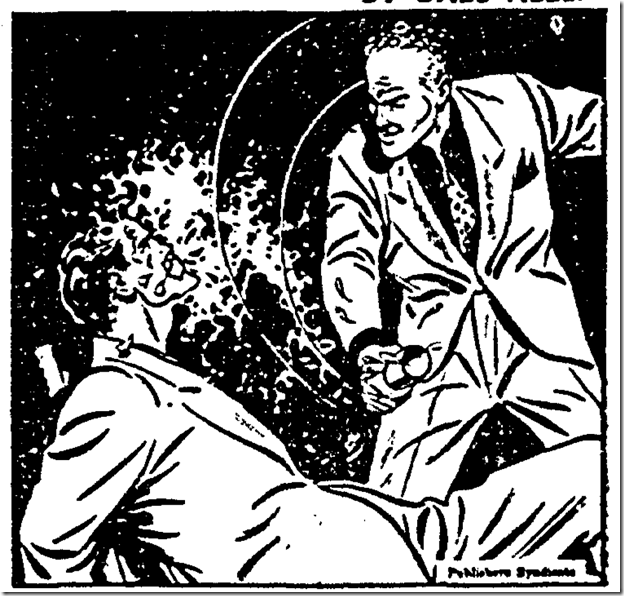
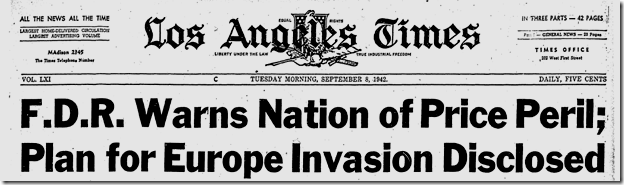
Sept. 8, 1942:Playwright Clifford Odets of 8729 Lookout Mountain Ave. is arrested on charges of drunk driving and speeding on Roosevelt Highway (Pacific Coast Highway) at Topanga Canyon. CHP officers say Odets refused to stop until they forced him off the road.
Lani Nelson wins the title of Miss Car Hop of 1942 in a contest in which judges were seated in cars.
Accountant Lawrence J. Murphy is accused of trying to kill his wife by closing up the house and turning on the gas. She fled to a cousin’s home, where Murphy allegedly threatened her with an ice pick.
Saying that he “hated women,” chemist Gregorio Cardenas Hernandez, 27, tells Mexico City police he killed four women and buried them in shallow graves at the back of his home.
“Across the Pacific”opens tomorrow at Warners’ downtown and Hollywood theaters.
James writes: Here’s another of those interviews I did during a random burst of energy in 1975. This one took place a couple of weeks before my previously-posted talk with Dick Lane, and my memory is that this one is probably a bit better because of the range of topics it covers.
JAMES CURTIS:Getting back to Harry Langdon, what was the reason Langdon came to Columbia?
JULES WHITE:It’s a very strange story. Harry Langdon had become a big star. So big that he was so imbued with his own importance that he became a very difficult man to live with. Frank Capra, who had made Harry Langdon, wouldn’t even talk to him. He got the reputation of being a louse—temperamental, discontented, argumentative, hard to live with. Can’t do this. So, nobody wanted him. His popularity had waned. I don’t know how his last few pictures were financially; I guess they were not too good. Because you know that the public is fickle. They’ll find a new sweetheart every day, and the old sweetheart can go fly a kite. So it was with Langdon. So it was with Charley Chase—although Chase wasn’t temperamental. He just had hit a spot in his life where his films were not in demand.
I had a writer. He was a man who originally got Langdon and Capra together. His name was Arthur Ripley. Arthur Ripley was a brilliant, brilliant man.
James Curtis’ interview with Jules White, Part 1 | Part 2 | Part 3 | Part 4
James Curtis’ interview with Dick Lane Part 1 | Part 2 | Part 3 | Part 4 | Part 5 | Part 6 | Part 7
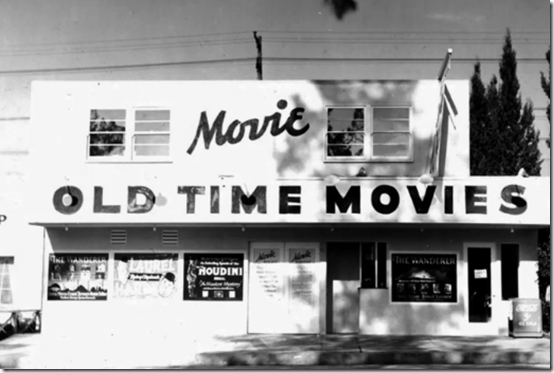
Photo: “Palace of Silents,” a documentary on the Silent Movie Theater.
Cinecon 48 featured several surprises. The Nicholas Sisters opened the festival by performing with their relatives, and Bert Wheeler’s granddaughter made an appearance. Another excellent surprise on Saturday was the moving documentary, PALACE OF SILENTS, which tells the story of Los Angeles’ Silent Movie Theatre. The production features great interviews, cinematography, and music as it reveals how John and Dorothy Hampton built and lovingly ran the theatre, the theatrical days under Laurence Austin and his tragic shooting, the revival under Charlie Lustman’s ownership, and its current days as the Cine-Family. Hopefully the filmmakers can line up distribution for this fine film.

A photo of Constance Bennett has been listed on EBay as Buy It Now for $18.75.
The New Queen of the Dead
No, I have not died and been succeeded by the Princess of the Dead. But I found that the four-obits-a-week thing was getting stale, and I was just churning them out. Not fair to me, or Larry, or my Gentle Readers (if indeed there are any out there—c’mon, people let’s hear some comments!).
I will still mention, from time to time, notable passings, but I want to use one of the few 21st century innovations I approve of—YouTube—to highlight performers of note (or, sadly, not enough note). When I was a young tot [you may insert joke here about the McKinley Administration], I could tell people about, say, Winnie Lightner or Skeets Gallagher, and receive blanks stares. I still receive blank stares—a lot of them, actually; do you think it’s me?—but now I can send people YouTube links, and they either politely pretend they have watched them (and I know who you are) or e-mail back, “OMG, I loved that, am forwarding it to my friends, and am Googling Skeets Gallagher as we speak!”
So for the next few weeks—or months, if your approval is met—I’d like you to meet and greet some old friends. I’m going to get the ball rolling with
Constance Bennett
(1904 – 1965)
Connie Bennett was one of those actresses—like Joan Crawford—who was so high-octane glamorous that people never gave her any credit for her considerable talent. She was from a famed theatrical family and was herself a movie star by the age of 20. She was serious about her art—I interviewed her delightful son, Peter Plant, ages ago and he assured me that she studied her scripts, was always on time and yes, really thought about her characters. But unlike Bette Davis, James Cagney and others, she did not fight for good roles. So today on TCM we mostly see Constance Bennett starring in a lot of turgid crap.
Eve has decided to change the approach of Queen of the Dead and it seemed like a good time to move her to Tuesdays, so starting tomorrow be sure to check on Tuesdays for the new Queen of the Dead feature with Eve Golden, who will debut with a post on Constance Bennett.

Photo: Harold Lloyd in “Hot Water,” shown at Cinecon.
The 48th Annual Cinecon Film Festival is almost over in Hollywood. Once again, the festival features classic silent and sound films, many of which have not been seen in theatres since their original release. So far this year, there have been few Los Angeles or Hollywood locations visible in the films. Here is the roundup for Thursday through Saturday.
Thursday night, August 30 started off with a bang when the Nicholas Sisters, the granddaughters of wonderful dancer Fayard Nicholas of the Nicholas Brothers dance team, copied a dance their grandfather and great uncle were performing on screen. An energetic way to start the evening. This was followed by the musical short ARTISTRY IN RHYTHM (1944), with Hollywoodland resident Stan Kenton leading his really big band and singers in a variety of numbers, this was hip and swingy.
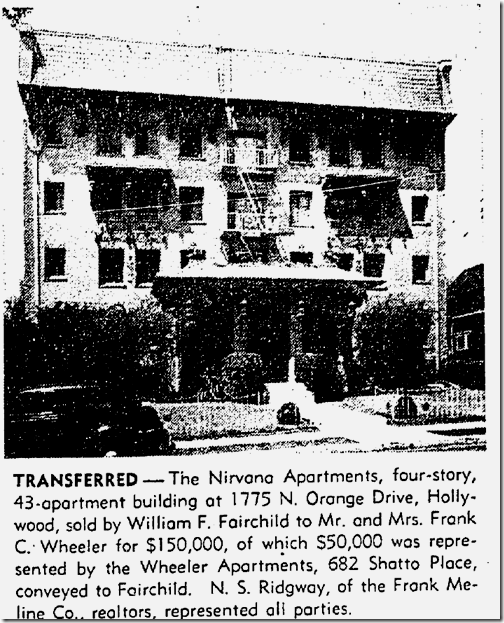
A few months ago, a friend and I were walking up Orange Drive from the El Capitan Theatre to the Hollywood Heritage Museum and noticed a striking Japanese looking apartment building at 1775 N. Orange Drive. It featured a pagoda-style roof and carved dragons under the eaves. After reading the historical-cultural monument plaque on the front, I decided to investigate more about the history of the building.


