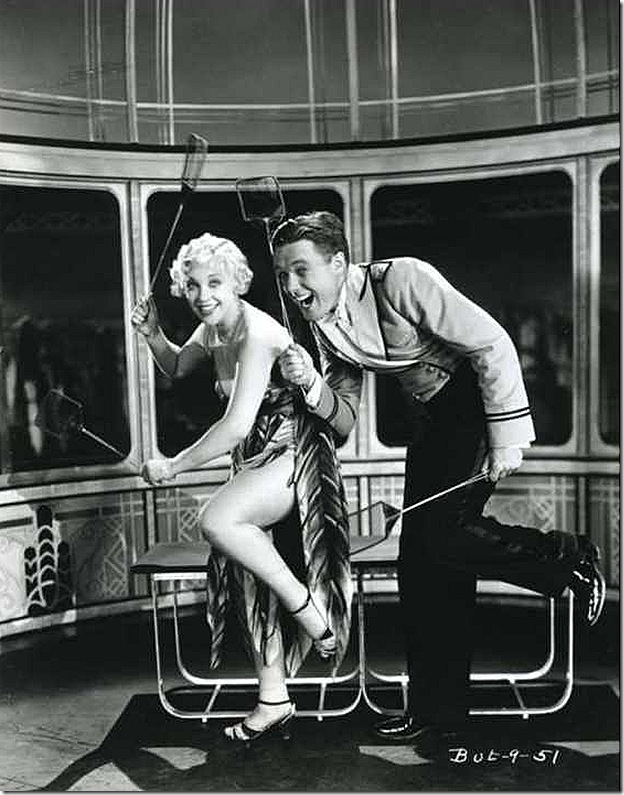
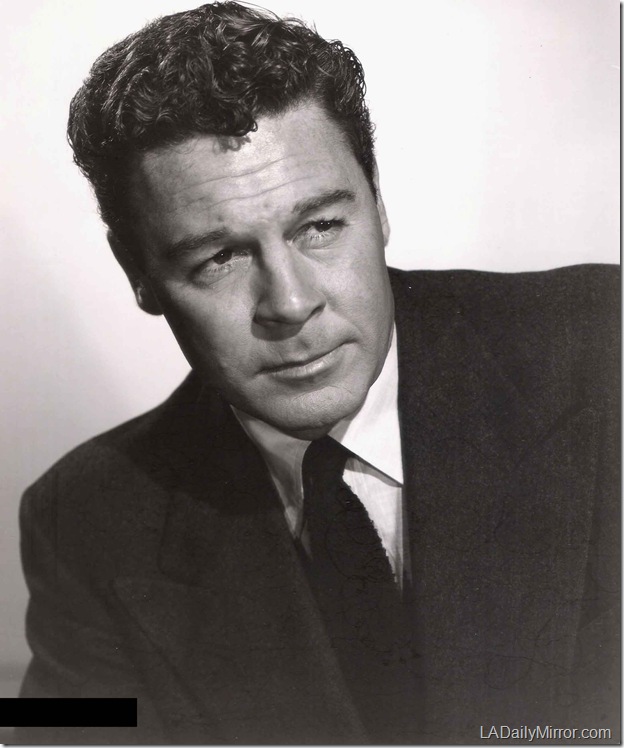
A photo of Marjorie White and Frank Albertson has been listed on EBay, with bids starting at $9.99.
Marjorie White
1904 – 1935
My friend, writer Mel Neuhaus, calls them “say girls.” The hard-boiled dames who start out every line with a side-of-the-mouth “say . . .” You know, they were part of the “comedy couple” in early talkies, who lightened things up when we got tired of the stars cooing at each other. These gals never became as famous as their tough-talking sisters Jean Harlow, Carole Lombard or Joan Blondell, but they brightened up many a Depression-era film: Helen Kane, Lillian Roth, Polly Walters, Zelma O’Neal, Pert Kelton, the great Patsy Kelly.
One of the brightest was Marjorie White (not to be confused with her near-contemporaries Alice White or Thelma White). Pert rather than pretty, with a mile-wide grin and a strong belt singing voice, she was born in Canada in 1904 and was onstage by the age of eight, as one of the Winnipeg Kiddies; by her early twenties, she had teamed with Thelma Wolpa in a vaudeville act (Wolpa later became the aforementioned Thelma White, so they were sisters, if only via the stage). In 1924 Marjorie married dancer Eddie Tierney, then appearing in Keep Kool (one of the Keep Kool Kuties was Barbara Stanwyck, by the way). Tierney joined the White Sisters act.
Marjorie appeared in a handful of Broadway shows and revues, including Hello, Lola (1926, with a young Elisha Cook and Ben Franklin—I am assuming not that Ben Franklin), Ballet Moderne (which opened and closed like a suitcase in 1928), Lady Fingers (with the wonderful Eddie Buzzell, 1929) and Ziegfeld’s 1932 Hot-Cha! (I would kill to have seen this—it also starred Bert Lahr, June MacCloy, Buddy Rogers, Eleanor Powell, Iris Adrian—a great “say girl” herself—and Lupe Velez). Brooks Atkinson of the NY Times called Marjorie a “jaunty hoyden” in this show, which sums her up better than I ever could.
Fox snapped her up in 1929, putting her into their all-star musical revue Happy Days. In a way, Marjorie starred, as a showboat singer bound for Broadway—but she was really the smallest potatoes in the film, which showcased cameos by Fox stars Janet Gaynor, Charles Farrell, Edmund Lowe, Victor McLaglen, George Jessel, Will Rogers, Ann Pennington and others (also making her screen debut was 13-year-old Betty Grable, deep in the chorus line). The NY Times called Marjorie an “enterprising little person” in Happy Days, noting her “energetic and comic efforts.”
A good supporting role in the Gaynor/Farrell starrer Sunnyside Up (1929) followed, a classic comedy-couple pairing with Marjorie and the braying Frank Richardson. She had two good numbers (“You’ve Got Me Picking Petals Off of Daisies” and “It’s Great to Be Necked,” along with a reprise of the title tune). And at only 4’10”, she made wee Janet Gaynor look normal-sized. In 1930, she brightened up Her Golden Calf as well, as the comic relief to leading lady Nancy Carroll: “If it were possible to have more of the singing of Marjorie White . . . the photoplay would be more amusing,” wrote the NY Times.
That same year she was reteamed with Frank Richardson and the annoying El Brendel for New Movietone Follies of 1930, starring William Collier, Jr., and Miriam Seegar. Her biggest hit—or at least her best-remembered film—was Just Imagine, the art deco sci-fi extravaganza of 1930. It was a lost film for decades, and the production stills were so enticing, that when Just Imagine was finally discovered, it turned out to be an inevitable disappointment. The comedy was limp, the romance (Maureen O’Sullivan and John Garrick) dull, El Brendel annoying. But comedy couple Marjorie White and Frank Albertson remain the hit of the film, especially in their comic duet, “Never Swat a Fly.”
1930 and 1931 consisted mostly of long-forgotten films and small roles: as the delightfully-named Totsy Franklin in the Jeanette MacDonald film Oh, for a Man; Charlie Chan Carries On; as “Pee Wee” in Women of All Nations (with El Brendel, again); The Black Camel (another Chan thriller); the Joe E. Brown comedy Broadminded; and a cameo in the short Hollywood Halfbacks (also featuring such B or washed-up stars as Mary Brian, Johnny Mack Brown, Franklin Pangborn, Betty Compson and Priscilla Dean).
Only in MGM’s wonderful Possessed (1931) did Marjorie get a good part, as a gum-chewing doxy brought to the newly-snooty Joan Crawford’s apartment. Marjorie’s part is brief but memorable—she is funny and touching, recognizing that she is out of her element and managing to make a graceful, embarrassed exit. Them it was off to Broadway and Hot-Cha, and back for a nice supporting part on Wheeler and Woolsey’s 1933 Dilpomaniacs (in which she did a slapstick song and dance, “Sing to Me,” with Bert Wheeler). Later that year came a tiny part in Paramount’s Edmund Lowe/Wynne Gibson comedy Her Bodyguard.
But by the mid-1930s, work was drying up for these early-talkie “say girls.” Marjorie supported herself with nightclub and vaudeville work; her only 1934 film was as Larry Fine’s giggly secret bride in the Three Stooges short Women Haters—and it turned out to be her swan song. On Aug. 20, 1935, she was a passenger in a car involved in a two-vehicle collision in Los Angeles; she died the following day, aged 31. The film industry was still reeling from Will Rogers’ death the week before in a plane crash, and Marjorie’s obit was pretty much buried on the inside pages.
I leave you with this clip of Marjorie White in the otherwise pretty terrible Just Imagine (1930), singing PETA’s theme song, “Never Swat a Fly,” with the quite adorable Frank Albertson: http://www.youtube.com/watch?v=xRuWwK51CgI
—Eve Golden









 ladailymirror.com