Movieland Mystery Photo

Nov. 18, 2013, Mystery Photo

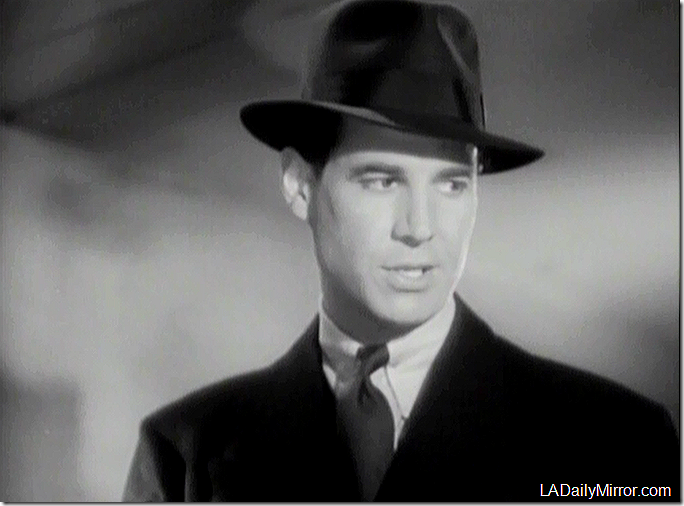
Several weeks ago, the Daily Mirror asked for suggestions about mystery photos. Writer and novelist Christopher McPherson responded with a large number of photographs, which he shared with us. Here’s the first one.  The annoying black box to the left covers the spot where our mystery chap autographed his picture and the little black box at the right covers the code number.  Thanks, Christopher!

Posted in Film, Hollywood, Mystery Photo, Photography | Tagged , , , , | 15 Comments

Mary Mallory / Hollywood Heights — The Fall of the Romanoffs Documents Russian Revolution

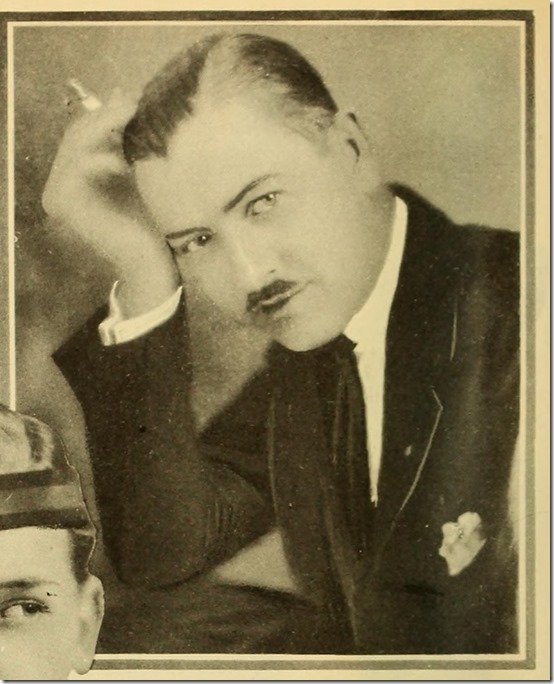
motography18elec_0689

Before CNN, the worldwide web, and the 24-hour news cycle, most persons received their only news of outside world and national events through newspapers. Most cities possessed multiple newspapers pitched to different audiences, some focusing strictly on hard news, some featuring the tabloid, to cater to this important need.

With the invention of moving pictures, films became an integral part in relaying the visceral and emotional impact of news events. In fact, they sometimes shaped news and influenced national policies. J. Stuart Blackton re-created and reenacted battles of the Spanish-American War with the “The Battle of Santiago Bay” and “The Battle of Manila Bay” in 1898, inflaming prejudices and inflating American action. The 1912 short “Saved From the Titanic,” filmed just weeks after the actual sinking of the great ship, reenacted the terrible disaster. While people searched out documented histories of important events in newspapers, many also desired visual representations of these happenings.

Mary Mallory’s “Hollywoodland: Tales Lost and Found” is available for the Kindle.

Continue reading

Posted in 1917, Film, Hollywood, Hollywood Heights, Mary Mallory | Tagged , , , , | 4 Comments

Fatal Fury

Nov. 16, 1907, Fatal Fury

Note: This is a story I originally wrote in 2006 for the 1947project and I’m reposting it for newer readers.

Nov. 16, 1907: Mrs. Amanda Cook (she is also identified as Jennie and Mary) came to Los Angeles from Boston in 1906 with two of her children in search of her husband, Frederick, a union plasterer and bricklayer. She advertised in the newspapers without success and finally took a job as a cook at the Juvenile Detention Home.

Persuaded by her cousin to seek a divorce, she hired attorney George W. MacKnight, who sought out her errant husband and began divorce proceedings.

One day, after being threatened with divorce, Frederick appeared at the juvenile home and upon seeing his wife, said: “What the hell did you come out here for? Why didn’t you stay with your folks in Boston?”

At his office, MacKnight attempted a reconciliation. When asked if he thought he should support his children, Frederick said: “Yes, but I blow in my money with the boys and cannot save a dollar for the kids.”

Miss Jennie Cook, Nov. 16, 1907 Frederick said he didn’t want to get a divorce, so MacKnight asked Amanda if she would take her husband back. “Fred, you know I’ll do that in a minute,” she said. Frederick agreed to rent a house for them as long as MacKnight dropped the case—but the lawyer refused until Frederick made good on his promise.

As soon as the Cooks got into the hallway, Frederick said: “Do you think I’m going to be damn fool enough to support you and those kids?”

His wife replied: “Oh, Fred, you don’t mean that. Why, you just promised to take us back and get a little house for us all together.”

“Well,” Frederick replied, “if you don’t make the lawyer of yours dismiss this case I’ll kill you and him and the judge, too, and if the bum police ever catch me, I’ll kill myself.”

Amanda got a divorce, telling her lawyer: “I’m not afraid of him because he has threatened to cut my throat or blow out my brains a thousand times.”

Frederick began plotting to kill her. His first idea was to murder her at juvenile hall by shooting through a hole he cut in a screen, but he fled after being caught putting a pistol in the opening.

Fred D. Cook, Nov. 16, 1907The next idea was far more cunning.

A champion roller-skater, Frederick went to a hairdresser on South Broadway, where he bought a false mustache and had his hair dyed, explaining that he was so well known in roller contests that he was prevented from entering.

On Aug. 27, 1906, he found Amanda on the fast streetcar from Santa Monica, sat next to her and shot her in the forehead, then stood up and shot her twice more. Several passengers grappled with him and got the gun, but Frederick swung free of the moving streetcar “near the Hammel and Denker ranch,” The Times said, and escaped.

Amanda’s bloody body was left between the seats as the car completed its rounds, slowly sliding down until “only the pathetic, shabby little shoes stuck out into the aisle to haunt those who made that terrible ride,” The Times said.

Frederick surrendered a year later in Fort Worth, Texas, claiming the shooting was authorized by “unwritten law” because he caught his wife with another man.

In 1908, he was convicted and sentenced to life in prison at San Quentin. As for the Cooks’ three children (an older child had been left with relatives in Boston) no record can be found.

Posted in 1907, Crime and Courts, Streetcars, Transportation | Tagged , , , , | 2 Comments

Riot at Tule Lake Internment Camp?

Nov. 15, 1943, Comics

Nov. 4, 1943, Melee at Internment Camp
Nov. 3-16, 1943: It’s almost impossible to get a clear idea from these stories of what was actually occurring at the internment camp at Tule Lake. Early in the saga, one official said “there’s nothing to it,” but later on there are accounts of a riot that may have been staged “on direct orders from Tokyo” and allegations that Japanese at the camp “buried thousands of pounds of fresh pork and used tractors to play polo.” No, really!

In editorials , and in news accounts by Kyle Palmer, The Times had encouraged the evacuation and internment of Japanese in the strongest language. One editorial included below alleges that Dillion S. Myer, head of the War Relocation Authority, was a squishy soft liberal New Dealer (another bete noire of The Times) who refused to take a hard line with “disloyal” Japanese and says that the camps should be put under Army control.

The Dies committee, named for Rep Martin Dies Jr. (D-Texas), referred to in some stories will become better known as the House Un-American Activities Committee. You may have heard of it. If you haven’t, you certainly will.

Opening soon: “Lassie Come Home” and “Young Ideas” at Grauman’s Chinese, Loew’s State, Fox Uptown and Cathay Circle.

Continue reading

Posted in 1943, Art & Artists, Comics, World War II | 1 Comment

Black Dahlia: George Hodel — Soil Samples at the Sowden House: FAIL

Your Theory Is Junk

Saturday was, in case you had forgotten, the one-year anniversary of Buster the Wonder Dog’s frolic at the Sowden House in a search for evidence to link Dr. George “Evil Genius” Hodel to the Black Dahlia killing. You may recall that Buster “alerted” at several locations and that soil samples were taken for testing for possible human decomposition.

The supermarket media and reporters who specialize in one-source stories have had their fun with “Ex-Homicide Cop Says Evil Dad Killed the Black Dahlia ” and moved on to whatever will pump up TV ratings or is trending on Google, “Victoria’s Secret Fashion Show” being today’s likely topic.

Let’s recap the media frenzy:

image

Feb. 3: “Can This Dog  Solve the Black Dahlia Homicide?” by Christine Pelisek in the Daily Beast.

And to quote the Pasadena Star-News of Feb. 1 (Author: Cadaver dog discovered Black Dahlia death scene at Hollywood home by Frank C. Girardot):

The Nov. 9 search of the historic Sowden House on Franklin Avenue in Hollywood was set up in conjunction with the TV show “Ghost Hunters.” Although it was filmed, the segment with Buster never aired.

“It certainly seems like someone was murdered there,” Dostie said. “Something happened.”

But the L.A. Daily Mirror has a long memory and we have posted on the matter regularly, inquiring about the results of soil tests, which were expected, according to Pelisek’s article:

Back at the Hodel house last November, Buster was turned loose to search for scents related to human decomposition—and he perked up, or “alerted” as Dostie calls it, at several potential clues in the basement. Soil samples were taken and results are expected next week.

We waited. Next week came and went. And the week after that.

And the week after that.

Months went by.

Nothing.

Now, I hope you aren’t disappointed or surprised, because Steve Hodel and Buster’s owner, retired Sgt. Paul Dostie, went on a show called “Darkness Radio” on Nov. 5 for its “True Crime Tuesday” feature. And at the 34:38 mark, Dostie says:

At that point we sent the samples off, and unfortunately we’ll probably not get analysis on that. (slight laugh) It’s been almost a year now. And it’s really unfortunate. But we can get some from outside…

In other words, the producers of “Ghost Hunters” took Hodel, Dostie and Buster to the Sowden house, filmed Buster engaging in activity that they described as “alerting” to human decomposition and didn’t use it in the show. Then the tape was aired on KNBC-TV Channel 4, on Feb. 1, kicking off sweeps month, when TV stations go into hyperdrive, broadcasting their most lurid, sensational stories in an attempt to boost their Nielsen ratings.

Executive summary: Buster the Wonder Dog’s frolic in looking for Black Dahlia “evidence” at the Sowden House was all about KNBC trying to boost its ratings for sweeps month. It was a nothing story, which is why “Ghost Hunters” didn’t use it. And now we have proof.

Another good story ruined by the L.A. Daily Mirror.

Posted in 1947, Black Dahlia, Hollywood, LAPD, Television | Tagged , , , , | 3 Comments

LAPD: Parker Center Cop Shop Files

June 16, 1974, Michael Lee Edwards

Several weeks ago, I was given a box of material that was cleaned out of the old press room at the LAPD’s Parker Center headquarters, sometimes called “the cop shop.” The box was a jumble of press releases, photographs, artists’ sketches and other items dating from the late 1960s to the early 1980s. I am organizing and cataloging the material and I’ll be posting selected items on a weekly basis.

The majority of the material is from the LAPD, but there are a few items from the Sheriff’s Department, the Fire Department and other agencies. The photos, showing police officers, suspects and victims, are particularly challenging because many of them are undated and unidentified. Some police officers only have badge numbers or serial numbers. Some victims and suspects are only identified by a DR number or a booking number. And some have nothing.

I’m starting with the 1974 killing of Michael Lee Edwards (DR 74-553-835), the only unsolved murder of a Los Angeles police officer.

Here is 2002 story on the case by former Times reporter Anna Gorman.

And the “77th Street Requiem” by Wendy Hornsby sounds suspiciously like the Michael Lee Edwards case. (Sorry, I originally had “99th Street Requiem.”)

Surely there must be at least one gun enthusiast among the Brain Trust who can tell us what kind of 9 millimeter pistol has six lands and grooves with a right-hand twist.

Continue reading

Posted in 1974, Cold Cases, LAPD, Parker Center Cop Shop Files | Tagged , , , , | 5 Comments

Blogging the Wolfe Book — Seven Years Later

Note: In 2006, I devoted a daily blog to  fact-checking Donald Wolfe’s “The Black Dahlia Files” on a molecular level. The project was so time-consuming – and “Dahlia Files” is such junk – that I stopped about Page 96 and began taking requests to fact-check various remaining sections of the book.

I recently noticed that my blogging of the Wolfe book had received new interest and thought it would be valuable to repost the index to all the items, cleaned up a bit. The links lead to another old blog of mine, which looks completely different. Such is the nature of the Internet.

The blog begins: People keep asking me: “Have you read the Wolfe book?” meaning Donald H. Wolfe’s “The Black Dahlia Files: The Mob, the Mogul and the Murder That Transfixed Los Angeles.” My answer is always the same: I bought a copy but I haven’t read it yet.

Still, people keep telling me it’s a wonderful job and solves the murder, usually prefaced by the statement that “I don’t know anything about the case, but…”

So here we go, in excruciating detail, with frequent detours, asides and references to the five-foot shelf of Black Dahlia books. Since I have to read this turkey, you might as well suffer right along with me. If you’re not interested in Black Dahlia minutiae you will find this a painfully tedious process, which is why I don’t read other Black Dahlia books—they’re junk

Update: And in case you are wondering, I still haven’t heard from Wolfe about the faked document (Part 72). Not that I really expected to.

And this, not the Wolfe book, but something more enduring, an installment in the “Bunny Brown and His Sister Sue” series, one of my mother’s childhood favorites.


Larry Harnisch (described by James Ellroy as a Dahlia scholar/Dahlia freak, take your pick) is blogging in real time as he reads Donald H. Wolfe’s “The Black Dahlia Files: The Mob, the Mogul and the Murder That Transfixed Los Angeles.”

Part 1, Blogging the Wolfe Book
Part 2, The Monster
Part 3, Extra! Extra!
Part 4, Sniff Test
Part 5, Weather Report
Part 6, The Boy on the Bicycle
Part 7, A “C” From the Health Inspector
Part 8, Neutral Milk Hotel
Part 9, A Moment of Silence, Please
Part 10, The Riddler

Continue reading

Posted in 1947, 2006, Black Dahlia, Books and Authors, Cold Cases, Film, Hollywood, LAPD | Tagged , , , , , , | 5 Comments

Rediscovering Los Angeles – Masonic Hall

Dec. 30, 1935, Rediscovering Los Angeles

Dec. 30, 1935: For this installment of Rediscovering Los Angeles, Times artist Charles Owens and columnist Timothy Turner visit Los Angeles’ former Masonic Hall, a building from the 1870s on Main street “on the east side just south of the Plaza.” Unlike the later series by Owens and Joseph Seewerker, published in book form as “Nuestro Pueblo,” these features were never reprinted. It’s interesting to note that even in the 1930s, Los Angeles was being rediscovered.

Continue reading

Posted in Architecture, Art & Artists, Downtown, Main Street, Nuestro Pueblo | Tagged , , , , , | 2 Comments

Movieland Mystery Photo (Updated + + +)

Nov. 11, 2013, Mystery Photo

And for Monday, a mystery chap.

Continue reading

Posted in Film, Hollywood, Mystery Photo | Tagged , , | 44 Comments

Mary Mallory / Hollywood Heights — Greenacres Is the Place to Be

Greenacres
Harold Lloyd and Greenacres in New Movie Magazine.


At the beginning of the fledgling motion picture industry, actors and other creative types earned adequate salaries, in line with middle-class jobs. They lived in modest bungalows, residential hotels, apartments or rented small homes.

When star names sold films at the box office, salaries began skyrocketing. As salaries rose, so did the quality of personal residences. Some actors lived in style at the Alexandria Hotel, Los Angeles Athletic Club and other quality hotels and apartments, while several stars began buying or building elaborate homes to display their wealth and stature in areas like Los Feliz, Hancock Park and Whitley Heights.

Douglas Fairbanks and Mary Pickford renovated a modest hunting lodge on Beverly Hills’ Summit Drive into the lovely estate Pickfair, the de facto Buckingham Palace of Hollywood royalty. Producer Thomas Ince constructed Dias Dorados in Beverly Hills’ Benedict Canyon. Mack Sennett intended to build a lavish estate above and behind the Hollywoodland sign in 1925, killed by financial pressures. Comedy superstar Harold Lloyd soon followed in constructing his own residential palace.

Mary Mallory’s “Hollywood: Tales Lost and Found” is available for the Kindle.

Continue reading

Posted in 1927, Architecture, Film, Hollywood, Hollywood Heights, Mary Mallory | Tagged , , , , , , | 5 Comments

LAPD: Parker Center Cop Shop Files — Mysterious PC Numbers

PC_450_80

Here’s an example of what I’m talking about. This anonymous fellow was captured by a bank security camera and the photo is marked PC 45080. Often in these cases, the PC number will be rendered PC 450 (80), in which the last two numbers apparently signify the year. The matter is further complicated because some of the bank robbery photos have FBI numbers (which begin 91-123456) and others have LAPD DR numbers.

(And yes, there are lots of men with hairy chests in these pictures. It was the era.)

By the way, the LAPD apparently changed its numbering system to this protocol about 1983: The first two numbers are the year. The next two are the LAPD area. The rest are the sequential numbers issued through the year. So 83 01-23456 would be an incident that occurred in 1983 (83) in LAPD’s Central Area (01) and given the number 23456

Here’s another example:

Continue reading

Posted in 1976, 1980, LAPD, Parker Center Cop Shop Files | Tagged , , , | 5 Comments

LAPD: Parker Center Cop Shop Files — A Research Question on LAPD Case Numbering

While I’m on the subject of the LAPD Cop Shop Files, let me see if there’s anyone among the Daily Mirror Brain Trust who is familiar with LAPD case numbers. It seems that after many years of following the protocol “DR 65 (year) 123-456” that the LAPD made a switch in middle of 1983 to the following system: “DR 83 (year) 01-23456.” Is that correct?

Also, it appears that case numbers are not necessarily chronological. Were case numbers assigned in blocks to different divisions or allocated somehow other than chronologically?

Finally, I find that some cases have a DR number or a PC number and that some cases have both. For example, a 1976 case could be DR 76 123-456 AND PC 123 (76). Can anyone explain?

Thanks!

Posted in Crime and Courts, LAPD, Parker Center Cop Shop Files | Tagged , , | 2 Comments

LAPD: Parker Center Cop Shop Files – Starting Next Week

DR-65-594-262

The “Remorseful Rapist” from 1965, one of the items from the Cop Shop Files.


Several weeks ago, I was given a box of material that was cleaned out of the old press room at the LAPD’s Parker Center headquarters, sometimes called “the cop shop.” The box was a jumble of press releases, photographs, artists’ sketches and other items dating from the late 1960s to the early 1980s. I am organizing and cataloging the material and I’ll be posting selected items on a weekly basis.

It will be an interesting ride through old L.A. crimes. I promise.

Coming next week on the L.A. Daily Mirror.

Posted in 1965, Crime and Courts, LAPD, Parker Center Cop Shop Files | Tagged , , | 9 Comments

We Are Revolutionists!


Note: This is a post I wrote in 2006 for the 1947project.

Nov. 9, 1907: Local sympathizers, anarchists and socialists are organizing a mass meeting to protest the imprisonment of Ricardo Flores Magon, Librado Rivera, Antonio Villareal and L. Gutierrez De Lara, who are being held on charges of trying to overthrow the Mexican government.

After years of avoiding capture, Magon, Rivera and Villareal were arrested Aug. 23 at 111 E. Pico St. after a brawl with Thomas Furlong of the Furlong Secret Service Bureau of St. Louis, along with Los Angeles Police Detectives Felipe Talamantes, [Thomas F.?] Rico and two deputies. De Lara was arrested by U.S. marshals at 420 W. 4th St. on Sept. 27.

The Times said of the August incident: “The street was filling with people. Men and women crowded before the house just in time to see a light survey and a coupe dash up before the door. Then the door opened and out into the light
staggered the officers and their prisoners. They fought on the steps and in the street.”

“ ‘We are revolutionists! We are patriots! We are being kidnapped! Help! Help!’ they shrieked.”

In a 1921 letter to his attorney, Magon wrote: “We avoided being kidnapped into Mexico by voicing in the street the intentions of our captors. A big crowd gathered, and it was necessary for our abductors to take us to the police station, and to rapidly manufacture a charge against us.”
The men were defended by Job Harriman, described by The Times as a Socialist agitator.

De Lara said upon his arrest: “I am a student, a writer and, if need be, a martyr. I have written many books. I am now on a cycle of novels in which socialistic questions are discussed. Like Balzac or Zola, I have a mission. I am arrested and thrown into a dungeon. I care not for that, if they furnish me paper, ink and a light.”

To be continued.

Ricardo Flores Magon site


Posted in 1907, History | Tagged , , | 1 Comment

Movieland Mystery Photos — Suggestions, Please

Nov. 9, 2013, Mystery Photo

Another once-famous  face, now forgotten.


Gary Martin recently wrote:

I am amused by the reader’s comment that this week’s mystery is “too easy” and I guess it is as all the usual suspects have written in with the correct cast and title.

Apparently I was out of town the week this film played: I do not know what it is nor have I ever seen any of these actors before …excepting a very young Jack Hawkins. (Friday, right.) I do suspect, however, that it is a British film.

And that makes it all the more amusing to me because growing up in Kansas during the mid fifties, when TV was a young medium, before there were Late Shows, we were fed a steady diet of British programers. Nope. I must have fallen asleep the night this played. …as I often did with programers. Ah well, Monday is another week.

I would like to remind everyone that from the beginning, my first criterion in selecting a mystery person or movie is that I didn’t know who or what it was. To pick a favorite example, I had never heard of Jack Mulhall until I randomly pulled his envelope out of the photo library  several years ago. The same is true with today’s mystery lady (and yes, some of you may recognize her from before).

So to Gary, I would like to say: I couldn’t have identified this week’s movie, “Fallen Idol.” That’s why I picked it. The vast majority of movies (with a few exceptions like “Hillbilly Blitzkrieg” — ahem) I have never seen, which is why we will never have “Casablanca” or “Gone With the Wind” or “Citizen Kane” (well, maybe the back of Everett Sloan’s head).

I would fail every week — if that makes you feel any better.

Which means that I’m impressed every week with the knowledge of the Daily Mirror Brain Trust. You are amazing in your knowledge of film and I am proud to have you as readers.

Despite how it may seem, there is a philosophy behind the mystery photos — I have never seen them as a mere trivia contest. The photos have always been a reflection on the notion that fame is fleeting and once-famous faces are forgotten.

But I have been thinking: Don Danard wants more Westerns. Mary Mallory would like more silent films. And a recent technical malfunction with “Coney Island,” which yes, I had not seen, made me think about opening the mystery photos to guests who could submit pictures or frame grabs.

How about it, mystery photo fans? What would you like to see — or not see?

Posted in Film, Hollywood, Mystery Photo | Tagged , , | 16 Comments

‘Love Child’ Abandoned in Movie Theater as Parents Die in Suicide Pact

Nov. 8, 1933, Comics

Nov. 8, 1933, Missing Love Child

Nov. 8, 1933: Los Angeles history is so rich that all you need to strike gold is to poke a stick in the ground, and today is a perfect example.

We have the story of Jack Bodin Sr., 41, who was estranged from his wife, and Bodin’s girlfriend, Barbara Muller, either 21 or 22 depending on news reports. Bodin, who was variously identified as a salesman, advertising executive and “cafe man” and Muller had a daughter, Audrey Louise Muller Bodin,  on Aug. 1, 1932, but abandoned her in a downtown movie theater at 5th and Broadway on Oct. 3.

The couple apparently decided to commit suicide by booking passage on the steamer ship Yale, sailing from Los Angeles to San Diego and then jumping from the ship on its return to Los Angeles.

In The Theaters: “Footlight Parade” premieres at Warner Bros. Hollywood.

Continue reading

Posted in 1933, 1936, Art & Artists, Broadway, Comics, Crime and Courts, Downtown, Film, Hollywood, Suicide, Theaters | 4 Comments

Hartsook Photographs Jack Pickford

hartsook_Jack_pickford

This Fred Hartsook portrait of Jack Pickford, the brother of actress Mary Pickford, has been listed on EBay. Hartsook (d. 1930) was one of the leading photographers in the silent era. There is more about him in Mary Mallory’s “Hollywoodland: Tales Lost and Found.”  Bidding on this item starts at $29.95.

Posted in Film, Hollywood, Photography | Comments Off on Hartsook Photographs Jack Pickford

The ‘Masked Marvel Murder’ – Part 12

Greta Keller and David G.G. Bacon

The 1942 marriage of Greta Keller and David G.G. Bacon, Albany Times-Union, Sept. 14, 1943, courtesy of Steven Bibb. 


I have spent far more time than I intended on the “Masked Marvel Murder” and not just because it’s an intriguing, unsolved homicide. There are several lessons for the serious researcher and historian, particularly the insight it offers into the 1947 Black Dahlia case.

For example, we meet many of the same individuals who will appear in the Elizabeth Short killing, but the Bacon case is relatively pristine compared to the layers upon layers of fictionalized nonsense about the Black Dahlia. There is only one shoddy, heavily fictionalized book dealing with the case at any length instead of the five-foot shelf of nonsense about the Black Dahlia. And no one has come forward – yet – to claim that their father killed David G.G Bacon.

Continue reading

Posted in 1943, Black Dahlia, Cold Cases, Film, Hollywood, LAPD, Lesbian, Gay, Bisexual, Transgender, World War II | Tagged , , , , , | 13 Comments

L.A. Becomes N.Y.

L.A. Becomes N.Y.

Dear New Yorkers: You love to make fun of us, but here we are at Spring and 5th last night, watering down the street for yet another production set in your fair city but filmed in downtown Los Angeles. And yes, just up the street is the usual fleet of New York taxicabs.

Posted in Downtown, Film, Hollywood, Location Sleuth, New York, Spring Street | Tagged , , , , , , | 4 Comments

The ‘Masked Marvel Murder’ — Part 11

"The Masked Marvel"

David G.G. Bacon, far right, in “The Masked Marvel,” courtesy of Steven Bibb.


So far, the David G.G. Bacon killing is relatively pristine, at least compared to the Black Dahlia case; the killing doesn’t appear in “Hollywood Babylon” or any other similar junk, and no one has come forward — yet — to accuse their father of the killing. Even so,  it has not entirely escaped the genre of crappy biographies. Really, books like “Hollywood Babylon” and Scotty Bowers’ “Full Service” are nothing but soft-core porn using the names of conveniently dead people.

I hadn’t planned to shoot holes in another “tell-all” book after the Ted Healy/Wallace Beery project, but I couldn’t pass up touching at least briefly on Darwin Porter’s purported biography from 2005, “Howard Hughes: Hell’s Angel,” which was followed by “The Encyclopedia of Unsolved Crimes” by Michael Newton, the co-author, with Janice Knowlton, of “Daddy Was the (you guessed it) Black Dahlia Killer.”

The “Masked Marvel Murder” Part 1 | Part 2 | Part 3 | Part 4 | Part 5 | Part 6 | Part 7 | Part 8 | Part 9 | Part 10

Continue reading

Posted in 1940, 1941, 1942, 1943, Books and Authors, Film, Hollywood | Tagged , , , | 7 Comments