
March 21, 1944
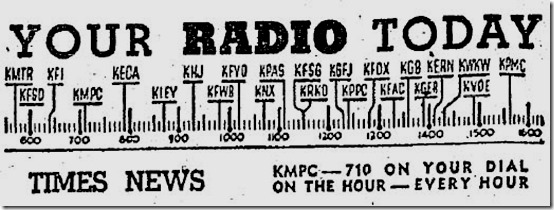
It’s Tuesday in 1944 and today we have:
— Rita Hayworth is the guest on “Burns and Allen.” Courtesy of Otrrlibrary.org
— “Fibber McGee and Molly.” Courtesy of Archive.org.
March 21, 1944
It’s Tuesday in 1944 and today we have:
— Rita Hayworth is the guest on “Burns and Allen.” Courtesy of Otrrlibrary.org
— “Fibber McGee and Molly.” Courtesy of Archive.org.
March 21, 1944
HOLLYWOOD, March 20 — I’d like to give a little argument to the reviewer who recently printed that Humphrey Bogart wasn’t at his best in love scenes. For my money, Bogey has most of the hand kissing boys backed off the boards when it comes to romantic sincerity. At various times Ann Sheridan and Bette Davis have told me they felt the same way about Bogey’s brand of love making (in the movies of course). Now I hear that Bette and Msr. Bogart will get a chance to do some of their most hectic love scenes in a movie they will do, “Lucky Sam McCarver.”
This Sidney Howard play was staged on Broadway about 15 years ago with Claire Ames and John Cromwell in the leading roles. It’s about a gambler with a 5th Avenue lady who fall in love — and how! Henry Blanke will produce.

March 21, 1944
The Wireless: Cong. Dies, who riles easy, is demagoging at a couple of news broadcasters. Now he intends to ask the stations, he says, if they are willing “to afford maligned persons an opportunity to answer false charges over the same facilities and to the same audience.” Let’s assume, Cong. Dies, that you want to be fair — and that you’re not just hunting for a headline. Would you favor the same fair shake for defenseless citizens who’ve been maligned on the floor of Congress? Would you allow the answerers the same immunity from the consequences of reckless statements that congressmen get? Or are you, after all, looking for a headline?
Can you imagine the shrieks from the part-time defenders of “freedom of the press” if Pres. Roosevelt dared to ask a let-up in the walloping he gets? To date, I haven’t heard a peep from them at Dies’ suggestion.

March 20, 1944: The cover story features ballerina Nana Gollner, better known as Golovina. The featured photographer is Carl Mydans, who was held prisoner by the Japanese for 16 months. His essay is on the Tule Lake “Segregation Center,” which may remember was the site of some turmoil in 1943. The week’s movie is “Lady in the Dark.” And yes, Carl Mydans’ son is Seth Mydans of the New York Times. Courtesy of Google.
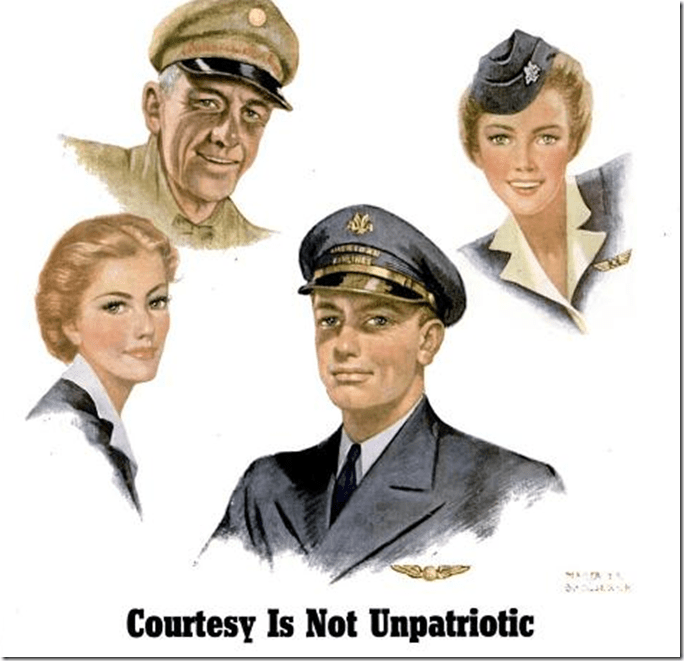
Courtesy in the air, from American Airlines.
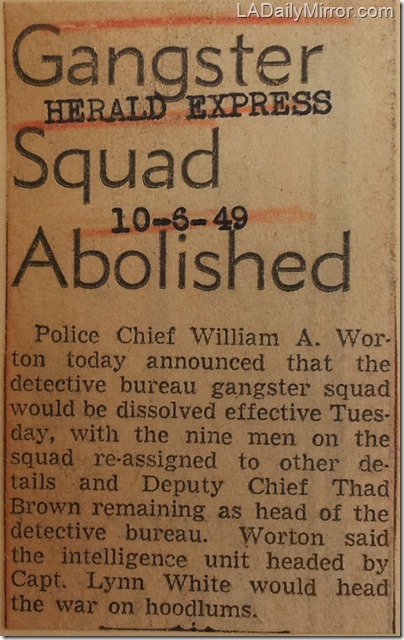
Oct. 6, 1949
Here’s another item from the LAPD scrapbooks at the city archives: The police chief is William A. Worton (are you paying attention, everybody who thinks William Parker was chief in 1949? especially you, Will Beall, writer of “Gangster Squad?”) and he disbands the gangster squad.

Josephine Serrano Collier, courtesy LAPD.

The LAPD is honoring the memory of Officer Josephine Serrano Collier, who died last month at the age of 91 in Tucson. The LAPD says she was its first Latina officer. Here she is in November 1949, arresting an 80-year-old panhandler in Pershing Square.
March 20, 1944
It’s Monday in 1944, which means we have:
— Franchot Tone, Chester Morris, Anne Baxter and Miriam Hopkins in “The Hard Way” on Lux Radio Theatre. Courtesy of Archive.org.
— “The Lone Ranger.” Courtesy of Archive.org.

March 20, 1944
HOLLYWOOD, March 19 — Well, it looks like the diaper-washing days of Mr. and Mrs. Phil Terry (also known as Joan Crawford) are over for good or at least for a long time. The Terrys, who have been taking their time about movie jobs, are going back to work. Joan, as we told you, does “Mildred Pearce” for Warners and over the weekend Phil signed for the role opposite Anne Shirley in “Here Comes the Bride” at RKO.
What’s more, the studio is taking an option on Terry, and he may remain on that lot. In addition to Anne and Phil, “Here Comes the Bride” also has Jane Darwell, just back from Broadway and a fling on the stage in “Suds in Your Eye” in the cast. A word about the title — Para had “Here Comes the Bride” tied up, but RKO hopes to clear the title.
SNAPSHOTS OF HOLLYWOOD COLLECTED AT RANDOM: Carole Landis cooked dinner for her bridegroom, Capt. Wallace, Friday night.
Rosalind Shaffer is not byline I recognize. She filed this feature on Preston Sturges, published in the St. Petersburg Times, March 20, 1944.
Here’s a bonus fact: Shaffer helped found the Hollywood Women’s Press Club.

March 20, 1944
Jerome Hartman: 44-year-old lieutenant commander U.S.N… Hails from Dayton, Ohio … When World War I was over, he became a resident M.D. at the veterans’ hospital in Ohio. For five years, he devoted himself to the care of our wounded soldiers … When World War II came along, he enlisted in the Navy and was assigned, as an observer, to the British flat-top Illustrious.” … The carrier sailed into the Mediterranean, where in battle it was bombed unmercifully. There was no obligation on the part of Cmdr. Hartman to risk his safety. But, without asking questions, he changed his battle station to top deck where, oblivious of bombs, he treated every sailor he found wounded … For this extraordinary “heroism in tending wounded men” this American was decorated by the British government.
John Rankin: Congressman from Miss., appeaser, Negro-and-alien baiter, obstructionist, anti-Semite and darling of native Fascists … In June ’41 he outraged Congress with a vicious attack on minorities. On representative, deeply shocked, answered him, walked out into the lobby, collapsed and died … This Rankin dared to tell Congress that “slavery was the greatest blessing the Negro ever had” … In April ’43 he declared on the House floor that the plan to “Beat Hitler First” was suicidal … He admitted hiding some of his expenses by keeping his wife on the congressional payroll for $3,250 a year as his private secretary, though she did not work in his office.


Here’s another front page that was saved in the LAPD scrapbooks at the city archives. This is the Daily News from June 7, 1949.
Notice the bizarre byline: Will O’Wisp. I can’t recall seeing a fake byline on a news story before. The Times used to publish political items by “The Watchman,” but that’s a bit different.
Note to people making 1940s L.A. gangster pictures (this means you, “Gangster Squad”): Our young hooligans used a burp gun rather than an old-fashioned Thompson submachine gun.

March 19, 1944
It’s Sunday in 1944, which means we have:
— “The Jack Benny Show.” Courtesy of Otrrlibrary.org
—“The Texaco Star Theater” with Fred Allen. Courtesy of Otrrlibrary.org.
March 19, 1944
— CBS’ “World News Today” reports on Allied bombing of Germany and the battle for Cassino. “This is still a battle of yard by yard annihilation.” Courtesy of Archive.org.
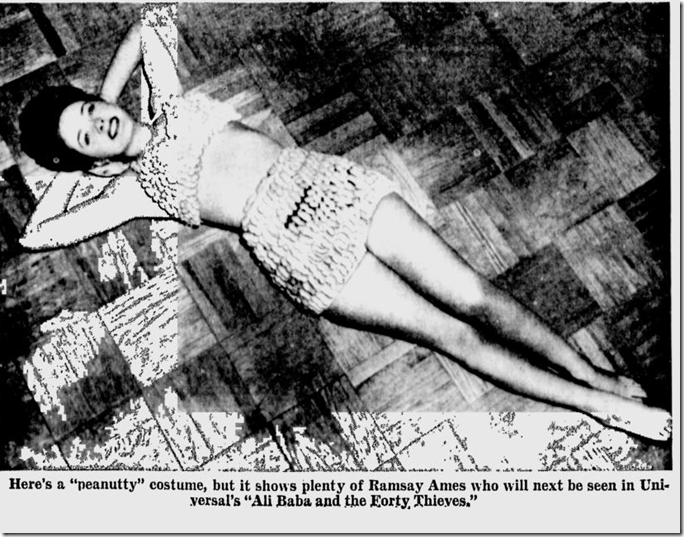

March 19, 1944
It was old home week when I visited the first lady of the theater, Ethel Barrymore, on the “None but the Lonely Heart” set.
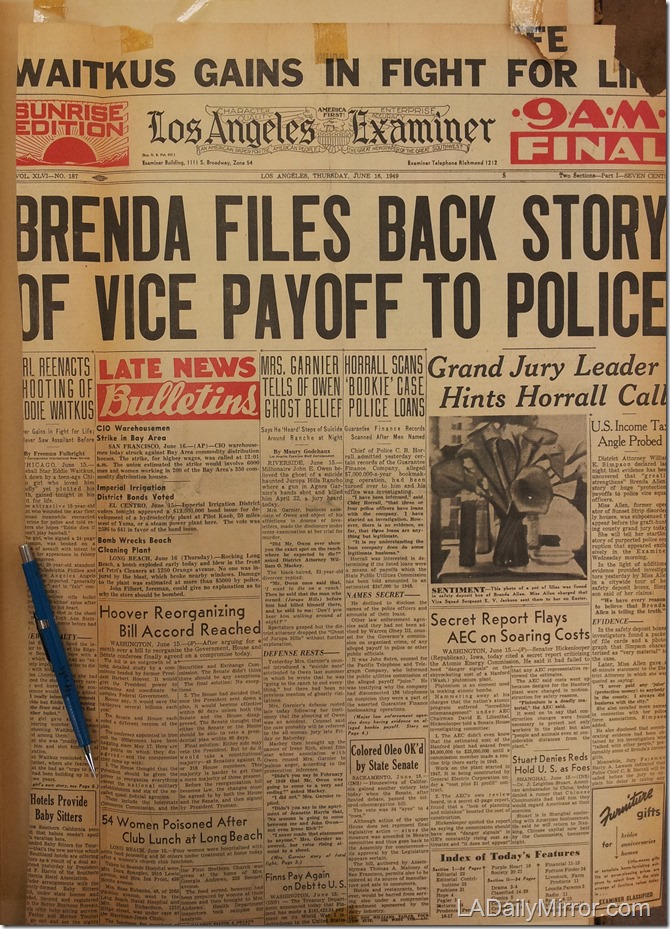

I recently visited the city archives and thanks to archivist Michael Holland, I learned that the LAPD kept scrapbooks in the 1940s. Not all years are represented, unfortunately, but the department apparently subscribed to a clipping service at one point.
This front page is from the June 16, 1949, Los Angeles Examiner with a headline about the Brenda Allen scandal. Notice that this is the 9 a.m. final. Like all newspapers of that era, the Examiner had multiple editions through the day. I mention this because newspapers today have one edition, so the idea of tearing up a page several times over the course of a day is unfamiliar. My impression is that this edition wasn’t delivered to homes (that would be an earlier edition) but was sold on newsstands.
And to save you the trouble of looking, there’s nothing about the Black Dahlia case in the scrapbook for 1947. Not a single clipping was saved. The most you may find is a few stories about the Leslie Dillon fiasco in the 1949 scrapbook.

March 18, 1944
It’s Saturday in 1944 and today we have:
— Jungle Jim and the crew evade Japanese soldiers. “The Adventures of Jungle Jim.” Courtesy of Otrrlibrary.org via Archive.org.
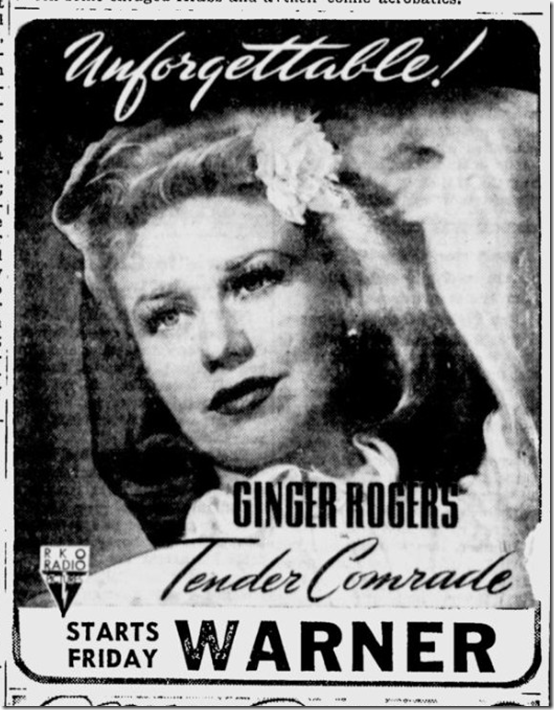
March 18, 1944
HOLLYWOOD, March 17 — Warners are going all out for American movies, and if you want to call that “flag waving” it’s all right with them. As Jack Warner says: “You can’t wave a better flag!” One of the first of the specials will be “San Antonio,” a saga of Texas and the Alamo which should be a minor sized riot where the Texas are concerned….
IT’S GOSSIPED IN MOVIE CIRCLES that Columbia has bought “Burlesque” for Rita Hayworth.

March 18, 1944
Novelette: Irving Berlin arrived the other day from England with messages for kin and loved ones of members of “This Is the Army.” Berlin phoned parents, wives, sweethearts and pals, and took down messages to relay to the boys in his show now abroad. He made several hundred calls.
The most touching: Two soldiers gave him the same name of “the only girl in the world.”
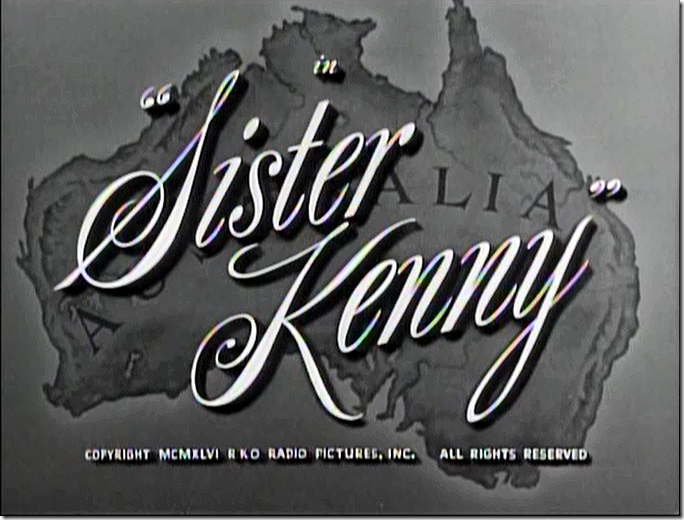
This is “Sister Kenny,” which I thought would be fun to post since Louella Parsons had recently written about it. You may recall that Parsons said Kenny was Rosalind Russell’s house guest while visiting Los Angeles.

Morgan Lithograph’s poster for “The Sheik.”
Fast-cutting, hyper-kinetic trailers and TV spots today sell upcoming films to the general public. In the 1910s-1920s, however, eye-catching visual illustrations like posters and theater displays lured paying customers into movie palaces. Film studios provided lithography companies with photographs or suggested designs around which talented artists produced striking key art promoting the films. Exhibitors rented or purchased the never-ending supply of publicity materials from the studios, manufacturers and exchanges to display throughout their theater or around the town in sizes ranging from half-sheets and one-sheets, to wall-size three- and six-sheets, all the way to gigantic billboard-sized 24-sheets. The Morgan Lithograph Co. reigned as one of the top poster lithographers of this period, creating stunning images branding a company’s product and selling them on a grand scale to consumers.
According to the book, “Cleveland: the Making of a City,” Captain William J. Morgan and his younger brother, George, established the W. J. Morgan & Co. on Superior Street in 1864 to produce broadsheets and various forms of business ephemera (trade cards, pamphlets, blotters, postcards, posters) to advertise local businesses. Increasing orders from surrounding states soon forced the company to abandon using a hand press and employ a punched stamp press to churn out product. They also moved to larger headquarters.
Mary Mallory’s “Hollywoodland: Tales Lost and Found” is available for the Kindle.

