L.A. Daily Mirror Retro Drinking Guide — The Brooklyn Cocktail

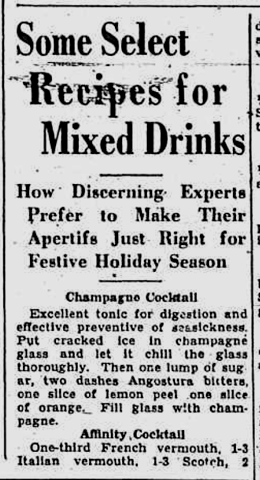
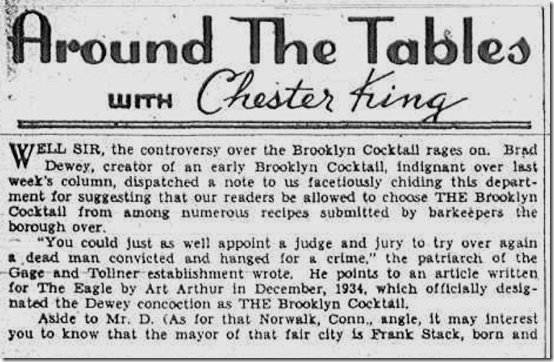
March 5, 1937, Brooklyn Cocktail

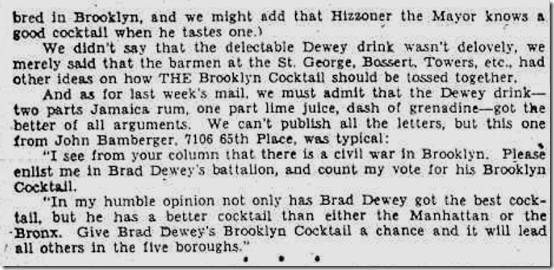
March 7, 1937, Brooklyn Cocktail

Note: This is a repost from 2013.

Yes, the Manhattan cocktail once had competition from drinks named for the other boroughs. Here’s a recipe for the Brooklyn Cocktail, from the Brooklyn Daily Eagle, March 7, 1937. The Brooklyn Cocktail as made by Brad Dewey consisted of

Two parts Jamaica rum
One part lime juice
Dash of grenadine

We won’t be toasting the new year with the Brooklyn Cocktail (we’re working) but if someone is brave enough to try one, let us know how it is.

And in case you are wondering, research shows that there was also a Bronx Cocktail. Evidently it, too, has fallen out of favor.

Posted in 1937, Food and Drink | Tagged , | 3 Comments

Movieland Mystery Photo (Updated + + + +)

Jan. 3, 2015, Mystery Photo
This week’s movie has been the 1937 Warner Bros.’ picture “Call It a Day,” with Olivia De Havilland (Friday’s guest), Ian Hunter (not shown), Anita Louise (not shown), Alice Brady (Wednesday’s guest), Roland Young (Thursday’s guest) and Frieda Inescort (not shown). It was directed by Archie L. Mayo  and written by Casey Robinson from a play by Dodie Smith. Monday’s guest was Elsa Buchanan and Tuesday’s guest was Bonita Granville.

Continue reading

Posted in Film, Hollywood | Tagged , , | 47 Comments

Mary Mallory / Hollywood Heights: Los Angeles Bans ‘The Cabinet of Dr. Caligari’ (Updated)

Cabinet of Dr. Caligari
A still from “The Cabinet of Dr. Caligari from “The Movies Come From America.”


Update: A reader on the film site, Nitrateville, pointed out that novelist Upton Sinclair wrote about the protest at “The Cabinet of Dr. Caligari” in his short story/novel, “They Call Me Carpenter: Tale of the Second Coming,” for Hearst International in 1922.

As with most of his writing, he points out the political and social aspects of the protest, that it was not so much about German propaganda, as it was protesting imports that might hurt American business if they were better products. An early dig at the film industry working to try and stop foreign competition might have come back to hurt him when he ran for Governor of California in the 1930s, and the industry worked to smear him and his reputation.

Sinclair describes the scene as his character decides to go to Western City’s Excelsior Theatre on Broadway with his friend, German professor, Dr. Henner, to see a German film that Henner recommended.

They see a large crowd out front, and realize they’re dressed in military uniforms, pushing and yelling at patrons attempting to enter the theatre. Dr. Henner decides to hang back, but the protagonist asks a bystander why the crowd is doing this, and he replies, “Because it’s Hun propaganda.” He breaks through the crowd to get in and asks the man at the door of the theatre if the film is propaganda. The theatre worker replies, “They say they won’t let us show German pictures, because they’re so much cheaper; they’ll put American-made pictures out of business, and it’s unfair competition.”

After watching the film, he realizes how different it is from American films, with the futuristic sets taking him into the dreams and mind of a mad man. He thought it was very interesting and contained fine acting.

Exiting the theatre, he hears the protesters shouting that watchers are sending money to the Germans watching the film, sending their cash to the enemy rather than helping starving Americans. He describes the scene as a mad scene, almost like something out of the movie. He tries to get away, but they start beating and kicking at him, calling him a traitor as he runs for cover.

In effect, he describes how the film industry helped manipulate Anti-German opinion to their own benefit in banning “The Cabinet of Dr. Caligari” from playing in Los Angeles’ Miller’s Theatre in his fictional account.

Over the last few weeks, news of Sony Studios pulling “The Interview” from film theaters after threats by the Guardians of Peace (GOP), who may or may not be North Korea, flooded the internet. After suggestions of possible 9-11 style attacks on cinemas that might show the film, exhibitors quickly cancelled tit, and it appeared “The Interview” might possibly never be seen. The artistic community scoffed at Sony’s abandoning freedom of speech. It appears as of Tuesday, December 23, 2014, that independent exhibitors approached Sony (or vice versa) and now the film will open in perhaps 200 theaters on Christmas Day.

In May 1921, however, Los Angeles residents caused such a ruckus that the German Expressionist film, “The Cabinet of Dr. Caligari,” was pulled from Miller’s Theatre, never seen in the city until six years later. This time, creative organizations worked to try and ban all German films from the United States, which would have been a terrible blow to freedom of speech and expression.

Mary Mallory’s “Hollywoodland: Tales Lost and Found” is available for the Kindle.

Continue reading

Posted in 1921, 1922, Film, Hollywood, Hollywood Heights, Mary Mallory | Tagged , , , , , , | 5 Comments

Not on Netflix: ‘Batman’ and ‘Day the Earth Stood Still’

"Batman"

The Joker isn’t kidding this time. Batman really is disappearing!


“Batman” will join the Not on Netflix brigade starting Jan. 1, according to Moviefone.

Also disappearing from Netflix’s streaming service are “12 Angry Men,” “Carrie,” “The Day the Earth Stood Still,” “Guess Who’s Coming to Dinner,” “Journey to the Center of the Earth,” “Kramer vs. Kramer,” “The Longest Yard,” “Manhattan,” “Mr. Smith Goes to Washington,” “Roman Holiday” and “Titanic.”

Every month, to make way for new fare, Netflix removes films from its streaming catalog.

In December, Netflix dropped “Five Easy Pieces” and “Reds,” Moviefone said. And in November, Netflix pulled “Apocalypse Now,” “Butch Cassidy and the Sundance Kid,” “Footloose” and “The Good, the Bad and the Ugly,” according to Now Streaming.

Of course, we’re old school at the Daily Mirror, so our collection is on DVDs and we are unaffected, but it does show the problems with moving to streaming video.

Posted in Film, Hollywood | Tagged , , | 2 Comments

L.A. Daily Mirror Retro Drinking Guide: The Harvey Wallbanger

Harvey Wallbagner

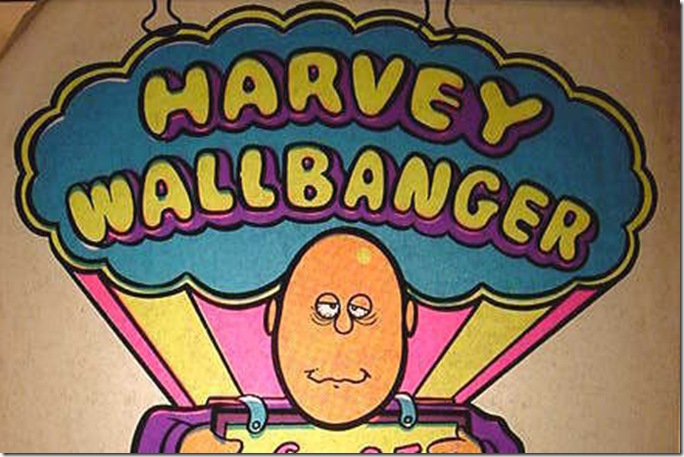
A vintage 1972 iron-on transfer of Harvey Wallbanger himself, on EBay for $12.


Note: This is a repost from 2013.

We have been looking at some historic drinks for this holiday season. To the millennials in the audience: This is what mom and dad used to drink (along with the Tequila Sunrise) when they went out in the 1970s.

Return with us now to the thrilling days of yesteryear:

1 ounce of vodka
4 ounces of orange juice
half an ounce of Galliano.

Poured over ice in a highball glass.

Cue Grand Funk Railroad’s “Gimme Shelter” or Carole King’s “It’s Too Late.”

Posted in 1971, Food and Drink, Music | Tagged , | Comments Off on L.A. Daily Mirror Retro Drinking Guide: The Harvey Wallbanger

Ray Bradbury’s Unrealized Opera: ‘Leviathan ‘99’

Ray Bradbury 'Leviathan '99'

Since Ray Bradbury died in 2012, I have been rummaging around the Daily Mirror archives in a frustrating search for a copy of his libretto for an opera titled “Leviathan ’99,” which I obtained many years ago when I was working for the Arizona Daily Star in Tucson and covering the Arizona Opera Company.

I finally found it (while looking for something else, of course) and thought I would write a brief post about it.

I don’t recall the precise circumstances under which I was able to make a photocopy of the libretto. It might have been loaned to me by the late Glynn Ross, who was then head of the opera company. Notice that in the attached cover letter to Ross, Bradbury refers to living in Tucson. It’s also possible that I borrowed the libretto  — just long enough to make a photocopy — from a composer friend who was in informal discussions with Ross about writing the music. As I recall, I don’t believe my friend ever wrote a note of music for a production.

The script runs 100 pages and was bound like a movie script, and the format is much like a screenplay. A copy is apparently in the Center for Ray Bradbury Studies at Indiana University.

Bradbury "Leviathan '99"

As far as I can determine, “Leviathan ’99” never became an opera. Apparently it was done as a radio drama in 2009.

Posted in 1984, Books and Authors, Music | Tagged , , , , , | 1 Comment

Los Angeles Celebrates Christmas, 1913

Dec. 25, 1913, Christmas in Los Angeles

Dec. 25, 1913, Christmas

Dec. 25, 1913: The Times carries a biblical passage across the nameplate (notice the artwork of the new and old Times buildings) and a Page 1 cartoon by Edmund Waller “Ted” Gale. “Cartoonist Gale” frequently drew a character known as Miss Los Angeles, but I don’t recall seeing “Mr. Wad” before. Gale was an institution at The Times for many years, but finally quit in a dispute and went to the Los Angeles Examiner.

One way Los Angeles celebrated Christmas 100 years ago was dinner at the Cafe Bristol, Spring and 4th streets.  The 50-cent luncheon deluxe would be $11.80 today.

Or one could take a refreshing, invigorating bath at Melrose Avenue and Gower Street, location of the Radium Sulphur Springs, which advertises: Drink the most radioactive natural curative mineral water.

And there’s a poem by Britain’s poet laureate, Robert Bridges, which you may recognize because John Denver turned it into a song, “Christmas Eve, 1913.”

Best wishes from the Los Angeles Daily Mirror.

Continue reading

Posted in 1913, Art & Artists, Food and Drink, Medicine | Tagged , , , , | 5 Comments

Mayor Garcetti Fires Up the Lindbergh Beacon

Dec. 24, 2014, Lindbergh Beacon

And yes, here is the Lindberg beacon atop City Hall, illuminating the skies over Los Angeles for Christmas Eve 2014.

Posted in 2014, City Hall, Downtown | Tagged , , | 2 Comments

Lindbergh Beacon to Be Lit

Mayor Eric Garcetti has announced that he will fire up the Lindbergh beacon atop City Hall tonight and that it will remain lit through Jan. 5. I’ll post photos later.

Posted in Uncategorized | Comments Off on Lindbergh Beacon to Be Lit

L.A. Daily Mirror Retro Drinking Guide: A Brief History of the Tom and Jerry

image

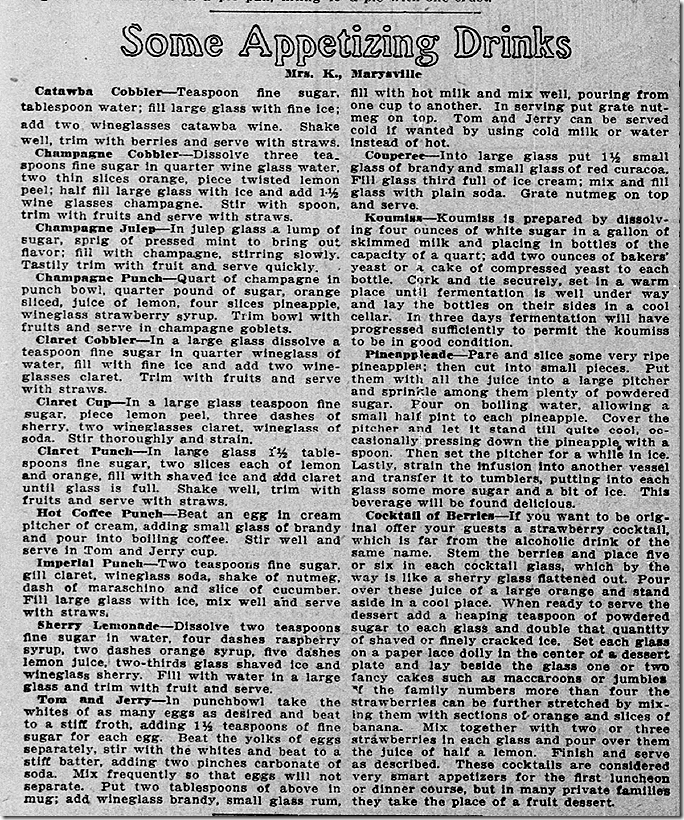
A recipe for the Tom and Jerry from the San Francisco Call, June 30, 1912.


Note: This is a repost from 2013.

Over on Facebook, Christopher McPherson asked whether the Tom and Jerry was named for the MGM cartoon characters. I said I suspected the opposite was true, rather like Disney’s Chip ‘n’ Dale being named for Chippendale furniture.

All the old newspaper stories give credit for the drink to bartender Jerry Thomas, who according to one account was born in New Haven, Conn., in 1825 (or Watertown, N.Y., in 1830).

Continue reading

Posted in 1862, Books and Authors, Food and Drink | Tagged , , | 2 Comments

L.A. Daily Mirror Retro Shopping Guide

image

Final suggestion: “Missing Reels,” by Farran Smith Nehme, who writes so wonderfully about films on the Self-Styled Siren. “Missing Reels” is available from Amazon. Locally, it’s listed at Book Soup (“on our shelves now”), Skylight Books (“ships to store in 1-5 days”)  and Vroman’s (“probably in stock; call first”).

Posted in Books and Authors, Film, Hollywood | Tagged , , | 1 Comment

‘Laura’ — The Making of a Film Noir Classic, Part 42

In Time to Come

An image from the Broadway play “In Time to Come,” directed by Otto Preminger, listed on EBay as Buy It Now for $32.75.


In case you just tuned in, I’m using Louella Parsons’ May 15, 1944, item on Rouben Mamoulian being replaced as the director of “Laura” to take a meandering look at the making of the film, which was released in Los Angeles in November 1944.

The first 30 posts were devoted to the writing career of “Laura” novelist Vera Caspary; the state of the detective story in 1941, when she was writing the novel; the New York locations Caspary used in the book; and an examination of the major and minor characters.

The next nine posts broke down the novel to study the significant challenges of adapting it for the screen.

What follows now has more to do with studio deal-making and executive power plays rather than the creative process, and it’s as complex as any novel of political intrigue.

The Making of “Laura” Part 1 | Part 2 | Part 3 | Part 4 | Part 5 | Part 6 | Part 7 | Part 8 | Part 9 | Part 10 | Part 11 | | Part 12 | Part 13 | Part 14 | Part 15 | Part 16 | Part 17 | Part 18 | Part 19 | Part 20 | Part 21 | Part 22 | Part 23 | Part 24 | Part 25 | Part 26 | Part 27 | Part 28 | Part 29 | Part 30 | Part 31 | Part 32 | Part 33 | Part 34 | Part 35

James Ellroy to script remake of ‘Laura’

Spoilers ahead

Continue reading

Posted in 1944, Books and Authors, Film, Hollywood, World War I, World War II | Tagged , , , , , , | 4 Comments

The L.A. Daily Mirror Retro Drinking Guide

tom_and_jerry_mugs
A set of five Tom and Jerry mugs listed on EBay as Buy It Now for $20.


Note: This is a repost from 2013.

We don’t keep a bottle of Scotch in our desk in the city room of the L.A. Daily Mirror. In fact, we are something of a wet blanket when it comes to imbibing.

However, we can’t resist a nod to drinks of the past during this time of year.

Our first is the Tom and Jerry (we still have grandma’s dozens of Tom and Jerry mugs stashed away somewhere or other). The Tom and Jerry was a seasonal favorite back in 1940s, but I can’t say I have seen them at a party or ever tasted one.

If you’re planning some retro holiday celebrating (you know who you are), here’s how to make them.

Continue reading

Posted in 1945, Food and Drink | Tagged , | 3 Comments

L.A. Daily Mirror Retro Shopping Guide

Hllzapoppin

Yes, “Hellzapoppin’ ” is actually out on DVD. It’s available from Amazon UK for £7.99 (about $12.50). But there’s a catch: It’s a Region-2 DVD. I’m told by someone who bought a copy that it’s a sharp print and will play in an all-region DVD player.


Posted in Film, Hollywood | Tagged , , | 1 Comment

‘Laura’ — The Making of a Film Noir Classic, Part 41

image
Otto Preminger makes his film debut as an actor in 1942 in “The Pied Piper.” Preminger said in a 1970 interview in On Film: “Although I’m Jewish, I can look like a Nazi if I shave my head.” The film starred Monty Woolley, who was at one time cast as Waldo Lydecker in “Laura.”


In case you just tuned in, I’m using Louella Parsons’ May 15, 1944, item on Rouben Mamoulian being replaced as the director of “Laura” to take a meandering look at the making of the film, which was released in Los Angeles in November 1944.

The first 30 posts were devoted to the writing career of “Laura” novelist Vera Caspary; the state of the detective story in 1941, when she was writing the novel; the New York locations Caspary used in the book; and an examination of the major and minor characters.

The next nine posts broke down the novel to study the significant challenges of adapting it for the screen.

What follows now has more to do with studio deal-making and politics rather than the creative process.

The Making of “Laura” Part 1 | Part 2 | Part 3 | Part 4 | Part 5 | Part 6 | Part 7 | Part 8 | Part 9 | Part 10 | Part 11 | | Part 12 | Part 13 | Part 14 | Part 15 | Part 16 | Part 17 | Part 18 | Part 19 | Part 20 | Part 21 | Part 22 | Part 23 | Part 24 | Part 25 | Part 26 | Part 27 | Part 28 | Part 29 | Part 30 | Part 31 | Part 32 | Part 33 | Part 34 | Part 35

James Ellroy to script remake of ‘Laura’

Continue reading

Posted in 1942, 1943, 1944, Books and Authors, Film, Hollywood, Stage | Tagged , , , , | 1 Comment

L.A. Daily Mirror Retro Shopping Guide

Dead to Me

If you are running a bit late in your holiday shopping, you might consider an advance order of “Dead to Me,” a YA (young adult) novel to be issued by Disney-Hyperion in March.

“Dead to Me” is by Mary McCoy, a longtime friend of the L.A. Daily Mirror, writer on numerous history blogs, top-notch history/genealogy librarian and most recently senior librarian at the L.A. Public Library’s Teen’Scape.

“Dead” has been receiving good advance notice and was praised by Kirkus Reviews: “McCoy’s mystery unfolds slowly and cautiously, offering enough clues—and red herrings—to keep readers hooked. Its conclusion is tidily, perhaps a bit too conveniently, resolved, but against the richly envisioned backdrop of golden-age Hollywood’s sinister underbelly, this minor quibble is easily forgiven.”

It is available for preorder for $17.99 in Southern California bookstores: Vroman’s, Skylight Books and Book Soup; online via Amazon  in hardback ($13.49) and for the Kindle ($9.99).

Posted in Books and Authors, Hollywood | Tagged , | Comments Off on L.A. Daily Mirror Retro Shopping Guide

Movieland Mystery Photo (Updated + + + +)

image

This week’s mystery movie was the 1942 MGM film “Tennessee Johnson” with Van Heflin (Friday’s mystery guest), Lionel Barrymore (Thursday’s mystery guest), Ruth Hussey (Tuesday’s mystery guest), Marjorie Main, Regis Toomey and J. Edward Bromberg (not shown). The screenplay was by John L. Balderston and Wells Root, based on a story by Milton Gunzberg and Alvin Meyers. It also featured Morris Ankrum as Jefferson Davis (Monday’s mystery guest) and Charles Dingle (Wednesday’s mystery guest) as Sen. Jim Waters. It was directed by William Dieterle.

Longtime reader Dennis Gilliam raised an interesting question about whether I do repeats. The answer is no, with this caveat: I don’t repeat mystery movies, which began when the Daily Mirror was canceled by The Times and I kept it going as a personal project. Anything I did before that using stills from The Times photo library is fair game.

Continue reading

Posted in Film, Hollywood, Mystery Photo | Tagged , , | 60 Comments

Mary Mallory / Hollywood Heights: Hollywoodland Riding Stable First of Its Kind in Los Angeles

Hollywoodland Riding Trails


W
hen it announced its opening for business on March 31, 1923, the Hollywoodland real estate development promised quality homes, upscale amenities now considered de rigueur in gated communities, and beautiful surroundings to discerning homebuyers. The first to construct a business district inside its boundaries, the first to establish a jitney service, the first hillside housing development that built homes following the contours of the hills, Hollywoodland also proclaimed itself the first to establish a stable and riding school for its residents.

Located at the very top of Beachwood Canyon, the subdivision land and a total of 640 acres had been purchased by streetcar barons and real estate moguls Eli P. Clark and M. H. Sherman from Julia Lord on July 8, 1905. Two incredibly smart businessmen, Clark and Sherman bought acreage near their streetcar lines, waiting until the opportune moment to open them for sale. They owned land in Sherman (now West Hollywood), and out in the San Fernando Valley, as well as Hollywoodland and other areas. They also wisely brought Harrison Gray Otis on as partner, in order to receive plenty of free advertising, stories, or what could be called advertorials, in The Los Angeles Times. After his death, his son-in-law Harry Chandler continued the practice.

Mary Mallory’s “Hollywoodland: Tales Lost and Found” is available for the Kindle.

Continue reading

Posted in 1923, Hollywood, Hollywood Heights, Mary Mallory | Tagged , , , | 1 Comment

L.A. Daily Mirror Retro Shopping Guide

Norden Bomb Sight

This Norden bomb sight has been listed on EBay with bids starting at $1.950. As with anything on EBay, an item and vendor should be evaluated thoroughly before submitting a bid.

Posted in World War II | Tagged , | Comments Off on L.A. Daily Mirror Retro Shopping Guide

The Shrinking U.S. Newspaper, 1896 – 2014


Shrinking AMerican Newspaper

Here’s an issue of the San Francisco Call from 1896 compared to a recent page from the 2014 Los Angeles Times.

Continue reading

Posted in 2014 | Tagged , , , | 1 Comment